
Category: Diversity / Inclusivity
Beware Anne Bonny… (redux post)
A Reason For PRIDE:
The Oral Histories of the AIDS Crisis
The voices of artists and activists illuminate the human experience behind the AIDS epidemic.
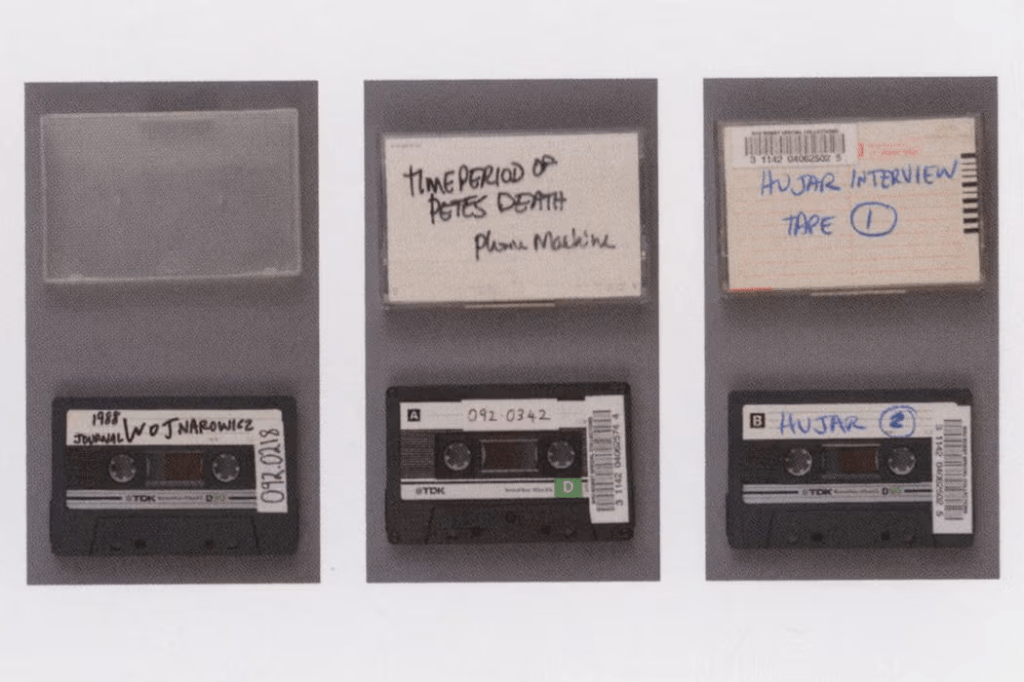
From a photograph of David Wojnarowicz’s audio cassette tapes, 1987-89 and undated in Voice=Survival, 2017 via JSTOR
By: Liz Tracey
When approaching recent historical events, where the scope of destruction and loss can be unfathomable in scale, oral history can bring both connection and immediacy through individual stories of loss, grief, rescue, or triumph that would otherwise disappear in the grand sweep of “Great Men and their Deeds.”
Scholar Indira Chowdhury describes the approach:
[T]he method enables the documentation of certain aspects of historical experience that are often missing from other kinds of historical sources. Oral historians not only interview and engage in conversation with living sources, they also find themselves challenged in a unique way—the historian is transformed into a protagonist in the dialogue. Oral history is perhaps the only field where the sources talk back to the historian, confronting, disputing, disrupting, and sometimes resisting the historian’s understanding of the past (Frisch 1990; Shopes 2012). Oral history works with the interviewee as a partner in dialogue and the verbal form historical truth can take is always co-constructed (Cook and Goodall 2013; Goodall and Cadzow 2009; Portelli 1991).
Some of the most effective (and affecting) projects using this approach concern communities that may be far outside of the audience’s experience, whether due to time, geography, or identity. Works like Shoah by Claude Lanzmann, Hard Times by Studs Terkel, and Boots of Leather, Slippers of Gold by Elizabeth Lapovsky Kennedy document their subjects through the voices of those who lived through specific moments and events that can be overwhelming or remain unknown without a more interpersonal method.
“Many of the best works about this disease have been produced by people at various stages of HIV infection.”
The history of the HIV/AIDS epidemic has recently become the subject of numerous oral history projects, where the stories of survivors, caregivers, activists, and health care professionals have been collected and made available online, traditionally published, and edited into documentaries.
One such collection, Visual Arts and the AIDS Epidemic, was begun in 2015 by the Smithsonian Archives of American Art after receiving a grant from The Keith Haring Foundation. Haring founded the foundation in 1989, a year before his death from HIV-related illness, to maintain his artistic and philanthropic legacy. The project interviewed forty artists about their lives, their work, and how the AIDS crisis intersected and permeated both.
The interviews in the Visual Arts and the AIDS Epidemic collection cover wide ranges of personal and creative history, ranging from insider gossip and “name-dropping” to theoretical discussions of method and art history. They benefit from interviewers who bring their own experience as artists, art scholars, and historians to the conversation, with questions and insights that make this collection a rich multifaceted history of AIDS, the arts, and activism.
In his 1990 article, journalist Richard Goldstein wrote about the deep relationship between art about AIDS and its creators. “One senses in much art about AIDS a sense of familiarity with its subject,” Goldstein writes,
as if the artist were immersed in dealing with the epidemic—as so many are. Many of the best works about this disease have been produced by people at various stages of HIV infection. Perhaps they have lost a lover, nursed a dear friend, or attended a dozen funerals at a young age, and feel themselves to be, in every sense, set apart by the experience. They are implicated. Their art signifies a collective trauma—mass death in the midst of life.
Reveal Digital, an initiative “to amplify important, long-overlooked voices of the twentieth century,” has made these histories, and more, available in their developing open access collection HIV, AIDS and the Arts.
Artists in The Early Years of the Epidemic
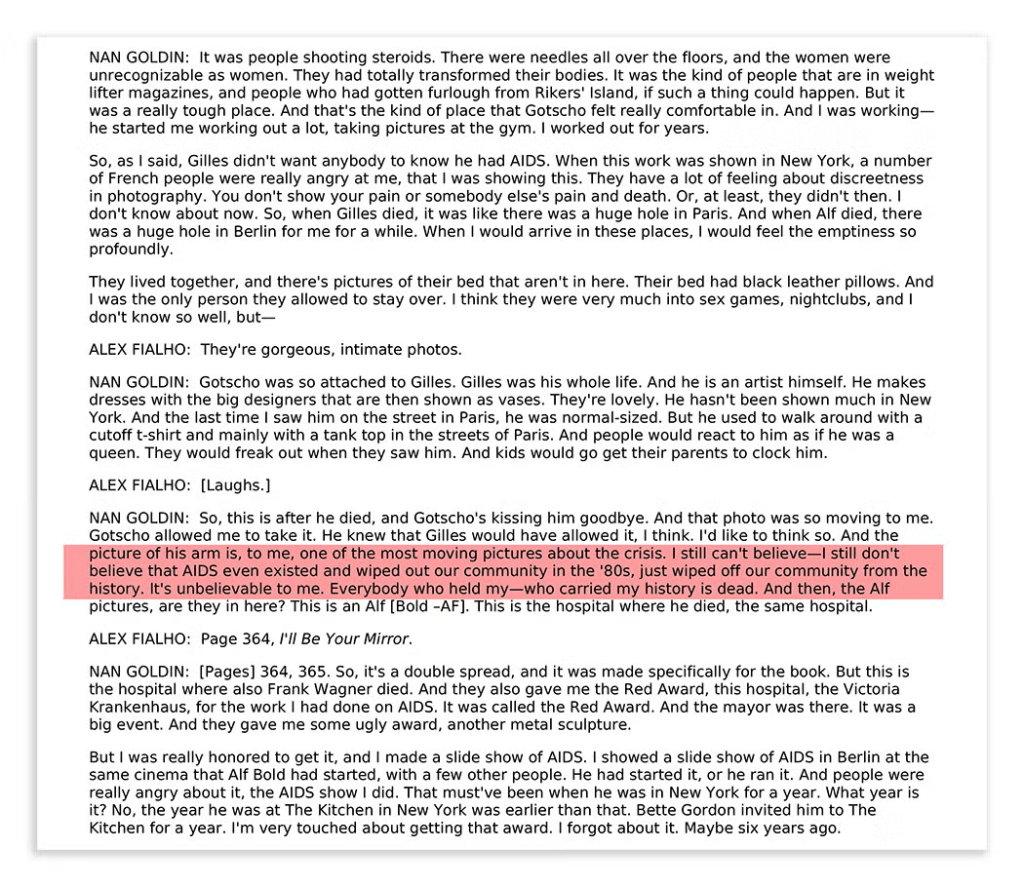
“I still can’t believe—I still don’t believe that AIDS even existed and wiped out our community in the ’80s, just wiped off our community from the history. It’s unbelievable to me. Everybody who held my—who carried my history is dead.” —Nan Goldin
The initial public responses by the US government to the first years of the epidemic were jokes at the expense of the ill at press conferences. President Reagan didn’t publicly say the word “AIDS” until 1985, four years after the first reported cases and two months after family friend Rock Hudson died of AIDS-related complications. That same year, Ryan White, a hemophiliac teenager with AIDS in Indiana, was prevented from returning to school after his diagnosis, and his family had to move after someone shot into their home.
One year later, William F. Buckley published a New York Times op-ed calling for HIV-positive people to be tattooed on the upper arm and buttocks to protect others (assuming that would protect both future sexual partners and intravenous drug users who might share needles). News reports about the disease largely focused on fear of contagion, the promiscuity and danger of gay men, and the threat of HIV to “normal” Americans.
Information about treatments for the many opportunistic infections that HIV made people vulnerable to was gathered in the early years by those under threat. Newsletters like “AIDS Treatment News” were photocopied and sold at LGBTQ bookstores, and buyers clubs imported potential treatments not yet approved by the Food and Drug Administration or available in the US. These groups and others, working with health care providers, had to become experts and educators at a time when US Congress was successfully prohibiting the use of funding from the Centers for Disease Control for education and prevention materials that would “promote or encourage, directly or indirectly, homosexual activities.”
In the interviews gathered in the Visual Arts and the AIDS Epidemic collection, artists describe how they first became aware of AIDS: from a loved one diagnosed after an illness; from hearing of a friend’s passing after not seeing them for a while; from a doctor telling them to stay with a partner because “there’s something going around”; or by learning of their own diagnosis. Friends were lost to the disease, and surviving family members denied the illness or sometimes actively excluded partners from funerals.
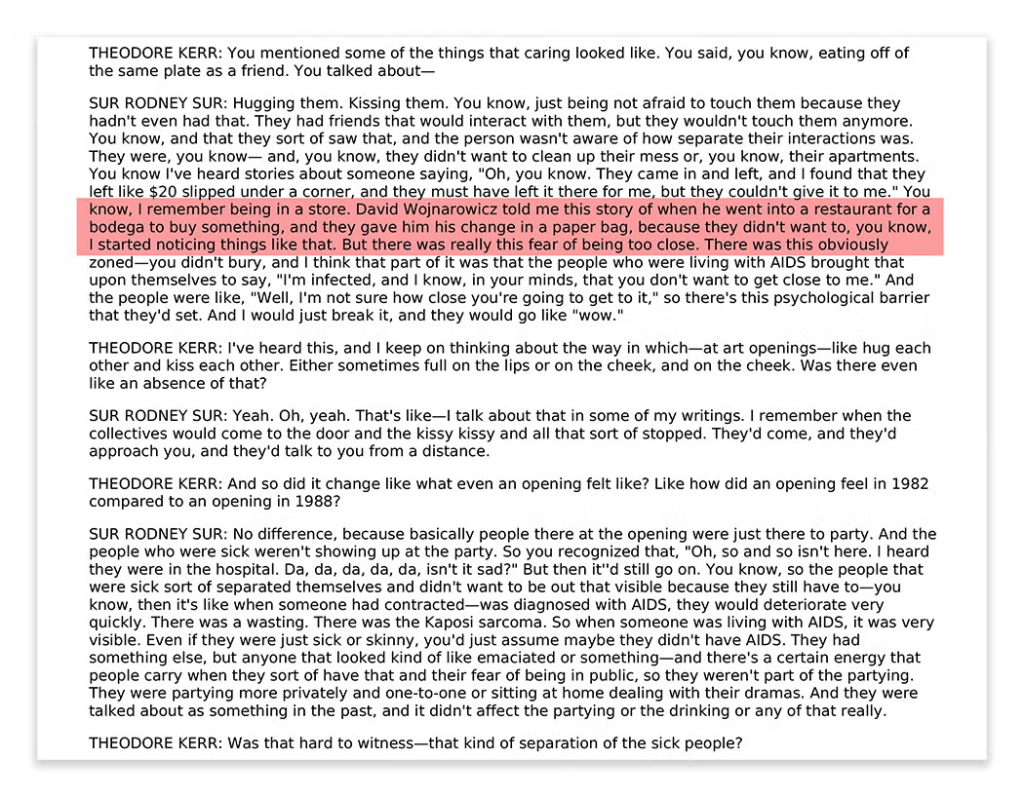
Sur Rodney (Sur), a New York City-based writer, gallery co-director, and archivist, relates that the late artist David Wojnarowicz would go to his local bodega in New York City where the clerks returned his change in a paper bag, out of fear. He describes his own anxieties when stepping in after a friend’s death to help save and archive their artworks and collections so they wouldn’t be destroyed (before there were nonprofit organizations to do so).
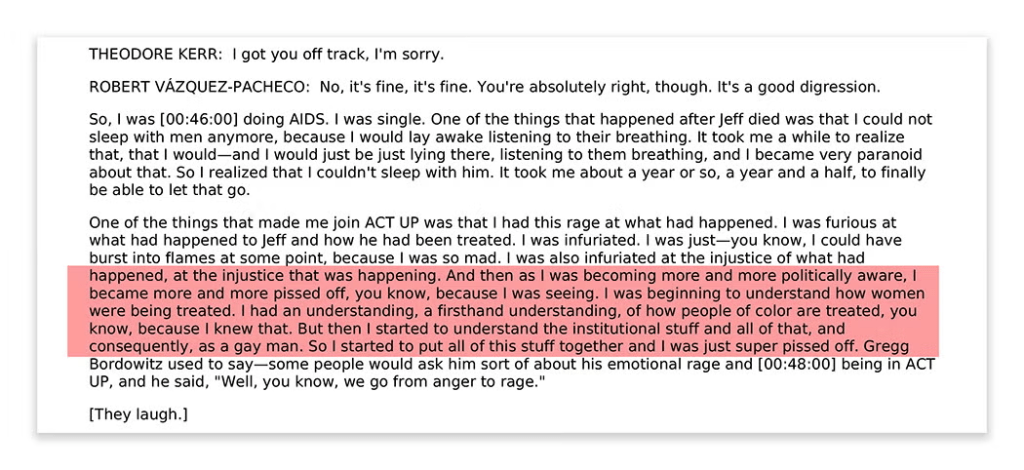
These personal experiences unfolded within the larger context of governmental indifference, active discrimination against people with the disease (or belonging to groups that were deemed “at risk”), and a growing consciousness of the political landscape of the epidemic. Robert Vasquez-Pacheco, a member of ACT UP and Gran Fury, recounts,
as I was becoming more and more politically aware, I became more and more pissed off, you know, because I was seeing. I was beginning to understand how women were being treated. I had an understanding, a firsthand understanding, of how people of color are treated, you know, because I knew that. But then I started to understand the institutional stuff and all of that, and consequently, as a gay man. So I started to put all of this stuff together and I was just super pissed off.
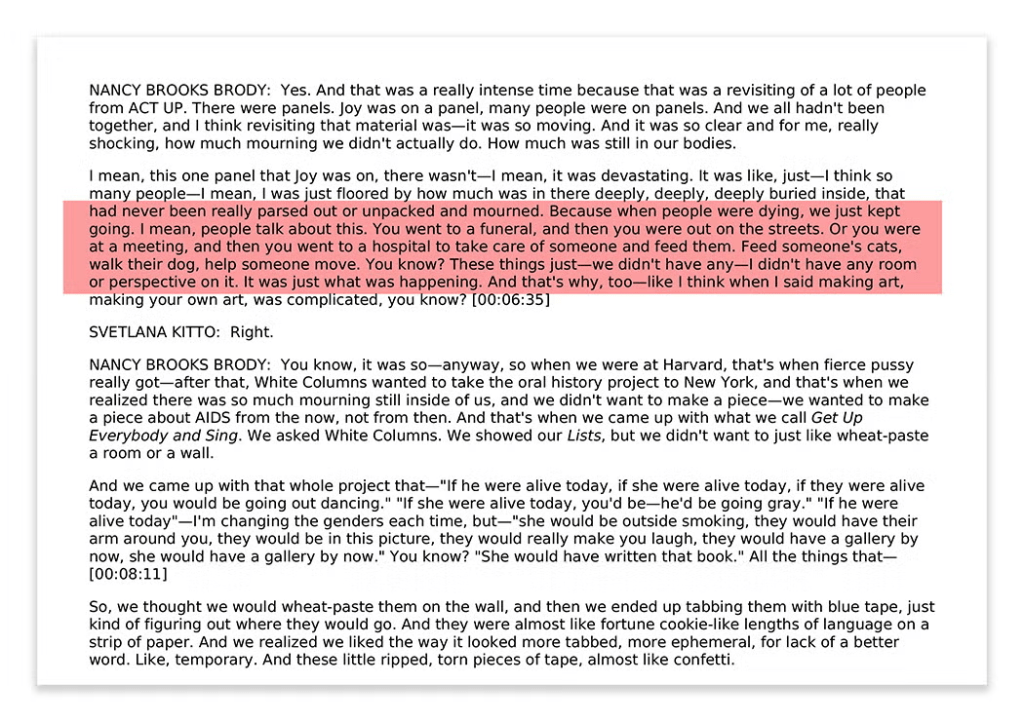
Some version of this process, repeated for many of the subjects, led people to activism, whether through art, volunteer work, protest, or sometimes all three. Nancy Brooks Brody (1962-2023), a visual artist and member of the fierce pussy collective, describes the progression in her interview.“Because when people were dying,” she explains,
we just kept going. […] You went to a funeral, and then you were out on the streets. Or you were at a meeting, and then you went to a hospital to take care of someone and feed them. Feed someone’s cats, walk their dog, help someone move. You know? These things just—we didn’t have any—I didn’t have any room or perspective on it. It was just what was happening.
The meetings she, and others, refer to were those of ACT UP New York (The AIDS Coalition to Unleash Power), which began in 1987 at a community meeting where Larry Kramer asked, “How long does it take before you get angry and fight back?” Kramer, a playwright and essayist who had been covering AIDS since the beginning through journalism, had co-founded the non-profit Gay Men’s Health Crisis in 1982. His play The Normal Heart, an impassioned call to action, spurred members of the audience to meet and subsequently take part in one of the most significant and effective activist movements of the twentieth century.
Creating Art in an Epidemic
The artistic works of those interviewed are diverse, both in media and approach: photographing people living with AIDS, using détournement to turn existing works into calls to action via graphic design, or using their body to confront audiences with the existence of the disease through performance. In some cases, their illness became an essential component of their art: John Dugdale, a former commercial photographer, began using nineteenth-century methods to capture and produce his work after HIV-related retinitis and a stroke left his sight significantly impaired. Ron Athey, one of the NEA Four, used his own HIV-positive body to create work exploring sex, trauma, and desire. The place of the artist within (or outside) a community could become a contentious issue, especially at a time when representation of people with AIDS was so fraught.
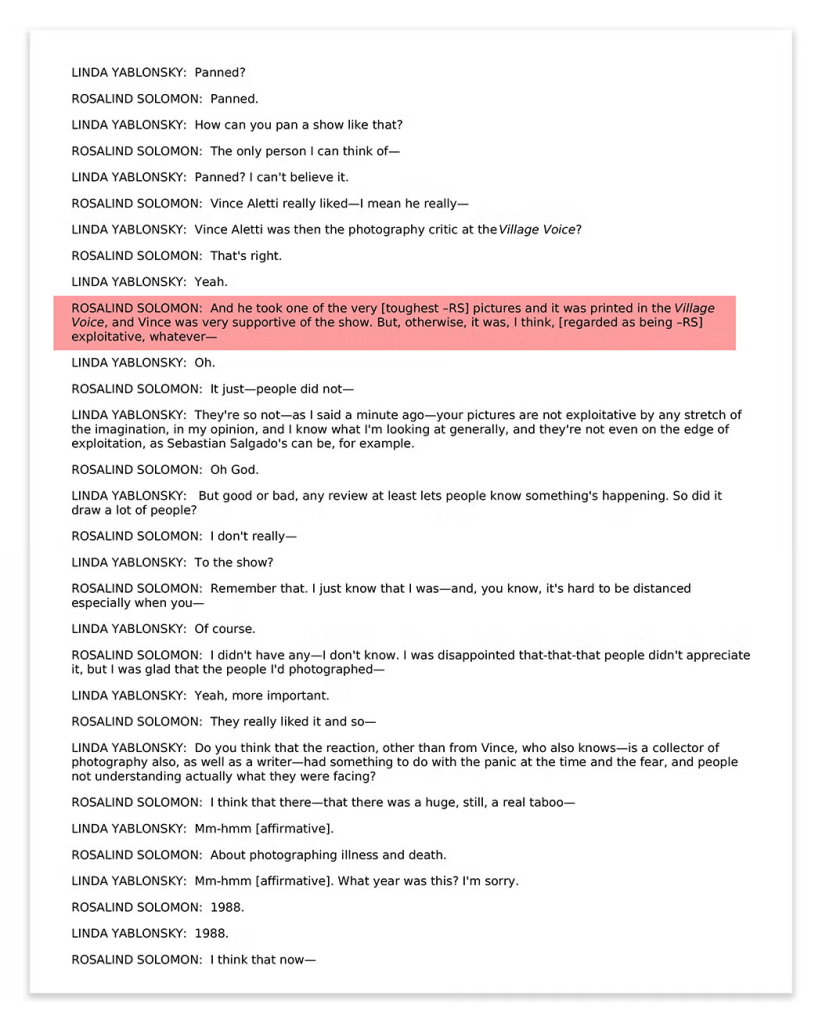
Rosalind Fox Solomon, whose 1988 show Portraits in the Time of AIDS featured photographs of the subject alone or with loved ones, some with visible lesions or in the hospital, relates that her project was critically panned and called “exploitative” at the time.
As another “outsider” to the communities she photographed, Nan Goldin reports that she encountered similar criticism for her exhibition The Ballad of Sexual Dependency, despite her immersion in the cultures she documented. In the book of the collected photographs, she writes, “I’m not crashing; this is my party. This is my family, my history.”
Some of the most vibrant, and now iconic, images of AIDS were created as (and for) protest: Silence = Death, the work of the Silence = Death Collective (and not ACT UP, as Avram Finkelstein relates in his interview) became the primary pictorial representation of ACT UP and a rallying slogan for the fight against the disease. Keith Haring did his own take on it for a poster, adding “Ignorance = Fear” to a “See No Evil, Hear No Evil, Speak No Evil” scene.
Collectives like Gran Fury and fierce pussy, which organized inside the ACT UP activist group, created posters for wheat-pasting that served as art, education, and calls to action around AIDS, homophobia, health care, and visibility. Whether newsprint works of text, guerrilla-installed bus station “ads,” or rolls of stickers of bloody hands announcing “One AIDS Death Every 10 Minutes,” the art of AIDS activism used any means available to communicate the urgency of the crisis.
The Visual Arts and the AIDS Epidemic collection demonstrates the power of oral history to preserve not just historical events, but what it felt like to live in the moment and survive it when so many people did not. Together with Reveal Digital’s HIV, AIDS, and the Arts archive, the collection ensures that these voices, experiences, and creative histories continue to be available to inform and educate future generations.
Have a correction or comment about this article?
Please contact us.
To PRIDE!
LGBTQIA+ Pride Month
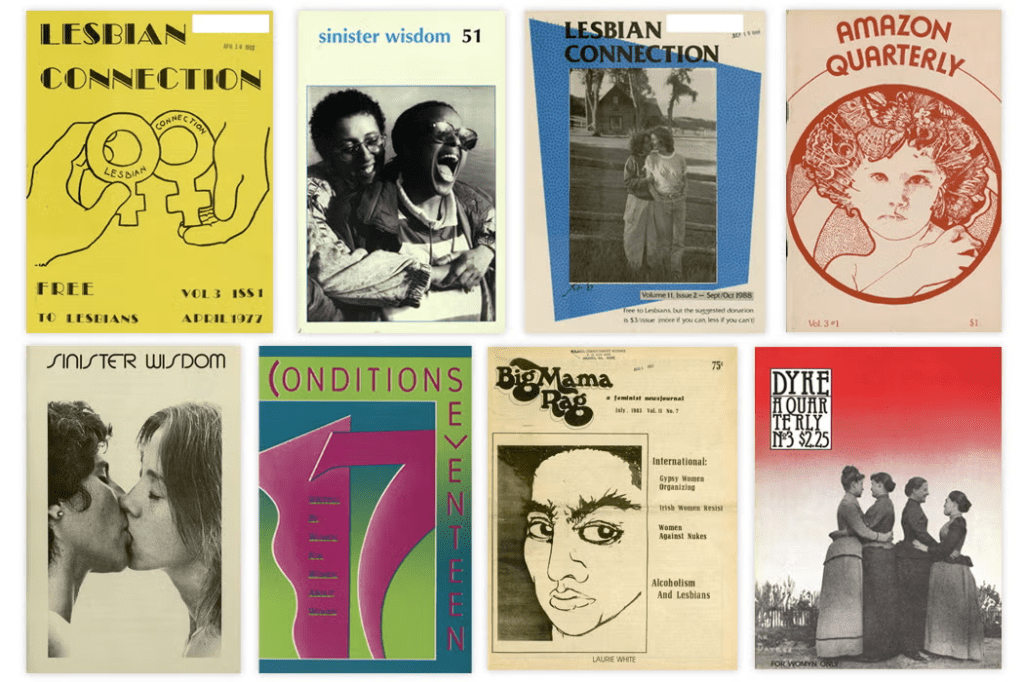
June is LGBTQ Pride Month, so JSTOR Daily gathered some of our favorite stories to celebrate. All with free and accessible scholarly research.
By: The Editors
June is LGBTQIA+ Pride Month in the United States, so we’ve collected some of our most popular stories on a range of topics—from pronouns to politics—that highlight the history of the LGBTQIA+ community. As always, links to free JSTOR scholarship are included with each of these.
Pete Hegseth Just Erased Atheists from the Military
Remember this is a Christian nationalist who wants to push his version of religion on everyone else. He has denied promotion to women and black people. He is a radical religious crusader, which I know because he has a crusader tattoo. Years of trying to make the US military of which I was one and my dog tags read pagan for religion more inclusive are being destroyed by an administration that is filled with people who are driven to promote and push a religious domination on the military and country. It has long been known that religious zealots infected the Air Force Academy and were pushing the evangelical version of the Christian religion. In Germany I had to spend an uncomfortable 8 months when a fundamentalist religious group in our unit decided that as it was an open secret in the unit I was one of the gay members of the unit that was more open about it they needed to save me from my sins. Every time I went to the chow hall one of them cornered me at a table and started to preach at me. Not talk to me, not to offer friendship, but to tell me all about hell and how horrible I was and that their god hated how I was and that I was in willful disobedience to their great deity. They could save me from their already determined fate if I just joined them and gave my life to their god instead of the heathen sin some demons had infected me with.
I got so damn frustrated with them. Then my friends who had started eating with me to drive them away came up with a plan. We created a religion based on greek mythogoly that we called the “House of Aphrodite”. We drew up a few tenets of the region, one of which was that it was a sex religion and to worship everyone needed to do so with each other nude. The last time they saw me at the chow hall and several of them tried to sit with me and my friends, my friends sprung the trap. They told the guys we would gladly go to their church meetings and pray with them but only if they went to one of our religious meetings first. They did not know we were religious they claimed but we assured them we were very devout. Thinking we were talking about a “liberal” church they readily agreed and then my friends sprung the trap. They told them about our religion The House Aphrodite and the tenets. My friends emphasized how we all worshiped in the nude and some rituals enacted required people to touch each other even on their sexual organs to honor the goddess. My friends played it up and I could hardly keep from laughing at the horrified looks on their faces. Needless to say they declined our invitation to join us in worship. But after that they never bothered me again. Hugs
Indiana’s Lt Gov says Christians need to HATE…
As I have written about before I had to remove hate from my system. Because of what I experienced growing up and the toxic nature of those I was raised by / around I developed a deep anger building to intense hate. It was consuming me as I had no outlet for that poison it was ruining the being I was / could be. I saw Ron starting to pull away from me as he saw the effects of my inner struggle with hate even as he did not know why I had such deep emotions and intense reactions. I had a choice. I could go with the hate, give into it and make it all I was. That would make me like those I grew up with. Or I could excise it, leave it behind, look for and crave something far different that might be like cold water on blistered skin. A balm to help me heal and to build the person I wanted to be, not that they wanted me to be. I went from the “slave” name they called me to being Scottie. It was not easy, it still is not. I am not and never will be perfect. I struggle not to be easily angered, to look for the good in others, to not to imagine faults. But by making those first steps I was able to keep Ron and he guided me forward not even understanding he was doing it. Happy hugs. Scottie
What’s Everybody Reading?
I’m still working on “The Forsytes,” and eagerly anticipating beginning my niece’s book, “Reven Across Golden Skies”, but today I bought a book called “When Women Were Dragons,” and I’m really looking forward to that one, too. I might have to start a second book before finishing “The Forsytes” … Anyway, if you’re looking for something, the Smart Ones have a list for June:
June 2026 Queer Romances
by Dahlia Adler · Jun 5, 2026 at 4:00 am · View all 8 comments

Happy Pride Month, one and all! As usual, June is packed to the gills with queer romance, so selecting just five titles felt a nigh impossible task. While I’ve done it, I definitely encourage you to seek out the many more excellent-looking books gracing shelves this month and support as many queer creators as possible!
For the Bride

Author: Becca Grischow
Released: June 2, 2026 by Penguin Books
Genre: Contemporary Romance, LGBTQIA, Romance
From the author of I’ll Get Back To You, a sapphic enemies-to-lovers romance that follows a Type-A maid of honor setting out to do the most and a Type-B bridesmaid with her life only just put-together, who must put aside their animosity to plan the wedding of the summer
On the surface, Alice has her life together. She’s got a job in music she loves; she’s firmly sober; and she’s grateful to be back in the good graces of her ex-girlfriend-once-best-friend-now-literal-only-friend Gin. Just in time, too, because Gin’s getting married this summer! And Alice gets to be a bridesmaid.
If only the maid-of-honor wasn’t Renee Type-A, the opposite of her in every way, and a long-time Alice-hater who’s clung to her animosity like a leech. Every second Alice spends around Renee makes her feel like who she used to be, rather than the person she’s spent years trying to make herself into—and she doesn’t want to be reminded of her younger self any more than she wants to be thinking, more constantly than she wants to admit, about her hair, her lips, her wit…. No, Alice has her own stuff to figure out. She still loves music, but her career feels directionless. She’s grieving the loss of her father just a year ago, to alcohol. And then she finds out that her mother’s started to date her father’s ex-bandmate, which sends her reeling…and with the wedding just around the corner, she doesn’t want to bother Gin about any of it.
It’s pure chance that Renee runs into Alice, just when she needs someone the most—and suddenly, everything shifts. Neither of them are what they assumed the other to be. Over the days and nights they’re spending helping Gin throw a DIY summer wedding of epic proportions, Alice and Renee discover that though they have nothing in common—that might be precisely what each of them need. Heartfelt and hopeful, For the Bride is a banter-filled sapphic romance with deep emotional resonance about found family, second chances, and finding love in the unexpected.
Grischow’s sophomore romance revolves around bridal party hijinks, which is already one of my all-time favorite tropes, but this one gave me alllll the feels. Protagonist Alice is still grieving not just the loss of her father but his seeming unwillingness to even try to live for her, and while she herself has reformed from her hard-partying ways, she’s grappling with the visions and memories of her other people can’t seem to shake. It’s a really lovely coming-of-age story alongside a chemistry-filled opposites attract romance, and one of my favorite romantic reads of the year so far. (snip-ordering info on the page)
The Open Era

Author: Edward Schmit
Released: June 2, 2026 by Berkley
Genre: Contemporary Romance, LGBTQIA, Romance
Love evens the score between two tennis players in this stunning debut romance.
Recently-turned-pro tennis player Austin Hardy has been out since high school and it’s never been a big deal. That is, until he becomes the first openly gay man to compete in a Grand Slam tournament. Suddenly, being gay is a huge deal, with headlines to prove it.
Unprepared for this new spotlight, Austin’s anxiety disorder hits a breaking point, and he trips and falls at practice. Right next to the very attractive, very talented, and probably straight Diego Cruz, ranked second in the world.
The two professional rivals start a friendship off the court. But between their flirty banter, mixed signals, and looming showdown, Austin is thrown further off his game by Diego.
With the eyes of the world on Austin, the weight of history on his shoulders, and Diego across the net, he must decide whether love means nothing or if it means everything as he battles for the trophy during an electric two weeks at the US Open.
Look, I know everyone’s tired of “If you love Heated Rivalry, check out X,” but hear me out. Sports Romance. Rivals. Secretly getting to know each other and developing a physical attraction. Professional athletes of significant talent facing each other in a major competition. This is a debut that’s earned its comp to the series of the moment while also very much being its own thing, starring an already out tennis player who’s quickly rising in the ranks and being spread out over the considerably shorter time span of the US Open. I was a fan of this one from chapter one, and I’ll definitely be picking up whatever Schmit puts out next. (snip-ordering info on the page, plus More Books!)
This is how I am going to address ANTI-LGTBQ+ Christians…
I really enjoy how well someone who knows the bible and the meaning of the words of Jesus can turn the bible bashers arguments around on them to show support for the oppressed minorities. Hugs
Your Saturday Bird Post:
Black Skimmer
Rynchops niger
Wayaya (Wayampi)
Also Known As
- Tayataya (Carib)
- Pa’â guasu (Guaraní)
- Iwenti (Palikúr)
- Corta-Mar (Portuguese)
- Rayador (Spanish)
About
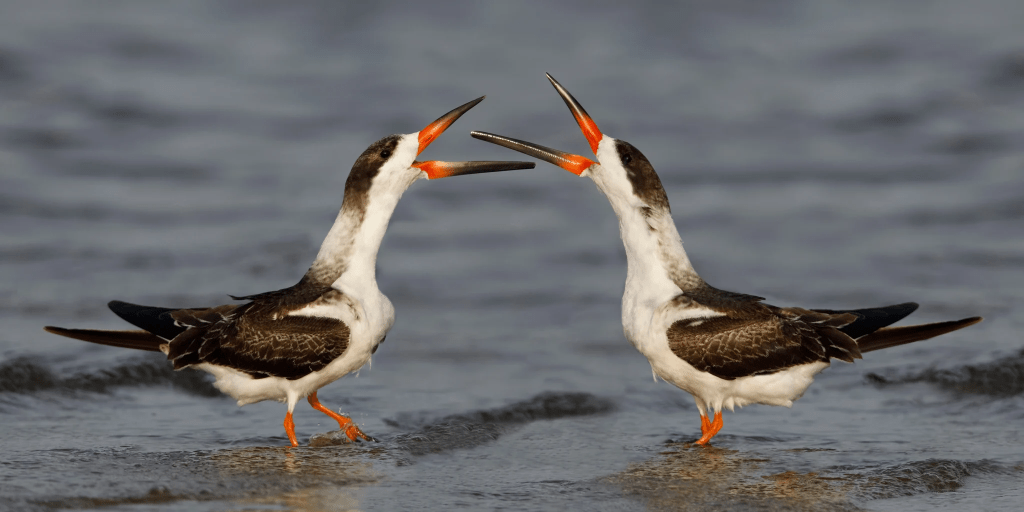
A group of Black Skimmers in flight resembles an aerial ballet, circling, banking, and gracefully alighting as one. Although taxonomists place this unique, long-winged waterbird in a separate genus, it’s closely related to gulls and terns.
The Black Skimmer’s most striking feature is its gaudy red-and-black bill: Both jaws are long and narrow like a knife blade, with the lower jutting out well beyond the upper. Its unique appearance lends the Black Skimmer a number of evocative folk names, including Scissor-bill, Cutwater (Cortagua or Corta-agua in South America), and Seadog (after its calls, often compared to dog barks).
This odd bill is what affords these birds their distinctive foraging style, and the name “skimmer.” A feeding skimmer flies low over the water with its beak open and lower mandible partially submerged. Where a broader bill would send a continuous spray of seawater straight down the throat of another species, the uniquely narrow mandible of the skimmer cuts through the water like a fin. When the extended lower mandible touches prey, such as a small fish, the bill’s upper mandible snaps down, securing the bird’s meal.
Another remarkable feature of the Black Skimmer is its eyes, which have large pupils that can narrow to vertical slits, like a cat’s pupils. This adaptation compensates for glare off the water’s surface and may enhance the bird’s vision as it hunts in dim light or at night.
Threats
According to the North American Breeding Bird Survey, Black Skimmers have declined in the United States by almost 90 percent since 1966. This is largely due to habitat loss and human disturbance at nesting colonies. These birds are also affected by oil spills and chemical pollution in coastal waters, and may face additional threats during the breeding season with climate change as sea levels continue to rise. (snip-MORE)
A Small Bunch Of Stuff
Life has been happening here with me this couple of weeks, and I have a few things I’ve picked up here and there to post when I’m busy. Most of this is positive, because why not?
Hey-today is World Environment Day! Let’s be proud to care for our home; we all get overheated.
| June 5, [since 1972] |
 | World Environment Day was established by the U.N. General Assembly to commemorate the opening of the Stockholm Conference on the Human Environment in Sweden. The United Nations Environment Program (UNEP) was established as a result of the conference. |
| UNEP’s mission: To provide leadership and encourage partnership in caring for the environment by inspiring, informing, and enabling nations and peoples to improve their quality of life without compromising that of future generations. |
Each year World Environment Day adopts a different theme. |


Wouldn’t work on Ollie!
And finally, a story of theft that has worked out well, from the person whose work was stolen!
Now, all the reviews have happened, so you can just relax and enjoy a bit of justice!

Farming While Beige 14 hours ago
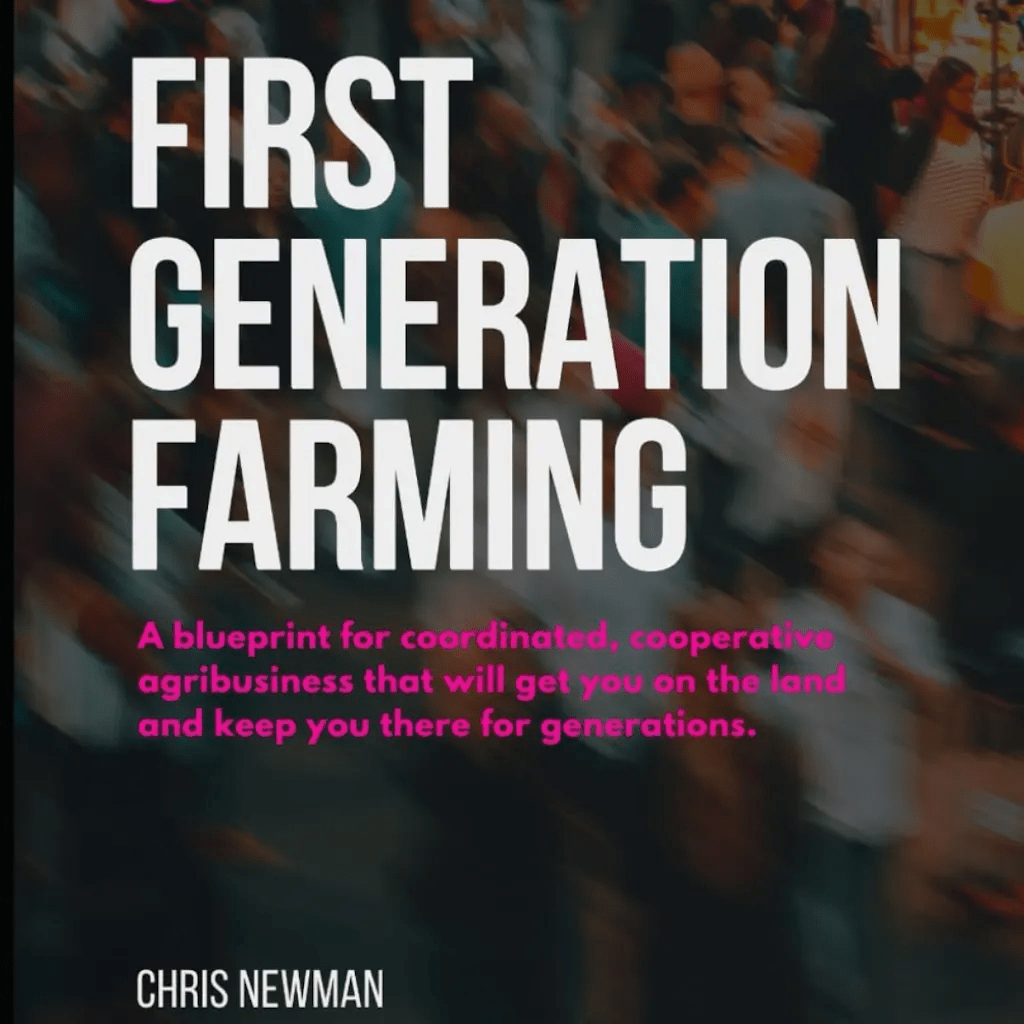
My book’s nearing the top 1,000 in all books on Amazon… this is nuts. https://www.amazon.com/dp/B0GBR2ZBCF#…

http://youtube.com/post/Ugkx4ERU1GoB4DsmLI_-MLNRSBtQ5f8EvrQn?si=VdQCJjNjD1X_YoIw

