July 26, 1953 In his first move to overthrow the U.S.-backed dictatorship of Cuban leader Fulgencio Batista, 26-year-old Fidel Castro led 134 other young revolutionaries to unsuccessfully attack the Moncada military barracks in Santiago de Cuba. Castro had concluded that armed struggle was the only way to unseat Batista, who had taken power in a military coup in 1952. The Cuban Revolution is known as the July 26 Movement, and is celebrated annually there. The Moncada Barracks, still showing a few bullet holes and pockmarks from that fateful early morning assault in 1953, is now both a historic site and an elementary school.
July 26, 1967 H. Rap Brown, then head of the Student Nonviolent Coordinating Committee (SNCC) was ordered arrested by then-Governor Spiro Agnew, who accused him of inciting a riot through his speech two days earlier at a civil rights rally in Cambridge, Maryland. At the event, Brown declared, “Black folks built America, and if America don’t come around, we’re going to burn America down . . . If Cambridge doesn’t come around, Cambridge got to be burned down.” Shortly after the speech, Brown was hit in the head by buckshot from a policeman’s shotgun. That night the segregated elementary school on the black side of town and 20 businesses burned down (there was no looting), some along Race Street, the racial divide which neither black nor white were expected to cross. H. Rap Brown following the disturbances in Cambridge, Maryland. What happened in Cambridge
July 26, 1990 The Americans with Disabilities Act (ADA) was signed into law by President George H.W. Bush. It prohibited discrimination based on disability in employment, in public accommodation (e.g., hotels, restaurants, retail stores, theaters, health care facilities, convention centers), in transportation services, and in all activities of state and local governments. The law did not go into effect until January 26, 1992.
GENEVA — The U.N. Human Rights Council voted on Monday to renew the mandate of an LGBTQ rights expert, a move welcomed by advocates amid the absence of the United States, a former key supporter that is now rolling back such protections.
Western diplomats had previously voiced concerns about the renewal of the mandate of South African scholar Graeme Reid who helps to boost protections by documenting abuses and through dialogue with countries.
The motion for a three-year renewal passed with 29 votes in favor, 15 against and three abstentions. Supporters included Chile, Germany, Kenya and South Africa while several African nations and Qatar opposed it.
“The renewal of this mandate is a spark of hope in a time when reactionary powers worldwide are trying to dismantle progress that our communities fought so hard to achieve,” said Julia Ehrt, executive director of campaign group ILGA World.
The United States, which has disengaged from the council under President Donald Trump, citing an alleged antisemitic bias, was previously a supporter of the mandate under the Biden administration.
Since taking office in January, Trump has signed executive orders to curb transgender rights and dismantle diversity, equity and inclusion practices in the government and private sector.
His administration says such steps restore fairness, but civil rights and LGBTQ advocates say they make marginalized groups more vulnerable.
In negotiations before the vote, Pakistan voiced opposition to the mandate on behalf of Muslim group OIC, calling it a tool to advocate “controversial views.”
Video from Kenny Laynez-Ambrosio, 18, puts fresh scrutiny on the harsh tactics used to reach the Trump administration’s ambitious enforcement targets
‘You’ve got no rights’: teenage US citizen records violent arrest by immigration officers – video
On the morning of 2 May, teenager Kenny Laynez-Ambrosio was driving to his landscaping job in North Palm Beach with his mother and two male friends when they were pulled over by the Florida highway patrol.
In one swift moment, a traffic stop turned into a violent arrest.
A highway patrol officer asked everyone in the van to identify themselves, then called for backup. Officers with US border patrol arrived on the scene.
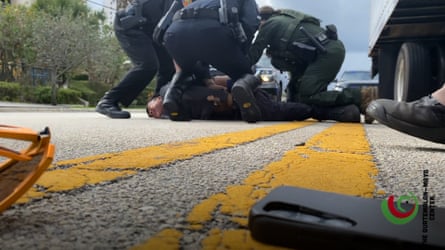
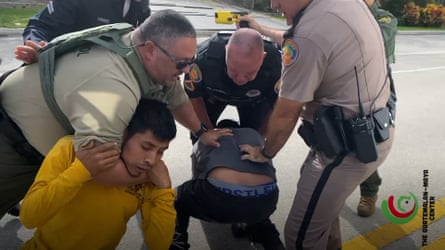
Video footage of the incident captured by Laynez-Ambrosio, an 18-year-old US citizen, appears to show a group of officers in tactical gear working together to violently detain the three men*, two of whom are undocumented. They appear to use a stun gun on one man, put another in a chokehold and can be heard telling Laynez-Ambrosio: “You’ve got no rights here. You’re a migo, brother.” Afterward, agents can be heard bragging and making light of the arrests, calling the stun gun use “funny” and quipping: “You can smell that … $30,000 bonus.”
“The federal government has imposed quotas for the arrest of immigrants,” said Jack Scarola, an attorney who is advocating on behalf of Laynez-Ambrosio and working with the non-profit Guatemalan-Maya Center, which provided the footage to the Guardian. “Any time law enforcement is compelled to work towards a quota, it poses a significant risk to other rights.”
Chokeholds, stun guns and laughter
The incident unfolded at roughly 9am, when a highway patrol officer pulled over the company work van, driven byLaynez-Ambrosio’smother, and discovered that she had a suspended license. Laynez-Ambrosio said he is unsure why the van was pulled over, as his mother was driving below the speed limit.
Laynez-Ambrosio hadn’t intended to film the interaction – he already had his phone out to show his mom “a silly TikTok”, he said – but immediately clicked record when it became clear what was happening.
The arrest of an undocumented man in Florida, as caught on video by Kenny Laynez-Ambrosio on 2 May 2025. Photograph: Screengrab from video by Kenny Laynez-Ambrosio/Courtesy of the Guatemalan-Maya Center
The video begins after the van has been pulled over and the border patrol had arrived. A female officer can be heard asking, in Spanish, whether anyone is in the country illegally. One of Laynez-Ambrosio’s friends answers that he is undocumented. “That’s when they said, ‘OK, let’s go,’” Laynez-Ambrosio recalled.
Laynez-Ambrosio said things turned aggressive before the group even had a chance to exit the van. One of the officers “put his hand inside the window”, he said, “popped the door open, grabbed my friend by the neck and had him in a chokehold”.
Footage appears to show officers then reaching for Laynez-Ambrosio and his other friend as Laynez-Ambrosio can be heard protesting: “You can’t grab me like that.” Multiple officers can be seen pulling the other man from the van and telling him to “put your fucking head down”. The footage captures the sound of a stun gun as Laynez-Ambrosio’s friend cries out in pain and drops to the ground.
Laynez-Ambrosio said that his friend was not resisting, and that he didn’t speak English and didn’t understand the officer’s commands. “My friend didn’t do anything before they grabbed him,” he said.
Kenny Laynez-Ambrosio, 18, filmed his own arrest in Florida. Photograph: The Palm Beach Post/Reporter Valentina Palm
In the video, Laynez-Ambrosio can be heard repeatedly telling his friend, in Spanish, to not resist. “I wasn’t really worried about myself because I knew I was going to get out of the situation,” he said. “But I was worried about him. I could speak up for him but not fight back, because I would’ve made the situation worse.”
Laynez-Ambrosio can also be heard telling officers: “I was born and raised right here.” Still, he was pushed to the ground and says that an officer aimed a stun gun at him. He was subsequently arrested and held in a cell at a Customs and Border Protection (CBP) station for six hours.
Audio in the video catches the unidentified officers debriefing and appearing to make light of the stun gun use. “You’re funny, bro,” one officer can be overheard saying to another, followed by laughter.
Another officer says, “They’re starting to resist more now,” to which an officer replies: “We’re going to end up shooting some of them.”
Later in the footage, the officers move on to general celebration – “Goddamn! Woo! Nice!” – and talk of the potential bonus they’ll be getting: “Just remember, you can smell that [inaudible] $30,000 bonus.” It is unclear what bonus they are referring to. Donald Trump’s recent spending bill includes billions of additional dollars for Ice that could be spent on recruitment and retention tactics such as bonuses.
Laynez-Ambrosio said his two friends were eventually transferred to the Krome detention center in Miami. He believes they were released on bail and are awaiting a court hearing, but said it has been difficult to stay in touch with them.
Laynez-Ambrosio’s notice to appear in court confirms that the border patrol arrived on the scene, having been called in by the highway patrol. His other legal representative, Victoria Mesa-Estrada, also confirmed that border patrol officers transported the three men to the border patrol facility.
The Florida highway patrol, CBP, and Immigration and Customs Enforcement did not respond to requests for comment before publication.
‘We are good people’
Trump officials increasingly recruit local police for immigration enforcement despite ‘red flags’
Read more
Laynez-Ambrosio was charged with obstruction without violence and sentenced to 10 hours of community service and a four-hour anger management course. While in detention, he said, police threatened him with charges if he did not delete the video footage from his phone, but he refused.
Scarola, his lawyer, said the charges were retaliation for filming the incident. “Kenny was charged with filming [and was] alleged to have interfered with the activities of law enforcement,” he explained. “But there was no intended interference – merely the exercise of a right to record what was happening.”
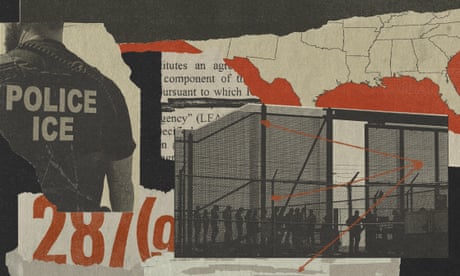
In February, Florida’s governor, Ron DeSantis, signed an agreement between the state and the Department of Homeland Security allowing Florida highway patrol troopers to be trained and approved by Ice to arrest and detain immigrants. While such agreements have been inked across the US, Florida has the largest concentration of these deals.
The arrests of 2 May 2025. Photograph: Screengrab from video by Kenny Laynez-Ambrosio/Courtesy of Guatemalan-Maya Center
Father Frank O’Loughlin, founder and executive director of the Guatemalan-Maya Center, the advocates for Laynez-Ambrosio, says the incident has further eroded trust between Florida’s immigrant community and the police. “This is a story about the corruption of law enforcement by Maga and the brutality of state and federal troopers – formerly public servants – towards nonviolent people,” he said.
Meanwhile, Laynez-Ambrosio is trying to recover from the ordeal, and hopes the footage raises awareness of how immigrants are being treated in the US. “It didn’t need to go down like that. If they knew that my people were undocumented, they could’ve just kindly taken them out of the car and arrested them,” he said. “It hurt me bad to see my friends like that. Because they’re just good people, trying to earn an honest living.”
The Guardian is granting anonymity to Laynez-Ambrosio’s mother and the men arrested in the footage to protect their privacy
In the case of Saturday Night Fever, “[t]he use of disco-inflected classical music in the film represents the economic and social success to which Tony and his friends ultimately aspire,” argues McLeod. “The disco milieu represents one form of illusion—the illusion of power in the outside ‘real’ world that Tony imagines.”
Indeed, classical music represents an exotic world of sophistication, elitism, and wealth which, especially when merged with a homogeneous disco beat, becomes an enticing symbol of the unattainable, illusory, and artificial nature of Tony’s dreams.
Walter Murphy’s “A Fifth of Beethoven” makes its appearance when Tony and his friends arrive at the 2001 Oddyssey (sic) disco club.
“To some extent he is represented as the new heir to the cultural prestige of classical music,” writes McLeod of Tony’s appearance. The soundtrack, with its
seemingly contradictory and almost synthetically forced fusion of classical music and disco underlines the artificiality of his entrance and of the world into which he has crossed. It is likely no accident that the famous “fate” motive, heard here near the beginning of the movie, functions as a foreshadowing of the dramatic events that will soon unfold within this world.
“A Fifth of Beethoven” is easily the highest-profile instance of disco appropriation of classical music. Beethoven’s Symphony No. 5 is typically associated with notions of monumentality, heroism, fate, and relentless transcendence of the will. And while Beethoven’s version is about transcending humanity, Murphy’s is steeped in humanity, as it represents acceptance of common human desires—such as dancing—rather than superhuman transcendence of them.
The soundtrack also featured another instrumental disco–classical interpretation: David Shire’s “Night on Disco Mountain,” which adapts Mussorgsky’s orchestral tone poem Night on Bald Mountain (which is also the Chernabog segment in Disney’s Fantasia). “Night on Disco Mountain” is heard when Tony and his friend pretend to jump off the Verrazzano-Narrows Bridge.
“The faked suicides are symbolized by the ‘fake’ classical music,” writes McLeod.
Shire’s track adds another layer of grotesque ambient sounds to further heighten the atmosphere of chaos and alienation, producing what McLeod calls “an international and futuristic potpourri of sounds.”
“A Fifth of Beethoven” and “Night on Disco Mountain” weren’t isolated instances of classical–disco fusion. Wendy Carlos’s Switched-On Bach and Switched-On Brandenburgs recordings became instant commercial radio and dance hits. K-Tel Records initiated their popular Hooked on Classics series that combined classical music with elements of disco and pop music. This trend spawned a number of disco–classical albums such as Klassiks Go Disko, featuring “A Sixth of Tchaikovsky” and “Brahms’s Disco Dance No. 5,” and Saturday Night Fiedler, an album of disco arrangements by the Boston Pops.
“Many of classical music’s qualities, such as structural complexity and cultural prestige, were natural targets for simplification, reduction, and transmission to a mass audience,” argues McLeod. Artificiality is another common thread, as both genres thrive on the notion. “As in a discotheque,” he writes, “classical music is often enjoyed and appreciated in escapist settings by wealthy, well-dressed devotees.”
There are also similarities between classical and disco compositional style.
Last year, a little-known office in the U.S. Department of Labor helped Black workers at a Texas medical center recover $900,000 in back wages, and Black workers at a Caterpillar manufacturing plant in Illinois recover $800,000, each time over allegations that those applicants lost out on jobs because of their race. Called the Office of Federal Contract Compliance Programs, this division investigates and fights employment discrimination for one-fifth of the U.S. labor force. It was created in 1965 when President Lyndon B. Johnson signed an executive order strengthening the provision of the Civil Rights Act of 1964 that banned racial discrimination by employers. The O.F.C.C.P. specifically enforced the law among businesses and institutions that contracted with the government or received federal funds. The landmark law also banned segregation and discrimination in all public places, including schools, libraries, restaurants and buses.
For more than 60 years, the executive order helped many thousands of workers who had endured discrimination. Yet despite the law, research shows that Black Americans continue to face pervasive employment discrimination at a rate that has not declined since the late 1980s.
On his second day in office, President Donald Trump labeled O.F.C.C.P.’s efforts to enforce the 1964 Civil Rights Act illegal and discriminatory — presumably against white people. He signed his own executive order revoking Johnson’s on behalf of, as he put it, “hardworking Americans who deserve a shot at the American dream.”
Within the week, Trump’s acting secretary of labor ordered the O.F.C.C.P. to “immediately cease and desist all investigative and enforcement activity” and close all open cases. A few weeks later, O.F.C.C.P.’s acting director proposed slashing its staff by 90 percent. In fewer than two months, six decades of civil rights enforcement was essentially dead.
Trump has justified these actions by claiming he is rooting out racial discrimination disguised as “diversity, equity and inclusion.” Indeed, the other federal agency charged with investigating employment discrimination, the Equal Employment Opportunity Commission, recently created a page on its website dedicated to helping white Americans file complaints based on being victimized by diversity, equity and inclusion programs.
But to see what Trump is doing as simply eliminating so-called “D.E.I.” is to misunderstand the scale and the consequences. What’s at stake is not only corporate diversity trainings, equity offices and the use of pronouns in email signatures. Many diversity, equity and inclusion programs were put in place to help ensure compliance with civil rights laws and to foster integration in a society that for most of its history explicitly discriminated against Black Americans. No court has deemed these programs illegal. Yet in the opening months of his second term, Trump has capitalized on the unpopularity of equality efforts among some Americans, glibly wielding the language of D.E.I. to initiate the broadest and most significant assault on civil rights and racial integration in this country in more than a century.
Image
President Lyndon B. Johnson meeting with civil rights leaders (from left, Rev. Dr. Martin Luther King Jr., Whitney Young and James Farmer) in January 1964, months before the signing of the Civil Rights Act.Credit…GHI/Universal History Archive/Universal Images Group, via Getty Images
Since returning to power, Trump has used his singular authority as the head of the federal government to recast the white majority as the primary victims of systemic racial discrimination — though no evidence, not even self-reporting among white people, shows this to be true. In addition to upending long-established enforcement of civil rights law in employment, he has undermined civil rights protections in housing and education and environmental policy; crippled or shuttered entire federal civil rights agencies; and retracted federal findings of civil rights violations against police departments.He has forced by mandate, threat and coercion the elimination of policies and cultural norms focused on integration and equality throughout government, education and the private sector. Trump has claimed — though he has no authority to do so — to have repealed birthright citizenship, which was embedded in the Constitution at the end of slavery to guarantee Black Americans citizenship by birthright and grants automatic citizenship to all people born on American soil.
Trump’s actions have not materialized out of nowhere. Conservatives have spent decades chipping away both at civil rights protections and the national will to address racial inequality. Since the racial reckoning of 2020, Republicans have toppled affirmative action in college admissions and waged an enormously successful campaign to make the language of equity and inclusion anathema, to label books and lessons about the nation’s history “anti-white” and “divisive” and to prohibit everything from Black studies to university diversity offices. And earlier this month, the Supreme Court, which over the years has made it increasingly challenging for Black Americans to prove discrimination, has now made it easier for straight white people to do so.
The notion that equality efforts have gone too far has proved seductive to many white Americans, who are the least likely of all groups to believe that racism is an obstacle for Black Americans. Polling shows the majority of Republicans see efforts to ameliorate racism as “making life more difficult for white Americans” and believe that racism against Black Americans was a problem in the past, but that now white Americans suffer from racism more than any other group.
And Trump’s message is most likely finding a broader audience. Pew Research Center polling on racial attitudes six months before the 2024 election showed that the percentage of Democratic voters who believed white people “benefit a great deal from advantages in society that Black people did not have” plummeted 15 points in just two years. The legal scholar Ian Haney López explained what he believes caused the rapid decline. “Many white liberals were themselves skeptical of diversity, equity and inclusion, were themselves disposed to complaints about ‘wokeness’ and its demands that people be sensitive about speech around racial issues,” he told me. “And so now when there are all these attacks on D.E.I., there are surprisingly few defenders.”
Still, the efficiency with which Trump has collapsed the civil rights and equality infrastructure of the federal government has stunned the nation’s veteran civil rights leaders. “This is a full-on assault on all that we have gained in the last 125 years,” Maya Wiley, president and chief executive of The Leadership Conference on Civil and Human Rights, told me. “Civil rights is the architecture of democracy, so the only reason you do this is because you are trying to steal democratic power from people.”
Civil rights activists fear that the threat of losing federal funds or being investigated and punished for trying to integrate, combined with the decimation of the entities charged with defending them, is creating an environment where institutions will be afraid to admit too many Black students, hire too many Black staff members or put scientific, medical or economic resources toward alleviating the singular disparities Black people still face across American life. The Trump administration is “actually creating incentives to exclude Black folks,” says LaTosha Brown, a community organizer and co-founder of Black Voters Matter.
The resounding success of the civil rights movement was in largely convincing American society that racism was wrong. But its citizens never agreed on how best to correct racism’s harms. While it seems clear that, say, when it comes to crime, passing laws alone is not enough (that’s why we have law enforcement), we can lose sight of that principle when it comes to the rights of minority groups. If you are a member of the racial majority, or the group that holds power, rights can feel both innate and abstract, invisible and assumed. But for Black Americans and other historically marginalized groups, the right to be treated as equal citizens, to be treated fairly by the government, private companies and individuals, has for most of the history of this country not been guaranteed. These rights needed to be codified and enforced precisely because the deprivation of those rights was codified and enforced for almost as long as this country existed. When in the past the federal government stopped enforcing these laws, those rights have always deteriorated.
Today, as the Trump administration is systematically taking apart the enforcement apparatus of the federal government, agency by agency, it is sending a powerful message to American institutions that discrimination will not be punished. This may once again leave Black Americans with rights that exist largely on paper.
The ‘Colorblindness’ Trap: How a Civil Rights Ideal Got Hijacked
The fall of affirmative action is part of a 50-year campaign to roll back racial progress.
March 13, 2024
No cornerof the massive federal bureaucracy is being left untouched by Trump’s dismantling of civil rights. In March, Lee Zeldin, administrator of the Environmental Protection Agency, shuttered the Office of Environmental Justice and External Civil Rights and announced he was eliminating all 10 of its regional divisions. President George H.W. Bush established the office in 1992 because he saw the disproportionate exposure to deadly pollutants, toxic waste and pesticides faced by Black people and other marginalized groups across the country as an issue that the federal government needed to address. Over three decades, the office has worked to protect communities suffering and dying from industrial pollution and to track the impacts of pollution and climate change.
To Zeldin, these efforts amounted to “D.E.I.” and “forced discrimination” — though it is unclear how or against whom. In March, the administration moved to dismiss a landmark environmental-justice suit in Louisiana against a chemical plant located in a poor, predominantly Black community where the cancer risk was so high — the highest in the country, in fact — that a nearby elementary school had to be shuttered. The government had been moving to curb the plant’s dangerous emissions, and the case was set to go to trial in April, before the administration abandoned it. The Trump administration has also terminated a settlement requiring officials in a rural Alabama town to help families in another poor Black community that had been exposed to raw sewage for decades.
Trump has scuttled the entire civil rights divisions of the Social Security Administration and the Department of Homeland Security, and closed the division in the Department of Veterans Affairs that sought to address longstanding racial disparities in how veterans receive compensation for their disabilities.
In April, Trump issued another executive order that seeks to abolish the linchpin of modern civil rights enforcement, known as “disparate impact liability.” Sixty years after the civil rights movement made racial discrimination illegal, discrimination is rarely explicit. Disparate impact recognizes that nearly all discrimination today is covert and hidden behind race-neutral policies or actions. When state legislators create new congressional maps that eliminate majority-Black districts, for instance, they are not going to declare that they are doing so to dilute Black voting power. But under disparate impact, Black residents don’t have to prove that legislators intended to discriminate. They can prove discrimination if the accused cannot show that there was a legitimate reason for the disparity and that there weren’t other actions they could have taken that would have done less harm. Without disparate impact, it would be impossible for most people who have experienced discrimination in housing or employment or education to prove it, and so its elimination would essentially gut any remaining ability to enforce civil rights law today.
In the realm of housing, the administration has repealed a federal rule making clear that cities, counties and states that receive federal funding must take seriously their obligation, enshrined in the 1968 Fair Housing Act, to take proactive steps to integrate housing. It has also slashed funding for enforcement against housing discrimination and promised to cut in half the staff of the Department of Housing and Urban Development, which enforces the Fair Housing Act.
Image
President Trump signing executive orders, including “Ending Radical and Wasteful Government D.E.I. Programs and Preferencing,” on Jan. 20, 2025, hours after being sworn into office.Credit…Anna Moneymaker/Getty Images
Civil rights enforcement at the Department of Education is similarly being taken apart. The administration announced that it was eliminating seven of the department’s 12 regional civil rights offices, which compel schools to integrate, collect educational data that reveals racial and other disparities and investigate discrimination in schools and universities.
The Education Department sent a letter to all educational institutions receiving federal funds asserting without evidence that they were engaging in “pervasive and repugnant race-based” discrimination against white and Asian students. Federal data shows that Black students are disproportionately concentrated in schools with fewer resources and less funding, and experience significant academic disparities. And yet the letter told public schools and universities that they had 14 days to purge all diversity and equity efforts — which include programs that try to help diversify teaching staffs and help Black students close the achievement gaps they suffer from nationwide — or lose access to federal funds.
This reveals another powerful tool the Trump administration is using to subvert civil rights: the might of the federal dollar. By withholding federal money from integration and equity programs, it is turning the Civil Rights Act against its aims. The law originally derived its tremendous power not just from the authority it gave the federal government to sue to force compliance but from the way it deployed federal money to incentivize integration and fair treatment. Recognizing that schools, local and state governments, universities and thousands of private employers, from airplane manufacturers to pharmaceutical companies, received billions of federal dollars to do their work, the law gave the government the power to strip funds from any organization that discriminated against not just Black people but anyone based on their race, color or nationality (and later gender, disability, sexuality and veteran status). These categories of people were called “protected classes” precisely because they belonged to marginalized groups whose rights needed protection from the majority.
It was the threat of both lawsuits and losing federal funds — a full decade after the Supreme Court’s Brown v. Board of Education decision made school segregation illegal — that finally forced recalcitrant Southern school districts to desegregate. Now the Trump administration is dismissing longstanding federal court orders against school districts that still have never fully integrated, and using the law to force the end of programs designed to eliminate racial disparities that Black and other students face.
But probably the starkest change is the redirecting of the Department of Justice away from fighting anti-Black discrimination and toward eliminating integration efforts. Harmeet Dhillon, the new head of the department’s Civil Rights Division, sent a memo to the staff making it clear the mandate going forward would be to enforce Trump’s executive orders targeting diversity programs.While Black Americans have historically relied on the federal government to vindicate their rights when facing discrimination from state and local officials, the Trump administration has moved to dismiss voting rights and civil rights cases involving police departments and close Department of Education investigations into anti-Black discrimination, at the same time that it is bringing new investigations against institutions that have diversity programs. The Civil Rights Division of the Justice Department was created by the Civil Rights Act of 1957 precisely for the purpose of protecting the voting rights of Black citizens and prosecuting crimes against civil rights workers. The remaking of the storied division into one that no longer focuses on defending the civil rights of marginalized groups has led to a mass exodus, with some 70 percent of its attorneys leaving or planning to leave, according to recent news reports.
Black Americans may now struggle to find protection of their civil rights in the private sector as well. In mid-March, the E.E.O.C.’s acting chair, Andrea Lucas, sent letters to 20 of the nation’s most prominent law firms questioning whether their employment practices, including their work to integrate the profession, are violating the 1964 Civil Rights Act. Lucas demanded that the law firms provide extensive hiring and compensation data for staff and fellowship programs, and has encouraged employees to report their firms for engaging in “potentially unlawful” diversity efforts. Lucas used the firms’ own promotion of their integration work as evidence that they may be discriminating against white people. But this claim stands in stark contrast to the data: Despite these diversity efforts, just 4.4 percent of lawyers at law firms nationwide are Black.
A few days after Lucas sent her letters, Trump announced that one of the nation’s most prestigious firms, Paul Weiss, agreed to eliminate its integration programs and allow an auditor to search out any diversity and equity employment practices, among other concessions. In a statement sent to colleagues, the firm’s chairman said it was retaining its “longstanding commitment to diversity in all of its forms,” but agreed to “follow the law with respect to our employment practices.”
By targeting these law firms, Trump seems to be trying to kneecap the private civil rights enforcement infrastructure as well. Most of the firms that received Lucas’s letter have partners or other attorneys who sit on the board of the Lawyers’ Committee for Civil Rights Under Law, which was formed in 1963 after President John F. Kennedy convened a meeting of more than 200 lawyers to help defend the rights of Black Americans. Last year, the Paul Weiss firm was recognized for its pro bono work with the organization, including partnering on suits against the white-nationalist groups the Proud Boys and the Patriot Front. Private firms and in-house corporate legal departments have donated more than one million pro bono hours to the Lawyers’ Committee and its clients in the last decade alone. Now Paul Weiss has agreed to do pro bono work for the administration. The capitulation roiled the profession.
“The Lawyers’ Committee got the commitment of America’s most prominent, most powerful law firms to assure fairness and equality through enforcement of civil rights,” says William Robinson, a former executive director of the Lawyers’ Committee. “That’s what Trump is attacking.” Trump, he said, is dismantling the Civil Rights Act “by executive fiat.”
President Trump claims that destroying what he calls “D.E.I.” will return the United States to a meritocracy, and, in his words, bring a new American “golden age.” But the metaphor reveals more than it perhaps intends. America’s last golden age was called the Gilded Age, an era around the turn of the last century known for its rapid economic growth and ostentatious wealth. But there’s a reason that era evokes an image where Black people exist outside the frame. What Trump calls the golden age, Black Americans call the Nadir, the lowest point, a term coined by the historian Rayford W. Logan to describe the period when, with the blessing of the federal government, the rights that Black Americans achieved following slavery’s demise were violently and systematically taken away.
It can be hard to imagine how quickly racial progress can disappear. But consider that during Reconstruction, Radical Republicans in Congress propelled the establishment of the first national civil rights in the country’s history. Congress passed a series of laws and constitutional amendments granting Black Americans citizenship by birthright; protecting their right to vote, hold office and serve on juries; and prohibiting discrimination in housing, public places and on public transit. Under the protection of the federal government, Black Americans were able to own land, start businesses, build schools and colleges, work middle-class jobs in the federal government, vote and serve in office. In 1870, for example, Hiram Revels became the first Black person elected to the U.S. Senate, representing Mississippi, and in 1873, Henry Hayne became the first Black man to attend the University of South Carolina, making it the only integrated public university in the South. These were stunning feats in majority-Black states that less than a decade earlier enslaved nearly all the Black people within their borders. Progress must have felt inevitable.
Image
A woodcut from 1870 depicting Hiram Revels, Republican of Mississippi, taking the oath of office to become the nation’s first Black senator.Credit…Bettmann/Getty Images
But just four years later, in 1877, the Republican Rutherford B. Hayes, following a contested presidential election, secured Southern Democratic support by agreeing to withdraw federal troops who protected Black Southerners from the violence of their former enslavers and insured their ability to cast a ballot.
Though the rights of Black Americans remained enshrined in the Constitution, almost immediately states began to pass both explicit segregation laws and so-called “race-neutral” laws such as grandfather clauses, which dictated that men whose grandfathers had cast a ballot before 1867 were the only ones guaranteed the right to vote. These laws almost completely disenfranchised Black people, of course, because before then nearly all Black people had been enslaved and were therefore unable to vote.
Forced to live under what W.E.B. Du Bois called the “veil” of codified segregation and racial oppression, Black people were vanquished from institutions, workplaces and public spaces they once shared with white Americans. Under the cover of law, states stripped Black Americans of their ability to vote, to serve on juries, to ride on integrated train cars, to shop in integrated stores. For nearly a century, there would be no more Black senators and no Black students at the University of South Carolina, as the America that could have been succumbed to the America that always was.
As racial apartheid was being systematically erected on a state level, Black people looked to the federal government for protection. But in 1913, President Woodrow Wilson, whose father was an enslaver and a chaplain in the Confederate Army, nationalized Jim Crow when he allowed the federal government to segregate its work force, putting the presidential stamp of approval on discrimination against Black citizens.
It is no accident that we remember so little of this time when Black Americans won their rights and then quickly lost them. Much of this amnesia was a consequence of a sophisticated disinformation campaign promulgated by a turn-of-the-century version of the Moms for Liberty — a group of white women called the United Daughters of the Confederacy. Following the Civil War, the United Daughters worked to cement the “Lost Cause” narrative across the South by successfully advocating that school textbooks and curriculum and public monuments valorize the white slaveholding South and justify the stripping of Black Americans’ rights. They advanced a narrative that Reconstruction had been a failure because Black people — unscrupulous, ignorant and incapable of self-governance — had ascended into positions that were rightfully white. In her 1895 textbook, “A School History of the United States,” Susan Pendleton Lee, a member of the Lexington, Va., chapter of the U.D.C. who said she aimed to give children “a just and interesting account of the whole country,” wrote that “many of the Negroes in the legislatures, in the courts of justice, and in the magistrate’s chair could neither read nor write, and were unable to understand any of the important questions of the troublous times. Government administered by such irresponsible hands, became every day more unjust and corrupt,” while “ the hard lot of the intelligent, cultivated white population … saw the States they loved so well thus ruined and degraded.”
Today conservatives rely on a similar forced forgetting, rebranding their attacks on civil rights as an attempt to defend them. This subversion reduces the 1964 Civil Rights Act to a simple mandate to make colorblindness — a blindness to the existence and saliency of race — the law of the land. It is an ahistoric interpretation that treats those who today try to use race to integrate as equivalent to those who once used race to segregate. By this logic, the Civil Rights Act itself becomes unmoored from the very legacy of anti-Blackness that forced Congress to pass the law in the first place.
But all the civil rights acts going back to the 1800s — all of them — were passed by Congress to try to end the subordination, discrimination and segregation of a people whose ancestors were enslaved. Millions of Americans living today took their first breaths in a country where, because they are Black, they were excluded by law from homes, from neighborhoods, from loans, from schools, from parks, from universities, from jobs, from stores, from restaurants, from hospitals, from libraries and, in some parts of the country, from entire professions.
There is no resemblant history for white Americans, and no evidence that white Americans today face systemic discrimination in a nation where they remain the majority and where the federal government and most institutions, especially this nation’s most elite ones, are still overwhelmingly run by white people. This is how the efforts to erase the history of racism and Black American freedom struggles intersect with the efforts to roll back civil rights. Over the last few years, in the name of equality, many Republican-led states have passed laws that forbid accurate teaching about racism and encourage the purging of books and curricula about Black Americans and other marginalized groups. President Trump is now federalizing these laws, forcing them onto states, universities and communities. He is promising to take over this nation’s most prestigious public museums and purge them of exhibits that “divide Americans based on race, or promote programs or ideologies inconsistent with Federal law and policy.”
That’s because every lesson plan and plaque that recounts slavery or legal discrimination, every commemoration that celebrates Black firsts, reminds us why civil rights laws and enforcement agencies, race-conscious research and diversity hiring and educational policies were required to begin with, and why they remain necessary today.
By deploying the Civil Rights Act against the very people it was created to protect, conservatives hope to get as close to their ultimate goal as possible: repealing it. The mainstream conservative writer Christopher Caldwell argues that the Civil Rights Act of 1964 forced upon society a new Constitution irreconcilable with the first. He has argued that efforts to enforce the law robbed the South of its democracy and created onerous rules that limited American freedoms.His analysis diminishes the fact that “democracy” in the South before the civil rights acts existed only for white people, and that the act vastly expanded freedoms for Black Americans and other marginalized groups. White men, Caldwell wrote in his 2020 book, “The Age of Entitlement: Americas Since the Sixties,” “fell asleep thinking of themselves as the people who had built this country and woke up to find themselves occupying the bottom rung of an official hierarchy of races.”
That sentiment about the Civil Rights Act is evidently shared by Mike Gonzales, a senior fellow at the Heritage Foundation, the conservative think tank that published “Project 2025.” He wrote in February that Trump is “on the warpath against the radical ’60s,” adding “many of the things that conservatives are setting out to dismantle have their origin in that fateful decade.”
An America without the ’60s, of course, is an America without civil rights, women’s rights, immigrant rights, disability rights and gay rights. It is an America where meritocracy did not and could not exist.
The astounding ambit of Trump’s first months has made it possible to imagine a future that looks eerily like the past. An America where the Constitution still stands, but Black people and other marginalized groups receive virtually no protection from the federal government, and the actions of that government instead encourage discrimination. An America where Black people may nearly disappear, first from textbooks, curriculum and museums, and then from predominantly white institutions and entire professions, such as law, medicine and science, where they are already severely underrepresented. And since conservatives are also threatening and defunding medical and other programs at historically Black colleges and have sued even Black organizations that have tried to specifically help Black people, the America Trump may be bringing about is an America that the vast majority of Black Americans alive today have never lived in — a second Nadir.
It may seem unfathomable. But history provides a warning: In this country, when the circumstances are right, the fragile norms around race can be dislodged, and freedoms can erode and then evaporate.
Read by Janina Edwards
Narration produced by Krish Seenivasan
Engineered by Alec K. Redfearn
Source photographs for top illustration: George Doyle/Stockbyte, via Getty Images; Gravity Images/The Image Bank, via Getty Images; Mint Images, via Getty Images.
Nikole Hannah-Jones is a domestic correspondent for The New York Times Magazine covering racial injustice and civil rights.
This is not a work of fiction. It’s from my clinical notes, drawn from the quiet corners of a family learning how to listen, how to see, and how to love. What follows is Maya’s story—and ours too. It began with misunderstanding and grew into music. It was shaped by silence, and strengthened by learning how to hear what was never said out loud.
—
🧠 Main Characters
• Maya (17) – A brilliant, autistic teen who expresses herself through music but struggles with verbal communication and sensory overload. Her inner world is rich, but rarely understood.
• Daniel (45) – Her father, a pragmatic man who misinterpreted Maya’s behavior as defiance. He’s emotionally shut down but carries deep guilt.
• Leah (43) – Her mother, who tried to advocate for Maya but became isolated in the process. She’s exhausted, but still hopeful.
• Eli (15) – Maya’s younger brother, who felt invisible growing up. He’s witty, sarcastic, and secretly protective of Maya.
—
I. The Fracture
The house had grown quiet over the years—not the peaceful kind, but the kind that echoed with things unsaid. Leah sat at the kitchen table, her fingers wrapped around a chipped mug, staring at the steam like it held answers. Upstairs, Maya rocked gently in her chair, headphones on, fingers twitching over her keyboard. Her music was her voice now.
Eli moved through the house like a ghost. He didn’t slam doors or raise his voice. He just existed in the spaces between tension. And Daniel—he hadn’t been home in months. He lived alone now, in a small apartment filled with regrets and unopened letters.
Maya had always been different. Brilliant, but misunderstood. Her silence wasn’t emptiness—it was survival. Her meltdowns weren’t tantrums—they were overload. But Daniel never saw that. He saw defiance. He saw rebellion. And slowly, the family unraveled.
—
II. The Breaking Point
It happened at school. Maya, overwhelmed by noise and light and chaos, collapsed in the hallway. Hands over her ears, rocking, humming. Someone filmed it. Of course they did.
Eli found the video first. He didn’t speak. Just slid his phone across the table to Leah and walked out.
That night, Leah called Daniel.
“She was screaming,” she said. “And no one heard her.”
Daniel arrived the next morning. He stood in the doorway like a stranger. Eli didn’t look up. Maya didn’t come down. Leah didn’t cry. Not anymore.
“She doesn’t talk much,” Leah said. “But she plays.”
Daniel didn’t understand. Not yet.
—
III. The Song
Eli knocked on Maya’s door. “Can I record you?” he asked.
She didn’t answer, but she didn’t say no.
He sat on the floor, phone in hand, and watched as Maya’s fingers danced across the keys. The melody was aching, defiant, beautiful. It was everything she couldn’t say.
He uploaded it that night. The Quiet Between Us.
The video spread. Comments poured in. People who felt seen. People who understood.
Daniel watched it on repeat, tears streaking his face.
“I didn’t know she could feel like that,” he said.
“She always did,” Leah replied. “You just didn’t know how to listen.”
—
IV. The Shift
Daniel knocked on Maya’s door. She didn’t look up, but she didn’t turn away.
“I heard your song,” he said. “I’m sorry I didn’t hear you sooner.”
Maya reached for her keyboard. Played a single note. Then another.
Daniel sat beside her, silent. Listening.
Leah watched from the hallway, hand over her heart.
Eli uploaded another video: The Quiet Between Us – Live.
They began to change. Slowly. Imperfectly.
Daniel stopped trying to fix. He started trying to understand.
Leah stopped carrying everything alone. She let herself be held.
Eli stopped disappearing. He became the bridge.
And Maya? She kept playing.
—
V. The Reconnection
They sat together in the living room. Maya played. Eli recorded. Leah smiled. Daniel closed his eyes and listened.
No one spoke. But everything was said.
They weren’t perfect. But they were real.
And in the quiet between them, they found something louder than words.
They found each other.
🎵 Epilogue: The Song That Speaks (Follows graphic)
—
🎵 Epilogue: The Song That Speaks
Maya’s music became a language for others.
Eli started a podcast for neurodivergent families.
Daniel and Leah spoke at workshops. Not as experts—but as learners.
Their story wasn’t about fixing.
It was about listening.
About loving each other—not in spite of difference,
but with it.
Because love isn’t always loud.
Sometimes, it’s quiet.
And sometimes, the quiet is where love begins.
This is more than a story. It’s a lived truth. Signed not with ink—but with the quiet strength of love, survival, and rediscovery.
This is entirely about erasing the LGBTQ+ community from society. They teach and preach hate about us then use that acts of violence and vandalism to claim the “public” is against the LGBTQ+ representation. Why we generate such hate for just living our lives openly like they do is beyond my understanding. The people pushing hardest to erase the LGBTQ+ have only misunderstood texts in their holy book written over centuries in different cultures and languages. Yet they read it as if the words they are reading mean the same now or are correctly translated. And still that doesn’t give them the right to remove the LGBTQ+ from the public square and teach hate against us. The reasons given by the transportation secretary are meaningless garbage and complete untrue. Hugs
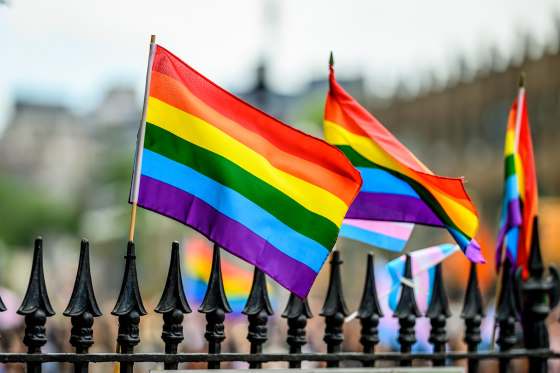
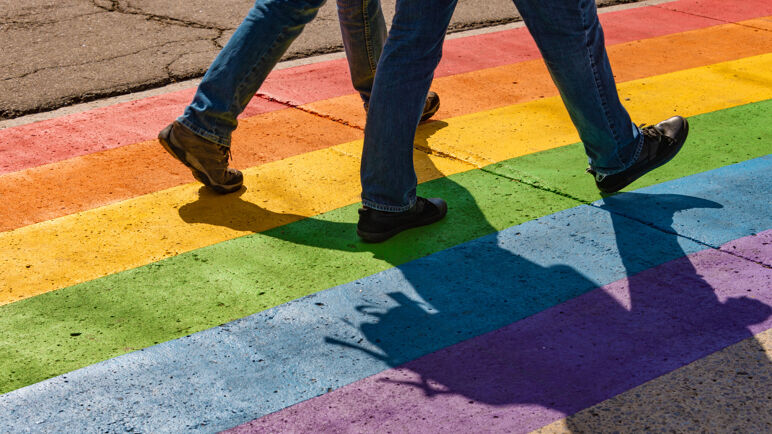
In a literal erasure of LGBTQ+ identity in South Florida, the city of Boynton Beach has complied with recent orders from Gov. Ron DeSantis (R) and the Trump administration to eliminate a rainbow crosswalk in the beachside city.
Video reveals a road crew painting over the once-colorful intersection at East Ocean Avenue and Southeast First Street on Wednesday morning. It’s now painted black.
Boynton Beach has “removed the inclusionary-painted intersection on the 100 block of East Ocean Avenue to ensure full compliance with state and federal transportation mandates and address safety concerns,” a statement from the city read. “The decision follows recent guidance from the U.S. Transportation Secretary and the Florida Department of Transportation.”
The Pride commemoration was first unveiled in June 2021.
The rainbow intersection has been vandalized before. During Pride month in 2023, surveillance video captured a motorcyclist burning out over the mural, leaving black tread marks across it. He then stopped to record the damage he caused.
The Pride erasure comes just days after a coordinated campaign by the Florida governor and the federal Transportation Department to remove rainbow intersections across the state.
On July 1, former Road Rules reality star and current Secretary of Transportation Sean Duffy issued a social media edict to all U.S. governors to remove the crosswalk art.
“Taxpayers expect their dollars to fund safe streets, not rainbow crosswalks,” Duffy declared. “Political banners have no place on public roads. I’m reminding recipients of @USDOT roadway funding that it’s limited to features advancing safety, and nothing else. It’s that simple.”
In the order and subsequent interviews, Duffy implies the Pride crosswalks are causing chaos on the roads and have led to traffic fatalities.
“Far too many Americans die each year to traffic fatalities to take our eye off the ball,” Duffy told the far-right Daily Signal.
“Roads are for safety,” he said somewhat incongruously, “not political messages or artwork.”
Duffy didn’t specify what percentage of the 39,345 traffic deaths in the U.S. in 2024 were caused by rainbow crosswalks.
Other cities in South Florida with rainbow intersections, including Delray Beach, Fort Lauderdale, and West Palm Beach, face the same state and federal mandates. It wasn’t immediately clear whether or how they would comply.
Other Pride crosswalks in the state have also been subject to vandalism, some repeatedly.
Florida Transportation Secretary Jared Perdue enthusiastically endorsed the federal mandate the day after it was issued.
“Florida’s proactive efforts to ensure we keep our transportation facilities free & clear of political ideologies were cemented into law by @GovRonDeSantis,” Perdue posted to socials. “Great to now have our federal partners also aligned behind this same common-sense policy.”
Rand Hoch, president of the Palm Beach County Human Rights Council, called the orders “blackmail”.
“This is just another example of the president and the governor blackmailing local governments by telling them they’re going to withhold funding so they can try to publicly erase the LGBTQ+ community,” he told the Sun-Sentinel. “This seems to be a priority of these administrations.”
Despite the public erasure, Hoch, who was present at the 2021 unveiling of the Boynton Beach Pride intersection, said LGBTQ+ people “are not going to disappear.”
Subscribe to the LGBTQ Nation newsletter and be the first to know about the latest headlines shaping LGBTQ+ communities worldwide.
Mesopithecus pentelicus thrived in the rainforests of the late Miocene, 7 million years ago. Credit: Mauricio Antón
Small, slender and short-lived, with broad noses, big, dark-adapted eyes, living underground, and in the shadows of a shattered, steamy, chaotic world. Richard Musgrove asks: will this be us in 10,000 years?
Climate change is the greatest challenge in human history – current trends could have us eventually approaching extremes not seen on our planet for 15 million years. Will a destabilised global climate wreak economic havoc, leading to societal collapse, mass mortalities, even extinction? Or will we pull ourselves out of this spectacular self-imposed nose-dive?
Which raises the question – what if we don’t? How will humanity change on a much hotter Earth?
Numbers matter
Uncharted territory approaches as we nudge the Paris Agreement’s 1.5°C above preindustrial levels, on track for a potentially catastrophic 2.7°C by 2100. What about 2200, or 3200?
Globally, days above 50°C have doubled since the 1980s – in Australia, Pakistan, India and the Persian Gulf – with the ‘feels-like’ temperature often higher. Even immediately reduced carbon emissions will still mean lingering planet-wide heating and associated effects for many thousands of years.
Our adaptability has led us this far, but what does evolution have in store for our species if we don’t rise to face our greatest challenge? The answer is unlikely to be in the mirror.
Nothing sweats like us (snip-MORE)
===========
Medicaid ‘gamers’ are the new ‘welfare queens’ by Aaron Rupar
Republicans are taking strawman arguments to absurd extremes. Read on Substack
Earlier this month, Donald Trump and congressional Republicans passed a grotesque budget bill that (partially) funds massive tax breaks for the wealthy and a ramped-up ICE goon squad by cutting cutting $1.1 trillion from Medicaid and an additional $185 billion from federal food assistance programs, all while adding $2.8 trillion to the deficit.
Not surprisingly, the bill is massively unpopular. As a result, Republicans are gaslighting Americans about its impact, particularly regarding the cuts to Medicaid, which are expected to cost 10 million Americans their health coverage.
The Medicaid cuts could result in more than 16,000 extra deaths per year, researchers say. Republicans have tried to distract from that reality with a combination of blatant lies and misdirecting rhetoric. To hear them tell it, they’re only cutting supposed waste, fraud, and abuse. So when you lose benefits, they’re here to explain why it’s probably your own damn fault.
The lazy gamer myth
Republican messaging surrounding Medicaid cuts borrows heavily from Ronald Reagan’s playbook. (snip- MORE)
Of course, there are innumerable instances when the Bible has historically been used to enforce the idea that gender is a divinely ordained binary, with male and female genders that are distinct, complementary, and assigned at birth.
Indeed, the Bible’s general attitude toward gender is expansive, with verses exploring God’s focus on the interior over the exterior, the distinction between sex and gender, the role of eunuchs in scripture, and more.
Here are 10 Bible verses that show a biblical approach to gender that is as varied as the colors in a rainbow.
Genesis 1:27 So God created humans in his image, in the image of God he created them; male and female he created them.
Day and night. Water and dry land. Male and female. The creation poem might sound like it’s dealing in binaries, but we know that all of these things have transitional elements. Day and night contain transitions at dawn and dusk; the spectrum of water and dry land includes tidal plains and coral reefs; and people who are intersex, genderqueer, nonbinary, and more can be found between “male and female”.
Genesis 25:27 When the boys grew up, Esau was a skillful hunter, a man of the field, while Jacob was a quiet man, living in tents.
Jacob is described as “smooth” (Genesis 27:11) and stays in the tent where he cooks – traditional female attributes in the ancient world. Yet he is chosen over his “hairy” brother Esau, a skilled hunter, to lead God’s people, showing that God does not place value on traditional gender norms.
Isaiah 56:4-5 For thus says the Lord: To the eunuchs who keep my Sabbaths, who choose the things that please me and hold fast my covenant, I will give, in my house and within my walls, a monument and a name better than sons and daughters; I will give them an everlasting name that shall not be cut off.
Eunuchs were men who had been castrated, especially those employed to guard the women’s living areas. They represent clear historical examples outside of the gender binary in the Bible and are welcomed into the temple and to the community of worship.
Matthew 19:11-12 But [Jesus] said to them, “Not everyone can accept this teaching, but only those to whom it is given. For there are eunuchs who have been so from birth, and there are eunuchs who have been made eunuchs by others, and there are eunuchs who have made themselves eunuchs for the sake of the kingdom of heaven. Let anyone accept this who can.”
The disciples ask Jesus to clarify the explanation of gender in Genesis 1 as it relates to divorce. In answering them, Jesus offers this non-judgmental example of eunuchs that invokes a range of genders. This indicates the law should be flexible enough to allow for this range, instead of being too narrow to recognize its existence.
Galatians 3:27-28 As many of you as were baptized into Christ have clothed yourselves with Christ. There is no longer Jew or Greek; there is no longer slave or free; there is no longer male and female, for all of you are one in Christ Jesus.
The apostle Paul explains that unity in Christ is what’s important, superseding the concept of gender and other identity markers.
Mark 11:17 [Jesus] was teaching and saying, “Is it not written, ‘My house shall be called a house of prayer for all the nations’? But you have made it a den of robbers.”
In this verse, Jesus is referencing Isaiah 56, when eunuchs are welcomed into the community at temple. He prioritizes welcoming all people, regardless of gender.
Acts 8:38-39 He commanded the chariot to stop, and both of them, Philip and the eunuch, went down into the water, and Philip baptized him. When they came up out of the water, the Spirit of the Lord snatched Philip away; the eunuch saw him no more and went on his way rejoicing.
1 Samuel 16:7 But the Lord said to Samuel, “Do not look on his appearance or on the height of his stature, because I have rejected him, for the Lord does not see as mortals see; they look on the outward appearance, but the Lord looks on the heart.”
When the prophet Samuel was charged by God to look for a new king, David didn’t seem as king-like as the other options presented to Samuel — but he was still the right choice. Once again, we see that God does not share the human preoccupation with external biological features. Our physical bodies do not determine deeper matters of our identity.
Romans 2:29 Rather, a person is a Jew who is one inwardly, and circumcision is a matter of the heart, by the Spirit, not the written code. Such a person receives praise not from humans but from God.
As with the example of God choosing David because of what was in his heart, here the Bible says that physical alteration (like being circumcised) isn’t what matters to God — it’s what’s in the heart.
Genesis 16:13 So [Hagar] named the Lord who spoke to her, “You are El-roi,” for she said, “Have I really seen God and remained alive after seeing him?”
Hagar changes the name she uses for God, reflecting a change in how she recognizes who God is — not a change in God’s own identity, but an uncovering that leads to a fuller understanding and affirmation of God’s identity. Similarly, someone may choose to change the gender (and the name that goes with it) that they identify with as a reflection of a greater understanding and affirmation of who they are, out of a desire that the world may better know and understand them, too.
Heather BradyHeather Brady is the audience engagement manager at Sojourners.