Minnesota Governor Tim Walz criticized President Donald Trump during an interview with MSNBC host Jen Psaki, stressing just why the people who elected Trump to run the country “like a business” were completely misguided.
Walz particularly lamented the impacts of Trump’s ongoing trade war with Canada and Mexico, noting that Trump has a history of scuttling deals and “a proven track record of being an absolute failure.”
U.S. Secretary of Defense Pete Hegseth speaks at the Al Udeid Air Base, Thursday, May 15, 2025, in Doha, Qatar. (AP Photo/Alex Brandon)
Military commanders will be told to identify troops in their units who are transgender or have gender dysphoria, then send them to get medical checks in order to force them out of the service, officials said Thursday.
A senior defense official laid out what could be a complicated and lengthy new process aimed at fulfilling President Donald Trump’s directive to remove transgender service members from the U.S. military.
The new order to commanders relies on routine annual health checks that service members are required to undergo. Another defense official said the Defense Department has scrapped — for now — plans to go through troops’ health records to identify those with gender dysphoria.
Far Right Federal Judge Rules Gay And Trans People Can Be Discriminated Against In Workplaces
Judge Kacsmaryk, a federal judge in the Northern District of Texas, ruled on the EEOC’s treatment of Title VII employment discrimination claims on gay and trans people.
On Thursday, Judge Matthew Kacsmaryk—a far-right federal judge in the Northern District of Texas with a record of aligning with the GOP’s most extreme legal positions—issued a ruling declaring that Title VII no longer protects LGBTQ+ people from workplace discrimination. The decision directly contradicts the Supreme Court’s landmark 2020 ruling inBostock v. Clayton County, which held that discrimination based on sexual orientation or gender identity is, by definition, sex discrimination. Kacsmaryk’s ruling marks one of the most alarming judicial rollbacks of LGBTQ+ rights in recent memory—and sets up a direct legal challenge to one of the foundational civil rights protections for queer and trans people in the United States.
Montana Court Issues Final Blow to Anti-Trans Health Care Law
A judge found that the law’s premise is not scientific, but “political and ideological.”
A state judge in Montana has permanently struck down SB 99, a law which sought to ban gender-affirming care for Montana youth under age 18.
The court decision is a welcome reprieve for young trans Montanans, who have had the threat of forced detransition hanging over their heads since 2023. The bill would have threatened the licensure of physicians who provided trans-affirming care to this age group and prevented state funds from being used for gender-affirming surgeries, hormones, puberty blockers, and “social transitioning” measures for trans youth. It also would have allowed parents of trans kids to sue medical professionals for providing their children with the proper care.
But these kinds of laws, which are being passed around the country, are highly unscientific. They try to erase the biological reality of gender and sexual diversity to further a far-right gender ideology. As the court ruling declared, “the State’s interest is actually a political and ideological one: ensuring minors in Montana are never provided treatment to address” their gender dysphoria.
“In other words, the State’s interest is actually blocking transgender expression.”
1) The court found overwhelming evidence backing the benefits of gender-affirming care for trans people.
I watched videos of this protest and the complete violence of the police going full out assault against the gay protestors who were just standing there. The Christian group in anger at what the mayor said about them, so the next day blocked access to the town hall not letting reporters, workers, or people in the community into the town hall. The Christian group did not have a permit and violated sound level ordnances but the police did not try to remove them or force them to let people through to the town hall. But the police did again violently attack the counter protestors from the neighborhoods. It seems clear the police are pro the Christian haters who want conversion therapy done on LGBTQ+ kids to wipe out anyone not straight and cis. The police chaplain is on the fly for the hate group as you can see below. The Christian hate group wants to force everyone to live as their church doctrines demand. They are extremely hateful towards the LGBTQ+ community. They demand that people respect and accommodate their views but refuse to accept the rights of the LGBTQ+ community, not accept the rights that the LGBTQ+ communities are due. I will post the rest of the post by Joe. My. God. but at the end I will post a video that streamer Vaush made on this subject also. As Vaush says the prosecutors refused to press charges on many the police arrested. Maybe because they were innocent protestors viciously attacked by bigoted police. Hugs
In the days after a chaotic confrontation between police and protesters at a conservative Christian rally on Capitol Hill, several groups have questioned why the demonstration was held at Cal Anderson Park and how the city could have better prepared.
The rally, advocating “freedom from same sex attraction” and ”the sacrality of biological gender,” was permitted in the heart of the state’s most LGBTQ+-friendly neighborhood, in a park named for the state’s first openly gay elected official.It attracted scores of protesters who scrapped with police. Twenty-three people were arrested.
Local LGBTQ+ advocates and at least one City Hall politician expressed anger the permit was granted for Cal Anderson, alleging the location was intended to rile the neighborhood’s residents.
The Deputy Director of the Federal Bureau of Investigation (FBI) announced via a social media post on Tuesday evening the FBI will investigate allegations of targeted violence against religious groups regarding last weekend’s chaotic Cal Anderson Park rally.
Dan Bogino posted the announcement on X at 5:15 p.m., writing, “We have asked our team to fully investigate allegations of targeted violence against religious groups at the Seattle concert. Freedom of religion isn’t a suggestion.”
MayDay USA, which describes itself as a Christian Pro-Life organization, held the rally at Cal Anderson Park in Seattle’s Capitol Hill neighborhood. It was met by LGBTQ+ protesters in a competing rally. At some point, police were called in, and there were multiple scuffles between the group and officers.
One of the prominent supporters of Mayday USA is former Spokane Valley state representative Matt Shea, of the “On Fire Ministries,” according to the Radical Women Seattle. Mayday USA organizers have set up a tour of five cities in the country, with Saturday’s event being held in what is considered the heart of the LGBTQ+ community in Seattle on Capitol Hill.
Seattle Mayor Bruce Harrell said the far-right rally was specifically held at the park in Seattle’s known LGBTQ+ neighborhood “to provoke a reaction by promoting beliefs that are inherently opposed to our city’s values.”
In a statement, Mayor Harrell called Seattle “a welcoming, inclusive city for LGBTQ+ communities, and we stand with our trans neighbors when they face bigotry and injustice.” Harrell said anarchists joined the counterprotesters, which resulted in violence and arrests. He said the event organizes shut down the event early after being asked to do so.
Matt Shea, the far-right extremist cited above, has appeared here multiple times, most recently in February 2023 when a church then-affiliated with Shea was ordered to pay Planned Parenthood nearly $1 million in legal fees and a fine related to protests that “interfered with patient care.”
He first earned national headlines in 2019 when leaked chats showed his violent fantasies about executing non-Christians and when it was learned that he had participated in militia drills to train young men for “biblical warfare.”
Shea advocates for the creation of a 51st US state based on “biblical law.” He has also said that all American men who fail to avow allegiance to Jesus should be executed.
He was expelled by the Washington state Republican caucus but refused to resign even after the feds found that he had “participated in an act of domestic terrorism against the United States” by helping plan the armed takeover of the Malheur Wildlife Refuge in Oregon in 2016.
Shea did not seek reelection in 2020 and is now the pastor of Covenant Christian Church in Spokane.
Snippet: In the book The Great Open Dance: A Progressive Christian Theology, theologian Jon Paul Sydnor argues that even the apostle Paul calls for an allegorical reading of Genesis by citing his letter to the church in Galatia. In Galatians 4:21-31, Paul explains the significance of Sarah and Hagar. In verse 24, he tells his audience, “These things are being taken figuratively: the women represent two covenants.” If Paul didn’t read Genesis literally, then I think that permits Christians to interpret Genesis from a more open perspective when it comes to gender and sexuality.
I hold out hope that the Bible can be interpreted in such a way as to make room for me and other trans people. I grasp on to the idea that there is a Christianity out there that is safe and committed to fighting anti-trans legislation. Perhaps to my own harm, I even sometimes find myself hoping that fundamentalists and the Far Right can be persuaded. Persuaded to care, persuaded to see the shared humanity between themselves and transgender people, persuaded by their own good book to protect my community and change their ways. Though I know this is unlikely, I continue to cling to hope. As I am literally fed and cared for by a Christian community, I gain a better understanding of what faith looks like. Today, I am choosing to have faith in my identity as something beautiful and chosen, and good.
In Transgender, Intersex, and Biblical Interpretation, theologians Terese J. Hornsby and Deryn Guest write, “The trans body is not a minority exception to a two-gendered system; it is not an anomaly or a body that exists in the margins. The reality is that there are no margins.” This limitlessness, this abundance, is not only good theology, it is safety, it is belonging.
The entire article is saying that the public schools should be for everyone … except LGBTQ+ kids and parents of those kids. Yes gay and trans children exist and need / deserve to see themselves represented in the community just as much as straight cis kids do. This is a hate bill, banning a group because the majority in charge doesn’t like them. The flags they say are ok to fly like the Gladstone flag or the thin blue line flag are not neutral and they most definitely represent a political ideology. Again this is about erasing the LGBTQ+ kids / people from society to make the Christian fundamentalist and insecure parents who know they can’t have produced a gay / trans kid feel better about themselves. It is a desire to force the fundamentalist view point on every one regardless if they believe it. It is a desperate attempt to return to the 1950s. Hugs
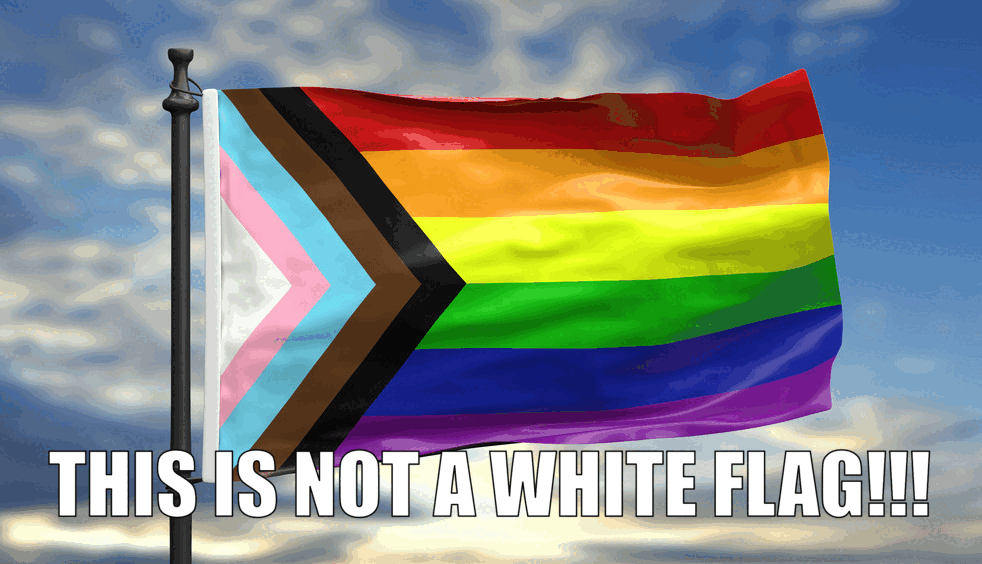
The law effectively bans Pride flags and other LGBTQ flags from being flown at schools or government buildings. In 2019, Gov. Steve Bullock, D-Montana, flew a Pride flag over the state Capitol, which drew criticism from Republicans.
Language in the bill does allow flags like the Gadsden flag and other “official historical flags” to be flown. It also allows flags for law enforcement officers and fallen officers, like the “Thin Blue Line” flag, which Gov. Gianforte, R-Montana, flew above the Montana Capitol on Thursday, May 15, 2025.
When HB 819 was debated on the floor of the Montana House of Representatives, Mitchell said the bill was intended to ensure government entities remain a place of neutrality and was not to impact an individual’s free speech.
“Government buildings, schools and public facilities serve all citizens and should not be used to promote political, ideological or activist messaging,” said Mitchell during the March 6 floor debate.
Critics of HB 819 say the bill targets free speech by allowing provisions for specific flags like the Gadsden “Don’t Tread on Me” flag to be flown, while others were prohibited. Rep. Pete Elverum, D-Helena, said under the language, a Confederate flag could be flown.
“What we’re doing here is we’re expressly prescribing what speech is allowed, ‘these flags’, and what speech is not allowed, ‘these other flags’,” said Rep. Pete Elverum, D-Helena, on March 6. “And as for the definition of ‘promoting a certain ideology,’ those [flags] are expressly prohibited, but at the exact same time we’re sitting here with a bill proclaiming to be about free speech, we’re expressly prohibiting some and promoting others.”
Flags of tribal nations, foreign countries, military service branches, the POW/MIA flag and official school or government entities’ flags are also permitted under the law.
HB 819 went into effect immediately after Governor Greg Gianforte signed it.
This year, both Utah and Idaho have passed similar laws restricting or banning Pride flags on government property or at schools.
New Montana law decides which flags fly in public schools.
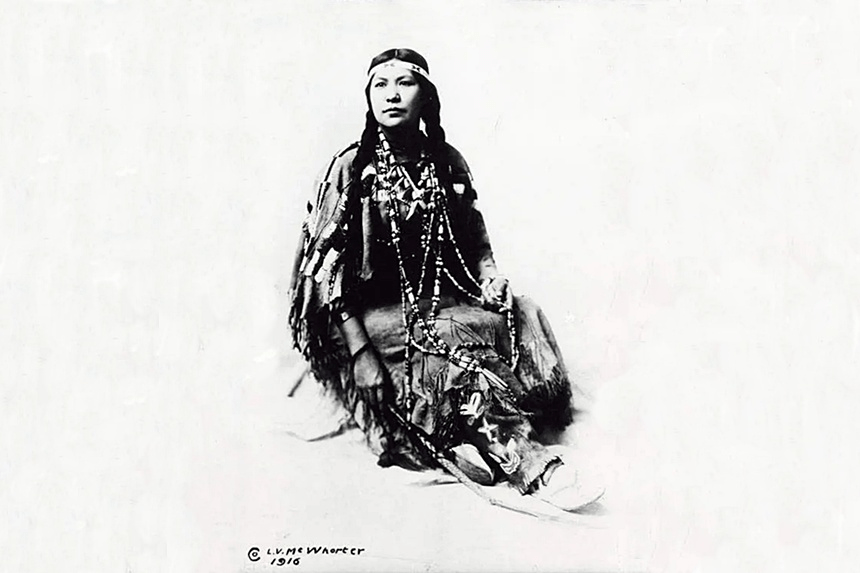
“I am most grateful that…I was born long enough ago to have known people who lived in the ancient way before everything started to change.” –Mourning Dove
Maybe it was because she was born in a canoe on Idaho’s Kootenai River. Or because she was multiracial. Or because she went to a convent school to learn English as a ten-year-old. Whatever the reason, Christine Quintasket, whose Salish language name was Hum-ishu-ma (Mourning Dove in English, which she adopted as her literary name as an adult), wrote stories about the hostility white people had toward Native Americans and the confusion they suffered when educated in white schools.
Born around 1884 to Sinixt/Colville Lucy Stukin of the upper Columbia River and Okanagan/Irish Joseph Quintasket of British Columbia, the future writer grew up speaking the Salishan dialect in her mother’s home near Kettle Falls, Washington, according to her autobiography. Mourning Dove’s grandmother taught her the traditional customs of Columbia Plateau natives. Teequalt, an older woman who lived with the family, introduced her to tribal spirituality, and Jimmy Ryan, an adopted white orphan, taught her to read English through dime novels.
As a young girl, Mourning Dove remembered sitting by a campfire and listening to the animated voice of a tribal storyteller imitating an animal. “We thought of this as all fun and play, barely aware that tale-telling and impersonations were part of our primitive education,” she recalled decades later.
Mourning Dove’s indigenous education ended in 1894 when she went to the Sacred Heart School at the Goodwin Catholic Mission near Kettle Falls. When her mother died in 1902, the writer returned home to care for her younger siblings. After her father remarried in 1904, she moved to Great Falls, Montana to attend the Fort Shaw Industrial Indian School. In 1908 Mourning Dove sorrowfully watched the last roundup of America’s wild bison herd as the Old West faded. “One magnificent fellow fought like a lion as they tried to crowd his wonderful shaggy head into a box car,” she told an interviewer. She later incorporated the roundup in her writing. (snip-MORE, not too long to read, and it’s really interesting!)
May 23, 2025, 3:13 PM EDT; Updated: May 23, 2025, 3:35 PM EDT
Allie Reed
Correspondent
A large transgender flag with signatures and messages during a protest.
Photographer: Manaure Quintero/Bloomberg
The Trump administration must republish two Harvard Medical School professors’ papers it censored because they contained words related to gender ideology, a federal judge ruled Friday.
“The plaintiffs are likely to succeed in proving that the removal of their articles was a textbook example of viewpoint discrimination by the defendants in violation of the First Amendment,” Judge Leo Sorokin wrote for the US District Court for the District of Massachusetts.
The US Department of Health and Human Services took down peer-reviewed articles by doctors Gordon Schiff and Celeste Royce from the now-inactive Patient Safety Network website, run by the HHS’s Agency for Healthcare Research and Quality.
PSNet said the articles were taken down in accordance with President Donald Trump’s executive order directing agencies to remove content that promotes “gender ideology.” Schiff’s article, on suicide risk assessment, and Royce’s, on endometriosis, both referenced transgender people.
“This is a flagrant violation of the plaintiffs’ First Amendment rights as private speakers on a limited public forum,” Sorokin wrote.
The government can only restrict speech on a limited public forum like PSNet in a way that is reasonable and viewpoint neutral, the order said, and the administration’s restrictions were not.
Sorokin said it is not within his discretion “to evaluate the wisdom of restricting access to peer-reviewed scientific information that enhances patient safety by fostering more informed and timely diagnostic care—or of eliminating entirely a free, online repository of patient-safety resources accessed each year by thousands of medical professionals seeking to provide better, safer care to their patients in the United States. Those are matters for the political branches of government to decide.”
The preliminary injunction applies to Schiff and Royce’s articles, as well as other content removed from PSNet in a similar manner.
The Trump administration is asking a federal judge to reject a challenge from two Harvard University Medical School physicians seeking to block the government’s removal of research papers because they included terms related to the LGBTQ communities. https://t.co/Bj8Wuuu8c7






 Allie ReedCorrespondent
 A large transgender flag with signatures and messages during a protest.Photographer: Manaure Quintero/Bloomberg
