Pres. Reagan Signs Stewart B. McKinney Homeless Assistance Act, & More in Peace & Justice History for 7/22

July 22, 1756

The “The Friendly Association for gaining and preserving Peace with the Indians by Pacific Measures.” was founded in Philadelphia. It was comprised primarily of Quakers (members of the Society of Friends who wished to pursue peaceful coexistence between the native peoples and the European immigrants to the Pennsylvania region.
Quakers and Indians 
July 22, 1877
A general strike, part of the railroad strike that had paralyzed the country, was called in St. Louis, where workers briefly seized control of the city. Within a week after it began in Martinsburg, West Virginia, the railroad strike reached East St. Louis, Illinois, where 500 members of the St. Louis Workingmen’s Party joined 1,000 railroad workers and residents.

Strikers in St. Louis continued operation of non-freight trains themselves, collecting the fares, making it impossible for the railroads to blame the workers for loss of passenger rail service.
More about the 1877 general strike 
July 22, 1966
Federal Judge Claude Clayton issued an injunction ordering the police of Grenada, Mississippi, to stop interfering with lawful protest, ordering them instead to protect demonstrations, and requiring certain rules to be set down for the conduct of marches.
This ruling followed weeks of arrests and beating of demonstrators who had been attempting to integrate all the businesses and other institutions in their town.
July 22, 1987
President Ronald Reagan signed into law the Stewart B. McKinney Homeless Assistance Act (named for a member of Congress from Connecticut) which provided emergency relief provisions for shelter, food, mobile health care, and transitional housing for homeless Americans.
More about the act 

https://www.peacebuttons.info/E-News/peacehistoryjuly.htm#july22

Priorities

(This is here in part because clicking through to read on Substack for free is good for her numbers, and she deserves all the numbers. -A)

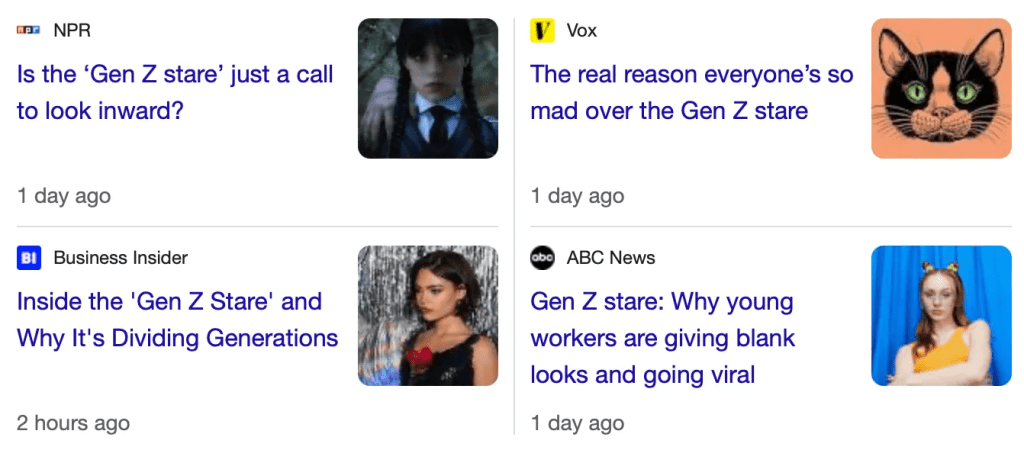
My Thoughts on the ‘Gen Z Stare’ by Charlotte Clymer

And I do have thoughts. Read on Substack

Legacy media is very concerned with the ‘Gen Z Stare’

In the past week, there’s been robust discourse in legacy media about the so-called ‘Gen Z Stare’ and the bursts of generational conflict it reportedly captures.

It’s gotten write-ups by The New York Times, The Washington Post, USA Today, The Boston Globe, NBC News, ABC News, CNBC, Newsweek, Indy100, Axios, Fortune, Vox, Vice, Business Insider, The Independent, Forbes, Buzzfeed, Slate, HuffPost, Glamour, People, and Marie Claire, among others.

As a millennial, I am apparently urged to be concerned about this phenomenon of Gen Z folks supposedly failing to appropriately interact with me through sufficiently pleasant facial expressions, so I thought it might be helpful to offer my thoughts:

The sitting president of the United States is currently covering up a massive sex trafficking operation that targeted children and likely implicates a number of powerful people who are currently out in the world and free to continue preying on children.

The sitting president of the United States just successfully pressured Paramount and CBS to cancel the #1 late-night talk show on broadcast television as part of what appears to be a blatant bribery deal because the host has been critical of him.

The sitting president of the United States just got the extremist Republican majority in Congress to strip 11 million Americans of health care coverage by the end of 2026 and upwards of 17 million Americans when you account for new federal work requirements. (snip-MORE; it’s succinct and quick, and it’s all good facts for grocery/other places lines, for discussion.)

Peace & Justice History for 7/21

https://www.gocomics.com/lards-world-peace-tips/2025/07/20

July 21, 1878
Publication of “Eight Hours,” written by Reverend Jesse H. Jones (music) and I.G. Blanchard (lyrics), the most popular labor song until “Solidarity Forever” was published by the IWW (Industrial Workers of the World) in 1915.
“Eight hours for work,
Eight hours for rest;
Eight hours for what we will.”

All the lyrics
(The eight-hour was an established concept before the song.)
July 21, 1925
The so-called “Monkey Trial” ended in Dayton, Tennessee, with high school teacher John T. Scopes convicted of violating a state law against teaching Darwin’s theory of evolution. It was considered illegal to contradict the Bible’s description of God’s seven-day creation of the world in Genesis.
The trial pitted two of America’s leading advocates as the opposing lawyers: William Jennings Bryan, thrice the Democratic presidential candidate (1896, 1900, 1908) and the state’s prosecutor; Clarence Darrow, a lawyer famous for representing the underdog, at the defense table. Referred to as “the trial of the century” even before it began, it was the first trial ever broadcast (on radio).
Bryan became ill and died shortly after the trial’s end; the conviction was later overturned by Tennessee’s Supreme Court.

 
The Defendant John T. Scopes
 
 The Attorneys: Darrow & Bryan/ The Verdict: Thou Shall Not Think
Interest in the trial by the populace and the media (and the heat in the courtroom) prompted Judge John T. Raulston to move the trial outdoors to the courthouse lawn. Bryan himself was called as a witness on the literal interpretation of scripture.
Attorney General Thomas Stewart, in response to Darrow’s questioning, asked, 
“What is the meaning of this harangue?” “To show up fundamentalism,” shouted Mr. Darrow, “to prevent bigots and ignoramuses from controlling the educational system of the United States.”
Mr. Bryan sprang to his feet, his face purple, and shook his fist in Darrow’s face:

“To protect the word of God from the greatest atheist and agnostic
in the United States.”

ACLU History: The Scopes ‘Monkey Trial’
More about the Monkey Trial 
July 21, 1954
Major world powers, meeting in Geneva, Switzerland, reached agreement on the terms of a ceasefire for Indochina, ending nearly eight years of war. The war began in 1946 between nationalist forces of the Communist Viet Minh, under leader Ho Chi Minh, and France, the occupying colonial power after the Japanese lost control during World War II.
The Geneva conference included France, the United Kingdom, the U.S., the U.S.S.R., People’s Republic of China, Cambodia, Laos, and both Vietnamese governments (North and South).


The peace treaty called for independence for Vietnam and a 1956 election to unify the country. However, only France and Ho Chi Minh’s DRV (Democratic Republic of Vietnam (North)) signed the document.
The United States did not approve of the agreement. Instead, they backed Emperor Boa Dai and Prime Minister Ngo Dinh Diem’s government in South Vietnam and refused to allow the elections, knowing, in President Eisenhower’s words, that “Ho Chi Minh will win.” The result was the Second Indochina War, more commonly known as the Vietnam War.

The treaty is signed 
July 21, 1976

Plaza de Mayo mother
A military junta under General Jorge Rafael Videla took power in Argentina on March 24, disbanding parliament and taking over all labor unions. The military kidnapped hundreds of people from two villages of Jujuy province in northern Argentina, thirty of whom never returned from a clandestine detention center. Most of those disappeared worked for the Ledesma sugar refinery.
Since 1983, on the Thursday closest to July 21, Madres de Plaza de Mayo (an organization of mothers and wives of the missing) are joined by others, and walk the 7 km (4.3 miles) from Calilegua to San Martin, demanding answers about their loved ones. Madres de Plaza de Mayo is supported by Amnesty International and the United Nations Human Rights Commission.

Read more 

https://www.peacebuttons.info/E-News/peacehistoryjuly.htm#july21

ICE Raids Are Getting WAY More Dangerous

I would like people to compare the “tough guy” speech given by the ICE person about removing child molesters and kidnappers, rescuing children from forced labor, the worst criminals, murders, making mom and pop safe with the four crimes they mentioned that of the dozens and dozens arrested were accused of.  One guy was charged with fentanyl distribution, one was charged with trespass, a third was charged with driving without a license and refusing to show identification.  Wow mom and pop are so much safer now that the worst of the worst are in detention with no due process.   Let’s be clear, they are going after legal immigrants, they are going after those following the rules, they are showing up at places where these people are working and looking for work because the goal is to remove all the brown people.  It is that simple, it is a white supremacy thing driven by racist like Stephen Miller who hates Spanish speaking people and those with brown skin.  They held a US citizen veteran for three days with no due process and no explanation.  Take a guess of his skin color?  Brown?  Great guess and correct.  These gang thugs are not trying to make the US safer for anyone, they are determined to make it whiter.   At the 5:21 mark ICE thugs abruptly stop their car in the middle of the street and with guns and tasers ready while masked and in no uniform they rush a woman who is a well known activist who has been openly filming them for weeks.  This is an attempt to cause fear and stop people from viewing and reporting their actions. This is such a 1930s Hitler’s Germany moment in the US.  And Vaush talks about how the nation if flooded with guns and these masked people with no uniforms rushing at people could be shot by people in reasonable fear for their lives as Roger also has been saying.    Hugs

More clips from The Majority Report on different subjects I feel are important to share.

Some The Majority Report clips on ICE and the democrats

Frederick Douglass Does Some Great Work at Seneca Falls, Dockum Drug Store Sit-Ins, & More, in Peace & Justice History for 7/19

July 19, 1848 
The first Women’s Rights Convention in the U.S. was held at Seneca Falls, New York. Its “Declaration of Sentiments” launched the movement of women to be included in the constitution.The Declaration used as a model the U.S. Declaration of Independence, demanding that the rights of women as individuals be acknowledged and respected by society. It was signed by sixty-eight women
and thirty-two men.
The impetus came from Elizabeth Cady Stanton and Lucretia Mott, both of whom had been excluded, along with all the other female American delegates, from the World Anti-Slavery Convention (London, 1840) because of their sex.


Frederick Douglass, the former slave and abolitionist leader attended the convention and supported the resolution for women’s suffrage.
When suffrage finally became a reality in 1920, seventy-two years after this first organized demand in 1848, only one signer of the Seneca Falls Declaration, Charlotte Woodward, then a young worker in a glove manufactory, had lived long enough to cast her first ballot.
The Seneca Falls Convention and the Early Suffrage Movement 
The Declaration of Sentiments
July 19, 1958
Several black teenagers, members of the local NAACP chapter (National Association for the Advancement of Colored People), entered downtown Wichita’s Dockum Drug Store (then the largest drugstore chain in Kansas) and sat down at the lunch counter.

Wichita sit-in sculpture
The store refused to serve them because of their race. They returned at least twice a week for the next several weeks. They sat quietly all afternoon, creating no disturbance, but refused to leave without being served. Though the police once chased them away, they were breaking no law, only asking to make a purchase, a violation of store policy.
This was the first instance of a sit-in to protest segregationist policies. Less than a month later, a white man around 40 walked in and looked at those sitting in for several minutes. Then he looked at the store manager, and said, “Serve them. I’m losing too much money.”
That man was the owner of the Dockum drug store chain.
That day the lawyer for the local NAACP branch called the store’s state offices, and was told by the chain’s vice president that “he had instructed all of his managers, clerks, etc. (statewide), to serve all people without regard to race, creed or color.”
July 19, 1974 
Martha Tranquill of Sacramento, California, was sentenced to nine months’ prison time for refusing to pay her federal taxes as a protest against the Vietnam War.
July 19, 1993
President Bill Clinton announced regulations to implement his “Don’t Ask, Don’t Tell” policy regarding gays in the military, saying that the armed services should put an end to “witch hunts.” The policy was developed by General Colin Powell, then Chair of the Joint Chiefs of Staff, and eventually summarized as “don’t ask, don’t tell, don’t pursue, don’t harass.”
July 19, 2000
A federal administrative law judge ordered white supremacist Ryan Wilson to pay $1.1 million in damages to fair housing advocate Bonnie Jouhari and her daughter, Dani. The decision stemmed from threats made against Jouhari by Wilson and his Philadelphia neo-Nazi group, ALPA HQ.


Bonnie and Dani Jouhari

https://www.peacebuttons.info/E-News/peacehistoryjuly.htm#july19

The Young GOPer Behind “Alligator Alcatraz” Is the Dark Future of MAGA

https://newrepublic.substack.com/p/the-young-goper-behind-alligator

Some clips from The Majority Report dealing with Racism in the US and Israel and ICE.

Please Join Me!

Writting and calling the US Senators about this. We’ve already paid for this money to be disbursed, with the understanding that it will be. This recission is UnAmerican.

Rescission Package Would Sabotage Recent Funding Deal, Cripple Future Ones

July 15, 2025, 1:47 pm

President Trump’s proposal to rescind $9.4 billion in previously approved spending, which the Senate is expected to vote on this week, is a bad idea for several reasons, as noted in a recent CBPP report. The rescission package would significantly damage life-saving global health programs, peacekeeping efforts, and economic development abroad, and would hurt domestic community TV and radio stations supported by the Public Broadcasting Service and National Public Radio. It also builds on the Administration’s broader effort to illegally impound funds, which includes withholding for months the spending that was ultimately included in the rescissions package prior to the formal request and unlawfully delaying or blocking billions of dollars for other programs from going out.

What’s less obvious but no less important, the package — combined with the Administration’s broader campaign of illegally impounding funds — could also make it far more difficult for Congress to fund the government in a bipartisan way in the future.

Here’s why:

Most of the funds in the rescission package were enacted in March legislation that was passed by Congress — including on a bipartisan basis in the Senate — and signed into law by the President to fund the government for the rest of fiscal year 2025. To provide the 60 votes required to avoid a Senate filibuster, at least eight Democratic senators needed to join with 52 Republican senators to invoke cloture on the funding bill.

But presidential rescission requests operate under different rules and require only 51 votes to pass the Senate, so no Democratic votes are needed. If the Senate approves the package (which passed the House on a party-line vote), this would show that Republicans could quickly revise on a partisan basis, with merely 51 votes in the Senate, a bipartisan funding agreement reached only a few months earlier that required support from no fewer than 60 senators.

Nothing has changed about the provisions in the package since the funding was approved in March. They are simply policies President Trump has long opposed and doesn’t want to carry out. But that is not a justification for a rescissions request. After all, it’s typical in an appropriations deal that no one gets everything they want. That means congressional negotiators may get more or less funding than they prefer for a given agency; it also means the Administration may be required to implement programs it does not support.

But if Senate Republicans go along with the Administration’s efforts to simply remove spending they had earlier agreed to as part of the March deal, this would undermine the ability to strike future deals. Office of Management and Budget director Russell Vought has also indicated that the Administration “will strongly consider” sending further rescissions requests to Congress. And of course, the trust needed to make these deals is further undermined when the Administration also chooses to withhold money illegally without even submitting a rescissions package.

The result would likely be lasting damage to our ability to fund the government in a bipartisan way, and the consequences will become clearer in just the next few months. Enacting appropriations for fiscal year 2026, which starts October 1, will require Democratic senators to join with Republicans to reach the needed 60-vote threshold. This Democratic support may not materialize if Democrats believe the President and congressional Republicans will later undo, by rescission or impoundment, any agreement they sign onto.

More generally, there’s little reason for the minority party in Congress to agree to a deal when the Administration and the majority party can strip away funding they don’t like in a purely partisan way, or if the Administration may attempt unilaterally — and illegally — not to implement it at all, with no pushback from the majority party in Congress. As a result, it would be far more difficult to reach the bipartisan agreements necessary to fund the government on time and with the resources required to serve the country’s needs.

Senators should keep those consequences in mind as they consider the President’s current rescission request.

Topics: 

Federal Budget