One-third of young women who don’t take birth control say they fear its side effects. Misinformation plays a role, a health expert says.
This story is part of our monthly series, Campus Dispatch. Read the rest of the stories in the series here.
As long as contraception has been widely available, misconceptions about its safety—from weight gain fears to claims you need a birth control “cleanse” every few years—have scared some young women away from using it. Today, this kind of misinformation is no longer solely circulated in locker rooms or sleepovers. In the modern digital world, active misinformation and disinformation campaigns that deter people from using contraception circulate on social media—reaching millions.
The origin of this issue varies. Sometimes, rumors about birth control are intentionally created and promoted for political purposes; this is disinformation. Sometimes, false claims are unintentionally spread by people who believe their statements are true. Other times, one person misrepresents their real, lived experience as a universal truth.
Since the fall of Roe v. Wade in 2022, contraception and comprehensive sex education have become more than just public health priorities: They are now the front lines of defense in protecting reproductive rights and empowering people—young women especially—to make choices about their bodies.
I am a public health master’s candidate focused on reproductive health and communications. This summer, I am interning at the sexual health and equity non-profit Advocates for Youth, which champions bodily autonomy for young people. In my work here to develop sex education materials and resources for young people and educators, as well as in my academic research, I’ve come to believe that combatting digital misinformation about birth control will require a collective response.
Taking health advice from TikTok
It’s easy to see how young people can fall victim to digital misinformation: Imagine you’re a 15-year-old girl dealing with severe period pain, or perhaps your acne has gotten out of control. Or maybe, you’re just excited to start having sex for the first time and want to do so safely. After talking with your mom and doctor, you decide to try hormonal birth control. You feel relieved. After months of keeping this big life choice to yourself, you finally shared your needs—and you were heard. You have a plan.
That night, some two hours into your usual TikTok scroll, you’re shown a video featuring a beautiful young woman you recognize from your “For You” page. She says birth control not only wrecked her hormonal balance, but will also cause cancer. You’ve seen this creator’s lifestyle content before and always trusted her. In the most-liked comments, hundreds of people echo her experience, sharing stories of hair loss or feeling “crazy” on the pill. Some comment they’re grateful to have never started birth control at all. Nowhere in the comments do you see a doctor or other medical expert pushing back, insisting that birth control is safe and effective.
What do you do?
Perhaps you search TikTok for other perspectives. You find a couple videos from OB-GYNs disputing the claims. But the other creator’s post had more than 200,000 views and hundreds of comments, while that one OB-GYN’s explainer only has 5,000 views and 20 comments. On social media, attention often passes for credibility.
You text your best friend, who asks her older sister. The sister agrees with the original creator’s claims.
Now you’re really nervous (your sister’s friend has had two boyfriends, after all!). You go back to your mom to say you’re not sure about the plan anymore. You’re scared of what birth control will do to your body. She tries to reassure you that it’s safe, but you can’t stop thinking about the women on TikTok who said it wasn’t.
“Data clearly show the deluge of misinformation about reproductive health care, including birth control, on social media,” reads a June 2024 statement from the American College of Obstetricians and Gynecologists, the nation’s top association of OB-GYNs. “This misinformation can cause real harm for patients by encouraging unsafe methods of contraception; by sharing ineffective methods that expose people to unintended pregnancy; or by scaring people away from safe, effective, evidence-based methods of contraception.”
The American Medical Association is likewise sounding the alarm that the rapid spread of misinformation puts lives at risk.
Instead, politicians capitalize on this weakening trust in medicine by amplifying misleading claims. Right-wing commentators like Ben Shapiro and Candace Owens routinely use their platforms to denounce birth control and spread lies about its effectiveness and adverse effects, while claiming they are concerned for women’s health. Some academic researchers and political analysts suggest these are deliberate efforts to dampen opposition should Republicans begin repealing access to birth control using the Comstock Act, an anti-obscenity law from the late 1800s that could stop doctors from mailing contraception or abortion pills. The fewer people believing in the efficacy of birth control, the more compelling their case.
Combatting disinformation together
Too often, efforts to combat misinformation are limited to one-on-one doctor’s office conversations, high school health class (if a school district even offers evidence-based sex education; many don’t), or sporadic debunking posts from reproductive health organizations.
Those of us who believe, as I do, that birth control should be a right for every person who needs it must challenge misinformation and disinformation with the same vigor and coordination as the people and groups spreading it. To meaningfully push back, organizations committed to advancing reproductive health-care access must invest in sweeping digital campaigns—paid, organic, and partnerships—to combat misconceptions and reclaim the narrative around contraception. I’m not the only one who believes these trends call for swift action to match the scale of the problem.
Power to Decide, an organization working to expand access to reproductive health services, is evolving its long-running hashtag campaign #thxbirthcontrol to meet the moment. What began in 2012 as a campaign on X to influence public perception of birth control has now expanded to other platforms including TikTok, where the group posts short videos that highlight the positive, everyday impacts of contraception. Combatting stigma with content that’s compelling, relatable, and accurate is essential to combatting misinformation. So is getting that content directly to the people most swayed by misinformation.
At the launch of their new Health Misinformation and Trust initiative, KFF President and CEO Drew Altman explained, “Most Americans have encountered health misinformation, but a large group simply isn’t sure if it’s true or false. Most people fall into this muddled middle place—underscoring the real opportunities we have to counter misinformation but also the risks of inaction.”
While both of these efforts are promising, they cannot be effective in isolation; a coordinated, aligned response is necessary to effectively combat misinformation.
One encouraging approach is Advocates for Youth’s “The Busybodies Club.” This national campaign, which launched before I joined the organization, combines digital education with relational organizing to teach young people how to “spot fake facts, identify misinformation, and challenge misconceptions.” The Busybodies Club is structured to recognize that challenging misinformation requires more than facts—it requires trust, community, and creativity at the interpersonal and systemic levels. The organization’s guide to spot red flags on birth control posts is a great starting point for folks interested in being part of the solution.
And as more organizations join the fight to combat misinformation about birth control, it’s important to acknowledge that hormonal birth control may not be right for everyone. Depending on the method and hormone type, contraceptives may cause headaches, nausea, and mood changes. For people who experience adverse side effects, there are alternatives like the copper IUD, or different hormonal formulations. This kind of honesty is essential to rebuild trust in contraception and for people to truly exercise reproductive autonomy.
Autonomy means choice. Trouble arises, though, when young women use falsehoods to inform their decisions. Misinformation can convince young people, incorrectly, that everyone will have terrible side effects from hormonal birth control or that or that all non-hormonal methods are equally effective. The copper IUD is more than 99 percent effective. Tracking your cycle is not—it fails to prevent pregnancy up to 25 percent of the time.
The current landscape can make it scary for young people to start birth control, and it shouldn’t be. When a girl wants to take charge of her sexual and reproductive health, I believe she should feel empowered, informed, and supported—not frightened. In an era where reproductive autonomy faces relentless attacks online and in legislatures, arming young people with facts isn’t a luxury. It’s a matter of survival.
Disclosure: Shoshana Kaplan is a 2025 graduate fellow at Rewire News Group, focused on sexual health. She is a summer intern at Advocates for Youth, where she receives some funding for her work.
As I keep saying this is a small very loud mostly religious driven minority using ever tool and lie they can to change perception of the LGBTQ+ to erase them from society to create the cis straight society they want to force on everyone. We must counter them by being as loud and forceful to not only refute their lies but also promote the joy of living freely as an inclusive society. Hugs
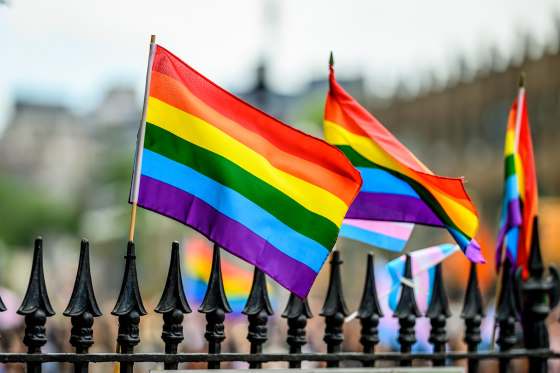
Close-Up of rainbow flag with crowd In background during LGBT Pride Parade. Getty Images.
Ohio lawmakers on both sides of the aisle have introduced several LGBTQ-related bills so far this General Assembly.
Republicans have put forth a drag ban bill, a piece of legislation that would make it harder for a student to use a different name or pronoun at school, and a bill requiring transgender political candidates to list their deadname, among others.
On the other side of the aisle, Democrats have introduced the Ohio Fairness Act and a bill that would ban conversion therapy.
An Ohio court partially overturned a ban on gender-affirming care for LGBTQ youth earlier this year, meaning doctors can still prescribe puberty blockers and hormone therapy.
Anti-LGBTQ bills
Ohio House Bill 249 would ban drag performers from performing anywhere that is not a designated adult entertainment facility. State Reps. Angie King, R-Celina, and Josh Williams, R-Sylvania Twp., introduced the bill, which has had sponsor testimony.
This is a re-introduction of a bill from the previous General Assembly that did not make it out of committee and faced much opposition.
Ohio House Bill 190 would require parental permission for schools to use different pronouns or different names for students that don’t match up with the biological sex or birth name.
Williams and state Rep. Johnathan Newman, R-Troy, introduced the bill, which has had sponsor testimony.
Ohio House Bill 172 would ban children 14 and older from receiving mental health services without parental consent. Newman also introduced this bill, which has had sponsor testimony.
Ohio House Bill 196 would require political candidates to list their former names on candidacy petitions. This, however, would not apply to names that have been changed due to marriage. King and state Reps Rodney Creech, R-West Alexandria, introduced the bill, which has had sponsor testimony.
Ohio House Bill 262 would designate the weeks from Mother’s Day to Father’s Day as Natural Family Month. Williams and state Rep. Beth Lear, R-Galena, introduced the bill, which has had sponsor and opponent testimony.
Pro-LGBTQ bills
Ohio Senate Minority Leader Nickie Antonio, D-Lakewood, has introduced a few bills that support LGBTQ people. Antonio is the only openly gay lawmaker in the Ohio General Assembly.
Ohio Senate Bill 70, also known as the Ohio Fairness Act, would expand anti-discrimination laws to include sexual orientation and gender identity. House Bill 136 is a companion bill.
Antonio has introduced the Ohio Fairness Act in every General Assembly since she was elected to the Ohio House of Representatives in 2011 and this is the first time since 2018 the bill has no Republican support.
Ohio Senate Bill 71 would ban any licensed health professionals from doing conversion therapy when providing mental health treatment to minors. Antonio and state Sen. Beth Liston, D-Dublin, introduced the bill. House Bill 300 is a companion bill.
Ohio Senate Bill 211 would designate the first full week of June as “Love Makes a Family Week.” Antonio introduced this bill as well.
None of these bills have had any hearings so far this General Assembly. Ohio lawmakers are on summer break and will come back to the Statehouse this fall.
After over 21 months of Israel’s brutal assault on Gaza, the humanitarian crisis in the Strip has reached its worst point yet. 94% of Gaza’s hospitals have been destroyed or damaged. Dozens of children have died from malnutrition. And Israeli troops continue to kill scores of Palestinians as they try to receive food from the so-called “Gaza Humanitarian Foundation.”
In this second part of Zeteo’s live ‘Unshocked,’ Dr. Yasser Khan – a Canadian ophthalmologist and plastic surgeon who has traveled twice to Gaza since October 7, 2023 – describes to Mehdi and Naomi how Israel’s humanitarian assault on Gaza has turned injuries and disabilities in Gaza into, “a death sentence.”
Dr. Yasser Khan: “It was horrific, the most horrific things that I’ve ever seen.”
In the interview, Dr. Khan shares the stories of his many patients, the vast majority of whom he says were women and children.
Dr. Khan also discusses how upon returning from Gaza, many of his colleagues in the medical field refused to believe such stories, with some even going out of their way to tell him that, “‘he’s done nothing to be a hero.’”
Dr. Khan explains how he came to the conclusion that what he was seeing in Gaza was indeed a genocide and why he takes so much inspiration from the people in Gaza. Mehdi, Naomi, and Dr. Khan also take questions from a live audience.
Do consider becoming a paid subscriber so you can get early access to exclusive content like this.
Also, if you are interested in learning more about Israel’s assault on Gaza’s healthcare system, check out Zeteo’s most recently acquired documentary, ‘Gaza: Doctors Under Attack.’
These were the words used by the King Of Belgium recently and every day things are getting worse, as starvation starts to run rampant across the area. And all of this was man made. We cannot be silent about this.
These are difficult and traumatic times and, to help us navigate them, my team and I will be producing a regular stream of books to enable people to better understand the psychology of our leaders and the world around us, as well as ourselves. You can buy these self-help ebooks at http://www.RussellsBooks.com
Also, if you like my videos, please like, subscribe, comment and also JOIN MY NEWSLETTER to stay in touch and up to date with all my content: https://razzaque.short.gy
GENEVA — The U.N. Human Rights Council voted on Monday to renew the mandate of an LGBTQ rights expert, a move welcomed by advocates amid the absence of the United States, a former key supporter that is now rolling back such protections.
Western diplomats had previously voiced concerns about the renewal of the mandate of South African scholar Graeme Reid who helps to boost protections by documenting abuses and through dialogue with countries.
The motion for a three-year renewal passed with 29 votes in favor, 15 against and three abstentions. Supporters included Chile, Germany, Kenya and South Africa while several African nations and Qatar opposed it.
“The renewal of this mandate is a spark of hope in a time when reactionary powers worldwide are trying to dismantle progress that our communities fought so hard to achieve,” said Julia Ehrt, executive director of campaign group ILGA World.
The United States, which has disengaged from the council under President Donald Trump, citing an alleged antisemitic bias, was previously a supporter of the mandate under the Biden administration.
Since taking office in January, Trump has signed executive orders to curb transgender rights and dismantle diversity, equity and inclusion practices in the government and private sector.
His administration says such steps restore fairness, but civil rights and LGBTQ advocates say they make marginalized groups more vulnerable.
In negotiations before the vote, Pakistan voiced opposition to the mandate on behalf of Muslim group OIC, calling it a tool to advocate “controversial views.”
Video from Kenny Laynez-Ambrosio, 18, puts fresh scrutiny on the harsh tactics used to reach the Trump administration’s ambitious enforcement targets
‘You’ve got no rights’: teenage US citizen records violent arrest by immigration officers – video
On the morning of 2 May, teenager Kenny Laynez-Ambrosio was driving to his landscaping job in North Palm Beach with his mother and two male friends when they were pulled over by the Florida highway patrol.
In one swift moment, a traffic stop turned into a violent arrest.
A highway patrol officer asked everyone in the van to identify themselves, then called for backup. Officers with US border patrol arrived on the scene.
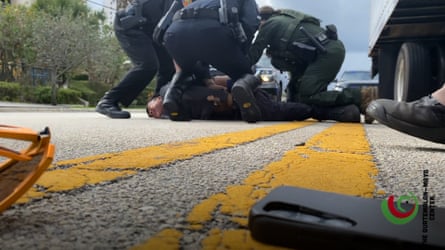
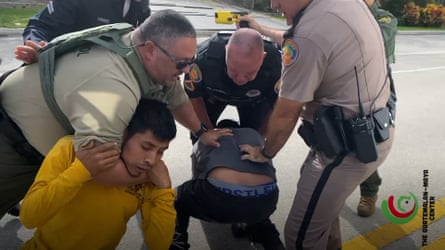
Video footage of the incident captured by Laynez-Ambrosio, an 18-year-old US citizen, appears to show a group of officers in tactical gear working together to violently detain the three men*, two of whom are undocumented. They appear to use a stun gun on one man, put another in a chokehold and can be heard telling Laynez-Ambrosio: “You’ve got no rights here. You’re a migo, brother.” Afterward, agents can be heard bragging and making light of the arrests, calling the stun gun use “funny” and quipping: “You can smell that … $30,000 bonus.”
“The federal government has imposed quotas for the arrest of immigrants,” said Jack Scarola, an attorney who is advocating on behalf of Laynez-Ambrosio and working with the non-profit Guatemalan-Maya Center, which provided the footage to the Guardian. “Any time law enforcement is compelled to work towards a quota, it poses a significant risk to other rights.”
Chokeholds, stun guns and laughter
The incident unfolded at roughly 9am, when a highway patrol officer pulled over the company work van, driven byLaynez-Ambrosio’smother, and discovered that she had a suspended license. Laynez-Ambrosio said he is unsure why the van was pulled over, as his mother was driving below the speed limit.
Laynez-Ambrosio hadn’t intended to film the interaction – he already had his phone out to show his mom “a silly TikTok”, he said – but immediately clicked record when it became clear what was happening.
The arrest of an undocumented man in Florida, as caught on video by Kenny Laynez-Ambrosio on 2 May 2025. Photograph: Screengrab from video by Kenny Laynez-Ambrosio/Courtesy of the Guatemalan-Maya Center
The video begins after the van has been pulled over and the border patrol had arrived. A female officer can be heard asking, in Spanish, whether anyone is in the country illegally. One of Laynez-Ambrosio’s friends answers that he is undocumented. “That’s when they said, ‘OK, let’s go,’” Laynez-Ambrosio recalled.
Laynez-Ambrosio said things turned aggressive before the group even had a chance to exit the van. One of the officers “put his hand inside the window”, he said, “popped the door open, grabbed my friend by the neck and had him in a chokehold”.
Footage appears to show officers then reaching for Laynez-Ambrosio and his other friend as Laynez-Ambrosio can be heard protesting: “You can’t grab me like that.” Multiple officers can be seen pulling the other man from the van and telling him to “put your fucking head down”. The footage captures the sound of a stun gun as Laynez-Ambrosio’s friend cries out in pain and drops to the ground.
Laynez-Ambrosio said that his friend was not resisting, and that he didn’t speak English and didn’t understand the officer’s commands. “My friend didn’t do anything before they grabbed him,” he said.
Kenny Laynez-Ambrosio, 18, filmed his own arrest in Florida. Photograph: The Palm Beach Post/Reporter Valentina Palm
In the video, Laynez-Ambrosio can be heard repeatedly telling his friend, in Spanish, to not resist. “I wasn’t really worried about myself because I knew I was going to get out of the situation,” he said. “But I was worried about him. I could speak up for him but not fight back, because I would’ve made the situation worse.”
Laynez-Ambrosio can also be heard telling officers: “I was born and raised right here.” Still, he was pushed to the ground and says that an officer aimed a stun gun at him. He was subsequently arrested and held in a cell at a Customs and Border Protection (CBP) station for six hours.
Audio in the video catches the unidentified officers debriefing and appearing to make light of the stun gun use. “You’re funny, bro,” one officer can be overheard saying to another, followed by laughter.
Another officer says, “They’re starting to resist more now,” to which an officer replies: “We’re going to end up shooting some of them.”
Later in the footage, the officers move on to general celebration – “Goddamn! Woo! Nice!” – and talk of the potential bonus they’ll be getting: “Just remember, you can smell that [inaudible] $30,000 bonus.” It is unclear what bonus they are referring to. Donald Trump’s recent spending bill includes billions of additional dollars for Ice that could be spent on recruitment and retention tactics such as bonuses.
Laynez-Ambrosio said his two friends were eventually transferred to the Krome detention center in Miami. He believes they were released on bail and are awaiting a court hearing, but said it has been difficult to stay in touch with them.
Laynez-Ambrosio’s notice to appear in court confirms that the border patrol arrived on the scene, having been called in by the highway patrol. His other legal representative, Victoria Mesa-Estrada, also confirmed that border patrol officers transported the three men to the border patrol facility.
The Florida highway patrol, CBP, and Immigration and Customs Enforcement did not respond to requests for comment before publication.
‘We are good people’
Trump officials increasingly recruit local police for immigration enforcement despite ‘red flags’
Read more
Laynez-Ambrosio was charged with obstruction without violence and sentenced to 10 hours of community service and a four-hour anger management course. While in detention, he said, police threatened him with charges if he did not delete the video footage from his phone, but he refused.
Scarola, his lawyer, said the charges were retaliation for filming the incident. “Kenny was charged with filming [and was] alleged to have interfered with the activities of law enforcement,” he explained. “But there was no intended interference – merely the exercise of a right to record what was happening.”
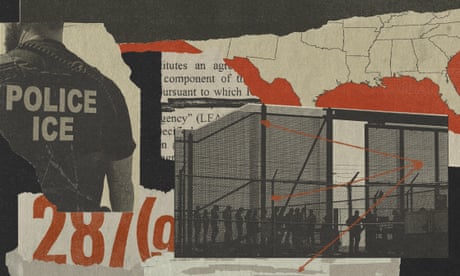
In February, Florida’s governor, Ron DeSantis, signed an agreement between the state and the Department of Homeland Security allowing Florida highway patrol troopers to be trained and approved by Ice to arrest and detain immigrants. While such agreements have been inked across the US, Florida has the largest concentration of these deals.
The arrests of 2 May 2025. Photograph: Screengrab from video by Kenny Laynez-Ambrosio/Courtesy of Guatemalan-Maya Center
Father Frank O’Loughlin, founder and executive director of the Guatemalan-Maya Center, the advocates for Laynez-Ambrosio, says the incident has further eroded trust between Florida’s immigrant community and the police. “This is a story about the corruption of law enforcement by Maga and the brutality of state and federal troopers – formerly public servants – towards nonviolent people,” he said.
Meanwhile, Laynez-Ambrosio is trying to recover from the ordeal, and hopes the footage raises awareness of how immigrants are being treated in the US. “It didn’t need to go down like that. If they knew that my people were undocumented, they could’ve just kindly taken them out of the car and arrested them,” he said. “It hurt me bad to see my friends like that. Because they’re just good people, trying to earn an honest living.”
The Guardian is granting anonymity to Laynez-Ambrosio’s mother and the men arrested in the footage to protect their privacy



 Scottie's Playtime