This has been a bad week. Here it is Thursday and this has been cues for days. Sorry I have a few of these to catch up on and post. Even though this was done back in 2014, it is also relevant and something we need to understand for today. Don’t shrink back, push forward. The few times I have corrected someone after telling them my spouse was a he when they assumed she, I received wonderful reactions of inclusion and acceptance. Hugs
Shh! Silence Helps Homophobia asks people to stand up and speak out against homophobia! This campaign ran during 2014-15.
We are Scotland’s national charity for LGBTI young people, working with 13–25 year olds across the country. We also deliver the LGBT Charter programme to schools, organizations and businesses. Our goal is to make Scotland the best place to grow up for lesbian, gay, bisexual, transgender and intersex young people.
We play a leading role in the provision of quality youth work to LGBTI young people that promotes their health and wellbeing, and are a valued and influential partner in LGBTI equality and human rights.
In Major Win For Trans Students, New Jersey Court Rules Against Forced Outing Policies by Erin Reed
The pair of rulings came in an environment where Trump and red states are pushing anti-trans policy across the United States.Read on Substack
Yesterday, the New Jersey Superior Court’s Appellate Division issued two unanimous rulings blocking forced outing policies in school districts across Morris and Monmouth counties. In mid-2023, Hanover Township Public Schools in Morris County, Marlboro Township Public Schools in Monmouth County, Middletown Public Schools in Monmouth County, and Manalapan-Englishtown Regional School District in Monmouth County implemented policies mandating the disclosure of a student’s transgender status to their parents. The policies varied in scope—some required notification only if a student formally changed their gender identity at school, while others mandated disclosure if a student merely mentioned being transgender in counseling sessions. Shortly after the policies were enacted, they were challenged in court and met with preliminary injunctions, preventing their enforcement. The appellate court upheld these injunctions yesterday.
The plaintiffs in both cases are New Jersey Attorney General Matthew Platkin and Sundeep Iyer, Director of the New Jersey Division on Civil Rights. The Attorney General’s office represented them in both cases. However, in Platkin et al. v. Middletown Township Board of Education et al., the American Civil Liberties Union and LGBTQ+ rights organization Garden State Equality filed amicus briefs in support of the plaintiffs. In Platkin et al. v. Hanover Township Board of Education et al., no amicus briefs were submitted. The cases were overseen by Judges Robert J. Gilson, Avis Bishop-Thompson, and Lorraine M. Augostini. Gilson was appointed by Democratic Governor Jon Corzine, while Bishop-Thompson and Augostini were appointed by Republican Governor Chris Christie. (snip-MORE)
Corewell, Largest Michigan Provider, Resumes Trans Youth Care Despite Illegal Trump EO by Erin Reed
On Wednesday, the hospital system announced that it was resuming gender affirming care after a brief pause due to Trump’s executive order attempting to ban it for those under 19.Read on Substack
In an announcement on Wednesday, Corewell Health, the largest healthcare provider in Michigan, stated that it would resume gender-affirming care for transgender youth under the age of 19. The decision follows a temporary halt in services to new patients after President Trump issued an executive order unlawfully claiming the authority to withhold federal funding from hospitals providing such care. Corewell Health is the first—and the largest—hospital system to reverse course after initially pausing treatment, a move that sparked nationwide protests against other healthcare providers that have yet to reinstate care.
The hospital, in a statement released Wednesday, said that its decision was always meant to be temporary, and that decisions around transgender healthcare best belong to patients and their doctors.
“We are lifting our pause on new hormone therapies for pediatric patients seeking gender affirming care. Care decisions are best made between physicians and their patients and families.
We briefly paused beginning these therapies to allow us time to assess the potential impact that recent policy changes might have on our patients and their health. Contrary to some inaccurate reports, we never suspended any gender affirming care for any of our patients.”
The decision to reinstate care is huge for Michigan transgender patients. The hospital system is the largest in the state, employing over 60,000 people. The LGBTQIA+ adolescent page for one of the member hospitals states, and stated through the closure, “The adolescent and young adult medicine team at Helen DeVos Children’s Hospital takes a holistic, individualized approach to patient care. We guide Michigan patients and their families through comprehensive education and an evidence-based approach. We know this is a challenging time for many of our patients and their families. No matter what is happening around us, we will always remain committed to providing high-quality care for all of our patients.” (snip-MORE)
But please don’t delete without scrolling down to the Extra Credit item, which is of particular and specific pertinence to our interests here on Playtime, and just do that one if you can’t stomach bothering your congresscritters today. Seriously, just do the Extra Credit item-you won’t be sorry, and you will make a difference!!!Thanks, A.
I hope you’re hanging in there today. I know things remain gobsmackingly awful, but I remain cautiously optimistic that the opposition is at last finding its sea legs.
A few reasons for this are:
1) House Democrats announced this morning that they have formally established a Rapid Response Task Force and Litigation Working Group! Good! We need a committee specifically dedicated to this fight, and this one, it seems, will be. I also happen to know that a huge political influencer is meeting with the Democrats this morning (and all week) to teach them how to make effective posts for social media. It’s overdue, and I’m very glad it’s happening.
2) There are now several big rallies or actions in the works—a nationwide protest on February 17, a one-day general strike on February 28, and a “total shutdown” on March 15. I’m sure many more things are being planned. There’s also now a website for a General Strike, and 200K people—including me—have already signed a strike card. The organizers offer a weekly Discord discussion, by the way, if you have questions about how a general strike might work. All are welcome.
3) Finally, my sister Lily went to her first Indivisible meeting last night. She called me from her car—in high excitement, I might add—to tell me that the meeting, which was hosted by a brand new Indivisible group, Rockland Indivisible, was so full that she couldn’t even get into the parking lot of the library where it was being held! Cars were backed up on the freeway trying to get in! She eventually found parking a ways away and walked over, but the room was so full she couldn’t get inside. She listened from the hallway and was blown away by the energy and enthusiasm of the 300 people (!!) in the room. More were watching on Zoom. This kind of out-of-control enthusiasm for (and turnout at) a new Indivisible group is just wildly encouraging.
I could go on. It’s building. It’s coming. I feel it. We just need to keep fanning the flames.
Our job is to not quit while it’s hard. They want us to. They’re counting on it. They literally think we’re snowflakes. They think their orgy of destruction will force us to walk away in exhaustion.
They’re going to find out that they’re very wrong.
Breathe in strength. Breathe out fear. I’m not downplaying the danger. It’s real. I simply believe in our power more than I fear their malevolence. You should too.
Hi, I’m a constituent calling from [zip]. My name is ______.
I’m calling to demand that the Senator vocally support the Consumer Financial Protection Bureau and protect it from being dismantled by the Trump administration. The CFPB does vital work to protect consumers like me from being scammed by predators. A block to its funding is both illegal and also puts me at direct risk for financial harm. [H/T]
Speaking of which, almost everything Elon Musk is doing is illegal. Does the Senator stand for law and order or doesn’t s/he? If s/he does, then s/he needs to fight to take Congress’s power back. Agencies like the CFPB and USAID can’t be shut down without Congressional approval. That’s the LAW. Standing up for it is literally the Senator’s job. Thanks.
Hi, I’m a constituent calling from [zip]. My name is _______.
[If Republican:]
I’m calling in strong opposition to defunding USAID. Why is Congress letting Musk do this? It’s illegal. Any closing of an agency established by Congress can only be approved by Congress. Also, USAID gives the US massive influence overseas, it keeps diseases at bay, and it gives U.S. farmers a place to sell their produce. By gutting it you are hurting Americans. Please restore support for USAID immediately. I didn’t vote for Elon Musk and I’ll be damned if I’m going to let him hurt my country. Thanks.
[If Democrat]
I’m upset about the gutting of USAID. I appreciate Democrats’ support for it, but the message needs to be stronger, louder and more effective. Congress needs to take its power back—any major reform or closing of an agency established by Congress can only be approved by Congress. More needs to be done now to stop the dismantling of USAID and other vital agencies, and to provide appropriate protections to the federal workforce. Thanks.
The Children’s Hospital of Los Angeles, a former leader in gender-affirming health care in the bluest of blue states, has stopped offering vital health care to new patients, cancelling scheduled appointments for hormone treatments. We know that a lack of access for trans kids leads to higher rates of depression and suicide so we must call this out for what it is, a callous and fear-based decision to capitulate in advance to a transphobic White House trying to rule by Executive Order. Gender affirming care is protected under California state law so denying this care is also illegal.
CHLA’s patient relations line is 323-361-4682 (you have to let the entire outgoing message play to get to the VM. The “press pound” function doesn’t work.
Say something like:
My name is ____ and I am deeply disappointed by CHLA’s decision to stop providing gender-affirming care to new patients. This sends a terrible message to the rest of the country that even hospitals in blue states are unwilling to provide vital healthcare for trans patients. It also goes against California State Law. Please reverse this horrible decision. It will only lead to increased rates of depression and suicide for trans children. Thank you.
You can also call California Attorney General Rob Bonta. He’s written a letter to put CHLA on notice, but needs to know that is not enough. His office’s number is 1-800-952-5225 (press 1 for English, then 7 to leave a message). If you live in CA be sure to say that but you can call even if you don’t.
My name is ____ and I want to make sure you’re doing everything you can to protect trans kids in our communities. I was extremely disappointed to hear that Children’s Hospital of LA recently stopped providing gender-affirming care for new patients. This sets a dangerous precedent for other medical providers in California and violates the Unruh Civil Rights Act. I understand your office has put CHLA on notice but we need you to do more until this dangerous decision is reversed. Thank you.
Get Organized
Join Indivisible’s weekly discussion with co-founders Ezra Levin and Leah Greenberg on Thursdays, 3pm ET/12pm PT.
When horrendous news comes at us as fast as it has the last few weeks, the only way to process it and stay grounded is to come together in community and discuss what’s happening. And, more importantly, discuss how we fight back. I can’t adequately describe how helpful these weekly Indivisible calls are to me. Ezra and Leah are so smart, so strategic, and so tough. They give me a lot of hope.
Want to stay apprised of what’s happening in the news but need it in a not-overwhelming format? I really like Matt Kiser’s Substack “What the F**k Just Happened Today?” (The actual name contains the full curse word, so if that’s a dealbreaker don’t click on it.)
Matt describes it this way:
WTF Just Happened Today? is a clear, once-a-day newsletter helping normal people make sense of the news. It’s curated daily and delivered every afternoon around 3 pm PT.
My job is to help distill news that deserves attention into a clear, understandable, and accurate first draft of history for normal people who might not otherwise engage with the news. WTFJHT covers the news through the lens of the executive branch specifically – and the president in particular – followed by the legislative and judicial branches in general, and in that order.
I find it to be a useful way of keeping track of the top headlines without drowning in information overload. Maybe you will, too. Check it out here.
Messaging! Messaging! Messaging! 📣
Truth Bombing is a new means of communicating that tackles the misinformation problem. Learn to use your creativity and social media to create & distribute pro-democracy messaging where it will do the most good.
This is Civic Sunday’s 6th zoom about it, by popular demand. Thursday Feb 13, 2pm PST/5pm EST.
Join Grassroots Democrats HQ and WisDems to make calls to voters for the Wisconsin Supreme Court election! Join them every week on Wednesdays to recruit volunteers from 3-5pm PT/6-8pm ET and Sundays to contact voters from 10am-12pm/1pm-3pm ET.
You’ll be making calls to talk to voters in Wisconsin about what issues are important to them & the importance of the Supreme Court Race and Spring Elections!
First time making calls? Phone banking is easy, fun, and rewarding! You’ll receive comprehensive training at the start of your shift.
Right now, ICE agents and other federal immigration officers are racially profiling and detaining U.S. citizens and people with valid visas because of how they look. For example, some Native residents of Arizona and New Mexico have already been questioned or detained by federal immigration agents. Some federal agents have also rejected Tribal ID cards or Certificates of Degree of Indian Blood (CDIB) as proof of citizenship. In response to these civil rights violations, Tribal leaders across the country are encouraging their members to carry documentation and to know their rights if ICE agents stop them on the street or knock on their door.
In these ICE roundups, federal agents are also violating people’s constitutional rights — which apply regardless of immigration status — by arresting people without reasonable suspicion. Additionally, although being here as an undocumented person is a civil violation and not a crime, federal agents are arresting undocumented people who have no criminal records.
Please do everything in your power to stop the presidential administration’s illegal and unconstitutional actions, including by rejecting Trump nominees who plan to break the law, speaking out forcefully to pressure the White House to walk back violations of the law, refusing to fund immigration raids and detention, and conducting oversight visits of immigration detention centers. Immigrants and Indigenous people make America great. Thanks.
OK, you did it again! You’re helping to save democracy! You’re amazing.
with which to address and direct our government, the American Bar Association has provided very good such words. I was thinking I was going to make this a morning post, but I’m going ahead and publishing so people can get to work in the morning. Thanks for everything you can do! It matters, and we have to really push our legislators to do the right things, now more than ever before in my own lifetime, and I thought that was when we invaded Iraq. This is exponential amounts of that.-A.
The American Bar Association Pulls The Fire Alarm by Rebecca Schoenkopf
Yesterday, the American Bar Association did something it pretty much never does: It spoke out on politics. If you’re a cow with a head injury or an alien from outer space or a typical Trump supporter, you might think the organization is being partisan in so doing, but that word doesn’t apply when the president and his party are in the midst of committing a Nazi terrorist attack to destroy the United States once and for all, and with it, the Constitution, the rule of law, and the rest of our 249-year experiment.
But that’s what’s happening, which means groups like the ABA must speak out. It’s not the kind of thing that’s going to make a ripple at the next Make Cousins Love Again Trump Nazi Jamboree in Pig Whistle, Alabama, but it might be instructive for some of the real lawyers currently trading their integrity and legal ethics to work for Donald Trump, or real lawyers quietly hanging on in government agencies facing a choice over whether or not to do that.
Y’all know how lawyers who work for Trump tend to get disbarred, right?
The Trump regime, unsurprisingly, is being very clear that if the choice for lawyers is between following the law and breaking it for Trump, they’ll pick the latter every time. Pam Bondi’s Justice Department has already let it be known in no uncertain terms that their alliance is to den Führer.
Letters have been drafted begging the ABA to stand up against the two-bit dictator. The ABA has already had to come out in opposition to Trump’s executive order threatening targeted investigations into DEI in bar associations of all kinds, at all levels. The clear implication being that if you speak out against Stupid Hitler in any way, Stupid Hitler will target you. NBC News has much more on what the conversations surrounding bar associations are looking like right now.
Now we have this very long statement from Bill Bay, the president of the ABA. Again, if you’re a MAGA Nazi supporter, it might seem “partisan.” To normal people who don’t hate America and everything it stands for, it’s just patriotic.
The full statement, which is titled “The ABA Supports The Rule Of Law,” with a few things bolded for emphasis:
It has been three weeks since Inauguration Day. Most Americans recognize that newly elected leaders bring change. That is expected. But most Americans also expect that changes will take place in accordance with the rule of law and in an orderly manner that respects the lives of affected individuals and the work they have been asked to perform.
Instead, we see wide-scale affronts to the rule of law itself, such as attacks on constitutionally protected birthright citizenship, the dismantling of USAID and the attempts to criminalize those who support lawful programs to eliminate bias and enhance diversity.
We have seen attempts at wholesale dismantling of departments and entities created by Congress without seeking the required congressional approval to change the law. There are efforts to dismiss employees with little regard for the law and protections they merit, and social media announcements that disparage and appear to be motivated by a desire to inflame without any stated factual basis. This is chaotic. It may appeal to a few. But it is wrong. And most Americans recognize it is wrong. It is also contrary to the rule of law.
The American Bar Association supports the rule of law. That means holding governments, including our own, accountable under law. We stand for a legal process that is orderly and fair. We have consistently urged the administrations of both parties to adhere to the rule of law. We stand in that familiar place again today. And we do not stand alone. Our courts stand for the rule of law as well.
Just last week, in rejecting citizenship challenges, the U.S. District Judge John Coughenour said that the rule of law is, according to this administration, something to navigate around or simply ignore. “Nevertheless,” he said, “in this courtroom and under my watch, the rule of law is a bright beacon which I intend to follow.” He is correct. The rule of law is a bright beacon for our country.
In the last 21 days, more than a dozen lawsuits have been filed alleging that the administration’s actions violate the rule of law and are contrary to the Constitution or laws of the United States. The list grows longer every day.
These actions have forced affected parties to seek relief in the courts, which stand as a bulwark against these violations. We support our courts who are treating these cases with the urgency they require. Americans know there is a right way and a wrong way to proceed. What is being done is not the right way to pursue the change that is sought in our system of government.
These actions do not make America stronger. They make us weaker. Many Americans are rightly concerned about how leaders who are elected, confirmed or appointed are proceeding to make changes. The goals of eliminating departments and entire functions do not justify the means when the means are not in accordance with the law. Americans expect better. Even among those who want change, no one wants their neighbor or their family to be treated this way. Yet that is exactly what is happening.
These actions have real-world consequences. Recently hired employees fear they will lose their jobs because of some matter they were assigned to in the Justice Department or some training they attended in their agency. USAID employees assigned to build programs that benefit foreign countries are being doxed, harassed with name-calling and receiving conflicting information about their employment status. These stories should concern all Americans because they are our family members, neighbors and friends. No American can be proud of a government that carries out change in this way. Neither can these actions be rationalized by discussion of past grievances or appeals to efficiency. Everything can be more efficient, but adherence to the rule of law is paramount. We must be cognizant of the harm being done by these methods.
Moreover, refusing to spend money appropriated by Congress under the euphemism of a pause is a violation of the rule of law and suggests that the executive branch can overrule the other two co-equal branches of government. This is contrary to the constitutional framework and not the way our democracy works. The money appropriated by Congress must be spent in accordance with what Congress has said. It cannot be changed or paused because a newly elected administration desires it. Our elected representatives know this. The lawyers of this country know this. It must stop.
There is much that Americans disagree on, but all of us expect our government to follow the rule of law, protect due process and treat individuals in a way that we would treat others in our homes and workplaces. The ABA does not oppose any administration. Instead, we remain steadfast in our support for the rule of law.
We call upon our elected representatives to stand with us and to insist upon adherence to the rule of law and the legal processes and procedures that ensure orderly change. The administration cannot choose which law it will follow or ignore. These are not partisan or political issues. These are rule of law and process issues. We cannot afford to remain silent. We must stand up for the values we hold dear. The ABA will do its part and act to protect the rule of law.
We urge every attorney to join us and insist that our government, a government of the people, follow the law. It is part of the oath we took when we became lawyers. Whatever your political party or your views, change must be made in the right way. Americans expect no less.
– William R. Bay, president of the American Bar Association
Again, if you’re a Nazi Republican, that probably feels like an attack. All good and true things feel like attacks to Nazi Republicans, we reckon.
This is a plea to lawyers to remember that they’re lawyers and act accordingly, unlike the freaks Trump has installed atop the Justice Department and in OMB and everywhere else, many of whom have represented Trump so many times that the concept of legal ethics is probably a foreign language at this point. (Use it or lose it! It applies to high school Spanish and also legal ethics, we guess.) And it’s a plea to elected officials to at least pretend like they weren’t making jerk-off motions behind their backs when they took their oaths.
Note that the full statement, while referring to specific things, doesn’t invoke the dictator by name. That seems intentional.
Bay said last week at a speech in Phoenix that the ABA “will not shrink from the things we believe in.” More:
“We will stand tomorrow for what we stand for today and what we stood for yesterday: the rule of law, the importance of our judicial system, the essential role of lawyers, an inclusive profession,” he said. “These are our north stars. We will hold fast to our core principles in the face of shifting winds.”
Bay closed out his speech to a standing ovation, saying, “I believe this will be our finest hour.”
We certainly hope so. The times we live in require it.
EJ Dionne quotes Erwin Chemerinsky, dean of UC Berkeley Law, who emphasizes that “We are in the midst of a constitutional crisis right now. There have been so many unconstitutional and illegal actions in the first 18 days of the Trump presidency. We never have seen anything like this.” It’s not coming. We’re in the thick of it. The speaker of the House — an avowed Christian extremist insurrectionist — will not say out loud that Trump and Elon Musk should obey court orders. JD Vance and Elon Musk are pretty sure the answer to that is “no,” and that courts should have to physically make them obey orders.
Because guess what? The speaker of the House is one of those domestic enemies people swear to protect America from, and so is the president, and so is the vice president, and so is their unelected South African apartheid terrorist buddy.
I am reposting this because brucedesertrat had a great comment and when I went to the link the site demanded I stop my ad blockers and sigh in. I refused to do both. So a few minutes ago I posted a fresh article on the NIH funding and in this original post I added three links to the Kennedy Center and Felon president tRump. Hugs
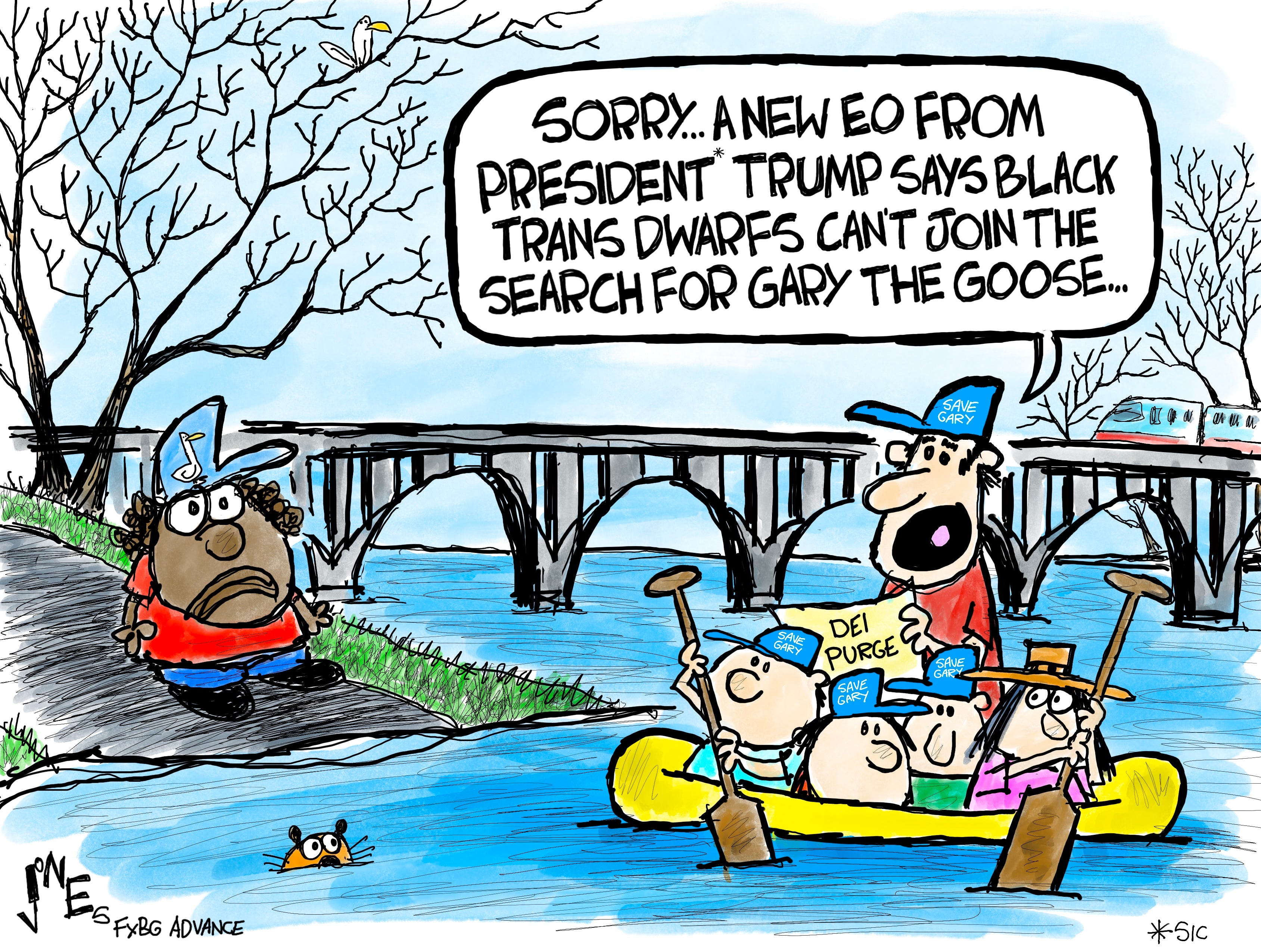
This is a local cartoon drawn for the FXBG Advance, which is looking into the ways Trump’s Executive Orders will affect the 540 region.
I think it’s funny when readers of mine who don’t live here mention Gary the Goose. A lot of people were making Gary the Goose the region’s mascot, but I wasn’t aware of that until he disappeared. Maybe he didn’t want the job and that’s why he left. Or, maybe he heard about Trump’s tariffs and planning to make Canada the 51st state, so he protested by flying back to Canada. Or, maybe when the otters came back, they said, “Beat it, Goose.”
Or maybe Gary, who got used to being around humans, paddled too close to the Stafford side of the river, which is full of yee-haw fuckers, and Gary the Goose’s goose got cooked.
Creative note: I was thinking last week that I needed to get the train bridge into a local cartoon. I also got a Rappahannock Otter into a cartoon. I asked my editor, Martin, if Gary was starting to get a little long in the tooth. Is he still relevant? He’s been missing for about a year, I think. We decided that if it’s funny, then we still go with it.
Also, a proofer didn’t get the cartoon and neither did a friend. I was like, whaaaaat?
Dear Laura: I got your check for a paid membership (anyone can do that), but I can’t find your email address. Please email me at clayjonz@gmail.com so I can get you up and running. We want your comments. I’m starting to think Gary the Goose will be found before we find Laura.
Another update: When I publish these cartoons for the Advance, I make sure to state on social media that they’re on local issues. I don’t get upset when readers who don’t live here don’t get the local cartoons. Why should you understand it? What does make me pull my hair out is when readers complain they don’t understand it even though I left a comment with the cartoon on social media that it’s on a local issue. Sheesh. Now if you do live here and don’t get it, that’s on me.
(From A: I got a big laugh, thinking about how dumb the Republicans are being about such things, especially due to actual human biology at conception.)
Attorney General Peter F. Neronha and 14 attorneys general today issued a joint statement to reaffirm their commitment to protecting access to gender-affirming care in response to the Trump Administration’s recent Executive Order. The coalition released the following statement:
“As state attorneys general, we stand firmly in support of healthcare policies that respect the dignity and rights of all people. Health care decisions should be made by patients, families, and doctors, not by a politician trying to use his power to restrict your freedoms. Gender-affirming care is essential, life-saving medical treatment that supports individuals in living as their authentic selves.
“The Trump Administration’s recent Executive Order is wrong on the science and the law. Despite what the Trump Administration has suggested, there is no connection between “female genital mutilation” and gender-affirming care, and no federal law makes gender-affirming care unlawful. President Trump cannot change that by Executive Order.
“Last week, attorneys general secured a critical win from a federal court that directed the federal government to resume funding that had been frozen by the Trump Administration. In response to the Court’s Order, the Department of Justice has sent a notice stating that ‘federal agencies cannot pause, freeze, impede, block, cancel, or terminate any awards or obligations on the basis of the OMB memo, or on the basis of the President’s recently issued Executive Orders.’ This means that federal funding to institutions that provide gender-affirming care continues to be available, irrespective of President Trump’s recent Executive Order. If the federal administration takes additional action to impede this critical funding, we will not hesitate to take further legal action.
“State attorneys general will continue to enforce state laws that provide access to gender-affirming care, in states where such enforcement authority exists, and we will challenge any unlawful effort by the Trump Administration to restrict access to it in our jurisdictions.”
Joining Attorney General Neronha in issuing this statement are the attorneys general of California, Colorado, Connecticut, Delaware, Hawaii, Illinois, Maine, Maryland, Massachusetts, New Jersey, New York, Nevada, Vermont, and Wisconsin.