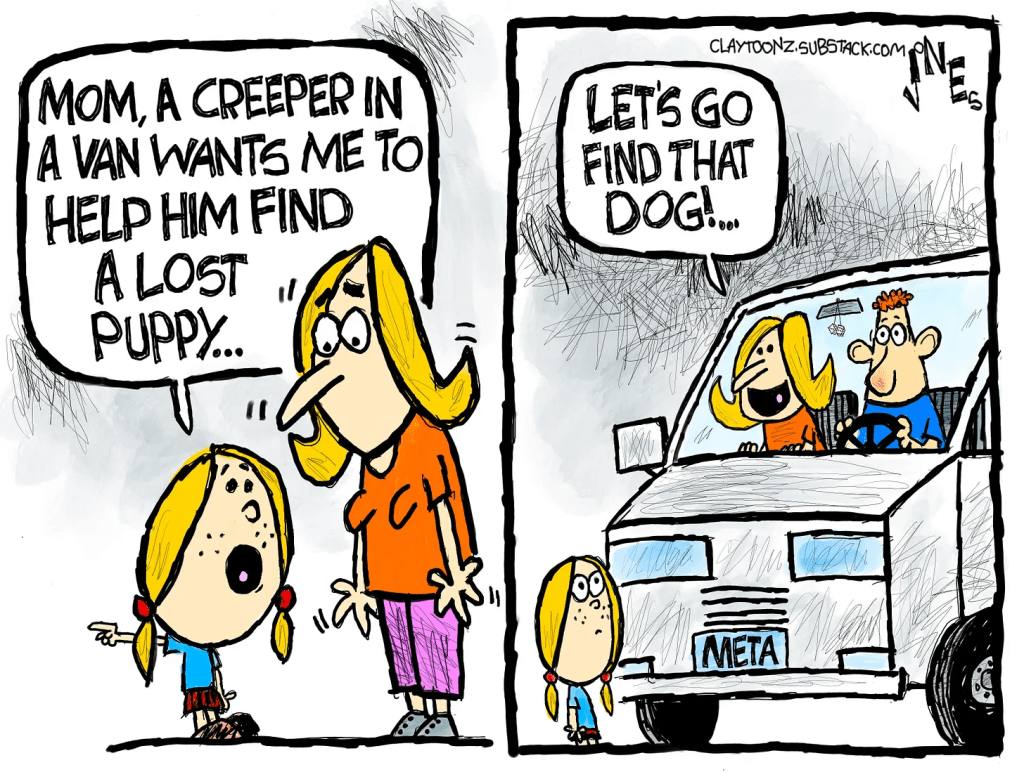
This is what working for the people, working for the public means. This is what representing the will of the people / public looks like. This is what is attracting the people / public voters to the democrats, yet Chuck Schumer as yet to endorse Mamdani. Why? Because the two are the opposite sides of the political coin. One wants to serve and represent the people / public and the other is a corporate democrat beholden to big money donors and major lobbyist groups. Same with Hakeem Jerofies who only endorsed Mamdani when on election night it became clear he would be the winner. Hugs
Josh Johnson2 days agoHi Friends, I wanted to share this with you a little early. I’ll be a guest on @ColbertLateShow this Wednesday. First time being interviewed on the show. To be a guest weeks before the show comes to an end feels really special. Thank you for being part of the reason this is happening.
Leading off: Very liberal Americans, who have rated the Democratic Party poorly relative to other partisans since 2024, have swung sharply back toward congressional Democrats over the last few months. A new poll also finds voters who dislike both parties now prefer Democrats by 31 points. These gains should reassure a party that has faced internal strife since Trump’s second term began, but look less due to renewed faith in the Democrats and more like anti-Trump consolidation. That might not matter for the midterms — a vote won is a vote won — but it will matter for 2028 and beyond.
On deck this week: Tuesday’s Deep Dive will cover some new research on the level of ideological thinking in the electorate and the value (or not) of ideological moderation by the Democrats, and Friday’s Chart of the Week will respond to whatever’s in the news. I’m also finalizing questions for our April Strength In Numbers/Verasight poll this week — so subscribers, send in your question recommendations if you haven’t already! (Email or comments are fine.)
On with the data.
1. Anti-Trump sentiment, not pro-Democratic enthusiasm, is uniting Democrats again
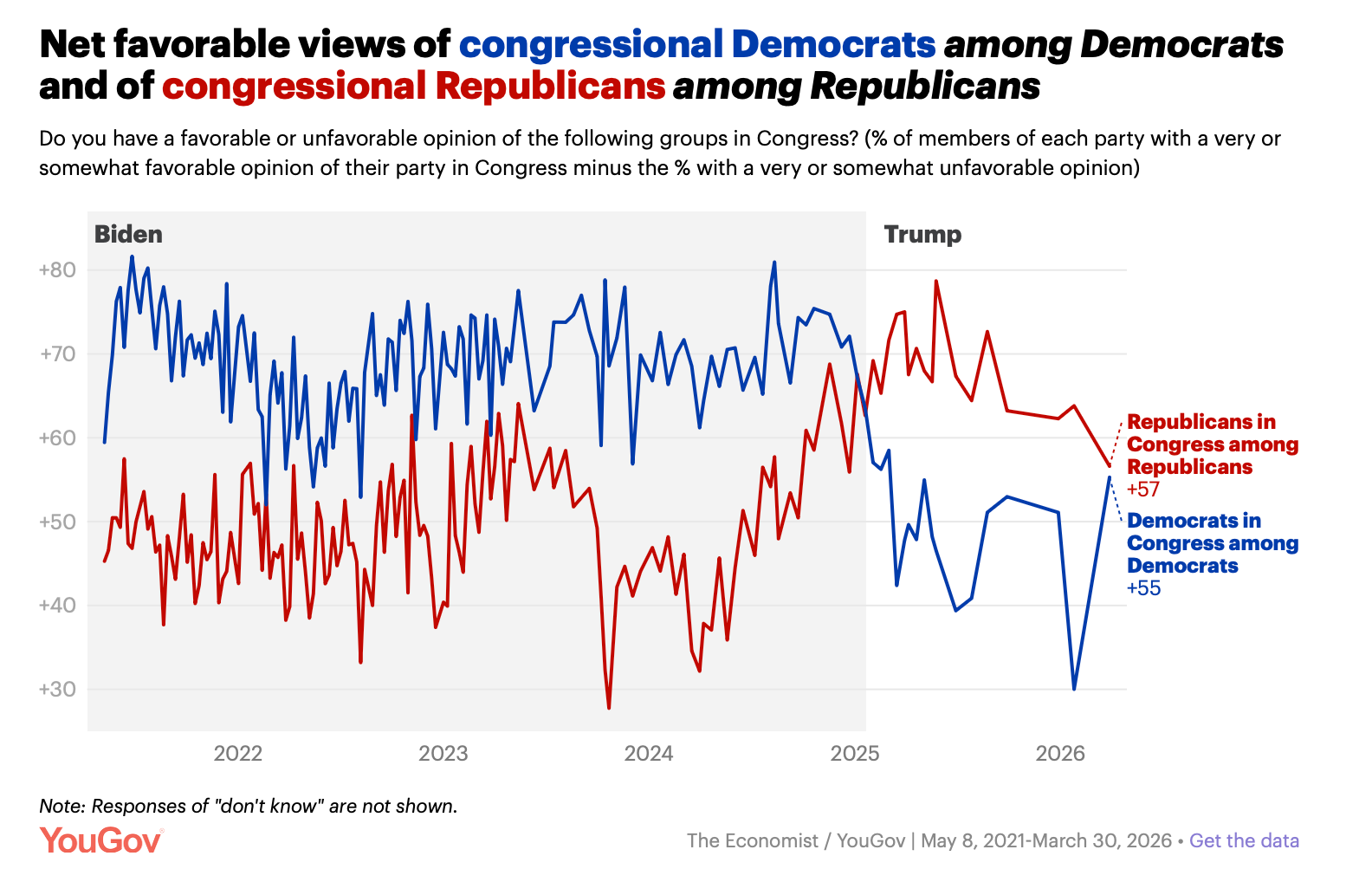
A new YouGov/The Economist poll, fielded from March 27 – 30, finds that Democratic voters have grown significantly warmer toward their members of Congress over the last few months. Earlier in 2026, Democrats said their party’s MOCs were favorable at a rate just 30 points higher than the rate they said their party was unfavorable. That gap has now grown to +55 — rivaling the favorability of Republican MOCs among Republican voters.
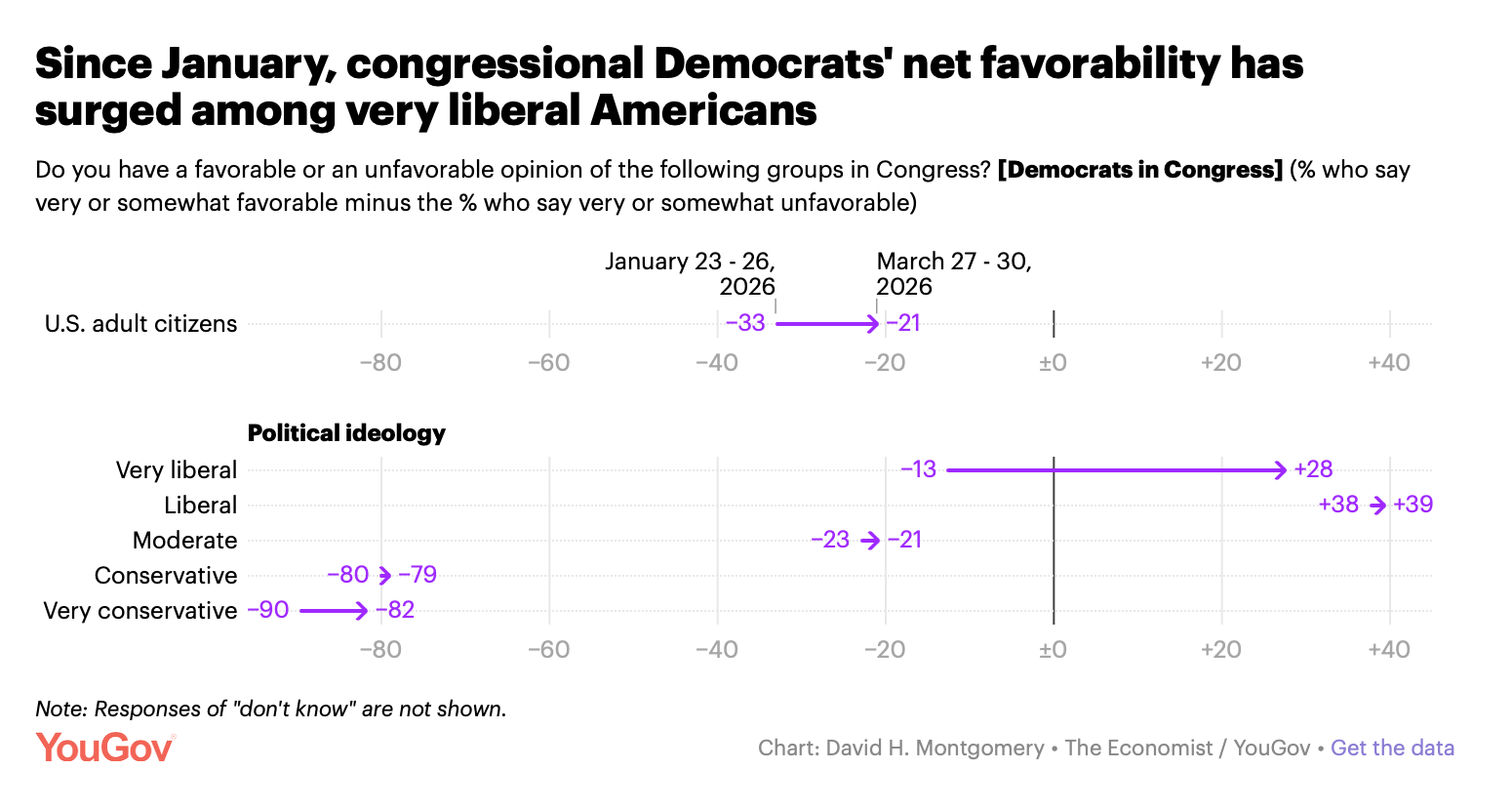
Aggregate Democratic views have increased because very liberal Americans have become sharply more favorable toward congressional Democrats since January. This group evaluated the party’s members of Congress favorably by a net +28 points margin — up from a -13 deficit in January. That’s a 41-point shift in two months:
Among Americans who are liberal but not very liberal, moderate, or conservative (basically everyone else), views of congressional Democrats barely budged.
Overall, U.S. adults give the Democrats a favorability rating of -21, 5 points higher than the rating they currently give Republicans.
That is a meaningful change. Last summer, Strength In Numbers documented that Democratic party favorability was unusually weak even as the party remained competitive on the generic ballot. We dug into the survey microdata and found out that this was because many left-leaning Americans were frustrated with their own side after the 2024 loss. Charles Franklin, who conducts the Marquette University Law School Poll, has been tracking the same dynamic in both national and Wisconsin polling. Among Democratic identifiers in Wisconsin, his data shows a net +56 favorability rating for their party, compared to +74 among Republican identifiers for the GOP.
Franklin finds that while Democrats still disagree about what they’re for, they are virtually unanimous in what they’re against: Donald Trump.
The simplest explanation for Democrats’ gains is that politically active party members on the left — who have had a lot of complaints about how the party is handling Trump 2.0 — are now responding to the same thing many other Americans are right now. That is, the president has moved public policy on many issue domains far to the right and up on the authoritarian axis (certainly far past the policy temperature “set point,” to use the language of the thermostatic model), and progressives are setting their differences with the Democrats aside for the moment as they focus on defeating an increasingly unpopular Republican president. This looks more like anti-Trump unity than pro-Democratic enthusiasm.
But it’s not just the base
The Democrats’ consolidation of left-wing liberalism is one piece of a broader backlash to Trumpism that shows up in the polling data right now. Another notable finding this week is from a new CNN/SSRS survey that found that about one-quarter of the public holds an unfavorable view of both parties. These are the so-called “double haters.” This group prefers Democrats on the 2025 generic ballot by 31 points.
This is a big deal for two reasons. First, that’s a massive shift; Double haters broke for Trump in 2016 and again in 2024. Now they’re swinging hard the other way.
Like Franklin’s polling, the CNN report also finds that Democrats’ gains are driven largely by opposition to the GOP, not enthusiasm for Democrats themselves. When asked what they dislike about Democrats, 22% of double haters called the party “do-nothing” and 11% said they aren’t standing up enough to Trump and the GOP, while 10% said they’re too liberal.
Will 2026 be a Democratic fake out?
So we’ve got two layers of anti-Trump consolidation happening at once. YouGov’s data shows the Democratic left is coming home, and the CNN poll shows voters who dislike both parties — a swing group that has been decisive in recent elections — are breaking heavily toward Democrats for the first time in years. Neither group is necessarily enthusiastic about Democrats. But both are currently heavily voting against Republicans. According to the CNN poll, 79% of voters who plan to support Democrats say their vote is a message of opposition to Trump. (Only 46% of Republican voters say they’ll vote to show support for the president.)
This could make for a big electoral win for Democrats in November, despite the division in the party and its overall nominally unpopular rating. According to CNN, Democratic-aligned voters are 17 points more likely than Republicans to call themselves “extremely motivated” to vote in 2026 — even though they’re 14 points less likely to view their own party favorably. Meanwhile, the Democrats have opened up a large lead in the U.S. House generic congressional ballot for 2026. They are up +6 in both the CNN and YouGov surveys, and closer to +5 on average.
This is the pattern I’d expect in a midterm environment that favors the out-party. But with many Americans (including the vaunted “double-haters”) still viewing the Democrats as weak and ineffectual, a big electoral victory will not completely solve their deeper problems of identity and division.
The trend in this data is good for the Democrats, in other words — but don’t misread a positive trend for a positive level.
2. What Strength In Numbers published last week
Readers of Strength In Numbers got three articles last week — a lighter load, since I was out sick Monday and Tuesday.
This week’s Deep Dive asked a question I’ve been getting a lot lately: if Trump is 20+ points underwater, why aren’t Democrats leading the generic ballot by 20?
I wish! 😄 Leading Kansas writes this time in regard to data centers, and about addressing our local governments in our own behalf.It works the same in every state.
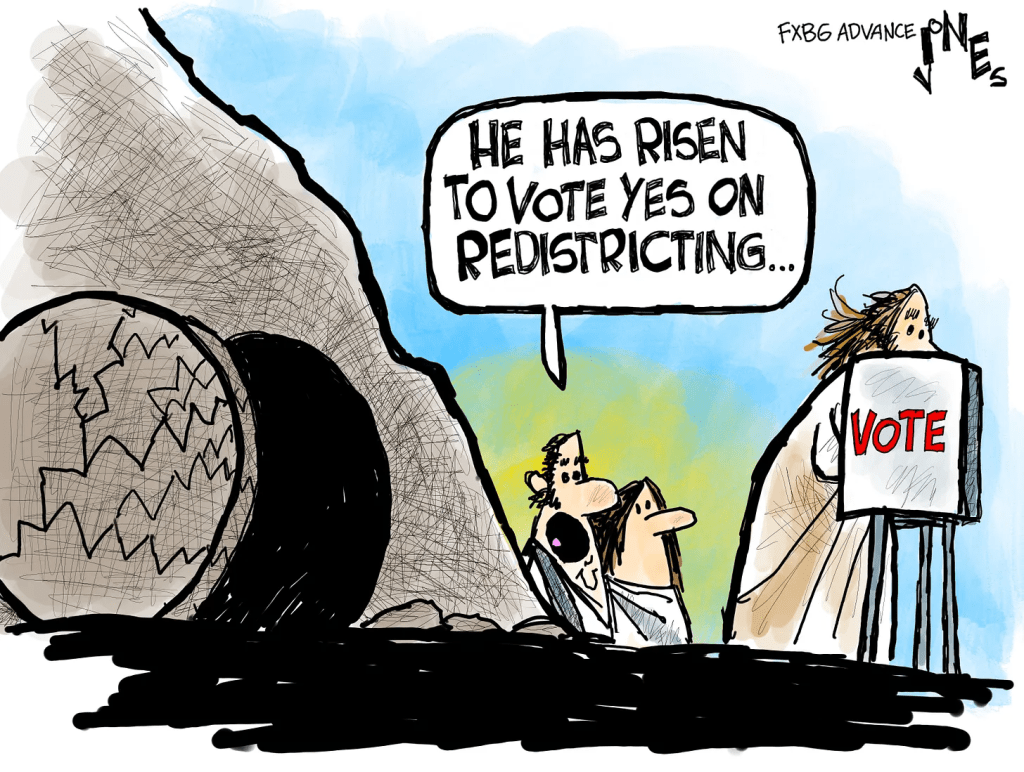
This cartoon was drawn for the Fredericksburg Advance. But don’t yell at them for it; you can yell at me.
If you live in Virginia, you have been bombarded with flyers about the special election on redistricting. And it’s not just flyers but also TV commercials, which are also popping up online. We are getting these things from both sides.
There is a special election in November on a state constitutional amendment that would give Democrats as many as four seats in Congress. The measure would also temporarily bypass the state’s redistricting commission to redraw maps in the middle of the decade.
The state’s Supreme Court approved the measure to be on the ballot less than a week before early voting began. State Republicans repeatedly tried to stop Democrats from moving forward with the referendum. The irony here is that Republicans claim that voting yes will disenfranchise voters, while they literally tried to keep this off the ballot so people couldn’t vote on it.
This is a direct response to Donald Trump and Republicans redistricting mid-decade to give themselves more seats. Donald Trump even said he was entitled to have more congressional seats. This is one reason why we need to No Kings protest. Donald Trump already believes he’s entitled to win elections he’s lost. (snip-MORE, and it’s on point)
Energy company Deep Fission is in the process of building a new and untested type of underground nuclear reactor in Parsons, KS
The Trump administration has reduced regulations to encourage nuclear power production
The reactor will likely power data centers for artificial intelligence
Large data centers consume huge amounts of water and energy and produce different types of pollution, leading to health risks for nearby residents
In November 2025 a two-year-old energy company called Deep Fission broke ground in Parsons, Kansas. They hope this project will enable them to install the second ever energy producing nuclear reactor in the state, after Wolf Creek, potentially with more reactors on the way in the future. If the early “characterization” drilling goes to plan, they claim the reactor could begin pumping electricity into the grid in the near future.
Parsons is a city of 10,000 in southeastern Kansas, near the Oklahoma border. I’ve lived in Kansas for most of my life and I had not heard of Parsons until last week. So, why is Deep Fission in Parsons, Kansas, and why now? Not coincidentally, the Great Plains Industrial Park, also located in Parsons, has lately been advertised as a prime location for new data centers to power the trillion-dollar (yes, trillion with a T) artificial intelligence boom forced upon us by large technology corporations and their venture capitalist backers. Which means the Parsons nuclear reactor project would likely come as a package with one or more new data centers, along with potential economic prosperity and a host of legitimate concerns that community members have already raised.
Part 2: The New Nuclear Power
While the Department of Energy set a goal for the Parsons reactor to go online in July of this year, Deep Fission themselves are aiming to connect to the grid by 2027 or 2028. Two years is still an unusually rapid rollout for a nuclear power plant, which usually takes 6-10 years from groundbreaking to full operation.
Nuclear energy is typically labeled as “clean” energy compared to coal, oil, and natural gas, meaning that it releases fewer pollutants into the air and water than fossil fuel consumption. Still, there are two main concerns. First is the disposal of nuclear waste, which ranges from the lightly contaminated clothing of plant workers to the lethally radioactive spent fuel a plant produces over time. This latter “accounts for just 3% of the total volume of waste, but contains 95% of the total radioactivity.”
A relatively new method in the US and Europe for disposing of our most dangerous nuclear waste is to bury it very deep underground, so that it can be surrounded by solid rock to provide the same level of pressure containment as required at structure at a surface nuclear reactor facility. The father-daughter team that eventually founded Deep Fission originally created Deep Isolation to dispose of nuclear waste. Deep Fission takes their concept a step further by placing the entire reactor, and therefore its most dangerously radioactive elements, into a borehole drilled one mile underground.
The second main concern related to nuclear energy production is, of course, accidents or attacks. It is true that large-scale nuclear accidents are very rare, but when they happen, they become instant, globally recognized disasters whose names we all know: Chernobyl, Three Mile Island, Fukushima. The effects are so widespread as to be practically impossible to quantify. The reactor explosion and meltdown in Chernobyl, for example, caused several dozen deaths directly related to radiation exposure, but various studies have predicted anywhere from thousands up to a million eventual additional cancer deaths. Not to mention the environmental and economic cost to the entire region around Chernobyl. And radioactive boars still terrorize people and farmland in the region around the Fukushima plant in Japan.
But those issues are known, and regulations have historically attempted to shore up potential dangers posed by new plants. In contrast, nothing like the underground nuclear reactor in Parsons, Kansas has ever been attempted before, and thanks to Executive Order 14301, will not need to go through long established design and testing phases that other types of nuclear reactors have been subject to in the past. John Young, a mining environmental regulatory specialist who lives in Sedgwick County, asks, “Why abandon the current regulatory process for something created out of whole cloth with no public input? And no one can define the current regulatory pathways for Federal and State authorizations.
“What,” Young asks in frustration, “could possibly go wrong?”
Part 3: Data Centers and Artificial Intelligence
So that is a glimpse into the nuclear energy side of things. Next we must address concerns around data centers and artificial intelligence. Data centers come in different sizes, like the smaller center being proposed in Wellington, KS, which would reportedly “use roughly 30% of the city’s electrical capacity while generating an estimated $1.3 million in annual electric utility revenue” while consuming only two gallons of water per day. Larger data centers consume resources less modestly. “Around the country, and the world, there is a land race among the big tech companies for sites for their data centers,” claims a November 2024 investigative report by Rolling Stone. Data centers are much newer than nuclear energy technology, yet the ways in which they harm communities near them have already become apparent.
Water: “Large data centers can consume up to 5 million gallons per day, equivalent to the water use of a town populated by 10,000 to 50,000 people,” according to a June 2025 study by the Environmental and Energy Study Institute (EESI). And data centers built explicitly to power AI represent the fastest growing portion of the market.
Last year, researchers at the University of California, Riverside calculated that ChatGPT—one of several popular Large Language Models (LLMs) vying for marketplace dominance—answered about 10,000 queries per second. The processing load to do so guzzled about 6,000 liters (or about 1,000 toilet flushes) of fresh water per second, all day, every day. That is only generating written text. AI photos require more water, and still more for AI video. “The extraction process is permanent,” explains the University of Alabama at Birmingham Institute for Human Rights. Water used to cool data centers evaporates as it cools hot components, meaning it can no longer be used by people in the region who need water for drinking, cooking, bathing, laundry, and general survival.
Pollution: Unfortunately, it is not only consumption of water to worry about. The evaporation of water cooling data centers leaves behind higher concentrations of nitrates and other contaminants leaked through agricultural fertilizers and pesticides into local water supplies, drastically increasing incidents of “rare cancers, muscle disorders, and miscarriages” among people who live nearby. Geographically, Parsons, Kansas sits atop the Alluvial and Ozark Aquifers.
Reports of noise pollution have increased near data centers as well. Residents in different Virginia towns experienced disturbing high and low frequency humming in a wide radius around two new data centers.
These same experts predict that the disempowerment will not only come at the individual level, but also at the societal level, as lawmakers turn their attention and favor even more toward tech companies and AI services that increasingly take over tasks that used to be performed by human beings.
The purpose of this article is not to overwhelm with doomsaying or inevitability. If the Deep Fission underground reactor works as advertised, it could genuinely provide cleaner energy than fossil fuel and mitigate some of the effects of climate change. But to get there safely, we need to demand transparency and regulatory protections from political and corporate leaders. If enough of us speak up in place like Parsons, Topeka, Sedgwick County, and every corner of our town, state, country, and world, we embolden those watching, each other, and ourselves to continue building the world we want and deserve.
Rev. Barber: We have to start teaching people that when we talk about politics, there is not an aspect of your life—from your birth to your death—that is not impacted.
When we look at the midterm elections, we have to start with the basics. We are electing every member of the United States House of Representatives and one-third of the United States Senate. In most places, we are electing their entire state general assemblies, and many are electing governors, attorney generals, and so forth. We are electing the very people who impact every aspect of our lives. These elections determine whether we will have people in office who want to ensure everyone has health care or who want to take health care away; whether we want people in office who will vote to make sure everyone is paid a living wage versus just giving more money to corporations; whether they will care about poor and low-wage voters and the resources for people to afford a basic life, or whether all they will care about is giving more wealth to the already wealthy. That is what’s on the line.
Rev. Dr. William Barber, co-chair of the Poor People’s Campaign speaks at the Poor People’s Campaign: A National Call For Moral Revival Rally at the US Supreme Court on October 27, 2021 in Washington, DC. (Photo by Jemal Countess/Getty Images for Repairers Of The Breach)
What is at stake is whether or not you have a Congress that will demand that the President, whoever that President is, cannot just act unilaterally, but must get congressional approval for war; whether or not we have a budget; whether or not TSA agents are paid; whether or not government employees are paid; whether or not we have a Congress that will stand up and not just be a rubber stamp to what an authoritarian President wants to do or will just “go along to get along.”
We have to start teaching people that when we talk about politics, there is not an aspect of your life—from your birth to your death—that is not impacted. You’re not officially recognized without a birth certificate, which is the result of a political decision. You can’t guarantee your Medicaid, Medicare, or Social Security without political decisions. Even as you die, people must understand that politics is not just about personality; it’s about people being put in place and the kinds of policies and vision they will enact.
Rev. Dr. William J. Barber II, is a Professor in the Practice of Public Theology and Public Policy and Founding Director of the Center for Public Theology and Public Policy at Yale Divinity School. He serves as President and Senior Lecturer of Repairers of the Breach, Co-Chair of the Poor People’s Campaign
Jeff Tiedrich uses blue language. It’s easily ignored if you don’t care for blue language; this is some great coverage of yesterday.Also, Bluesky posts don’t embed easily on WP, so really, this is better on the page. Just click on the link directly below. It’s also mostly here, but you’ll have to click on the Bluesky posts to see the excellent photos; they didn’t embed.
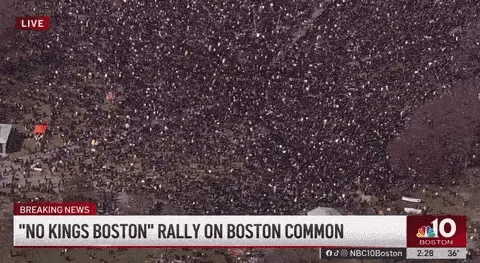
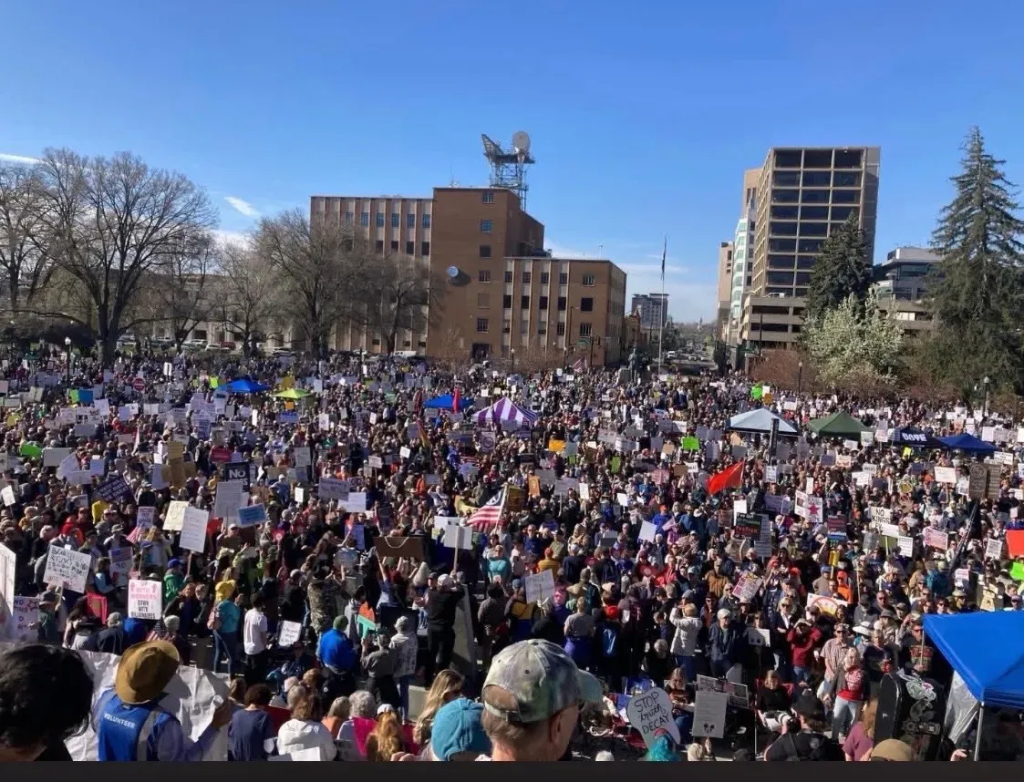
over eight million of us gathered peacefully coast to coast, to rise up as one and convey a singular message: fuck you, you fucking fuck — you’re not our king.
wait, did I say coast to coast? no, it was the entire world telling Donny Convict to fuck straight off.
(just click the link to see the post on Bluesky. How it works, I guess. -A)
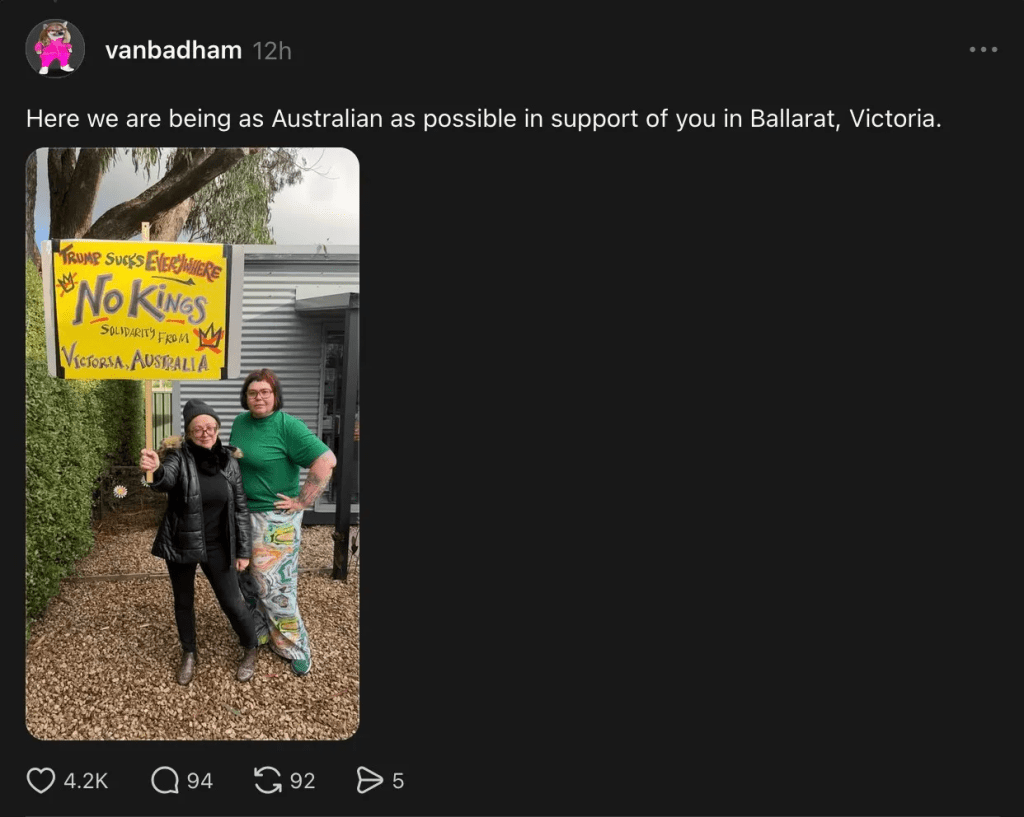
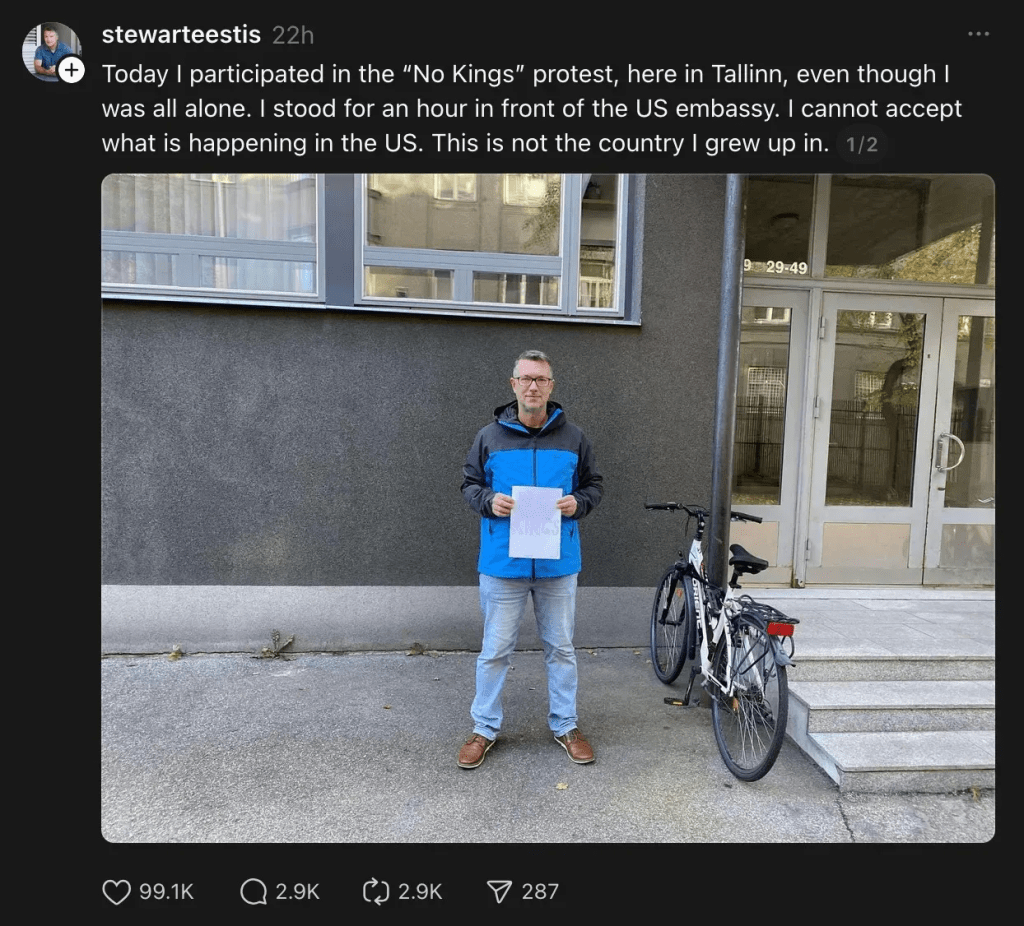
HAPPENING NOW: A HUGE crowd has gathered in London, England for a protest against the far right in coordination with the No Kings day protests in the US
In 1789, furious protesters stormed the Bastille in Paris. This marks the start of the French Revolution that put an end to the highly corrupt, rotten regime of aristocrats and the ultra rich. Yesterday, thousands joined a #NoKings protest at the Bastille.
“I’m so proud of you. you chased out of this state pure evil. you chased them out. you chased out the fun-size fascist Greg Bovino. you chased out that evil Kristi Noem. Kristi Noem is so evil, I’m starting to think that that dog took his own life. just couldn’t take it. ‘is this my future? I need to get out. I’m taking the goat with me.’”
while millions of people were protesting the fucked-up reign of Mad King Donny, CPAC couldn’t even fill one small room. look at this clownfuckingly pathetic display.
it’s as if Sad Trombone became a real political party.
great optics, you guys. bravo. ten out of ten — no notes.
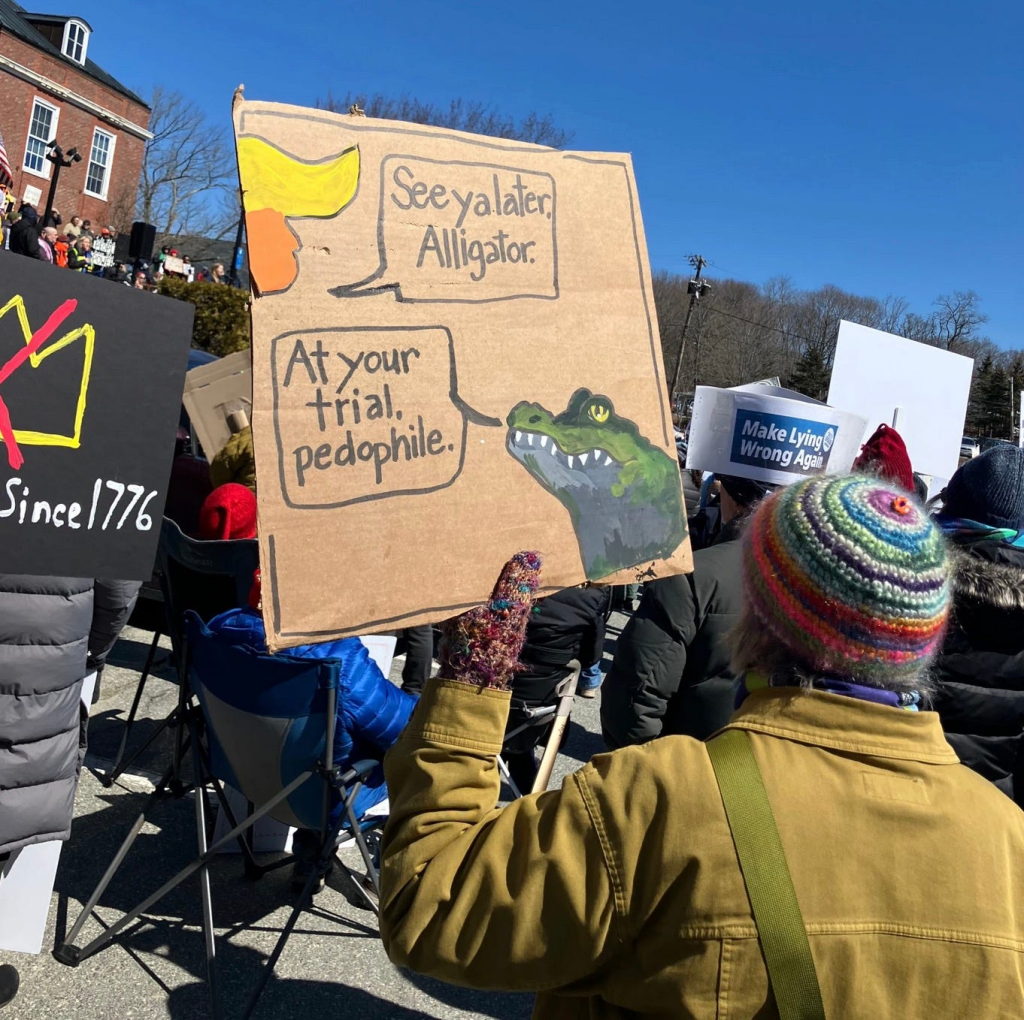
fuck those fucking fucks. let’s go out with a bang. here are some of the best protest signs from around the country.
(Just go see it all. You’ll be sorry if you don’t!)Snip
and finally, once again, our unknown poet laureate from Ellsworth, Maine.
as for Sundowning Grandpa Bugfuck, he was unusually silent — and nowhere to be seen. there were none of his usual protest-day batshit meltdowns on the feed of his crappy app. he couldn’t even be bothered to post AI slop of himself shitting on protesters, as he did last October.
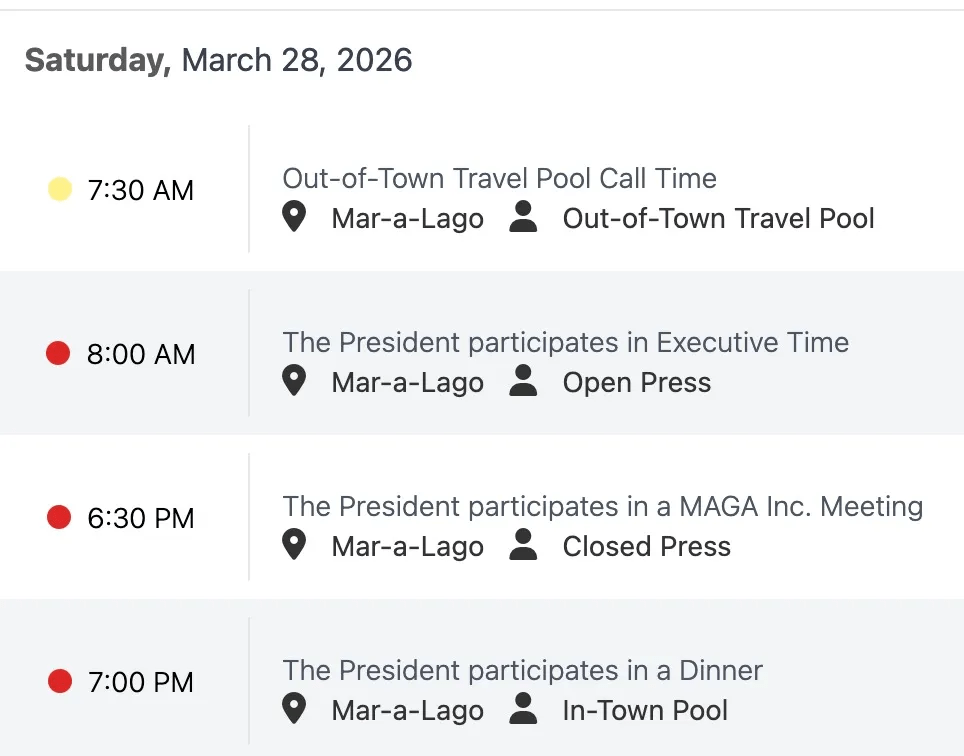
he just spent the day holed up in Motel-a-Lago. according to his official schedule, the lazy fuck didn’t even bother to cheat at golf.
I’ve got a news flash for you, Donny: America is sick of you. aside from your brain-dead cultists who are too fucking stupid to understand what’s going on, nobody voted for this shit.
nobody voted for the historic and stately East Wing to be demolished so that you can replace it with some vulgar Epstein Dance Hall™ — and speaking of your dead pedo bestie, nobody voted for the continuing cover-up of a massive pedophile ring.
nobody voted for off-the-charts corruption and greed.
nobody voted for masked ICE thugs teargassing children, and murdering anyone who looks at them funny. nobody voted for innocent immigrants to be disappeared off the streets and shipped off to far-away slave-labor gulags.
nobody voted for the price of everything continuing to skyrocket — especially when you promised bring all that shit down on Day One.
nobody voted for our allies to be insulted and ignored, or for Ukraine to be thrown to the wolves, or for Greenland to be perpetually harassed, or for Venezuela to become a vassal state.
and nobody voted for an unwinnable clusterfuck of a don’t-you-dare-call-it-a-war in Iran — certainly not one that shut down the Strait of Hormuz, destabilized the entire Middle East, and sent the price crude through the roof.
guess what, Donny: you’re such a loathsome piece of shit that over eight million people took to the streets yesterday to deliver this singular message: fuck you, you fucking fuck — you’re not our king, and you never will be.
and, I hope, NOT misogynist. The other Dem candidate still has some answering to do in regard to that. That being said, he’d still be better than Susan Collins.Emphasis below is mine.
On Monday, days after Republican Sen. Susan Collins voted in favor of an amendment to Trump’s SAVE Act that would ban transgender students from girls’ sports nationwide, Maine Gov. Janet Mills—who is running in a Democratic primary to unseat her—came out with a forceful statement in favor of transgender youth in sports. Mills was asked about her position on a new ballot referendum that will likely go before voters this November—which would ban transgender girls from sports, bar transgender students from bathrooms in schools across the state, and carve transgender students out of the Maine Human Rights Act in certain cases. It is Mills’ first time directly opposing the referendum, and a significant case of a Democratic candidate running for a swing seat standing up for transgender people.
“I would not support a ballot measure that demonizes children and demonizes and uses as a political ploy, as the Republicans have done, the right-wing Republicans have done, with this kind of initiative. It targets some of the most vulnerable people in our society,” Mills said at a press conference. “I brought up five daughters in Maine. They all played sports. They should all have an opportunity to play sports. My husband was a coach, a high school coach, and I saw, I always saw in the eyes of those kids, new energy, new feeling about life, a new way to engage in teamwork, to make new friends, and that’s what sports does—gives you a different perspective on life, makes you a better human being.”
Her statement was in response to a referendum from “Protect Girls Sports in Maine,” an anti-transgender organization funded by far-right Republican megadonor and billionaire Richard Uihlein, of Uline office supplies, who donated $800,000 to bankroll the signature drive. The referendum successfully collected enough signatures to appear on the ballot this November. It would define sex for school purposes as “a person’s biological status as male or female recorded at birth on the person’s original birth certificate”—a definition that would bar transgender students’ legal recognition. It would require schools to “maintain separate restrooms, locker rooms, shower rooms, and other private spaces for each sex,” going beyond sports, and would create a transgender sports ban across the state. It would also create a private right of action allowing individuals who encounter transgender students in bathrooms to sue the school that permitted their access—while carving all of these provisions out of the Maine Human Rights Act.
This is not Mills’ first foray into the fight over transgender athletes. In February 2025, Trump singled out Maine at a meeting with Republican governors, threatening to pull federal funding unless the state banned transgender girls from girls’ sports. The next day, Mills confronted Trump at the White House, telling him, “See you in court.” What followed was an unprecedented federal pressure campaign: six federal agencies launched investigations targeting the state—all over a handful of transgender athletes out of roughly 53,000 high school sports participants statewide. When Maine refused to comply, the Department of Justice sued the state in April 2025—that lawsuit is still ongoing.
Mills’ stance in support of transgender athletes is a notable position for a Democratic governor running for a purple Senate seat in an era where well-funded political pundits and organizations have aimed to push Democrats to the right on transgender issues. Her approach stands in stark contrast to that of fellow Democratic Governor California Gov. Gavin Newsom, a likely 2028 presidential contender, who has repeatedly thrown transgender people under the bus. In March 2025, Newsom told conservative activist Charlie Kirk on the debut of his podcast that trans participation in girls’ sports was “deeply unfair.” And just weeks ago, in an interview with Katie Couric, he said he could not see a way for trans women to fairly compete on women’s sports teams—while insisting he was not throwing the community under the bus. Mills, by contrast, is running toward the issue rather than away from it, and doing so in a competitive seat.
Mills, who is term-limited and cannot run for a third consecutive term as governor in 2026, is running against fellow Democrat Graham Platner for the chance to unseat Collins. Platner, for his part, has also been ardently pro-transgender rights. He opposed the referendum as early as November 2025, telling NOTUS that it “targets transgender kids and takes Maine backwards.” After Collins voted for the Tuberville amendment this weekend, Platner criticized her on social media, writing, “At a time when Mainers are dealing with rising gas prices and airport chaos, this is what she’s focused on—attacking kids and taking away your right to vote.” Of the referendum itself, Platner has said, “I think banning people from playing in sports in the gender that they see themselves as and identify as, doing that in a wholesale way, is going to be restrictive of people’s rights. So, I do not think that banning is the answer.”
The Maine Democratic primary is June 9, with the winner facing Collins in the November general election—the same ballot where voters will likely decide the fate of the anti-trans referendum. That means the fight over transgender rights in Maine will play out simultaneously on two tracks: the Senate race, where both Democratic candidates have now staked out firm positions in defense of transgender youth, and the referendum. How both play out could reshape the political calculus around transgender issues for Democrats nationwide.
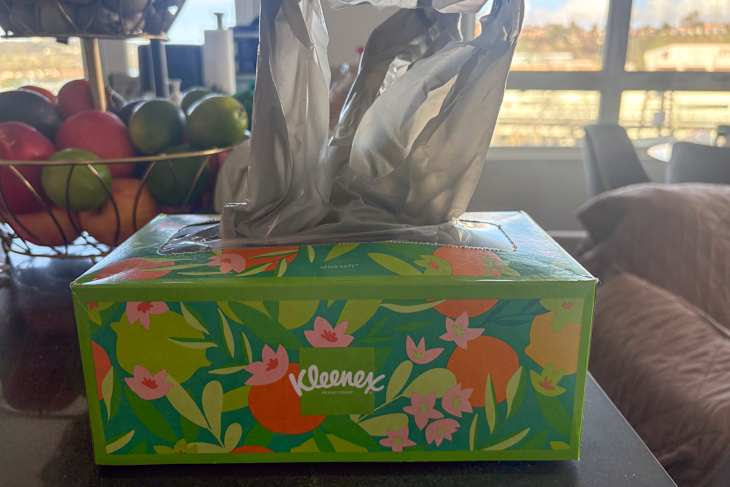
Here’s how I repurposed my empty tissue box as a plastic grocery bag dispenser in a few easy steps:
Take a plastic shopping bag and stuff it horizontally into the tissue box with the handles sticking out of the slit on top.
Grab another plastic bag and weave it through the handles of the bag sticking out of the box, then stop once it’s about three-quarters the way through.
Stuff both bags into the box, with the handles of the second bag sticking out again like you had before.
Repeat the process until all of the plastic bags are in the box (I was able to fit about 12 bags in mine!)
Gently pull a bag out of the box when you want to use it, just like a regular Kleenex box! Follow steps 1 through 4 to refill when you have more bags to store.
(I don’t care for twangy folk music that would be country&western if it wasn’t U.S. Folk music, but. I have high regard for Woody Guthrie, really like the lyrics of this song, and Bette Midler covers it well, updating lyrics a bit while retaining its folk integrity. Thanks, Ten Bears!)
Emily Gregory defeats Republican Jon Maples in district that is home to US president’s Palm Beach estate
Democrats managed to flip a seat in the Florida state house in the district that is home to Donald Trump’s Mar-a-Lago.
Emily Gregory, a Democrat, defeated Republican Jon Maples, who had an endorsement from the US president, in the special election in Florida’s 87th state house district. The Associated Press called the race on Tuesday evening, with Gregory, a public health expert and small business owner, leading by more than 2 percentage points.
The Republican who previously held the seat had won by 19 percentage points in 2024.
Trump voted in the race via mail-in ballot, despite criticizing the practice as “mail-in cheating” during an event in Tennessee this week. The president has long attacked voting by mail, describing it as a scam and arguing it creates fraud in elections. He still opted to vote by mail in the race although he was recently in Palm Beach, where early in-person voting was under way until Sunday.
The president had urged voters to back Maples, a financial adviser who describes himself as an “America-First patriot”. Maples had faced scrutiny in recent weeks over allegations that he did not live in the district in which he was running, claims that he denied.
Democrats have said that Gregory’s win shows voters frustrated over rising costs are moving away from Trump and the Republican party.
“Mar-a-Lago just flipped red to blue, which should have Republicans sweating the midterms,” Heather Williams, the president of the Democratic Legislative Campaign Committee, said on social media. “A Trump +11 district in his own backyard shouldn’t be in play for Democrats, but tonight proves Republicans are vulnerable everywhere.”
State Democrats have flipped 29 districts since Trump’s election, Williams said.
314 Action, a political committee that works to get Democratic scientists elected to office, had endorsed Gregory and praised her win, writing in a statement that “a Stem wave is coming”.
“Emily won because Floridians trust her to make decisions based on evidence not ideology,” said Shaughnessy Naughton, the group’s president. “She’s bringing science back to the state house and heading to the [state] capitol on a mission to lower costs, restore healthcare and bring down the temperature in Tallahassee.”