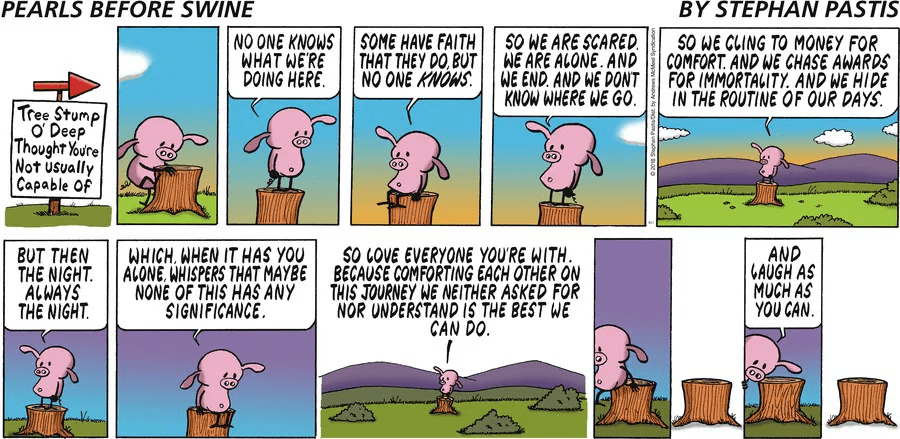
https://www.gocomics.com/pearlsbeforeswine/2025/09/21

FWIW.
| September 21, 1963 The War Resisters League organized the first American anti-Vietnam War demonstration in New York City. The League, founded in 1923, was the first peace group to call for U.S. withdrawal from Vietnam, and played a key role throughout the war, organizing rallies, the burning of draft cards, civil disobedience at induction centers, and assisting resisters. History of WRL  WRL home |
September 21st (since 1982) The International Day of Peace was established by United Nations resolution in 1981 and first celebrated in 1982 (then as the 3rd tuesday of the month). Events are planned all over the world to promote peace and make it more visible. About Peace Day and plans around the world |
Because it doesn’t hurt to know a little about these things, too.
In the news of the week ending September 19, 2025, are lots of profanity, a stone skimming scandal, and saying goodbye to Robert Redford.
If I ever win the lottery, remind me to save and invest the money.
Every time I put down an ant trap, a mouse comes in overnight and takes it away. What are they doing with them?
I love prescription medication commercials that say “Tell your doctor what medications you’re taking.” Shouldn’t my doctor know that already?
Could you eat an entire meal at a restaurant without your phone? That’s what you have to do at the new eatery Hush Harbor in Washington, D.C., which doesn’t allow cell phones. They will supply you with letter-writing materials and board games though!
Life advice: Try not to be the type of person who would go on a reality show.
Kids, what if I told you that in the 1960s and ’70s, companies embedded vinyl records on the back of cereal boxes? It’s true!
If I put down mouse traps, will a larger animal come into the house overnight and take those?
Why do things have to change?
Massachusetts is currently in the process of picking a new state flag and a new state seal. The old ones were perfectly fine but I guess they’re no longer appropriate for modern times. Or something.
Unfortunately, the finalists are TERRIBLE. The seals are passable, I guess, but the state flag choices are a mayflower (the flower, not the ship), a mountain with a gold star on top, and a circle of turkey feathers.
Writer Matt Taibbi thinks the state should run with the turkey idea but maybe in a Norman Rockwell direction.
Some people have joked that the new flag should be the colors of Dunkin’ Donuts, and compared to the finalists that might not be a bad idea.
I have a theory that everyone swears. They may not do it all the time and they may even pick the mildest of curse words. But everyone from the ages of 9 to 90 does it.
The New York Times thinks so too. The writer, Mark Edmundson, grew up in the 1950s and ’60s when cursing was relatively rare. And the people that swore were almost always guys (only never in front of a parent, teacher, or cop). But it’s everywhere now, from homes to schools and on television. I’m still sometimes shocked by what the basic cable channels can get away with now.
We try our hardest to leave out certain words in the pages of the Post, and if you leave a comment, please try to control yourself as well.
“Cheating Scandal Rocks World Stone Skimming Championships”
Robert Redford starred in many classic films, including All the President’s Men, Butch Cassidy and the Sundance Kid, The Way We Were, The Sting, Three Days of the Condor, Captain America: The Winter Soldier, The Candidate, and many other movies and TV episodes. He was also a director, helming Ordinary People (for which he won an Oscar), Quiz Show, and A River Runs Through It. He died Tuesday at the age of 89.
Here’s the Post’s Bill Newcott on Redford’s career.
Bobby Hart was half of the music duo Boyce & Hart. They not only recorded their own music, they wrote and produced songs for The Monkees, including “Last Train to Clarksville” and the theme song to the show. They also wrote “(I’m Not Your” Steppin’ Stone,” “Come a Little Bit Closer,” and the theme song to Days of Our Lives (!). He died last week at the age of 86.
Here’s Boyce & Hart on a classic episode of I Dream of Jeannie (they also made an appearance on Bewitched around the same time).
Uploaded to YouTube by Willy Gilligan
Patricia Crowley starred in the TV series Please Don’t Eat the Daisies and played Mary Scanlon on Port Charles. She appeared in dozens of other TV shows and films. She died Sunday at the age of 91.
Thomas Perry was a writer of bestselling thriller and suspense novels. He died Monday at the age of 78.
Marilyn Hagerty achieved fame at the age of 85 when her newspaper restaurant review of Olive Garden went viral. She was championed by Anthony Bourdain, and he even published a collection of her columns, titled Grand Forks: A History of American Dining in 128 Reviews. She died Tuesday at the age of 99.
Ricky Hatton was the former world boxing champion. He died Sunday at the age of 46.
Here’s how Taft’s bid for a second term made for a chaotic 1912 election.
This was a big day for the debuts of classic shows. Lost in Space, Green Acres, I Spy, The Big Valley, and Gidget all started on this day in 1965.
It was actually a big week for debuts. Other shows that launched this week in 1965: I Dream of Jeannie, Hogan’s Heroes, F Troop, The Dean Martin Show, and The Wild, Wild West.

That woman has a lot of hands.
You can use your own hands to make these recipes with those fruits and veggies.
Smitten Kitchen has Broccoli Parmesan Fritters and a Cranberry-Walnut Chicken Salad. Jellojoy has a Jello Fruit Cake, while Martha Stewart has Boiled Asparagus. The Pioneer Woman has a recipe for something called Melting Potatoes, and Allrecipes has Copycat Cracker Barrel Fried Apples. Iowa Girl Eats has this Marinated Vegetable Salad, Love & Lemons has Roasted Brussels Sprouts, and Dance Around the Kitchen has Banana Pudding.
All these recipes sound $%&*! great!
If you’re keeping track, it happens at 2:19 p.m. ET. (It also starts at that time even if you’re not keeping track.)
This, is, the, day to celebrate? periods, Commas; Exclamation “points” and other … forms of punctuation!!!!
The annual U.S. vs. Europe golf event takes place at Bethpage Black in Farmingdale, New York. Here’s the broadcast schedule.
Hacks star Hannah Einbinder ended her Emmys speech with choice words for Donald Trump’s secret police force and some solidarity with the people of Palestine.
I love all his work, including boosting the indies, and preservation/conservation of U.S. natural resources. I can’t pick a favorite, but the first movie I saw with Robert Redford in it was “Inside Daisy Clover.” He was a genius in that, and in all that he did. This is a pleasant tribute. (And Newman’s Own products are actually high quality, and quite good; beloved by both human and pet.🌞)
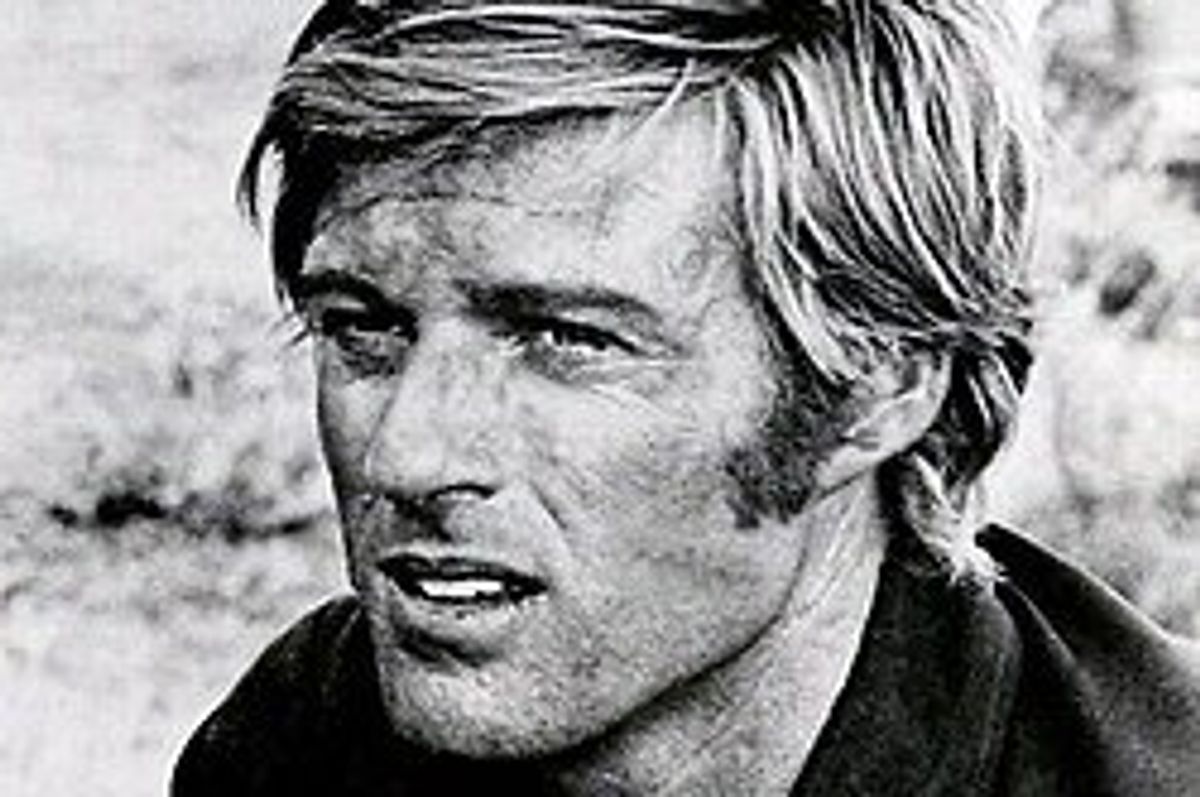
A photo of Robert Redford.
Robert Redford was many things to many people: husband, father, heartthrob, Oscar-winning actor, trailblazer. But to fellow actor Paul Newman, he was both co-star and dear friend.
When Newman passed away in 2008, Redford wrote a touching tribute to him for Time Magazine.
“I first met Paul Newman in 1968, when George Roy Hill, the director of Butch Cassidy and the Sundance Kid, introduced us in New York City,” Redford wrote. “When the studio didn’t want me for the film–it wanted somebody as well known as Paul–he stood up for me. I don’t know how many people would have done that; they would have listened to their agents or the studio powers.”
One of their most powerful connections was laughter. “Whenever he’d make a mistake on set, he would enjoy it more than anybody,” Redford wrote. “I’d look at him, and he’d look at me, and I’d say, ‘You’re not fooling anybody. You’re not staring at me intensely; you’ve lost your line.’ And he’d roar with laughter.”
Redford shared their heartfelt pranks: “We played lots of pranks on each other. I used to race cars, and after he took this rare Porsche I owned for a drive, he began to get into racing. He had incredible reflexes, and he got really good, but he talked so much about it that I got sick of it. So I had a beaten-up Porsche shell delivered to his porch for his 50th birthday. He never said anything, but not long after, I found a crate of molten metal delivered to the living room of my (rented) house. It dented the floor. I then had it turned into a really ugly sculpture and dropped it into his garden. To this day, neither one of us has ever mentioned it.”
So it wasn’t surprising that even after Newman died, Redford would lovingly tease him. In a now resurfaced clip from the Pete’s Dragon press junket in 2016, film critic Kevin McCarthy compliments Redford on his performance in Captain America: Winter Soldier. He says, “There’s a moment in that movie where you walk up to your fridge and you open it up – and in your fridge is Newman’s Own spaghetti sauce.” Redford gives his trademark sly smile.
So it wasn’t surprising that even after Newman died, Redford would lovingly tease him. In a now resurfaced clip from the Pete’s Dragon press junket in 2016, film critic Kevin McCarthy compliments Redford on his performance in Captain America: Winter Soldier. He says, “There’s a moment in that movie where you walk up to your fridge and you open it up – and in your fridge is Newman’s Own spaghetti sauce.” Redford gives his trademark sly smile.
“Have you ever gone out and purchased Newman’s Own, like salad dressing?” McCarthy asks. Again Redford smiles and jokes, “No. Are you kidding? No, I like good food.” His face continues to brighten on the topic.
Redford adds, “Ready for a funny story? My wife and I were in a restaurant in Napa Valley and there was a table next to us of about seven people. And they kept looking over and commenting. And I thought, ‘We’re not gonna be left alone, they’re gonna come over and bug me’ and so forth. And sure enough, this guy comes up from the table and says ‘I’m sorry, I hate to interrupt. We’re all here and we are such fans. I just wanted to tell you how much we love your work.’ And I said ‘Well thank you.’ And he said, ‘And we love your salad dressing.'”
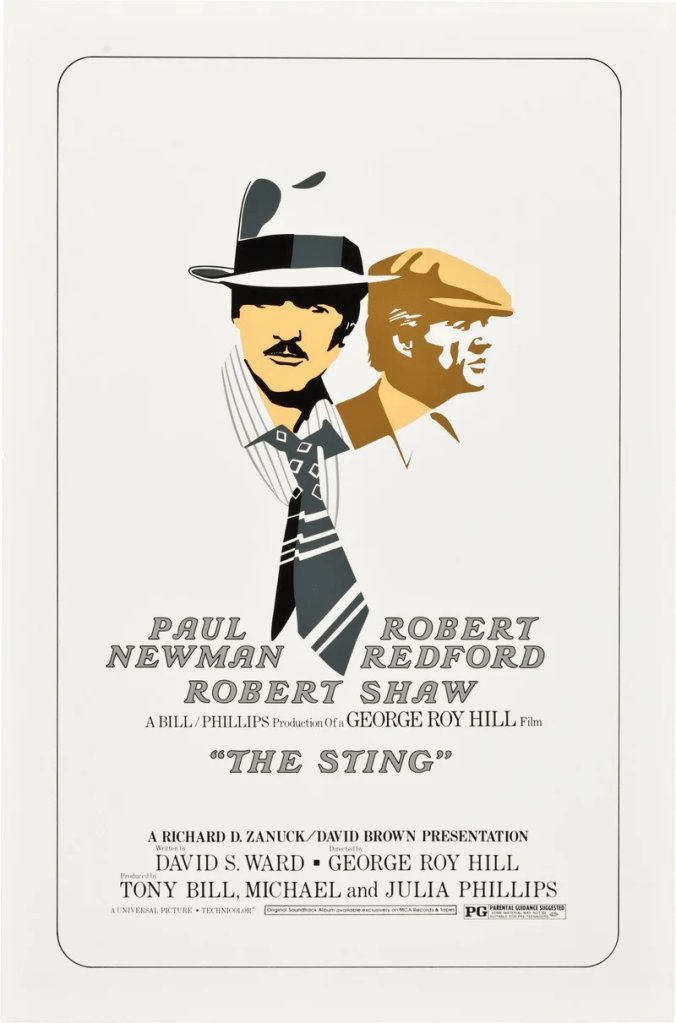
McCarthy laughs, then confirms, “They thought you were Paul Newman? Did you correct him or did you let it go?” Redford dryly, without missing a beat, says, “No. I was so stunned, I just stared into space for a while. But it was a great moment.”
Commenters point out how special their friendship was. “I love how he’s teasing his friend even beyond the grave,” one wrote. “I like to imagine that in that moment he knew Paul heard that comment and smiled.”
McCarthy goes on to talk about the magic of Pete’s Dragon and how it changed Redford’s character’s worldview. He asked, “Do you have something like that in your own life? Something that magical that happened that essentially changed the way you saw life?”
Redford answers quickly. “I did.” He describes being taken to the library as a child and says of the children’s books he read, “All the stories in the children’s section were about a life bigger than the one you were living in. And I got really taken with that. And the idea of fantasy. The idea of seeing a world larger than your own is where the magic was.”
Tributes to Redford are flooding in after news of his death. Director Ron Howard took to X to write, “RIP and thank you Robert Redford, a tremendously influential cultural figure for the creative choices made as an actor/producer/director. And for launching the Sundance Film Festival, which supercharged America’s Independent Film movement. Artistic game changer.”
Governor Spencer Cox of Utah, where Redford spent many cherished years until his passing, wrote on X, “Decades ago, Robert Redford came to Utah and fell in love with the place. He cherished our landscapes and built a legacy that made Utah a home for storytelling and creativity. Through Sundance and his devotion to conservation, he shared Utah with the world.”
Everyone should read her books! Or her substack, or her blog. Or all of those!
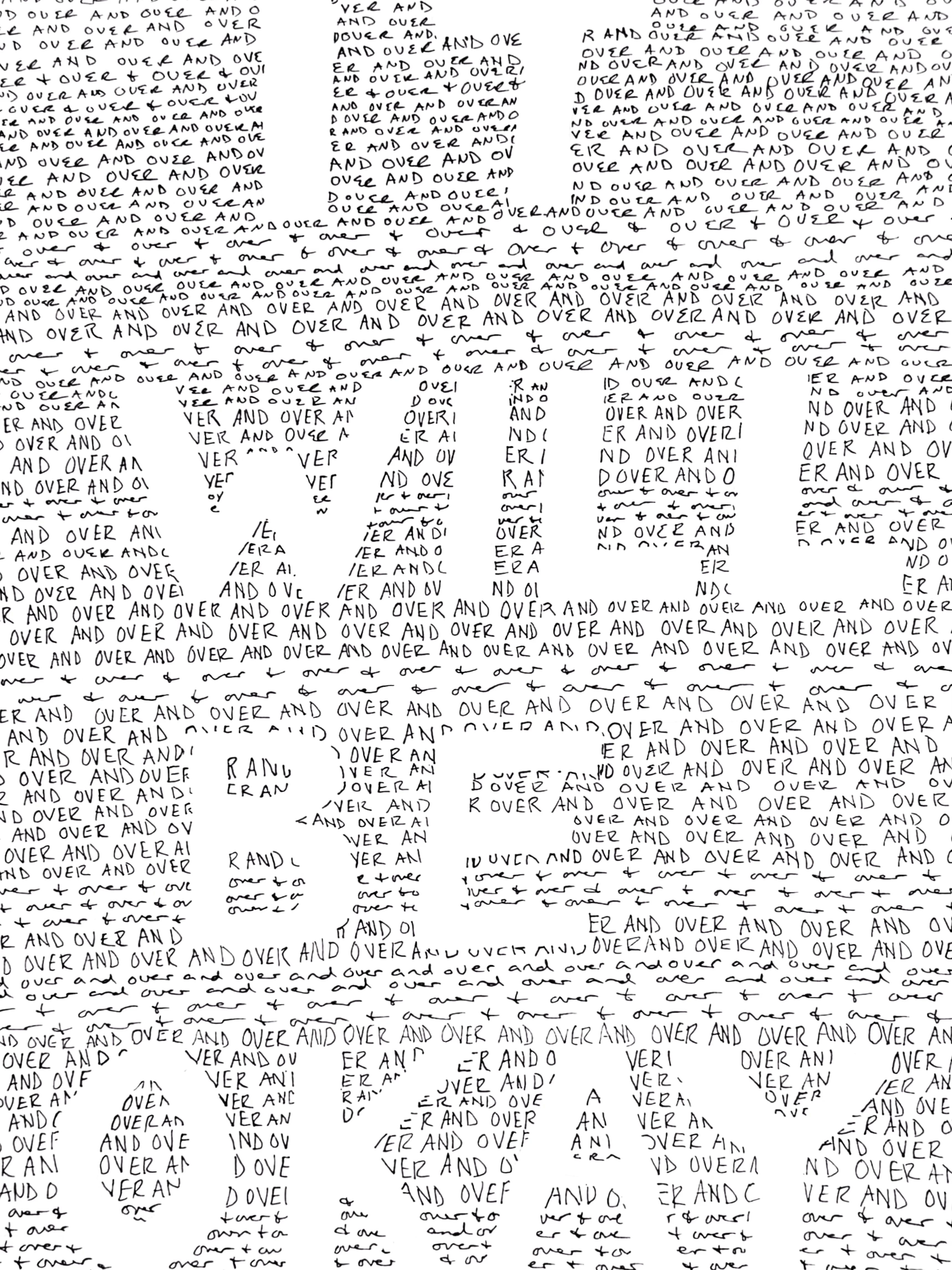
IT WILL BE OKAY by Jenny Lawson (thebloggess)
Read on Substack
This week’s doodle was one I started a long time ago and came back to off and on whenever my anxiety got crazy. This week I finished it.
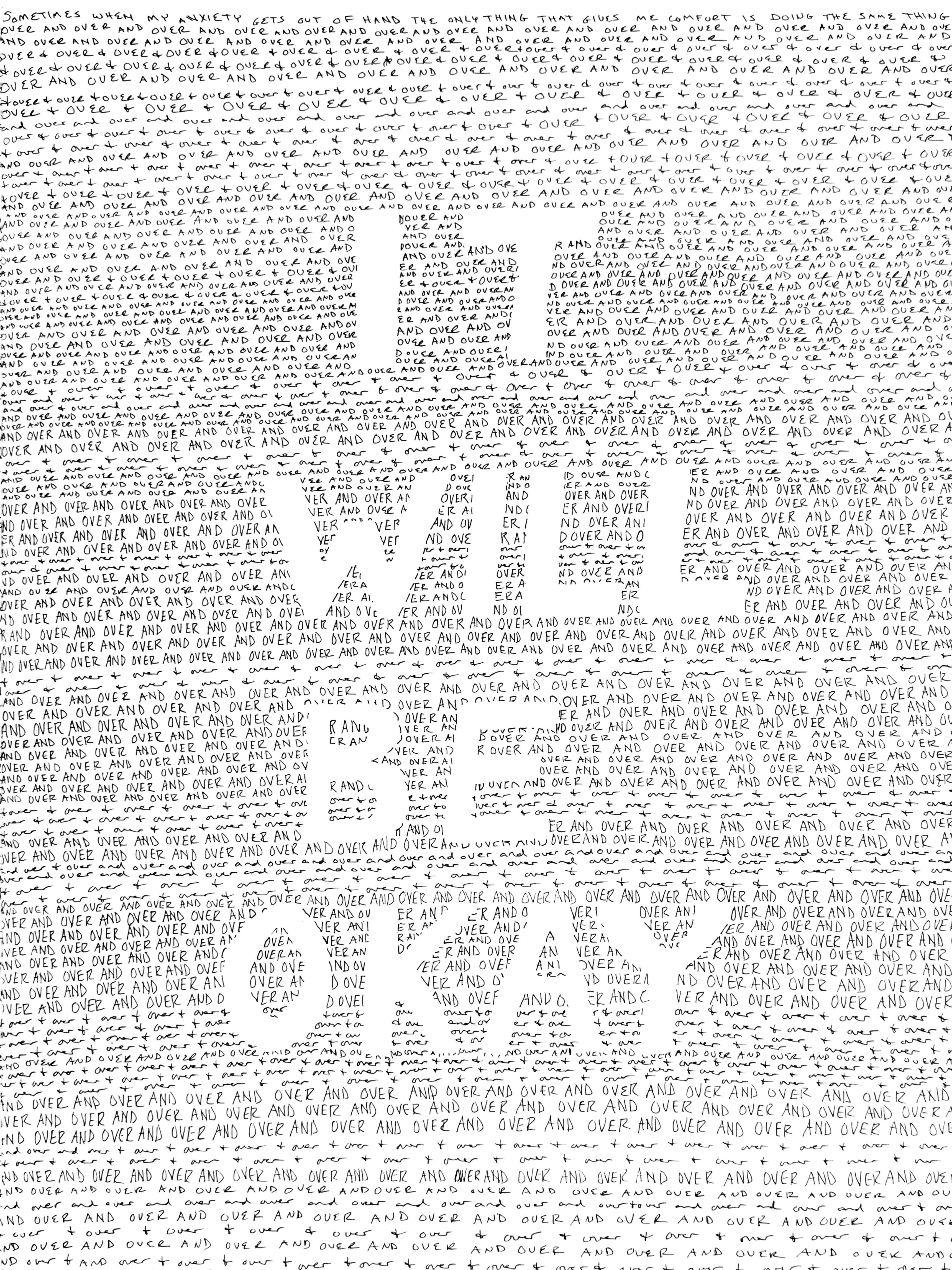
“Sometimes when my anxiety gets out of hand the only thing that gives me comfort is doing the same thing over and over and over and over and over and…”
Does it count as art if it’s just text? I’m not sure, but it brings me comfort and maybe it will bring you comfort too.
Whenever I worked on this I reminded myself that every time I’d been worried in the past, if I could go back it time I would assure myself that “It will be okay.” Maybe not easy. But always okay, eventually. And now I tell myself that again. I tell you too.
It will be okay.
Your friend ~ me
PS. In other art-related news, feel free to interpret this (probably not haunted) painting I wasted too much time pointlessly cleaning.
As Swiss glaciers melt at an ever-faster rate, new species move in and flourish, but entire ecosystems and an alpine culture can be lost
Photographs by Nicholas JR White By Katherine Hill
From the slopes behind the village of Ernen, it is possible to see the gouge where the Fiesch glacier once tumbled towards the valley in the Bernese Alps. The curved finger of ice, rumpled like tissue, cuts between high buttresses of granite and gneiss. Now it has melted out of sight.
People here once feared the monstrous ice streams, describing them as devils, but now they dread their disappearance. Like other glaciers in the Alps and globally, the Fiesch is melting at ever-increasing rates. More than ice is lost when the giants disappear: cultures, societies and entire ecosystems are braided around the glaciers.
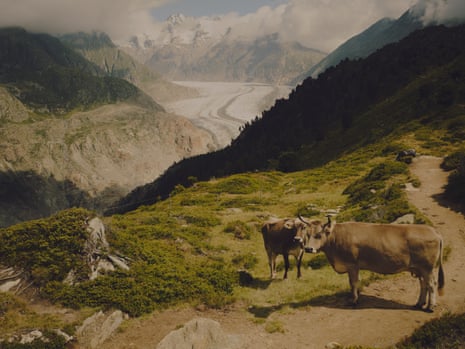
The neighbouring Great Aletsch, like the Fiesch, flows from the high plateau between the peaks of the Jungfrau-Aletsch, a Unesco region in the Swiss canton of Valais and Europe’s longest glacier. It is receding at a rate of more than 50 metres a year, but from the cable car above it remains a mighty sight.
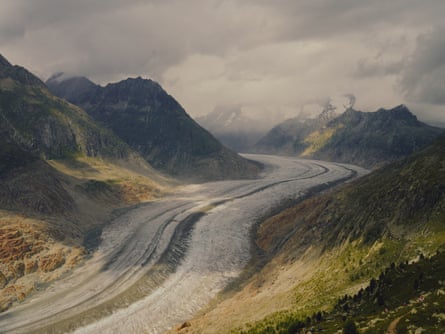
Clouds scud across the sky and shafts of light marble the ice. On the rocky slopes leading down to the glacier from the ridge, there are pools of aquamarine brilliance, the ground speckled with startling alpine flowers. The ice feels alive, with waterfalls plunging into deep crevasses and rocks shimmering in the sun.
“It’s just so diverse, these harsh mountains and ice, and up the ridge, a totally different habitat,” says Maurus Bamert, director of the environmental education centre Pro Natura Aletsch. “This is really special.”
Participants now pray for the glacier not to vanish, but they once prayed for it to retreat and stop swallowing their meadows
Many of the living worlds in the ice and snow are not visible to the human eye. “You don’t expect a living organism on the ice,” Bamert says. But there is a rich ice-loving biotic community and surprising biodiversity that thrives in this frozen landscape.
Springtails or “glacier fleas” survive on the snow’s crust – this year alone, five new species were identified in the European Alps. But there are also algae, bacteria, fungi and ice worms, as well as spiders and beetles, which feed on springtails.
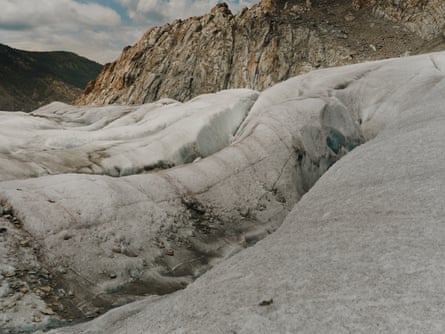
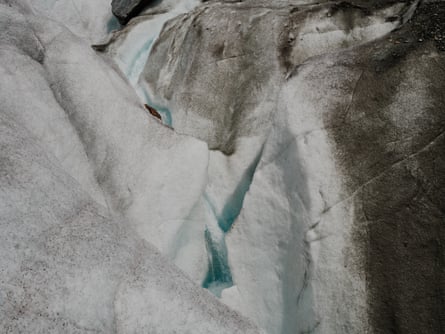
As ice melts, this landscape and its inhabitants, human and non-human, are all affected. Along the glacier’s path, ice turns to water and the rushing sound of the river becomes audible. In 1859, at the greatest extent of its thickness, the glacier reached 200 metres higher than it does now.
The landscape revealed by the melt is mostly bare rock, riven with fissures that spill across the hillside. Jasmine Noti from Aletsch Arena, the regional tourism organisation, says these widen each year, new cracks appear and routes are redesigned. The ice acts like a massive buttress, gluing the hillside together, and as it melts, slippage and instability increase.
As the edges of the glacial valley descend into the cool cover of the Aletschwald forest, “it’s like walking through time”, says Bamert. On the higher slopes, older pines dominate, but lower down the trees thin, and the pioneer species of larch and birch cover the hillside: early signs of newer postglacial reforestation.
It only takes about five to 10 years for plants to colonise the land. Further down yellow saxifrage and mountain sorrel cling to the rocks. All this was once under ice sheets, but the succession of growth tells a story of glacial retreat, historic and recent.
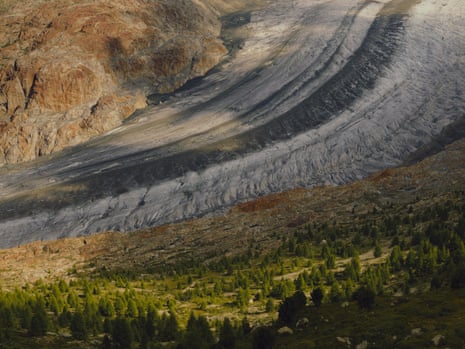
Tom Battin, professor of environmental sciences at Lausanne’s Swiss Federal Institute of Technology, says glacial margins are a transitional landscape where ecosystems are vanishing and appearing. An expert on the microbiology of stream ecosystems, Battin led a multiyear project on vanishing glaciers and what is lost with them.
As he walks down to the Märjelensee, one of the Aletsch’s glacial lakes, this transition is readily apparent. In this mountain hollow, there was once an expansive lake with ice cliffs around its rim. Today, the pools of water are lit by patchy sun and rain, fish jumping and bog cotton dancing in summer light.
Battin points to aquatic mosses. These, he says, could never live in glacial streams which are fast flowing and extreme. Wading into the water, he searches for the golden-brown blooms of a particular alga, Hydrurus foetidus, which is a keystone species that thrives in glacier-fed rivers, fixing carbon dioxide into organic matter.
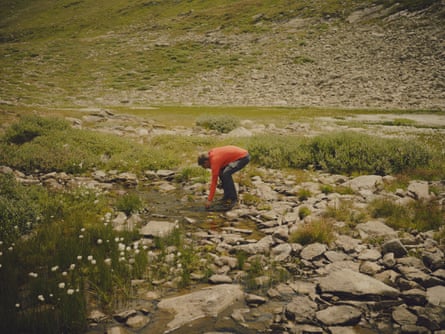
Lee Brown, professor of aquatic sciences at Leeds University, has studied invertebrate communities in glacier-fed rivers around the world, and says we do not yet know the full importance of those that are likely to disappear.
“It’s a challenge to communicate,” he says, pointing out the crucial roles that tiny organisms have in the “trophic networks” – the nutrients flowing between organisms within an ecosystem – that connect ice, rivers, land and oceans. Biofilms, or communities of micro-organisms that stick to the surface of ice and rivers, filter the water. Glaciers wash down vital nutrients from the mountain, but their rivers may run dry when the ice melts.
Without this biodiversity which you can’t see, all that other biodiversity that people care about might disappear
Tom Battin
There are whole worlds in and around the ice, poorly known and understood until recently. Mountains are like high islands, Battin says, with unique ecosystems and endemic species.
“Without this biodiversity which you can’t see,” he says, “all that other biodiversity that people care about might disappear.”
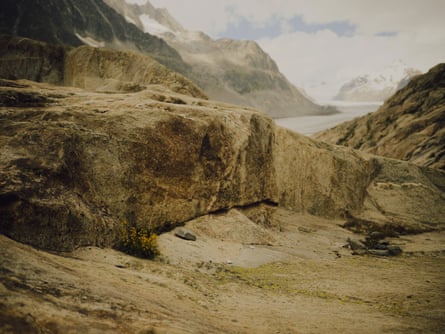
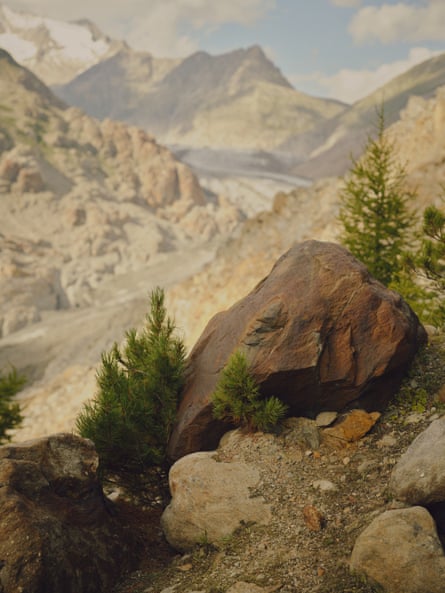
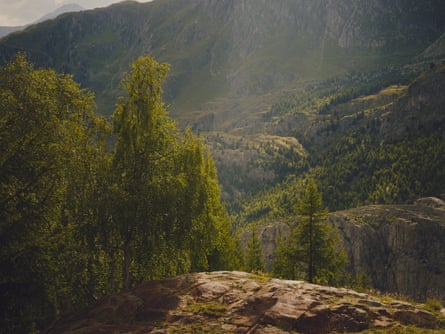
Francesco Ficetola is a professor of environmental science at Milan University who leads the PrioritIce project examining emerging ecosystems in glacial forelands, or land exposed by the retreating ice. As it melts, he says, “there’s a powerful combined effort of organisms” to create new and increasingly complex habitats.
As something is gained, however, much is lost. Cold-climate specialists such as ptarmigan and Alpine ibex are retreating up mountains, their habitats becoming ever smaller. The Swiss pines, on whose seeds nutcracker birds feed, are also moving upwards. Specialist alpine flowers and other pioneer plants at glacier edges are threatened, pushed out by the succession of forests and meadows.
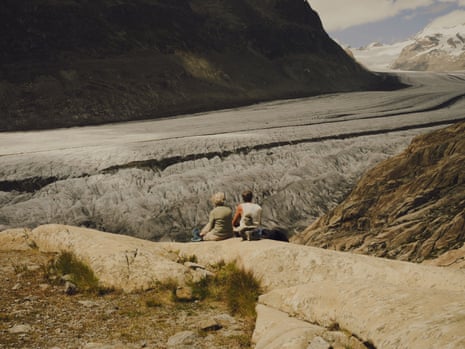
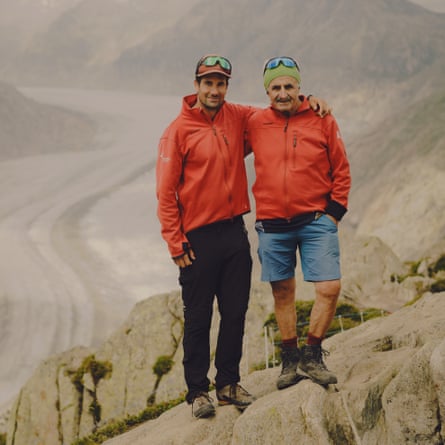
For the people of this region, too, life alongside the glacier is changing. The guides Martin Nellen and his son, Dominik, have lived with the Aletsch glacier all their life. Martin jokes that the older he gets, the farther he must climb from the ridge to the glacial valley as the ice melts. “It’s rubbish,” he says.
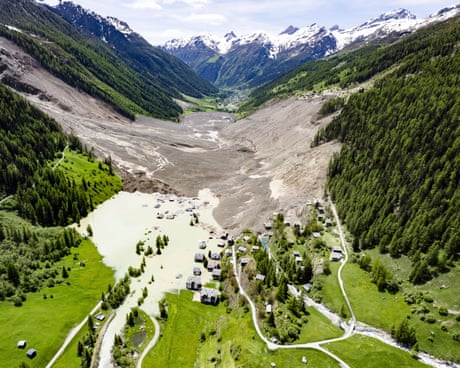
Martin was instrumental in raising funds for information boards, which he also helped design, that explain the life story of the Aletsch. Dominik says they feel “sad, of course” about the glacier’s retreat, but they are also proud to educate people about glaciers and the distinctive landscape of snow-covered peaks and lush pastures.
Every year at 6am on 31 July people gather for a procession that winds from the church in Fiesch to the Mariahilf chapel in the forest above. Participants now pray for the glacier not to vanish, but they once prayed for it to retreat and stop swallowing their meadows and grazing land.

Divine assistance was first requested in 1652. Rosa, one of those gathered for the pilgrimage, remembers the deep snow and cold of past years. “I have been going since I was five,” she says. “There used to be more people.”
This procession is special for the reversal of its request, but similar stories exist across the Alps. They are a reminder that something intangible is lost as glaciers disappear. The great rivers of ice have shaped the imaginations of inhabitants and visitors. Not everyone sees the glacier through the lens of faith, but many visitors – whether praying, guiding or educating – worry what the future holds.
At a place called Baseflie, a cross still stands, erected in 1818 to banish the Aletsch glacier when it threatened pastures. Today, the wooden silhouette against a blue sky seems like a memorial to all that may be lost as glaciers vanish.
Find more age of extinction coverage here, and follow the biodiversity reporters Phoebe Weston and Patrick Greenfield in the Guardian app for more nature coverage
Nor did I have input. But I’ve found my spirit author regarding seasons!
The next four months are the most wonderful time of the year.

What kind of terrible person hates summer?
It’s me. Hi. I’m the problem, it’s me (to quote a newly engaged woman).
Longtime readers of the Post know that I hate the summer months of June, July, and August with the intense heat of a thousand suns (which is often what those months feel like).
Summer is overrated. I think there’s a secret summer society that has people brainwashed that June, July, and August are the perfect months. The sun! The heat! The beaches! The cookouts! To which I would add: The bugs! The sweltering heat! The sunburns!
Remember those Country Time lemonade mix commercials, the ones that lamented that “summer will be a short 94 days?” I used to think, really, it’s going to be that long?
I bet if you really pinned people down and promised to keep their responses anonymous, they would actually admit that fall is better than summer.
(Kids aren’t factored in that polling because they get out of school in the summer and are carefree for three months (though I bet they love getting new school supplies). I have to do the same exact things I do the other months of the year; the only difference is I sweat more.)
I like the “Ber” months,” the months of fall and early winter: September, October, November, December.
There’s a great argument to be made that the new year should start in September instead of January. I wouldn’t make that argument myself, but I could!
Vacations are over, kids are back in school, adults have a new focus on work, people are making plans, the weather is changing. There’s an energy that happens in the fall that you don’t get in the lazy days of summer. There’s more of a fresh, new-feeling start as the calendar ticks over from August to September than there is when we go from December to January. Labor Day could be the new New Year’s.
There’s also better food in the fall and winter. Comfort foods like hot, hearty soups and chili. Pasta and stews and pies. We can turn on the oven again in the “Ber” months.
What do we eat in the summer? A salad? Yeah, that’s comforting.
Holidays? I’ll take Halloween, Thanksgiving, and Christmas over St. Patrick’s Day, Easter, and the Fourth of July. All of the holidays from March until August put together don’t add up to the three big holidays you get in the fall and winter.
Clothing? In the warm, sticky months you wear shorts and gross flip-flops. I don’t need to see anyone’s feet. In the “Ber” months, there are more clothing options, and I’m actually more comfortable in jeans, a sweatshirt, or a flannel shirt than I am with less clothing in the summer.
You say the “Ber” months are the “Brrr” months? So what? Are you a construction worker? Are you a mail carrier? Then why are you concerned with how cold it is? Go inside your home and turn up the heat. Wrap yourself in a blanket and make yourself a cup of tea.
Tea is the official drink of fall and winter, by the way.
Even arts and entertainment are better in the fall. The movies seem to be of better quality, the big books come out. Sure, fall TV isn’t quite what it used to be (new shows premiere year-round now), but people still look forward to September and October when new seasons of their old favorite shows start.
Every August, local newscasters and meteorologists sigh heavily that the summer is ending. The nice temperatures are going away! Can’t we prolong the summer a little bit longer? They get all upset that instead of it being 90 it’s 68, which apparently is some unbearable temperature.
I submit to you that “nice weather” in the summer is actually pretty rare. I’d rather view the spectacular brown and gold treescape above or snowy winter scenes than a bright sun broiling asphalt.
You say I can just turn on the air conditioner in the summer if it’s too hot and humid? I don’t have an air conditioner, and people who don’t have an air conditioner can’t escape the heat and humidity (I don’t know what it’s like where you live, but here in New England, all homes come with heat but you usually have to add the A/C yourself). You can always put on another piece of clothing if it’s too cold. If you keep taking off an article of clothing when it’s too hot, eventually someone will call the police (and they’ll be filming you on their phone and putting it online).
Of course, a lot of this is a regional thing. There are more warm months in places like Texas and Arizona and Florida, and it’s a regular thing for them. Which is why I would never live in Florida (and the weather is only one of approximately eleven reasons why I would never live in Florida).
So I’m happy that it’s after Labor Day. The next four months are the most wonderful time of the year. And even when the “Ber” months are over, everything is still good because then we get the “Ary” months. As a lover of the cold and snow, I welcome them too.
I own sweaters and I know how to use them.
Yes, it will be 2 more clicks. Trust me, you’ll be better for the clicking!
In the face of all the news of the day, here is also this. Too. May they be happy and all that.
Former Marine Lt. Col. Oliver North, 81, and his one-time secretary Fawn Hall, 65 — of Iran-contra fame in the 1980s — have married, Michael Isikoff reports.
They reportedly renewed their acquaintance in November at the funeral of North’s wife of 56 years.
North’s adult children were apparently unaware of their father’s Aug. 27 marriage to Hall.
“We were not at the wedding because we didn’t know it was happening,” his daughter Sarah Katz told the NYT on Tuesday night. “And mostly we hope it won’t impact our relationship with our dad because we do love him and we’re still in the process of mourning our mother.”
https://morningmemo.talkingpointsmemo.com/i/173273572/together-at-last


