There is a great deal of peace & justice history for June 1, that includes Sojourner Truth, the Greenwood massacre, Nazis, Sen. Margaret Chase Smith, The Lord’s Prayer in public schools and SCOTUS, and even more; here for PRIDE I’m featuring Henry Gerber. The link for the entire date’s history is beneath.
June 1, 1932
Gay rights organizer Henry Gerber published an article in Modern Thinker magazine attacking the view that homosexuality is a neurosis.
In 1924, Henry Gerber, a postal worker in Chicago, started the Society for Human Rights, America’s first known gay rights organization.
“The Society for Human Rights is formed to promote and protect the interests of people who are abused and hindered in the legal pursuit of happiness which is guaranteed them by the Declaration of Independence, and to combat the public prejudices against them.”
After having created and distributed a newsletter called “Friendship and Freedom,” Gerber was arrested and held for 3 days without a warrant or being charged with any infractions. Upon release he lost his job for “conduct unbecoming a postal worker.” Following the last of his three trials, in which the charges were ultimately dismissed, Gerber moved to new York City and re-enlisted in the U.S. Army, serving another 17 years. He lived until 1972, passing away at the the U.S. Soldiers’ and Airmen’s Home in Washington, D.C., living long enough to see the Stonewall Rebellion [see June 28, 1969], the beginning of the modern gay rights movement.
More on Henry Gerber (2 links; I’m including the 2d one because it’s a National Parks Services page, but it’s “in progress,” as we would expect in light of Exec. Orders…)
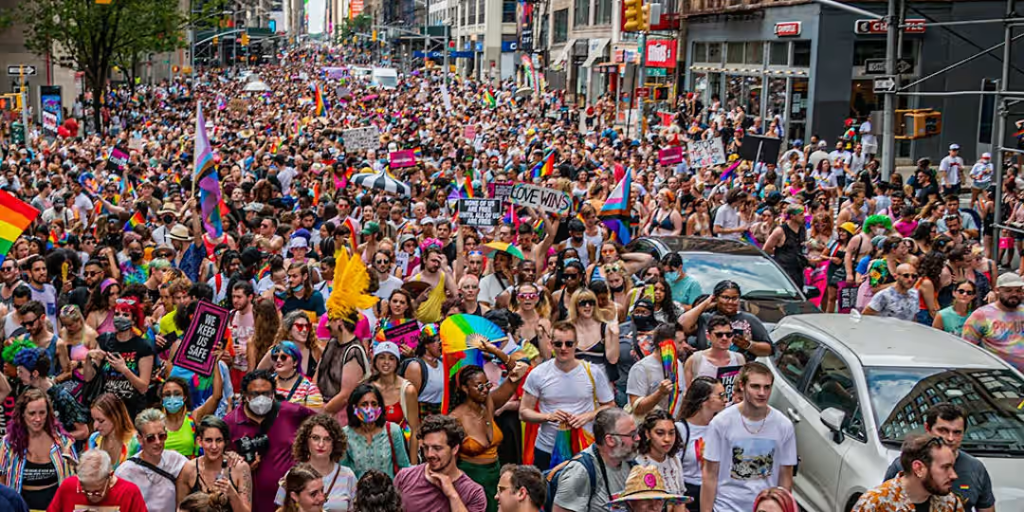
Pride Month is an annual celebration of the many contributions made by the LGBTQ+ community to history, society and cultures worldwide. In most places, Pride is celebrated throughout the month of June each year in commemoration of its roots in the Stonewall Riots of June 1969. However, in some areas—especially in the Southern Hemisphere—pride events occur at other times of the year.
Origins of Pride Month
The roots of the gay rights movement go back to the early 1900s, when a handful of individuals in North America and Europe created gay and lesbian organizations such as the the Society for Human Rights, founded by Henry Gerber in Chicago in the 1920s.
Following World War II, a small number of groups like the Mattachine Society and the Daughters of Bilitis published gay- and lesbian-positive newsletters and grew more vocal in demanding recognition for, and protesting discrimination against, gays and lesbians. In 1966, for example, members of the Mattachine Society held a “sip-in” protest at Julius, a bar in New York City, where they demanded drinks after announcing that they were gay, in violation of local laws against serving alcohol to gays and lesbians.
Despite some progress in the postwar era, basic civil rights were largely denied to gay, lesbian, bisexual and transgender people—until one night in June, 1969, when the gay rights movement took a furious step forward with a series of violent riots in New York City.
Stonewall Riots
https://www.history.com/articles/pride-month (this is one of those videos embedded on the page, beneath is a bit about it, then more about the riots. Go see the video, if you like!)
How the Stonewall Riots Sparked a Movement
The 1969 Stonewall Inn Riots sparked the beginning of the gay rights movement in America. Learn how.
As was common practice in many cities, the New York Police Department would occasionally raid bars and restaurants where gays and lesbians were known to gather. This occurred on June 28, 1969, when the NYPD raided the Stonewall Inn, a bar in the Greenwich Village neighborhood of Manhattan.
When the police aggressively dragged patrons and employees out of the bar, several people fought back against the NYPD, and a growing crowd of angry locals gathered in the streets. The confrontations quickly escalated and sparked six days of protests and violent clashes with the NYPD outside the Stonewall Inn on Christopher Street and throughout the neighborhood.
By the time the Stonewall Riots ended on July 2, 1969, the gay rights movement went from being a fringe issue largely ignored by politicians and the media to front-page news worldwide.
I am really becomeing in favor of this person for governor. I love how he talks about trans kids and how he wants them to feel included in society. He said that because of the risk of suicide and self harm if these children are excluded he won’t do that to them. He is not giving an inch on trans issues. As for advantages or not as Emma and Sam discuss there is a basket ball player so tall that he can stand on his toes and put the ball in the net. Is that an unfair advantage? Hugs
Trumpeter Robyn Steward thought clubs weren’t for her until she encountered Fabric’s accessible upgrade – the new home for her radically inclusive, space-themed night
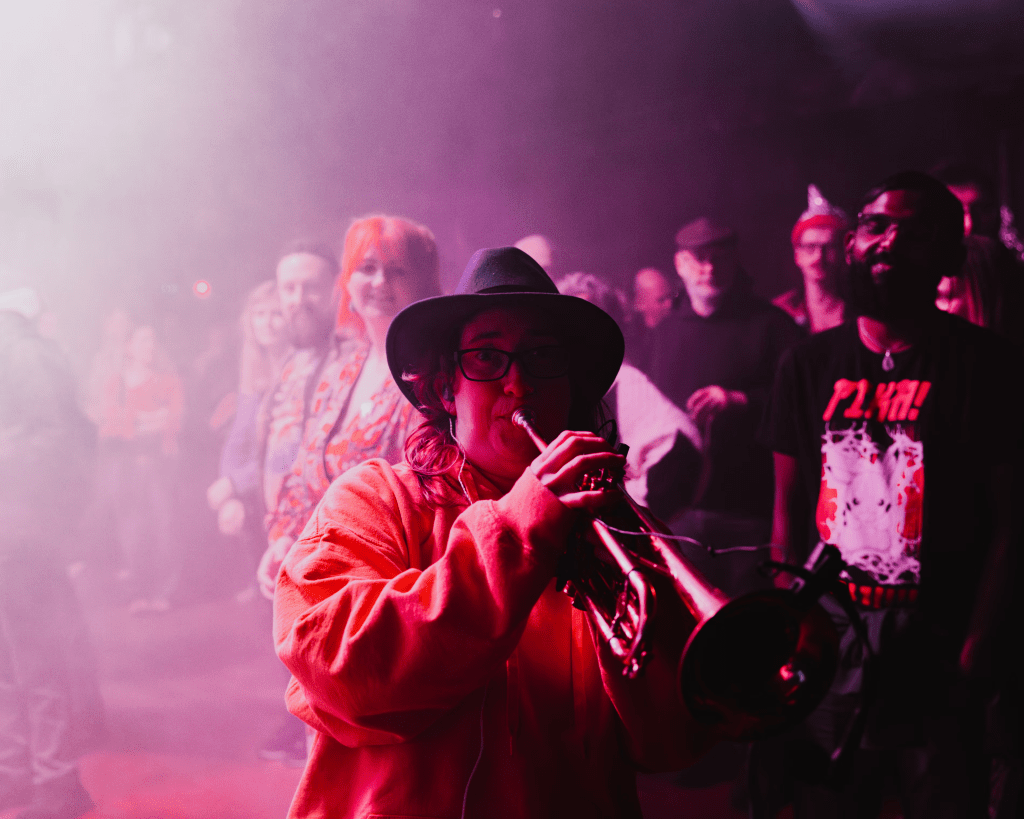
Working the crowd … Robyn playing at one of her Robyn’s Rocket nights at Fabric. Photograph: Siân O’Connor
Until May last year, trumpeter Robyn Steward had never been in a nightclub space, save for playing trumpet with Lancaster duo the Lovely Eggs at London’s Heaven, and a few nights in a university hall that doubled as a lunch room. Steward is autistic and has multiple disabilities including cerebral palsy. “Sometimes strobes can trigger migraines for me, or feel overwhelming,” she says. “I feel like my body’s a bit lost.”
When she wanted to see a gig at Fabric nightclub in London, she asked a friend to go with her as a carer. “I was amazed at how accessible it was,” she says. Subtle touches integrate multiple access needs into the space. “The mezzanine level meant that I didn’t have the strobes in my face. There was a rail that I could hold on to, and there was seating opposite the balcony so I could sit and watch the gig.” She also noticed Fabric’s recently upgraded sensory dancefloor, which deliberately transforms sound into tactile vibrations to better cater for the hearing impaired. “I could see that the lights were strobing and everything, but I felt safe,” Steward says.
Inspired, she contacted Fabric to see if they might host her long-running, space-themed experimental music night Robyn’s Rocket, which since 2017 has been booking noise bands, DJs and improv groups in London venues from Deptford to Dalston. While it champions disabled and autistic performers and audiences, Robyn’s Rocket is principally about integration. “People with and without learning disabilities – and autistic and non-autistic people – should spend time together, where there isn’t any kind of power dynamic,” she says. Her aim is to create a space “where people are all just having a really nice time together”.
We meet in a music studio in Deptford, south London, the day before the Rocket’s first night at Fabric. Steward, 39, is relentlessly upbeat; straight after the interview, she heads to the shops where a friend helps her figure out an unspecific drinks rider request. It’s in keeping with the Rocket spirit of clarifying what might usually be assumed or implied. Online, she supplies detailed visual storyboards of how an evening will progress. All artists fill out detailed tech and access riders. Every box and cable is given a name, shape or colour. All Rocket gigs are livestreamed and timings are strictly adhered to so those streaming the gig don’t get lost. “The schedule, once it’s agreed, it’s pretty non-negotiable,” Steward says.
On arrival, everyone is presented with a silver rocket-shaped badge, angled up, across or down as a visual barometer of how much communication they’re comfortable with. Fabric is adorned with more than 100 posters: signposts always feature words and shapes and are populated with cartoon characters, human and alien. Silver foil covers the stage, and live projections from visual artist Rucksack Cinema are suitably astral. “You’re into new planets, are you?” crows the frontman of “cosmic dross” band Henge.
For Steward, the space theme is also about imagining an equitable new world. “You might meet somebody here with a learning disability, or an autistic person. You might not. But everyone is equal in this space.” The Robyn’s Rocket nights echo the aesthetic and political spirit of Afro-futurist jazz visionary Sun Ra and his Arkestra. “The idea that you can create a different dimension, almost a different planetary experience, at these events is very consistent,” says Mark Williams, co-founder of the Deptford-based arts charity Heart N Soul (where Steward is an associate artist). “It’s using imagination and creativity to free people, and to exist on a different kind of plane.”
Steward was born in Suffolk, and took to music when a tutor brought instruments to her primary school: “I really wanted to go on the trumpet, but they ran out of time, so I spent a whole week blowing raspberries.” The tutor returned for an assembly the next week, and Steward immediately requested the trumpet. “I played a clear note straight away.”
As an infant, Steward used Makaton (a language that uses a combination of signs, symbols and speech) to communicate until she attended Musical Keys, a group for children with special needs, aged three: “It was song based, and so I learned to speak that way – there was a lot of repetition.” Once she learned to speak, she wouldn’t stop; her parents got her a Dictaphone for long car journeys: “They’d say, ‘You can talk to this Dictaphone as much as you want, but leave us alone in the front.’ I would make my own radio shows that would come out sounding like Alan Partridge’s Knowing Me, Knowing You.”
Unlike her East Anglian counterpart, Steward is an excellent, direct communicator. The first half of her career was spent delivering autism training, speaking at conferences, and in research. She’s also written books such as The Autism-Friendly Guide to Self Employment. But, by age 30, Steward became “very conscious that I needed to think about what I want to spend the rest of my life doing”. She had recently learned to improvise on trumpet through the big band at a local adult education centre, and seeing a gig by trumpeter Andy Diagram (who plays the trumpet with guitar pedals) proved crucial to developing her own art. With the help of Heart N Soul, she built Robyn’s Rocket up from a small residency in Deptford to a regular slot at Cafe Oto in east London, later inviting musicians including Alabaster DePlume, Coby Sey and Mica Levi to perform.
The vocalist Seaming To played a Rocket night in 2024. “More and more friends of mine are realising that they have neurodivergent aspects,” Seaming To says. “And quite a lot of them find it really awkward coming out to noisy places. At Robyn’s night, you can admit to feeling awkward, and it’s all acceptable.”
On the night, Steward dons her trademark purple fedora and doubles up as space trumpeter and energetic MC. “I’ve done this gig partly because I just wanted to put Henge on,” she says, beaming from the stage. For all the very human practicalities of Robyn’s Rocket, Steward still has celestial ambitions. “And why wouldn’t you want to put them on in a homemade spaceship?”
One good thing about trolling comedians, they always know exactly how to respond.
New York City Pride recently announced the Grand Marshals for its annual Pride parade, scheduled for June 28.
It’s quite a roster, featuring trans actress Dominique Jackson, drag star Peppermint, trans journalist and radio personality Bernie Wagenblast, activist group Gays Against Guns and SNL alum Bowen Yang.
Of course someone was gonna have an opinion on this lineup, and one of them tried to come for Yang in the comments of the announcement on Instagram.
And Yang, ever the seasoned comedian, had the perfect response. The troll demanded to know “why bowen,” and Yang didn’t miss a beat, quipping:
“showed hole to the board.”
(snip-embedded social post)
Perfect.
It’s a strange question in the first place: Yang made history when he joined the SNL cast in 2019.
In a statement, NYC Pride wrote:
“Bowen Yang became a household name as the first Chinese-American cast member on Saturday Night Live in 2019.”
“With that platform, he helped usher in an era of authentic queer humor in mainstream media, earning an Emmy® for writing and becoming the most-nominated Asian male performer in Emmy® history in the process.”
The better question is “why not Bowen?”
(🤣 🤣 🤣 snip-MORE ; lots of embedded social media posts; enjoy!)
Q+A with one of the Broadview Six, who had all charges dropped against them after grand jury misconduct.
Marisa Kabas
For the last seven months, Kat Abughazaleh wasn’t allowed to go to Alaska. It’s not that she had any particular reason to, but being under felony indictment meant that she was only allowed to travel throughout the lower 48 United States. And forget leaving the country. But on Thursday, those restrictions were suddenly lifted when all charges against her were dropped.
Abughazaleh, 27, woke up Friday a free woman. The former Illinois congressional candidate was charged in October along with five others for conspiring to impede an officer near the Broadview ICE facility just outside of Chicago. In reality, Abughazaleh and her co-defendants were there to protest the federal government’s increasingly public cruelty and the human rights abuses happening inside Broadview specifically, and broadly by ICE. The Trump administration, not surprisingly, did not appreciate their very public pushback and responded with brutality and violence. But with all charges against them now dropped, the only thing they’re an example of is why fighting fascists is good.
With the trial scheduled to begin just after Memorial Day, US district judge April Perry called an emergency hearing Thursday to discuss missing pieces of the trasncript from the grand jury proceedings where DOJ lawyers convinced jurors to indict Abughazaleh, her campaign field director Andre Martin, Michael Rabbitt, Brian Straw and two others who had the charges against them dropped earlier.
The case was already on the decline, with prosecutors dropping the felony charges against the remaining four in April as questions about the grand jury transcripts popped up. They still faced a full trial on misdemeanor charges and up to one year in jail. But Judge Perry ruled the DOJ’s handling of the grand jury and subsequent redactions constituted grave misconduct, making it impossible to move forward.
I spoke with Abughazaleh by phone Friday morning about right wing fuckery, ridiculous rumors, and how she plans to reclaim her life after the federal government tried to destroy it. Our conversation has been edited and condensed for clarity.
MARISA KABAS, THE HANDBASKET: How did it feel waking up this morning?
KAT ABUGHAZALEH: I had to get up at like 5am to go on Morning Joe, but I woke up and I was like, oh yeah, I don’t have to go to trial this week—which is not a statement I thought I’d have to say ever in my life.
KABAS: Walk us through what you thought the next week or so was supposed to be like before yesterday’s hearing.
ABUGHAZALEH: I was supposed to have not just trial prep with my lawyers, but having to get my clothes dry cleaned. Going to get a manicure because my nails always always look awful. I spent way too long at a Nordstrom Rack picking out shoes that I thought looked fashionable but also modest and wouldn’t make jurors think I was a bitch. On Tuesday we were supposed to have jury selection. On Wednesday we were supposed to have opening arguments, which is a shame that we don’t get to hear our lawyers spit absolute fire. But yeah, it’s nice not to do it in the first place.
KABAS: Absolutely. So what do you think you’re gonna do instead?
ABUGHAZALEH: I have a 12-hour live stream tomorrow to raise money for our legal funds because, despite not having to go to trial, we’re still picking up the pieces of our lives both emotionally and financially. Every single one of us as co-defendants, we have very real fears of bankruptcy and being in debt for the rest of our lives because of this. And then, I don’t know, sleep a bunch. Get my passport renewed, something that I couldn’t do for the last seven months. I couldn’t even go to Alaska.
KABAS: Are you serious? Could you go to Hawaii?
ABUGHAZALEH: No, just the lower 48. Couldn’t even go to Puerto Rico.
KABAS: So this has really restricted your movement as a human being for the last seven months.
ABUGHAZALEH: Yeah, and it’s something that’s really scary, especially as the government gets more and more aggressive, just being like, oh, you’re stuck here no matter what happens.
“Kat” Abughazaleh speaking after today’s crazy developments in the “Broadview 6” case
KABAS: So when did you get a sense that things might be changing this week?
ABUGHAZALEH: So we’ve been requesting to see the grand jury transcripts or just have the judge look at them for months. And ahead of trial Chris Parente—Brian Straw’s lawyer—just asked the judge, “Can you just look at the unredacted version?” And her understanding was that the redactions were referring to some IT issues, and the prosecution had never corrected her. So she looked at the unredacted transcript and then called a hearing the next morning. And it was sealed. Now the transcript is public.
She was saying “I’m not sure that the charge will get dismissed without prejudice because there’s not a lot of precedent for that, especially for a misdemeanor.” And then we broke for an hour for the government to talk it over, and then they came in. I remember one of my lawyers looking at me as one of the government’s lawyers [Andrew Boutros] started talking, and she just turns to me and says, “Congratulations.” And I went, “What?” And then Boutros said, “dismissed with prejudice.” [Meaning the case was permanently closed.] And it was just surreal. Absolutely surreal.
KABAS: Did you have a sense of where things were heading or were you totally shocked by the outcome?
ABUGHAZALEH: I truly did not think it would get dismissed yesterday. I did not want to get my hopes up. I thought that we were going to trial for sure, just because it’s very unusual to try a federal misdemeanor. I knew we would win in that case, but I was completely shocked.
KABAS: How do you think this will change or impact anti-ICE protests and prosecutions in the future?
ABUGHAZALEH: I hope that it does have impact. It was meant to intimidate us into silence, and none of us took a deal. None of us sold each other out (not that there was anything to sell each other out on.) But, you know, we were charged with conspiracy. We were facing like 10 years in prison.
(snip-there is MORE, but this is already a long post, and I’m a free subscriber to Handbasket, and don’t want to just lift their work. Click on through!)