Riley Gaines, who has turned a fifth place finish against non-trans swimmers into career with MAGA media.
Now let me see if I have this right. Riley Gaines finished 5th in a race with a trans athlete. And, if that trans athlete had NOT been in the race, Riley Gaines would still have finished in 5th place because the two swimmers were TIED for 5th. So, a trans athlete being in the race did not have any effect on Riley Gaines at all
First of all, I would like proof of this man’s “big balls.”
Second, he is a national security disaster. From his Wikipedia page:
His maternal grandfather Valery Martynov was a KGB Lieutenant Colonel executed by the Soviet Union as a double agent. After his execution his widow moved with her children, including Coristine’s mother, to the United States.
Also from Wikipedia:
Bloomberg News reported that Coristine had been fired from his internship at cybersecurity firm Path Network in 2022 for allegedly leaking internal company information to a competitor. Following his dismissal, a large collection of internal Path documents and conversations was leaked online.
The apple may not fall too far from the tree in this instance.
Reuters published a story alleging that Coristine’s online content delivery network DiamondCDN had facilitated the work of the cybercriminal group EGodly. In 2023 Egodly thanked Coristine saying “We extend our gratitude to our valued partners DiamondCDN for generously providing us with their amazing DDoS protection and caching systems, which allow us to securely host and safeguard our website,” Egodly has claimed involvement in a number of crimes including email hacking, theft of cryptocurrency, and the harassment of a former FBI agent.
This guy would never have passed any sort of normal security clearance. That this story isn’t a massive front page scandal is an indictment of the times we live in.
A Ukrainian lawmaker nominated Donald Trump for a Nobel Peace Prize, and has now withdrawn it, saying he had ‘lost any sort of faith and belief” in Trump and his ability to secure a ceasefire between Moscow and Kyiv. The mystery here is why ever had “faith” or “beliefe” in Donald Trump in the first place?
To believe in Donald Trump, you either have to be a cultist who does not live in reality, or have previously taken a tack hammer to the head.
The Ukrainian official, Oleksandr Merezhko, said Trump is “evading—he is dodging—the need to impose sanctions on Russia.” That’s because he’s Putin’s beyotch. Has Merezhko not been paying attention all these years?
Pakistan submitted a formal recommendation for Trump to receive the Nobel Peace Prize after saying his “decisive diplomatic intervention and pivotal leadership” stopped its recent military spat with India over Kashmir. Although India stated there was no need for external mediation on the Kashmir issue, playing down Trump’s role. Factor in that India’s leader is a Trump fan.
But now, just a day after recommending TACO for the Nobel Peace Prize, it’s condemning him for attacking Iran, saying the strikes “constituted a serious violation of international law” and the statute of the International Atomic Energy Agency. Pakistani Prime Minister Shehbaz Sharif, in a phone call Sunday with Iranian President Masoud Pezeshkian, expressed his concern that the bombings had targeted facilities that were under the safeguards of the IAEA.
Today, Georgia GOP Rep. Buddy Carter has formally nominated Trump for a Nobel Peace Prize, writing to the committee that it’s “in recognition of his extraordinary and historic role in brokering an end to the armed conflict between Israel and Iran.”
But, Buddy…you don’t negotiate peace by bombing somebody. Also, the peace deal isn’t working. Israel accused Iran of violating the deal, and Trump got upset, probably because further escalation would ruin his pretend chances of winning a Nobel Peace Prize. Also, you don’t win a Nobel Peace Prize by bombing a nation that’s never attacked you.
Trump said, “We basically — we have two countries that have been fighting so long and so hard that they don’t know what the fuck they’re doing.” Oh, and you do, TACO?
Buddy didn’t nominate Trump for the Nobel Peace Prize because he believes it would be deserved. Like Pakistan and the Ukrainian guy, Buddy is using the prize to kiss Trump’s ass. Pakistan and Ukraine both turned around and said Trump doesn’t deserve it, which they already knew. Maybe they should buy him planes. Buddy, I don’t know what you want from Trump, but can you buy him a plane?
Of course, Republicans are praising Trump for a peace deal with Israel and Iran, but why? There are no conditions or terms. Neither nation has given any concessions to the other. Has Iran agreed to abandon its nuclear program? No. Even if they did, why would it be more trustworthy than the deal Obama already made with Iran that Trump destroyed, which was working? Did Israel give Iran any concessions, like maybe abandoning its nuclear program that nobody wants to talk about?
Trump’s peace treaty is like the TEMU of peace treaties. It’s going to break just as soon as you start playing with it. (snip-MORE)
=============================
NATO Making Careful Preparations To Keep Baby Trump Entertained During Tomorrow’s Big Summit by Rebecca Schoenkopf
Wouldn’t want him to get bored or stomp out and demand to go home or anything! Read on Substack
This morning, Donald Trump was angry. One would imagine that after ending all wars forever with his flawless execution of the ceasefire between Israel and Iran, he just wanted to have a nice celebratory night, while SecDef Pete Hegseth drunked and belched around the White House residence in a sexy teddy singing “Nobel Peaaaaaaace Biiiiiiiiirthday, Missssteerrrrr [HIC!] Prezzzzdinint!”
Alas.
Instead it appears Israel and Iran stopped shooting long enough to let President Dumbass get on Truth Social and declare flawless victory, before they got right back to shooting at each other. It’s gotta be tough pretending to be the leader of the free world when none of the world, free or otherwise, has any respect for your leadership. (snip-MORE, and it is good!)
With Trump’s strikes on Iran and all the other shitstorms his administration has caused, the anniversary of American women losing their reproductive rights isn’t going to get a great deal of press. Here’s just one link to what abortion bans mean for women after the Supreme Court decision. There are plenty more.
============
Inside the queer pop-up parties you’ll never want to leave
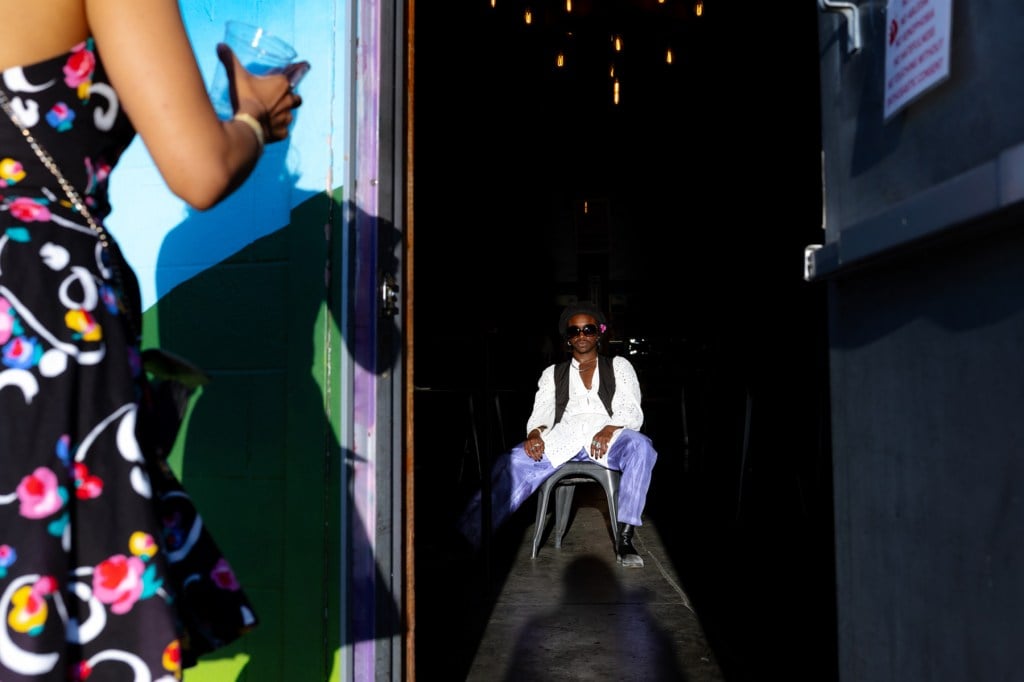
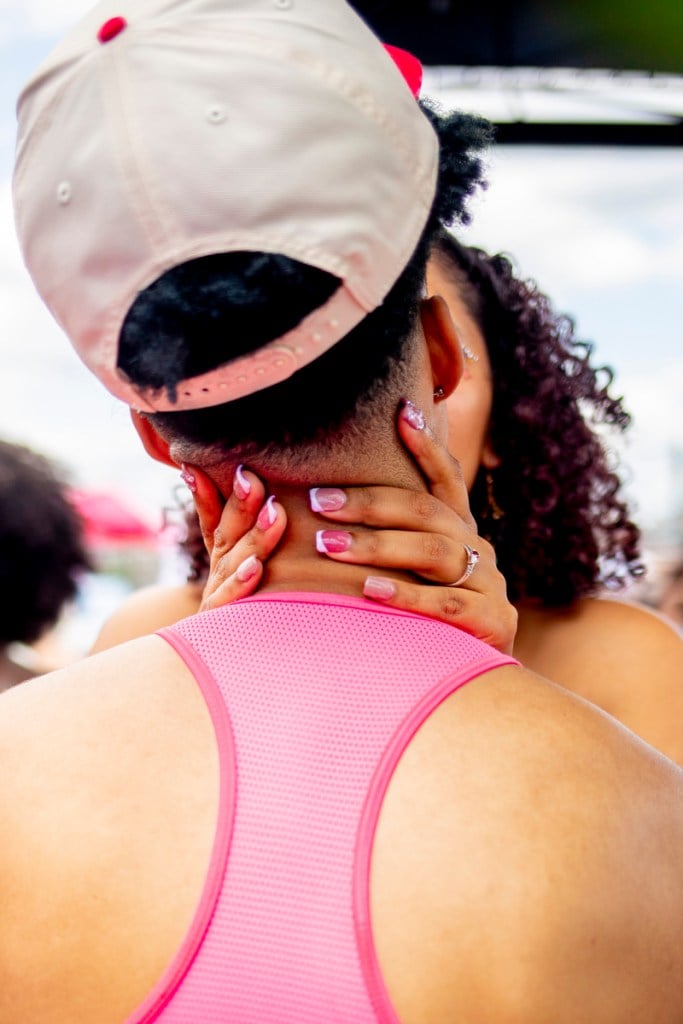
Glitter sparkles across people and surfaces, rainbow-colored acrylic nails snap in time to the Afrobeat, and boisterous cheers egg on the occasional dance floor death drop. These are moments that make up spaces created for and by queer and trans people of color (QTPOC). From Los Angeles to Philadelphia, New York City to Atlanta, queer community organizers, DJs, musicians and artists are producing monthly pop-up events that attendees and organizers say are reimagining queer liberation through collective joy.
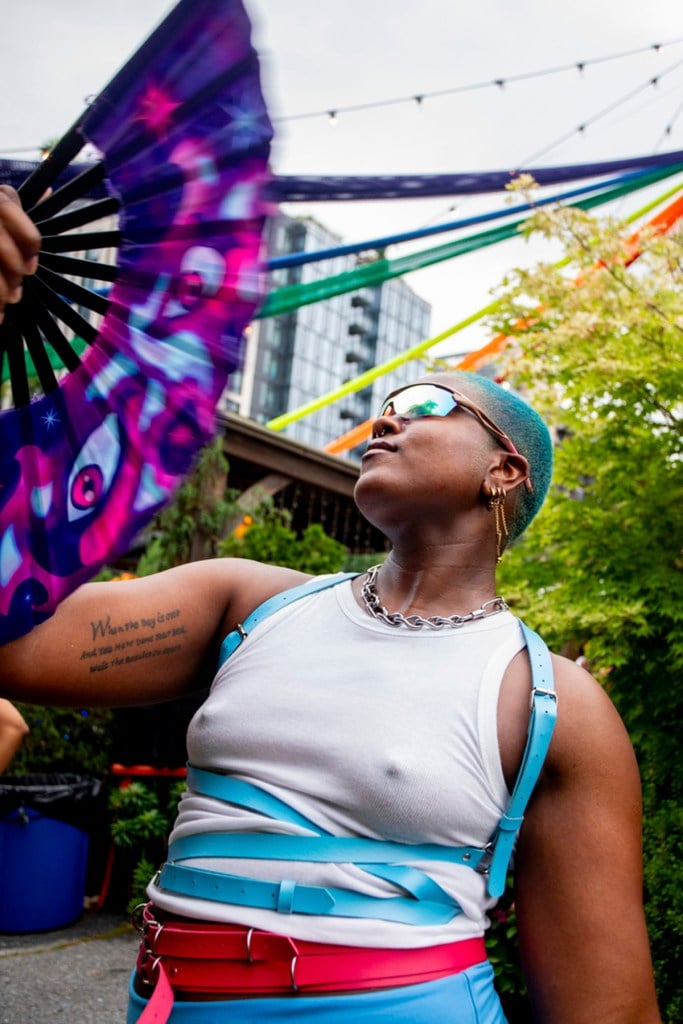
Events range from underground warehouse raves like Hood Rave in Los Angeles to sunlit day parties and potlucks featuring patio yoga. Regardless of format, the trappings of queer life and culture are evident everywhere you look — necklaces made of popper bottles; chest harnesses as fashion; flags; fans; cheeky political statements across nails, hats and tees. The recognition of Black and Brown queer experiences is often apparent in event titles, like New York City’s notorious Papi Juice dance party and Los Angeles’ weekly Toxica event for sapphic Latine queers.
These parties also frequently double as advocacy work, where they highlight mutual aid campaigns, promote queer causes and spread political awareness. In recent years, DJ shouts of “Free Palestine” are frequently met with affirmative cheers from dance floors dotted with keffiyehs and watermelon imagery. QTPOC parties are also changing the tunes of gay nightlife from the pop/EDM/disco variety to a musical mix of hip-hop, trap, house, reggaeton, soca and Afrobeats.
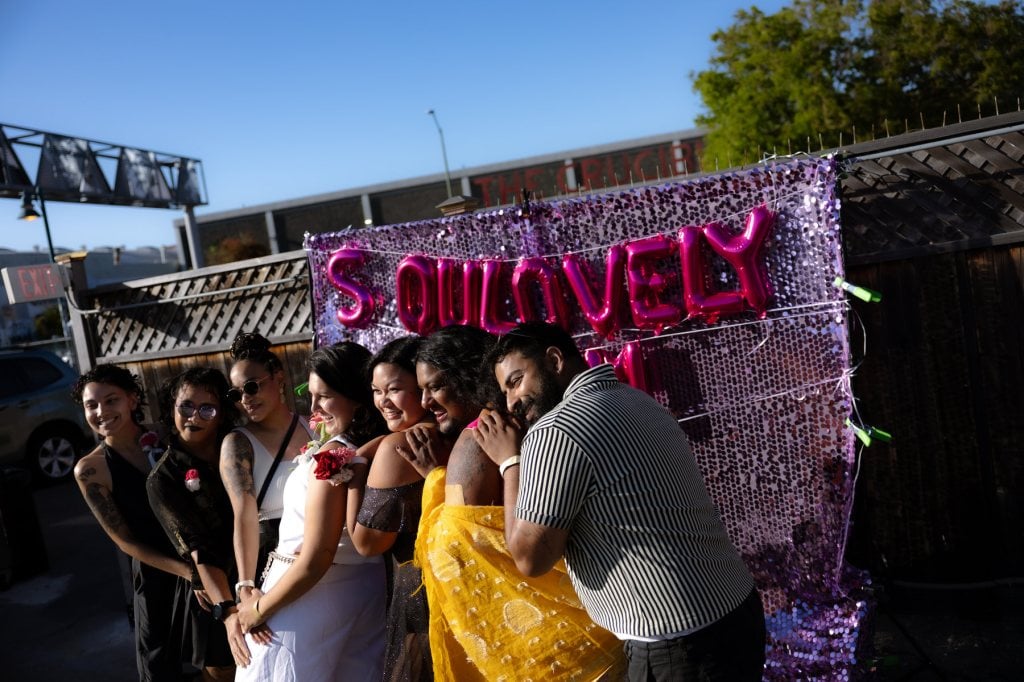
“Everybody is able to see themselves in the music and feel safe here,” said Terri Flamer, who attended the Soulovely prom in Oakland, California, in May. “That’s probably the best thing about it, is you’re safe to be yourself, you can party, you meet people that don’t look like you and it’s all love.”
Queer dance parties also enable the ecstatic experience of group dance, which can be understood as its own form of activism. Maya Bhardwaj, a scholar studying the global influx of such parties in the last decade, called them queer utopias that center: “healing, mental health, ancestral faith practices, queer Black and Brown music and dance traditions, and spaces for activists and cultural workers to gather beyond mainstream bars and nightlife.” Mission statements from QTPOC dance party organizations often invoke terms like “affirmation,” “celebration” and “sustaining.“
While queer nightlife as a space of resistance isn’t new — it has its roots in AIDS activism of the ’80s — the intersectional community building and intention brought to crafting these spaces makes the current slate of QTPOC parties feel fresh. Often exclusionary White male gay spaces are frequently the only options for LGTBQ+ nightlife, and the pop-up event has become a go-to to address a lack of gatherings that feel welcoming to QTPOC folks.
There’s this sense of pain shared among QTBIPOC […] and therefore the joy that is experienced at these parties feels more necessary, more dire and more of a relief.”Nicole Prucha
Pop-up spaces provide “a feeling of safety in being able to trust that the people who are there have experienced or understand what it is like to be othered, in a sense apart from our sexuality,” said performance studies scholar Nicole Prucha about her experience attending Los Angeles QTPOC parties. As a queer Arab person who has often struggled to find places where she feels truly seen, Prucha said parties like Casual, Hot Pot and its sister event HabibiPot fill a vital need for queer people of color: “A place of refuge and queer world-building” at a time when LGBTQ+ rights are under attack.
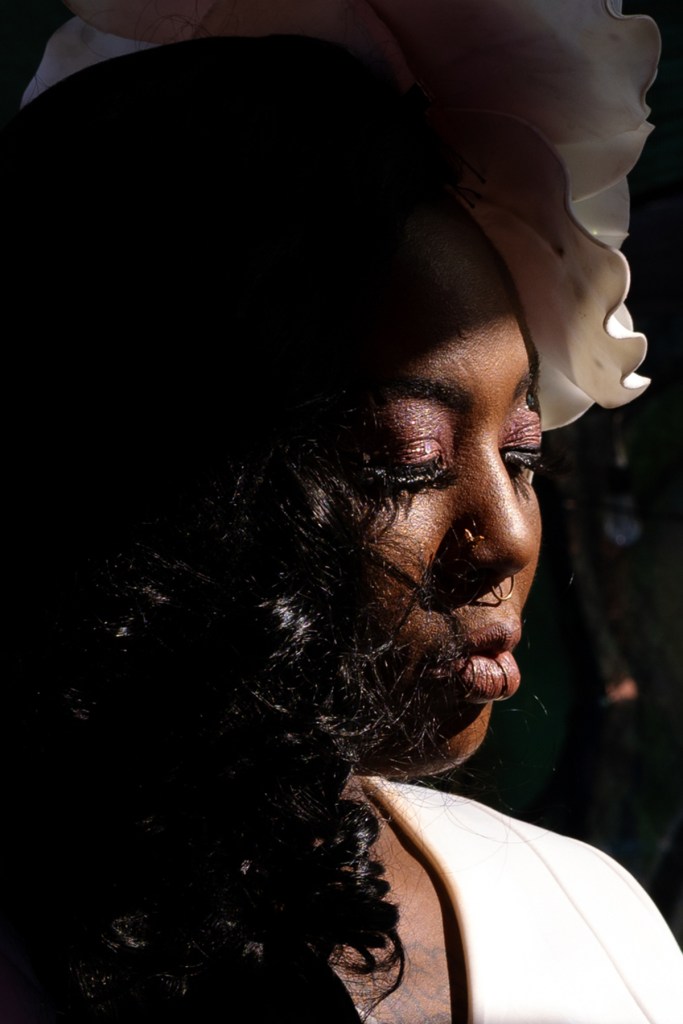
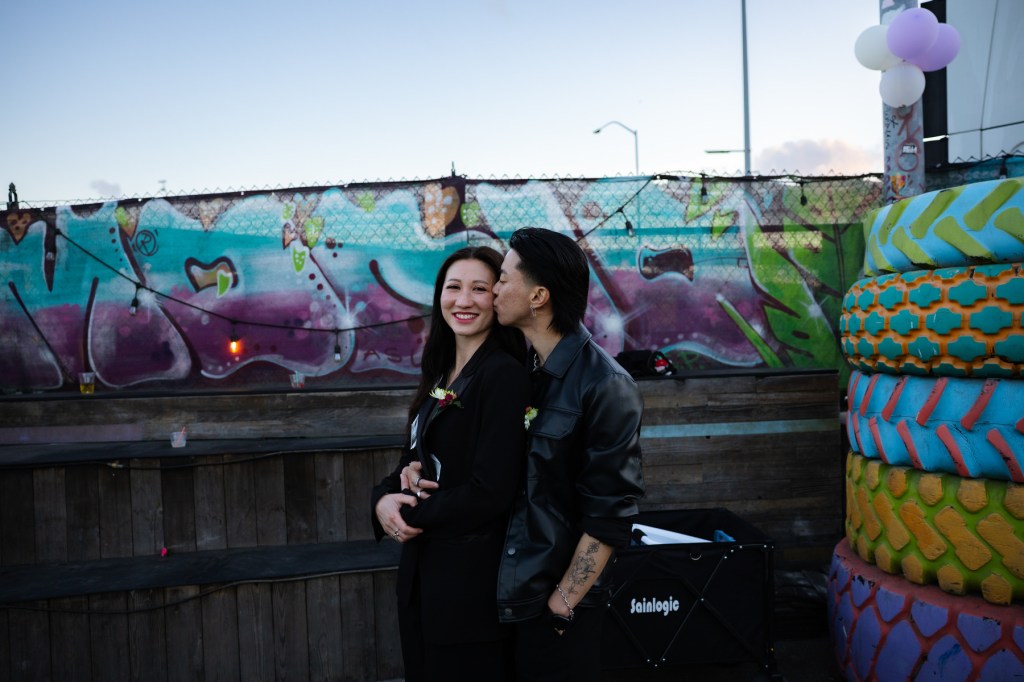
Terri Flamer attends Soulovely’s prom, held in the 14th season of Oakland’s QTPOC-centered monthly party. (Manuel Orbegozo for The 19th)
Event organizers are often working with limited resources amid challenging financial situations. Five queer BIPOC coordinators — Kike Ayorinde, Camryn Casey, Madi Dalton, dRi Guillén and Leslie Tellería — produce community-funded Lavender Evolutions (LE) events in D.C., and the ticket sales for each event contribute to the next event. In a collective statement, the organizers shared that they are largely unpaid but, “We do give core organizers small payments to cover things like gas, food during events, and the many hours of labor leading up to an event.” The LE organizers acknowledge that “money is a huge barrier and we could always use more of it, but for us, it’s more important that we have events that are financially accessible.”
They keep ticket prices below $25 to achieve that aim but struggle with the financial load of creating these pop-up spaces. The organizers say they are often unable to meet the market rates of DJs and other collaborators due to tight budgets, while logistical support frequently comes from community members willing to volunteer their time to assist with check-in and ticketing. Another challenge they face is making their work in building queer community attractive to funders. “Grant makers don’t always understand the scope of the work that we do and why it’s so important, especially in this moment,” organizers said.
Despite the challenges, organizers said the work is worthwhile. “We do experience burnout but we rely heavily on the collective,” the organizers said. “More than anything, we prioritize people. For our core organizers, it’s a delicate balance because our time and energy is limited. We’re all balancing our full-time jobs, life and Lavender, but the love of community keeps us going.”
They need us, we need them. It’s not always about the bottom dollar, sometimes it’s about building community and the dollars come after.Sgt. Die Wies
The 19th sent photographers to queer pop-up parties and events in Oakland, Washington, D.C., and Atlanta to show these spaces of radical queer joy in action and highlight the work that queer organizers are doing to build QTPOC community across the country.
OAKLAND
Soulovely has brought QTPOC-centered “cultural affairs” to the Bay Area for 14 years
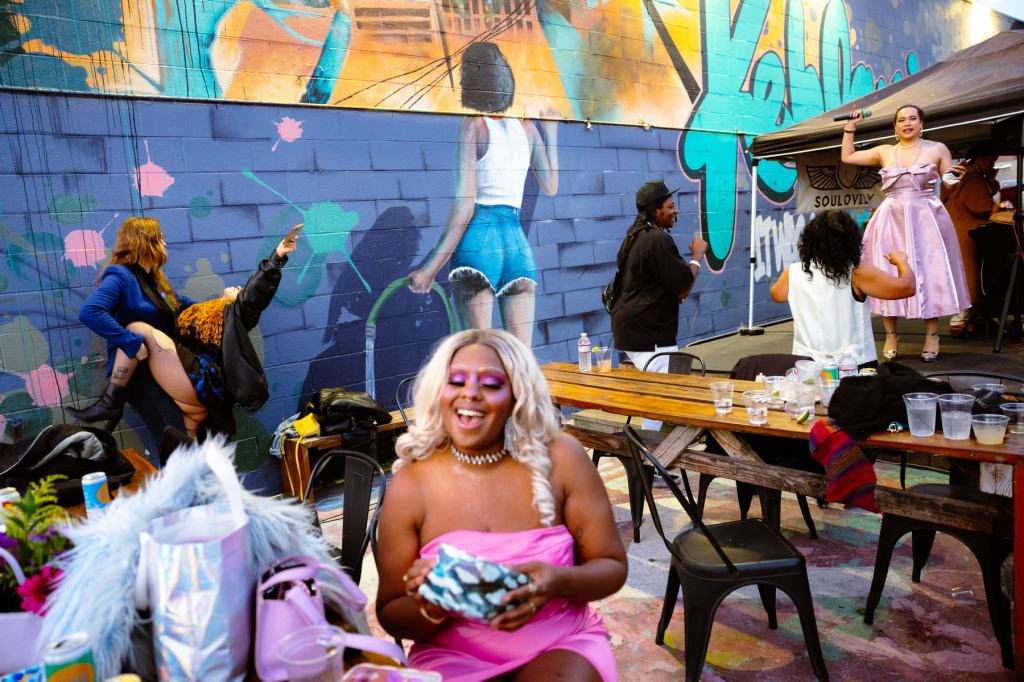
Many attendees of Soulovely’s prom said it was a first for them, providing queer and trans people of color (QTPOC) an opportunity to attend a prom in a safe and community-based setting. (Manuel Orbegozo for The 19th)
Soulovely is a beloved and long-lasting pillar of queer life in the Bay Area. Since 2011, its monthly events have served as a safe haven for a predominantly BIPOC queer community to celebrate their identities and bodies through music and dance. “I actually just found out that a loved one passed. So coming here was kind of like in honor of them as well, because they love to dance, I love to dance, we met out dancing — it brings people together,” said Mello-Jahlil Travis, who attended Soulovely in May.
Burlesque producer and performer Sgt. Die Wies attended the Soulovely queer prom on May 11 and says she thinks the space provides an opportunity to be “solution-based versus just focusing on the negativity. “ (Manuel Orbegozo for The 19th)
Attendees and organizers both are often quick to point out these spaces are not about excluding White, straight or otherwise non-QTPOC people. Rather they are about radical inclusion and belonging. Sgt. Die Wies, a burlesque producer and performer who attended the Soulovely queer prom in May, said that the party is all ages with a variety of ethnicities coming out to be together:“It’s beautiful to see because there’s so much division in the world right now.”
Mello-Jahlil Travis (they/them) said the Soulovely Prom gave them an opportunity to have a different prom experience. “I’m stoked to be here amongst other beautiful queer people. It’s important to be able to see people who look like you be themselves and feel free. There’s not everywhere that I feel like I can have my nails painted and dress like this. It’s dope to be around people who can receive that.” (Manuel Orbegozo for The 19th)
While all are welcome, Jaycee Chang especially appreciates the way Soulovely centers queer and trans people of color. “It is both a space of joy and being a community but also, it’s a relatively politicized space where they’re very intentional about the artists that they bring in, the DJs, the themes,” Chang said.
And that can even extend to their families.
“One of the DJs who helped host HabibiPot [in Los Angeles], her mom was there to watch her first DJ set and she played Arab classics that my own mom had introduced me to,” Prucha said. “They’re both Palestinian, and her mom was there, standing on the tables with the rest of us, and she was crying because she was so happy that her daughter was there and had found community.”
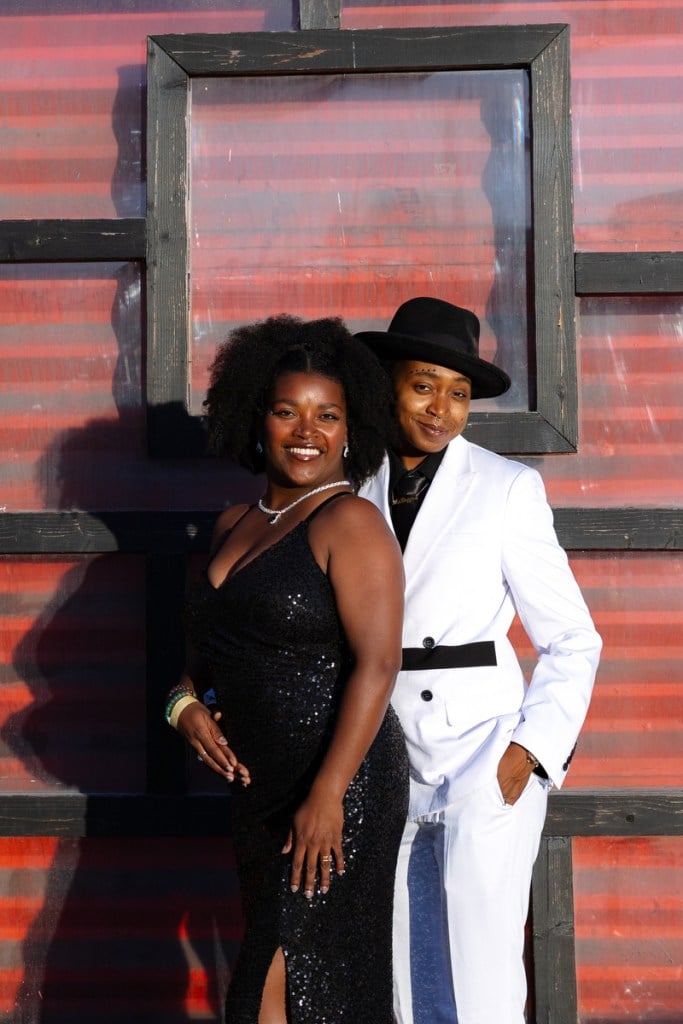
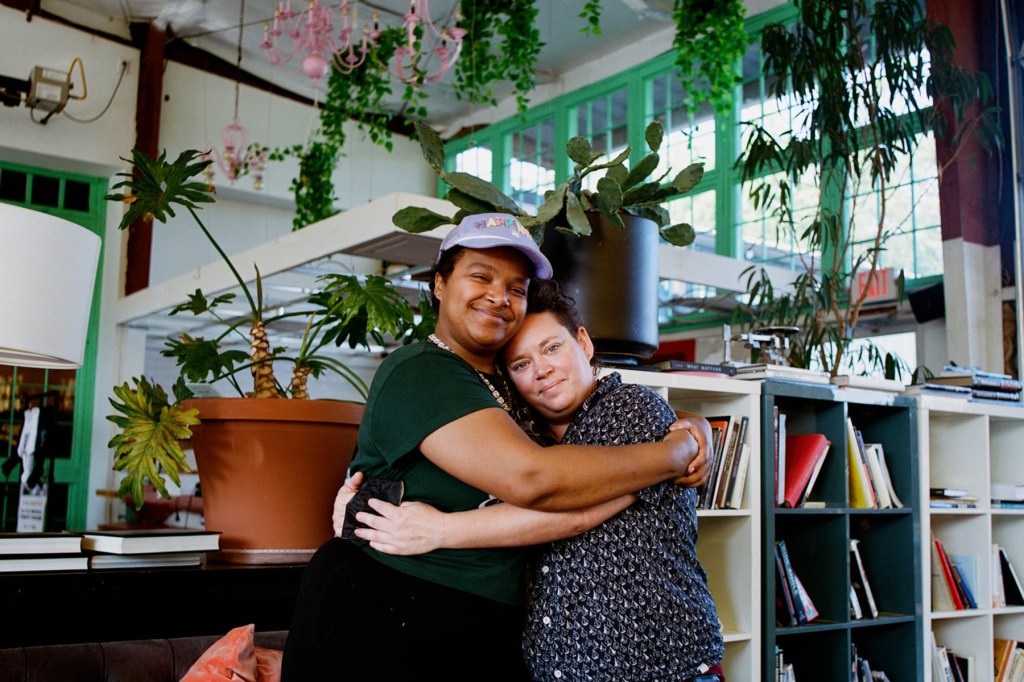
Tiara Reed (left) met her now-fiancée Chenelle Reed (right) at a Soulovely event and said “it’s so significant to have spaces where unapologetic joy and levity and freedom are welcome and everyone can just bask in it.” (Manuel Orbegozo for The 19th)
These spaces also provide opportunities for LGBTQ+ people to meet each other beyond dating apps. A 2020 Pew Research Center study reported that lesbian, gay and bisexual people were both more likely to use online dating and more likely to experience harassment through dating apps than their straight counterparts.
Soulovely is always part of our story.”Chenelle Reed
Ahn Lee feels safe at Soulovely parties because harassment is far less likely. “I feel like no one’s gonna try to come at me in a way that doesn’t feel comfortable,” Lee said.
Since 2011, Soulovely events have provided a safe haven for the queer BIPOC community in the Bay Area. (Manuel Orbegozo for The 19th)
And for others, like Tiara Reed and Chenelle Reed, Soulovely has become a character in their love story. Reflecting on the experience of meeting her now-fiancée, Tiara, at Soulovely and their future together, Chenelle said, “It’s going to be absolutely beautiful, because we have places like this … where you can connect and learn that anything is possible, family in all the ways is possible.”
Jaycee Chang (they/them, right) with their partner Ahn Lee (she/they, left), has been coming to Soulovely for over a decade. Chang said: “Even when the world is chaotic and there’s a lot of harm happening, we can come together as a community and create spaces that feel like refuge, like safety.” (Manuel Orbegozo for The 19th)
ATLANTA
Southern Fried Queer Pride builds QTPOC community through education and embodied healing
Grassroots collective Southern Fried Queer Pride (SFQP) — now in its 11th year — focuses its events toward “artivism” with a stated mission to fight narratives that confine Southern LGTBQ+ people to “stigma, statistics and struggle” instead aiming to uplift an “honest narrative of resilience, rich history and vibrance.” SFQP offers year-round programming, typically providing between 40 to 60 events that feature community education — like the upcoming trans health care workshop — as well as gallery shows, marches and dance parties, such as its June trans cabaret and open mic.
Maya Wiseman (left) and Magdalena (right) have both volunteered for SFQP for years and say organization offers a space of respite and community connection for them. (Piera Moore for The 19th)
Community organizer Maya Wiseman said the May 18 SFQP Community Potluck was an alcohol-free and masks-required event to further expand on their inclusiveness, which has become a hallmark of SFQP events. “Queer folks have been marginalized throughout time, but often queer folks, whether they know it or not, naturally end up creating safe spaces for everyone,” said Wiseman, who has worked with SFQP as a community organizer for six years. “We try to create spaces that say ‘come as you are,’ because we’re not having this at a club. If you want to come here in pajamas, in a tank top and shorts, it’s fine with us.”
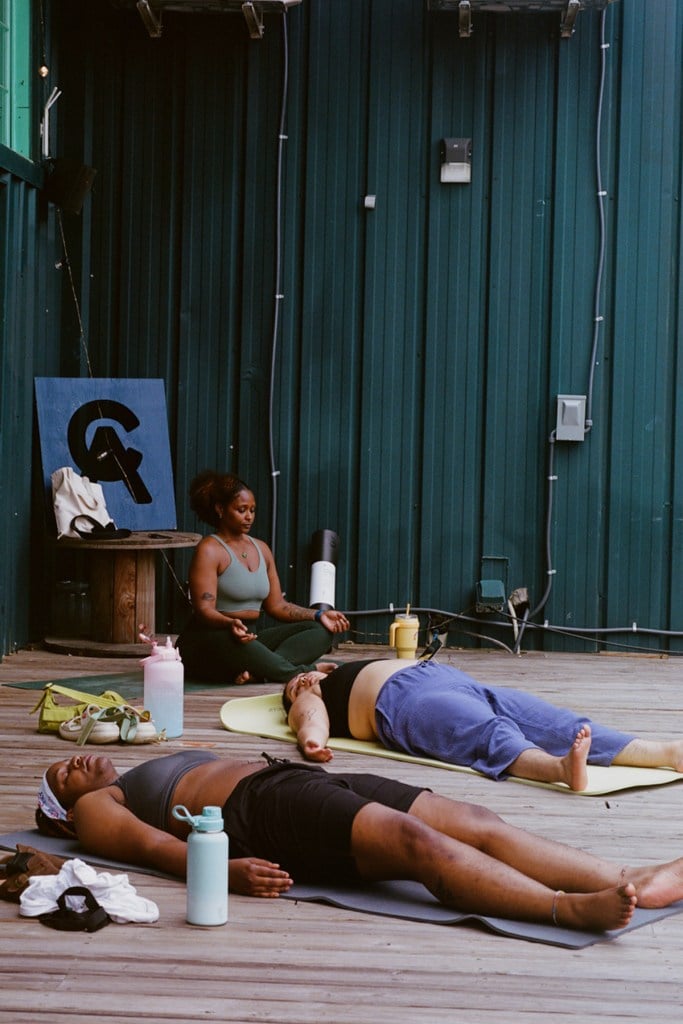
Southern Fried Queer Pride offered yoga at its May 18 community potluck in Atlanta. (Piera Moore for The 19th)
Atlanta’s queer community is very easy to navigate, and SFQP is a big reason why.”Magdalena
WASHINGTON, D.C.
Lavender Evolutions and Alphabet Soup make space for QTPOC joy at summer day parties
Alphabet Soup Events uses a tiered ticket pricing system that recognizes the systemic financial issues queer and trans people of color face to increase racial diversity across its attendees. (Mariah Miranda for The 19th)
While not explicitly centering QTPOC, Alphabet Soup events, like the recent Daisy Dykes pool party, are “sapphic-focused” and find other ways to make their events inclusive and accessible for queer people of color. Tickets are available at different price tiers, with some lower-cost tickets allotted for BIPOC attendees.
A couple dances together at a pool party by Alphabet Soup Events. (Mariah Miranda for The 19th)
Adu Ogbagiorgis has witnessed a big shift in the racial makeup of Alphabet Soup parties after the organizer started this pricing practice, which they see as a welcome recognition that “Black queers have a different experience than White queers.” For Ogbagiorgis, this approach to ticketing shows they want people of color to come to the events. “So it’s really awesome to see that a lot of more predominantly White spaces are making space for Black queers,” they said.
Mackenzie Bolden said they can be themselves at Alphabet Soup events. “I feel like I can just embrace my skin, embrace my personality, embrace my queerness, embrace everything that is me. And that’s something I treasure and will never take for granted because of how often I don’t feel that way.”
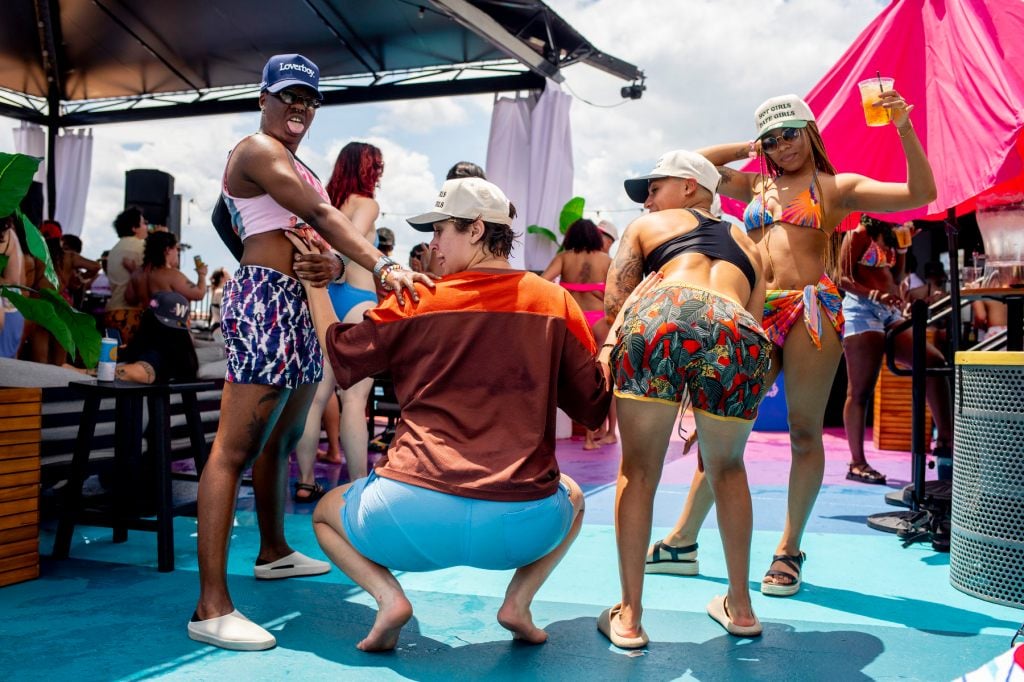
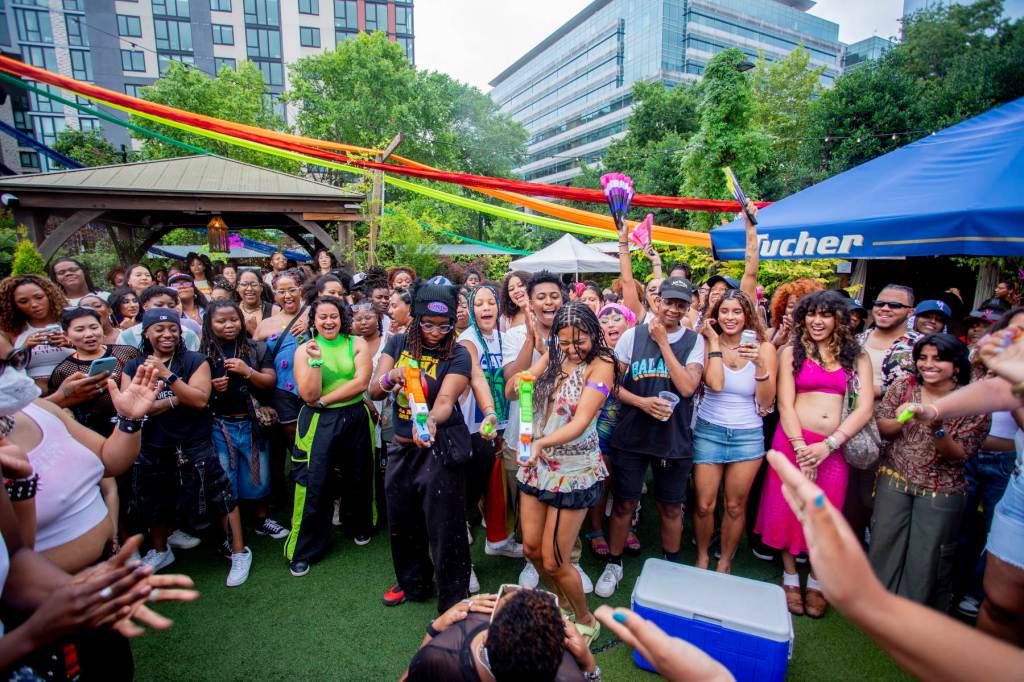
Lavender Evolution’s SWEAT party featured a wet t-shirt contest at on June 8 in D.C. (Mariah Miranda for The 19th)
Lavender Evolutions hosted a daytime beer garden pop-up called SWEAT on June 8 that featured a wet T-shirt contest, a water balloon toss and little cabanas filled with the sounds of multiple kikis.
Ciara Bridges whips out their fan while attending Lavender Evolution’s SWEAT party in D.C. on June 8. (Mariah Miranda for The 19th)
Jojo Morinvil, who attended the SWEAT party, deeply values the way Lavender Evolutions has been intentional in their creation of space for queer BIPOC people to enjoy themselves. “They started out doing nature walks and book [clubs], then, as they grew, they really created safer spaces for folks to socialize, to get to know people and learn queer history, [along with] events where you can dance and party with your friends,” Morinvil said.
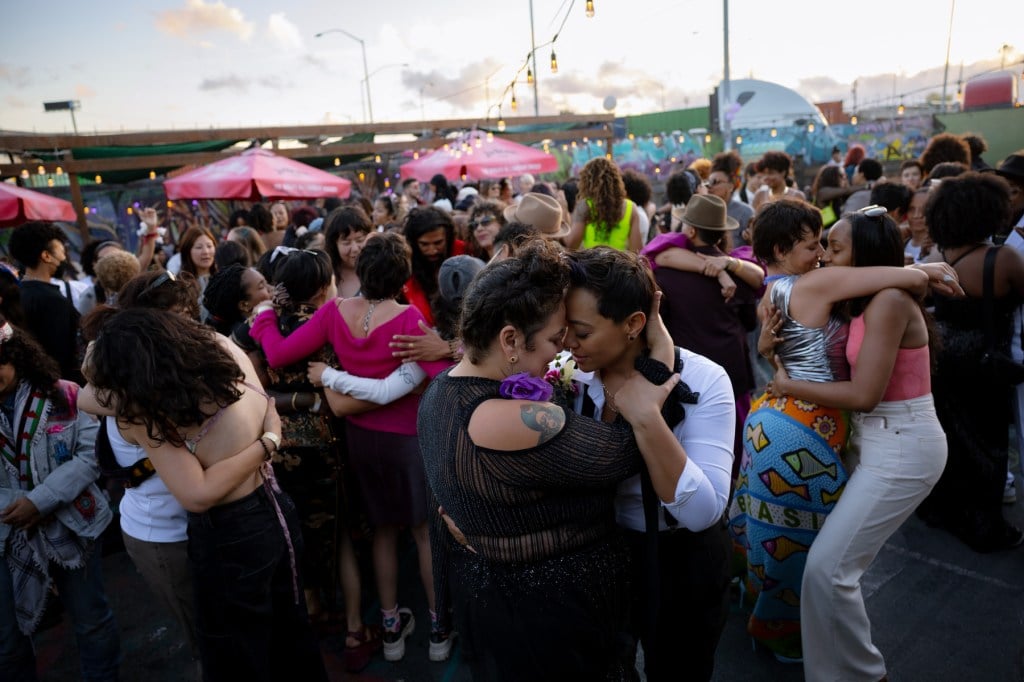
Couples and friends slow dance at Soulovely’s queer prom in Oakland on May 11. (Manuel Orbegozo for The 19th)
I truly believe that being whimsical will crush the patriarchy.”Sgt. Die Wies
Sgt. Die Wies points to the unabashed vibrance, love and joy experienced at parties like Soulovely as “things (that) are going to just crush the darkness. We’ve survived harder times than this. We’ve been bullied before. They ain’t got shit on us. There’s too many of us. There’s too much light and too much love and too much joy. We’ll be okay.”
Mariah Miranda, Piera Moore and Manuel Orbegozo contributed reporting.
June 25, 1948 The United States, Great Britain and France began the Berlin Airlift of food and supplies to the German city in defiance of the Soviet Union’s blockade of the roads. At the height of the Airlift, two groups of planes flew in four-hour blocks around the clock.While one group of aircraft was loaded and serviced, the other group was in the air. On the 264-mile route, 32 aircraft were in the air simultaneously. Supplies would be quickly unloaded and the aircraft would return for more food, fuel and other necessities for the 2.5 million West Berliners. It was the most ambitious aerial supply operation in history. The Soviet blockade was not lifted until the following May but the airlift continued for four months more. Berliners watch a plane involved in the Berlin Airlift bringing food and supplies About the Berlin Airlift
June 24, 1948 In Washington, D.C. President Harry Truman signed the Selective Service Act, creating a system for registering all men ages 18-25, and drafting them into the armed forces as the nation’s military needs required.
June 24, 1948 In Germany, the Soviet Union denied permission for Allied (U.S., France or Great Britain) forces to travel over Soviet-controlled territory to reach Allied-controlled West Berlin; the roads were allegedly closed for repairs and electricity was cut off to West Berlin. This was a blockade of food and all other supplies to the western enclave within East Germany and its population of more than two million.
June 24, 1970 The U.S. Senate voted overwhelmingly to repeal the Gulf of Tonkin Resolution. The resolution, which had authorized the president “to take all necessary measures to repel any armed attack against the forces of the United States,” was used by President Lyndon Johnson, absent a formal congressional, and constitutional, declaration of war, to justify open-ended pursuit of war in Vietnam. The resolution was passed in August, 1964 following a provocation by the U.S. destroyer Maddox in North Vietnamese territorial waters, which was portrayed as aggressive military action by North Vietnamese PT boats.
June 24, 1980 A general strike was held in El Salvador against death squads, primarily military or paramilitary units carrying out political assassinations and intimidation as part of the Salvadoran government’s counterinsurgency strategy. Salvadoran death squad destroying a village The U.S. government helped fund and train Salvadoran police forces. Questioned about the nature of the aid in a Senate hearing, Undersecretary of State for Latin American Affairs Elliott Abrams said, “I think that government has earned enough trust, as I think we have earned enough trust, not to be questioned, frankly, about exporting torture equipment. But I would certainly be in favor of giving it to them if they want it.” Noam Chomsky on El Salvador
June 23, 1683 “Tamanend,” sculpture by Raymon Sandoval, 1995, Front & Market Street in Philadelphia. Chief Tamanend (The Affable), leader of the Pennsylvania’s thirteen Lenni-Lenape tribes, and other chiefs went to Philadelphia to meet with William Penn. Penn wished to buy four parcels of land (most of current Montgomery County), and the chiefs agreed to the sale, each making their mark on the deeds which had been translated for them. Soon thereafter, Penn met with Tamanend at Shakamaxon under a large tree later known as the Treaty Elm. Penn said, “We have come here with a hearty desire to live with you in peace . . . We believe you will deal kindly and justly by us, and we will deal kindly and justly by you . . . .” Tamanend offered, “We will live in love with William Penn and his children, as long as the creeks and rivers run, and while the sun, moon, and stars endure.”
June 23, 1963 Reverend Martin Luther King, Jr. led a massive march down Detroit’s Woodward Avenue followed by a speech to a rally in Cobo Hall. The speech was essentially the same as that he delivered from the steps of the Lincoln Memorial in Washington, D.C. two months later, known as “I Have a Dream.” Photo of King speaking in Detroit from the Wayne State University’s Reuther Archive.
June 23, 1966 High school students in Grenada, Mississippi, tried to purchase tickets in the downstairs “white” section of the local movie theatre. Black moviegoers had always been required to sit in the balcony under Jim Crow segregationist laws. When they were refused tickets, they sat down on the sidewalk in front of the theatre. Fifteen were arrested, including Jim Bulloch, a Southern Christian Leadership Council (SCLC) organizer, who was charged with “inciting to riot.” Jim Bulloch, one of the SCLC organizers in Grenada, Mississippi Grenada Mississippi, 1966, Chronology of a Movement
June 23, 1972 Life magazine published a photo by Vietnamese photographer Nick Ut of children running from an attack with Napalm, an incendiary chemical weapon used widely by U.S. forces to burn out the jungle, thus eliminating cover (foliage) for North Vietnamese and Viet Cong troops. Napalm, a sticky mixture of gasoline, polystyrene and benzene that burns at very high temperature, had been used in WWII and Korea. Read about the photograph
June 23, 1972 The Education Amendments of 1972, commonly known as Title IX, became U.S. law, prohibiting sex discrimination at educational institutions. More infoText of the law
June 23, 1973 The International Court of Justice granted an injunction, requested by the Australia and New Zealand governments, against French nuclear weapons testing in the South Pacific.
because when the US does these things, they take place in all of our names whether we want it, or not. It’s part of why the power for these things lies in our legislature. The power does not rest with the executive unless the legislature votes to give it.
This summer will mark 80 years since the attacks stunned the world. Today, every one of the crew members who carried out the bombings is dead. Here, one of the last writers to interview them reopens his files
‘It was a beautiful morning. The sun was shining on the buildings. Everything down there was bright – very, very bright. You could see the city from 50 miles away, the rivers bisecting it, the aiming point. It was clear as a bell. It was perfect. The perfect mission.”
I’m sitting in a Chinese restaurant in San Francisco opposite the navigator of the Enola Gay, the B-29 bomber that dropped the atomic bomb on Hiroshima on 6 August 1945. The year is 2004, and Theodore “Dutch” Van Kirk, aged 83, has agreed to be interviewed for a book I’m writing for the 60th anniversary of that fateful mission. Van Kirk informs me, with the trace of a smile, that this will probably be the last interview in his life.
We have spent the afternoon looking through wartime logbooks from his 58 overseas combat missions. Now, between servings of dim sum, he is telling me about the 59th, the one that wiped out a city, along with well over 100,000 people.
“The instant the bomb left the bomb bay, we screamed into a steep diving turn to escape the shockwave. There were two – the first, like a very, very, very close burst of flak. Then we turned back to see Hiroshima. But you couldn’t see it. It was covered in smoke, dust, debris. And coming out of it was that mushroom cloud.”
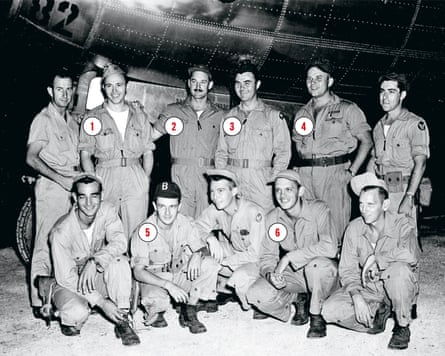
The crew of the B-29 bomber Enola Gay. Stephen Walker interviewed Theodore ‘Dutch’ Van Kirk, navigator (1); Tom Ferebee, bombardier (2); Paul Tibbets, pilot (3); Bob Lewis, co-pilot (4); George ‘Bob’ Caron, tail gunner (5); and Robert Shumard, assistant engineer (6). Photograph: Photogquest/Getty Images
He stops a moment, awe visibly registering on his face. “The city was gone. It was only three minutes since we’d dropped the bomb.”
Van Kirk died in 2014. In the years since we met, all the other crew members who flew on the missions to Hiroshima, and to Nagasaki three days later on 9 August, have also died. Meanwhile, the numbers of hibakusha, those who survived the attacks, are rapidly dwindling. We are passing into a twilight of history. As we approach the 80th anniversary of the atomic bombings, this biological fact seems disturbingly relevant. Twenty years ago, the world was a dangerous place. Today, it’s more so. More nations are developing nuclear weapons with few, if any, effective international controls. Tactical nuclear strikes have been explicitly threatened by Vladimir Putin and Kim Jong-un. And, just in the last week, war has broken out in the Middle East over fears that Iran may be very close to having a bomb. In such times, perspective matters. The shocked testimony of those like Van Kirk needs to be heard. History has lessons to teach us.
It was this thought that prompted me to reopen my files, to reread the transcripts of interviews with some of the crew members of both attacks. Much of this material was untouched for two decades; nothing relating to the Nagasaki mission was published. Here were some of the last testimonies of those who did the unthinkable. They were in their 80s or 90s, nearing the end of their lives. How did they remember it?
On 4 August 1945, Charles “Don” Albury, a 24-year-old B-29 pilot, was summoned to a secret briefing on Tinian, a Pacific island 1,500 miles south of Japan. Then the biggest bomber base in the world, Tinian was a jump-off point for a conveyor belt of the almost daily destruction of Japan. About 300,000 people had already died and 9 million were now homeless.
But Albury’s outfit had yet to take part in the attacks. Known as the 509th Composite Group, they occupied a secret compound on a far corner of the base. “Security was very, very tight,” Albury told me when I met him at his home in Orlando, Florida. Then aged 83, he grinned mischievously. “I remember one time the base commander got too near one of our planes. A guard nearly shot him.”
Even the 509th’s crews knew nothing about their ultimate missions. And they had been training for almost a year. First in Utah, later on Tinian: “We kept dropping practice bombs and flying these crazy steep turns. We did it day after day. For months.” But nobody told them why, and few dared ask. Those who did could find themselves swiftly dispatched by their leader, Paul Tibbets, a battle-hardened bomber pilot, to hardship posts above the Arctic Circle. “You learned to keep your mouth shut,” said Albury.
But in that 4 August briefing a part of the secret was about to be revealed.
Nine days earlier, on 26 July, President Truman had delivered his ultimatum to Japan in the Potsdam declaration: either surrender unconditionally, or face “prompt and utter destruction”. The means of that destruction was not specified. And Japan had not surrendered.
If I live for 100 years I will never get these few minutes out of my mind
I got a lot from reading and re-reading this. I tried to comment there, but WordPress sigh. Anyway, as a show of respect, here is this. Very good info and commentary
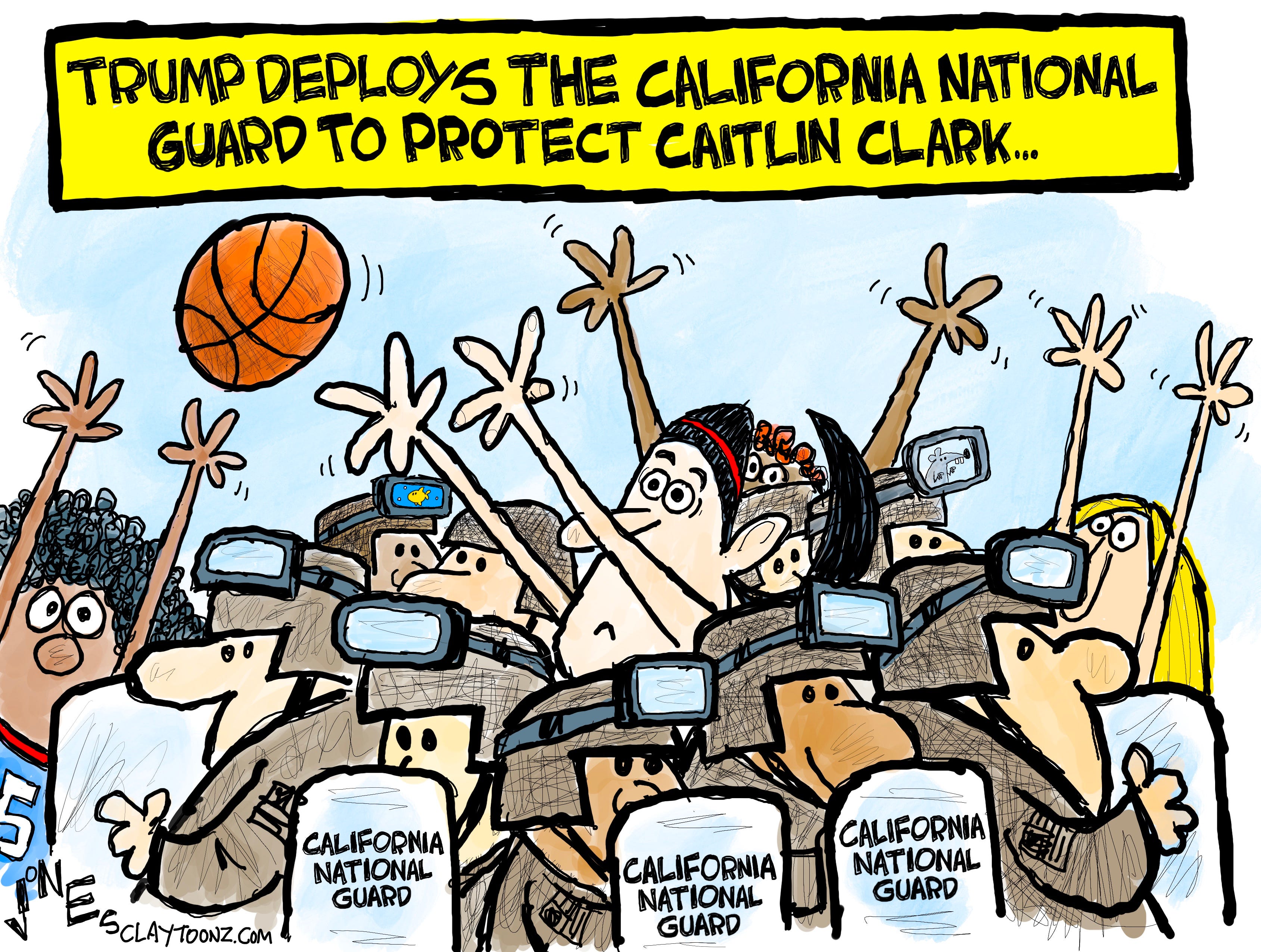
An appeals court is allowing Donald Trump to retain control of the California National Guard.
A three-judge panel of the San Francisco-based 9th U.S. Circuit Court of Appeals said Trump “probably” acted within his authority, and added that his administration “probably” complied with the requirement to coordinate with Governor Gavin Newsom, and even if it did not, he had no authority to veto Trump’s directive.
The panel, with two Trump-appointed judges and one Biden-appointed judge, is using “probably” a lot in their ruling. That’s probably a bunch of bullshit.
The law sets out three conditions that a president can federalize state National Guard forces; an invasion (which isn’t happening here), a “rebellion or danger of a rebellion” against the government (which isn’t happening here), or a situation in which the U.S. government is unable with regular forces to execute the country’s laws (another thing not happening here).
The appeals court said the final condition had probably been met because protesters hurled items at immigration authorities’ vehicles, used trash dumpsters as battering rams, threw Molotov cocktails, and vandalized property, frustrating law enforcement. There was that probably again. What about the cops shooting reporters? Which cop agency is enforcing that?
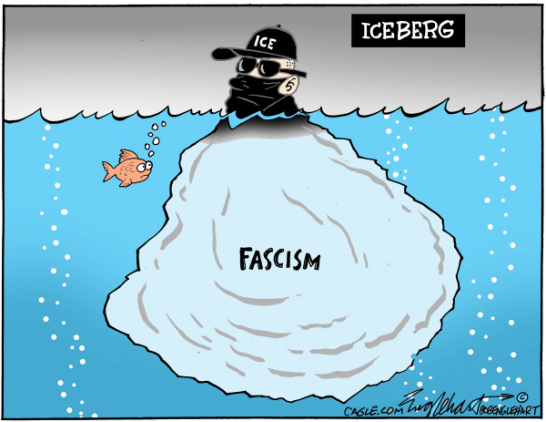
Yet, the governor never called the president (sic) to say that Los Angeles or California couldn’t execute the nation’s laws because ICE agents were having items thrown at them. And lately, ICE and Trump have been breaking more laws than protesters. Can we deploy a state’s National Guard to enforce laws on Trump?
The courts need to factor in that Trump deployed the National Guard to fight Californians. (snip-MORE, including Caitlin Clark)
I was admiring the view from my buddy’s backyard late yesterday afternoon when a hawk, or some kind of bird of prey, almost flew into my head. What?
The backyard overlooks a ravine. So the hawk was flying as usual, but his height decreased as he approached the hill, him not approaching the ground but the ground coming to him, and the next thing you know, he comes closer to objects on the ground, in this case, me. Bear with me, I’m making a point.
This did not happen on Tuesday, but it did happen yesterday, which was Wednesday (there may be some MAGAts reading, and they probably can’t figure out how a calendar works). What I’m telling you is that yesterday, there was a 100 percent increase in hawks nearly flying into my head.
Of course, I’m exaggerating. While the hawk did make me jump as it came from behind, it was probably about 15 to 20 feet away. Still, it was at my head level, though it wasn’t ever about to slam into me. I still jumped, but my point remains.
Immigration and Customs Enforcement and the Department of Homeland Security have both claimed multipletimes since May that there’s been a 413 percent increase in assaults against their agents to justify their wearing of masks to conceal their identities.
OK, DHS and ICE…since when? Since Trump took over the White House? I mean, gosh and golly gee wilikens, 413 percent is a lot. That is huge, right? You would think with such a huge increase in assaults that we’d hear more about it, especially since ICE agents are such huge victimized crybabies.
What action justifies being classified as an assault? I mean, if it’s the action New York City Comptroller and mayoral candidate Brad Landers committed when ICE illegally arrested him, then it’s not really much of an assault. When I was a kid, my mother used to threaten to beat me with a wet noodle. That threat of an “assault” never really scared me, and I was afraid of everything. The three things I was afraid of the most were sharks, tornadoes (before we even had Sharknadoes), and my mother. If you beat an ICE agent with a wet noodle, Kristi Noem would probably call it an assault.
I would have to know what kind of noodle would classify as an assault, only if it’s wet, of course. Would it have to be a spaghetti noodle, a linguine noodle, or a cork screw noodle? How about one of those Asian flat noodles? Maybe that could do some damage.
In a column for The Washington Post, Phillip Bump wrote, “That ICE uses a percentage is telling. A 413 percent increase could mean that the number of assaults went from 200 in 2024 to 1,026 in 2025 — or that it went from eight to 41.” Bump points out, “But there’s a big difference between an increase of 826 assaults and an increase of 33 — especially if some of those ‘assaults’ are of the Lander variety.”
If the assaults are of the Lander variety, then DHS and ICE are lying about the assaults. Also, if the assault by Landers was so bad, then why did ICE drop the charges, including assault, against him? (snip-MORE)
June 19, 1865 Known among African Americans as Juneteenth (also Freedom Day, Jubilee Day, Liberation Day, or Emancipation Day), this is the day enslaved people in Texas and parts of Louisiana learned they had been freed by President Abraham Lincoln’s Emancipation Proclamation. U.S. Major General Gordon Granger landed at Galveston, Texas, and announced the order that the slaves had been freed. This was two-and-a-half years after the Proclamation had taken effect January 1, 1863. It had stated, “that all persons held as slaves” within the rebellious (Confederate) states “shall be then, thenceforward, and forever free.” This had been kept from the slaves so the slaveowners could reap additional harvests, or because there weren’t enough Union soldiers to enforce the order until Granger arrived, but Juneteenth is the celebration of that day…. A Junetheenth celebration Richmond. Photo from Library of Congress (maybe 1921) Learn More About Juneteenth?New York Times “Black Joy—Not Corporate Acknowledgment—Is the Heart of Juneteenth”The Atlantic
June 19, 1964 Two hundred college students left Oxford, Ohio’s Western College for Women to join hundreds of other civil rights volunteers in Mississippi as part of “Freedom Summer.” Under the umbrella organization of COFO(Council of Federated Organizations) they worked on projects across the state.Led by SNCC (Student Non-Violent Coordinating Committee) and CORE (Congress of Racial Equality) field secretaries, they helped Negroes try to register to vote, they taught in Freedom Schools, participated in community organizing and, in doing so, endured the hostility toward civil rights work among whites in the deep South. “If we can crack Mississippi,” the students said, “we can crack segregation anywhere.” Mississippi Freedom Summer Volunteers singing We Shall Overcome, 1964< Student protestors are photographed by a policeman on Freedom Day in Greenwood, Mississippi in 1964. ROBERT MOSES, director of the 1964 Mississippi Summer Project and leader of the training program in Oxford, is shown here during a break in a session which he conducted in Jackson, Mississippi, to prepare African-Americans for politically effective action. more photos Good background on the need for a “Freedom Summer”
June 19, 1964 The Civil Rights Act of 1964 was approved after surviving an 83-day filibuster in the United States Senate. The new law, initiated and passed through the determination of President Lyndon Johnson and Senate Republican leader Everett Dirksen of Illinois, guaranteed for the first time equal access to public accommodations “without discrimination or segregation on the ground of race, color, religion, or national origin.” Massive demonstrations a year earlier ensured passage of the Acts The Senate had never before voted to end the filibuster of a civil rights bill, all of which were consistently opposed by the bloc of senators from the South. Following Senator Robert Byrd’s (D-West Virginia) 14+ hour-long speech, Senator Dirksen rose to speak, “We dare not temporize with the issue which is before us. It is essentially moral in character. It must be resolved. It will not go away. Its time has come.” About the Civil Rights Act
June 19, 1982 One thousand landowners occupied key islands in protest against French nuclear weapons tests at Kwajalein Atoll.The atoll, part of the Marshall Islands in the western Pacific Ocean, is about 2100 miles [3400 km] southwest of Hawaii and 1400 miles [2250 km] east of Guam. The island is now home to USAKA (United States Army Kwajalein Atoll), the Ronald Reagan Ballistic Missile Defense Test Site, and about 2000 support personnel and family members on Kwajalein and the islands Roi and Namur. Kwajalein Atoll Struggles of Pacific Islanders to stop nuclear testing
June 19, 1987 U.S. Supreme Court ruled teaching of creationism in public schools to be a violation of the U.S. constitution’s prohibition on establishment of religion by the government [Edwards v. Aguillard]. Students, parents and teachers had contested the Louisiana “Balanced Treatment for Creation-Science and Evolution-Science in Public School Instruction” law (Creationism Act). It required schools that taught evolution to also teach creation science. “The preeminent purpose of the Louisiana Legislature was clearly to advance the religious viewpoint that a supernatural being created humankind,” concluded Justice William Brennan in his majority opinion.
(I’m inserting this, because it’s not yet made it into the newsletter. -A) June 17, 2021 (for June 19) President Joe Biden declared Juneteenth a national holiday. Read a bit about the significance here, from the National Museum of African American History & Culture: “This year marks the second anniversary since President Joe Biden named Juneteenth a federal holiday in 2021. “As more Americans celebrate Juneteenth with family and community, it is vital to share the important historical legacy behind Juneteenth and recognize the long struggle to make it an officially recognized holiday. It is an opportunity to honor our country’s second Independence Day and reflect on our shared history and future. “The origins of Juneteenth date to June 1865. Even though the Emancipation Proclamation was signed by President Abraham Lincoln in 1863 and the Confederate army surrendered to the Union army in April 1865, enslaved people in Texas — the westernmost Confederate state — could not exercise their freedom until June 19, 1865. ‘On that date, Union General Gordon Granger led some 2,000 Union troops, many of whom were Black, into Galveston Bay, where they announced that the more than 250,000 enslaved Black people in the state were free by executive decree. This day came to be known as ‘Juneteenth,’ deriving its name from combining ‘June’ and ‘nineteenth.’” Read More
After reflecting further on Piers Akerman’s recent assertion that my analysis of the situation in the Middle East was “utter bullshit” and not tethered to reality, I realised how angry that made me feel. As a white, elderly, Anglo-Saxon male, I believe I have earned the right to be most distressed by Western privilege and the arrogance which so often distorts reality, much like a fairground mirror. It paints Palestinians as irrational terrorists and Iranians as fanatical mobs, erasing the colonial fingerprints smeared across their histories. That is the real bullshit.
Take Iran: a democracy overthrown in 1953 by Anglo-American operatives for the crime of nationalizing its oil. The CIA’s coup reinstated the Shah—a tyrant whose torture squads (trained by SAVAK and Mossad) disappeared thousands. When Iranians finally revolted in 1979, the West recoiled not at the Shah’s brutality but at the loss of a pliant client. Now, the same powers that strangled Iranian democracy lecture its theocrats on human rights—a grotesque pantomime.
I am sorry to say that Netanyahu embodies this hypocrisy. He rails against Iran’s “aggression” while annexing Palestinian land, arms settlers who burn olive groves, and starves Gaza into submission. His hysteria over Iran’s nuclear program (still unproven after decades of sanctions) mirrors the WMD lies he helped sell in 2003. Remember his cartoon bomb stunt at the UN? Pure theatre. What truly terrifies him isn’t ayatollahs with centrifuges but a regional order where Israel isn’t the unchecked hegemon.
The West has perfected a sinister alchemy of psychological inversion—an Orwellian recalibration of language that transforms resistance into terrorism, domination into peace, and sovereignty into existential threat. When Hamas fires rockets, it’s decried as barbarism, while Israel’s 56-year occupation of Palestinian land vanishes from view like morning mist. Apartheid walls that carve up stolen territory are rebranded as “security measures”, their concrete brutality softened by bureaucratic euphemisms. Iran’s civilian nuclear program sparks apocalyptic warnings, while Israel’s arsenal of 90 thermonuclear warheads—never inspected, never acknowledged—sits quietly in the Negev desert. This linguistic jujitsu doesn’t merely describe reality; it manufactures it, ensuring Western audiences see only mirrors and shadows where power and oppression stand plain as day.
I urge you to consider that none of this emerged in a vacuum. The US and UK engineered the Middle East’s instability—from Sykes-Picot’s arbitrary borders to arming Saddam against Iran, then crying havoc when blowback came. October 7th didn’t erupt from ancient hatreds; it was the predictable eruption of a people caged, humiliated, and drone-struck for generations. To focus solely on Hamas’ atrocities while ignoring Israel’s 56-year occupation is like condemning a burning man for screaming.
There can be no meaningful progress without first confronting uncomfortable truths. The West must reckon with its destructive legacy—the CIA’s 1953 coup in Iran that strangled democracy, the 1967 war that birthed an occupation now in its sixth decade, and the 2003 invasion of Iraq based on fabricated WMD claims. These aren’t ancient histories but open wounds that continue to shape regional dynamics. Pretending otherwise isn’t diplomacy; it’s willful blindness.
Netanyahu’s hysterical warnings about “existential threats” must be exposed for what they are—not genuine security concerns but a naked fear of justice. His real nightmare isn’t Iranian centrifuges but the collapse of the apartheid system that preserves Jewish supremacy from the Jordan River to the Mediterranean. Every settlement expansion, every Gaza blockade, and every racist nation-state law reveals the true project: not coexistence but permanent domination.
We must fearlessly reject the false symmetry of “both sides” narratives. While Israelis live with the psychological trauma of potential violence, Palestinians endure the daily reality of military checkpoints, land theft, and indiscriminate bombardment. Comparing Hamas rockets to Israel’s occupation is like comparing a slingshot to a tank battalion—technically both weapons, but existing in fundamentally different universes of destructive power. True peace begins when we stop equating the oppressed with their oppressors.
The future demands more than temporary ceasefires. It requires dismantling the myths that let the West play both arsonist and firefighter. Otherwise, we’re just counting the days until the next explosion.













 <


