
Category: Military
Peace & Justice History for 2/9

| February 9, 1780 Captain Paul Cuffe, his brother John, two free negroes, and other residents of Massachusetts petitioned the state legislature for the right to vote. A few years earlier, Cuffe and his brother had refused to pay local taxes, reasoning that there was a connection between an obligation to pay taxes to a government and the right to vote for that government.  Captain Paul Cuffe Cuffe’s memoir available Cuffe’s career as ship captain, shipowner, African colonizer and generous citizen |
| February 9, 1950 United States Senator Joseph P. McCarthy (R-Wisconsin) accused more than 200 staff members in the State Department of being Communists, launching his anti-red crusade. He made the allegation in a public speech in Wheeling, West Virginia, saying that state was infested with communists, and brandished a sheet of paper which he said contained the alleged traitors’ names.  “I have here in my hand,” he said, “the names of 205 men that were known to the Secretary of State [Dean Acheson] as being members of the Communist party and who nevertheless are still working and shaping the policy of the State Department.” The number changed repeatedly over the following months. Some years later, he confided the paper was actually just a laundry list. Anti-Communist fear ran high in the U.S. at the time. Federal civil servant and Soviet spy Alger Hiss had been recently convicted, and a communist government had just come into power in China. Those accused by McCarthy and others often lost their jobs, regardless of the validity of the accusation of their connection to the Communist Party. McCarthy’s career of irresponsible accusation Joe McCarthy’s Oversight Abuses (The Levin Center) Released 50 years later, transcripts of closed committee hearings reveal more abuse |
February 9, 1964 The G.I. JOE action figure made its debut as an 11.5 inch “doll” for boys with 21 moving parts, named after the movie, The Story of G.I. JOE.  Puts you in the action! |
| February 9, 1965 President Lyndon Johnson ordered a U.S. Marine Corps Hawk air defense missile battalion deployed to Da Nang, South Vietnam, to provide protection for the key U.S. air base there. American military advisers had been in country since the defeat and withdrawal of the French in 1954, but this was the first commitment of combat troops to South Vietnam.There was considerable reaction around the world to this new level of U.S. involvement. Both the People’s Republic of China and the Soviet Union threatened to intervene if the United States continued its military support of the South Vietnamese government. In Moscow, some 2,000 demonstrators, led by Vietnamese and Chinese students and clearly supported by the authorities, attacked the U.S. Embassy. Britain and Australia supported the U.S. action, but France called for negotiations.  A Marine HAWK missile launcher is in position at the Danang Airfield. |
| February 9, 2002 Ten thousand, organized by Gush Shalom (peace bloc in Hebrew), a coalition of Israeli peace groups, marched in Tel Aviv against the Ariel Sharon government’s increasingly brutal attacks on Palestinian civilians. The harsh tactics were part of Israel’s continuing occupation of the West Bank (of the Jordan River) and the Gaza Strip, territory beyond Israel’s internationally recognized 1967 borders. |
| February 9, 2003 Six weeks before the Iraq War began, Secretary of State Colin Powell on ABC-TV’s “This Week” dismissed the need for U.N. weapons inspectors to continue searching Iraq for weapons of mass destruction. He said the administration saw no further need for ”inspectors to play detectives or Inspector Clouseau running all over Iraq.” Clouseau was the bumbling detective played originally by Peter Sellers (and lately Steve Martin) in the Pink Panther films.  Peter Sellers as Inspector Clouseau U.N. weapons inspectors, left, and Iraqi National Monitoring Directorate members visit a Baghdad storage facility in this photo taken Feb. 5, 2003, just hours before U.S. Secretary of State Colin Powell appeared at the U.N. Security Council to offer evidence of alleged Iraqi attempts to hide banned weapons.  |
https://www.peacebuttons.info/E-News/peacehistoryfebruary.htm#february9
Peace & Justice History for 2/8

| February 8, 1962 More than 20,000 attended a demonstration in Paris against the Secret Army Organization (Organisation de l’Armée Secrète or OAS), a group of European-Algerians which used terrorist methods to keep Algeria a French colony. They set off bombs in Metropolitan France and made multiple attempts on President Charles DeGaulle’s life. DeGaulle had chosen a referendum among Algerians to decide their independence; Europeans were outnumbered 9:1 by the native population of Sunni Muslim Arabs and Berbers. The demonstration was held in violation of a declared state of emergency (because of OAS actions) and, in the subsequent rioting, at least eight people were killed and 240 injured (half of them police officers).  The terrorist crimes of the OAS |
| February 8, 1968 The Orangeburg Masssacre  Three black students were killed and 50 wounded in a confrontation with highway patrolmen at a South Carolina State rally supporting arrested civil rights protesters. Orangeburg’s only bowling alley, the All Star, was still segregated years after the Civil Rights Act of 1964 had outlawed discrimination based on race in such public accommodations. On the previous two days, college students had entered the bowling alley, refusing to leave after they were not allowed to bowl. Fifteen of the second group were arrested. The Orangeburg Massacre (2 links) |
| February 8, 1980 President Jimmy Carter unveiled a plan to re-introduce draft registration. |
https://www.peacebuttons.info/E-News/peacehistoryfebruary.htm#february8
Peace & Justice History for 2/5
| February 5, 1830 America’s first daily labor newspaper began publication in New York City. George Henry Evans, a 29-year-old journeyman printer, was the publisher of “New York Daily Sentinel.”  George Henry Evans More about George Henry Evans |
| February 5, 1991 49 German troops conscientiously objected to serving in Turkey during the Gulf War. The German peace movement actively supported U.S. soldiers stationed there by helping them file for conscientious objector (CO) status. By the end of the month, there were nearly 30,000 civilian COs refusing to serve in the military. |
February 5, 2007 Lieutenant Ehren Watada Lieutenant Ehren Watada faced a court martial for refusing to deploy to Iraq and for publicly criticizing the war, the first officer since Vietnam to be so tried. A volunteer from Hawaii who joined the U.S. Army prior to the invasion in 2003, he had refused to serve because: “It would be a violation of my oath because this war to me is illegal in the sense that it was waged in deception, and it was also in violation of international law.” Initially having served in South Korea, he learned more about the Iraqi conflict and the bogus claims of Saddam Hussein’s possession of weapons of mass destruction. He offered to resign or serve in Afghanistan but was refused: “Mistakes can happen but to think that it was deliberate and that a careful deception was done on the American people – you just had to question who you are as a serviceman, as an American.” |
https://www.peacebuttons.info/E-News/peacehistoryfebruary.htm#february5
Some TizzyEnt clips. They are mostly short with the longest a few seconds over 5 minutes.
Literally Watching Again In Real Time, Peace & Justice History For 2/2
| February 2, 1779 Anthony Benezet and John Woolman, both prominent Quakers (Society of Friends), urged refusal to pay taxes used for arming against Indians in Pennsylvania. Since William Penn established the state two generations earlier, the Friends had dealt with the Indian tribes nonviolently, and had been treated likewise by the native Americans. Benezet and the Quakers were also early and consistent opponents of slavery.  More about Anthony Benezet |
| February 2, 1848 The Treaty of Guadalupe Hidalgo was signed in the Mexican city of the same name, ending the Mexican War. In 1845 Congress had voted to annex Texas, and President James K. Polk sent General Zachary Taylor and troops to patrol the border, newly defined by Congress as the Rio Grande, though it previously had been the Nueces River. Following an encounter between Mexican and U.S. troops, Polk called for Congress to declare war on Mexico. General Winfield Scott and troops eventually seized Mexico City.The treaty’s provisions called for Mexico to cede 55% of its territory (present-day California, Nevada and Utah, New Mexico, most of Arizona, and portions of New Mexico, Wyoming and Colorado), and to recognize the Rio Grande as the southern border of Texas, in exchange for fifteen million dollars in compensation for war-related damage to Mexican property. According to the treaty, U.S. citizenship was offered to any Mexicans living in the 500,000 sq miles (1.3 million sq km) of new U.S. territory.  Land ceded to the U.S. after the Mexican War. The Treaty of Guadalupe Hidalgo |
| February 2, 1931 The first of well over 400,000 Mexican-Americans from across the country, some of them citizens and many of them U.S. residents for as long as 40 years, were “repatriated” as Los Angeles Chicanos were forcibly deported to Mexico. More on those deported, Los Repatriados |
| February 2, 1932 The Conference on the Reduction and Limitation of Arms, the world’s first disarmament meeting, opened in Geneva, Switzerland. Sponsored by the League of Nations, and attended by delegates from 60 nations, no agreement was reached. The U.S. delegation called for the abolition of all offensive weapons as the basis for negotiations but found little support. |
| February 2, 1966 The first burning of Australian military conscription papers as a protest against the Vietnam War occurred in Sydney, Australia.  |
February 2, 1970 Bertrand Russell later in life Bertrand Russell, mathematician, Nobel laureate in literature and philosopher of peace, died in Penryndeudreaeth, Merioneth, in Wales at age 97.  Bertrand Russell at age 10 “Patriots always talk of dying for their country but never of killing for their country.” — Bertrand Russell More of Russell’s wisdom |
| February 2, 1980 Reports surfaced that the FBI had conducted a sting operation targeting members of Congress. In what became known as ”Abscam,” members suspected of taking bribes were invited to meetings with FBI agents posing as Arab businessmen, offering $50,000 and $100,000 payments for special legislation. Audio and video recordings of the meetings were made surreptitiously. Six members of the house were convicted of accepting bribes. Another member of the House and one senator were targeted but took no money.  FBI agents in Abscam sting operation Actual FBI videotape of one attempted scam |
February 2, 1989 Soviet participation in the war in Afghanistan ended as Red Army troops withdrew from the capital city of Kabul. They left behind many of their arms for use by Afghan government forces. They were driven out principally by the insurgent mujahadin, armed through covert U.S. funding. Read more “Charlie Wilson’s War” movie trailer |
| February 2, 1990 South African President F.W. De Klerk unbanned (lifted the legal prohibition on) opposition parties: the African National Congress (ANC), the Pan-Africanist Congress and the South African Communist party were officially considered legal. He also announced the lifting of restrictions on the UDF, COSATU and thirty-three other anti-apartheid organizations, as well as the release of all political prisoners and the suspension of the death penalty. This was the result of his negotiations with the imprisoned Nelson Mandela, a leader of the ANC. The ecstatic reaction to De Klerk’s beginning the end of apartheid on BBC video |
Peace & Justice History for 2/1

February 1, 1960 Greensboro first day: Ezell A. Blair, Jr. (now Jibreel Khazan), Franklin E. McCain, Joseph A. McNeil, and David L. Richmond leave the Woolworth store after the first sit-in on February 1, 1960. Four black college students sat down at the Woolworth’s lunch counter in Greensboro, North Carolina, and were refused service because of their race. To protest the segregation of the eating facilities, they remained and sat-in at the lunch counter until the store closed. Four students returned the next day, and the same thing happened. Similar protests subsequently took place all over the South and in some northern communities. By September 1961, more than 70,000 students, both white and black, had participated, with many arrested, during sit-ins.  On the second day of the Greensboro sit-in, Joseph A. McNeil and Franklin E. McCain are joined by William Smith and Clarence Henderson at the Woolworth lunch counter in Greensboro, North Carolina. “Segregation makes me feel that I’m unwanted,” Joseph McNeil, one of the four, said later in an interview, “I don’t want my children exposed to it.” Listen to Franklin McCain’s account of what happened |
| February 1, 1961 On the first anniversary of the Greensboro sit-in, there were demonstrations all across the south, including a Nashville movie theater desegregation campaign (which sparked similar tactics in 10 other cities). Nine students were arrested at a lunch counter in Rock Hill, South Carolina, and chose to take 30 days hard labor on a road gang. The next week, four other students repeated the sit-in, also chose jail. |
February 1, 1968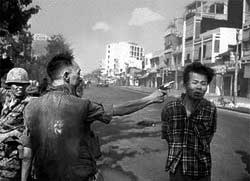 General Nguyen Ngoc Loan executes Nguyen Van Lem a NLF officer. Saigon police chief Nguyen Ngoc Loan summarily executed Nguyen Van Lem, suspected leader of a National Liberation Front (NLF aka Viet Cong) assassination platoon, with a pistol shot to the head on the street. AP photojournalist Eddie Adams’s Pulitzer Prize-winning photograph of the incident became one of the most famous, ubiquitous and lasting images of the war in Vietnam, affecting international and American public opinion regarding the war. |
https://www.peacebuttons.info/E-News/peacehistoryfebruary.htm#february1
Peace & Justice History for 1/31
| January 31, 1865 The U.S. House of Representatives passed (119-56) the 13th constitutional amendment which abolished slavery, and sent it to the states for ratification (three-quarters of the states would do so by the end of the year). The Kentucky legislature didn’t vote to ratify until 1976. Mississippi’s legislature finally ratified it in 1995 but failed to submit the paperwork to the federal government until 2013. Text of the amendment: “Neither slavery nor involuntary servitude, except as a punishment for crime whereof the party shall have been duly convicted, shall exist within the United States, or any place subject to their jurisdiction.” More about the 13th Amendment |
January 31, 1876 Sitting Bull: One of several chiefs who refused to comply. The U.S. government ordered that all Native Americans had to move to reservations by this date or be declared hostile. Most Sioux did not even hear of the ultimatum until after the deadline. |
January 31, 1945 Eddie Slovik Private Eddie Slovik became the first American soldier since the Civil War to be executed for desertion, and the only one who suffered such a fate during World War II.Supreme Allied Commander Dwight D. Eisenhower ordered Slovik’s execution be carried out, he said, to avoid further desertions in the late stages of the war.  Eisenhower |
| January 31, 1950 U.S. President Harry S. Truman publicly announced his decision to support the development of the hydrogen (fusion) bomb, a weapon theorized to be hundreds of times more powerful than the atomic (fission) bombs dropped on Japan at the end of World War II.  |
| January 31, 1971 The Winter Soldier Hearings began in a Howard Johnson’s motel in Detroit. Sponsored by Vietnam Veterans Against the War, the three days of hearings were an attempt by soldiers who had served in Vietnam to inform the public of the realities of U.S. conduct in the war. The veterans testified that the My Lai massacre was not an isolated incident, and that some American troops had committed atrocities.   Among those who spoke about aspects of their service in Vietnam was John Kerry, a former Navy lieutenant and future senator and presidential candidate. More than 100 veterans testified to sometimes brutal acts. Oregon Senator Mark Hatfield later entered the transcript of the Winter Soldier hearings into the Congressional Record but, otherwise, the proceedings captured little attention.  The term “winter soldier” is a play on words of Thomas Paine in 1776. He spoke of the “sunshine patriot and summertime soldiers” who deserted at Valley Forge because the going was rough. Winter Soldier film watch the trailer (appox 4 minutes) watch the entire movie (1:35) VVAW/Winter Soldier Organization |
| January 31, 1993 300,000 Berliners rallied to protest attacks on immigrants, and against racism and renewed support for Nazism on the 60th anniversary of Adolf Hitler’s rise to power. During the previous year there had been 2,285 racially motivated attacks, including 77 against Jewish sites, and the death of two young Turkish girls in an arson attack. |
https://www.peacebuttons.info/E-News/peacehistoryjanuary.htm#january31
An Informational Resource
I receive Economic Policy Institute’s newsletter for general info about which I contact my congresscritters. EPI have opened a page dedicated to what the White House, the Legislature, and the courts are doing that affect working people. I figure, first of all, forewarned is forearmed, as to little things that may not be loudly reported but which affect us regular people just out here trying to live our lives. So, here’s a link and a snippet. When a person goes on the page, you can get your choice of newsletters in your email box, if you care to; or you can just look around. Thanks for checking it out-I think it will help people.
======
Snippet: (and page link)
Featured
This week in Federal Policy Watch
Trump administration undermines federal workers, immigrants, and DEI programs. Read more
The origin of Federal Policy Watch
EPI’s 2017 Perkins Project on Worker Rights and Wages tracked the first year of the first Trump administration.
Learn more
(Lots more on the page. It offers a filter, so you can be sure to see that which affects you and those for whom you care.)
Peace & Justice History for 1/30
Longest. January. Ever. But it’s also Fred Korematsu Day-Woot!
| January 30, 1948 Mohandas K. Gandhi was killed in Delhi by an assassin, a fellow Hindu, who fired three shots from a pistol at a range of three feet. An American reporter who saw it happen |
| January 30, 1956 As Martin Luther King, Jr. stood at the pulpit, leading a mass meeting during the Montgomery, Alab ama, bus boycott, his home was bombed. King’s wife and 10-week-old baby escaped unharmed. Later in the evening, as thousands of angry African Americans assembled on King’s lawn, he appeared on his front porch, and told them: “If you have weapons, take them home . . . We cannot solve this problem through retaliatory violence . . . We must love our white brothers, no matter what they do to us.”  Martin Luther King, Jr. and wife Coretta Scott, 1960 |
| January 30, 1968 The Tet (lunar new year) Offensive began as North Vietnamese and Viet Cong forces launched surprise attacks against major cities, provincial and district capitals in South Vietnam. Though an attack had been anticipated, half of the South’s ARVN troops (Army of the Republic of Vietnam) were on leave because of the holiday. There were attacks in Saigon (the South’s capital) on the Independence Palace (the residence of the president), the radio station, the ARVN’s joint General Staff Compound, Tan Son Nhut airfield, and the United States embassy, causing considerable damage and throwing the city into turmoil. |
| January 30, 1972 In Londonderry (aka Derry), Northern Ireland, unarmed civil rights demonstrators were shot dead by British Army paratroopers in an event that became known as “Bloody Sunday.” The protesters, all Catholics, had been marching in protest of the British policy of internment without trial of suspected Irish nationalists. British authorities had ordered the march banned, and sent troops to confront the demonstrators when it went ahead. The soldiers fired indiscriminately into the crowd of protesters, ultimately killing 14 and wounding 17. By the end of the year 323 civilians and 144 military and paramilitary personnel would be dead.   Mural: Bloody Sunday martyrs Eyewitness accounts |
January 30, 2010 Thousands of protesters from across Japan marched in central Tokyo to protest the U.S. military presence on Okinawa. Some 47,000 U.S. troops are stationed in Japan, with more than half on the southern island of Okinawa. Residents have complained for years about noise, pollution and crime around the bases. News about the protest (This link is to the 2016 protest; P&J’s link for the 2010 protest links to Not Found.) |
January 30, since 2011 Fred Korematsu Day Fred Korematsu Fred Korematsu, was born in Oakland, California, to a Japanese-American family. When World War II broke out Japanese-American citizens were subject to curfews and, following an executive order from Pres. Roosevelt, were sent to internment camps. Fred Korematsu refused to go and was convicted and sent to a camp. He challenged the constitutionality of Executive Order 9066 all the way to the Supreme Court. In 1944 the Supreme court ruled against him. Finally in 1983, a Federal court in San Francisco overturned the original conviction. In 1988 Congress passed legislation apologizing for the internments and awarded each survivor $20,000. The “Fred Korematsu Day of Civil Liberties and the Constitution” is observed every January 30th and in an increasing number of states. “Protest, but not with violence. Don’t be afraid to speak up. One person can make a difference, even if it takes 40 years…” – Fred Korematsu More about Fred Korematsu |
https://www.peacebuttons.info/E-News/peacehistoryjanuary.htm#january30

