President Donald Trump made only a smattering of false claims in his inaugural address on Monday, mostly sticking to vague rhetoric, subjective assertions and uncheckable promises of action.
But then he embarked on a lying spree.
In an unscripted second speech on Monday, to supporters who had gathered in the US Capitol Visitor Center’s Emancipation Hall, Trump made false claims about elections, immigration and the Capitol riot on January 6, 2021, among other subjects. He then made additional false claims in a freewheeling third speech at Washington’s Capital One Arena and again while speaking to reporters as he signed executive orders in the Oval Office.
Here is a fact check of some of his Monday claims.
Trump’s tariffs on China: In the Oval Office, Trump repeated his false claim that the US has “taken in hundreds of billions of dollars from China” through the tariffs he imposed during his first presidency. US importers make the tariff payments, not China, and study after study has found that Americans bore the overwhelming majority of the cost of Trump’s tariffs on China; it’s easy to find specific examples of companies that passed along the cost of the tariffs to US consumers.
Previous presidents and tariffs on China: Trump repeated his frequent false claim that no previous president had imposed tariffs on Chinese imports, saying that “until I came along, China never paid 10 cents to this country.” Aside from the fact that US importers pay the tariffs, the US was actually generating billions per year in revenue from tariffs on Chinese imports before Trump took office; in fact, the US has had tariffs on Chinese imports since 1789. Trump’s predecessor, Barack Obama, imposed additional tariffs on Chinese goods.
Tariffs: In his inaugural address, Trump said, “Instead of taxing our citizens to enrich other countries, we will tariff and tax foreign countries to enrich our citizens.” But this description of tariffs is false. Tariffs imposed by the US government are paid by US importers, not foreign countries.
Inflation rates: Trump falsely claimed during his inaugural address that the US experienced “record inflation” during the Biden administration. Trump could fairly say the US inflation rate hit a 40-year high in June 2022, when it was 9.1%, but that was not close to the all-time record of 23.7%, set in 1920. (And the rate has since plummeted. The most recent available inflation rate at the time Trump spoke here was 2.9% in December.)
Trade with the European Union: In the Oval Office, Trump repeated his false claims that the European Union doesn’t “take” farm products, cars or “almost anything” from the US.
While the EU certainly has some trade barriers that make it harder for US companies to export products there, it’s a massive exaggeration to categorically declare it doesn’t accept “almost anything.” The US exported more than $639 billion worth of goods and services to the EU in 2023.
The US government says the EU bought $12.3 billion worth of US agricultural exports in the 2023 fiscal year, making it the fourth-largest export market for US agricultural and related products behind China, Mexico and Canada.
And while US automakers have often struggled to succeed in Europe, according to a December 2023 report from the European Automobile Manufacturers’ Association, the EU is the second-largest market for US vehicle exports — importing 271,476 US vehicles in 2022, valued at nearly 9 billion euro. (Some of these are vehicles made by European automakers at plants in the US.)
Immigration and the border
Prisons and mental institutions: Trump spoke in all three speeches of migrants having come from foreign prisons and mental institutions into the US under President Joe Biden, a frequent refrain during his 2024 campaign. In the first speech, he said “many” Biden-era migrants have come from such facilities; in the second speech, he said, “We don’t want the jails of every country in the world virtually being deposited into the United States”; in the third, he said, “All over the world they’re emptying their prisons into our country; they’re emptying their mental institutions into our country.”
Related articleTrump’s inaugural address, annotated and fact-checked
All of this is uncorroborated. Trump and his presidential campaign have never corroborated the claim that “many” Biden-era migrants have come from prisons or mental institutions, though it’s of course possible that some migrants spent time in such facilities. And Trump’s campaign could not substantiate his stories about numerous foreign countries supposedly opening up such facilities to somehow bring the people in them into the US.
The president has sometimes tried to support his narrative by asserting the global prison population is down. But that’s incorrect. The recorded global prison population increased from October 2021 to April 2024, from about 10.77 million people to about 10.99 million people, according to the World Prison Population List compiled by experts in the United Kingdom.
“I do a daily news search to see what’s going on in prisons around the world and have seen absolutely no evidence that any country is emptying its prisons and sending them all to the US,” Helen Fair, co-author of the prison population list and research fellow at the Institute for Crime & Justice Policy Research at Birkbeck, University of London, said in June.
Venezuela and migration: Trump spoke in the arena speech about gang members being “taken off the streets of Venezuela and deposited into our country,” claiming crime in Venezuela has plummeted “because they took their criminals and gave them to us through an open border policy of the previous administration.”
Trump has never corroborated his claims about Venezuela’s supposed practice of somehow intentionally bringing its unwanted criminals into the US under Biden, and experts have told CNN, PolitiFact and FactCheck.org that they know of no evidence for them.
Border wall construction: Trump repeated his false claim in his post-inaugural speech that he had “571 miles of wall” built on the southern border during his first administration. That’s a significant exaggeration; official government data shows 458 miles were built under Trump — including both wall built where no barriers had existed before and wall built to replace previous barriers.
Birthright citizenship: In the Oval Office, Trump repeated his false claim that the US is “the only country in the world” with birthright citizenship. CNN and various other outlets debunked the claim when Trump made it during his presidential campaign in 2015, during his first presidency in 2018 and during his presidential transition in 2024. About three dozen countries provide automatic citizenship to people born on their soil, including US neighbors Canada and Mexico and the majority of South American countries.
Elections and January 6, 2021
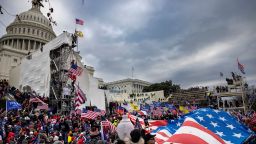
Pelosi and January 6, 2021: In the post-inaugural speech, Trump repeated his false claims that former House Speaker Nancy Pelosi rejected his offer of 10,000 National Guard troops to protect the Capitol on January 6, 2021, and that Pelosi “admitted it on tape, that her daughter made.” He reprised the claim later in the Oval Office.
There is no evidence Pelosi turned down such an offer — and it is the president, not the speaker, who is in charge of the District of Columbia National Guard, so Pelosi wouldn’t have had the power to reject the offer even if it had been made to her, which Pelosi says it wasn’t. In addition, Pelosi is not on tape admitting that Trump’s story is correct.
In a video recorded by her filmmaker daughter, Alexandra Pelosi, on January 6 and later obtained by House Republicans, who posted a 42-second snippet on social media in June, Pelosi was shown expressing frustration at the inadequate security at the Capitol, and she said at one point, “I take responsibility for not having them just prepare for more.” But that general statement is clearly not a specific admission that she had rejected a Trump offer of 10,000 troops.
In fact, another part of the video appears to undermine Trump’s frequent claims that Pelosi was the person who turned down a National Guard presence in advance of January 6. She said, “Why weren’t the National Guard there to begin with?”
After Trump began referencing this video in June, Pelosi spokesperson Aaron Bennett said in an email to CNN: “Numerous independent fact-checkers have confirmed again and again that Speaker Pelosi did not plan her own assassination on January 6th. Cherry-picked, out-of-context clips do not change the fact that the Speaker of the House is not in charge of the security of the Capitol Complex — on January 6th or any other day of the week.”
The Capitol rioters: Trump said in the Oval Office that he believes that “in many cases” January 6 rioters were “outside agitators,” suggesting they weren’t actual Trump supporters. (He added a note of humility, saying, “What do I know, right?” but then reiterated, “But I think they were.”)
Trump’s belief is baseless. While one man convicted for his role in the riot admitted that his goal was to rile up Trump supporters, there is no evidence there were “many” such people in the crowd, nor for the Trump-promoted conspiracy theory that left-wing Antifa members were responsible for the attack. Almost all of the more than 1,500 people charged over the riot were fervent Trump devotees.
The January 6 committee and documents: In his post-inaugural speech, Trump spoke of the House select committee that investigated the January 6 attack on the Capitol, whose members Biden pardoned in one of his last acts as president. Trump falsely claimed that “they destroyed and deleted all of the information, all of the hearings, practically not a thing left.” He returned to the subject later in the Oval Office, falsely claiming that “they destroyed all of the documents, they deleted all of the information, there’s no information.”
There has been a long-running dispute between Republicans and Democrats over the status of certain committee records that Republicans said should have been archived and that Democratic committee chair Bennie Thompson argued did not have to be archived, such as because they were not useful to the committee’s investigation. But there’s no basis for Trump’s claim that “all” information and documents were discarded.
As FactCheck.org reported on Monday, the January 6 committee released not only a final report that more than 800 pages long, but also transcripts of interviews with more than 140 witnesses – and, according to Thompson, the committee’s staff worked with the National Archives and Records Administration and other government bodies “in preparing the Select Committee’s more than 1 million records for publication and archiving.”
The legitimacy of the 2020 election: In his post-inaugural speech to supporters, Trump returned to his lie that the 2020 election “was totally rigged”; he made the “rigged” claim again in the arena speech. Trump legitimately lost a free and fair election to Biden.
Democrats and the 2024 election: Trump falsely claimed in his post-inaugural speech that unspecified opponents “tried” to rig the 2024 election but were unable to do so. This is nonsense, too; Trump beat former Vice President Kamala Harris in a free and fair election.
California and the 2024 election: In the post-inaugural speech, Trump said, “I think we would’ve won the state of California” if the state had stronger voter identification laws. There is simply no basis for the claim; there is no sign of mass fraud in California, and Trump lost to Harris thereby more than 3 million votes.
Trump’s margin of victory in Alabama: In the post-inaugural speech, Trump falsely claimed, “We won Alabama by 48 points.” Trump did win the conservative state by a large margin, but not as large as he claimed; he beat Harris there by about 30.5 percentage points.
Trump and “the youth vote”: As he did the day before the inauguration, Trump falsely claimed in his arena speech Monday that “we won the youth vote by 36 points” in the 2024 election. He didn’t say how he was defining “the youth vote” — his transition team didn’t respond to CNN’s Sunday request for clarification — but there’s no basis for his claim by any reasonable definition.
While young voters, particularly young men, did shift toward Trump compared with the 2020 election, exit poll data published by CNN found that Harris beat Trump 54% to 43% among voters ages 18-24, 53% to 45% among voters ages 25-29, and 51% to 45% among voters ages 30-39. Even if Harris’ actual margins were smaller — exit poll data is often flawed — there is simply no sign that Trump dominated Harris with young voters.
China and the Panama Canal: Trump vowed in his inaugural address that the US will take back the Panama Canal — and falsely claimed that “above all, China is operating the Panama Canal.” He added in the Oval Office that “China controls the Panama Canal.”
There are valid questions about Chinese influence over infrastructure on and around the Panama Canal. Most notably, a subsidiary of a Hong Kong-based company operates a port at each end of the waterway, having first won the bidding competition for the contract in the 1990s. But Panama has run the canal itself since the US handed it over to the country in 1999. Specifically, the canal is operated by the Panama Canal Authority, whose administrator, deputy administrator and 11-member board are Panamanians selected by Panama’s government.
Related articleTrump commutes sentences of Proud Boys and Oath Keepers leaders as he pardons over 1,000 January 6 US Capitol rioters
The vast majority of its employees are Panamanian. It is Panama that decides which companies get awarded the contracts to run the ports on the canal. And other canal ports are operated by companies that are not Chinese — including one run by an American-Panamanian joint venture.
“The Canal is and will continue to be Panama’s and its administration will continue to be under Panamanian control with respect to its permanent neutrality,” Panamanian President José Raúl Mulino said in a statement Monday. Without mentioning China directly, Mulino also appeared to reject Trump’s claim that China is operating the canal, saying, “There is no presence of any nation in the world that interferes with our administration.”
China’s oil purchases from Iran: In the arena speech, Trump repeated his false story about how he supposedly pressured China into stopping its purchases of oil from Iran during his first presidency. China’s oil imports from Iran did briefly plummet under Trump in 2019, the year the Trump administration made a concerted effort to deter such purchases, but they never stopped — and then they rose sharply again while Trump was still president. “The claim is untrue because Chinese crude imports from Iran haven’t stopped at all,” Matt Smith, lead oil analyst for the Americas at Kpler, a market intelligence firm, told CNN in 2023.
China’s official statistics recorded no purchases of Iranian crude in Trump’s last partial month in office, January 2021, and also none in most of Biden’s first year as president. But that doesn’t mean China’s imports actually ceased; industry experts say it is widely known that China has used a variety of tactics to mask its continued imports from Iran.
Kpler found that China imported about 511,000 barrels per day of Iranian crude in December 2020, Trump’s last full month in office. The low point under Trump was March 2020, when global oil demand crashed because of Covid-19. Even then, China imported about 87,000 barrels per day, Kpler found. (Since data on Iranian oil exports is based on cargo tracking by various companies and groups, other entities may have different data.)
Iran and terror groups: In the arena speech, Trump repeated his inaccurate boast that Iran “didn’t have money for Hamas” and “didn’t have money for Hezbollah” during his presidency. He emphasized in the Oval Office that Iran had “no money” for the two groups. Iran’s funding for these groups did decline in the second half of his presidency, in large part because his sanctions on Iran had a major negative impact on the Iranian economy, but the funding never stopped entirely, as four experts told CNN in 2024. In fact, Trump’s own administration said in 2020 that Iran was continuing to fund terror groups including Hezbollah. You can read a longer fact check here.
Spain and BRICS: Trump falsely claimed in the Oval Office that Spain is a member of the international organization known as BRICS, telling a reporter, “They’re a BRICS nation, Spain. You know what a BRICS nation is? You’ll figure it out.” Spain is not a member of BRICS; the “S” is for South Africa, which joined the group previously known as BRIC — Brazil, Russia, India and China — in 2010.
This story and headline have been updated to include additional information.
CNN’s Bryan Mena, Alicia Wallace, Phil Mattingly, Michael Rios and Elizabeth González contributed to this report.