There are videos at the link below. I don’t know where we are a species right now. It seems more and more people are willing to give in to the lowest of our natures while mocking those who try to live up to the best we could be. The Christians trying to keep books that have LGBTQ+ characters out of schools can’t be bothered by the shooting of starving people including kids trying desperately to get something to eat. They are not doing anything to help, just everything they can to lash out bashing a minority group just for existing using their god to do it. Yet did not their god say to feed the hungry? To help the immigrants among you? They are so desperate to control others sexuality but they don’t care about those acting cruelty to the ones most needing help. Hypocrites, which side of god do they get to sit on? Hugs
American contractors guarding aid distribution sites in Gaza are using live ammunition and stun grenades as hungry Palestinians scramble for food, according to accounts and videos obtained by The Associated Press.
Two U.S. contractors, speaking to the AP on condition of anonymity because they were revealing their employers’ internal operations, said they were coming forward because they were disturbed by what they considered dangerous and irresponsible practices. They said the security staff hired were often unqualified, unvetted, heavily armed and seemed to have an open license to do whatever they wished.
They said their colleagues regularly lobbed stun grenades and pepper spray in the direction of the Palestinians. One contractor said bullets were fired in all directions — in the air, into the ground and at times toward the Palestinians, recalling at least one instance where he thought someone had been hit.
“There are innocent people being hurt. Badly. Needlessly,” the contractor said.
He said American staff on the sites monitor those coming to seek food and document anyone considered “suspicious.” He said they share such information with the Israeli military.
Videos provided by one of the contractors and taken at the sites show hundreds of Palestinians crowded between metal gates, jostling for aid amid the sound of bullets, stun grenades and the sting of pepper spray. Other videos include conversation between English-speaking men discussing how to disperse crowds and encouraging each other after bursts of gunfire.
The testimonies from the contractors — combined with the videos, internal reports and text messages obtained by the AP — offer a rare glimpse inside the Gaza Humanitarian Foundation, the newly created, secretive American organization backed by Israel to feed the Gaza Strip’s population. Last month, the U.S. government pledged $30 million for the group to continue operations — the first known U.S. donation to the group, whose other funding sources remain opaque.
A spokesperson for Safe Reach Solutions, the logistics company subcontracted by GHF, told the AP that there have been no serious injuries at any of their sites to date. In scattered incidents, security professionals fired live rounds into the ground and away from civilians to get their attention. That happened in the early days at the “the height of desperation where crowd control measures were necessary for the safety and security of civilians,” the spokesperson said.
Aid operation is controversial
Gaza’s more than 2 million Palestinians are living through a catastrophic humanitarian crisis. Since Hamas attacked Israel on Oct. 7, 2023, setting off the 21-month war, Israel has bombarded and laid siege to the strip, leaving many teetering on the edge of famine, according to food security experts.
For 2 1/2 months before GHF’s opening in May, Israel blocked all food, water and medicine from entering Gaza, claiming Hamas was stealing the aid being transported under a preexisting system coordinated by the United Nations. It now wants GHF to replace that U.N. system. The U.N. says its Gaza aid operations do not involve armed guards.
Over 57,000 Palestinians in Gaza have been killed since the war erupted, according to the territory’s Health Ministry, which does not distinguish between civilians and militants.
GHF is an American organization, registered in Delaware and established in February to distribute humanitarian aid during the ongoing Gaza humanitarian crisis. Since the GHF sites began operating more than a month ago, Palestinians say Israeli troops open fire almost every day toward crowds on roads heading to the distribution points, through Israeli military zones. Several hundred people have been killed and hundreds more wounded, according to Gaza’s Health Ministry and witnesses.
In response, Israel’s military says it fires only warning shots and is investigating reports of civilian harm. It denies deliberately shooting at any innocent civilians and says it’s examining how to reduce “friction with the population” in the areas surrounding the distribution centers.
AP’s reporting for this article focuses on what is happening at the sites themselves. Palestinians arriving at the sites say they are caught between Israeli and American fire, said the contractor who shared videos with the AP.
“We have come here to get food for our families. We have nothing,” he recounted Palestinians telling him. “Why does the (Israeli) army shoot at us? Why do you shoot at us?”
A spokesperson for the GHF said there are people with a “vested interest” in seeing it fail and are willing to do or say almost anything to make that happen. The spokesperson said the team is composed of seasoned humanitarian, logistics and security professionals with deep experience on the ground. The group says it has distributed the equivalent of more than 50 million meals in Gaza in its food boxes of staples.
GHF says that it has consistently shown compassionate engagement with the people of Gaza.
Throughout the war, aid distribution has been marred by chaos. Gangs have looted trucks of aid traveling to distribution centers and mobs of desperate people have also offloaded trucks before they’ve reached their destination. Earlier this month, at least 51 Palestinians were killed and more than 200 wounded while waiting for the U.N. and commercial trucks to enter the territory, according to Gaza’s Health Ministry and a local hospital. Israel’s military acknowledged several casualties as soldiers opened fire on the approaching crowd and said authorities would investigate.
Videos, texts, internal reports document havoc at food sites
AP spoke to the two contractors for UG Solutions, an American outfit subcontracted to hire security personnel for the distribution sites. They said bullets, stun grenades and pepper spray were used at nearly every distribution, even if there was no threat.
Videos of aid being dispensed at the sites seen by the AP appear to back up the frenetic scenes the contractors described. The footage was taken within the first two weeks of its distributions — about halfway into the operations.
In one video, what appear to be heavily armed American security contractors at one of the sites in Gaza discuss how to disperse Palestinians nearby. One is heard saying he has arranged for a “show of force” by Israeli tanks.
“I don’t want this to be too aggressive,” he adds, “because this is calming down.”
At that moment, bursts of gunfire erupt close by, at least 15 shots. “Whoo! Whoo!” one contractor yelps.
“I think you hit one,” one says.
Then comes a shout: “Hell, yeah, boy!”
The camera’s view is obscured by a large dirt mound.
The contractor who took the video told AP that he saw other contractors shooting in the direction of Palestinians who had just collected their food and were departing. The men shot both from a tower above the site and from atop the mound, he said. The shooting began because contractors wanted to disperse the crowd, he said, but it was unclear why they continued shooting as people were walking away.
The camera does not show who was shooting or what was being shot at. But the contractor who filmed it said he watched another contractor fire at the Palestinians and then saw a man about 60 yards (meters) away — in the same direction where the bullets were fired — drop to the ground.
This happened at the same time the men were heard talking — effectively egging each other on, he said.
In other videos furnished by the contractor, men in grey uniforms — colleagues, he said — can be seen trying to clear Palestinians who are squeezed into a narrow, fenced-in passage leading to one of the centers. The men fire pepper spray and throw stun grenades that detonate amid the crowd. The sound of gunfire can be heard. The contractor who took the video said the security personnel usually fire at the ground near the crowds or from nearby towers over their heads.
During a single distribution in June, contractors used 37 stun grenades, 27 rubber-and-smoke “scat shell” projectiles and 60 cans of pepper spray, according to internal text communications shared with the AP.
That count does not include live ammunition, the contractor who provided the videos said.
One photo shared by that contractor shows a woman lying in a donkey cart after he said she was hit in the head with part of a stun grenade.
This photo, provided by an American contractor on condition of anonymity because they were revealing their employers’ internal operations, shows a woman slumped over in a donkey cart after the contractor said she was hit in the head with part of a stun grenade at a food distribution site in Gaza run by the Gaza Humanitarian Foundation in June 2025. (AP Photo)
An internal report by Safe Reach Solutions, the logistics company subcontracted by GHF to run the sites, found that aid seekers were injured during 31% of the distributions that took place in a two-week period in June. The report did not specify the number of injuries or the cause. SRS told the AP the report refers to non-serious injuries.
More videos show frenzied scenes of Palestinians running to collect leftover food boxes at one site. Hundreds of young men crowd near low metal barriers, transferring food from boxes to bags while contractors on the other side of the barriers tell them to stay back.
Some Palestinians wince and cough from pepper spray. “You tasting that pepper spray? Yuck,” one man close to the camera can be heard saying in English.
SRS acknowledged that it’s dealing with large, hungry populations, but said the environment is secure, controlled, and ensures people can get the aid they need safely.
Verifying the videos with audio analysis
To confirm the footage is from the sites, AP geolocated the videos using aerial imagery. The AP also had the videos analyzed by two audio forensic experts who said they could identify live ammunition — including machine-gun fire — coming from the sites, in most cases within 50 to 60 meters of the camera’s microphone.
In the video where the men are heard egging each other on, the echo and acoustics of the shots indicate they’re fired from a position close to the microphone, said Rob Maher, a professor of electrical and computer engineering at Montana State University and an author and research expert in audio forensic analysis. Maher and the other analyst, Steven Beck, owner of Beck Audio Forensics, said there was no indication that the videos’ audio had been tampered with.
The analysts said that the bursts of gunfire and the pop sequences in some of the videos indicated that guns were panning in different directions and were not repeatedly aimed at a single target. They could not pinpoint exactly where the shots were coming from nor who was shooting.
GHF says the Israeli military is not deployed at the aid distribution sites. Lt. Col. Nadav Shoshani, an army spokesman, said the army is not stationed at the sites or within their immediate proximity, especially during operating hours. He said they’re run by an American company and have their own security.
One of the contractors who had been on the sites said he’d never felt a real or perceived threat by Hamas there.
SRS says that Hamas has openly threatened its aid workers and civilians receiving aid. It did not specify where people were threatened.
Palestinians carry boxes containing food and humanitarian aid packages delivered by the Gaza Humanitarian Foundation, a U.S.-backed organization approved by Israel, in Rafah, southern Gaza Strip, Tuesday, May 27, 2025. (AP Photo/Abdel Kareem Hana,File)
American analysts and Israeli soldiers work side by side, contractors say
According to the contractor who took the videos, the Israeli army is leveraging the distribution system to access information.
Both contractors said that cameras monitor distributions at each site and that American analysts and Israeli soldiers sit in a control room where the footage is screened in real time. The control room, they said, is housed in a shipping container on the Israeli side of the Kerem Shalom crossing into Gaza.
The contractor who took the videos said some cameras are equipped with facial recognition software. In live shots of the sites seen by the AP, some videos streams are labeled “analytics” — those were the ones that had the facial recognition software, said the contractor.
If a person of interest is seen on camera — and their information is already in the system — their name and age pops up on the computer screen, said the contractor. Israeli soldiers watching the screens take notes and cross-check the analysts’ information with their own drone footage from the sites, he said.
The contractor said he did not know the source of the data in the facial recognition system. The AP could not independently verify his information.
An internal SRS report from June seen by the AP said that its intel team would circulate to staff a “POI Mugs Card,” that showed photos of Palestinians taken at the sites who were deemed persons of interest.
The contractor said he and other staff were told by SRS to photograph anyone who looked “out of place.” But the criteria were not specified, he said. The contractor said the photos were also added to the facial recognition database. He did not know what was done with the information.
SRS said accusations that it gathers intelligence are false and that it has never used biometrics. It said it coordinates movements with Israeli authorities, a requirement for any aid group in Gaza.
An Israeli security official who was not named in line with the army’s protocol, said there are no security screening systems developed or operated by the army within the aid sites.
Mr. Abrego has filed an amended complaint asking the court to declare the government’s actions unlawful and to order his release. He describes his torture in El Salvador in the complaint.
While Mr. Abrego sits in jail in Tennessee pending a hearing over his disposition in a bogus criminal case brought by a politicized Department of Justice, his lawyers have filed a new complaint amending the original one that sought his return to the United States after the government admitted they had sent him to El Salvador in error.
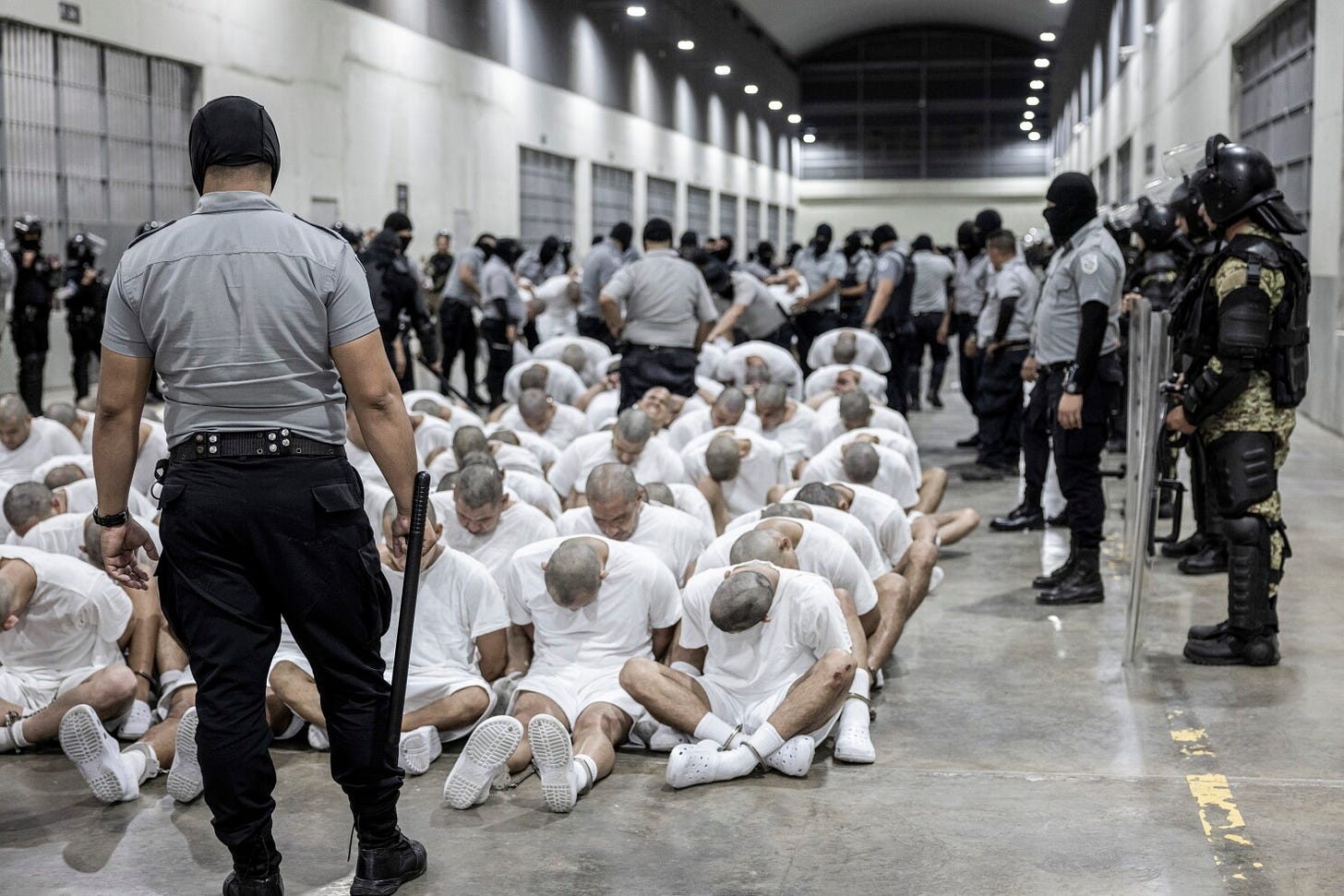
This new filing not only references the protected whistleblower account of the now-fired Justice Department lawyer Erez Reuveni – who outlined the government’s malfeasance and coverup of the unlawful removal of Mr. Abrego, but it also details the conditions at the CECOT torture prison, where hundreds of people remain trapped incommunicado as their class action works its way through the courts.
The Breakdown is a reader-supported publication. To receive new posts and support my work, consider becoming a free or paid subscriber.
Subscribe
Beginning on page 20 of the 40-page amended complaint, Mr. Abrego’s lawyers outline the reality of life in CECOT. Content warning for inhumane conditions and torture:
Upon information and belief, all Defendants are aware that the government of El Salvador tortures individuals detained in CECOT. Indeed, U.S. President Donald Trump has made comments to the press expressing glee and delight at the torture that the Government of El Salvador inflicts upon detainees in CECOT.
Each of the 256 cells is intended to hold approximately 80 inmates but often holds nearly double. See Ex. F. The cramped cells are equipped with tiered metal bunks without mattresses, two basins for washing, and two open toilets. There are no windows, fans, or air conditioning, despite the region’s warm and humid climate.
Inmates in CECOT are confined to their cells for 23.5 hours daily and cannot go outdoors. They are denied access to reading materials, including even letters from friends or family. Inmates are prohibited from receiving visits from family and friends. Meals are provided through the bars, and the facility enforces strict regulations to maintain order.
In May 2023, Cristosal, a leading human rights organization in El Salvador, released a comprehensive report detailing severe human rights abuses within the country’s prison system, especially CECOT. The investigation documented the deaths of 153 inmates between March 27, 2022, and March 27, 2023, attributing many to torture, beatings, mechanical asphyxiation (strangulation), and lack of medical attention. Autopsies revealed common patterns of lacerations, hematomas, sharp object wounds, and signs of choking or strangulation. Survivors reported being forced to pick food off the floor with their mouths, subjected to electric shocks, and exposed to untreated skin fungus epidemics.
Plaintiff Abrego Garcia reports that he was subjected to severe mistreatment upon arrival at CECOT, including but not limited to severe beatings, severe sleep deprivation, inadequate nutrition, and psychological torture.
Plaintiff Abrego Garcia was the first name called to disembark the plane that transported him to El Salvador on March 15, 2025. As he exited the aircraft, still in chains, two officials grabbed his arms and pushed him down the stairs, forcing his head down
There were strong lights illuminating the area despite it being nighttime, and cameras were filming the detainees’ arrival.
Plaintiff Abrego Garcia was pushed toward a bus, forcibly seated, and fitted with a second set of chains and handcuffs. He was repeatedly struck by officers when he attempted to raise his head.
Upon arrival at CECOT, the detainees were greeted by a prison official who stated, “Welcome to CECOT. Whoever enters here doesn’t leave.” Plaintiff Abrego Garcia was then forced to strip, issued prison clothing, and subjected to physical abuse including being kicked in the legs with boots and struck on his head and arms to make him change clothes faster. His head was shaved with a zero razor, and he was frog-marched to cell 15, being struck with wooden batons along the way. By the following day, Plaintiff Abrego Garcia had visible bruises and lumps all over his body.
In Cell 15, Plaintiff Abrego Garcia and 20 other Salvadorans were forced to kneel from approximately 9:00 PM to 6:00 AM, with guards striking anyone who fell from exhaustion. During this time, Plaintiff Abrego Garcia was denied bathroom access and soiled himself. The detainees were confined to metal bunks with no mattresses in an overcrowded cell with no windows, bright lights that remained on 24 hours a day, and minimal access to sanitation.
While at CECOT, prison officials repeatedly told Plaintiff Abrego Garcia that they would transfer him to the cells containing gang members who, they assured him, would “tear” him apart.
Indeed, Plaintiff Abrego Garcia repeatedly observed prisoners in nearby cells who he understood to be gang members violently harm each other with no intervention from guards or personnel. Screams from nearby cells would similarly ring out throughout the night without any response from prison guards on personnel.
During his first two weeks at CECOT, Plaintiff Abrego Garcia suffered a significant deterioration in his physical condition and lost approximately 31 pounds.
Mr. Abrego’s amended complaint is asking the court for an order:
a) Declaring that Defendants’ actions, as set forth herein, violated the laws of the United States and the Fifth Amendment to the U.S. Constitution;
b) Immediately ordering Defendants to restore the status quo ante, which includes returning Abrego Garcia to Maryland, where he was before being picked up by DHS agents in March, 2025;
c) Issue a writ of habeas corpus ad testificandum, ordering that Plaintiff Abrego Garcia be brought before this Court for a habeas corpus hearing. At the habeas corpus hearing, this Court should order Defendants to show cause why continued detention is lawfully permissible; and if they cannot meet their burden of so showing, issue a writ of habeas corpus and order Plaintiff Abrego Garcia’s immediate release from custody;
d) Order that Defendants return Abrego Garcia to his prior Order of Supervision;
e) Granting Plaintiffs costs and fees under the Equal Access to Justice Act; and
f) Granting such other relief at law and in equity as justice may require.
For in-depth coverage on the case of Mr. Abrego, the case to return all the prisoners sent to CECOT, and other cases of people deported without due process, you can listen to the UnJustified podcast hosted by former Deputy Director of the FBI Andrew McCabe and me.
A crop field in Oxnard, California, U.S., June 18, 2025. REUTERS/Pilar Olivares
Lisa Tate is a sixth-generation farmer in Ventura County, California, an area that produces billions of dollars worth of fruit and vegetables each year, much of it hand-picked by immigrants in the U.S. illegally.
Tate knows the farms around her well. And she says she can see with her own eyes how raids carried out by agents from U.S. Immigration and Customs Enforcement in the area’s fields earlier this month, part of President Donald Trump’s migration crackdown, have frightened off workers.
“In the fields, I would say 70% of the workers are gone,” she said in an interview. “If 70% of your workforce doesn’t show up, 70% of your crop doesn’t get picked and can go bad in one day. Most Americans don’t want to do this work. Most farmers here are barely breaking even. I fear this has created a tipping point where many will go bust.”
In the vast agricultural lands north of Los Angeles, stretching from Ventura County into the state’s central valley, two farmers, two field supervisors and four immigrant farmworkers told Reuters this month that the ICE raids have led a majority of workers to stop showing up.
That means crops are not being picked and fruit and vegetables are rotting at peak harvest time, they said.
One Mexican farm supervisor, who asked not to be named, was overseeing a field being prepared for planting strawberries last week. Usually he would have 300 workers, he said. On this day he had just 80. Another supervisor at a different farm said he usually has 80 workers in a field, but today just 17.
A Guatemalan immigrant works on a crop field at a farm in the Kern County, California, U.S., June 19, 2025. REUTERS/Pilar Olivares
BAD FOR BUSINESS
Most economists and politicians acknowledge that many of America’s agricultural workers are in the country illegally, but say a sharp reduction in their numbers could have devastating impacts on the food supply chain and farm-belt economies.
Douglas Holtz-Eakin, a Republican and former director of the Congressional Budget Office, said an estimated 80% of farmworkers in the U.S. were foreign-born, with nearly half of them in the country illegally. Losing them will cause price hikes for consumers, he said.
“This is bad for supply chains, bad for the agricultural industry,” Holtz-Eakin said.
Over a third of U.S. vegetables and over three-quarters of the country’s fruits and nuts are grown in California, according to the California Department of Food and Agriculture. The state’s farms and ranches generated nearly $60 billion in agricultural sales in 2023.
If they show up to work, they don’t know if they will ever see their family again.
Migrant worker
Of the four immigrant farmworkers Reuters spoke to, two are in the country illegally. These two spoke on the condition of anonymity, out of fear of being arrested by ICE.
One, aged 54, has worked in U.S. agricultural fields for 30 years and has a wife and children in the country. He said most of his colleagues have stopped showing up for work.
“If they show up to work, they don’t know if they will ever see their family again,” he said.
The other worker in the country illegally told Reuters, “Basically, we wake up in the morning scared. We worry about the sun, the heat, and now a much bigger problem – many not returning home. I try not to get into trouble on the street. Now, whoever gets arrested for any reason gets deported.”
Item 1 of 4 An immigrant worker harvests crops during the weekend, as labor shortages risk leaving fields unpicked, in Oxnard, California, U.S., June 22, 2025. REUTERS/Pilar Olivares
[1/4]An immigrant worker harvests crops during the weekend, as labor shortages risk leaving fields unpicked, in Oxnard, California, U.S., June 22, 2025. REUTERS/Pilar Olivares
To be sure, some farmworker community groups said many workers were still returning to the fields, despite the raids, out of economic necessity.
The days following a raid may see decreased attendance in the field, but the workers soon return because they have no other sources of income, five groups told Reuters.
Workers are also taking other steps to reduce their exposure to immigration agents, like carpooling with people with legal status to work or sending U.S. citizen children to the grocery store, the groups said.
ICE CHILL
Trump conceded in a post on his Truth Social account this month that ICE raids on farmworkers – and also hotel workers – were “taking very good, long-time workers away” from those sectors, “with those jobs being almost impossible to replace.”
Trump later told reporters, “Our farmers are being hurt badly. They have very good workers.” He added, “They’re not citizens, but they’ve turned out to be great.”
He pledged to issue an order to address the impact, but no policy change has yet been enacted.
Trump has always stood up for farmers, said White House spokeswoman Anna Kelly in response to a request for comment on the impact of the ICE raids to farms. “He will continue to strengthen our agricultural industry and boost exports while keeping his promise to enforce our immigration laws,” she said.
Bernard Yaros, Lead U.S. Economist at Oxford Economics, a nonpartisan global economics advisory firm, said in a report published on June 26 that native-born workers tend not to fill the void left by immigrant workers who have left.
“Unauthorized immigrants tend to work in different occupations than those who are native-born,” he said.
ICE operations in California’s farmland were scaring even those who are authorized, said Greg Tesch, who runs a farm in central California.
Farmers and laborers in California told Reuters that many field workers have stopped showing up to pick fruit and vegetables. Emma Jehle reports.
“Nobody feels safe when they hear the word ICE, even the documented people. We know that the neighborhood is full of a combination of those with and without documents,” Tesch said.
“If things are ripe, such as our neighbors have bell peppers here, (if) they don’t harvest within two or three days, the crop is sunburned or over mature,” said Tesch. “We need the labor.”
The Reuters Tariff Watch newsletter is your daily guide to the latest global trade and tariff news. Sign up here.
Reporting by Tim Reid, Sebastian Rocandio, Pilar Olivares and Leah Douglas. Editing by Mary Milliken and Rosalba O’Brien.
Homeland Security Secretary Kristi Noem | Steven Spearie/The State Journal-Register / USA TODAY NETWORK
Rep. Robert Garcia (D-CA) confronted Homeland Security Secretary Kristi Noem about the administration sending a gay man to a prison camp in El Salvador and not even knowing if he’s still alive. Noem said that it wasn’t her problem.
Noem, who has bragged in the past about shooting her dog to death, appeared before the House Homeland Security Committee for a hearing yesterday, where Garcia asked her about Andry Hernandez Romero, a gay hair dresser from Venezuela who came to the U.S. legally to escape anti-LGBTQ+ violence and who was sent to the CECOT camp in El Salvador, which is known for torturing inmates, earlier this year.
The administration, which sent immigrants to the CECOT without letting courts determine if they were in the country illegally or if they had committed any crimes, has refused to try to bring anyone back from the camp.
“Would you commit to just letting his mother know – as a mother-to-mother – if Andry is alive?” Garcia asked Noem. “He was given an asylum appointment by the United States government. We gave him an appointment, we said, Andry, come to the border at this time and claim asylum, he was taken to a foreign prison in El Salvador.”
“His mother just wants to know if he’s alive. Can we check and do a wellness check on him?”
Noem said she doesn’t “know the specifics” of Hernandez Romero’s case but said that since he’s in El Salvador, Garcia should be asking El Salvador’s government about him.
“This isn’t under my jurisdiction,” Noem said.
Garcia reminded her that she said that the Salvadoran prison is a “tool in our toolkit” for fighting crime.
“You and the president have the ability to check that Andry is alive and not being harmed,” he said. “Would you commit into at least looking and asking El Salvador if he is alive?”
“This is a question that is best asked to the president and the government of El Salvador,” Noem responded drily.
Garcia to Noem: "Can you commit to just letting his mother know mother to mother if Andry is alive? He was given an asylum appointment by the United States government."(Noem wouldn't commit to it.)
Hernandez Romero is a Venezuelan immigrant who trekked to the U.S. and entered legally last year at San Diego. There, he asked for asylum, saying that he was being targeted in Venezuela for being gay and due to his political beliefs. He was held in a CoreCivic detention center, where he was screened by Charles Cross Jr.
“The government had found that his threats against him were credible and that he had a real probability of winning an asylum claim,” his lawyer, Lindsay Toczylowski, said.
In March, he, along with over 200 other immigrants, was taken in shackles to the CECOT camp in El Salvador. Even his lawyer said she didn’t know what happened to him until he was gone and missed a hearing in his immigration case.
In a video from the CECOT, Hernandez Romero could be heard saying, “I’m not a gang member. I’m gay. I’m a stylist,” as he was slapped and had his head shaved.
It was later revealed that the evidence Immigration and Customs Enforcement (ICE) had against Hernandez Romero was his tattoos, which came from a report from the contractor CoreCivic, specifically from former police officer Charles Cross Jr., who lost his job with the Milwaukee police after he drunkenly crashed into a house and allegedly committed fraud. His name was subsequently added to the Brady List, a list of police officers who are considered non-credible for providing legal testimony in Milwaukee County.
Cross claimed that Hernandez Romero had crown tattoos associated with a gang. The tattoos are labeled “Mom” and “Dad” and are common symbols associated with his hometown of Capacho, Venezuela. Capacho is known for its elaborate festival for Three Kings Day, and a childhood friend, Reina Cardenas, told NBC News that it was that festival that awakened Hernandez Romero’s desire to be an artist.
“Andry dedicated his life to arts and culture, and he worked hard to better his craft,” Cardenas said.
Subscribe to the LGBTQ Nation newsletter and be the first to know about the latest headlines shaping LGBTQ+ communities worldwide.
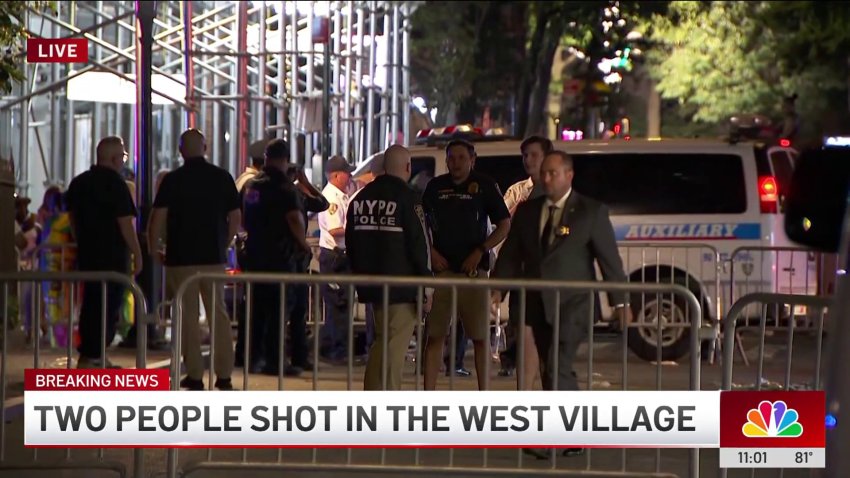
Two teenage girls were shot late Sunday night near Manhattan’s Stonewall Inn hours after the annual Pride March passed through the neighborhood.
The NYPD said the two people, a 16-year-old and a 17-year-old, were shot around 10:15 p.m. in the West Village, busy with revelers celebrating the end of Pride celebrations.
One of the shooting victims was struck in the head, according to police sources. That girl, 16, was last said to be in critical condition. The other victim was said to be stable.
Police had not confirmed any arrests as of early Monday.
The shooting occurred in Sheridan Square, a few steps away from the historic Stonewall Inn, a landmarked site. The neighborhood attracted tens of thousands on Sunday for the annual parade and end to Pride Month celebrations.
Police did not share a possible motive or any suspect descriptions.
Police said at least two people were shot on Sunday, as Pride celebrations came to a close in New York City. NBC New York’s Charles Watson reports.
Crackdown on Pride is part of effort to curb democratic freedoms ahead of a hotly-contested election next year
Tens of thousands march against Hungary’s government for LGBT rights – video
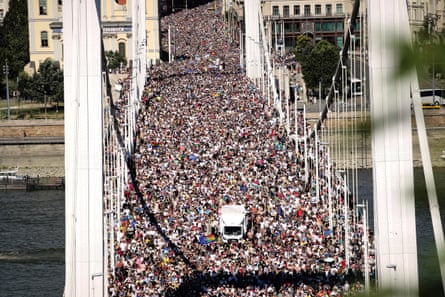
Tens of thousands of people have taken to the streets of Budapest in defiance of the Hungarian government’s ban on Pride, heeding a call by the city’s mayor to “come calmly and boldly to stand together for freedom, dignity and equal rights”.
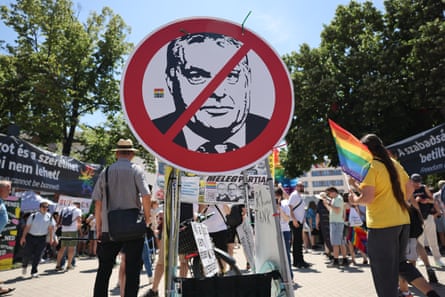
Jubilant crowds packed into the city’s streets on Saturday, waving Pride flags and signs that mocked the country’s prime minister, Viktor Orbán, as their peaceful procession inched forward at a snail’s pace.
Organisers estimated that a record number of people turned up, far outstripping the expected turnout of 35,000-40,000 people.
“We believe there are 180,000 to 200,000 people attending,” the president of Pride, Viktória Radványi told AFP. “It is hard to estimate because there have never been so many people at Budapest Pride.”
The mass demonstration against the government was a bittersweet marking of Budapest Pride’s 30th anniversary; while the turnout on Saturday was expected to reach record levels, it had come after the government had doubled down on its targeting of the country’s LGBTQ+ community.
Hungary Pride participants in the march cross the Elisabeth Bridge in Budapest, Hungary. Photograph: Rudolf Karancsi/AP
“We came because they tried to ban it,” said Timi, 49. The Hungarian national was marching with her daughter, Zsófi, 23, who had travelled from her home in Barcelona to join the rally.
After the ruling Fidesz party, led by the rightwing populist Orbán, fast-tracked a law that made it an offence to hold or attend events that involve the “depiction or promotion” of homosexuality to minors, many Hungarians vowed to show their disapproval by attending Pride for the first time.
Viki Márton was among those who had made good on the promise, turning up with her nine-year-old daughter.
The pair had come equipped with hats, water spray, and a swimsuit, more worried about heat than rightwing protesters. “I want her to see the reality,” said Márton. “And I’m so excited to be here!”
Tens of thousands of Hungarians took to the streets on Saturday, despite Orbán’s warning on Friday that those who attend or organise the march will face ‘legal consequences’. Photograph: János Kummer/Getty Images
Earlier this month, police announced they would follow the government’s orders and ban the march. The progressive mayor of Budapest, Gergely Karácsony, was swift to respond, saying that the march would instead go ahead as a separate municipal event, with Karácsony describing it as a way to circumvent the need for official authorisation.
On Saturday, the mayor reiterated why the city had decided to host the event, hinting at how the march had become a symbol of discontent against a government that has long faced criticism for weakening democratic institutions and gradually undermining the rule of law.
“The government is always fighting against an enemy against which they have to protect Hungarian people,” said Karácsony.
“This time, it is sexual minorities that are the target … we believe there should be no first and second class citizens, so we decided to stand by this event.”
Akos Horvath, 18, who had travelled two hours from his city in southern Hungary to take part in the march, described it as an event of “symbolic importance”.
Speaking to news agency AFP, he added: “It’s not just about representing gay people, but about standing up for the rights of the Hungarian people.”
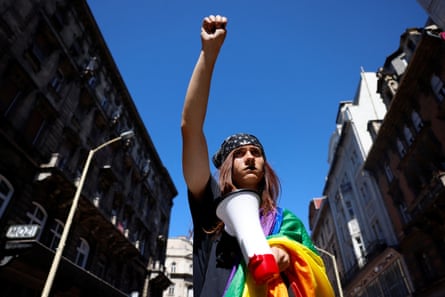
The sentiment was echoed by fellow marcher Eszter Rein-Bódi. “This is about much more, not just about homosexuality,” Rein-Bódi told Reuters “This is the last moment to stand up for our rights.”
‘This is about much more, not just about homosexuality,’ one participant told Reuters. Photograph: Lisa Leutner/Reuters
Tens of thousands of Hungarians, including senior citizens and parents with their children, plus politicians and campaigners from 30 countries, took to the streets on Saturday, despite Orbán’s warning on Friday that those who attend or organise the march will face “legal consequences”.
The Hungarian prime minister sought to minimise concerns over violence, however, saying that Hungary was a “civilised country” and police would not “break it up … It cannot reach the level of physical abuse”.
Still, in a video posted to social media this week, the country’s justice minister, Bence Tuzson, warned the Budapest mayor that organising a banned event or encouraging people to attend is punishable by up to a year in prison.
Speaking to reporters on Friday, the mayor brushed off the threat and downplayed concerns that police would later impose heavy fines on attende s. “Police have only one task tomorrow: to guarantee the safety and security of those gathered at the event,” said Karácsony.
The potential for violence had been amplified after three groups with ties to the extreme right said they were planning counter-marches. As the Pride march got under way, local news site Telex reported that the route of the march had to be changed after one of these groups blocked off a bridge.
Analysts had described the government’s bid to crackdown on Pride as part of a wider effort to curb democratic freedoms ahead of a hotly contested national election next year.
Orbán is facing an unprecedented challenge from a former member of the Fidesz party’s elite, Péter Magyar, leading Pride organisers to suggest they are being scapegoated as Orbán scrambles to shore up support among conservative voters.
Orbán’s government had also prompted concerns across Hungary and beyond after it said it would use facial recognition software to identify people attending any banned events, potentially fining them up to €500 (£425).
Ahead of the march, as campaigners scrambled for clarity on whether or how this technology would be used, AFP reported that newly installed cameras had appeared on the lamp-posts that dotted the planned route.
The threat had been enough to rattle some. Elton, 30, a Brazilian living in Hungary wore a hat and sunglasses as he took part on Saturday, explaining that he had been worried about jeopardising his job and immigration status, but that his Hungarian boyfriend had persuaded him to attend.
“This is my second time at Pride, but the first time I feel insecure about it,” he said.
Orbán’s government had also prompted concerns across Hungary and beyond after it said it would use facial recognition software to identify people attending any banned events. Photograph: Lisa Leutner/Reuters
Mici, a 21-year-old Budapest resident, said she had attended Pride marches in the past but this time had weighed whether to join in after she was spooked by reports of the facial recognition system.
“At first, I was scared to come out because of the news, but I feel safe with so many people.”
She hoped that the massive turnout for the march would be enough to push the Orbán government to change its stance.
“I think the crowd that has come from across Europe, the record numbers, will make Hungarian people see that this cause is well-supported.”




 Homeland Security Secretary Kristi Noem | Steven Spearie/The State Journal-Register / USA TODAY NETWORK