A Striking Departure: The number of declinations marks a striking departure not only from the Biden administration but also the first Trump term, according to the ProPublica analysis.
An Unusual Order: Former DOJ prosecutors said that they regularly reviewed caseloads. But none could recall an order like the one in February to review cases.
Different Priorities: While Elon Musk’s DOGE operatives said they were rooting out federal waste, fraud and abuse, the DOJ declined over 900 cases of federal program or procurement fraud.
These highlights were written by the reporters and editors who worked on this story.
In the first days after Pam Bondi was appointed attorney general last year, the Department of Justice began shutting down pending criminal cases at a record pace.
The cases included an investigation into a Virginia nursing home with a recent record of patient abuse; probes of fraud involving several New Jersey labor unions, including one opened after a top official of a national union was accused of embezzlement; and an investigation into a cryptocurrency company suspected of cheating investors.
In total, the DOJ quietly closed more than 23,000 criminal cases in the first six months of President Donald Trump’s administration, abandoning hundreds of investigations into terrorism, white-collar crime, drugs and other offenses as it shifted resources to pursue immigration cases, according to an analysis by ProPublica.
The bulk of these cases, which were closed without prosecution and known as declinations, had been referred to the DOJ by law enforcement agencies under prior administrations that believed a federal crime may have been committed. The DOJ routinely declines to prosecute cases for any number of reasons, including insufficient evidence or because a case is not a priority for enforcement.
But the number of declinations under Bondi marks a striking departure not only from the Biden administration but also the first Trump term, according to the ProPublica analysis, which examined two decades of DOJ data, including the first six months of Trump’s second term. ProPublica determined the increase is not the result of inheriting a larger caseload or more referrals from law enforcement.
In February 2025 alone, which included the first weeks of Bondi’s tenure, nearly 11,000 cases were declined, the most in a month since at least 2004. The previous high was just over 6,500 cases in September 2019, during Trump’s first administration.
Some of the cases shut down were the result of years long investigations by federal agencies such as the FBI and the Drug Enforcement Administration. For complex cases, the DOJ can take years before deciding whether to bring charges.
The shift comes as the DOJ has undergone an extraordinary overhaul under the Trump administration, with entire units shuttered, directives to abandon pursuit of certain crimes and thousands of lawyers quitting or, in some cases, being forced out of the agency.
In doing so, the DOJ is retreating from its mission to impartially uphold the rule of law, keep the country safe and protect civil rights, according to interviews with a dozen prosecutors and an open letter from nearly 300 DOJ employees who have left the department under Trump. The Trump DOJ, the employees wrote, is “taking a sledgehammer” to long-standing work to “protect communities and the rule of law.”
The change in priorities was outlined in a series of memos sent to attorneys early last year. Trump’s DOJ has said it is “turning a new page on white-collar and corporate enforcement” and emphasizing the pursuit of drug cartels, illegal immigrants and institutions that promote “divisive DEI policies.” Trump, in an address last March at the department, said the changes were necessary after a “surrender to violent criminals” during the past administration and would result in a restoration of “fair, equal and impartial justice under the constitutional rule of law.”
The department prosecuted 32,000 new immigration cases in the first six months of the administration, which was nearly triple the number under the Biden administration and a 15% increase from the first Trump term. It has pursued fewer prosecutions of nearly every other type of crime — from drug offenses to corruption — than new administrations in their first six months dating back to 2009.
The DOJ has also closed hundreds of cases involving alleged crimes that the administration has publicly emphasized as enforcement priorities. Even as the Trump administration unleashed Elon Musk’s Department of Government Efficiency operatives to root out waste, fraud and abuse in the federal government, the DOJ declined over 900 cases of federal program or procurement fraud. About three times as many cases of major fraud against the U.S. were declined under Trump compared with the average of similar time periods under prior administrations. And while the Trump administration has promised to “make America safe again,” its DOJ has declined more than 1,000 terrorism cases, also more than prior administrations.
Federal prosecutor Joseph Gerbasi had spent years in the department’s Narcotic and Dangerous Drug Section helping build cases against major suppliers of fentanyl ingredients in India and China. After Bondi came in, he was left bewildered when his team was ordered to abandon its work.
“All of the building blocks of what would become successful prosecutions were pulled out,” said Gerbasi, who retired as the section’s acting deputy chief for policy in March 2025 after 28 years with the department.
The move had an “overwhelming deflating effect on morale,” he said.
After Trump’s Inauguration, the Department of Justice Turned Down a Record Number of Cases
The first quarter of 2025, and especially February of that year, saw the department declining to prosecute cases against thousands of defendants outside of its regular six-month review process.
Source: DOJ data provided by TRACKen Morales/ProPublica
Barbara McQuade, who worked as a federal prosecutor in Michigan for two decades until 2017 during Republican and Democratic administrations, said it was not unusual for new administrations to come to office with a few “pet priorities” — such as a focus on violent crime or drug trafficking. But she said those changes usually involved modest adjustments in policy and that most of the decisions on what crimes to focus on were typically made at the local level by the district U.S. attorney in coordination with the FBI or other agencies.
“We would revise those about every five years, not having anything to do with any administration, just because it made sense,” she said.
A DOJ spokesperson, in an emailed response to questions about the spike in declinations, said that in “an effort to clean, remediate, and validate data in U.S. Attorneys’ case management system,” the department reviewed all pending criminal matters opened prior to the 2023 fiscal year, which included updating the status of closed cases. “This Department of Justice remains committed to investigating and prosecuting all types of crime to keep the American people safe, and the number of declinations is a direct result of our efforts to run the agency in a more efficient manner.”
The agency did not respond to questions about the types of cases declined.
The spike of declined cases began in February 2025 when the department ordered prosecutors to review every open case launched prior to October 2022 and determine whether to close it. Such a review would typically take months, according to one attorney tasked with reviewing cases. A memo, which was described to ProPublica reporters, ordered the review to be completed within 10 days.
Former DOJ prosecutors told ProPublica that they typically reviewed caseloads every six months with supervisors and that closing out languishing cases wouldn’t ordinarily be cause for concern. They said the February directive, however, was unusual. None could recall a similar order.
The directive came as higher-ups in the department had begun making frequent demands for data about specific types of cases and charging decisions, such as the outcome of fentanyl cases, according to former prosecutor Michael Gordon. Gordon, who helped prosecute Jan. 6 cases before moving to white-collar crime prosecutions, said the “fire drills” from officials in Washington became so regular that he grew used to the forlorn look on his supervisor’s face when he showed up at Gordon’s door, apologetically delivering yet another frantic request.
“It was either ‘give us stats we can use to make ourselves look good’ or ‘give us the stats to show how bad things are in this area,’” Gordon said. “It was never productive fact-finding.”
Though Gordon didn’t see the memo, he remembered getting the request to review all cases that had been open for more than two years and report back on their status, entering into a master spreadsheet basic information about any that he wanted to keep pursuing.
“The office was pushing us to close everything by a certain date so that when they had to report up to D.C. they had a low number of open cases,” he said. “You really had to go to bat to keep open a case that was more than two years old.”
Gordon said he was fired by the DOJ last June. He has filed a lawsuit alleging his termination was politically motivated. The department did not respond to questions about Gordon’s comments or his lawsuit. The government filed a motion to dismiss the case late last year, arguing that the federal court did not have jurisdiction over the matter. The court has not yet ruled on that motion, and the case is still pending.
Investigations into individuals or corporations declined for prosecution are generally not reported to courts and usually only disclosed in summary form by the DOJ in annual reports. To conduct its analysis, ProPublica obtained declination data from the DOJ and the Transactional Records Access Clearinghouse, a center that obtains data through Freedom of Information Act requests.
The DOJ Declined a Slew of Cases Shortly After Pam Bondi Was Confirmed as Attorney General
Nearly 11,000 criminal cases were declined during her first month in office.
Source: DOJ data provided by TRACKen Morales/ProPublica
Here are some of the areas most impacted by the spike in declinations.
Drugs
As president, Trump has spoken frequently about the “scourge” of drugs coming into the country. At the same time, the Justice Department has declined to prosecute nearly 5,000 cases of federal drug law violations, including trafficking and money laundering. The number of declinations were 45% higher than the average of the prior three new administrations.
Gerbasi, the counternarcotics prosecutor, declined to comment on specific cases that might have been declined in his office. But, he said, once Bondi was appointed, the priority in the office became building cases against Tren de Aragua, a Venezuelan group that the Trump administration has labeled a foreign terrorist organization.
“Tren de Aragua was not anywhere close to the scale or impact of the cartels we were focused on,” Gerbasi said. “But we were told to generate those cases.”
He said his office had to scramble to fly people to investigate local gangs in small towns that were reportedly affiliated with Tren de Aragua. “They never would have merited a full-scale federal investigation,” he said.
“It told me that decisions were going to be based on political appearances and not based on the merits of where investigative resources should be placed.”
The DOJ declined to comment on Gerbasi’s remarks.
Trump’s DOJ Has Rejected Far More Cases Than Previous Administrations Across a Wide Range of Categories
Many of the dropped cases were in programs the DOJ has claimed were priorities.
Source: TRAC, DOJ
Note: “Other” primarily includes government regulatory offenses and theft. Comparison to average of past administrations only includes the first six months after a presidential administration change: Obama (2009), Trump (2017) and Biden (2021)Ken Morales/ProPublica
National Security
Under Bondi, the DOJ declined more than 1,300 cases involving terrorism and national security, nearly twice what was typical at the start of the most recent new administrations. While domestic terrorism was the hardest-hit program, just over 300 cases involving charges of providing material support to foreign terrorist organizations were also dropped.
The DOJ program handling matters relating to national internal security — which considers cases of alleged spy activity and the security of classified information — saw over 200 declinations, which is four times as many as typical in the first six months of a new administration. Some of the cases related to serving as an unregistered foreign agent, a charge Bondi ordered prosecutors to stop pursuing unless they involved “conduct similar to more traditional espionage by foreign government actors.”
Jimmy Gurulé, a former federal prosecutor and George W. Bush appointee to the U.S. Treasury Department who investigated the financing of terrorism, said the decline in terrorism cases was troubling.
“The Trump DOJ has been used as a political weapon,” he said. “It’s a question of prioritizing resources. Are they going to be used for national security threats or to prosecute his political enemies and critics?” The DOJ did not respond to a request for comment on Gurulé’s remarks.
Labor
The DOJ shut down over 60 union corruption and labor racketeering cases, 2.5 times the number in Trump’s first term. Nearly half of the cases turned down for those offenses were out of the New Jersey U.S. attorney’s office, which in the past has aggressively pursued alleged union corruption. All were noted as declined for insufficient evidence.
Most of those cases had been opened by Grady O’Malley, an assistant U.S. attorney who oversaw several prosecutions of union corruption while working in the New Jersey office over four decades. He retired in 2023 and was disturbed to learn from former colleagues that the office was shutting down the open union probes.
A Trump supporter, O’Malley said that while he doesn’t blame the president, he worries the decision to drop so many cases could embolden unions that he and his colleagues spent years working to hold accountable. “No one is assigned to do labor union cases, and the unions have every reason to believe no one is looking.”
The New Jersey U.S. attorney’s office said it had no comment on the declination of labor cases.
White-Collar Crime
The Trump administration has pledged to root out “rampant” fraud in federal benefit programs like food stamps and welfare. The controversial surging of federal agents to Minnesota in January began as a stated crackdown on noncitizens allegedly ripping off nutrition and child care programs.
The DOJ, however, shut down more than 900 cases of federal program or procurement fraud in the first six months of the administration, including one targeting a mortgage lender accused by several state regulators of defrauding the Federal Housing Administration. The case was dropped due to “prioritization of federal resources and interests.” The U.S. attorney’s office for the Northern District of Alabama, which declined the case, did not reply to a request for comment. The number of fraud cases closed was about double that in the same time period of the Biden and first Trump administrations.
The agency also closed over 100 health care fraud cases as a result of “prioritization of resources and interests” even though the Trump administration has said it is making this area of enforcement a priority.
Among other cases the DOJ determined weren’t a priority: the probe into the Virginia nursing home accused of abuse, as well as investigations in Tennessee into fraud at a national hospital chain and one of the largest Medicaid managed care companies.
The Western District of Virginia U.S. attorney’s office, through a spokesperson, declined to comment on the nursing home case. A spokesperson for the U.S. attorney in the Middle District of Tennessee said the office does not comment on investigations that do not result in public charges.
The DOJ’s Antitrust Division, which focuses on preventing big businesses from creating harmful monopolies, also declined an unusually high number of cases in Trump’s second term. More than 40 cases were dropped within the first six months of Bondi’s tenure. That’s more than double the number declined in the same time period by the prior three new administrations.
Despite the declinations, the department said it charged slightly more people with fraud in 2025 compared with the final year of the Biden administration, and those cases alleged larger financial losses.
Promises Kept
The DOJ under Bondi has also rapidly pursued many of the priorities laid out in Trump’s early executive orders and her own “first day” directives to staff.
Trump in February 2025 issued an executive order pausing new investigations under the Foreign Corrupt Practices Act, which prohibits citizens and companies from bribing foreign entities to advance their business interests. The order asked the attorney general to review and “take appropriate action” on any existing probes to “preserve Presidential foreign policy prerogatives.”
In the first six months, Bondi’s DOJ shut down 25 such cases, which is more than the combined number dropped by the prior three new administrations over the same time period. One of the cases declined for prosecution involved a major car manufacturer, which had reported possible anti-bribery violations to federal investigators involving a foreign subsidiary. The DOJ declined the case for prosecution last June, citing the “prioritization of federal resources and interests.”
On her first day, Bondi ordered a review of criminal prosecutions under the Freedom of Access to Clinic Entrances, or FACE Act, which prohibits people from illegally blocking access to abortion clinics and places of worship. The department dropped as many cases under the act in its first six months as the past three new administrations combined, over the same time frame. Bondi’s order focused on “non-violent protest activity,” although at least one of the closed cases was being investigated as a violent crime. The DOJ has since charged protesters against Immigration and Customs Enforcement and journalists in Minneapolis under the FACE Act. The defendants in the case have pleaded not guilty.
The agency closed three times the number of cases alleging environmental crimes as the Biden administration did and one-and-a-half times as many as compared with Trump’s first term. The declinations came as the DOJ reassigned and cut prosecutors working on environmental cases. One-fifth of all of the dropped environmental protection cases were shut down for “prioritization of federal resources and interests.”
I know about the ginned up outrage dragged up by the Mills campaign. The dozens of years ago old Reddit posts that Platner responded to head on, explained, and I have seen him with women around him and he doesn’t act like a misogynist. He doesn’t try to justify the comments and denounces them. He does explain the mindset at the time he wrote them. A man in a male dominated macho military infantry unit who had been in combat was letting off steam in writing, not acting physically. He doesn’t believe that stuff now but the internet is a forever machine. He has changed from that angry young man into a thoughtful adult. If I were in Maine I could clearly see what he brings to the table vrs what Mills does. I strongly support Platner. Hugs
tRump claims he would let any country send oil to Cuba. That is not true. Canadawanted to send supplies and oil and tRump threatened them to back down. Mexico was going to supply oil to Cuba and tRump threatened to destroy the ships and attack Mexico, so they backed down. But when Putin sent oil, tRump totally ignored it and claimed to have wanted it. I do not know what Putin has on tRump but it has to be more than the Epstein files. It has to be something that could totally ruin him, his father, and his kids. Also Russia is openly helping Iran and yet tRump removed the oil sanctions to give them more money to continue to batter Ukraine while tRump stopped direct shipments of military supplies needed by Ukraine some time ago. The Europeans picked up the slack by buying the US military arms to send to Ukraine themselves. tRump is now refusing to honor the 750 million dollars worth of paid for orders of these countries to instead send the arms to the Middle East. Again what does Putin have on tRump and so many in our congress? Hugs.
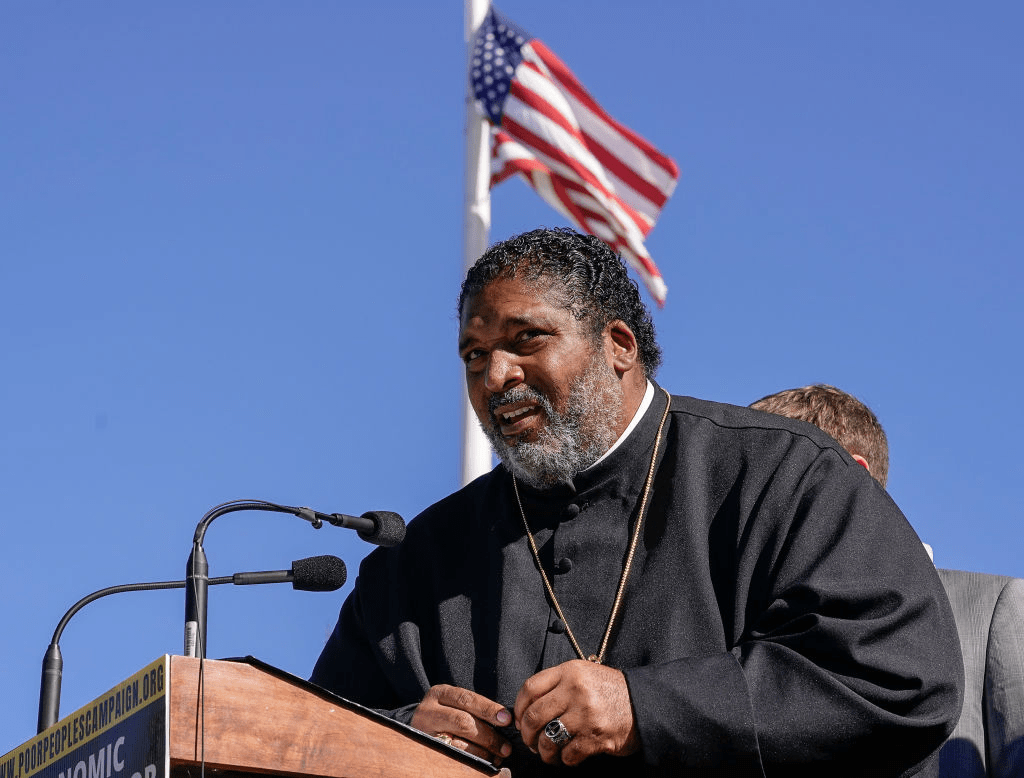
Rev. Barber: We have to start teaching people that when we talk about politics, there is not an aspect of your life—from your birth to your death—that is not impacted.
When we look at the midterm elections, we have to start with the basics. We are electing every member of the United States House of Representatives and one-third of the United States Senate. In most places, we are electing their entire state general assemblies, and many are electing governors, attorney generals, and so forth. We are electing the very people who impact every aspect of our lives. These elections determine whether we will have people in office who want to ensure everyone has health care or who want to take health care away; whether we want people in office who will vote to make sure everyone is paid a living wage versus just giving more money to corporations; whether they will care about poor and low-wage voters and the resources for people to afford a basic life, or whether all they will care about is giving more wealth to the already wealthy. That is what’s on the line.
Rev. Dr. William Barber, co-chair of the Poor People’s Campaign speaks at the Poor People’s Campaign: A National Call For Moral Revival Rally at the US Supreme Court on October 27, 2021 in Washington, DC. (Photo by Jemal Countess/Getty Images for Repairers Of The Breach)
What is at stake is whether or not you have a Congress that will demand that the President, whoever that President is, cannot just act unilaterally, but must get congressional approval for war; whether or not we have a budget; whether or not TSA agents are paid; whether or not government employees are paid; whether or not we have a Congress that will stand up and not just be a rubber stamp to what an authoritarian President wants to do or will just “go along to get along.”
We have to start teaching people that when we talk about politics, there is not an aspect of your life—from your birth to your death—that is not impacted. You’re not officially recognized without a birth certificate, which is the result of a political decision. You can’t guarantee your Medicaid, Medicare, or Social Security without political decisions. Even as you die, people must understand that politics is not just about personality; it’s about people being put in place and the kinds of policies and vision they will enact.
Rev. Dr. William J. Barber II, is a Professor in the Practice of Public Theology and Public Policy and Founding Director of the Center for Public Theology and Public Policy at Yale Divinity School. He serves as President and Senior Lecturer of Repairers of the Breach, Co-Chair of the Poor People’s Campaign
James Duckett is scheduled for execution in Florida on March 31, 2026 for his alleged 1987 murder of Teresa McAbee.
NOTE: As of 6pm ET on March 27, 2027, a *temporary* stay remains in place as the State seeks to reverse the stay rather than follow the advice of its own expert, who suggests that further DNA evaluation is warranted. Read the press release from FADP here. This stay may be revoked at any time. Please act as if the March 31 execution date will proceed.
Mr. Duckett has maintained his innocence since the day he was arrested. His attorneys argue that the case against him, built entirely on circumstantial evidence, has been undermined by recanted testimony, discredited forensic science, and the possibility of DNA testing that was never presented to the jury who sentenced him to death.
Duckett’s attorneys argue that modern forensic technology — capable of producing answers that were unattainable in the 1980s — now exists, yet the state is pressing forward with an irreversible punishment while key evidence remains inconclusively tested and thus, unresolved. (snip; more on the page, which is the petition page.)
Project 2025 was very clear. The goal is to remove all representation of LGBTQ+ people from society. Pride flags are determined to be political incitement and agitation; media representation and books with even an LGBTQ+ character are called sexualizing children while the same with straight kids is not, and letting a child express how they deeply feel inside by letting them change their hairstyle and clothing is called child abuse while doing the discredited / harmful conversion therapy to force a person of any age to be straight and cis is considered to be healthy for the child. Lies are spread constantly about puberty blockers by people who misrepresent what these medical studies show or only claim in fake medical studies that have no peer reviewed status by medical personnel in that field of study. The goal is to do what Russia, Hungary, and several other highly religious authoritarian countries have done, which is to wipe the existence of anything not straight and not cis from being. I don’t know if this is due to their being highly religious and wanting to force everyone in the country to live by their church doctrines or if they just are straight / cis so they don’t think if they don’t feel it that it can’t be true. I ran into that decades ago as a gay man with straight people claiming everyone was straight because they were and that was normal, but some people choose to be weird deviants and have bad types of sex. But if you ask them when they chose to be straight they think it is a stupid question as they never chose; they just were. Clips below. Hugs
“They go in the bathroom they’re supposed to, they upset people. If they go in the one that they now look like, they’re breaking the law, which could include pretty severe penalties” Guthrie told senators. “ … We seem to be really focused on this space and ignoring the fact that there are people that are just like us, human beings, just like us. What are they supposed to do?”
‘Do I feel like going to jail today, or do I feel like being attacked?’ trans man testifies
The bill builds on a wave of anti-LGTBQ+ bills that the Legislature and the governor have approved in recent years.
“Over the last several years, legislators have gone from refusing to protect us to actively targeting us,” Nikson Mathews, who serves as chair of the Idaho Democratic Queer Caucus, said at a news conference in February.
“Every single day when I’m out in public, I have to decide: Do I feel like going to jail today, or do I feel like being attacked,” Mathews told lawmakers.
A bathroom sign as seen on March 16, 2026, at the State Capitol Building in Boise. (Photo by Pat Sutphin for the Idaho Capital Sun)
The Idaho Legislature widely approved a bill that would criminalize “willfully” entering public and government bathrooms and changing rooms designated for another sex.
The bill — which heads to Gov. Brad Little for final consideration — would effectively block transgender people from using their preferred public bathrooms in Idaho, expanding on the state’s transgender bathroom ban in public schools.
House Bill 752 would create criminal misdemeanor and felony charges for people who “knowingly and willfully” enter a bathroom or changing room designated for the opposite sex, with some exceptions. The bill would apply in government-owned buildings and places of public accommodations, like private businesses.
A first offense would carry a misdemeanor, punishable by up to one year in prison. A second offense within five years would be a felony, punishable by up to five years in prison.
Only three states — Utah, Florida and Kansas — have criminal bans on trans people using bathrooms that align with their gender identity, according to the Movement Advancement Project, an LGBTQ+ advocacy group.
In a statement, Planned Parenthood Alliance Advocates — Idaho called the bill “the most extreme anti-transgender bathroom ban in the nation.”
One Republican opposed the bill in the Senate
In the Idaho Senate, the bill passed on a near-party line 28-7 vote Friday, with all six Democrats opposing. One Republican, Sen. Jim Guthrie, from McCammon, broke with Republicans support of the bill.
He called legislation like it “harmful.”
“They go in the bathroom they’re supposed to, they upset people. If they go in the one that they now look like, they’re breaking the law, which could include pretty severe penalties” Guthrie told senators. “ … We seem to be really focused on this space and ignoring the fact that there are people that are just like us, human beings, just like us. What are they supposed to do?”
Idaho Sen. Ben Toews, R-Coeur d’Alene, walks through the halls at the State Capitol building on Jan. 9, 2023. (Otto Kitsinger for Idaho Capital Sun)
Bill sponsor Sen. Ben Toews, R-Coeur d’Alene, told senators that the bill protects “common sense realities.”
“The Legislature has a fundamental duty to protect the bodily privacy and safety of Idaho citizens,” Toews said. “House Bill 752 provides a clear, proactive tool to secure sex-separated private spaces in our state, while accommodating common-sense realities.”
Once the bill is transmitted to Little, he has five days to decide on it. He has three options: sign it into law, veto it, or allow it to become law without his signature.
In the House, the bill passed on a 54-15 vote earlier this month, with six Republicans joining the House’s nine Democrats in opposition.
‘Do I feel like going to jail today, or do I feel like being attacked?’ trans man testifies
The bill builds on a wave of anti-LGTBQ+ bills that the Legislature and the governor have approved in recent years.
And for more than a decade, efforts to add anti-discrimination protections for LGBTQ+ people to state law have failed.
“Over the last several years, legislators have gone from refusing to protect us to actively targeting us,” Nikson Mathews, who serves as chair of the Idaho Democratic Queer Caucus, said at a news conference in February.
Mathews, a trans man with a beard, told a House committee earlier this year that the bathroom bill would force him to use the women’s restroom.
“Every single day when I’m out in public, I have to decide: Do I feel like going to jail today, or do I feel like being attacked,” Mathews told lawmakers.
A 2025 study by the UCLA School of Law’s Williams Institute found “no evidence of increased harms to people who are not transgender when transgender people are allowed to use restrooms and other gendered facilities according to their identity.” But when trans people are refused access to facilities that align with their gender, the study found that trans people report verbal harassment and physical assault.
Bill is about discrimination, Democratic senator says
Sen. Ron Taylor, a Democrat from Hailey, said the bill is about discrimination. He said constituents told him that they’d move out of Idaho if it passed — because it would throw their transgender children in jail.
Idaho state Sen. Ron Taylor, D-Hailey, enters the House of Representatives chamber for the governor’s State of the State Address on Jan. 12, 2026, at the State Capitol in Boise. (Photo by Pat Sutphin for the Idaho Capital Sun)
“Now maybe that’s what some of us want, is to chase a population that’s marginalized out of Idaho,” Taylor said. “But that’s not Idaho. Idaho was founded by a population that was marginalized.”
Sen. Brian Lenney, a Republican from Nampa, said the bill is about keeping women and girls safe from having men in their spaces.
“Trans women aren’t women,” said Sen. Joshua Kohl, a Republican from Twin Falls. “They’re men. And they need to be treated as such.”
Sen. Jim Woodward, R-Sagle, listens to proceedings during the Joint Finance-Appropriations Committee meeting on Jan. 13, 2026, at the State Capitol Building in Boise. (Photo by Pat Sutphin for the Idaho Capital Sun)
Sen. Jim Woodward, a Republican from Sagle in North Idaho, said the bill is largely borne out of an event where he said a man was found in a women’s locker room in a YMCA in Sandpoint. He said he’d vote for the bill, but he had some reservations.
“What comes next and how much further do we venture inside of a private building?” Woodward said. “I don’t support the punitive measures in this bill, but the policy does reflect the sentiment of my community, and so for that reason, I will support it. It is the best for the most.”
Sen. Melissa Wintrow, a Boise Democrat, said she saw people crying after a recent committee hearing on the bill.
“They were crying because they just didn’t feel as if they were human. That a simple little thing they had to do, like go to the bathroom, would have to be in a law,” Wintrow said.
Idaho Fraternal Order of Police opposed the bill
The bill was opposed by some law enforcement groups and several transgender Idahoans.
The bill outlines several exceptions, including to give medical assistance, law enforcement assistance, and if someone “is in dire need of urinating or defecating and such facility is the only facility reasonably available at the time of the person’s use.”
The Idaho Fraternal Order of Police flagged that exception as concerning.
“Officers responding to a complaint would be placed in the difficult position of determining an individual’s biological sex in order to enforce the statute,” Idaho Fraternal Order of Police President Bryan Lovell wrote. “In many circumstances, there is no clear or reasonable way for officers to make that determination without engaging in questioning or investigative actions that could be viewed as invasive and inappropriate.”
Kyle Pfannenstiel
Kyle Pfannenstiel is a reporter for the Idaho Capital Sun, covering health care and state politics. He previously reported for the Post Register/Report for America, Idaho Education News and the Idaho Press. Kyle is a military brat who calls Idaho home. He has a bachelor’s degree in journalism and political science from University of Idaho.
Idaho Capital Sun is part of States Newsroom, the nation’s largest state-focused nonprofit news organization.
This is about the save act. Chip Roy and the republicans constantly say it is no problem for people in the US to get a identifcation or be able to vote if they have changed their name via marriage. Fact is even Chip Roy’s own staff is struggling to get it done. And as Sam says that staff member gets the time off work and has the backing of a high level boss. The Save Act allows states to let people use the marriage license as a document but doesn’t require it. So only the blue states run by democrats will. Florida wont. And the state I was born in doesn’t allow for birth certificate changes without a court order. Roy says he doesn’t want to publicize this flaw or give it credit because the republicans want women / and gay men who might have changed their names to be blocked from voting. Again it is about promoting their view of a perfect world / and voter. A straight cis Christian white male who votes only for restrictive republicans and has a right wing ideology. Hugs