June 9, 1872 Julia Ward Howe, an abolitionist and the composer of “Battle Hymn of the Republic,” tried to establish the Mothers’ Peace Day Observance on the second Sunday in June. In 1872 the first such celebration was held and the meetings continued for several years. Her idea was widely accepted, but she was never able to get the day recognized as an official holiday. Mothers’ Peace Day was the predecessor of the Mothers’ Day holiday in the United States now celebrated on the third Sunday of May. Julia Ward Howe ca.1898 Her proclamation read in part: “As men have often forsaken the plough and the anvil at the summons of war, Let women now leave all that may be left of home For a great and earnest day of counsel. Let them meet first, as women, to bewail and commemorate the dead. Let them solemnly take counsel with each other as to the means Whereby the great human family can live in peace….”
June 9, 1954 Special Counsel for the U.S. Army Joseph N. Welch confronted Senator Joseph P. McCarthy (R-Wisconsin) during hearings into alleged communist infiltration of the Army Signal Corps.McCarthy had attacked a member of Welch’s law firm, Frederick G. Fischer, among many others, as a communist. This was alleged due to Fischer’s prior membership in the National Lawyers Guild. The Guild was the nation’s first racially integrated bar association. Army counsel Joseph N. Welch (l) confronts Senator Joseph McCarthy (r) Welch was outraged by the attempt to destroy the reputation and career of someone of whose integrity he had no doubt: “Until this moment, senator, I think I never gauged your cruelty or recklessness . . . . Have you no sense of decency, sir? At long last, have you left no sense of decency?” The entire hearings and this encounter were seen live on television, the first congressional committee hearings ever to be broadcast. McCarthy’s ability to make such accusations was soon greatly diminished. Watch the confrontation National Lawyers Guild, since 1937 and today
June 9, 1984 150,000 marched in London, England, for nuclear disarmament, protesting the presence of U.S. cruise missiles on British soil.
June 9, 1993 Police banned a vigil by Women in Black (Zene u Crnom) in Belgrade, Serbia. Who are the Women in Black? Women in Black demonstrations combine art & politics
First you know this man was threatened all the way back to the US that his family would be rounded up and tortured if he told of what happened to him in that prison. I wonder if they had to wait until injuries healed before they could let the public see him? Ron says they maybe starved him and had to feed him again to build up his weight and looks. Poor man I hope he is able to safely get his story out. It is clear the charges against him are fraudulent and made up. Just like the government kept saying he was an MS 13 gang member which two courts found he was not. Also he was living in Maryland and his court case is being heard in DC so why is the Justice department trying his new charges in Tennessee? Why not add the charges to the case being heard now in DC. Clearly they hope to get a much more conservative and racist court there than they would in the northern states. I am surprised they did not charge him in Texas. Hugs.
Mistakenly deported Salvadoran native Kilmar Abrego Garcia appeared in a Tennessee courtroom Friday, hours after he was brought back to the United States to face criminal charges for allegedly transporting undocumented migrants within the U.S.
More than two months after the Trump administration admitted it mistakenly deported Abrego Garcia from Maryland to his native El Salvador, a two-count indictment unsealed Friday alleges that he participated in a years long conspiracy to haul undocumented migrants from Texas to the interior of the country.
The return of Abrego Garcia from his native El Salvador follows a series of court battles in which the Trump administration repeatedly said it was unable to bring him back, drawing the country toward the brink of a constitutional crisis when the administration failed to heed the Supreme Court’s order to facilitate his return.
MORE: Justice Department investigating 2022 Abrego Garcia traffic stop: Sources
He made his initial court appearance Friday evening in the Middle District of Tennessee, answering “Yes, I understand” in Spanish when U.S. Magistrate Judge Barbara Holmes asked him if he understood the charges against him.
Judge Homes set a hearing for June 13, where Abrego Garcia will be arraigned on charges and the judge will take up the government’s motion to hold him in pre-trial detention on the grounds that he “poses a danger to the community and a serious risk of flight” He will remain in federal custody in Tennessee pending next week’s hearing.
“If convicted at trial, the defendant faces a maximum punishment of 10 years’ imprisonment for ‘each alien’ he transported,” said the government’s motion for detention, which also contained an allegation — not included in the indictment — that one of Abrego Garcia’s co-conspirators told authorities that Abrego Garcia participated in the murder of a rival gang member’s mother in El Salvador.
Abrego Garcia’s attorney, in an online press briefing, called the charges against his client “an abuse of power.”
Kilmar Abrego Garcia is placed in the back seat of a truck by ICE agents after arriving in Nashville, Tenn., June 6, 2025.
ABC News
“They’ll stop at nothing at all — even some of the most preposterous charges imaginable — just to avoid admitting that they made a mistake, which is what everyone knows happened in this case,” said attorney Simon Sandoval-Moshenberg.
“Mr. Garcia is going to be vigorously defending the charges against him,” the attorney said.
The decision to pursue the indictment against Abrego Garcia led to the abrupt departure of Ben Schrader, a high-ranking federal prosecutor in Tennessee, sources briefed on Schrader’s decision told ABC News. Schrader’s resignation was prompted by concerns that the case was being pursued for political reasons, the sources said.
Schrader, who spent 15 years in the U.S. Attorney’s Office in Nashville and was most recently the chief of the criminal division, declined to comment when contacted by ABC News.
The alleged conspiracy spanned nearly a decade and involved the domestic transport of thousands of noncitizens from Mexico and Central America, including some children, in exchange for thousands of dollars, according to the indictment.
Abrego Garcia is alleged to have participated in more than 100 such trips, according to the indictment. Among those allegedly transported were members of the Salvadoran gang MS-13, sources familiar with the investigation said.
MORE: Timeline: Wrongful deportation of Kilmar Abrego Garcia to El Salvador
Abrego Garcia is the only member of the alleged conspiracy charged in the indictment.
Attorney General Pam Bondi, at a Friday afternoon press conference, thanked Salvadoran President Nayib Bukele for “agreeing to return Abrego Garcia to the United States.”
“Our government presented El Salvador with an arrest warrant and they agreed to return him to our country,” Bondi said.
Bondi said that if Abrego Garcia is convicted of the charges, upon the completion of his sentence he will be deported back to his home country of El Salvador.
“The grand jury found that over the past nine years, Abrego Garcia has played a significant role in an alien smuggling ring,” Bondi said. “They found this was his full time job, not a contractor. He was a smuggler of humans and children and women. He made over 100 trips, the grand jury found, smuggling people throughout our country.”
Attorney General Pam Bondi speaks as Deputy Attorney General Todd Blanche listens during a news conference about Kilmar Abrego Garcia at the Justice Department, June 6, 2025, in Washington.
Julia Demaree Nikhinson/AP
In a statement to ABC News, Abrego Garcia’s attorney said that he’s going to keep fighting to ensure Abrego Garcia receives a fair trial.
“From the beginning, this case has made one thing painfully clear: The government had the power to bring him back at any time. Instead, they chose to play games with the court and with a man’s life,” Sandoval-Moshenberg said. “We’re not just fighting for Kilmar — we’re fighting to ensure due process rights are protected for everyone. Because tomorrow, this could be any one of us — if we let power go unchecked, if we ignore our Constitution.”
Abrego Garcia, a Salvadoran native who had been living with his wife and children in Maryland, was deported in March to El Salvador’s CECOT mega-prison — despite a 2019 court order barring his deportation to that country due to fear of persecution — after the Trump administration claimed he was a member of the criminal gang MS-13. His wife and attorneys deny that he is an MS-13 member.
The Trump administration has acknowledged in court filings that Abrego Garcia’s removal to El Salvador in March was in error, because it violated a U.S. immigration court order in 2019 that shielded Abrego Garcia from deportation to his native country, according to immigration court records. An immigration judge had determined that Abrego Garcia would likely face persecution there by local gangs that had allegedly terrorized him and his family.
The administration argued, however, that Abrego Garcia should not be returned to the U.S. because he is a member of the transnational Salvadoran gang MS-13, a claim his family and attorneys have denied. In recent weeks, Trump administration officials have been publicizing Abrego Garcia’s interactions with police over the years, despite a lack of corresponding criminal charges.
After Abrego Garcia’s family filed a lawsuit over his deportation, U.S. District Judge Paula Xinis in Maryland ordered the Trump administration to facilitate his return to the United States. The U.S. Supreme Court affirmed that ruling on April 10.
Abrego Garcia was initially sent to El Salvador’s notorious CECOT prison but was believed to have later been transferred to a different facility in the country.
The criminal investigation that led to the charges was launched in April as federal authorities began scrutinizing the circumstances of a 2022 traffic stop of Abrego Garcia by the Tennessee Highway Patrol, according to the sources. Abrego Garcia was pulled over for speeding in a vehicle with eight passengers and told police they had been working construction in Missouri.
According to body camera footage of the 2022 traffic stop, the Tennessee troopers — after questioning Abrego Garcia — discussed among themselves their suspicions that Abrego Garcia might be transporting people for money because nine people were traveling without luggage, but Abrego Garcia was not ticketed or charged.
The officers ultimately allowed Abrego Garcia to drive on with just a warning about an expired driver’s license, according to a report about the stop released last month by the U.S. Department of Homeland Security.
Asked what circumstances have changed since Abrego Garcia was not taken in custody during that traffic stop in Tennessee, Bondi replied, “What has changed is Donald Trump is now president of the United States, and our borders are again secure, and thanks to the bright light that has been shined on Abrego Garcia — this investigation continued with actually amazing police work, and we were able to track this case and stop this international smuggling ring from continuing.”
Asked by ABC News’ Pierre Thomas asked whether this should be seen as resolving the separate civil case in Maryland in which a federal judge ordered the government to facilitate Abrego Garcia’s return, Deputy Attorney General Todd Blanche said, “There’s a big difference between what the state of play was before the indictment and after the indictment. And so the reason why he is back and was returned was because an arrest warrant which was presented to the government and in El Salvador. So there’s, there’s a big difference there as far as whether it makes the ongoing litigation in Maryland moot. I would think so, but we don’t know about this. He just landed today.”
As ABC News first reported last month, the Justice Department had been quietly investigating the Tenessee traffic stop. As part of the probe, federal agents in late April visited a federal prison in Talladega, Alabama to question Jose Ramon Hernandez-Reyes, a convicted felon who was the registered owner of the vehicle Abrego Garcia was driving when stopped on Interstate 40 east of Nashville, sources previously told ABC News. Hernandez-Reyes was not present at the traffic stop.
MORE: Newly released video shows Abrego Garcia’s 2022 Tennessee traffic stop
Hernandez-Reyes, 38, is currently serving a 30-month sentence for illegally re-entering the U.S. after a prior felony conviction for illegal transportation of aliens.
After being granted limited immunity, Hernandez-Reyes allegedly told investigators that he previously operated a “taxi service” based in Baltimore. He claimed to have met Abrego Garcia around 2015 and claimed to have hired him on multiple occasions to transport undocumented migrants from Texas to various locations in the United States, sources told ABC News.
When details of the Tennessee traffic stop were first publicized, Abrego Garcia’s wife said her husband sometimes transported groups of fellow construction workers between job sites.
“Unfortunately, Kilmar is currently imprisoned without contact with the outside world, which means he cannot respond to the claims,” Jennifer Vasquez Sura said in mid-April.
Sen. Chris Van Hollen of Maryland, who flew to El Salvador and met with Abrego Garcia shortly after his deportation, said Friday that the Trump administration had “relented” regarding his return.
“After months of ignoring our Constitution, it seems the Trump Admin has relented to our demands for compliance with court orders and due process for Kilmar Abrego Garcia,” Van Hollen posted on X. “This has never been about the man — it’s about his constitutional rights & the rights of all.”
Abrego Garcia entered the U.S. illegally as a teenager in 2012, according to court records. He had been living in Maryland for the past 13 years, and married Vasquez Sura, a U.S. citizen, in 2019. The couple has one child together.
ABC News’ Laura Romero contributed to this report.
Ann Arbor (Informed Comment) – Harald Ringbauer et al. writing in Nature report on a genetic study of the ancient Phoenicians that is really going to anger Lebanese Christian nationalists. In fact, it contains a profound lesson for nationalists and nationalism in general, which is that the whole thing is a scam thought up in the last 250 years.
The 19th century racist thinker Ernest Renan saw a racial distinction between “Aryans” and “Semites.” From that point of view, the Punic wars between Rome and Carthage had a racial element, since Phoenicians were classed as “Semites.” But it turns out it was all a tiff among people we would now class as Italians.
The Phoenicians had been thought to be a unified civilization that began in what is today Lebanon. Well, they did start off in what is today Lebanon. But the “unified civilization” bit turns out to be a misconception.
The Phoenicians developed an alphabet. Like most alphabets, the letters had originally been pictograms. The Hebrew, Aramaic and Arabic, as well as the Greek and Roman alphabets (we still use the latter) derived from the Phoenician. For instance a picture of waves stood for water (ma’), and that became our M, which still looks like waves. Or a circle stood for eye (`ayn), which became our ‘o.’
Since the Phoenicians founded city-states all around the Mediterranean and left inscriptions in that alphabet, scholars had assumed that they were a related people. Phoenician settlements in the western Mediterranean were called “Punic,” but the language and customs were the same.
Regarding the Lebanese origins of this civlizational complex, Ringbauer et al. write, “We find that individuals from the Levantine Phoenician site of Akhziv in present-day Israel cluster together with previously published Bronze and Iron Age Levantine individuals, including from Megiddo in present-day Israel and the Phoenician cities of Sidon and Beirut in present-day Lebanon.” That is, they looked at ancient individuals from around the Levant and found that they all had shared haplotypes, i.e. they were Canaanites. Phoenicians, Hebrews, Nabataeans, etc. were all Canaanites culturally and genetically.
Now imagine the scientists’ astonishment when they looked at DNA from individuals who had lived in Phoenician cities such as Ibiza off Spain or Carthage in Tunisia to find that it did not display the ancient haplotypes or genetic sequences associated with Levantine peoples.
They write, “However, a mitochondrial genome from Carthage and whole-genome data from 12 individuals from the nearby rural Punic site of Kerkouane show substantial south European ancestry as well as indigenous North African ancestry. Partial North African ancestry was also found in genome-wide data from eight individuals from two Punic sites in Sardinia, combined with a broad eastern Mediterranean ancestry. Together with analysis of the whole-genome sequence of an individual from Ibiza, which was also interpreted to harbour eastern Mediterranean ancestry, this suggested that Punic people had complex ancestry.”
They observe of these “Phoenicians of the middle and western Mediterranean, “They are broadly distributed with a primary mode overlapping Bronze and Iron Age individuals from Sicily and the Aegean, regardless of sampled location.” There were only three exceptions: two persons from Sicily and one from Sardinia showed Canaanite genetic heritage.
In all the other 119 samples from “Punic” sites, the genetic heritage was mixed, showing patterns similar to those in ancient Greece and Sicily. After around 550 BC, when Carthage was founded by the “Phoenicians” in what is now Tunisia, some North African [Amazigh] genetic heritage starts to circulate among some of them. But this was a minority population. The authors observe, “Even in North Africa, 10 out of the 27 individuals from Kerkouane and 5 out of the 17 individuals from Carthage can be modelled with no indigenous North African ancestry, and 84% of individuals from these sites have more than 50% Sicilian–Aegean ancestry, making it the dominant ancestry component also in North African Punic sites.”
Also, the Iberians were mostly not Iberians. “Only two Iberian individuals, from Ibiza and Cádiz, had confidently high proportions of Bronze Age Iberian ancestry… Instead, Punic sites in the western Mediterranean share similar ancestry distributions of predominantly Sicilian–Aegean or North African origin.”
So how did all this happen? The authors hypothesize that Lebanese Phoenicians colonized Sicily, which had earlier had Greek colonies, and the Sicilians adopted Phoenician language, religion and culture. They they were the ones who struck out west, establishing Phoenician colonies in the central and western Mediterranean.
Ringbauer and his colleagues explain, “A critical question raised by our results is how and when Canaanite–Phoenician culture and language were adopted by people without any detectable Levantine ancestry. One hypothesis is that, after Levantine Phoenicians founded settlements in the central and western Mediterranean in the early first millennium bce, these communities continuously incorporated people with Sicilian–Aegean ancestry.”
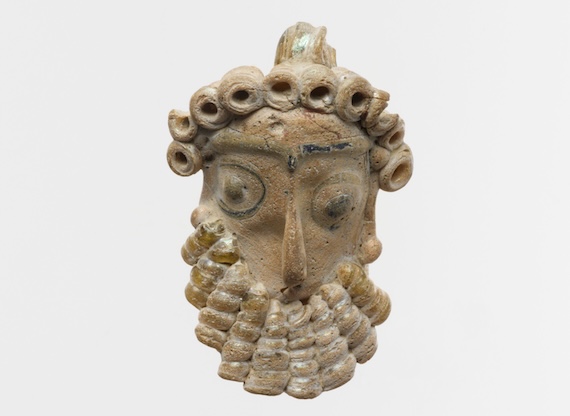
Glass head pendant, Phoenician or Carthaginian, ca. 450–300 BCE. Metropolitan Museum. Public Domain.
Reporting on the study for a Nature briefing, Ewen Callaway quotes Ringbauer as asking how it was that many Mediterranean peoples abandoned their own local cultures for that of the Phoenicians. “Does this mean Phoenician culture was like a franchise that others could adopt? That’s one for the archaeologists.”
Of course they were a franchise. So were the ancient Greeks, whose culture was adopted by so many Egyptians in places like Alexandria. As late as the 200s and 300s, there are no Arabic or Aramaic inscriptions in and around Damascus, only Greek ones. Ashkenazi Jews in Europe were also a franchise, which was joined by many gentiles — especially but not only women.
Nineteenth century European theorists of nationalism confused language groups with kinship groups, assuming that people who spoke a language were a “race,” perhaps even a “pure” one.
Today many Lebanese Christians claim to be “Phoenicians,” as though it was a pure “race” unconnected to the “Arabs.” And they take pride in Carthage, a Phoenician city, and in the Phoenician outposts of Spain, imagining they were all “Lebanese.” Ringbauer has knocked that down.
There are no nations or races of that sort. There are no “Aryans” and “Semites.” This was a linguistic distinction that was stupidly racialized. Racial “nation” was all a fevered racist fantasy. Even modern genetics only traces two lines of ancestry, the Y chromosome and the mitochondrial DNA of the X chromosome, whereas we have millions of ancestors. We’re all mongrels, all mixed up, and people in the Mediterranean basin all have a common ancestor from not so long ago. All humans have one likely only 200,000 years ago.
At the end of the video the Reverend says our only job is to love god by loving others. The only question is … how much will you love. Good thoughts in this video. Had the church been like this when I was a teen, had the church been inclusive like this when I was a little boy being molested by the Pastor I would have stayed in the faith, in the church. I might not have believed in the magic parts of the bible and I might have quibbled over the facts, but I would have stayed for the community. The environment of people who enjoyed each other’s company and loved the comradery of fellowship. Sadly the churches I saw as a child, as a teen, and as an adult lost people because rather than love, they clung to hate. The joy of feeling better than some other group, of being able to look down on them, to revel in negative emotions meant more to them than hugging those different that maybe they did not understand. They set themselves up as god judging others. Not as a loving flock, but as deciders over who was worthy to be in the flock. They were not the sheep, they wanted to be the Sheppard. Hugs
(And let me interject that I know that sometimes I’m a language/punctuation police officer, but I despise the term “reverse discrimination.” Either discrimination has happened, or it hasn’t, to be proven to whoever decides. There is no “reverse discrimination”. grr. Also, this is not a spoiler nor my opinion on the case, it’s simply that I guess it’s good for some people that I do not sit upon the SCOTUS, because I’d want to dismiss and tell them to use appropriate words so that the court could accurately decide based upon the evidence of discrimination, without being distracted by superfluous words. Please be at liberty to laugh at me about this. Then read all the following. -A)
It’s June 1, and that means we’re starting the last month, more or less, of this Supreme Court term. The cases the Court has had briefing on and heard oral argument in will all be decided by the end of this month, although some years it spills over into the first week of July.
We never know which cases are coming next. The Court doesn’t decide them in the order they hear them argued. But usually the biggest, most impactful cases aren’t decided until the end.
This week for “The Week Ahead,” I’ve got a scorecard with some of the most important still-undecided cases for this term on it. The goal is to give you some background to refer to, so when you hear the Court has announced a decision in a certain case you’ll be prepared to understand its significance.
Here they are, in order of when they were argued, although that’s likely to have little to nothing to do with when we will see opinions.
U.S. v. Skrmetti
The issue in this case is whether states can ban gender-affirming care for trans youth in the context of a 2023 Tennessee law that bans gender-affirming care, like puberty blockers and hormone therapy, for transgender patients who are minors. The Biden administration intervened in the case and was a party along with three transgender teens and their parents. That changed with the change in administrations. The Trump Justice Department, as you would expect, is on the other side of the case.
A key issue in the case is whether denying treatment to trans youth that is available to their gender conforming peers violates the Constitution by denying them equal protection under the law. A federal district court judge held that it did. But the Court of Appeals reversed. About 25 other Republican dominated states have similar laws. The result in this case will apply beyond Tennessee.
At oral argument, the conservative Justices seemed disinclined to accept the argument that this law is a form of sex discrimination, even though cisgender kids will be able to access treatment that transgender people won’t be able to receive if these laws stand. But the votes seemed to be in place to permit Tennessee and other states to keep their restrictive laws in place.
Free Speech Coalition v. Paxton
The case involves a 2023 Texas law that is supposed to keep minors from accessing pornography online. It requires websites to verify a person’s age before they are admitted to the site. But an industry group that calls itself the Free Speech Coalition sued, claiming the law violates the rights of adults who want to access the content, an impermissible burden on free speech. The ACLU is on their side in the case.
There was at least some indication at oral argument that the Justices are aware we no longer live in a world of dial up internet connections and want to revisit the standards that are used to “protect kids.” The technical legal issue is whether the court of appeals used the wrong legal standard to decide the case. Instead of using the highest standard of review and requiring the Texas law to pass “strict scrutiny” before it could burden the adults’ right to have access to protected speech, they only required that there be a “rational basis” connecting the law to its intent to protect minors.
Ames v. Ohio Department of Youth Services
The Court’s decision in this case could potentially signal a sea change in reverse discrimination employment litigation. The case involves a straight woman who claims she faced “reverse discrimination” on the job because she wasn’t gay, leading her to be passed over for promotion opportunities. The issue is whether a plaintiff who is a member of a majority group has to show that her employer is the “unusual” one who discriminated against the majority, before bringing a case under Title VII of the Civil Rights Act of 1964. If she wins, this sort of reverse discrimination case could become easier to bring.
The plaintiff lost out on a promotion to a lesbian woman. She was subsequently demoted and the position she was removed from was given to a gay man. All of this started 13 years into her employment, after a new boss, who was a gay woman, became her supervisor.
There was speculation following oral argument that the plaintiff might win unanimously. Justice Sotomayor seemed to say she thought the plaintiff might have a valid claim, noting that based on the record before the Court, there was “something suspicious” about what happened. The consensus among the Justices seemed to be that everyone had to be treated equally.
Smith & Wesson Brands v. Estados Unidos Mexicanos
There are two technical legal issues in this case, but together, they add up to an answer to the question of whether Mexico can sue U.S. gunmakers for what it has long maintained is their responsibility for the epidemic of gun violence within its borders. Mexico argues that a number of U.S. gunmakers made it possible for traffickers to illegally purchase firearms in the U.S., only for them to be provided to Mexican drug cartels.
The Court will decide: (1) Whether the production and sale of firearms in the United States is the proximate cause of alleged injuries to the Mexican government stemming from violence committed by drug cartels in Mexico; and (2) whether the production and sale of firearms in the United States amounts to “aiding and abetting” illegal firearms trafficking because firearms companies allegedly know that some of their products are unlawfully trafficked.
If the Court decides in Mexico’s favor, its lawsuit against U.S. gun manufacturers will move forward.
Louisiana v. Callais
This is the Louisiana redistricting case. The issues revolve around whether a Louisiana congressional district created to comply with the Voting Rights Act resulted in an unconstitutional gerrymander that discriminates based on race. The Callais plaintiffs are a group of “non-African Americans” who say the redistricted map violates the Constitution because it takes race into account in violation of the 14th Amendment.
Although the Court may be inclined to do away with the Voting Rights Act at some point, this case is reminiscent of a 2023 gerrymandering case out of Alabama, where a 5-4 majority that included Chief Justice Roberts and Justice Kavanaugh upheld the Voting Rights Act and forced Alabama to comply with it, rejecting maps drawn by the state legislature that made it all but impossible for Black citizens to elect candidates of their choice to Congress.
This case might have a similar outcome. It has similarly complicated facts and an up-and-down history on appeal. It comes down to whether Louisiana, whose population is about 1/3 Black, will have a second Black opportunity district. The technical issues involve whether a three-judge district court in this case was mistaken when it ruled that race predominated in the Louisiana legislature’s decision on maps, whether it erred in finding those decisions couldn’t pass the strict scrutiny test and a set of preconditions known as the Gingles factors, and whether the case is the sort of “non-justiciable” matter that should be resolved through the political process, not decided in the courts.
Mahmoud v. Taylor
The issue here is whether religious parents’ rights are violated when a school board doesn’t give them the ability to opt out from having LGBTQ-themed books available to their children in elementary school. The issue is presented as: Whether public schools burden parents’ religious exercise when they compel elementary school children to participate in instruction on gender and sexuality against their parents’ religious convictions and without notice or opportunity to opt out.
At oral argument, the Court’s conservative majority seemed sympathetic toward the parents.
Trump v. CASA, Inc. (consolidated with Trump v. Washington and Trump v. New Jersey)
This is the birthright citizenship case that was argued only earlier this month. We discussed it here. The issue isn’t whether Trump can end birthright citizenship. Rather, it’s whether the Supreme Court should stay the district courts’ preliminary injunctions except as to the individual plaintiffs and identified members of the organizational plaintiffs or states while the litigation works its way through the courts.
It’s hard to believe that it was just over a year ago that I sat outside, across the street from the U.S. Supreme Court building in the Senate Swamp, listening to the oral argument and preparing to comment on it in real time. (snip)
At the time, I wrote, “The case is all about Donald Trump and whether he can be prosecuted for the most serious of his crimes against the American people, trying to hold onto power after losing the 2020 election. It’s also about the legacy of the Roberts Court and whether history will view the already unpopular Justices as the Court that gave away democracy.”
Overall, there are more than 30 cases remaining on the Court’s dockets. There are also a number of procedural and other issues pending in cases that haven’t been fully briefed for a decision on the merits this term. This is the so-called shadow docket, where litigants ask the courts to make decisions in cases characterized as emergencies. Cases involving deportations and DOGE are among them. And also, the wild card, a number of cases still percolating through the lower courts where the issues aren’t yet ripe enough to be before the Supreme Court, but could become so in the next few months, at least enough to merit a trip to the shadow docket and interfere with the Supreme Courts’ summer break. The biggest question that remains for me is whether this Court will continue down the path it set itself upon last term, or will tell Trump no in a meaningful way?
Welcome to the new week. Thanks for being with me at Civil Discourse as we approach our third anniversary.
OK I admit this guy is a scholar so he uses words and phrases that are sometimes hard for me to follow with my limited education. But I do understand enough to follow what he is saying. Charley Kirk is full of shit on what he thinks they bible says because he is letting his own bigotry and prejudices create what the passages mean for him rather than research it with people more knowledgeable. Jesus and the bible were not against homosexuality as we understand it because they did not see sexuality and sex acts the same way we do. The sin of Sodom was lack of hospitality and men wanting to take a higher sexual role than angels. The people of the time of the bible were like young macho men types today, worried about what looked manly enough, and putting your penis in someone regardless of sex was manly. But the person who took another person in them was not, they were lessor. Women were viewed as lessor, inferior, and so were men that took another male’s penis inside them. It was not about pleasure or love, it was all about status. One thing I like about this guy is he freely admits the bible is context driven and doesn’t know what we know and understand today, that in some areas the morals we have today are superior to that of the bibles for example slavery. Hugs.



 Scottie's Playtime