Good Morning All. One of the difficulties and blessings we enjoy is the very thing we are doing right now: social media. People are able to express their information, their interests, their opinions to a world. We once trusted the network news and then a clown descended an escalator. Below is a 15-minute video from Neal DeGrasse Tyson that I found really helpful in navigating the bull. Hugs. Randy
The Texas State Board of Education launched the process of redesigning the state’s social studies standards earlier this year. Trace Thomas for The Texas Tribune
The Texas State Board of Education is reshaping how public schools will teach social studies for years to come, but its recent selection of the panelists who will advise members during the process is causing concern among educators, historians and both Democrats and Republicans, who say the panel’s composition is further indication that the state wants to prioritize hard-right conservative viewpoints.
The Republican-dominated education board earlier this year officially launched the process of redesigning Texas’ social studies standards, which outline in detail what students should know by the time of graduation. The group, which will meet again in mid-November, is aiming to finalize the standards by next summer, with classroom implementation expected in 2030.
A majority of the 15 members in September agreed on the instructional framework schools will use in each grade to teach social studies, already marking a drastic shift away from Texas’ current approach. The board settled on a plan with a heavy focus on Texas and U.S. history and less emphasis on world history, geography and cultures. Conservative groups like Texas Public Policy Foundation and the Heritage Foundation championed the framework, while educators largely opposed it.
In the weeks that followed, the board selected a panel of nine advisers who will offer feedback and recommendations during the process. The panel appears to include only one person currently working in a Texas public school district and has at least three people associated with far-right conservative activism. That includes individuals who have criticized diversity efforts, questioned school lessons highlighting the historical contributions of people of color, and promoted beliefs debunked by historians that America was founded as a Christian nation.
That group includes David Barton, a far-right conservative Christian activist who gained national prominence arguing against common interpretations of the First Amendment’s establishment clause, which prevents the government from endorsing or promoting a religion. Barton believes that America was founded as a Christian nation, which many historians have disproven.
Critics of Barton’s work have pointed to his lack of formal historical training and a book he authored over a decade ago, “The Jefferson Lies,” that was pulled from the shelves due to historical details “that were not adequately supported.” Brandon Hall, an Aledo Republican who co-appointed Barton, has defended the decision, saying it reflected the perspectives and priorities of his district.
Another panelist is Jordan Adams, a self-described independent education consultant who holds degrees from Hillsdale College, a Michigan-based campus known nationally for its hard-right political advocacy and efforts to shape classroom instruction in a conservative Christian vision. Adams’ desire to flip school boards and overhaul social studies instruction in other states has drawn community backlash over recommendations on books and curriculum that many felt reflected his political bias.
Adams has proclaimed that “there is no such thing” as expertise, describing it as a label to “shut down any type of dialogue and pretend that you can’t use your own brain to figure things out.” He has called on school boards to craft policies to eliminate student surveys, diversity efforts and what he considers “critical race theory,” a college-level academic and legal framework examining how racism is embedded in laws, policies and institutions. Critical race theory is not taught in K-12 public schools but has become a shorthand for conservative criticism of how schools teach children about race.
In an emailed response to questions from The Texas Tribune, Adams pointed to his earlier career experience as a teacher and said he understands “what constitutes quality teaching.” Adams also said he wants to ensure “Texan students are taught using the best history and civics standards in America” and that he views the purpose of social studies as forming “wise and virtuous citizens who know and love their country.”
“Every teacher in America falls somewhere along the political spectrum, and all are expected to set their personal views aside when teaching. The same goes for myself and my fellow content advisors,” Adams said. “Of course, given that this is public education, any efforts must support the U.S. Constitution and Texas Constitution, principles of the American founding, and the perpetuation of the American experiment in free self-government.”
Republicans Aaron Kinsey and LJ Francis, who co-appointed Adams, could not be reached for interviews.
David Randall, executive director of the Civics Alliance and research director of the National Association of Scholars, was also appointed a content adviser. He has criticized standards he felt were “animated by a radical identity-politics ideology” and hostile to America and “groups such as whites, men, and Christians.” Randall has written that vocabulary emphasizing “systemic racism, power, bias, and diversity” cannot coexist with “inquiry into truth — much less affection for America.” He has called the exclusion of the Bible and Christianity in social studies instruction “bizarre,” adding that no one “should find anything controversial” about teaching the role of “Judeo-Christian values” in colonial North America.
Randall told the Tribune in an email that his goal is to advise Texas “as best I can.” He did not respond to questions about his expertise and how he would work to ensure his personal beliefs do not bleed into the social studies revisions.
Randall was appointed by Republican board members Evelyn Brooks and Audrey Young, both of whom told the Tribune that they chose him not because of his political views but because of his national expertise in history and civics, which they think can help Texas improve social studies instruction.
“I really can’t sit here and say that I agree with everything he has said. I don’t even know everything that he has said.” Brooks said. “What I can say is that I can refer to his work. I can say that he emphasizes integrating civics.”
The advisory panel also consists of a social studies curriculum coordinator in the Prosper school district and university professors with expertise ranging from philosophy to military studies. The group notably includes Kate Rogers, former president of the Alamo Trust, who recently resigned from her San Antonio post after Lt. Gov. Dan Patrick criticized her over views she expressed in a doctoral dissertation suggesting she disagreed with state laws restricting classroom instruction on race and slavery.
Seven of the content advisers were selected by two State Board of Education members each, while Texas’ Commissioner of Higher Education Wynn Rosser chose the two other panelists. Board member Tiffany Clark, a Democrat, did not appoint an adviser, and she told the Tribune that she plans to hold a press conference during the board’s November meeting to address what happened.
Staci Childs, a Democrat from Houston serving on the State Board of Education, said she had anticipated that the content advisory group would include “extremely conservative people.” But her colleagues’ choices, she said, make her feel like “kids are not at the forefront right now.”
Pam Little, who is the board’s vice chair, is one of two members who appear to have chosen the only content adviser with active experience working in a Texas K-12 public school district. The Fairview Republican called the makeup of the advisory panel “disappointing.”
“I think it signals that we’re going in a direction where we teach students what we want them to know, rather than what really happened,” Little said.
The board’s recent decisions show that some members are more focused “on promoting political agendas rather than teaching the truth,” said Rocío Fierro-Pérez, political director of the Texas Freedom Network, a progressive advocacy organization that monitors the State Board of Education’s decisions.
“Whether your political beliefs are conservative, liberal, or middle of the road really shouldn’t disqualify you from participating in the process to overhaul these social studies standards,” Fierro-Pérez said. “But it’s wildly inappropriate to appoint unqualified political activists and professional advocates with their own agendas, in leading roles and guiding what millions of Texas kids are going to be learning in classrooms.”
Other board members and content advisers insist that it is too early in the process to make such judgments. They say those discussions should wait until the actual writing of the standards takes place, which is when the board can directly address concerns about the new framework.
They also note that while content advisers play an integral role in offering guidance, the process will include groups of educators who help write the standards. State Board of Education members will then make final decisions. Recent years have shown that even those within the board’s 10-member Republican majority often disagree with one another, making the final result of the social studies revisions difficult to predict.
Donald Frazier, a Texas historian at Schreiner University in Kerrville and chair of Texas’ 1836 Project advisory committee, who was also appointed a content adviser, said that based on the panelists’ conversations so far, “I think that there’s a lot more there than may meet the eye.”
“There’s people that have thought about things like pedagogy and how children learn and educational theory, all the way through this panel,” Frazier said. “There’s always going to be hand-wringing and pearl-clutching and double-guessing and second-guessing. We’ve got to keep our eye on the students of Texas and what we want these kids to be able to do when they graduate to become functioning members of our society.”
The makeup of the advisory panel and the Texas-heavy instructional framework approved in September is the latest sign of frustration among conservative Republicans who often criticize how public schools approach topics like race and gender. They have passed laws in recent years placing restrictions on how educators can discuss those topics and pushed for instruction to more heavily emphasize American patriotism and exceptionalism.
Under the new framework, kindergarteners through second graders will learn about the key people, places and events throughout Texas and U.S. history. The plan will weave together in chronological order lessons on the development of Western civilization, the U.S., and Texas during grades 3-8, with significant attention on Texas and the U.S. after fifth grade. Eighth-grade instruction will prioritize Texas, as opposed to the broader focus on national history that currently exists. The framework also eliminates the sixth-grade world cultures course.
When lessons across all grades are combined, Texas will by far receive the most attention, while world history will receive the least — though world history would receive more time under the new framework than the one currently used.
During a public comment period in September, educators criticized the new plan’s lack of attention to geography and cultures outside of America. They opposed how it divides instruction on Texas, U.S. and world history into percentages every school year, as opposed to providing students an entire grade to fully grasp one or two social studies concepts at a time. They said the plan’s strict chronological structure could disrupt how kids identify historical trends and cause-and-effect relationships, which can happen moreeffectively through a thematic instructional approach.
But that criticism did not travel far with some Republicans, who argue that drastic changes in education will almost always prompt negative responses from educators accustomed to teaching a certain way. They point to standardized test results showing less than half of Texas students performing at grade level in social studies as evidence that the current instructional approach is not working. They also believe the politicization of education began long before the social studies overhaul, but in a way that prioritizes left-leaning perspectives.
“Unfortunately, I think it boils down to this: What’s the alternative?” said Matthew McCormick, education director of the conservative Texas Public Policy Foundation. “It always seems to come down to, if it’s not maximally left-wing, then it’s conservative indoctrination. That’s my perspective. What is the alternative to the political and policymaking process? Is it to let teachers do whatever they want? Is it to let the side that lost the elections do what they want? I’m not sure. There’s going to be judgments about these sorts of things.”
This is not the first time the board has garnered attention for its efforts to reshape social studies instruction. The group in 2022 delayed revisions to the standards after pressure from Republican lawmakers who complained that they downplayed Texan and American exceptionalism and amounted to far-left indoctrination. Texas was also in the national spotlight roughly a dozen years prior for the board’s approval of standards that reflected conservative viewpoints on topics like religion and economics.
Social studies teachers share the sentiment that Texas can do a better job equipping students with knowledge about history, geography, economics and civics, but many push back on the notion that they’re training children to adhere to a particular belief system. With challenges like budget shortfalls and increased class sizes, they say it is shortsighted to blame Texas’ academic shortcomings on educators or the current learning standards — not to mention that social studies instruction often takes a backseat to subjects like reading and math.
“I think we’re giving a lot more credit to this idea that we’re using some sort of political motivation to teach. We teach the standards. The standards are there. That’s what we teach,” said Courtney Williamson, an eighth-grade social studies teacher at a school district northwest of Austin.
When students graduate, some will compete for global jobs. Others may go to colleges across the U.S. or even internationally. That highlights the importance, educators say, of providing students with a broad understanding of the world around them and teaching them how to think critically.
But with the recent moves requiring a significant overhaul of current instruction — a process that will likely prove labor-intensive and costly — some educators suspect that Texas leaders’ end goal is to establish a public education system heavily reliant on state-developed curricula and training. That’s the only way some can make sense of the new teaching framework or the makeup of the content advisory panel.
“I’m really starting to notice an atmosphere of fear from a lot of people in education, both teachers and, I think, people higher up in districts,” said Amy Ceritelli-Plouff, a sixth-grade world cultures teacher in North Texas. “When you study history, you look at prior conflicts and times in our history when there has been extremism and maybe too much government control or involvement in things; it starts with censoring and controlling education.”
Disclosure: Schreiner University, Texas Freedom Network and Texas Public Policy Foundation have been financial supporters of The Texas Tribune, a nonprofit, nonpartisan news organization that is funded in part by donations from members, foundations and corporate sponsors. Financial supporters play no role in the Tribune’s journalism. Find a complete list of them here.
The president of Boston University College Republicans wrote on X he called the U.S. Immigration and Customs Enforcement requesting it detain employees at Allston Car Wash, the site of a Nov. 4 raid where nine employees were arrested.
Boston University College Republicans President Zac Segal being interviewed at a club meeting. Segal posted on X that he called U.S. Immigration and Customs Enforcement to investigate the Allston Car Wash that was raided last week. (AVA RUBIN)
“I’ve been calling ICE for months on end. This week they finally responded to my request to detain these criminals,” BUCR President Zac Segal posted Nov. 7 above a Boston.com article about the ICE raid.
Segal declined to comment Thursday morning.
“As someone who lives in the neighborhood, I’ve seen how American jobs are being given away to those with no right to be here. Pump up the numbers!” Segal’s post concludes.
BUCR did not immediately respond to a request for comment Thursday morning.
The nine detained employees all had work permits, Allston Car Wash Manager Jose Barrera told Boston.com.
Barrera said around 22 federal agents arrived at the Cambridge Street car wash holding subpoenas, but agents began arresting employees before they could retrieve their documents from the locker room, Barrera told Boston.com.
ICE did not immediately respond to a request for comment Thursday morning.
This is a developing story and will be updated with more information.
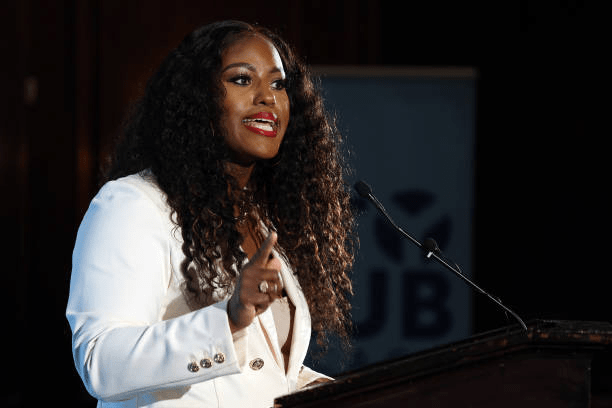
Chicago Teachers Union President Stacy Davis Gates speaks to the City Club of Chicago at Maggiano’s Banquets on Grand Avenue on Tuesday, March 5, 2024. (Terrence Antonio James/Chicago Tribune/Tribune News Service via Getty Images)
In the heart of Chicago, one Black woman has emerged as a powerhouse in the American labor movement: Stacy Davis Gates, President of the Chicago Teachers Union (CTU) and leader of the Illinois Federation of Teachers (IFT). At a time when public education, health care, and resources feel under siege, Davis Gates has positioned herself at the intersection of activism, advocacy, and community leadership — standing up to President Donald Trump’s political attacks by defending families and public education.
A steadfast advocate for Chicagoans, the union boss has her eyes set on the prosperity of Black residents in her city by any means necessary, leading a fearless charge against militarized operations including ICE and the National Guard — deployed under Trump’s direction. And since Chicago’s been targeted by the administration, Davis Gates hasn’t flinched in the face of terror. (snip-so much MORE-go read it; it’s not long)
Top Democratic officials put out a new guide, entitled “Deciding to Win,” that encourages Democrats to be a little more like Republicans on “identity and cultural issues.”
Left: David Axelrod // Public domain, Middle: James Carville // JD Lasica // Wikimedia Commons, Right: David Plouffe // Noam Galai // Wikimedia Commons
Erin In The Morning is a reader-supported publication. To receive new posts and support my work, consider becoming a subscriber.
Subscribe
This week, the self-styled centrist group WelcomePAC released a document entitled “Deciding to Win”—advised on by some of the Democratic Party’s most prominent strategists, including David Axelrod, James Carville, and David Plouffe—urging Democrats to act a little more like Republicans on so-called “identity and cultural issues.” The 58-page memo reads like a compendium of the consultant class’s worst instincts, encouraging candidates to become little more than poll-tested avatars and walking focus groups, trading conviction for triangulation. While the document rarely defines which “cultural issues” it means, the few times it does make it clear: queer and transgender people stand to lose the most if this vision of the Democratic Party takes hold.
The document begins with five key pillars for the party. Some of them make a lot of sense, such as “messaging on an economic program centered on lowering costs, growing the economy, creating jobs, and expanding the social safety net,” critiquing “the outsized political and economic influence of” the “ultra-wealthy,” and support for a $15/h minimum wage. Others, though, encourage the party to abandon platforms that have been central to its identity and mission to protect the most vulnerable in society, calling for the party to “Moderate our positions where our agenda is unpopular, including on issues like immigration, public safety, energy production, and some identity and cultural issues.”
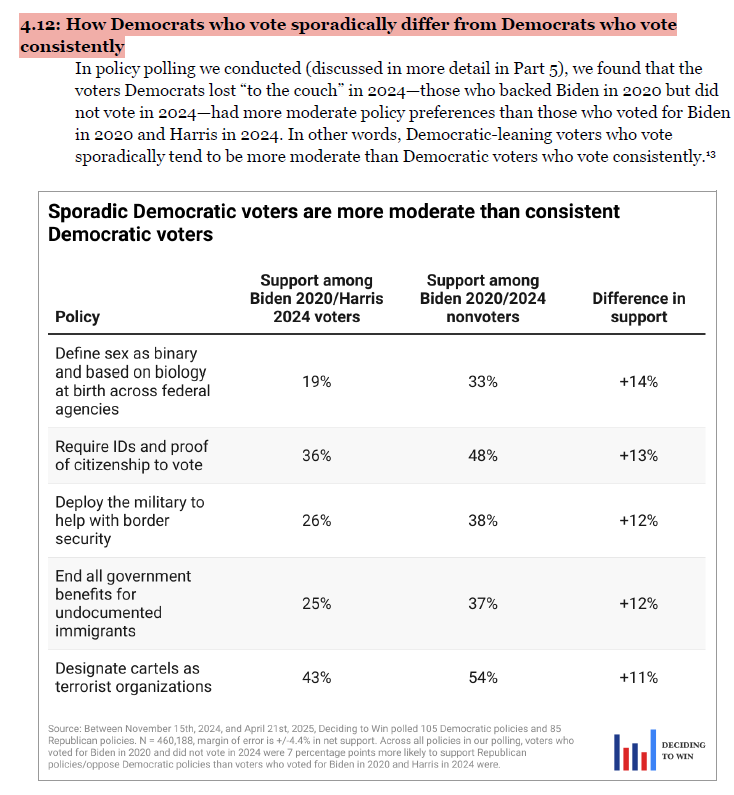
While the document rarely defines what “identity and cultural issues” means, the examples make its targets clear. Support for the Equality Act—legislation that would codify gender identity and sexual orientation as protected classes under federal law—is cited as proof the party has “moved left.” Another section lists “protecting the rights of LGBTQ+ Americans” as a priority voters supposedly don’t want Democrats to emphasize. Elsewhere, a discussion of how to mobilize voters “sitting on the couch” reveals that the most popular policy among them is “defining sex as binary and based on biology at birth across federal agencies.” Later in the document, it explicitly calls out transgender sports participation as an issue that the party should “moderate” on.
Screenshot of Deciding to Win Chart of “moderate” policies
Imagine a world where Democrats actually heeded this advice. The “define sex as binary” policy—already championed in Republican-led states and now embedded in everything the Trump administration does—has had devastating consequences for transgender Americans. It has stripped trans people of the ability to update their passports, creating serious barriers to travel; defunded organizations that affirm gender diversity; and fueled crackdowns on college campuses that allow trans students to use restrooms matching their gender identity. It’s a policy of bureaucratic erasure, one that threatens to undo decades of hard-won progress—yet it’s presented, almost casually, as a “moderate” position Democrats might adopt to win votes.
It’s a vision of politics that would turn Democrats into little more than Republican Lite—a “big tent” party spacious enough for those who despise us but not for those who most need protection. In that world, Democrats would lose not just the meaning of leadership but the very soul of why the party exists. And it’s a fantasy built on delusion: no amount of fine-tuned messaging or poll-tested calibration will ever transform the party into the perpetual winner these consultants imagine.
We don’t have to imagine what happens when Democrats follow this playbook — we’ve already seen it. In New Hampshire, Democrats capitulated on multiple anti-trans bills, including bans on youth sports participation and gender-affirming surgery, only to suffer one of the party’s worst defeats of the 2024 election cycle, losing 20 seats. By contrast, Democrats in Montana fought hard against similar measures and mounted some of the most visible resistance to anti-LGBTQ+ legislation in the country, picking up ten seats in the state House—one of the party’s strongest showings nationwide, in a state Trump carried easily. In Kentucky, Governor Andy Beshear vetoed anti-trans bills, including a sports ban, and still won reelection in a Trump +31 state. And in New York, a ballot measure enshrining gender identity protections outperformed Kamala Harris’s statewide margin by a wide margin.
Despite the evidence, a faction within the Democratic Party still treats queer and trans people as expendable—convinced that by trimming the edges of equality and tolerating “a little” discrimination, they can win back power. It’s a ruinous illusion. This kind of triangulation doesn’t blunt Republican attacks; it validates them. Every state that once embraced sports bans or “compromise” restrictions has since escalated to banning medical care, censoring books, and policing bathrooms. Capitulation has never advanced LGBTQ+ rights—not in policy, not in public opinion, not once. Democrats aren’t losing because they’ve been too loud or too firm in defending equality; they’re losing because the far right invests in its own moral narrative while Democrats second-guess theirs. The only way forward is to stand unapologetically on principle—as Andy Beshear did in Kentucky, citing it as the very reason for his success—not to chase the approval of consultants who mistake cowardice for strategy and appeasement for leadership.
Erin In The Morning is a reader-supported publication. To receive new posts and support my work, consider becoming a subscriber.
What I find deplorable is the fear they caused to the young children all to “capture” a woman who is working and has paperwork allowing her to be here. But the ICE thugs seem to get bounties for each person they snatch. She was a teacher there. How is this the going after the worst of the worst and removing dangerous criminals from the streets? Plus notice that the FBI is now warming of masked criminals pretending to be agents or officers to do crimes. As Emma says that was totally being predicted as kidnappings and trafficking’s of young people and children would start happening. Hugs
WNV linked each of these. Here are the original pages with snippets.
After No Kings, It’s Time to Escalate by Eric Blanc
We need bigger—and more disruptive—nonviolent campaigns that can go viral and peel away Trump’s pillars of support Read on Substack
American democracy is on the ropes. Trump and his billionaire backers are doing everything possible to transform our country into an authoritarian state like Hungary or Russia, where the trappings of institutional democracy mask brazen autocratic rule.
Our president’s sinking popularity numbers might not matter so much if his administration is either able to ignore electoral results or to distort the electoral map so badly that there’s almost no way to vote Republicans out.
Far too many Democrats and union leaders naively hoped that the courts would save us. But the Supreme Court has given a green light to Trump’s power grab, and it appears poised to overturn Section 2 of the Voting Rights Act, the last major legal roadblock to prevent Republicans from disenfranchising millions of Democrats and Black voters across the South.
Are we cooked? Trump would certainly like us to believe he’s unstoppable. Faced with the administration’s relentless offensive against immigrants, free speech, public services, and majoritarian rule, it’s normal to sometimes succumb to despair. But there’s no need to throw in the towel — and there are concrete next steps we can all take to win back the country through nonviolent resistance. As Chicago Teachers Union (CTU) president Stacy Davis Gates reminds us, Trumpism “won’t be stopped just in the courts or at the ballot box.” (snip-there is MORE on the page linked at “Read on Substack” above)
=====
The introvert’s guide to fighting for democracy by Protect Democracy
Six ways to protect democracy — without attending a protest Read on Substack
If you’re reading this, you’re concerned about our democracy’s slide into authoritarianism — and you want to do something about it. Wahoo! You’ve taken the first and most difficult step: committing to action.
Now come the fun parts.
I want to be really clear on a couple things to start out. First, there is no one-size-fits-all best way to exercise your First Amendment rights of speech and association. Every successful social movement has employed a wide variety of tactics and repeatedly adjusted to respond to facts on the ground. Opt for action over agonizing about optimal tactics.
Second, be realistic. We are all busy. Reflect on the commitments you can actually sustain with room to grow. It is far better to regularly move the ball forward on a smaller effort than to dive into and never complete an ambitious one.
Third, be unique! You have unique talents, skills, and passions. Let those guide your advocacy. Focus on projects that bring you joy, things you actually look forward to engaging with week after week. Lean into the comparative skills and expertise you bring to the movement.
With all that in mind, here’s a short list of six ways everyone can protect democracy — even (especially) if going to a protest or some other more public form of engagement isn’t for you.
1. Check in with your local library
Local libraries are the backbone of an informed democratic citizenry, and they provide crucial resources for underserved communities. But their funding is under attack by the administration, which has cut critical funds nationwide.
So, give the library in your neighborhood a call. See how they are doing in relation to funding cuts and if there are ways you can support them. Do they take book donations? Need volunteers? See if there are teach-in or reading groups you can join — or even lead. Offer to help curate pro-democracy reading lists for various ages. Many libraries are open to suggestions for books to add to the collection — here are some recommendations from our team.
2. Fill the gaps left by government programs
Taking care of one another is essential movement building. Check in on your food pantry and community kitchen — many of which have faced funding cuts — to see how you can help. (snip-MORE at the page linked above: “Read on Substack”)
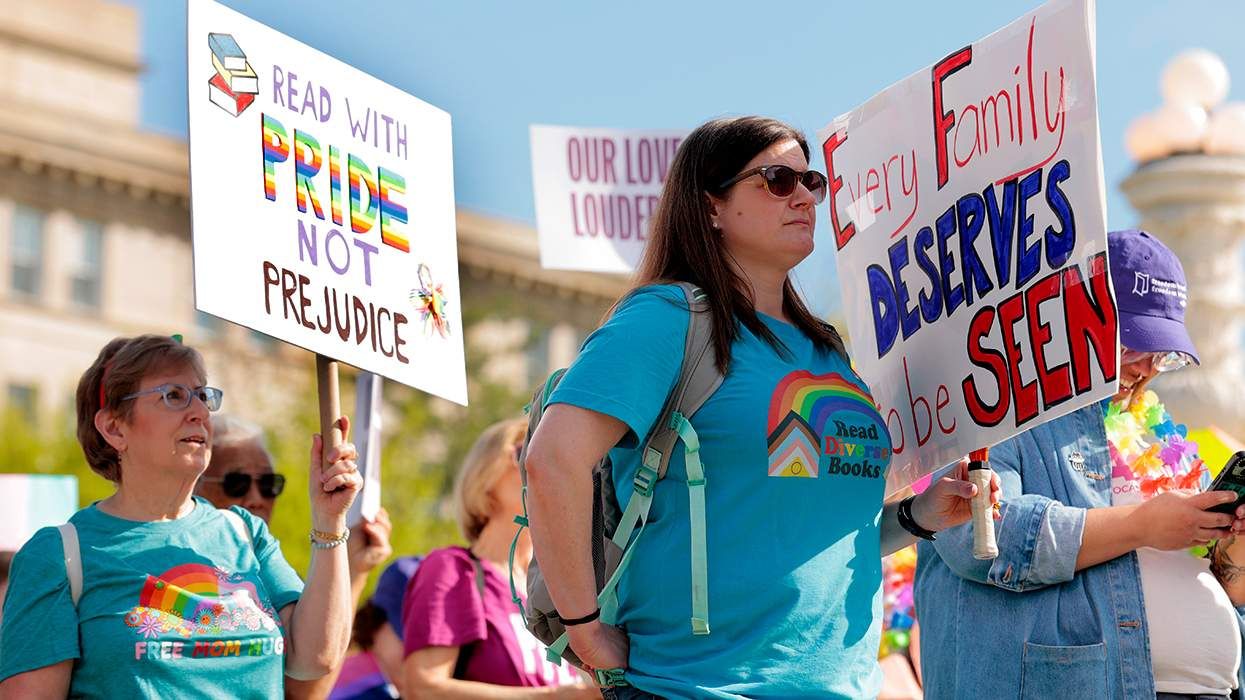
Protesters in support of LGBTQ+ rights and against book bans demonstrate outside of the U.S. Supreme Court Building while the justices heard arguments for the case of Mahmoud v. Taylor in Washington, DC., April 2025
Opinion: In Mahmoud v. Taylor, the justices gave bigotry a permission slip and ruled that parents can “opt out” of LGBTQ-inclusive lessons, further diminishing lessons and practices on inclusivity in civic society, argues Darek M. Ciszek.
The U.S. Supreme Court made a decision earlier this summer that has a significant impact on classrooms nationwide. In their 6-3 decision in Mahmoud v. Taylor, the majority completely missed the point as to why LGBTQ-inclusive education matters. By giving parents the option to pull their kids out of lessons that include LGBTQ+ characters or content, the Court prioritized personal religious objections over creating schools where students can learn without feeling invisible.
Justice Alito‘s majority opinion is especially troubling. He treats LGBTQ-inclusive education as if it were some optional “add-on” that schools can easily work around. As a former teacher, I can confidently say that is not how education works, especially when it comes to curriculum and lesson planning. And while Justice Thomas calls LGBTQ-inclusive education “ideological conformity,” he fails to see that most LGBTQ+ adults today grew up in a school system that forced us to conform to a cisgender and straight worldview. Ironically, I’d consider the Court’s narrow view of public education to be ideologically driven.
Let’s be clear about what LGBTQ-inclusive education is and isn’t. When teachers include books like Uncle Bobby’s Wedding in their curriculum, they are not trying to convert anyone’s child or attack anyone’s faith. They are trying to show students that families come in all colors, shapes, and sizes, reflecting our diverse society.
LGBTQ+ people are also part of every community. We have always been a part of human history, and we deserve to be represented in our nation’s schools. The goal is not to change what students believe at home; it is to teach them how to be respectful in a democratic and diverse world. Luckily, in her dissent, Justice Sotomayor got it right when she said that LGBTQ-inclusive education is “designed to foster mutual civility and respect.”
I could not agree more.
But here’s what the Court’s majority really got wrong: they ignored the anti-bullying efforts that motivate many LGBTQ+ inclusive education programs in the first place. According to the latest National School Climate Survey from GLSEN, 68% of American students reported feeling unsafe in school due to their SOGIE (sexual orientation, gender identity, and/or gender expression) characteristics.
That is two out of three LGBTQ+ youth.
These aren’t just statistics. These are real children trying to learn while dealing with a school environment that tells them, whether implicitly or explicitly, that their identities or families are somehow wrong or shameful.
When schools include diverse families in their lessons, they are not pushing an agenda. They are teaching kids that being different does not mean bad. They are giving LGBTQ+ students a chance to see themselves reflected in their education and helping other students see and understand those who are different from them.
Research shows inclusive education works. Studies have found that an LGBTQ-inclusive curriculum can improve the social and emotional well-being of LGBTQ+ youth. When kids learn about different types of families early on, they are more likely to treat their classmates with kindness instead of cruelty. In other words, when implemented correctly, LGBTQ-inclusive education can be an essential anti-bullying and student well-being strategy.
For instance, as a result of my doctoral research, I have learned that some schools around the world are starting to address LGBTQ+ bullying head-on, and, not surprisingly, it’s through curriculum and instruction. In Scotland, LGBTQ-inclusive education became required in 2021 across both primary and secondary, and most major subject areas. When I interviewed government staff about their experience implementing the new policy, I learned that they even worked with religious groups to inform the effort. Faith communities could agree that inclusion was important for reducing homophobic bullying, even if they had some religious concerns. Scottish students now learn how homophobic language hurts people and develop the social-emotional skills needed for creating safer schools. It’s not ideological instruction; it’s teaching kids critical peer relationship skills.
Similar to the Scottish experience, the U.S. Supreme Court could have left the door open for education authorities to find a balance that respects both religious families and vulnerable LGBTQ+ kids. Real inclusion programs do not ask anyone to abandon their faith. They ask people to treat others with respect and dignity, a lesson I believe everyone should support in class. Kids can learn that some families have two moms without being told their family is wrong. They can remember that using “gay” as an insult hurts people without abandoning their religious beliefs. Getting to know your neighbor does not go against faith.
Unfortunately for the U.S., the impact of the Court’s decision may be severe and widespread, especially in ideologically conservative states. Instead of dealing with complicated opt-out policies, I fear many school districts will probably remove LGBTQ+ inclusive materials entirely. Unfortunately, it can be easier to bow to political pressures than to fight, especially when faced with potential lawsuits or a loss of school funding. This means LGBTQ+ kids lose representation, and all students miss out on critical lessons in diversity and inclusion.
The Court’s decision also has broader implications beyond the LGBTQ+ community. By way of a new precedent, the case approves a heckler’s veto, allowing parents to claim a religious objection to any educational content they may not align with at home. This is because the majority opinion wasn’t apparent on how opting out of inclusive education would work in practice, or what would even qualify as a personal religious objection. We might start seeing opt-out forms for instruction on topics like human evolution, women’s rights, or civil rights history. Thanks to the Court, there is no line in the sand.
When we remove students from lessons about diverse communities, we fail everyone. But the call for truly inclusive education is not going anywhere. Our kids—all of our kids—deserve better.
Darek M. Ciszek is a PhD Candidate in Education at UCLA with a research focus on curriculum, learning, and social development.
Voices is dedicated to featuring a wide range of inspiring personal stories and impactful opinions from the LGBTQ+ community and its allies. Visit Advocate.com/submit to learn more about submission guidelines. Views expressed in Voices stories are those of the guest writers, columnists, and editors, and do not directly represent the views of The Advocate or our parent company, equalpride.
NEW YORK (AP) — Author Jodi Picoult has the dubious honor of being banned in two mediums this fall — her books and now a musical based on her novel “Between the Lines.”
“I’m pretty sure I’m the first author who has now had censorship occur in two different types of media,” Picoult says. “Honestly, I’m not out here to be salacious. I am writing the world as it is, and I am honestly just trying to write about difficult issues that people have a hard time talking about because that is what fiction and the arts do.”
The superintendent of Mississinewa High School in Gas City, Indiana, canceled a production last week of “Between the Lines,” saying concerns were raised over “sexual innuendo” and alcohol references in the musical. Jeremy Fewell, the superintendent, did not respond to a request for comment.
“It’s devastating for us to know that these kids who put in hundreds of hours of hard work had that torn away from them because of the objections of a single parent,” says Picoult.
“What I know, perhaps better than most people, as someone whose books have been banned, is when one parent starts deciding what is appropriate and what is inappropriate for the children of other parents, we have a big problem.”
Picoult noted that the same Indiana high school has previously produced “Grease,” where the sexual innuendo and alcohol abuse is much greater, including a pregnancy scare, sex-mad teens and the line “Did she put up a fight?”
“Between the Lines” centers on Delilah, an outsider in a new high school, who finds solace in a book and realizes she has the power to write her own story and narrate her own life. “It is a very benign message. And it’s actually a really important one for adolescents today,” says Picoult.
The original work, which features a nonbinary character, had already been edited with licensed changes to make it more palatable for a conservative audience, including removing any reference to the nonbinary character’s gender orientation.
The production was scheduled for Halloween weekend at the Gas City Performing Arts Center. The show has music and lyrics by Elyssa Samsel and Kate Anderson, and a story by Timothy Allen McDonald, based on the 2012 novel by Picoult and her daughter, Samantha van Leer. It played off-Broadway in 2022.
Picoult, the bestselling author of “My Sister’s Keeper” and “Small Great Things,” has also written about the moments leading up to a school shooting in “Nineteen Minutes,” which was banned 16 times in the 2024-2025 school year, according to PEN America, making her the nation’s fourth most-banned author.
“I had 20 books banned in one school district in Florida alone because of a single parent’s objection and she admitted she had not read any of the books,” said Picoult, a PEN America trustee. “She said that they were banned for ‘mature content and sexuality.’ There were books of mine that did not even have a single kiss in them.”
The uptick in book banning has spread to stages as well. The Dramatists Legal Defense Fund has documented recently challenged plays and musicals from states including Pennsylvania, Florida, Indiana, Kansas, Ohio and New Jersey after parents or teachers complained that the works’ social themes weren’t appropriate for minors.
The Northern Lebanon High School, in Fredericksburg, Pennsylvania, canceled a 2024 production of “The Addams Family,” citing concerns over scenes with violence, children smoking and subtle queer themes. Paula Vogel’s play “Indecent,” which explores a flashpoint in Jewish and queer theatrical history, was abruptly canceled in Florida’s Duval County in 2023 for “inappropriate” sexual dialogue.
Last year, the Educational Theatre Association asked more than 1,800 theatre educators in public and private schools across the U.S. about censorship. More than 75% of respondents reported pressure to reconsider their play and musical choices during the 2023-24 school year.
“We are not protecting kids,” said Picoult. “We are robbing them of materials that we use to deal with an increasingly complex world.”

The Texas State Board of Education launched the process of redesigning the state’s social studies standards earlier this year. Trace Thomas for The Texas Tribune

Left: David Axelrod // Public domain, Middle: James Carville // JD Lasica // Wikimedia Commons, Right: David Plouffe // Noam Galai // Wikimedia Commons