Current and former sheriffs around the country are joining forces and conducting independent investigations, despite all evidence, into the 2020 vote. CNN’s Sara Sidner reports.
This is another attempt to ruin public education and to instead indoctrinate kids / students with “American Exceptionalism” and conservative right wing views. There is a reason teaching is a profession, it has professional ethics and standards. This is why parents should not be setting curriculums and alternate history. This is why a lot of religious schools are unaccredited, they do not teach legitimate subject material that is required for a child to move to higher education, and to pass basic education tests. This is part of DeathSantis attack on schools and education, this is part of the don’t say gay and no CRT/ teaching accurate history including no sexual education while insisting teachers teach that the US was founded to be a Christian nation. If you think this is just a Florida problem remember DeathSantis is the front runner now for the republican nomination for president in 2024, and has raised hundreds of millions of dollars far out fund raising any other republican candidate. He is what the right wing wants for their king. Hugs
Gov. Ron DeSantis is vowing to “keep plowing forward” with plans to allow military veterans to teach in Florida classrooms, suggesting Wednesday that vets may be better suited to teaching than an education major.
“You give me somebody who has four years of experience as a Devil Dog over somebody who has four years of experience at Shoehorn U and I will take the Marine every day of the week and twice on Sunday,” DeSantis said during a press conference in Brevard County.
DeSantis made the comments defending a Senate bill last year that allowed for an alternative pathway to teaching certification for military veterans.
Just another huge block of voters, teachers, he is turning further against himself. They say if gays are five per cent of the population in Florida and they turn out , they can decide the election against Ron. Let’s all take him down
Keep in mind that Ron Desantis graduated from both Harvard Law and Yale. His children certainly won’t be taught by ill-equipped veterans rather than qualified school teachers.
This asshole went to Harvard. He knows active duty military can’t and shouldn’t teach Algebra or “Where The Red Fern Grows.” The point is to break public teachers unions and bleed public school money into the private sector. His “golly-shucks” populism is as cynical as the greed behind it is evil. He must really think his supporters are idiots. Or, at least, he’s counting on it.
…and Yale undergrad. He’s not stupid, notice how of all the red meat GQP issues, the one he won’t go near is abortion restrictions,? Last night in KS showed why. I hope he challenges the the biggest loser in the primaries. In the worst case scenario I suppose he’d be better than the orange malignancy, he does not inspire the cult the way Jim Jones Trump does.
Correct, he’s playing the same game all the Republicans do and just like them, not a single person calls him out on this shit.
No FL Dems goes online to point this fact out, hell not even a Biden admin Dept of Ed mentions it, he’s just spewing the same GOP talking points, uncorrected.
A good campaign policy, a horrible policy to implement. Of all the movies I’ve watched over the decades that have attempted to predict the future, I believe Idiocracy is the most likely to have nailed it.
This is a big reason why DeathSantis is becoming more popular than Trump in certain demographics.
Lazy anti-intellectualism along with religious bigotry, casuistry and sophistry are replacing logic, skepticism and relevance as critical thinking skills. If you own a cell phone then you are smarter than Einstein and the hatedlibs, so why bother reading shit?
I know there are some military vets teaching in schools, so I’m sure he’ll have his schools’ military vets screened for mental health issues, right? Regardless, what happens if one or more of those military vets who have mild to severe PTSD due to being in combat situs suddenly freaks out because of some loud noise, or children screaming/crying, or the classroom bell going off? What happens if said vet gets triggered and suddenly starts reenacting a traumatizing event? What happens if the vet starts treating the children like POWs?
Will these veterans know how to teach different kinds of learners? Would you have veterans do brain surgery? Teachers are professionals. Republicans are determined to dumb down the population and devalue education, and actual qualifications.
These Rethugs are deliberately trying to destroy public education.
Imagine some enlisted dink, absent any education training, qualifications, experience or certification whatsoever, trying to teach little kids how to read phonetically, or more advanced students history or civics or algebra, or high schoolers literature, chemistry, or physics.
Of course the point isn’t that they’ll be taught. They won’t be. They’ll “graduate” not knowing much of anything and thus be ineligible to seek college education.
A bunch of ignorant proles is all they’ll be. By design.
I wonder how the parents are going to like it. And this also answers George W Bush’s infamous question, “Rarely is the question asked: Is our children learning?”
I’m a veteran, this is a really stupid idea. Children aren’t soldiers, and shouldn’t be taught by those whose only qualification is that they were soldiers.
“4. Supremacy of the Military – Even when there are widespread domestic problems, the military is given a disproportionate amount of government funding, and the domestic agenda is neglected. Soldiers and military service are glamorized.”
Fourteen Defining Characteristics Of Fascism By Dr. Lawrence Britt
“We have a real treat for you today kids. We’re going to watch a movie called full Metal Jacket and shows you how to manage the nerds and misfits trying to infiltrate your classroom”
The GOP gonna eat that shit up come 2024 and if we aint careful so will a lot of so called “independents” who are just fucking GOP and ashamed to say it out loud. Lets see if the teachers will be able to push back at all on this. He is basically telling them they are useless so they either agree with him that they are ill suited to teach or they dont. Will be telling to see how many stick with desantis after this
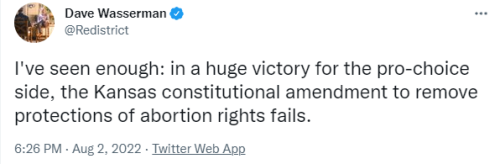
Dave Wasserman: “I’ve seen enough: in a huge victory for the pro-choice side, the Kansas constitutional amendment to remove protections of abortion rights fails.”
Time and time, over and over, Republicans will believe less and less in reality in order to protect the egos of their grossly corrupt strong men.
Pro Lifer: Well the mother should just give the baby up for adoption if she doesn’t want the baby
Me: So who will adopt the baby?
PL: I don’t know there’s lots of couples who want to adopt
Me: Do you know any couple who is waiting to adopt?
PL: Um well not personally but like I know there’s lots of people waiting to adopt.
Me: Do you know what a domestic adoption costs?
PL: I don’t know. $15,000 maybe?
Me: The average cost of domestic adoption in the United States is $70,000 if you go through a private agency.
PL: Oh I didn’t realize it was that much
Me: Yep it’s really expensive. It can be more if you want a newborn straight from the hospital. Up to $120,000.
PL: Well all life is precious.
Me: it really is. I’ve adopted through foster care and am currently a licensed foster parent. Would you be interested in becoming a foster parent yourself?
PL: Oh no I couldn’t do it.
Me: Why not?
PL: It would just be too much for me right now.
Me: Why is that?
PL: It would be too hard to handle all the issues that came with it. I’ve heard horror stories.
Me: Yep it can be extremely difficult. But what if I told you that you were required by law to become a foster parent?
PL: what?
Me: what if you had to become a foster parent by law?
PL: they would never do that. That would never happen.
Me: Well, if a woman is forced to bear a child she doesn’t want, and she goes ahead and has that child, someone has to care for the child either through adoption or foster care. You have to do one of those two things.
PL: But I don’t want any more kids.
Me: So you don’t want someone forcing you to have a child in your home that you don’t want or aren’t able to care for?
PL: no, that’s not my job to raise someone else’s child.
There it is, folks. Have the baby, but we don’t want anything to do with it afterwards.
Please notice how the church people disregarded or disobeyed the parent of these kids. Horrible abuse in the name of religion. Being gay is not a disease to be cured, it is a inborn condition that can not be changed, and the attempt is torture against those it is done to. Hugs
CBC News has learned police, Crown investigating complaints from 18 Christian Centre Academy students
Sean Kotelmach, Coy Nolin, Caitlin Erickson, Cody Nolin and 14 other former students of Saskatoon’s Christian Centre Academy, now called Legacy Christian Academy, allege they were subjected to exorcism, violent discipline and other abuse there. (Travis Reddaway/CBC)
Coy Nolin and his mother say they had no idea the four people in their living room were about to conduct a violent exorcism to cast out Coy’s “gay demons.”
Coy says that three days earlier, in an office at Saskatoon’s Christian Centre Academy, the school’s director had interrogated him for several hours after informants told the director Coy is gay. Coy, who was 16 years old at the time, says the director called him “evil” and “an abomination.”
Coy was suspended and told they would try to “cure” him.
“He told me I’d have to take it like a man,” Coy said.
Coy and his mother, Carilyn, say they agreed to the home visit in May 2004 assuming they would discuss the suspension.
But almost immediately after they walked into the house, the four officials from the school and adjoining Saskatoon Christian Centre church placed their hands on Coy. They began yelling, grunting and making other unintelligible sounds known as “speaking in tongues.”
“I was no longer in control. I was pushed aside,” Carilyn said.
After more than an hour, with Carilyn crying in the corner of the room, they stopped.
Coy says the director then grabbed his large wooden paddle, bent Coy over his lap and spanked him hard enough to leave him bruised and limping.
“That was one of the worst days of my life. Even now, just thinking about it, I go numb,” Coy said.
“This was abuse. This was a hate crime.”
Coy Nolin says he’s still scarred by the abuse he suffered while attending Saskatoon’s Christian Centre Academy, now called Legacy Christian Academy, but he is now proud of his identity and finding ways to heal. (Travis Reddaway/CBC)
CBC News has learned Coy and 17 other former students have filed criminal abuse complaints. After a 12-month investigation, Saskatoon police handed the file to Crown prosecutors in April to consider possible charges, according to police emails to students. It’s unclear when the Crown will make a decision.
The complaints include frequent paddlings, many of which allegedly occurred after the Supreme Court of Canada outlawed corporal punishment by educators in early 2004.
There are also allegations of coercion, traumatizing rituals and solitary confinement.
Many of the former students — and some of their parents — have agreed to tell their stories publicly for the first time to CBC News. They shared diaries, police statements and other documentation.
They say the physical, financial, social and emotional control from school and church officials was absolute, and that it has taken years to regain their dignity and sanity. Some say they’re still struggling.
“It’s taken a long time for people to speak up. I mean, it was a cult. It was essentially a cult,” said Caitlin Erickson, the first student to come forward to police.
Caitlin Erickson was the first of 18 former students of Saskatoon’s Christian Centre Academy, now called Legacy Christian Academy, to go to police. She says the degree of control exerted by school and church officials was similar to a cult. (Travis Reddaway/CBC)
Officials with the adjacent Legacy Christian Academy — the name was changed from Christian Centre Academy (CCA) in 2013 — initially agreed to an interview and said they’d answer all questions. The next day, they emailed a written statement and declined to answer any further questions.
“We are grieved to learn of former students who feel they were subjected to abuse during their time at CCA. We encourage and support any former student who feels this way to file a report with the police so these matters can be investigated and dealt with properly and legally,” the statement said.
Many of the alleged incidents involved leaders and staff of both the school and adjoining Saskatoon Christian Centre, now known as Mile Two Church. The two institutions have long shared a building in Saskatoon’s Lawson Heights neighbourhood, and the school’s current handbook notes they are guided by the “doctrinal beliefs” of Mile Two Church such as the infallibility of the Bible.
Mile Two Church officials declined repeated interview requests.
Erickson and other students say they’re skeptical. They say some of the same people are still working at the school and church, and that there has been no effort to apologize or make amends.
“They simply changed the name. It’s just a rebranding,” Erickson said.
Manual details ‘scriptural discipline’
Christian Centre Academy opened its doors to students in 1982, but it didn’t receive provincial accreditation allowing students to enter university or college until 1994. Like other private schools, parents pay tuition and participate in fundraising. It has also been receiving Saskatchewan government funding for the past decade.
Most of the former students who’ve come forward attended between 1995 and 2010, but there is no time limit on legal complaints of this nature involving minors.
Students and experts interviewed say all government subsidies and tax breaks for the church and school must be halted until police and prosecutors have dealt with the complaints and the government has conducted a full investigation of the school’s current practices.
They agree some key staff have left, but the former principal and school director are now teaching at other Christian schools in Saskatchewan.
“Oh my god, this makes my stomach turn. How could this happen?” said University of Regina professor emerita Ailsa Watkinson, who was involved in the 2004 Supreme Court case to ban corporal punishment in schools.
“Religion was used to torment, to discriminate. It’s cruel. This is torture. Anyone with common sense knows this.”
CBC News has obtained an 85-page, eight-lesson manual called The Child Training Seminar, written by the father of the current pastor. Students say that, during their time at the school, it was sold in the gift shop along with bibles and a selection of hand-made wooden paddles of various sizes. Students say it was used by school staff and strongly recommended for parents.
More than 20 pages are devoted to the benefits and practical applications of “scriptural discipline.”
It states “ungodly” professors, researchers and psychologists who opposed corporal punishment are “influenced by the devil” and should be ignored.
“Sometimes, spanking will leave marks on the child. If some liberal were to hear this, they’d immediately charge us with advocating child-beating,” states the handbook.
It gives detailed instruction on the types of infractions that warrant paddling, such as riding a bicycle while “forbidden.”
“Have him bend over and apply the paddle firmly. Don’t permit any wiggling around or jumping around. Don’t allow any pre-discipline howling and sniveling. Don’t let his crying and begging diminish the severity of punishment,” the handbook says.
For parents, it states fathers are the head of the household and must ensure the discipline is unemotional and consistent. It warns against using verbal discipline and says “mothers need to particularly guard against this.”
It’s unclear whether any of the handbook remains in use. The current student handbook makes no mention of corporal punishment in its “forms of discipline” section.
‘I was so scared’: former student
Sean Kotelmach, who attended the school from 1996 to 2008, said he had difficulty keeping up with the largely self-directed curriculum, which relied heavily on memorization and obedience. In his frustration, he began to talk back.
“They made me think I was stupid,” he said.
Kotelmach said he endured a punishment akin to solitary confinement as a 13-year-old. He was forced to arrive at school 15 minutes before other students, work alone at a desk in a small, windowless room for the entire day, then leave 15 minutes after his classmates had departed. He said this continued for two weeks.
He said he was also paddled multiple times. Kotelmach said he and others would “pad” their buttocks with up to nine pairs of underwear to soften the blows. If discovered, the student would be forced to remove the underwear and punishment would increase.
“Every part of me wanted to walk to the police and simply pull down my pants and show them what was done to me,” Kotelmach said. “[But] I was scared. I was so scared. I worried my parents would get in trouble for sending me to that school.”
Sean Kotelmach says Christian Centre Academy officials employed forms of solitary confinement. As a 13-year-old, he was placed a small, windowless room with only a desk for 10 consecutive school days, prohibited from speaking to anyone. (Travis Reddaway/CBC)
Later in life, medical tests would reveal Kotelmach’s dyslexia. He’s now creative director for a local marketing and media company, but said the emotional scars remain.
Kotelmach said he found the courage to file a police report last year after speaking with Erickson.
“I was tired of living with rage. I wake up in the middle of the night screaming. That’s no way to live. I want it to stop. I needed to do my part and say something,” Kotelmach said.
‘Criminal law applies to all of us’: law professor
The former students say many of these incidents, including Coy Nolin’s exorcism and paddling, occurred after the Supreme Court ruling in 2004.
In the ruling, the court limited corporal punishment to parents, and only under narrow circumstances. It must be proportional, can only be done on children between the ages of two and 12, and no implements are allowed.
It banned all other officials from doing so, and specifically mentioned teachers and school officials.
Queen’s University law professor Lisa Kelly said any teacher paddling a student after Jan. 30, 2004, was clearly committing an assault.
“That applies in any school, public or private. Criminal law applies to all of us. It is crystal clear,” Kelly said.
Kelly said any corporal punishment before 2004 could also be a concern for police and prosecutors. She said spanking, paddling or strapping a child hard enough to leave marks has long been considered by judges as excessive force.
Caitlin Erickson shared a story about her and the rest of the senior girls’ volleyball team being accused of whispering during a weekend church service in the fall of 2003.
They say that the following Monday at school, they were lined up in the auditorium and yelled at by the director, the principal and their female coach.
One by one, they were taken into a side room where one of the two male staff paddled them, they say.
“It looked like a canoe oar,” said Christina Hutchinson, the team’s captain. “Adult men doing that to a bunch of teenaged girls? It was so cruel. They were all crying, but I was so angry I didn’t cry.”
Like Erickson, Hutchinson said the school and church operated like a cult.
“Everything is based on constant fear — fear of being paddled, fear of going to hell,” she said.
They say most girls ended up with marks and bruises on their buttocks that spread as far as the back of their knees.
“I remember a week later, we were comparing bruises [in the locker room] and saying, ‘Oh, he must have been tired on you because yours isn’t nearly as bad as mine,'” Hutchinson’s sister, Stefanie, said.
She said some sessions were so vigorous that paddles broke and had to be duct-taped back together.
Erickson and other students say officials were acutely aware of the law. She said the school’s director handed out waivers in late 2003 in anticipation of the Supreme Court ban, asked parents to allow staff to continue paddling their children. Some parents refused to sign the document.
Kelly said waivers would be useless as a defence in court. A parent cannot consent to another person applying punitive physical force on their child.
One year after the Supreme Court ruling, the Saskatchewan government passed legislation banning corporal punishment in public schools. Kelly and Watkinson said this was “redundant” because the Supreme Court ruling already applied across Canada.
The Saskatoon Police Service has completed an investigation of alleged assaults and other abuse suffered by students at Christian Centre Academy, now called Legacy Christian Academy. The file has been handed to Crown prosecutors to consider possible charges, according to police emails to students. (CBC)
Academics said corporal punishment actually makes things worse. In a 2012 meta-analysis published in the Canadian Medical Association Journal, authors found that children who were spanked, paddled or strapped are more likely to have mental health issues, are more prone to violence and have lower quality relationships than those raised in a non-violent manner.
“Virtually without exception, these studies found that physical punishment was associated with higher levels of aggression against parents, siblings, peers and spouses,” stated the summary.
One of that paper’s authors, University of Manitoba professor Joan Durant, said the accounts of the Saskatoon students are heartbreaking.
“All of those things you describe are degradation and abuse. Intentionally instilling fear, isolation — none of that is acceptable. It never was,” said Durant, author of the book Positive Discipline in Everyday Life.
‘She doesn’t have a demon — she’s just shy’: parent
In their written statement to CBC News, school officials say paddling hasn’t been used there for two decades. When asked for specifics, they declined.
They said exorcism “has never been practised in our school, and we are unaware of any instance where this might have occurred.”
Former students say that’s not true.
On top of the exorcism described by the Nolin family, Hutchinson said they also took place on school property.
Hutchinson said when she was eight years old, she was asked to say the school prayer for the class. She was nervous and froze. She said that, for a week, the teacher kept her inside during recess. The teacher would sit Hutchinson on her lap, firmly squeeze and rock her repeatedly while speaking in tongues, Hutchinson said.
Hutchinson told her parents, who told administration, “She doesn’t have a demon — she’s just shy.”
In the statement, officials said any homophobia alleged by Coy Nolin and others does not exist at the school today.
“Our position on LGBTQ issues is that all students are welcome in our school, and we strive to provide a safe place for every student to grow and learn who God created them to be…we are committed to creating an environment where everyone is valued and treated with dignity, love, and respect. Therefore, we would never discipline students for their sexual orientation or gender identity,” said the statement.
They say the school is a different place than it was even a few years ago, with many new staff and leaders.
“We would welcome conversations with any students who might wish to come and revisit the school and, hopefully, find an opportunity for reconciliation,” it said.
Caitlin Erickson, Sean Kotelmach, Coy Nolin, Christina Hutchinson and others say many of the longtime staff and their relatives remain in key positions, from the pastor to the school principal.
They say no effort has been made to apologize publicly or privately.
Students waiting for justice
The students say their anxiety is growing as they wait to hear from police and prosecutors.
It’s unclear when Crown prosecutors will decide whether charges are warranted. In an email to a student, a Saskatoon police investigator said abuse files involving only a single complainant and accused can take six weeks for prosecutors to decide on possible charges. She said this file had been passed to Crown prosecutors and a decision on possible charges could take until April 2023.
A Saskatchewan Justice official declined to give details on the file and recommended asking the Saskatoon Police Service. A Saskatoon police official said they can’t comment because the investigation is ongoing.
Former students of the Christian Centre Academy, now called Legacy Christian Academy, say all government subsidies and tax breaks for the school and adjacent Mile Two Church must be halted until police and prosecutors have dealt with their abuse complaints and the government has conducted a full investigation of the school’s current practices. (Jason Warick/CBC)
Students say the people who committed the abuse must be held accountable, but that there were many other adults who witnessed it and did nothing. They wonder why this systemic abuse was ignored for so long.
That’s why they want the provincial government to investigate the school itself, freezing any funding and cancelling any tax breaks until all questions are answered.
In a written statement, a provincial Ministry of Education official said three on-site inspections are now conducted annually on independent schools, and the most recent one at Legacy Christian Academy occurred June 8.
It also said the Ministry of Education “has not received any complaints regarding LCA since funding for Qualified Independent Schools (QIS) began in 2012.”
Erickson says that’s not true. She shared a June 20 email exchange with Education Minister Dustin Duncan’s assistant.
Erickson emailed Duncan to say she “reached out to your office a number of times and received no response.” She identifies herself as a former student of Christian Centre Academy, now Legacy Christian Academy, and informs him of the criminal investigation underway.
“You have been told time and time again the damage these schools do,” she said before calling on the minister to de-fund LCA and other private Christian schools.
The provincial government says it hasn’t received any complaints about Christian Centre Academy, now called Legacy Christian Academy. But former students say that’s not true, and provided CBC News with recent email exchanges with Education Minister Dustin Duncan’s office. (Kirk Fraser/CBC News)
The minister’s assistant wrote back “on behalf of Minister Duncan” and acknowledged receipt of Erickson’s email.
“The Minister’s response will be forthcoming. Thank-you for taking the time to write,” stated the email.
Erickson said she knows of at least one other former student who recently told Duncan to de-fund LCA.
‘I’m proud of who I am’: Coy
Coy and his mother Carilyn say that following the exorcism in their home, officials declared Coy would be sent away to a special school in Edmonton to be “cured” of being gay.
Carilyn said she had ignored other warning signs over the years — including officials forcing Coy and the others to attend protests against gay marriage legislation — because her extended family, friends, finances and children’s futures were all connected to the church and school.
But the exorcism was too much. She stayed up all night writing a letter to the director and placed it on the windshield of his car.
“I thought this would be a wonderful school, but this was ridiculous. I am not sending my child away,” she said.
“We left and never looked back. It was like a thousand-pound weight lifted from my chest. It was the best thing I ever did.”
After graduating from a public high school a year later, Coy Nolin spent a couple of years in Banff, terrified to admit he was gay even to his own mother.
He eventually told her in a phone call.
“I know. I love you. Come home,” she said. Coy did.
Now working in a Saskatoon department store and in a loving relationship, the 34-year-old said life is still a struggle but he has many reasons to be grateful.
“It took a long time,” he said. “But I’m proud of who I am.”
CBC News has learned 18 former students of a private Christian school in Saskatoon have filed criminal complaints for alleged abuse, including paddling, coercion, traumatizing rituals and solitary confinement. https://t.co/WLO9nqaia7
CBC News has learned 18 former students of a private Christian school in Saskatoon have filed criminal complaints for alleged abuse, including paddling, coercion, traumatizing rituals and solitary confinement. https://t.co/WLO9nqaia7
It’s been 422 days since I came forward to police about the abuse that went on at the K-12 Christian School I attended in Saskatoon. #saskatoonhttps://t.co/Hj5dxpDIpw
Caitlin Erickson was the first of 18 former students of Saskatoon's Christian Centre Academy, now called Legacy Christian Academy, to go to police. She says the degree of control exerted by school and church officials was similar to a cult. pic.twitter.com/oPrBff5d6Y
Saskatoon police have completed an investigation of alleged assaults and other abuse suffered by former students of Christian Centre Academy. The file has been handed to Crown prosecutors to consider possible charges, according to emails to students from police obtained by CBC. pic.twitter.com/CkyH0zo6Ar
The Sask. government says it hasn't received any complaints about Christian Centre Academy since it began receiving provincial funding in 2012. But former students say that's not true, and provided CBC with recent email exchanges with Education Minister Dustin Duncan's office. pic.twitter.com/ejKUSaYOZH
The Sask. government says it hasn't received any complaints about Christian Centre Academy since it began receiving provincial funding in 2012. But former students say that's not true, and provided CBC with recent email exchanges with Education Minister Dustin Duncan's office. pic.twitter.com/ejKUSaYOZH
If you go to the web site of the story you can see a blown up picture of the one in the tweet with him at the desk surrounded by girls. Notice the two little girls with signs who look like they cannot believe they had to come and do this cosplay. Hugs
Student athletes at Oklahoma public schools are now required to complete “biological sex affidavits” to determine whether they are eligible to participate in athletics as school districts begin enforcing a state law.
In March, Oklahoma Gov. Kevin Stitt (R) signed into law the state’s “Save Women’s Sports Act,” which requires sports teams through college to be designated based on athletes’ “biological sex,” or sex assigned at birth.
In early July, the CBS-affiliate KOAM-TV reported that some school districts were beginning to distribute “biological sex affidavits” to student athletes to enforce the law.
In my 55 years on earth, I dont remember Republicans giving a crap about woman’s sports. I guess it took transgendered athletes to finally make them care.
This. My couldn’t-care-less-about-any-sports in the 30 years I’ve known him BIL (more an outdoor / photography / camping guy) suddenly started protesting to “save women’s sports” last year. The biggest farce I’ve ever seen – it was clear GQP talking points..
If this disqualifies someone from team sports, at least they won’t have to participate in public prayers at the 50-yard line. Always look on the bright side of life?
Are they going to do genetic testing for every child to confirm it? Are they going to pay for it? Isn’t there a HIPAA thing or is that out in Oklahoma?
After all the coverage of Lauren Hubbard, a trans woman weightlifter competing in the Olympics, she didn’t make a single lift when she’s in her prime age as a weightlifter and got clobbered by Li Wenwen, a 21 year old Chinese lifter who won her weight class (over 81 kg) on her first lift. She’s really a kid in the grand scheme of weightlifting and unless she gets injured, can compete in another 4 Olympics. You peak in your mid 30’s.
I’m pretty sure they went with the birth certificate as an end run around HIPAA. The birth certificate counts as state record, rather than medical record. And, no, they’re no going to pay for it.
Does this mean that transmen will now be competing in women’s sports? Or is it just a way to keep transgender people from competing in any sports at all? I think we know the answer to that…
The telling point is: will this apply equally to men’s sports as well? What if a high school’s star quarterback refuses to file such a document on general principles?
So the linked article is incorrect, and this will apply ONLY to (presumed) female students and not all students? That could be a problem if (presumed) male students are exempted, as that directly violates Title IX.
Waiting for one of these red school districts to defund/shutdown women’s sports in school and blame it on transgender students “ruining women’s sports for everyone.”
Russian students heading back to school in the autumn will be taught about the country’s values amid the Kremlin’s wider campaign to implement “patriotic” education in schools.
Starting from September 5, schools across the country will dedicate hours to so-called “conversations about important things”, Sergei Novikov, head of the presidential directorate for social projects, told Tass, the state news agency.
These “conversations” would focus on the values of Russian society as enshrined in the country’s national security strategy, he said.
Russian students heading back to school in the autumn will be taught about the country’s values amid the Kremlin’s wider campaign to implement “patriotic” education in schools
— The Times and The Sunday Times (@thetimes) August 1, 2022
The DeathSantis kingdom of Florida. DeathSantis is the warlord / feudal lord who wants to be king of the country. He thinks his kingdom is above the federal government. He has fought Biden on every measure to protect the public from Covid going so far as to demand businesses not follow federal rules then either. No matter how the courts ruled against him like his mentor TFG he claimed he won and was still the king. Hugs
Florida is advising school districts to ignore protections for LGBTQ students that President Joe Biden’s administration is trying to implement
ByBRENDAN FARRINGTON Associated Press
July 29, 2022, 5:28 PM
Florida advised school districts to ignore protections for LGBTQ students that President Joe Biden’s administration is trying to implement, saying the anti-discrimination language is not binding law and following the guidance could result in breaking state law.
Florida Education Commissioner Manny Diaz wrote to school districts Thursday saying they should not change current practices because of proposed new rules under Title IX that would extend sexual discrimination protections to students based on their gender identity or sexual orientation.
“Nothing in these guidance documents requires you to give biological males who identify as female access to female bathrooms, locker rooms, or dorms … or to allow biological males who identify as female to compete on female sports teams,” Diaz said.
He added that doing any of those things would “jeopardize the safety and wellbeing of Florida students and risk violating Florida law.”
But Agriculture Commissioner Nikki Fried, the only statewide elected Democrat and whose agency overseas school lunch programs, said the matter wasn’t just about bathrooms, but also about feeding students. The United States Department of Agriculture requires schools to put up a poster on nondiscrimination in order to receive federal money for lunch programs, she said.
“This is a fictitious culture war that they have created that is going to deny kids food,” Fried, who hopes to challenge Republican Gov. Ron DeSantis, said at a news conference. “I will do everything possible to ensure that Florida’s kids are not victimized by the DeSantis administration and denied their meals.”
Fried’s department recently told schools they should hang posters with the new language. The Diaz letter told schools to disregard that guidance because it could violate state law.
Last year, DeSantis signed a bill banning anyone assigned male at birth from participating in girls’ or women’s sports. This year, he signed a bill that prohibits discussion of gender identity or sexual orientation in public schools at least through grade 3.
Earlier this month, a federal judge in Tennessee blocked implementation of the proposed new federal protections after 20 states sued over the issue.
Florida's commissioner of education, Manny Diaz Jr., told school districts to disregard federal guidance aimed at protecting LGBTQ students https://t.co/1GEB6HMxGS
Florida advised school districts to ignore protections for LGBTQ students that President Joe Biden's administration is trying to implement…https://t.co/GQGCnpWyUA
Their public schools are already cratering (by design for privatization) because the teachers are retiring and leaving in droves, leaving a massive deficit – they’re hiring veterans with no teaching experience at dozens of elementary schools (and that’s just one example)
The (public) schools need both federal and state dollars. The FL DoEd under DeSantis doesn’t give shit the bind that they’ve created for the schools or the students. They’re just in a partisan pissing match.
When I was younger, I thought, well, I’ll wait until the prejudice old people die off, then maybe retire to Florida. Sadly, I’m a senior now, and nothing has changed in that state. It’s like hate, prejudice, and religion really kick in down there when someone turns 50.
Coach D is in an interracial marriage. In this heartfelt video, Coach D draws on his personal experience and asks the GOP why are they so focused on destroying interracial marriage and same sex marriage and now disgusting their desire to do so is.