Explanation: APOD is 30 years old today. In celebration, today’s picture uses past APODs as tiles arranged to create a single pixelated image that might remind you of one of the most well-known and evocative depictions of planet Earth’s night sky. In fact, this Starry Night consists of 1,836 individual images contributed to APOD over the last 5 years in a mosaic of 32,232 tiles. Today, APOD would like to offer a sincere thank you to our contributors, volunteers, and readers. Over the last 30 years your continuing efforts have allowed us to enjoy, inspire, and share a discovery of the cosmos.
Right now the tRump people are arguing in court that the right of judges to invoke country wide injunctions should be stopped. But they never held that view when republicans ran to this judge’s jurisdiction to stop and hinder every Biden executive order and law. Instead they crowed about it. However like the debt now that it is them in charge they don’t like what they used to stop Democratic Party initiatives. Hugs
Anti-LGBTQ+ Judge Matthew Kacsmaryk | YouTube screenshot
Anti-LGBTQ+ federal Judge Matthew Kacsmaryk ruled that Title VII of the 1964 Civil Rights Act doesn’t protect LGBTQ+ people from workplace discrimination — it only protects them from discriminatory termination. Kacsmaryk’s ruling contradicts the 2020 U.S. Supreme Court decision in Bostock v. Clayton County, a case that classified anti-LGBTQ+ workplace discrimination as a form of sex-based harassment prohibited by Title VII.
In the case, the state of Texas sued the federal Equal Employment Opportunity Commission (EEOC), claiming that the federal agency’s June 2021 guidance interpreting Title VII as prohibiting anti-LGBTQ+ workplace discrimination violated Texas’s “sovereign right” to establish governmental workplace policies dictating employee names, pronouns, dress codes, and facility usage as being based on a person’s sex assigned at birth (and not their gender identity).
The EEOC’s June 2021 guidance said that, to avoid illegally discriminating against LGBTQ+ people in the workplace, adherence to dress codes, use of personal pronouns, and access to gender-segregated facilities must be differentiated based on one’s gender identity and not their sex assigned at birth.
Texas said that the EEOC violated Texas’s free speech rights and Title VII’s sex-based protections by forcing the state’s Department of Agriculture (TDA) to base its workplace policies on gender identity instead of one’s sex assigned at birth. These particular TDA workplace policies were created by Sid Miller, a supporter of the current U.S. president who has said he’s “thrilled” by the ban on trans military members and has called trans identity a form of “leftist social experimentation.”
Texas sued the EEOC with the assistance of the Heritage Foundation, the right-wing think tank that constructed Project 2025, the very anti-LGBTQ+ blueprint for the current U.S. president’s second term in office.
Kacsmaryk agreed with the state of Texas, ruling that the TDA’s policies can legally ban transgender employees from using restrooms, pronouns, and dress codes that align with their gender identity. The TDA’s policies don’t constitute unequal treatment of trans employees, Kacsmaryk wrote, because they “equally” apply to everyone based on their sex assigned at birth, Truthout reported.
Kacsmaryk’s ruling altogether ignores trans identities in a manner consistent with the current president’s interpretation of federal anti-discrimination law. The president has signed executive orders directing all federal agencies, including the EEOC, to end all legal recognition of trans people’s gender identities and to, instead, only recognize a person’s “biological sex” as assigned at birth.
Kacsmaryk ordered the EEOC to remove all references to sexual orientation and gender identity as protected classes under Title VII from its June 2021 guidance.
In 2022, Kacsmaryk ruled against LGBTQ+ protections in Section 1557 of the Affordable Care Act – a law that bans healthcare discrimination on the basis of sex. The two doctors who sued in that case were represented by former Trump advisor Stephen Miller’s America First Legal Foundation, a far-right public interest group that opposes pro-LGBTQ+ civil rights.
Republicans and Christian groups often file their lawsuits in his district because of his tendency to rule in their favor.
Before his 2019 Senate confirmation hearing, Kacsmaryk removed his byline from an article condemning transgender health care in the Texas Review of Law and Politics, a far-right publication that he led as a law student at the University of Texas.
Hiding his contribution to the article likely prevented public scrutiny and questions about the article and his ties to The First Liberty Institute, a Christian conservative legal group that has represented clients who refused to serve LGBTQ+ people based on religious beliefs.
Subscribe to the LGBTQ Nation newsletter and be the first to know about the latest headlines shaping LGBTQ+ communities worldwide.
The state’s ban on gender-affirming pediatric care “cannot be justified” by science, a two-year review concluded.
Madison PaulyMay 27, 2025, 3:00 pm EDT
Spencer Cox of Utah answers a question during a discussion about how our society can learn to disagree in a way that allows us to find solutions on Wednesday, Nov. 15, 2023. | Logan Newell/The Coloradoan / USA TODAY NETWORK
In 2022, Utah Gov. Spencer Cox was the rare Republican governor who seemed to truly care about the well-being of transgender kids. “I don’t understand what they are going through or why they feel the way they do. But I want them to live,” he wrote in a letter that year, explaining why he was vetoing a bill that would have banned four trans middle- and high schoolers in Utah from playing on sports teams with classmates who shared their gender identity. “All the research shows that even a little acceptance and connection can reduce suicidality significantly.”
Meanwhile, nationally, Republican politicians were making opposition to trans rights a core tenet of their platforms, filing hundreds of bills attacking trans kids at the doctor’s office, at school, and on the field. Early in the 2023 legislative session, Cox capitulated, signing a bill that placed an indefinite “moratorium” on doctors providing puberty blockers and hormone therapy to trans kids with gender dysphoria. The bill ordered the Utah health department to commission a systematic review of medical evidence around the treatments, with the goal of producing recommendations for the legislature on whether to lift the moratorium. “We sincerely hope that we can treat our transgender families with more love and respect as we work to better understand the science and consequences behind these procedures,” Cox said at the time.
Now, more than two years later, that review is here, and its conclusions unambiguously support gender-affirming medical care for trans youth. “The conventional wisdom among non-experts has long been that there are limited data” on gender-affirming pediatric care, the authors wrote. “However, results from our exhaustive literature searches have lead us to the opposite conclusion.”
The medical evidence review, published on Wednesday, was compiled over a two-year period by the Drug Regimen Review Center at the University of Utah. Unlike the federal government’s recent report on the same subject, which was produced in three months and criticized gender-affirming pediatric treatments, the names of the Utah report’s contributors are actually disclosed on the more than thousand-page document.
The authors write:
The consensus of the evidence supports that the treatments are effective in terms of mental health, psychosocial outcomes, and the induction of body changes consistent with the affirmed gender in pediatric [gender dysphoria] patients. The evidence also supports that the treatments are safe in terms of changes to bone density, cardiovascular risk factors, metabolic changes, and cancer…
It is our expert opinion that policies to prevent access to and use of [gender-affirming hormone therapy] for treatment of [gender dysphoria] in pediatric patients cannot be justified based on the quantity or quality of medical science findings or concerns about potential regret in the future, and that high-quality guidelines are available to guide qualified providers in treating pediatric patients who meet diagnostic criteria.
In a second part of their review, the authors looked specifically at long-term outcomes of patients who started treatment for gender dysphoria as minors:
Overall, there were positive mental health and psychosocial functioning outcomes. While gender affirming treatment showed a possibly protective effect in prostate cancer in transgender men and breast cancer in transgender women, there was an increase in some specific types of benign brain tumors. There were increased mortality risks in both transgender men and women treated with hormonal therapy, but more so in transgender women. Increase risk of mortality was consistently due to increase in suicide, non-natural causes, and HIV/AIDS. Patients that were seen at the gender clinic before the age of 18 had a lower risk of suicide compared to those referred as an adult.
Submitted with the review was a set of recommendations—compiled by advisers from the state’s medical and professional licensing boards, the University of Utah, and a Utah non-profit hospital system—on steps the state legislature could take to ensure proper training among gender-affirming care providers, in the event it decides to lift the moratorium.
But according to the Salt Lake Tribune, legislators behind the ban are already dismissing the findings they asked for. In response to questions from the Tribune, Rep. Katy Hall, who co-sponsored the 2023 ban, issued a joint statement with fellow Republican state Rep. Bridger Bolinder, the chair of the legislature’s Health and Human Services Interim Committee, that dismissed the study’s findings. “We intend to keep the moratorium in place,” they told the Tribune. “Young kids and teenagers should not be making life-altering medical decisions based on weak evidence.”
Why ignore their own review? Polling, the legislators’ statement suggests. “Utah was right to lead on this issue, and the public agrees—polls show clear majority support both statewide and nationally,” Hall and Bolinder added in their statement. “Simply put, the science isn’t there, the risks are real, and the public is with us.”
Subscribe to the LGBTQ Nation newsletter and be the first to know about the latest headlines shaping LGBTQ+ communities worldwide.
A representative of Seattle Sperm Bank admitted to selling unused sperm vials to the FBI during an industry conference, purportedly for the agency to research splat patterns, multiple sources told LGBTQ Nation.
The sources say the admission came from the representative – who one source identified as Seattle Sperm Bank General Supervisor Angelo Allard – during an October 2022 meeting at the California Cryobank campus in Los Angeles. Allard did not reply to LGBTQ Nation’s multiple requests for comment, nor did Seattle Sperm Bank CEO Fredrik Andreasson, nor the bank’s communication team.
For decades, commercial sperm banks (on which many LGBTQ+ people rely to build their families) have faced ardent criticism over a host of ethical issues fueled by a lack of industry regulations. Donor-conceived people, recipient parents, and donors themselves have long sounded the alarm on the industry’s shady practices – from failing to enforce reasonable family limits to outright lying about donor medical histories. These activists continue to fight for legislation that would keep the banks in check.
This ongoing tension is why the 2022 meeting occurred in the first place. Sources say sperm banks hosted the gathering as a sort of olive branch to the reform advocates, though some who attended felt the banks were not actually willing to listen. Reportedly in attendance were lawyers, medical experts, activists, and scholars.
Although these activists have long known about the unethical practices of the industry, many were still shocked at what they heard.
Anti-fertility fraud activist Eve Wiley called it a “nails on a chalkboard moment” and said that the admission brought “a collective gasp in the room.” It was “unlike any other procedure any of us had heard,” she said.
She said the comment was skated over pretty quickly and that the man next to the speaker “was kind of like, ‘Dude, stop,’ giving, you know, the death stare essentially.”
A fertility expert who was also present in the room confirmed the story to LGBTQ Nation, saying they are “not sure what precipitated it” but that a “gentleman who was involved at a sperm bank raised his hand and basically said they sent sperm to the FBI at the request of the FBI for training purposes.”
“On one level it makes sense, you know, that you would need sperm to train on or to do some analysis of,” they said, “but I guess none of us had ever considered that law enforcement might reach a sperm bank and do this, certainly without consent from the parties themselves who could be genetically identified and put into a database if this were done.”
They said the representative seemed completely taken aback that anyone found the information troubling.
“They just stated it so matter-of-factly, like, ‘Yeah, this is what we do.’ And it was almost as if they didn’t see any privacy protections that needed to be discussed, any issues with that, any hesitation about turning information over to law enforcement in that manner, even for training purposes.”
Another expert who attended the meeting also heard the admission. They told LGBTQ Nation in an emailed statement that they remembered the representative from Seattle Sperm Bank “telling the group that they… provided the FBI with unused sperm for them to use for ‘practice.”’ The source (the same one who identified the speaker as Allard) said they do not remember the representative saying the sperm was “sold,” though.
A transcript of a Zoom chat obtained by LGBTQ Nation shows those who attended virtually discussing the admission in the chat. Folks called the revelation “shocking” and “incredibly concerning,” with some questioning if the DNA was being added to a criminal database.
LGBTQ Nation reached out to the National FBI office and received the following response from Seattle Field Office public affairs specialist Steven Bernd: “Our policy prohibits us, except in rare circumstances, from disclosing investigative techniques of an FBI investigation. However, I can plainly state that I did not find any information to suggest that the FBI has been purchasing sperm from a sperm bank.”
It’s not clear, however, whether the sperm would have been sold to the local or national office. Additionally, Bernd took less than an hour to reply to our request for a statement, raising the question of how much digging he did before saying he “did not find any information.”
The queer connection
Also reportedly present at the meeting were several LGBTQ+ family-building organizations, though none have corroborated the FBI admission with LGBTQ Nation.
Ron Poole-Dayan, executive director of Men Having Babies, stated over email that he had “no specific recollection” of the admission being made. The representative who attended the meeting from Family Equality no longer works for the organization, and a spokesperson said, “No current staff members have additional information to share.” Representatives from Colage, an organization for the children of LGBTQ+ people, and GLAD, an LGBTQ+ legal advocacy organization, did not respond to a request for comment.
Wiley called it “shocking” and “disheartening” that no LGBTQ+ organizations have come forward.
Laura High, a donor-conceived person and activist who was not present at the meeting, expressed disappointment that these organizations have not taken action.
“Especially right now we need to be able to rely on these organizations to keep the queer community safe,” she told LGBTQ Nation over email. “And the fact that they stayed silent on this incredibly clear violation of rights that clearly puts the queer community in jeopardy, especially under this regime is terrifying.”
High said many people in the activist community have told her they do not want to contribute to this story going public for fear of not being invited to future meetings or losing a seat at the table, and she wonders if perhaps that’s why these organizations also have not spoken up.
“But why on earth would you want to be sitting at that kind of table that clearly has no problem putting the queer community or any marginalized group in utter danger?” she said.
What’s at stake
The prospect of a bank selling sperm to the FBI without informed consent raises a number of ethical concerns, though the legality of it all is murky.
Donor contracts from Seattle Sperm Bank obtained by LGBTQ Nation state, “I understand that once I agree to participate in the donor program and have been accepted into the program, I may not impose restrictions on the manner in which my donor sperm may be used.”
“Technically, people can buy sperm for any purpose… but sperm samples are not intended for that purpose,” explained the fertility expert. “They’re intended for people to buy to family build. That is the assumption.”
“I think there would be a lot of people who would object, for example, if law enforcement just started suddenly going through trash in search of hair or saliva or discarded toothbrushes or fingernail clippings to include people in databases for ‘training purposes.’”
They said the lack of informed consent is one of the biggest issues. “I’ve talked to sperm donors, and they were not informed that this was going on.” LGBTQ Nation independently received direct confirmation from one Seattle donor who said they were never told this was a possibility.
Wiley said she is most concerned with sperm being mishandled or planted as evidence in a crime.
“What if someone steals that sperm and then sells it on the black market, and they plant that?” she said. “And is DNA being extracted and then being used in a database to catch criminals?… It’s hard to say what can happen.”
As someone who has spent her life fighting fertility fraud, Wiley has witnessed firsthand the horrific ways gametes can be mishandled. “It’s unbelievable,” she said, adding that “in the absence of laws and that legal landscape being the wild wild west, it’s really frustrating.”
High said trans people also have specific safety concerns, since they often preserve their sperm or eggs at these banks before starting gender-affirming care.
“We know this administration is targeting the queer community,” High said, “Especially the trans community, who actively uses the fertility industry to store their DNA before they medically transition.”
She said there is also particular concern for people of color. “We are well aware that people of color are actively and heinously targeted by the police force,” she said. “Secretly handing over sperm from Black donors or any donor of color does not just affect that donor, but potentially their entire family. We have a long and terrible history in this country of people of color getting set up for a crime by the police force.”
“This industry who’s already very famous for excluding recipient parents and donors of color is demonstrating that they are also willing to put those donors at risk for severe injustice… Seattle has given the FBI the ability to have a genetic tracker.”
There is also the matter of the DNA of the children conceived from each donor being in the hands of a government agency. One recipient parent, Romy Razuri, who told LGBTQ Nation she became an activist in the space after she had reason to believe Seattle Sperm Bank failed to report critical pieces of her donor’s medical information, called it “creepy.”
“It just doesn’t sound right. I mean, no matter how you look at it and if you try to make sense of it… Whatever the reason is, it’s just not okay.”
Asked if the information made her feel worried about her kids, she replied: “I mean, anything at this point related to donor conception makes me feel scared for my kids.”
Subscribe to the LGBTQ Nation newsletter and be the first to know about the latest headlines shaping LGBTQ+ communities worldwide.
“In almost every single case, the reason was anti-trans discrimination in the form of pressure to ‘detransition’ from one’s family, friends, or community.”
Erin In The Morning is a reader-supported publication. To receive new posts and support my work, consider becoming a subscriber.
Upgrade to paid
A report on the largest survey ever of trans Americans’ health was released on Wednesday, June 11, and its findings reaffirmed what many academics, health care providers and trans people already know: gender-affirming care saves and improves lives, but transphobia often dissuades people from pursuing or continuing it when they need it most.
Over 84,000 trans, nonbinary and gender nonconforming people aged 18 and up responded to the 2022 U.S. Transgender Survey, spearheaded by Advocates for Trans Equality (A4TE). Of respondents who had transitioned, 9% had gone back to living as their sex assigned at birth at some point in their lives, at least for a short while—but in almost every single case, the reason was anti-trans discrimination from one’s family, friends, or community.
“Social and structural explanations dominated the reasons why respondents reported going back to living in their sex assigned at birth at some point,” the report found. “Only 4% of people who went back to living in their sex assigned at birth for a while cited that their reason was because they realized that gender transition was not for them. When considering all respondents who had transitioned, this number equates to only 0.36%.”
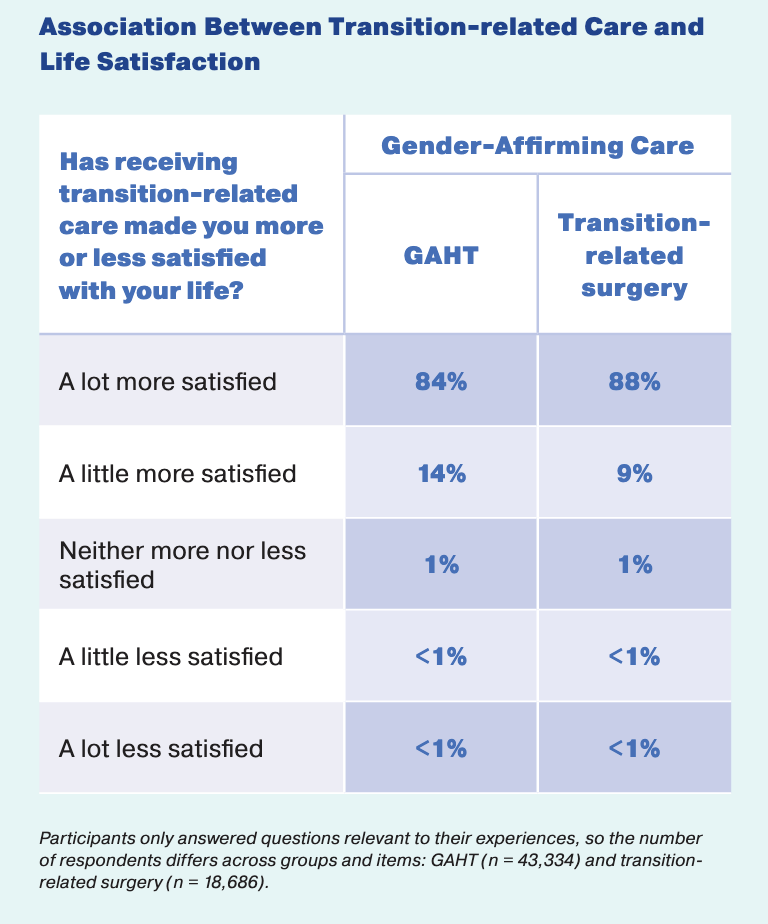
Meanwhile, respondents who received gender-affirming hormone therapy (GAHT) or gender-affirming surgery overwhelmingly reported feeling “more satisfied” with their lives—98% and 97% respectively.
Graphic courtesy of the 2022 U.S. Transgender Survey – Health and Wellbeing Report
This watershed report contradicts the popular narrative being circulated by mainstream media, far-right politicians and anti-trans groups that transgender people are “detransitioning” en masse due to life-shattering “transition regret.” In reality, it shows gender diverse people are living rich and vibrant lives—so long as they are provided the space, support and care they need from their health care providers and communities.
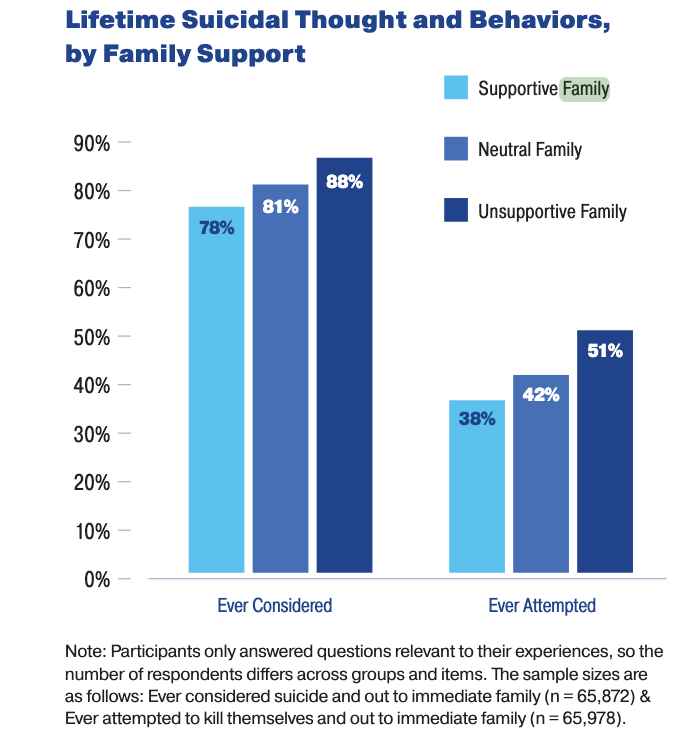
The survey found a trans person’s overall health and wellbeing also heavily depends upon rates of familial support, a factor that has a profound influence over a trans person’s lifetime experience of suicidality.
Graphic courtesy of the 2022 U.S. Transgender Survey – Health and Wellbeing Report
The survey has been released in increments as researchers at A4TE wade through the unprecedented amounts of data from trans people who lent their voice to the project. It is a much-needed, comprehensive overview on the challenges—and victories—seen in trans health care since the prior iteration of the study. The report is especially vital considering the Trump Administration moved to remove transgender people from the U.S. Census and other government websites, rendering trans communities potentially invisible, and robbing researchers of crucial data informing public policy decisions.
“Having real concrete and rigorous data about the realities of trans people’s day-to-day lives is also a vital part of dispelling all of those assumptions and stereotypes that plague the public discourse about our community,” said Olivia Hunt, A4TE’s Director of Federal Policy, during a press briefing this week.
The report also touched upon trans people’s access to health care, which increased between 2015 and 2022; the quality of care, as trust between doctors and trans patients has improved; disparities between trans people across racial groups, which showed trans people of color are generally more prone to experience discrimination compared to white trans people; and the mental health challenges facing the trans community, as 44% of respondents met the criteria for serious psychological distress, compared to less than 4% of the general U.S. population.
Many of these issues have likely been exacerbated since the data was collected. The lead-up to President Donald Trump’s return to the Oval Office incited a new wave of anti-trans animus, impeding access to care and stirring up transphobic vitriol and harassment.
“From 2015 to 2022, state-level policy environments became more protective in some ways for trans people; however, in 2022 alone, when the USTS was administered, 315 anti-LGBTQ bills were introduced across the country, many of which harm trans and nonbinary people’s access to healthcare, participation in sports, access to public facilities, or other facets of public life,” the report says.
“This political landscape has only worsened since the administration of the 2022 USTS, with the introduction of 571 anti-LGBTQ nationwide in 2023 and 489 in 2024,” it continues. “At the time of writing, data on trans and nonbinary people has been erased from federal health surveys. As funding for LGBTQ research is stripped away, the USTS has become an ever more critical resource on the lived experiences of trans and nonbinary people.”
Nonetheless, trans life and trans joy has persisted, as testimonies featured in the U.S. Trans Survey demonstrate.
“I have thrived in the past 12 months in transition, I have a genuine smile on my face most days & laugh with genuine joy,” wrote Charlotte, a trans woman, in her survey response. “I have grown into the woman I was meant to be.”
And as Roo, a nonbinary person, wrote: “Once I learned what it meant to be trans, I never looked back. I traded in my Regina George-esque life for a future with a balding head and a predisposition for a beer gut. I’ve never been more happy to be alive—every single day. ”
Erin In The Morning is a reader-supported publication. To receive new posts and support my work, consider becoming a subscriber.
Ann Arbor (Informed Comment) – Harald Ringbauer et al. writing in Nature report on a genetic study of the ancient Phoenicians that is really going to anger Lebanese Christian nationalists. In fact, it contains a profound lesson for nationalists and nationalism in general, which is that the whole thing is a scam thought up in the last 250 years.
The 19th century racist thinker Ernest Renan saw a racial distinction between “Aryans” and “Semites.” From that point of view, the Punic wars between Rome and Carthage had a racial element, since Phoenicians were classed as “Semites.” But it turns out it was all a tiff among people we would now class as Italians.
The Phoenicians had been thought to be a unified civilization that began in what is today Lebanon. Well, they did start off in what is today Lebanon. But the “unified civilization” bit turns out to be a misconception.
The Phoenicians developed an alphabet. Like most alphabets, the letters had originally been pictograms. The Hebrew, Aramaic and Arabic, as well as the Greek and Roman alphabets (we still use the latter) derived from the Phoenician. For instance a picture of waves stood for water (ma’), and that became our M, which still looks like waves. Or a circle stood for eye (`ayn), which became our ‘o.’
Since the Phoenicians founded city-states all around the Mediterranean and left inscriptions in that alphabet, scholars had assumed that they were a related people. Phoenician settlements in the western Mediterranean were called “Punic,” but the language and customs were the same.
Regarding the Lebanese origins of this civlizational complex, Ringbauer et al. write, “We find that individuals from the Levantine Phoenician site of Akhziv in present-day Israel cluster together with previously published Bronze and Iron Age Levantine individuals, including from Megiddo in present-day Israel and the Phoenician cities of Sidon and Beirut in present-day Lebanon.” That is, they looked at ancient individuals from around the Levant and found that they all had shared haplotypes, i.e. they were Canaanites. Phoenicians, Hebrews, Nabataeans, etc. were all Canaanites culturally and genetically.
Now imagine the scientists’ astonishment when they looked at DNA from individuals who had lived in Phoenician cities such as Ibiza off Spain or Carthage in Tunisia to find that it did not display the ancient haplotypes or genetic sequences associated with Levantine peoples.
They write, “However, a mitochondrial genome from Carthage and whole-genome data from 12 individuals from the nearby rural Punic site of Kerkouane show substantial south European ancestry as well as indigenous North African ancestry. Partial North African ancestry was also found in genome-wide data from eight individuals from two Punic sites in Sardinia, combined with a broad eastern Mediterranean ancestry. Together with analysis of the whole-genome sequence of an individual from Ibiza, which was also interpreted to harbour eastern Mediterranean ancestry, this suggested that Punic people had complex ancestry.”
They observe of these “Phoenicians of the middle and western Mediterranean, “They are broadly distributed with a primary mode overlapping Bronze and Iron Age individuals from Sicily and the Aegean, regardless of sampled location.” There were only three exceptions: two persons from Sicily and one from Sardinia showed Canaanite genetic heritage.
In all the other 119 samples from “Punic” sites, the genetic heritage was mixed, showing patterns similar to those in ancient Greece and Sicily. After around 550 BC, when Carthage was founded by the “Phoenicians” in what is now Tunisia, some North African [Amazigh] genetic heritage starts to circulate among some of them. But this was a minority population. The authors observe, “Even in North Africa, 10 out of the 27 individuals from Kerkouane and 5 out of the 17 individuals from Carthage can be modelled with no indigenous North African ancestry, and 84% of individuals from these sites have more than 50% Sicilian–Aegean ancestry, making it the dominant ancestry component also in North African Punic sites.”
Also, the Iberians were mostly not Iberians. “Only two Iberian individuals, from Ibiza and Cádiz, had confidently high proportions of Bronze Age Iberian ancestry… Instead, Punic sites in the western Mediterranean share similar ancestry distributions of predominantly Sicilian–Aegean or North African origin.”
So how did all this happen? The authors hypothesize that Lebanese Phoenicians colonized Sicily, which had earlier had Greek colonies, and the Sicilians adopted Phoenician language, religion and culture. They they were the ones who struck out west, establishing Phoenician colonies in the central and western Mediterranean.
Ringbauer and his colleagues explain, “A critical question raised by our results is how and when Canaanite–Phoenician culture and language were adopted by people without any detectable Levantine ancestry. One hypothesis is that, after Levantine Phoenicians founded settlements in the central and western Mediterranean in the early first millennium bce, these communities continuously incorporated people with Sicilian–Aegean ancestry.”
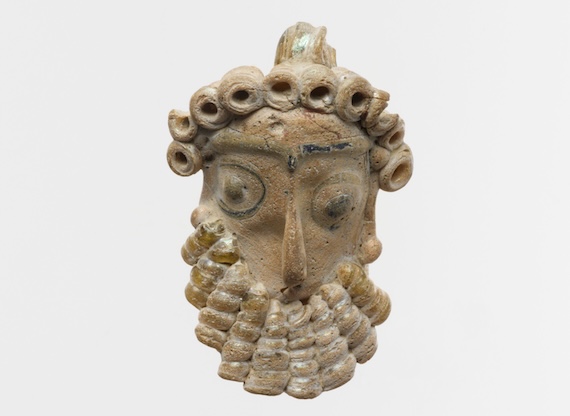
Glass head pendant, Phoenician or Carthaginian, ca. 450–300 BCE. Metropolitan Museum. Public Domain.
Reporting on the study for a Nature briefing, Ewen Callaway quotes Ringbauer as asking how it was that many Mediterranean peoples abandoned their own local cultures for that of the Phoenicians. “Does this mean Phoenician culture was like a franchise that others could adopt? That’s one for the archaeologists.”
Of course they were a franchise. So were the ancient Greeks, whose culture was adopted by so many Egyptians in places like Alexandria. As late as the 200s and 300s, there are no Arabic or Aramaic inscriptions in and around Damascus, only Greek ones. Ashkenazi Jews in Europe were also a franchise, which was joined by many gentiles — especially but not only women.
Nineteenth century European theorists of nationalism confused language groups with kinship groups, assuming that people who spoke a language were a “race,” perhaps even a “pure” one.
Today many Lebanese Christians claim to be “Phoenicians,” as though it was a pure “race” unconnected to the “Arabs.” And they take pride in Carthage, a Phoenician city, and in the Phoenician outposts of Spain, imagining they were all “Lebanese.” Ringbauer has knocked that down.
There are no nations or races of that sort. There are no “Aryans” and “Semites.” This was a linguistic distinction that was stupidly racialized. Racial “nation” was all a fevered racist fantasy. Even modern genetics only traces two lines of ancestry, the Y chromosome and the mitochondrial DNA of the X chromosome, whereas we have millions of ancestors. We’re all mongrels, all mixed up, and people in the Mediterranean basin all have a common ancestor from not so long ago. All humans have one likely only 200,000 years ago.
I admit my life was different but from the time I was five I knew I was attracted to males. Specifically both sexually and emotionally. One of the hell spawn female siblings even held me down to pound the point that I was “queer” into me. I did not understand why it was wrong, after all they were the ones telling me what to do and farming me out to their teen boyfriends. I craved being held by the boys and not so much the girls. But all the other gay and lesbian people I have talked to knew early also. Preteen time frame. 7 or 8 and up they knew they were gay and either knew they had to hide it or knew they couldn’t so had to live with being attacked for it. These people who think it is a choice, a fad, or a phase need to ask themselves the famous question. When did they know they were cis and straight and was it a choice they made. No they just felt it all their lives, they simply knew it. Same for the LGBTQ+. The only difference is straight cis kids see themselves everywhere from birth. Mommies and daddies, they see themselves in the older kids around them, in the news, movies, TV shows, and the books they read. It feels so natural to them they just don’t question it. They are lucky. Until recently like in the last decade LGBTQ+ kids did not see themselves reflected in society. No movies had kids like them, no books in the library had kids like them. Some kids did not even know the words for how they felt. It was changing in the last ten years. Schools made a push for inclusion and tolerance, movies showed LGBTQ+ kids, books had them as plots or characters. Kids could see themselves and be proud. That is what the haters, the anti-trans / anti-gay bigots want to remove. The ability of kids who are different from the majority to see themselves represented positively in society. It is why they write and pass don’t say gay bills, and why they ban books. It is why they try to ban drag shows and pride events. These people who demand a straight cis world with only them showing in public are terrified of a world where people can be different. To them those who are the other must be destroyed, ideas of acceptance and tolerance must be erradicated and removed. All because they don’t feel different from the majority so the difference must not be real. But it is and we need to realize the scars left on kids who grew up in the times when they never seen themselves represented in society. We must not go backward in time, regressing to a time of hate. Hugs
LGBTQ+ youth advocates gathered outside the Monmouth County Courthouse in Freehold on Tuesday, Aug. 15, 2023, where a school policy that would impact lesbian, gay, bisexual, transgender and queer youth was being reviewed in Superior Court. | Amanda Oglesby / Asbury Park Press / USA TODAY NETWORK
A new poll from Pew Research Center sheds some light on just how early LGBTQ+ people are aware of their identities. The study of LGBTQ+ adults in the U.S. found that most respondents understood their identity before the age of 14, with a substantial portion knowing about their identities before the age of 10.
Among gay and lesbian adults, 36% said that they felt they were gay or lesbian before the age of 10 and 35 first felt they were gay or lesbian from ages 10 to 13. Only a minority – 29% – had their first feelings about their sexuality after the age of 14.
The numbers were similar for transgender people. Approximately 33% felt they might be transgender before age 10, and 25% felt the same way between ages 10 to 13. Only 19% had their first feelings about being transgender after the age of 18.
Bisexual people tended to know the latest, but even a majority of bisexual people said that they had their first thoughts about being queer before age 18. Half – 50% – had their first feelings of being bisexual before age 14.
The question often comes up in discussions of LGBTQ+ youth, with many on the right insisting that people can’t know their identities before adulthood. Often, these people claim that only LGBTQ+ people can’t know their identities before adulthood, but then support heterosexuality and cisgender identities in young people.
But these statements fly in the face of LGBTQ+ people’s lived experiences, which often include years of hiding their identities before they create a safer space for themselves to live authentically as adults.
While LGBTQ+ respondents generally first thought about their queer identities when they were very young, most waited until they were older to tell others. While 71% of gay and lesbian people said that they first knew about their sexuality before age 14, only 13% said that they told someone before that age. Approximately 58% of trans people first thought they might be trans before age 14, but only 15% told someone before that age.
This also contradicts the rightwing narrative that young people are saying that they are trans or gay to gain social acceptance and not because they actually identify as such. In reality, young people are saying that they’re straight or cisgender when they actually aren’t, likely to try and get social acceptance.
Pew broke down the results even more and showed that gay men generally felt that they were gay at a younger age than lesbian women, with 40% saying they were younger than 10 years old when they first thought they were gay, as opposed to 29% of lesbian women.
| Pew Research Center
Bisexual women, on the other hand, likely knew earlier than bisexual men. 53% of bi women said they felt they might be bi before they were 14 years old, while just 40% of bi men said the same.
| Pew Research Center
The poll was conducted in January of this year and involved a sample of 3,959 adult LGBTQ+ Americans. The survey asked about a wide variety of topics, including support from family and friends, ties to the larger LGBTQ+ community, and social acceptance.
Subscribe to the LGBTQ Nation newsletter and be the first to know about the latest headlines shaping LGBTQ+ communities worldwide.


Anti-LGBTQ+ Judge Matthew Kacsmaryk | YouTube screenshot

Spencer Cox of Utah answers a question during a discussion about how our society can learn to disagree in a way that allows us to find solutions on Wednesday, Nov. 15, 2023. | Logan Newell/The Coloradoan / USA TODAY NETWORK
 Molly Sprayregen (She/Her )May 21, 2025, 12:00 pm EDT
Kyle Neal


 Alex Bollinger (He/Him)May 29, 2025, 3:30 pm EDT
LGBTQ+ youth advocates gathered outside the Monmouth County Courthouse in Freehold on Tuesday, Aug. 15, 2023, where a school policy that would impact lesbian, gay, bisexual, transgender and queer youth was being reviewed in Superior Court. | Amanda Oglesby / Asbury Park Press / USA TODAY NETWORK


 Scottie's Playtime