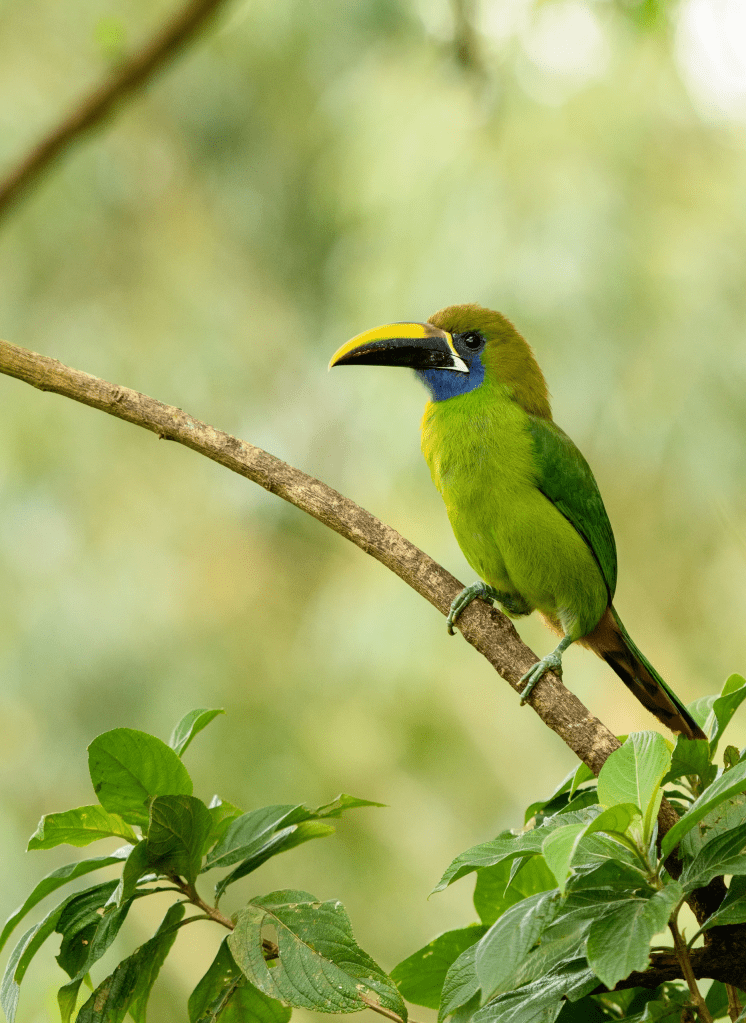
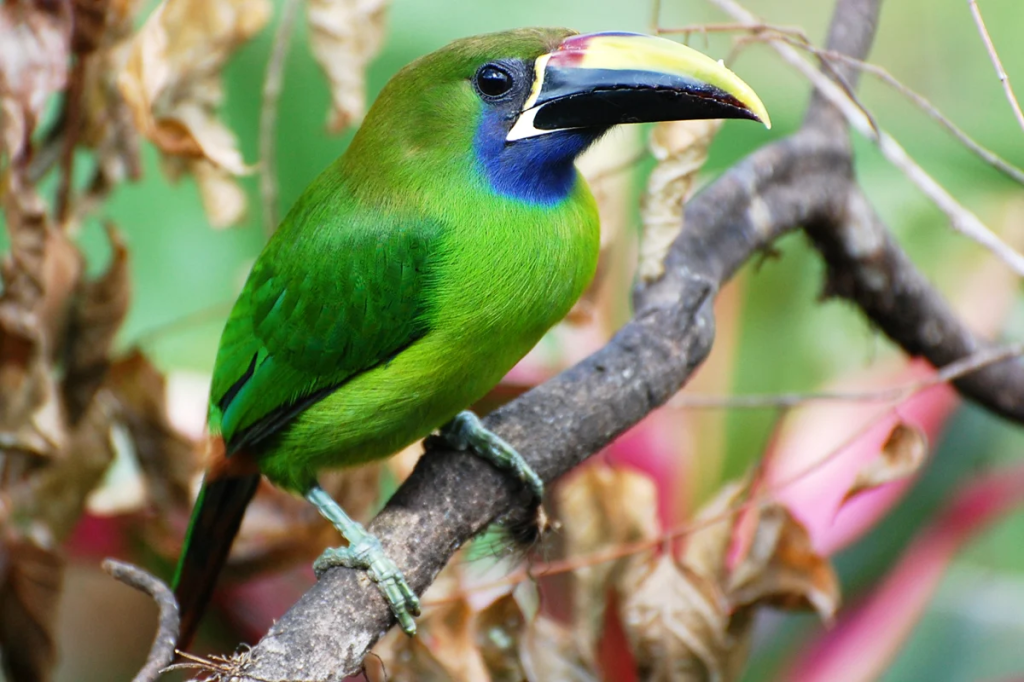
Aptly named for its striking green plumage, the Northern Emerald-Toucanet is actually quite camouflaged in the leafy forests where it makes its home. With its tropical take on countershading — darker green on the back and wings, lighter yellow-green below — this bird beautifully matches the color palette of forest leaves, whether seen from above or from below. With its accents of chestnut, blue, and white, and a large black and yellow bill, this pigeon-sized bird is a true beauty.
Similar to other toucans, Northern Emerald-Toucanets eat mostly fruit, capitalizing on the wide diversity of fruit-bearing trees in the humid forests of their home in Central America. These birds mostly swallow their food whole, including some larger-seeded fruits, which they repeatedly regurgitate and swallow until the flesh is consumed. Whether by regurgitation or defecation, these birds spread the seeds of their food trees throughout the forest. Many tropical trees have evolved to bear fruit specifically for this purpose, taking advantage of birds’ wings to spread their seeds far and wide. In fact, the process of moving through the digestive tract of an animal actually helps the seeds of many of these trees to germinate. In effect, these toucanets, along with a cohort of other fruit-eating birds and mammals, are gardeners of their own food forests. (snip)
Bird Gallery
The Northern Emerald-Toucanet is indeed a beautiful, vibrant green, top and bottom, with the back a deeper, darker hue and the underparts lighter and slightly yellowish. The long tail is iridescent blue and green, with a rusty or chestnut tip matched by the vent feathers beneath the tail. The eight subspecies across its geographic range vary in the coloration of the throat, either blue or white, and the bill. In all subspecies, the lower mandible is black. The upper mandible has some black as well, but may be almost entirely yellow. Some subspecies also have a reddish to brown patch near the nostrils.
A recent article from Jesse Singal in the New York Times seemed to indicate the organization might be quietly retreating from supporting trans youth care.
Erin In The Morning is a reader-supported publication. To receive new posts and support my work, consider becoming a subscriber.
Yesterday, anti-transgender activist and columnist Jesse Singal published a piece claiming there were “cracks in the wall” around gender-affirming care (which you can find fully fact-checked here). To make that case, he relied heavily on a statement from the American Society of Plastic Surgeons that bypassed the organization’s normal scientific review process and was advanced under pressure from leadership aligned with the Trump administration, including a president who is a major Republican donor. Singal also invoked the American Psychological Association, suggesting the organization was retreating from its 2024 position supporting transgender care and rejecting claims that gender identity is “caused” by external factors. But a representative for the APA tells Erin In The Morning that the organization stands firmly by its 2024 guidelines supporting transgender youth care and provided documentation indicating Singal mischaracterized its position.
“No, APA’s position has not changed,” says a representative speaking for the APA, attaching a link to their 2024 policy statement which provided broad support for gender-affirming care. “APA continues to support unobstructed access to evidence-based care for transgender and gender-diverse individuals of all ages.”
The 2024 policy statement is to date one of the most significant supportive stances of any medical organization for gender-affirming care. It states that gender-affirming medical care is medically necessary, opposes bans on gender-affirming care, declares that being transgender is not caused by autism or post-traumatic stress, establishes the organization’s support for combatting disinformation on transgender healthcare, and finds that rejection of a trans youth’s gender identity can increase their risk of suicide and harm their psychological wellbeing. The policy was passed overwhelmingly, 153-9, with each voter representing a large subset of the organization’s 157,000 members. Now, the organization says that it is not accurate to claim that there is any regression on support for transgender youth care from the organization.
The organization also disputes Singal’s portrayal of a 2025 letter written by Katherine McGuire to the Federal Trade Commission. In his piece, Singal claims the APA “cautioned that gender dysphoria diagnoses could be the result of ‘trauma-related presentations’ rather than a trans identity,” and noted that “co-occurring mental health or neurodevelopmental conditions (e.g., depression, anxiety, autism spectrum disorder) … may complicate or be mistaken for gender dysphoria,” framing this as evidence that the organization is retreating from its 2024 policy supporting transgender youth care. That interpretation is incorrect, according to an APA representative, who says the letter does not contradict the organization’s 2024 position and does not represent a regression in its support for evidence-based transgender care.
The FTC letter sent by APA Services was not saying that transgender identity can be caused by autism or depression. Rather, it was describing what any competent psychologist does with any patient: assess the whole person, including whether conditions like depression or anxiety are present. The letter does not say that depression or anxiety or autism cause gender dysphoria; it says that psychologists are careful about not mistaking these conditions for gender dysphoria. Notably, the letter was written in direct response to the Trump administration’s FTC, which had accused gender-affirming care providers of deceiving consumers, and McGuire was explaining that psychologists conduct thorough, individualized assessments—not that the organization’s position on care or “causes” of being transgender had changed. Had McGuire not indicated that psychologists were making these determinations, the FTC would likely then accuse the organization of not investigating its crank theories on gender dysphoria.
You can view the letter here:
American Psychological Assocation Response To Ftc Rfi Gender Affirming Care 9 26 2025 Signature (1)
“The 2024 policy statement and the 2025 FTC letter are consistent. The 2024 statement reflects the organization’s policy position on access to care. The 2025 FTC letter describes what competent psychologists do in individual clinical practice: they do not make generalized claims to families but instead provide individualized, evidence-based assessment. Both documents reflect APA’s consistent commitment to evidence-based psychological care,” says the representative.
The American Psychological Association’s reaffirmation of its support for transgender youth health care is significant. The organization is among several reportedly under FTC investigation as part of a broader effort to pressure medical bodies to retreat from transgender youth care. It is also facing a coordinated pressure campaign from anti-trans activists like Jesse Singal and outlets such as The New York Times, both of which have repeatedly sought to cast doubt on established standards of care. That context makes Singal’s portrayal especially consequential. Readers were left with the impression that the APA was backtracking. According to the organization itself, that is false. What Singal presented as evidence of “cracks in the wall” was yet another attempt to manufacture doubt around the professional consensus supporting transgender youth care.
Erin In The Morning is a reader-supported publication. To receive new posts and support my work, consider becoming a subscriber.
Any season of the year, the Mountain Chickadee is a delight to encounter. In their breeding season, they form neighborhoods of adjacent territories in the conifer forests of western Canada and the U.S., which ring in the early spring dawn with dozens of cheerful whistled songs. In winter, groups of Mountain Chickadees are joined by other birds — nuthatches, woodpeckers, creepers, kinglets — to form large dispersed flocks that move together through the forest, following the chickadees’ namesake rallying call.
Mountain Chickadees are social birds, living in groups of up to three mated pairs and juveniles of the last breeding cycle for most of the year, only breaking off into territorial pairs for the breeding season. In fact, while we tend to think of the breeding season as the time when mates are chosen and territories are established, most of this actually occurs in the winter. This is when the social hierarchy is solidified between the individuals in a group, and come spring, the dominant birds will reliably take the best territories. While boundaries may shift somewhat, the same birds will usually hold the same territories year after year. Pair bonds are formed during the winter as well, and usually last for as long as both birds survive.
Mountain Chickadees are well-known for their caching behavior. To survive harsh mountain winters, these chickadees hide surplus food throughout their winter territories, a behavior known as “scatter hoarding.” A single chickadee may cache tens of thousands of food items — insects, conifer seeds, or goodies from bird feeders — over the course of a year. They may cache food any time they have extra, and may recover caches any time of the year, but spend the most time caching in the fall, and the most time eating from them in the winter. In fact, studies have shown that Mountain Chickadees living in harsher winter environments have better spatial memory and are more adept at remembering where they have cached food. Unsurprisingly, these birds also survive longer. (snip-MORE)
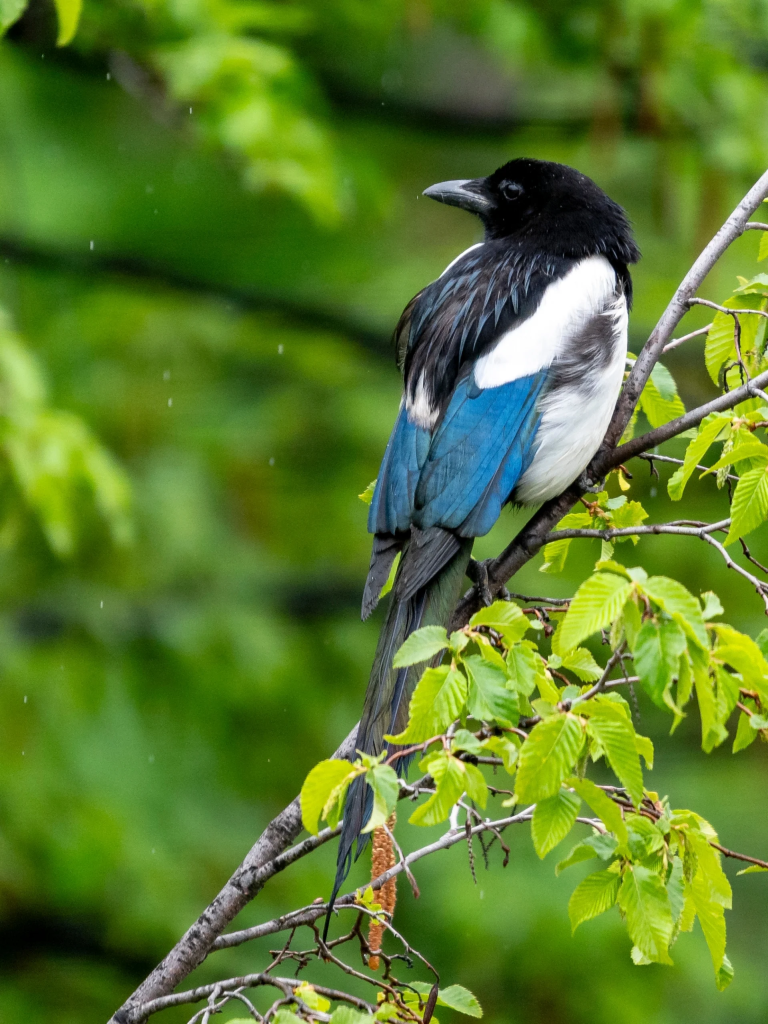
More than most, the Black-billed Magpie is a bird that inspires strong emotions in humans. A familiar species across much of the West, the Black-billed Magpie is intelligent, adaptable, and bold. For these attributes, they are both admired and loathed. While considered an annoyance or an inconvenience by some, they are also highly social and will occasionally leave “gifts” for humans who feed them.
Like many other intelligent and opportunistic corvids, magpies will take advantage of whatever resources they can. As such, the Black-billed Magpie is probably best known as a scavenger of garbage, carrion, and poorly guarded picnics. This has given these birds a bad reputation, with many regarding them as pests. A common folk belief is that magpies will wound cows to eat their flesh or drink their blood. Magpies will, in fact, stand on the backs of cows to probe and peck. However, the goal is typically not to eat the cow itself, but the parasites on the cow, such as ticks, that are doing just that. Cows are not the only beneficiaries of this behavior — magpies will eat ticks off of other large mammals, including bison, moose, elk, and deer.
The Black-billed Magpie holds a special place in mythology as well. Magpies are recognized as messengers in numerous Indigenous cultures of North America, sometimes to the aid of humans, sometimes to carry news to the Creator. One widespread story tells of how the magpie, for helping humans and birds alike, was given the honor of “wearing the rainbow” — a reference to the iridescent sheen on this bird’s wings and tail. (snip-MORE)
Explanation: Ever wonder what it would look like to crack open the Sun? The Egg Nebula, a dying Sun-like star, can unscramble this question. Pictured is a combination of several visible and infrared images of the nebula (also known as RAFGL 2688 or CRL 2688) taken with the Hubble Space Telescope. The star has shed its outer layers, and a bright, hot core (or “yolk”) now illuminates the milky “egg white” shells of gas and dust surrounding the center. The central lobes and rings are structures of gas and dust recently ejected into space, with the dust being dense enough to block our view of the stellar core. Light beams emanate from that blocked core, escaping through holes carved in the older ejected material by newer, faster jets expelled from the star’s poles. Astronomers are still trying to figure out what causes the disks, lobes, and jets during this short (only a few thousand years!) phase of the star’s evolution, making this an egg-cellent image to study!
A handsome bird of open landscapes, the Chocolate-vented Tyrant is an unusual species to be included among the so-called “flycatchers.” Inhabiting flat grassland and scrub, this bird is primarily a ground-dweller, rarely seen higher than a fencepost or tussock. Furthermore, this flycatcher is not one to catch insects on the wing (to “fly-catch” in ornithology lingo), preferring instead to hunt its prey on the ground. In keeping with this terrestrial lifestyle, the Chocolate-vented Tyrant has notably long legs and is more likely to run or walk than to hop or fly. In combination with its large size and rusty belly, the tyrant’s appearance and behavior are reminiscent of birds in the thrush family, such as the American Robin.
The Chocolate-vented Tyrant breeds in the cold, dry, and infamously windy Patagonian Steppe, also known as the Patagonian Desert. In an environment largely devoid of trees, this bird takes advantage of the open sky to perform an expansive aerial display, similar to other birds like the Red Knot and American Woodcock that use flat, open habitat in the breeding season. The Chocolate-vented Tyrant is also known to forage alongside wintering shorebirds — yet another habit unusual for its family, but typical of others, like the groups of sandpipers and plovers it sometimes joins.
Threats
Birds around the world are declining, and many of them, including the Chocolate-vented Tyrant, are facing urgent threats. Throughout the tyrant’s range in South America, livestock grazing, agricultural expansion, and invasive species all hinder this bird’s ability to thrive. Furthermore, sparse protected areas may be insufficient to support the species, particularly on its nonbreeding grounds in the Pampas, the vast grasslands region east of the Andes.
Habitat Loss
The Chocolate-vented Tyrant is losing habitat in both its breeding and nonbreeding ranges. On the Patagonian Steppe, where this species breeds, overgrazing by sheep disrupts the limited vegetation afforded by a dry climate, resulting in erosion and eventually desertification. The Pampas faces similar threats from overgrazing by cattle, as well as the clearing of native habitat in favor of agriculture.
The Chocolate-vented Tyrant is a habitat specialist, making it particularly vulnerable to threats like habitat loss and degradation. In addition to protecting habitat through our network of reserves, ABC also works to reduce the threat of invasive species and restore habitat. At ABC, we’re inspired by the wonder of birds and driven by our responsibility to find solutions to meet their greatest challenges. With science as our foundation, and with inclusion and partnership at the heart of all we do, we take bold action for birds across the Americas.
Creating & Maintaining Reserves
Habitat is the foundation for birds’ survival. Working with dozens of partners and local communities throughout Latin America, ABC supports a growing network of protected areas in more than a dozen countries. Totaling more than 1.3 million acres, nearly one-third of the world’s birdlife (more than 3,000 species) is protected by an ABC-supported reserve.
Beneath the icy stillness of the Arctic, where sunlight barely filters through thick sea ice, jellyfish are rewriting the rules of survival. For years, scientists assumed these delicate creatures could not withstand the region’s brutal winters. But that assumption shattered when researchers discovered adult Chrysaora melanaster jellyfish drifting under the frozen Chukchi Sea, tentacles trailing through near-freezing water.
The findings stunned marine biologists. Footage captured by Columbia University researchers using underwater vehicles revealed dozens of fully grown jellyfish gliding along the shallow seafloor. Their bells stretched nearly 24 inches across, and their tentacles extended up to 10 feet long. These jellyfish weren’t dormant, dying, or clinging to survival. They were alive and active, defying decades of assumptions about Arctic marine life, Live Science reports.
Arctic jellyfish are surviving the winter in their adult stage.
Life Under Ice Moves Slowly but Surely
To capture this rare glimpse, researchers rode snowmobiles across miles of frozen ocean and drilled through four feet of ice. Cameras dropped into the water below revealed not only jellyfish but a surprising abundance of other life — from algae to crustaceans. What stunned scientists most was that these jellyfish appeared healthy and fully developed, in the medusa stage, not the dormant polyp form previously believed to be their only means of winter survival, according to Columbia Climate School.
The cold helps them. It slows their metabolism, allowing them to conserve energy. And the ice above shields them from turbulent winter storms.
As Columbia biologist Andy Juhl put it, “Life under sea ice is like living in a refrigerator — everything slows down.” This slow-paced existence may help these jellyfish survive for years, not just months as once assumed.
Scientists found jellyfish living under four feet of Arctic ice.
From Arctic Shelters to Antarctic Giants
Jellyfish don’t just surprise us in the north. Thousands of miles south, in the icy waters of Antarctica, researchers aboard the Schmidt Ocean Institute’s expedition recently filmed one of the rarest marine animals ever seen — the ghost jellyfish. This deep-sea giant (*Stygiomedusa gigantea*) spans over three feet wide, with flowing oral arms stretching more than 30 feet. It drifts silently through the dark, catching prey without the aid of tentacles. It was filmed at 1,300 meters depth in a region only accessible because a massive iceberg had recently broken free, the Stewartville Star reports.
Ghost jellies are rarely seen — only 120 sightings have ever been recorded since their discovery in 1899. Their immense size and unusual feeding methods set them apart, but it’s their reproduction that draws perhaps the most curiosity. Unlike most jellyfish, ghost jellies give birth to live young. The juveniles emerge directly from the parent’s mouth after developing inside its bell, a trait called viviparity, according to Live Science.
These jellyfish were once believed to die off each winter.
Adaptation in Every Form
While ghost jellies are deep-sea dwellers, some were filmed at surprisingly shallow depths — just 260 feet in Antarctic waters. Researchers suggest that in polar regions, shifts in sunlight and prey behavior may draw these jellies closer to the surface.
Both Arctic and Antarctic jellyfish species show how adaptable these animals can be. In the Arctic, jellyfish once assumed to vanish in winter now appear to thrive, aided by the very cold that was thought to be their limit. In Antarctica, a creature thought to be relegated to unreachable depths rises when opportunity allows, providing rare glimpses of life in Earth’s most extreme waters.
What unites them isn’t just their beauty or rarity. It’s their resilience — silent drifters shaped by pressure, cold, and darkness, yet still pulsing through the oceans, undeterred.
Ghost jellyfish in Antarctica can grow over 30 feet long.
Climate Change Could Tip the Balance
Despite their resilience, these jellyfish may face new threats. According to Columbia Climate School, arctic species like *C. melanaster* rely on thick sea ice for shelter. As climate change causes rapid ice loss, these jellyfish — and many creatures that depend on sea ice — may see their habitats disappear. At the same time, jellyfish in warmer parts of the world are thriving, even swarming, in response to warming waters and fewer predators.
In the far north, though, it may be the opposite. With less ice, cold-adapted jellies could decline. In the case of these jellyfish, warming may simply mean vanishing.
Still, these discoveries are a reminder of how much we have yet to understand. The creatures beneath the ice and beyond the reach of sunlight continue to defy expectations, reminding us that the ocean — even in its coldest corners — is alive with mystery.
18-month-old Amalia, who, according to a lawsuit filed, suffered a life-threatening respiratory illness while in U.S. Immigration and Customs Enforcement (ICE) custody, reacts, in this handout picture obtained on February 7, 2026. Elora Mukherjee/Handout via REUTERS
] Kheilin Valero Marcano and Stiven Arrieta Prieto, parents of 18-month-old Amalia, who, according to a lawsuit filed, suffered a life-threatening respiratory illness while in U.S. Immigration and Customs Enforcement (ICE) custody, pose for a photo, in this handout picture obtained on February 7, 2026. Elora Mukherjee/Handout via REUTERS
Summary
Child had severe respiratory illness, lawsuit says
DHS says child received proper medical care and medications
Trump faces criticism for immigration detention practices
NEW YORK, Feb 7 (Reuters) – An 18-month-old girl detained for weeks by U.S. immigration authorities was returned to custody and denied medication after being hospitalized with a life-threatening respiratory illness, according to a lawsuit filed in Texas federal court.
The child, identified in the lawsuit as “Amalia,” was released by immigration authorities in President Donald Trump‘s administration after her parents sued on Friday. The parents, who also had been detained, were released as well. The suit had sought the release of all three of them.
In a statement provided on Monday following the publication of this story on Saturday, U.S. Department of Homeland Security spokeswoman Tricia McLaughlin said claims that Amalia did not receive proper medical treatment or medications were false.
The family was detained during a check-in with immigration authorities on December 11 and held at a facility in Dilley, Texas, according to the lawsuit. Amalia was hospitalized from January 18 to 28, and returned to the Dilley facility in the midst of a measles outbreak, the lawsuit said.
“Baby Amalia should never have been detained. She nearly died at Dilley,” said Elora Mukherjee, an attorney for the family.
Mukherjee said hundreds of children and families detained at Dilley lack sufficient drinking water, healthy food, educational opportunities or proper medical care, and should be released.
McLaughlin said in the statement on Monday that the child immediately received medical care after becoming ill, was admitted to a hospital for treatment and returned to the Dilley facility after being cleared for release by a pediatric doctor. Amalia was housed in the medical unit upon her return and received proper treatment and prescribed medicines, the statement said.
“It is a longstanding practice to provide comprehensive medical care from the moment an alien enters ICE custody. This includes medical, dental, and mental health intake screening within 12 hours of arriving at each detention facility, a full health assessment within 14 days of entering ICE custody or arrival at a facility, and access to medical appointments and 24-hour emergency care,” McLaughlin said.
Trump’s administration has been accused of heavy-handed and inhumane tactics as well as violating court orders while carrying out his mass deportation program.
A federal judge in Michigan criticized the administration in a January 31 ruling ordering the release of a five-year-old boy – seen in a viral photo wearing a blue bunny hat outside his house as federal agents stood nearby – who was detained by immigration agents in Minnesota. The administration is now seeking to deport the boy.
Amalia’s parents, originally from Venezuela, have lived in the United States since 2024 with their daughter, who is a Mexican citizen, according to the lawsuit. The lawsuit says all three intend to file asylum applications in the United States.
Amalia developed a fever on January 1 that reached as high as 104 degrees Fahrenheit (40 degrees Celsius), started vomiting frequently and struggled to breathe, according to the lawsuit.
She was taken to the hospital on January 18 with extremely low oxygen saturation levels and diagnosed with COVID-19, respiratory syncytial virus, viral bronchitis and pneumonia, according to the lawsuit. She was placed on supplemental oxygen.
Amalia was given a nebulizer and a respiratory medication upon her discharge from the hospital, but these were taken away by detention center staff upon her return, according to the lawsuit. The girl has lost 10% of her body weight and was given nutritional drinks to help her regain it, but these were also confiscated by authorities, according to the lawsuit.
Reporting by Jack Queen in New York; Editing by Sergio Non, Will Dunham and Daniel Wallis
I often say that a lot of anti-trans anti-gay anti-LGBTQ+ people have their feelings because they don’t feel different from the cis straight majority so can’t understand or accept that such things because they simply don’t feel that way. If they don’t feel it it can’t be real which is the same with how many white people feel about racism. Remember the old question of how do you know you’re gay or trans or lesbian or nonbinary or what ever simply because the people who grew up straight and cis felt normal in society? But if you ask them when they knew or how they knew they were straight and / or cis they are confused. If a boy at 10 comes out as gay the parents freak out, but if that same kid starts showing interest in girls the parents are ecstatic about their boy growing up. Why the difference? Because one fulfills their expectations and the other … well it just is not like them. It simply comes down to tradition and what feels normal for them. Every person who asked me if I tried to change my sexual orientation and there have been so many, to them I ask have you? They act offended. Why would I do that and I reply, then why should I. Then if they persist for some reason that I should do conversion therapy I ask could they convert from their straight / cis desires to being LGBTQ+? Again they are stunned why they would do that and instantly claim not I couldn’t do that. Then again why ask me to do it? Hugs
Providing objective, nonpartisan, rigorous, original journalism that investigates America’s anti-LGBTQ landscape and elevates everyday American heroes. Expect two rigorously reported stories every weekend.
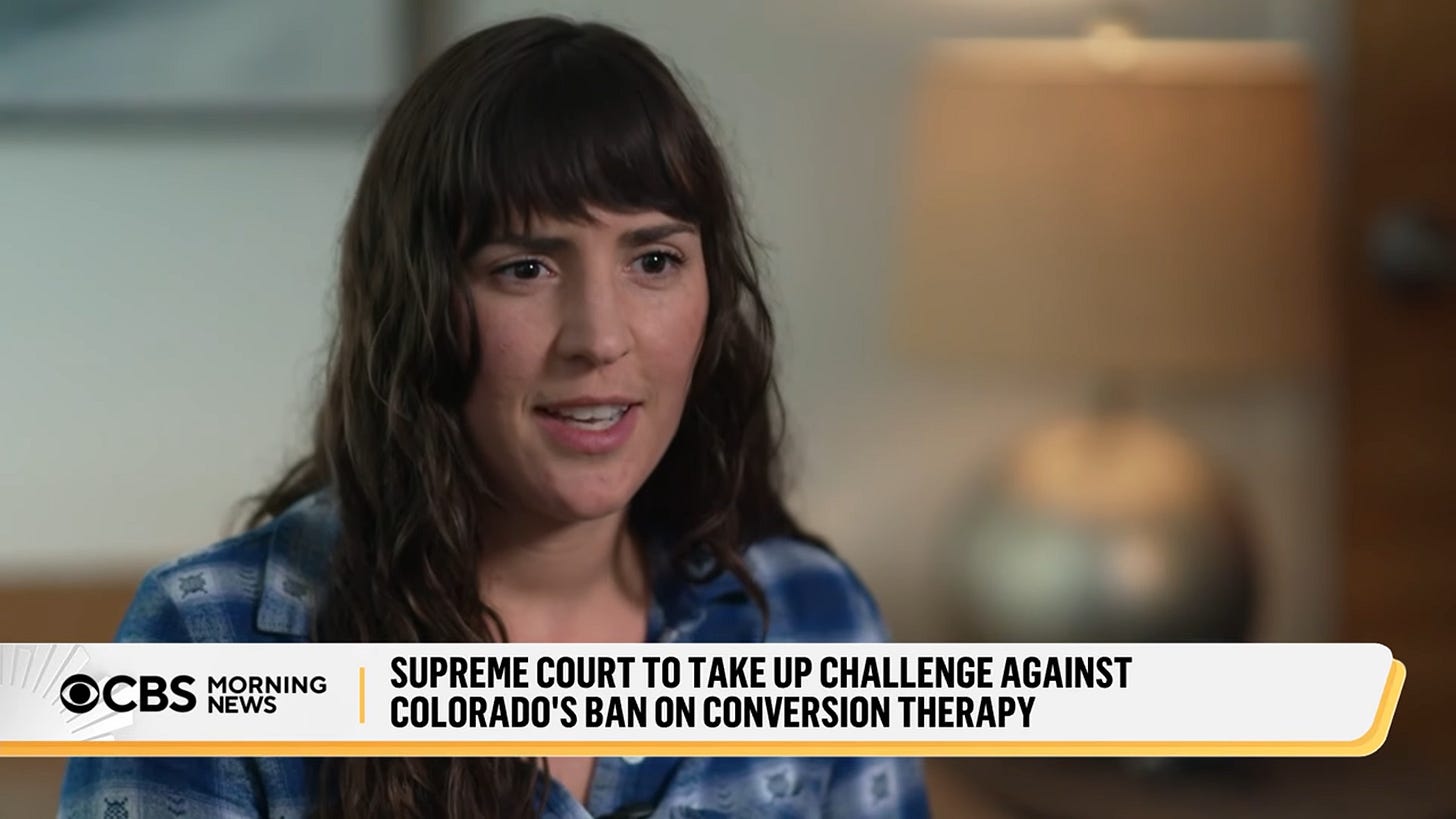
On Oct. 7, the U.S. Supreme Court heard oral arguments in Chiles v. Salazar, a case that challenges Colorado’s ban on conversion therapy.
Shortly after, Alliance Defending Freedom (ADF) sent an email to their supporters quoting Paul in Ephesians 6:12: “For our struggle is not against flesh and blood, but against the rulers, against the authorities, against the powers of this dark world and against the spiritual forces of evil in the heavenly realms.”
The email goes on to say, “You might think that a law like this might be just a ‘Colorado problem.’ Sadly, laws like this exist in 22 other states,” referencing other parts of the U.S. that have instituted conversion therapy bans.
This sort of language about conversion therapy is nothing new for the Christian legal group representing Kaley Chiles. Unlike most legal organizations, ADF is sharply anti-LGBTQ. Since their inception over 30 years ago, the group has fought to maintain anti-sodomy laws, uphold the right to discriminate against gay couples and overturn Roe v. Wade.
In recent years, a major element of their fight has been to legalize the discredited practice of conversion therapy.
The Supreme Court appears poised to rule in favor of ADF, which could effectively invalidate conversion therapy bans for minors by licensed professionals across the U.S. This victory would add to the organization’s already-high win streak, which they say is around 80%.
“I don’t think anyone is undermining LGBTQ rights as relentlessly as ADF,” Peter Montgomery, research director at the advocacy group People for the American Way, told Uncloseted Media and GAY TIMES. “They’re shaping the culture for generations to come.”
Although nearly every major medical association has denounced conversion therapy, ADF is arguing that disallowing the practice is a violation of the U.S. Constitution’s First Amendment.
“This case is part of its crusade to turn religious freedom into a license to harm others,” says Amy Tai, the co-author of an amicus brief in Chiles v. Salazar that is urging the Supreme Court to uphold the Colorado law. “It is part of a larger effort and movement to harm LGBTQ people and strip them of their constitutional rights.”
ADF, originally the Alliance Defense Fund, was founded by evangelical anti-gay activists in 1994. Alan Sears, their former CEO and president, co-authored “The Homosexual Agenda: Exposing the Principal Threat to Religious Freedom Today.” The book calls homosexuality a “disordered sexual behavior” and equates it with pedophilia and states that gay people on college campuses are involved in “the promotion of sexual relations between adults and children.”
D. James Kennedy, another founder, has preached about “reparative” therapy for gay folks. In a 1993 fundraising letter for his Christian media organization Coral Ridge Ministries, he asked “Would you want your son, daughter, or grandchild sharing a shower, foxhole, or blood with a homosexual?”
A third founder was the late James Dobson, who advised several presidents and argued that conversion therapy could “cure” people.
Since ADF launched, many powerful political figures with anti-LGBTQ beliefs have worked for them. While working as an ADF spokesperson between 2002 and 2010, House Speaker Mike Johnson described gay folks as “destructive” and argued that support for homosexuality could lead to support for pedophilia.
Kristen Waggoner speaking at a press conference in 2018 (Groversawit)
And their current president, Kristen Waggoner, has delegitimized the harm conversion therapy causes by defining the practice as merely having conversations.
Today, their influence in the U.S. government is stronger than ever, with ties to all three branches. In addition to Speaker Johnson, Supreme Court Justice Amy Coney Barrett has been a paid speaker for ADF at least five times since 2011. And in May, President Donald Trump appointed Waggoner to the newly-formed Religious Liberty Commission.
All of these resources and connections are employed to advance an anti-LGBTQ agenda. “They want to see what they see as the God-defined order for gender and marriage be imposed into law,” Montgomery says. “They are trying to create a legal regime in which people can claim religious beliefs to opt out of laws that apply to everyone else.”
History of Fighting to Criminalize Homosexuality and Legalize Conversion Therapy
Over time, ADF has incorporated these viewpoints into their litigation to try and dismantle legal protections for LGBTQ people.
“Just 20 years ago, they were still arguing in court that states should be able to criminalize gay people,” says Montgomery.
In 2000, for example, ADF funded amicus briefs in Dale v. Boy Scouts of America, a case where an assistant scoutmaster sued the Boy Scouts after the organization revoked his membership for being gay. The Supreme Court ruled in favor of ADF.
In 2003, when support for gay marriage was still low in the U.S., they filed an amicus brief to uphold the criminalization of gay sex in Lawrence v. Texas, arguing that the state has a right to regulate “public health and morality.” The group lost the case and sodomy laws were banned nationwide.
As public opinion changed and gay marriage became legal across America in 2015, ADF shifted to more nuanced arguments. “Now, because they know that most Americans favor LGBTQ equality, they’ve really reframed their arguments [around] religious liberty and free speech,” says Montgomery.
The organization has since set its sights on overturning state bans on conversion therapy. In 2018, ADF Senior Counsel Matt Sharp argued against a California bill that classified conversion therapy as fraud. And in 2019, the group sued New York City for a similar law, which led the city to reverse the ban out of fear the case would reach the Supreme Court.
A few years later, in 2021, ADF fought to overturn a statewide conversion therapy ban in Washington, where they represented Christian therapist Brian Tingley. In this instance, they argued that Washington’s law censored Tingley from speaking about gender dysphoria.
A federal appeals court unanimously upheld Washington’s law, with Circuit Judge Ronald Gould shutting down ADF’s argument, writing that: “Washington, like other states, has concluded that health care providers should not be able to treat a child by such means as telling him that he is ‘the abomination we had heard about in Sunday school.’”
Learning from their mistakes, ADF tried again with Chiles v. Salazar, claiming the Colorado law discriminates against Chiles’ viewpoint. Chiles is an evangelical therapist who received her counseling training and education from a seminary.
In their arguments to the Supreme Court, ADF says the conversion therapy ban encourages therapists to help minors explore LGBTQ identities and condemns assisting patients to align with their assigned gender.
Though intended to ban conversion therapy for all LGBTQ people, ADF’s case focuses on gender identity, capitalizing on souring U.S. public opinion on trans rights.
“Chiles believes that people flourish when they live consistently with God’s design, including their biological sex,” ADF wrote in a petition to the Supreme Court.
“ADF has tried to draw a connection between laws prohibiting conversion therapy and states attempting to force mental health professionals or doctors to treat transgender youth,” Christopher Stoll, senior staff attorney at the National Center for LGBTQ Rights, told Uncloseted Media and GAY TIMES. But if the law passes, conversion therapy would become legal to practice on all LGBTQ people.
Another part of ADF’s success stems from manufacturing legal battles to advance cases that match their goals.
Chiles, for example, had not incurred any legal penalty from the Colorado district attorney. Instead, ADF filed a pre-enforcement lawsuit, claiming that she had censored herself and stopped accepting patients for conversion therapy following the law’s passage.
“All of these cases are, in a sense, made up cases. … They’re brought on behalf of therapists who have not actually been subject to any kind of investigation or penalty by either state or local governments,” says Stoll, who is representing Kansas City, Mo. as ADF and Missouri’s Attorney General challenge the city’s ban on conversion therapy.
This strategy is what makes ADF stand out. Montgomery says that unlike many other legal organizations, ADF also helps file lawsuits and writes the bills that directly challenge precedents and legislation they hope to change.
This was in part how they were effective in overturning Roe v. Wade. ADF drafted the Gestational Age Act, which banned abortion in Mississippi after 15 weeks of pregnancy. That law then became the central point of the Dobbs case, which overturned abortion rights nationwide.
“They’re just engineered to test these legal arguments, when really no dispute has arisen,” says Stoll.
When asked for comment, an Alliance Defending Freedom Media Relations Specialist redirected Uncloseted Media to a website criticizing the Southern Poverty Law Center, saying the group mischaracterizes ADF as a hate group.
How ADF Operates Globally
ADF’s efforts to dismantle conversion therapy and LGBTQ rights span far beyond the U.S. Alliance Defending Freedom International (ADFI) boasts about efforts in 70 countries, where they push anti-LGBTQ legislation as far as possible in each country.
In 2012, ADF’s then-legal counsel Piero Tozzi spoke at a conference in Jamaica, advocating for the prohibition of gay sex, stating that the “retention of the legislation prohibiting sodomy is a bulwark against this agenda.” And in 2013, members of ADF defended a statute in Belize that characterized LGBTQ sex as “carnal intercourse against the order of nature.”
“They’re one of the most powerful and influential Christian right religious extremist groups that we have operating in Europe,” Neil Datta, executive director of the European Parliamentary Forum on Sexual and Reproductive Rights, told Uncloseted Media and GAY TIMES.
Datta says with offices in six cities with international human rights centers, ADFI contacts political allies throughout the continent, feeding them legal briefs and direct arguments. Then, those partners take that information and rejig it to align with their country’s political discourse.
“They’re hiring Europeans, training them in the American model of social issues litigation from an anti-rights perspective, and then hoping that [they] will be running with this in European courts,” Datta says. “They bring know-how and capacity to the continent.”
Datta says the U.S. is where the organization conducts its litmus tests for anti-LGBTQ laws and legal arguments: “In the U.S., you have 50 little courts that you can try things out in,” he says. “[ADF] has their own range of different areas that they would like to be active in, and they hunt for opportunities where they can make some progress.”
That includes the defense of Finnish politician Päivi Räsänen, who in 2021 was tried for hate speech for condemning a Lutheran church for supporting a Pride event. With ADFI’s assistance, Räsänen was acquitted in 2023.
Making Headway to Ban Conversion Therapy Abroad
While ADFI has yet to succeed in overturning conversion therapy bans in Europe, Datta says some politicians with links to the group have promoted reintegrative therapy, another form of therapy that attempts to help folks suppress same-sex attraction. While the term attempts to distance itself from conversion therapy, it uses similar procedures to the condemned practice.
However, Datta says ADFI is taking steps to shift the discourse by lobbying against the Digital Services Act, a European Union regulation for online hate speech.
In October, ADFI penned a letter to the European Commission asking the organization to review the law. ADF has also posted various blogs on the legislation, one posing a hypothetical about gender identity, stating, “Let’s say you went on Facebook … to post something as common sense as believing that there are only two genders. … If someone were to report that as hate speech, the E.U. could pressure Meta … to remove the post lest it face those stiff financial penalties.”
ADFI has also expanded its horizons to Africa. In May, Bettina Roska, an ADFI legal officer based in Geneva, joined a consortium of anti-LGBTQ advocates in a Pan-African conference on “family values” in Nairobi, Kenya.
“They are trying to do the same thing in Africa, around the African Union, and the African human rights system,” Jamie Vernaelde, senior researcher at Ipas, a non-governmental organization that focuses on reducing the harm of U.S. foreign policy, told Uncloseted Media and GAY TIMES.
Back in the U.S., the Supreme Court will rule on Chiles v. Salazar before the end of its current term next year. Their decision will potentially clear the way for conversion therapy to be practiced nationwide and abroad.
Vernaelde says that if Chiles v. Salazar is successful, ADF is hoping to bring their fight against conversion therapy worldwide in the same way they are expanding their anti-abortion lawsuits. Today, the group is attempting to undo abortion protections in the U.K. with the help of allies in the country’s right-wing Reform party.
“This is a template that they can use in other places that they can spread as widely as they want through their networks,” says Vernaelde.
If objective, nonpartisan, rigorous, LGBTQ-focused journalism is important to you, please consider making a tax-deductible donation through our fiscal sponsor, Resource Impact, by clicking this button:









 18-month-old Amalia, who, according to a lawsuit filed, suffered a life-threatening respiratory illness while in U.S. Immigration and Customs Enforcement (ICE) custody, reacts, in this handout picture obtained on February 7, 2026. Elora Mukherjee/Handout via REUTERS
 ] Kheilin Valero Marcano and Stiven Arrieta Prieto, parents of 18-month-old Amalia, who, according to a lawsuit filed, suffered a life-threatening respiratory illness while in U.S. Immigration and Customs Enforcement (ICE) custody, pose for a photo, in this handout picture obtained on February 7, 2026. Elora Mukherjee/Handout via REUTERS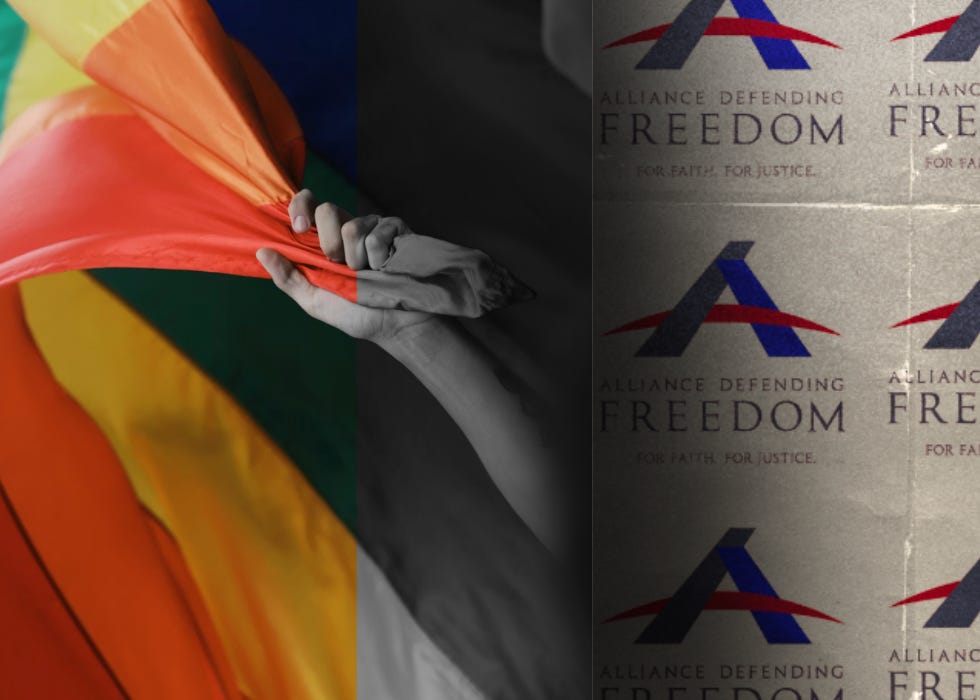





 Scottie's Playtime