Israeli Strikes Yemen’s Civilian International Airport | HasanAbi reacts

Poetry for An Election

You know what to do to find out more.

Morning After The Election by Regie Cabico

I can’t control
the vanishing
       of bees

       but I can control
the honey I swallow
to soothe
       the vocal cords

I can’t control boys
       bully-tumbling
another boy

in the classroom
       like they’re
in a mosh pit

but I can remember
       rolling on hills
with boys being the bully

I can’t change my major
from drama to global peace

but I can write
similes of serenity

& poetic sermons
in temples
of matrimonial fanfare

I know the bombs, the explosives,
and Molotovs are overhead

and I can’t control 
       the lottery, the multiverses,
and tomorrow’s astrology

but whatever tarot card I pick
       or whatever
   gets thrown
       at my face: 

Hangman
       or Fallen Towers

I can express
my weathering emotions

to sing while hoarse
to control air placement
to find the chakra

the right amount of air
to pass through my throat

oh sing with me
the octave between

blade & nectar
rubble & clouds 
ash & mountain

Copyright © 2024 by Regie Cabico. Originally published in Poem-a-Day on December 30, 2024, by the Academy of American Poets.

Peace & Justice History for 12/30

(Their email program seems to be off for the holidays! I keep a link; here is today’s.)

December 30, 1901
The worst year in the 20th century for lynching in the U.S. ended with a total of 130 victims (105 blacks, 25 whites).
Ida Wells-Barnett had been a teacher and newspaper editor in Memphis, Tennessee, where she wrote against the evils of lynching in her columns in The Free Speech and Headlight. Forced from the South by threat of violence, she continued her efforts in Chicago.

From a letter to President William McKinley from Barnett, published in the Cleveland Gazette April 9, 1898:
Mr. President, the colored citizens of this country in general, and Chicago in particular, desire to respectfully urge that some action be taken by you as chief magistrate of this great nation, first for the apprehension and punishment of the lynchers of Postmaster Baker, of Lake City, S.C.; second, we ask indemnity for the widow and children, both for the murder of the husband and father, and for injuries sustained by themselves; third, we most earnestly desire that national legislation be enacted for the suppression of the national crime of lynching.
For nearly twenty years lynching crimes, which stand side by side with Armenian and Cuban outrages, have been committed and permitted by this Christian nation. Nowhere in the civilized world save the United States of America do men, possessing all civil and political power, go out in bands of 50 and 5,000 to hunt down, shoot, hang or burn to death a single individual, unarmed and absolutely powerless. Statistics show that nearly 10,000 American citizens have been lynched in the past 20 years. To our appeals for justice the stereotyped reply has been that the government could not interfere in a state matter. Postmaster Baker’s case was a federal matter, pure and simple. He died at his post of duty in defense of his country’s honor, as truly as did ever a soldier on the field of battle. We refuse to believe this country, so powerful to defend its citizens abroad, is unable to protect its citizens at home. Italy and China have been indemnified by this government for the lynching of their citizens. We ask that the government do as much for its own.
December 30, 1936

above: Workers sit down at GM

Supporters pass in food to sitdown strikers
Members of the United Automobile Workers sat down at a General Motors plant in Flint, Michigan. GM, the world’s largest corporation at the time, had refused to recognize or negotiate with the union, despite passage of the National Labor Relations Act (Wagner Act) in 1935 which promised unions the right to organize. The local’s membership adopted a tactic developed by French workers. Instead of picketing outside a factory only to be ignored or forcibly cleared away, the sit-down strike enabled workers to halt production and seize the plant “from the inside.” The strike began just days after the end of a successful sit-down at Ford supplier Kelsey-Hayes. 

“Master Hands,” a corporate documentary about the Flint plant shot shortly before the strike 
December 30, 1971
Daniel Ellsberg, a Defense Department analyst, and his colleague Anthony Russo were indicted by a federal grand jury for releasing the Pentagon Papers to the news media. The papers were part of a 7000-page, top-secret government history of the United States’ political and military involvement in the Vietnam War from 1945 to 1971, and described air strikes over Laos, raids along the coast of North Vietnam, and offensive actions taken by U.S. Marines well before the American public had been told that such actions had occurred.

The Most Dangerous Man in America: Daniel Ellsberg and the Pentagon Papers 
The Post – new movie (2017) watch trailer 
Why were they being prosecuted? 
December 30, 1972
President Richard Nixon ordered an end to U.S. bombing of North Vietnam. The most recent air strikes had been retaliation for North Vietnam’s walking out of the peace negotiations in Paris and pressure to force it to submit to U.S. terms. Bombing of strategic targets and Hanoi (the North’s capital) and Haiphong lasted for eight days with a 36-hour break for Christmas. The 20,000 tons (18.1 million kg) of bombs killed just over 1600 North Vietnamese, and a dozen B-52s were lost. North Vietnam agreed to return to the bargaining table.
December 30, 1993
The state of Israel and the Vatican under Pope John Paul II agreed to extend diplomatic recognition to one another.

https://www.peacebuttons.info/E-News/peacehistorydecember.htm#december30

‘Shocking’ bodycam video released of New York officers fatally beating prisoner

https://www.nbcnews.com/news/rcna185537

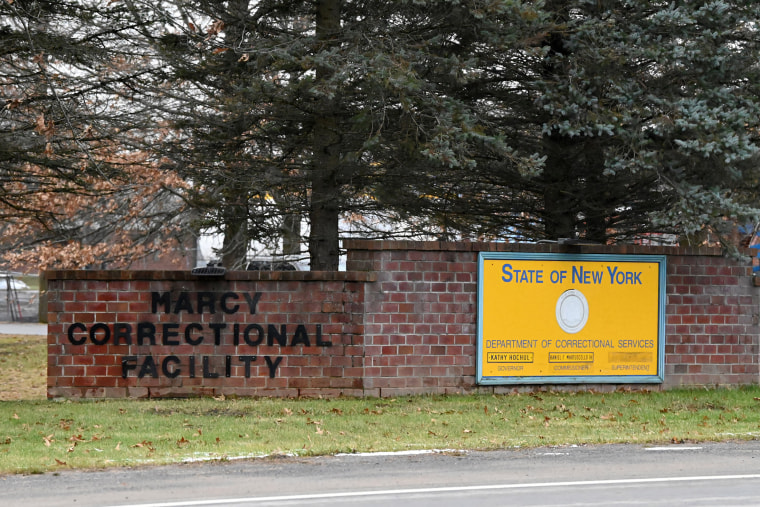
Robert Brooks, 43, died a day after being attacked by several correctional officers at the Marcy Correctional Facility on Dec. 9. His death has prompted a state investigation.
 
***  There is a video at the site linked above that is very informative and shows the man before the police killed him.  ***
 

The office of New York’s attorney general released body camera footage Friday showing the fatal beating of a state prisoner this month by correctional officers who punched and kicked him repeatedly while he was handcuffed on an infirmary bed.

The incident, which has drawn outrage from political leaders and was condemned by the officers’ union as “incomprehensible,” is being investigated by state Attorney General Letitia James. The inmate, Robert Brooks, 43, died in the hospital a day after the Dec. 9 attack.


“I do not take lightly the release of this video, especially in the middle of the holiday season,” James said at a virtual news conference.

“These videos are shocking and disturbing,” she added.

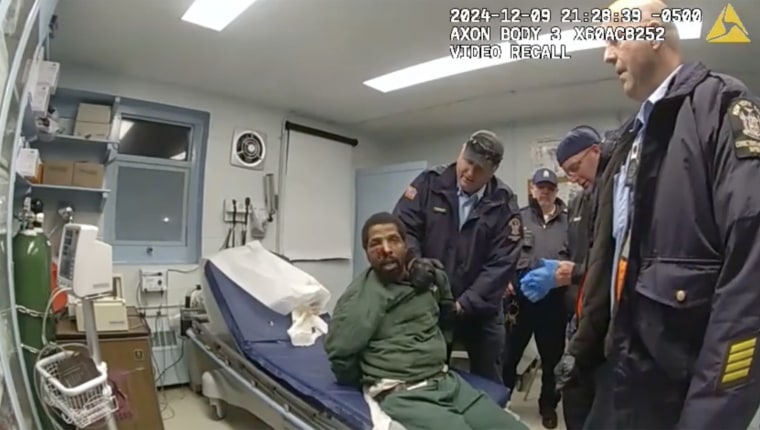
Brooks can be seen in the videos with his hands cuffed behind his back. In one video, he is sitting up as an officer presses his foot down on him. He is then punched by two officers.

At another point, he is forcefully yanked from the bed by his shirt collar and held up above the ground, his face visibly bloodied.

OSI is currently conducting an investigation into the death of Robert Brooks, who died on December 10, 2024 following an encounter with Department of Corrections and Community Supervision officers at Marcy Correctional Facility in Oneida County.
Robert Brooks as seen in body camera footage at the Marcy Correctional Facility in Oneida County, New York, on Dec. 9.Office of the New York State Attorney General

Last week, Gov. Kathy Hochul ordered the state Department of Corrections and Community Supervision to begin the process of firing 14 workers at the Marcy Correctional Facility in Oneida County, where the incident occurred. They include correctional officers, sergeants and a prison nurse. In the interim, all have been suspended without pay, except for one officer, who already resigned. In a statement following the release of the videos, Daniel Martuscello, the commissioner of the state corrections department, said his office has launched its own investigation in an effort to bring “institutional change.”

“Watching the video evidence of Robert Brooks’ life being taken left me feeling deeply repulsed and nauseated,” Martuscello said. “There is no excuse and no rationalization for a vulgar, inhumane act that senselessly took a life. This type of behavior cannot be normalized, and I will not allow it to be within DOCCS.”

Colorado Man Accused Of Attacking Reporter, Saying ‘This Is Trump’s America Now’

https://www.huffpost.com/entry/colorado-man-accused-attacking-tv-reporter-trump-america_n_676f8133e4b03f311afdc4bd

The Colorado TV reporter told police that he believed he had been followed by the man because he is Pacific Islander.
 

A Colorado man is facing possible bias-motivated charges for allegedly attacking a television news reporter after demanding to know whether he was a citizen, saying “This is Trump’s America now,” according to court documents.

Patrick Thomas Egan, 39, was arrested Dec. 18 in Grand Junction, Colorado, after police say he followed KKCO/KJCT reporter Ja’Ronn Alex’s vehicle for around 40 miles (64 kilometers) from the Delta area. Alex told police that he believed he had been followed and attacked because he is Pacific Islander.

After arriving in Grand Junction, Egan, who was driving a taxi, pulled up next to Alex at a stoplight and, according to an arrest affidavit, said something to the effect of: “Are you even a U.S. citizen? This is Trump’s America now! I’m a Marine and I took an oath to protect this country from people like you!”

Alex, who had been out reporting, then drove back to his news station in the city. After he got out of his vehicle, Egan chased Alex as he ran toward the station’s door and demanded to see his identification, according to the document laying out police’s evidence in the case. Egan then tackled Alex, put him in a headlock and “began to strangle him,” the affidavit said. Coworkers who ran out to help and witnesses told police that Alex appeared to be losing his ability to breathe during the attack, which was partially captured on surveillance video, according to the document.


According to the station’s website, Alex is a native of Detroit. KKCO/KJCT reported that he was driving a news vehicle at the time.

Egan was arrested on suspicion of bias-motivated crimes, second degree assault and harassment. He is scheduled to appear in court Thursday to learn whether prosecutors have filed formal charges against him.

Egan’s lawyer, Ruth Swift, was out of the office Friday and did not return a telephone message seeking comment.


Eight LA sheriff’s deputies fired for 2023 arrest and beating of trans man

https://www.theguardian.com/us-news/2024/dec/25/los-angeles-sheriff-trans-man

So much of this story is upsetting.  But one detail stood out to me, and it has not been stressed enough when police violence and false arrests.  The man, Mr. Brock lost his job three days after the brutal assault and may have suffered severe financial distress.  Police and prosecutors know that often just being charged can ruin a persons life.  Hugs

————————————————————————————————————–

Joseph Benza III, main officer involved in incident with Emmett Brock, pleaded guilty in federal court last week

Letters From An American

December 28, 2024 by Heather Cox Richardson
Read on Substack

On the clear, cold morning of December 29, 1890, on the Pine Ridge Reservation in South Dakota, three U.S. soldiers tried to wrench a valuable Winchester away from a young Lakota man. He refused to give up his hunting weapon. It was the only thing standing between his family and starvation, and he had no faith it would be returned to him as the officer promised: he had watched as soldiers had marked other confiscated valuable weapons for themselves.

As the men struggled, the gun fired into the sky.

Before the echoes died, troops fired a volley that brought down half of the Lakota men and boys the soldiers had captured the night before, as well as a number of soldiers surrounding the Lakotas. The uninjured Lakota men attacked the soldiers with knives, guns they snatched from wounded soldiers, and their fists.

As the men fought hand to hand, the Lakota women who had been hitching their horses to wagons for the day’s travel tried to flee along the nearby road or up a dry ravine behind the camp. Stationed on a slight rise above the camp, soldiers turned rapid-fire mountain guns on them. Then, over the next two hours, troops on horseback hunted down and slaughtered all the Lakotas they could find: about 250 men, women, and children.

Fifteen years ago, I wrote a book about the Wounded Knee Massacre, and what I learned still keeps me up at night. But it is not December 29 that haunts me.

What haunts me is the night of December 28.

On December 28 there was still time to avert the massacre.

In the early afternoon, the Lakota leader Sitanka had urged his people to surrender to the soldiers looking for them. Sitanka was desperately ill with pneumonia, and the people in his band were hungry, underdressed, and exhausted. They were making their way south across South Dakota from their own reservation in the northern part of the state to the Pine Ridge Reservation. There they planned to take shelter with another famous Lakota chief, Red Cloud. His people had done as Sitanka asked, and the soldiers escorted the Lakotas to a camp on South Dakota’s Wounded Knee Creek, inside the boundaries of the Pine Ridge Reservation.

For the soldiers, the surrender of Sitanka’s band marked the end of what they called the Ghost Dance Uprising. It had been a tense month. Troops had pushed into the South Dakota reservations in November, prompting a band of terrified men who had embraced the Ghost Dance religion to gather their wives and children and ride out to the Badlands. But at long last, army officers and negotiators had convinced those Ghost Dancers to go back to Pine Ridge and turn themselves in to authorities before winter hit in earnest.

Sitanka’s people were not part of the Badlands group and, for the most part, were not Ghost Dancers. They had fled from their own northern reservation two weeks before when they learned that officers had murdered the great leader Sitting Bull in his own home. Army officers were anxious to find and corral Sitanka’s missing Lakotas before they carried the news that Sitting Bull had been killed to those who had taken refuge in the Badlands. Army leaders were certain the information would spook the Ghost Dancers and send them flying back to the Badlands. They were determined to make sure the two bands did not meet.

But South Dakota is a big state, and it was not until late in the afternoon of December 28 that the soldiers finally made contact with Sitanka’s band. The encounter didn’t go quite as the officers planned: a group of soldiers were watering their horses in a stream when some of the traveling Lakotas surprised them. The Lakotas let the soldiers go, and the men promptly reported to their officers, who marched on the Lakotas as if they were going to war. Sitanka, who had always gotten along well with army officers, assured the commander that the band was on its way to Pine Ridge and asked his men to surrender unconditionally. They did.

By this time, Sitanka was so ill he couldn’t sit up and his nose was dripping blood. Soldiers lifted him into an army ambulance—an old wagon—for the trip to the Wounded Knee camp. His ragtag band followed behind. Once there, the soldiers gave the Lakotas an evening ration and lent army tents to those who wanted them. Then the soldiers settled into guarding the camp.

And the soldiers celebrated, for they saw themselves as heroes of a great war, and it had been bloodless, and now, with the Lakotas’ surrender, they would be demobilized back to their home bases before the South Dakota winter closed in. As they celebrated, more and more troops poured in. It had been a long hunt across South Dakota for Sitanka and his band, and officers were determined the group would not escape them again.

In came the Seventh Cavalry, whose men had not forgotten that their former leader George Armstrong Custer had been killed by a band of Lakota in 1876. In came three mountain guns, which the soldiers trained on the Indian encampment from a slight rise above the camp.

For their part, the Lakotas were frightened. If their surrender was welcome and they were going to go with the soldiers to Red Cloud at Pine Ridge, as they had planned all along, why were there so many soldiers, with so many guns?

On this day and hour in 1890, in the cold and dark of a South Dakota December night, there were soldiers drinking, singing, and visiting with each other, and anxious Lakotas either talking to each other in low voices or trying to sleep. No one knew what the next day would bring, but no one expected what was going to happen.

One of the curses of history is that we cannot go back and change the course leading to disasters, no matter how much we might wish to. The past has its own terrible inevitability.

But it is never too late to change the future.

Note:

Every year on this date, I post the story of the Wounded Knee Massacre.

My book about that event was so hard to write I had to take a long break in the middle of it. When you write a book, you get to know your characters as if they were family. Sometimes you love them and sometimes you don’t, but they become part of you. As the massacre drew inexorably closer, I wrote about the scenery, plant life, and animals of the Plains as a distraction from what I knew was coming.

But it came anyway. Even after all these years, I still have a hard time on the date of the massacre.

In an interview this year, someone asked me why I write as if I am running out of time, and it hit me that I write these letters because no matter how hard I tried, I could not stop the Wounded Knee Massacre.

But maybe I can help to stop the next one.

Peace & Justice History for 12/27

December 27, 1914
The International Fellowship of Reconciliation (IFOR), an inter-religious peace group, was founded in Cambridge, England.

“The International Fellowship of Reconciliation (IFOR) is an international spiritually based movement composed of people who commit themselves to active nonviolence as a way of life and as a means of transformation – personal, social, economic and political.”

“Your goal is, in my opinion, the only reasonable one and to make it prevail is of vital importance.”
–Albert Einstein, in a letter to the FOR
Read more 
December 27, 1971
Vietnam Veterans Against the War staged a peace protest at historic Betsy Ross House, Philadelphia.
December 27, 2002
North Korea ordered U.N. nuclear inspectors to leave the country and said it would restart the Yongbyon plutonium Plant to meet the fuel needs of its nuclear power reactor. The plant had been shut down and sealed by the U.N. in 1994 in exchange for shipments of fuel oil. When it was discovered that the North Korean had been pursuing a uranium-based weapons program, the U.S. and Japan, South Korea and the European Union suspended the fuel shipments.
December 27, 2002
1500 people gathered in Tel Aviv, Israel, the protest the Israeli military occupation of land beyond the 1948 borders of the country. With the slogans “End the Occupation” and “No to Racism,” and dressed mostly in black, they used a variety of means – drumming, singing, art installations, giving away olives and olive oil – to express their frustration and anger over the ongoing occupation.
Alternative Ten commandments at demonstration in Tel Aviv, Israel
The Coalition of Women for Peace also showed a movie, Jenin, Jenin, which had been banned for public showing, in defiance of police orders to stop the projector. Shown on a large outdoor screen, it was a narrative about the actions of the Israeli army the previous Spring in the occupied West Bank town of Jenin.

https://www.peacebuttons.info/E-News/peacehistorydecember.htm#december27

Peace & Justice History for 12/26

December 26, 1862
38 members of the Santee Sioux tribe were hanged in a public mass execution in Minnesota. 300 members of the band had been convicted of participating the the Minnesota Uprising and ordered to hang. However, all sentences except the 38 had been commuted by President Abraham Lincoln.
For decades white settlers had been encroaching on Santee Sioux territory, and they had been victimized by corrupt federal Indian agents on the reservations.In July agents and contractors had withheld food when their demands for kickbacks had been refused. The Indians eventually struck back, killing Anglo settlers and taking some hostages. In two battles with the U.S. Army, they killed or wounded dozens of soldiers, but ultimately lost and were put on trial.


America’s only legal mass execution
===========================================
December 26, 1966

The first Kwanzaa was celebrated in Los Angeles, California. It was conceived and organized in the wake of the Watts riots by Dr. Maulana (Ron) Karenga, a professor and chairman of Black Studies at California State University at Long Beach. Kwanzaa is a non-religious African-American holiday focusing on family, community, and culture.The name Kwanzaa is derived from the phrase “matunda ya kwanza,” which means “first fruits” in Swahili. The celebrations are expressed through song, dance, drumming, storytelling, poetry and the lighting of candles in a Kinara, all followed by a large traditional meal. The holiday is observed for seven days, each representing a different principle:

a Kwanzaa Kinara
• Umoja (oo-MO-jah) Unity
• Kujichagulia (koo-gee-cha-goo-LEE-yah) Self-Determination
• Ujima (oo-GEE-mah) Collective Work and Responsibility
• Ujamaa (oo-JAH-mah) Cooperative economics
• Nia (NEE-yah) Purpose
• Kuumba (koo-OOM-bah) Creativity
• Imani (ee-MAH-nee) Faith

Ron Karenga lighting the Kinara
History, Principles, and Symbols of Kwanzaa 
============================================
December 26, 1971


Two dozen members of Vietnam Veterans Against the War “liberated” the Statue of Liberty with a sit-in to protest resumed U.S. aerial bombings in Vietnam. They flew an inverted U.S. flag from the crown as a signal of distress.
more on this action 
=============================================
December 26, 1992

photo: Simran Sachdev Belgrade, 7.2009
Women In Black began campaign against rape during war, Belgrade, Serbia.
WIB website 
Women in Black is a world-wide network of women committed to peace with justice and actively opposed to injustice, war, militarism and
other forms of violence.

================================================
December 26, 1999

Alfonso Portillo Cabrera scored a resounding victory (nearly 70% of the vote in the second round) in Guatemala’s first peacetime presidential elections following a 36-year civil war.

Alfonso Portillo Cabrera after his election
Some perspective 

https://www.peacebuttons.info/E-News/peacehistorydecember.htm#december26

“Bilderberg Group changes itself for the modern world – and return of Trump”

Charlie Skelton

(I wasn’t going to post any news today, but in my interest of world peace, and everyone’s interest in things that are happening, this story is important, and it’s not likely to be in the commercial breaks of the game or whatever. If it comes up again, and/or where regular people see it in regular fashion, something will have already happened. Right now, it strikes me as something of which to be aware. Save reading it till tomorrow, if you like. I just want it here for the record. -A)

The former head of Nato, Jens Stoltenberg, has been named the new co-chair of the influential Bilderberg Group, which convenes a yearly transatlantic policy conference and has long been the subject of conspiracy theories around the extent of its power to shape global events.and/or

After a turbulent decade at the helm of the alliance’s military, Stoltenberg now takes over at its pre-eminent discussion forum: a fiercely private four-day event frequented by prime minsters, EU commissioners, bank bosses, corporate CEOs and intelligence chiefs.

Stoltenberg’s first Bilderberg was back in 2002, a few years before his second tenure as Norway’s prime minister. His decade as secretary general of Nato saw further visits, and he even gave the keynote speech at the group’s Saturday night banquet in Turin in 2018. His appointment as Bilderberg’s co-chair cements the group’s role at the heart of transatlantic strategy.

In February, Stoltenberg will also take over as chair of the Munich Security Conference, another important defence and diplomacy symposium. With a fellow Bilderberg veteran, the former Dutch prime minister Mark Rutte, replacing Stoltenberg at Nato, it marks a concentration of control at the top of the Atlantic alliance at a critical time.

Stoltenberg’s tenure at Nato was dominated by the Russia-Ukraine conflict, which had begun in earnest not long before he took office in 2014. Stoltenberg oversaw what he recently described as “the largest reinforcement of our collective defence in a generation”, noting proudly that “defence spending is on an upward trajectory across the alliance”.

A number of his new colleagues at Bilderberg have been benefiting from this uptick.

Several of the group’s 31-member steering committee have senior roles in the defence industry. The billionaire former Google boss, Eric Schmidt, chaired the recent National Security Commission on AI, and is now busy launching a kamikaze drone company aimed at the lucrative Ukraine market. Meanwhile, the hugely wealthy Swedish industrialist Marcus Wallenberg is chair of defense manufacturer Saab, which enjoyed a 71% boost in orders in the first nine months of 2024, largely due to the war with Russia.

The tech luminary and Donald Trump insider Peter Thiel founded the fast-growing robotics company Anduril and the booming surveillance and AI giant Palantir. His loyal lieutenant Alex Karp, the CEO of Palantir, was voted on to the board of Bilderberg a few years ago. Karp, who claims his company is “responsible for most of the targeting in Ukraine”, recently told the New York Times that the US will “very likely” soon be fighting a three-front war with China, Russia and Iran.

In some respects, the geopolitical mood today is not so different from how it was in the 1950s, when Bilderberg was born. (snip-MORE)

https://www.theguardian.com/world/2024/dec/25/jens-stoltenberg-bilderberg-group-trump-presidency