“That’s The Way Life Is”: Trump Tells Knicks Fans That Can’t Afford $8K Tickets To Kick Rocks

The center, called The Little Apple, could be a model for other cities exploring ways to make life more affordable for workers.
This story was originally reported by Chabeli Carrazana of The 19th. Meet Chabeli and read more of their reporting on gender, politics and policy.
Tucked in New York City Mayor Zohran Mamdani’s sprawling universal childcare plan is a little-talked-about milestone: In September, the city will open what appears to be the first free daycare for municipal workers in the country.
The center, called The Little Apple, is a pilot program that could prove to be a model for cities across the country that are childcare curious, but not ready to take the big universal swing.
Housed in a renovated space on the first floor of the David N. Dinkins Municipal Building in Manhattan, home base for more than 2,000 city workers, the Little Apple will offer free care to the kids of full-time staff. All workers in the Department of Citywide Administrative Services (DCAS), a city government support agency, can also take advantage of it regardless of their work location.
The center will be small — just 40 seats for children ages six weeks to 3 years old. To pay for it, the city budgeted about $1.5 million, or $35,000 per child.
“This is what Wall Street could call a good investment,” Mamdani said in a press conference announcing the new center. “We know that after housing, the cost of childcare is what is pushing working families out of this city.”
DCAS Commissioner Yume Kitasei told The 19th said the solution came about as a retention strategy, responding to the needs workers shared. In surveys, workers enthusiastically embraced the idea. One worker described access to free childcare as “life-changing.”
That’s probably not hyperbole. Childcare affordability is a national problem that has only grown more acute. Childcare costs an average of more than $13,000 annually nationwide; in New York for an infant at a center it’s closer to $21,000 on average. Paying for a daycare now vies with housing costs as the top constraint on family budgets, so much so that some parents have had to move or drop out of the workforce.
Cities, meanwhile, have been struggling to retain their workers since the pandemic. Benefits like childcare, which some cities and private companies have dabbled with, can help address the quality-of-life issues that are pushing workers out of jobs.
“This is a great time for us to sort of be thinking about: How can we make our jobs even more attractive to people and also retain the city workers that we have?” Kitasei said. “This is one piece of that puzzle.”
Kitasei added that a “healthy” number of staffers applied for The Little Apple and the department expects to fill its 40 childcare seats. Anyone who doesn’t get a spot will be put on a waitlist.
There is an appetite across the country for childcare solutions that could help bring down costs for certain workers, and cities are already taking on creative fixes.
Several already have childcare centers in municipal buildings or for city employees, including Boston, Los Angeles, Philadelphia and Grand Junction, Colorado, though none of them are free like New York’s. In Chattanooga, Tennessee, the county school district and a local childcare center known nationally for creating stable childcare models have partnered to provide childcare for the children of teachers inside unused classrooms in schools. Boone County, Missouri, is building a childcare center exclusively for children of first responders.
In the private sector, Google, General Mills and Siemens closed longstanding childcare centers they operated on their campuses in recent years, but efforts continue elsewhere. Patagonia has operated a childcare center at its California headquarters since the 1980s, a move it argues has lowered turnover from employees who use the site by 25 percent. Overstock.com also has an onsite childcare center at its Utah headquarters. Both are subsidized, not free.
“As cities in every region of the country compete with the private sector and other municipalities to attract and retain workers and elected officials, ensuring access to childcare offers an opportunity for local governments to build a representative workforce and invest in the future of their communities,” said Quincy Midthun, an outreach specialist with the Mayors Innovation Project at the High Road Strategy Center, a think tank focused on solutions to social problems.
The Little Apple, and New York City broadly, reflect a changing political tide when it comes to childcare.

The announcements of universal childcare in New York City and in New Mexico in the last year received an enormous amount of attention across the country. Both places took an idea that for many years was floated as a pipe dream — treating childcare similarly to public education — and turned it into reality. In New York, it’s one of the few issues that Mamdani, a Democratic socialist, and Gov. Kathy Hochul, a centrist Democrat, can agree on.
Voters are also hungry for more solutions: In poll after poll, they assert that spending money on childcare is a good investment.
Emmy Liss, who heads Mamdani’s childcare office, said childcare is at a “political tipping point.”
“We’re in this moment where folks across all political, socioeconomic, demographic spectrums recognize that childcare is essential, that childcare is something families are struggling to access, and know that the market economics of childcare don’t work without public investment,” Liss said. “We see recognition of that.”
With Little Apple, New York is testing what it looks like to commit to its promises of free care for all, but doing it first for its own employees.
“If we are asking folks to report to work in person in parts of the city where childcare is expensive, as it is all over the city, I think that we have to recognize that childcare is an important part of how we keep people in the workforce,” Liss said.
Mamdani and Hochul have been working to make childcare universally available to children in the city through a phased rollout set to conclude in four years. For 2-year olds, the mayor announced that 2,000 free seats will be available in the fall in four largely low-income areas of the city. Another 12,000 are planned for 2027. For 3-year-olds, about 2,000 new seats will be added in the fall, as well. The city has an existing universal childcare program for 4-year-olds.
Universal childcare as Mamdani envisions it will cover kids ages 6 weeks to 5 years with a price tag of about $6 billion annually, making it the most expensive pillar of his affordability agenda. Mamdani is expected to push to fund the program with a tax increase on the wealthy, a strategy Hochul has not been on board for, though the state is chipping in $4.5 billion. Mamdani has not yet unveiled what his universal childcare program would look like for infants and young toddlers.
How New York City’s program rolls out and its sustainability are being closely watched by proponents of universal care, who argue it’s also an anti-poverty measure.
“We know that other places are watching as we try different things out, including the work at the Little Apple,” Liss said.
In New York City, 21 percent of working parents experienced some kind of childcare hardship in 2024 that forced them to forgo care or use inadequate care, particularly families living in poverty, single mothers and Black parents, according to a recent report from Robin Hood, an anti-poverty organization, and Columbia University’s Center on Poverty and Social Policy.
An average of 3,400 2- and 3-year-olds were pushed into poverty between 2022 and 2024 specifically due to the cost of childcare, a separate report from the same organizations found. An estimated 4,100 2- and 3-year-olds would be lifted out of poverty each year if they had access to universal 2-K and 3-K education. That would reduce poverty for this age group by 9 percent.
Rebecca Bailin, the executive director of the parent organizing group New Yorkers United for Child Care, said the problem has reached such a fever pitch that thousands of parents started to organize around the issue in 2023 and helped push the agenda that was central to Mamdani’s election.
Bailin, who has a 1-year-old, said she can now depend on a 3-K program when her child turns 3 and likely a 2-K program, as well — a savings of about $100,000. The 2-K program Mamdani is rolling out will also be full-day care rather than partial-day care that wraps up around 2 p.m. like the existing 3-K program, addressing a top ask from parents.
“People are stoked,” Bailin said. “People feel like they can stay in the city.”
The Little Apple is a small part of the larger effort, but, “if we want to retain people, we have to do this,” Bailin said.
“This is something we want to see scaled. If city workers can’t afford to live here, that’s a real problem,” she continued. “This is really critical and we need this for everybody.”
When there’s a decent though old Democrat in the race. I remember when Trent Lott resigned after what he said about how things would have been better under President Thurmond. IMEO, Moulton should drop out now, rather than wreck the race and elect a Republican. When there is oppo information, people should heed it before the primary
After Representative Seth Moulton’s transphobic comments in 2024, he’s had a rocky relationship with his LGBTQ constituents. So on June 6, when he and a contingent of his supporters marched in the Boston Pride parade, he received a classic Massachusetts reception: direct confrontation.
Multiple videos circulating on social media show the Congressman being booed along the parade route as he otherwise flashed a smile and waved to constituents. The Democrat is retiring from Massachusetts’ sixth congressional district to run for Senate, challenging iencumbent and reliable trans ally Senator Ed Markey. Moulton drew ire after he called transgender girls “male,” legitimized GOP narratives about trans athletes, and then doubled down on it, griping about identity politics as queer Americans faced increasing political violence.
(snip-embedded Blue Sky; click the title above to go see)
Parade-goers called out Moulton, as seen in a video posted to Bluesky. Aidan Kohn-Murphy, a 22-year-old recent Harvard graduate and progressive content creator, who told Erin in the Morning he took that video, said there was a large group booing Moulton all along the parade route. Detractors can be heard yelling “Transphobe!” and “Trans lives matter!” In another clip posted to Reddit, Bostonians shouted, “Shame on you!”
Moulton’s campaign office did not immediately respond to a request for comment on the incident.
Kohn-Murphy said he was moved to voice his discontent due to Moulton’s repeated comments belittling the trans community and scapegoating trans youth over Democrats’ loss in the 2024 election. “There’s no queer community without trans people,” Kohn-Murphy said. “Trans people have constantly led the way in our movement and in the path towards queer liberation.”
Moulton apparently doesn’t quite see it that way. “Democrats spend way too much time trying not to offend anyone rather than being brutally honest about the challenges many Americans face,” Moulton told The New York Times in November 2024. “I have two little girls. I don’t want them getting run over by a male or formerly male athlete. But as a Democrat, I’m supposed to be afraid to say that.”
There is zero evidence to suggest that including transgender girls in women’s sports leads to an increase in athletics-related injuries. LGBTQ community leaders were swift to denounce Moulton’s assertions. “Referring to transgender athletes as ‘male or formerly male,’ the Congressman’s remarks were both harmful and factually inaccurate,” a press release from Mass Equality, a state LGBTQ rights organization, said. “These statements contribute to the ongoing stigmatization of transgender people.”
Other Democrats had also called out his behavior at the time. A top aide of his resigned. Hundreds gathered outside his office in protest. Governor Maura Healey and Rep. Ayanna Pressley condemned his position. “It’s important in this moment that we not pick on particularly vulnerable children,” Healey told reporters. “That’s what I’ve been disappointed in seeing.”
Moulton inflamed the situation further in his comments to WGBH, where he seemed to call trans inclusion “weird.”
“I mean, here we are accusing Republicans of being weird, and we’re the ones who are suddenly requiring people to put pronouns in their email signatures,” Moulton said.
“I mean, that’s kind of weird, to be honest. You know, we went through the whole gay rights movement. We went through the whole Civil Rights Movement. We never had to say, you know, ‘Seth Moulton: Straight’ or ‘Seth Moulton: White.’ And all of a sudden, we have to change all our values to meet the needs or demands of one very small minority group.”
Parade attendee Monica Reina-Gonzalez simply wasn’t having it. “You can’t come here and act like you support our community when you’re blaming our kids for losing the election,” Reina-Gonzalez told The Boston Globe.
In a statement from March 2025, Moulton seemingly tried to cool the temperature. “Transgender individuals, in particular, have faced significant adversity, experiencing discrimination, hate crimes, attempts to limit bodily autonomy, and worsened mental health as a result,” he wrote. He further cited his own voting record in favor of protecting transgender Americans, including some trans athletes.
For example, Moulton did indeed cosponsor the Equality Act, which would explicitly include LGBTQ+ people as a protected class under the Civil Rights Act. He also rejected Congress’ proposed Protection of Women and Girls in Sports Act under the Trump regime. “Younger kids who simply want to play recreational sports and build camaraderie like everybody else should not be targeted by the federal government,” Moulton wrote.
At the same time, he lamented that “too many Democrats are afraid that they will be attacked for even entertaining meaningful dialogue and debate around contentious issues” like gendered athlete policies. But as transgender lawmakers find themselves silenced in their respective governing bodies, bombarded with violent threats and rhetoric, and banned from using the bathroom in their place of work by the very colleagues they must legislate alongside, many found his self-proclaimed martyrdom superficial.
“He’s a politician who does not have any concrete value system,” Kohn-Murphy said. “I think if he’s willing to throw some of the most vulnerable in our community under the bus, then he cannot be trusted.”
It’s the second time Moulton has been booed at a progressive event; he was met with jeers at a No Kings rally this past October.
Earlier today, Bay State Stonewall Democrats—a contingent of LGBT Democratic voters in the state—endorsed Moulton’s opponent, Senator Ed Markey, for the September primaries.
“From the Transgender Bill of Rights to the Transgender Health Care Access Act to the Elder Pride Act, he has spent decades fighting to protect LGBTQ+ lives,” a post from the organization said of Markey.
“And when things got tough politically, he didn’t throw trans people under the bus to score points with skeptical voters,” the endorsement continued. “At a moment when our rights are under serious attack, the Bay State Stonewall Democrats stand with the candidate who stood up for us and won’t sell us out for political expediency.”
Sam points out that the times interviewed at least four women. Only one had anything bad to say about Platner and the rest had only positive things to say about him. The Times couldn’t collberate the claims of the woman who accused Platner of being physically rough with her. The woman making the accusations is a republican operative and one of the co-founders of the group Ladies for Kavanaugh. A group that supports Justice kavanaugh who was very credibly accused of rape. This woman accusing Platner of abusing women is a longtime Republican operative who helped Susan Collins write the speech she gave supporting Kavanaugh. She used a lot of the same language in the Times smear article as she has used in in other republican-supporting articles and events. It seems the majority of the attacks aimed at Platner are being driven / created by centrist and pro-Israel groups. These attacks include hints of far more serious crimes to come to light but they can’t substantiate them. Hugs
WASHINGTON – Today, Senator Ruben Gallego (D-AZ) introduced the Redistribution Of Billions by Instituting New High-income Obligations on Overlooked Debt (ROBINHOOD) Act to close the ‘borrow’ aspect of the ‘buy, borrow, die’ tax loophole that is used by the ultra-wealthy to finance extravagant spending without paying income or capital gains taxes.
“Working and middle-class Americans are paying their fair share – they do it with every paycheck. But the billionaires in this country? They’re using legal loopholes and tricky accounting to finance private jets and yachts while most Americans struggle to afford healthcare and groceries,” said Senator Gallego. “My legislation closes a critical loophole and brings us closer to billionaires finally paying their fair share.”
Punchbowl News: Gallego targets ‘buy, borrow, die’ tax maneuver
The ‘buy, borrow, die’ tax loophole has three stages:
The ROBINHOOD Act closes this loophole by treating taking out a loan as a realization event, meaning the individual would have to pay taxes on capital gains equal to the loan amount. The provisions of the bill apply to taxpayers who have an income over $100 million and/or assets worth more than $1 billion.
You can find a one-page summary of the legislation HERE.
You can find a section-by-section explainer of the legislation HERE.
You can find the full text of the legislation HERE.
Companion legislation was introduced in the House by Rep. Dan Goldman (NY-10).
“While working, wage-earning New Yorkers pay income taxes on every single paycheck, billionaires live tax-free by borrowing against their stock portfolios, real estate holdings, and art collections without paying a dime in taxes on that money,” Congressman Dan Goldman said. “By restoring basic fairness to our tax code and making the ultra-wealthy pay their fair share and contribute what they owe, this bill will generate revenue to invest in universal pre-K, child care, and working families instead of subsidizing billionaires’ yachts and private islands. It’s long past time for the wealthiest people in the country to pay their fair share.”
I’m looking forward to the publication of Jake Tapper’s next book.


For some bizarre reason that I don’t believe anyone has figured out yet, Donald Trump showed off a graph in the Oval Office, comparing the size of the Lincoln Memorial Reflecting Pool to the size of skyscrapers. Seth Meyers said, “You’re not allowed to compare horizontal to vertical. If that was the case, I-90 crushes the reflecting pool.”
Trump showed off a chart which compared the freshly-painted 2,030-foot-long pool against the 1,451-foot-high Sears Tower in Chicago, New York City’s 1,454-foot Empire State Building, and the 1,776-foot One World Trade Center. Upon seeing these comparisons, many people said, “So what?” What does the length of the Reflecting Pool compared to the size of skyscrapers have to do with anything?
You can take this incident to point out how senile Trump is becoming, but it also proves that he is surrounded by enablers because somebody had to print this graph. He’s comparing a pool to buildings, horizontal to vertical. Michael Kosta of The Daily Show said, “I’d say you’re comparing apples and oranges, but at least those are fruits.” (snip-MORE)

During congressional testimony, acting Attorney General Todd Blanche said that Donald Trump’s $1.8 billion slush fund, which his J6 insurrectionists/terrorists could have applied for, is dead. In the Oval Office today, Donald Trump said that he doesn’t know if it’s dead. He is lying.
The one thing that we do know for sure is that the immunity for Trump and his family from IRS audits is still alive and well. But more on that tomorrow.
The slush fund was not popular, even with Republicans, with one calling it “stupid on stilts.” Another unpopular thing, even with Republicans, is the appointment of Bill Pulte as acting Director of National Intelligence. Pulte is currently the director of the Federal Housing Finance Agency.
When asked if he has concerns that Pulte would “weaponize” the position, given the role he has played during Trump’s second term in digging into mortgage records to see whether Trump’s political adversaries have committed fraud, Senate Majority Leader John Thune said: “We don’t need a weaponized DNI; we need professionals there.” (snip-MORE)
Recently I posted a cartoon after reading this Propublica story about the connections between a Don Jr. linked company and a $620 million Pentagon loan. We haven’t heard as much in the news during the second presidential term about the Trump family and their various grifts (probably due to Trump taking the oxygen out of the room with his various vanity projects), so I’m posting some cartoons from the first as a reminder the entire Trump family is in it all for themselves.
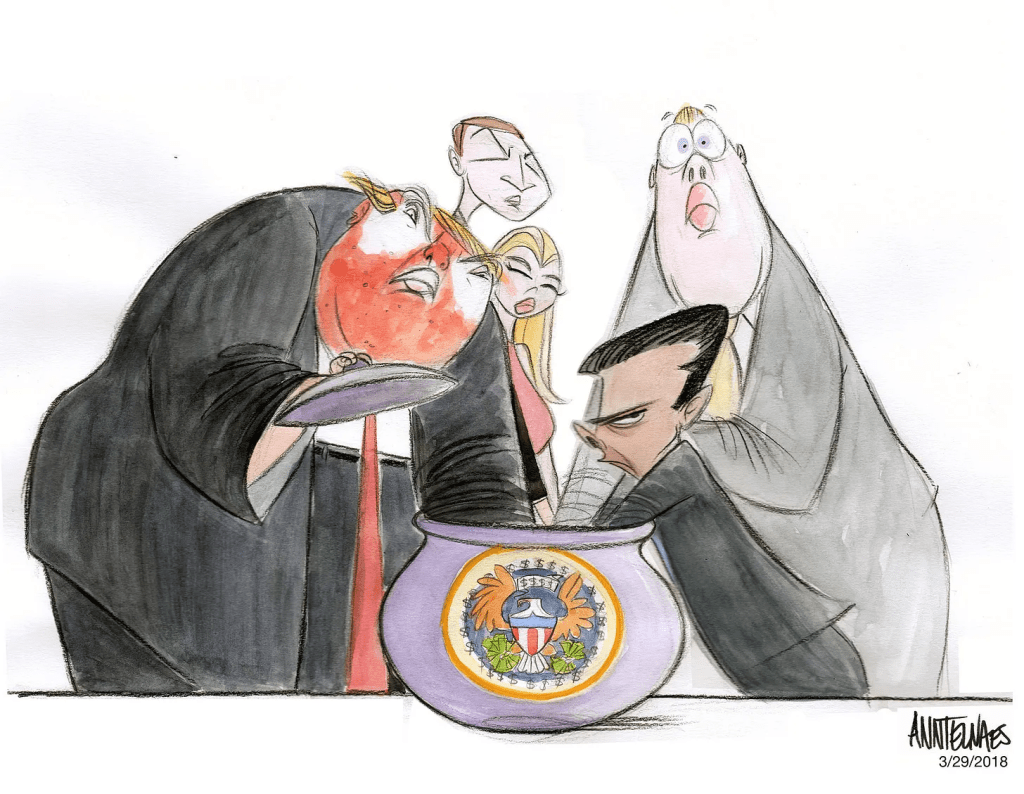


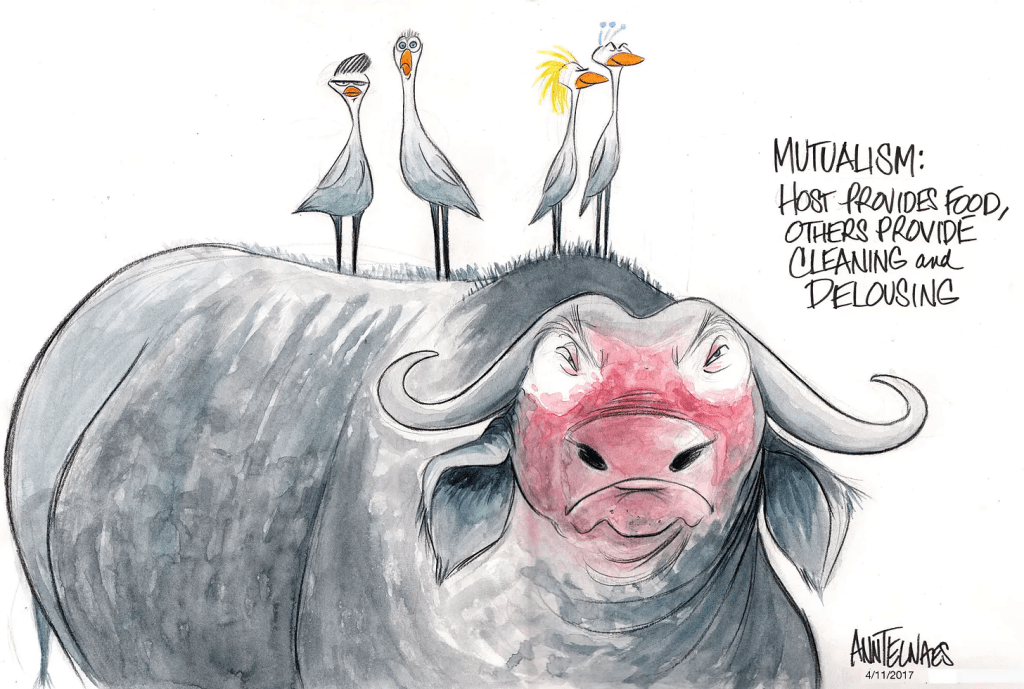

(snip-there are 7 MORE, and they are fantastic-go see!)

Andrew Paul Johnson was one of the insurrectionists who attacked the Capitol on January 6, 2021. He pleaded guilty to multiple nonviolent charges for breaching the Capitol, and was just a few months into his year-long sentence when Donald Trump gave him a pardon. Last March, he was sentenced to life in prison after a Florida jury found him guilty of five criminal charges, including molestation, lewd and lascivious exhibition, and transmission of material harmful to a minor.
Police reported that Johnson, 45, tried to keep the children quiet by telling them he would share millions of dollars in restitution money he expected to receive from the Trump regime in connection with his Jan. 6 case. Don’t worry, kids, he told them. Uncle Donald will take care of you. (snip-it’s disgusting that there is MORE just like this)
in Hawai’i!
After a three-year push, Hawai’i officially has implemented a shield law to explicitly protect providers and patients of gender-affirming care for the trans community.
House Bill 1875, also known as Act 059, was signed by Governor Josh Green—himself a physician—late last week. The bill explicitly adds gender-affirming care to its existing shield law, which broadly covered reproductive health, and established safeguards from “abusive litigation” coming from outside states.
Shield laws create “legal protections for patients, health care providers, and people assisting in the provision of certain health care in states where that care is legal from the reach of states with civil, criminal, and professional consequences related to that care,” according to the Center for Reproductive Health, Law and Policy at UCLA. For example, it means Hawai’i state actors may not aid out-of-state attacks—such as, say, through the extradition of health care providers—over lawful care rendered in Hawai’i.
“The legislature finds that the people of Hawai’i have a long tradition of protecting an individual’s right to privacy and bodily autonomy independently of, and more broadly than, the United States Constitution,” the bill reads. It emphasized that the right to privacy and bodily autonomy extends to minors.
“It is the policy of this State that the rights of equality, liberty, and privacy guaranteed under […] the Hawaii State Constitution are fundamental rights and that those rights include an individual’s right to make health care decisions about one’s own body, including the right to seek and receive health care services that affirm their expressed gender.”
The signing was a resounding victory for LGBTQ activists on the islands. Hawai’i was among the last of the blue states to enact a shield law for the transgender community and their providers.
“We’ve heard from legislators that this is considered a controversial topic and that they’d rather not engage in bills that could draw attention to Hawai’i from the Trump Administration,” Abby Simmons, Chair of the Stonewall Caucus of the Democratic Party of Hawai‘i, told Erin in the Morning last year.
Now, she’s singing a more triumphant tune. “This bill truly was a team effort,” she said in an interview this week. “Lawmakers wanted to understand the legal implications, hear from stakeholders, and make sure they were crafting legislation that would withstand challenges. While that process can sometimes feel slow, it also means that when legislation succeeds, it often has a stronger foundation.”
Simmons also said the playbook for getting the bill over the finish line was rooted in building a big tent. “I think what finally made HB1875 successful was that supporters increasingly focused on a message that resonated far beyond the LGBTQ+ community,” she continued.
“The conversation wasn’t simply about gender-affirming care. It was about protecting patients, families, and healthcare providers who are following Hawaiʻi law. It was about preventing out-of-state actors from interfering with healthcare decisions made here in Hawaiʻi. It was about provider stability at a time when Hawaiʻi already faces healthcare workforce shortages. And it was about preserving Hawaiʻi’s ability to govern itself.”
The bill arrived on the Governor’s desk amid rising federal threats from the Department of Justice against hospitals, including the use of judge and forum shopping to prosecute gender-affirming care providers in conservative jurisdictions based outside of their state. Last month, the Northern District of Texas—an infamously conservative federal court—ordered Rhode Island Hospital, which is almost 2,000 miles away, to hand over patient records from its transgender youth care program. That legal battle is ongoing.
“Gender-affirming care is lawful in Hawaiʻi, grounded in established medical standards, and essential to the well-being of transgender, nonbinary, māhū, and gender-diverse people,” Hawai’i’s LGBTQ political action committee, HOKU, wrote in submitted testimony from when the bill was being considered by the legislature.
“Failure to protect access to gender-affirming care is not only an attack on patients and providers; it is a violation of parental rights,” reads another submission from Pride at Work Hawai’i. “Parents and caregivers who affirm, support, and seek medically appropriate care for their keiki [child] are exercising their fundamental right.”
Donavan Kamakani Albano, Policy Fellow at the ACLU of Hawaiʻi, further spoke to the importance of gender diversity in Hawaiian tradition. Some right-wing officials may push the myth that transness is somehow novel or a “trend.” But Hawai’i has especially rich ties to its pre-colonial culture—including non-binary concepts of gender.
“In Kanaka Maoli culture, māhū describes someone who embodies kāne and wahine [the masculine and feminine] energies,” Albano’s testimony said. “While the visibility of māhū individuals has recently increased, ongoing barriers to gender-affirming care remain.”
This united LGBTQ advocacy with other causes. “Those principles brought together a broad coalition of supporters and helped lawmakers see the bill as a matter of healthcare access, privacy, and state sovereignty,” Simmons said.

