Hello Everyone. One of the things that I’ve struggled with over the years of doing various posts here and elsewhere is that I, quite frankly, am not an expert on anything. This makes me very self-conscious about my posting because I feel like I’m misleading people into making mistakes in their own thoughts and arguments. So, I’m going to try this new approach of calling my posts “conversation starter” with the hope that if I am wrong, or by shock and chance hit the mark a bit, readers can feel free to add opinion or correct me.
Any of us may be wrong by a long stretch or just a little bit, and I think we hold our opinions for fear of being made to look foolish or naïve. I would like to preface this with the reminder that these are my opinions, and much like assholes…., yeah. So… here goes.
One of the current position points for the GOP, and I’ve seen this especially in Indiana, Ohio and Florida, is the idea that property taxes are an unfair burden upon property owners (https://auditor.bcohio.gov/news_detail_T2_R36.php). I’ve heard them use the analogy that it is paramount to buying a meal from the resturant, paying for the meal, and then being required to return yearly to pay more for that original meal purchase. The human mind is going to immediately gravitate to the idea that the removal of a tax is a good thing. This, of course, is the MAGA and GOP mode of operations: appeal to the unthinking and immature mental reflex of their base towards their own ends. What the less wealthy MAGA likely hasn’t done, is recognize that this turns a tax burden upon the less wealthy, again. Here is my thinking:
If a wealthy person buys land, say, measuring 100 acres for his own home. Conceivably, a similar 100 acres would house 300-400 middle-class homes, or more if we consider apartments. In a simple math, because I know it doesn’t quite work this way but give me some latitude here, those two 100-acre portions of land would pay give-or-take the same tax. That means, by my simple measure, one family is paying the same tax as 300-400. Now, that doesn’t really seem very fair, and so the GOP/MAGA support the end of that tax. But, as we all know, the bills never stop. The money for roads, schools, parks, police and fire, etc., has to come from somewhere. A great deal of that comes from property tax. If it doesn’t come from the property tax, where will it come from? I would guess an increase in sales taxes, gas taxes, payroll state taxes. In this case, now the food, gas, entertainment, police and fire and whatever else, is going to be payed by that 3-400 middle-class families at a similar rate as the 1-wealthy family — meaning the tax burden has shifted to the middle-class families. Further, the wealthy person is going to have an even better financial position, which he will likely use to buy more land.
Demonstrators hold a sign saying “PROTECT MINORITY VOTING RIGHTS” outside the U.S. Supreme Court in Washington, D.C., in 2025.
Jemal Countess/Getty Images for Legal Defense Fund
By declining to take up a lower court ruling, the U.S. Supreme Court has dealt another blow to the Voting Rights Act.
The court announced Monday that it will not review an Arkansas-based lawsuit, leaving in place a 2025 appeals panel ruling that ends a long-used tool for protecting minority voters from discrimination under the landmark law in seven mainly Midwestern states.
That ruling found that in the states covered by the 8th U.S. Circuit Court of Appeals — Arkansas, Iowa, Minnesota, Missouri, Nebraska, North Dakota and South Dakota — private individuals and groups do not have the right to sue to enforce what’s known as Section 208 of the Voting Rights Act, which generally allows voters with a disability or inability to read or write to get help with voting from a person of their choice.
The Supreme Court’s move comes almost two months after its conservative supermajority issued a major ruling that further weakened the Voting Rights Act, setting off a groundswell in redistricting across the country.
In May, shortly after that undermining of Section 2 protections against racial discrimination in redistricting, the high court decided not to weigh in on what the legal world calls a “private right of action,” sending back to lower courts two cases brought by Black voters in Mississippi and Native American voters in North Dakota.
For decades, enforcement of these sections of the Voting Rights Act has mainly been driven by lawsuits by private individuals and groups.
But after conservative Justice Neil Gorsuch issued a single-paragraph opinion in 2021 questioning a private right of action, Republican officials in multiple states have raised a novel legal argument: Only the U.S. attorney general, they contend, has the right to bring lawsuits under these parts of the Voting Rights Act.
The case that the justices decided not to take up was brought by the immigrant advocacy group Arkansas United, which has provided Spanish-language interpreters at polling sites to assist voters with limited English proficiency. The group challenged an Arkansas law that bans a person who is not a poll worker from helping more than six voters cast ballots. In 2022, a federal judge ruled that the state law violates Section 208 of the Voting Rights Act. But after GOP state officials appealed, an 8th Circuit panel found last year that private groups, like Arkansas United, do not have the right to bring this kind of lawsuit, partly because such a right is not explicitly spelled out in the words of the Voting Rights Act.
So far, the 8th Circuit — which also found that there is no private right of action under Section 2 — is the only federal appeals court to break with decades of precedent on this legal issue.
In a statement, Arkansas’ Republican Attorney General Tim Griffin called the Supreme Court’s refusal to take up the 8th Circuit panel’s ruling “a victory for the state” and applauded the high court for “following the plain meaning of the language in the Voting Rights Act.”
The Supreme Court may take up this issue in a future case
The brief, unsigned order the high court released Monday did not explain why the justices decided not to review the 8th Circuit panel’s ruling in the Arkansas case.
But in a court filing last month, Republican officials in Arkansas pointed out that no other federal appeals court has issued a ruling that specifically addresses whether private groups and individuals can sue under Section 208. That, the Arkansas Republican officials argued, means there is no disagreement between appeals courts for the Supreme Court to resolve.
Arkansas United’s attorneys at the Mexican American Legal Defense and Educational Fund, however, countered that there is a “clear conflict between the Eighth Circuit’s decision and the unbroken line of cases allowing private litigants to vindicate their rights under Section 208.”
“The limited case law regarding private enforcement of Section 208 does not mean that the circuit split is nonexistent, or that the issue is unimportant,” the MALDEF attorneys wrote in their court filing. “Instead, it demonstrates just how much of an anomaly the Eighth Circuit’s decision is.”
Thomas Saenz, MALDEF’s president and general counsel, tells NPR that the civil rights group now plans to eventually ask the Supreme Court to review a private right of action under Section 208 through a Missouri-based lawsuit, which was put on hold while the appeals process for the Arkansas case played out.
The case led by Missouri Protection and Advocacy Services, which advocates for voters with disabilities, challenges a state law that bans a person from helping more than one disabled voter or voter who cannot read or write for each election, unless the person providing assistance is a poll worker or the voter’s immediate family member.
“We will attempt to move it forward, and these precedents will be cited to stop us,” Saenz says. “We will move up and hope that the Supreme Court will see that it needs to stop this situation where only one circuit in the entire country has taken a contrary view to everyone else and foreclosed private enforcement of the Voting Rights Act.”
Sam. Emma, and crew talk about the popularity of the DSA who want to use government to help the the people not just the wealthy few. Government working for the people. Notice how Chris Christy has to deny everything that Mamdani has managed to get done. Even though the evidence is documented he has to deny it. Donna Brazile who is a total corporate democrat who supports the entrenched establishment leadership wouldn’t speak up for Mamdani. Only the young guy did and even as he presented the facts the host let Christy talk all over him and mock him. Hugs
If you click on the link you can read the entire article for free as a gift article. What a corrupt authoritarian wannabe dictatorship the US government is. Hugs
Every autocracy has a central ideological mission. The current United States government wants to transform America from a multiracial democracy into a White Christian male-dominated ethnostate. This fanatical mission is increasingly influencing the administration’s policies, propaganda, and visuals produced by this United States government.
Their goal is to change who counts as an American, who can have leadership roles in government and society, who can vote, and who can walk the streets without fear of being imprisoned or deported.
This agenda of authoritarian transformation is the connective tissue binding the many news stories we see each day, whether it is the Trump administration deporting an estimated 17,500 immigrants to countries they have never visited, to White Christian Holy Warrior Pete Hegseth blocking promotions by female and Black Navy officers, to the wrecking of the Voting Rights Act.
Remember that Nazi salute given by Elon Musk at Trump’s Inauguration festivities, and that other Nazi salute given soon after by Steve Bannon at CPAC? They were not aberrations or provocations, but rather the opening shots of a race war now unfolding.
That war seeks to remove agency and mobility and rights and freedoms of non-Whites, while implementing schemes of population redesign, reducing the numbers of immigrants by disappearances, mass detentions, and deportations by government authorities.
MAGA is now a potent project of White race hegemony that feeds on several vectors: the long and tragic history of violence and legal and other effacements of Black people in America, the history of anti-immigrant xenophobia, and the example of authoritarian racial utopias that promoted some while cleansing society of others.
Foreign Policy, National Security Policy, and Elections
Transforming a multiracial and multifaith democracy into a White Christian ethnostate requires a holistic approach, and for months I have been tracking the attempts to achieve greater cohesion of government policy around this goal.
In a recent speech, Secretary of State Marco Rubio defended “Western civilization” as the shared identity of the United States and Europe and depicted mass migration as a threat to that civilization.
I have also examined how suppressing free and fair elections fits into this scheme.
Here I add the tool of population reengineering, which is embraced by White House policy advisor Stephen Miller, Musk, and many other MAGA luminaries. A throughline of the far-right from Benito Mussolini to Musk is Great Replacement Theory, the idea that Whites are being outperformed demographically by non-Whites, necessitating measures to save “civilization” from “erasure” and Whites from annihilation.
The Fascists provided the template. “Cradles are empty and cemeteries are expanding,” Mussolini declared in 1927. “The entire White race, the Western race, could be submerged by other races of color that multiply with a rhythm unknown to our own.” In a speech that year, Il Duce cast himself in the role of a “clinician” who undertook “necessary hygienic actions” to defend Italian people from criminals, leftists and other political dissidents. “We remove these individuals from circulation just like a doctor does with an infected person,” he concluded chillingly.
A vast network of penal colonies, confinement zones, and prisons appeared to “quarantine” the “abnormal.” This “therapeutic” approach to governance, as official Giuseppe Bottai called it, was later applied to Italian Jews, and in Italian Ethiopia the regime experimented with apartheid-style racial segregation to stop the wrong kinds of babies from being conceived.
This idea of state action to protect White Christian civilization and the “natural family” –one man, one woman, and both white–continues among the far right today, as does the attachment to Great Replacement theory.
“I think there is a deliberate plan to erase everything that identifies us: culture, Nation, family are under attack,” stated Giorgia Meloni, a neo-Fascist, in March 2019. As Prime Minister, Meloni champions White motherhood as an antidote to population changes caused by non-White immigration.
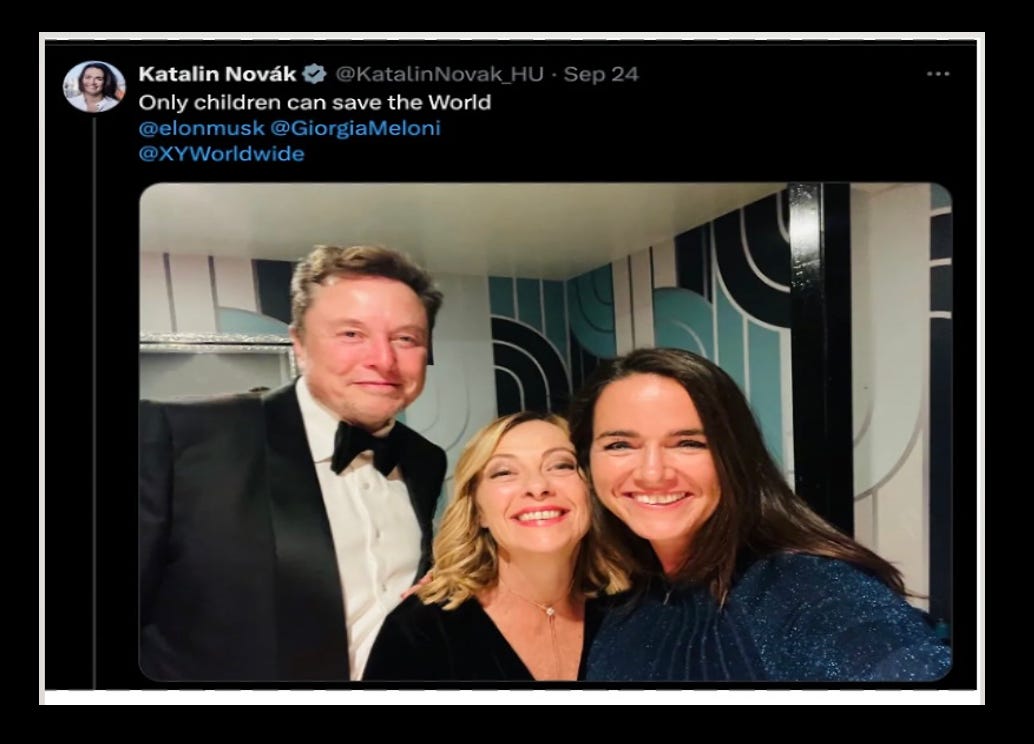
Having the right kinds of babies in the right numbers and keeping out undesirable races and births was a mainstay of the former Viktor Orban government. “Europe has become the continent of the empty crib,” said Hungarian Family Minister (and future President) Katalin Novak in 2019, echoing Mussolini. Novak had to resign from the presidency after she pardoned a pedophile, but she continues to advocate for “saving nations” from “a collapsing global birthrate,” this time through x-y, an organization she founded in 2024.
Musk, Meloni, and Novak at the launch of x-y.
X-y has been supported by Musk, who shares Novak’s preoccupation about Whites being replaced and civilization ending. A Washington Post investigation found that Musk posted 850 times in recent months on the topic of population and Whites being “a rapidly dying minority,” which triples his posting rate on these subjects in the previous 2 years.
An Optics of White Supremacy
We can expect X and other MAGA-friendly social media platforms to increase their messaging about a supposed race emergency, and we’ll likely see the Trump administration become more aggressive in its attempts to create an optics of White hegemony in government spaces.
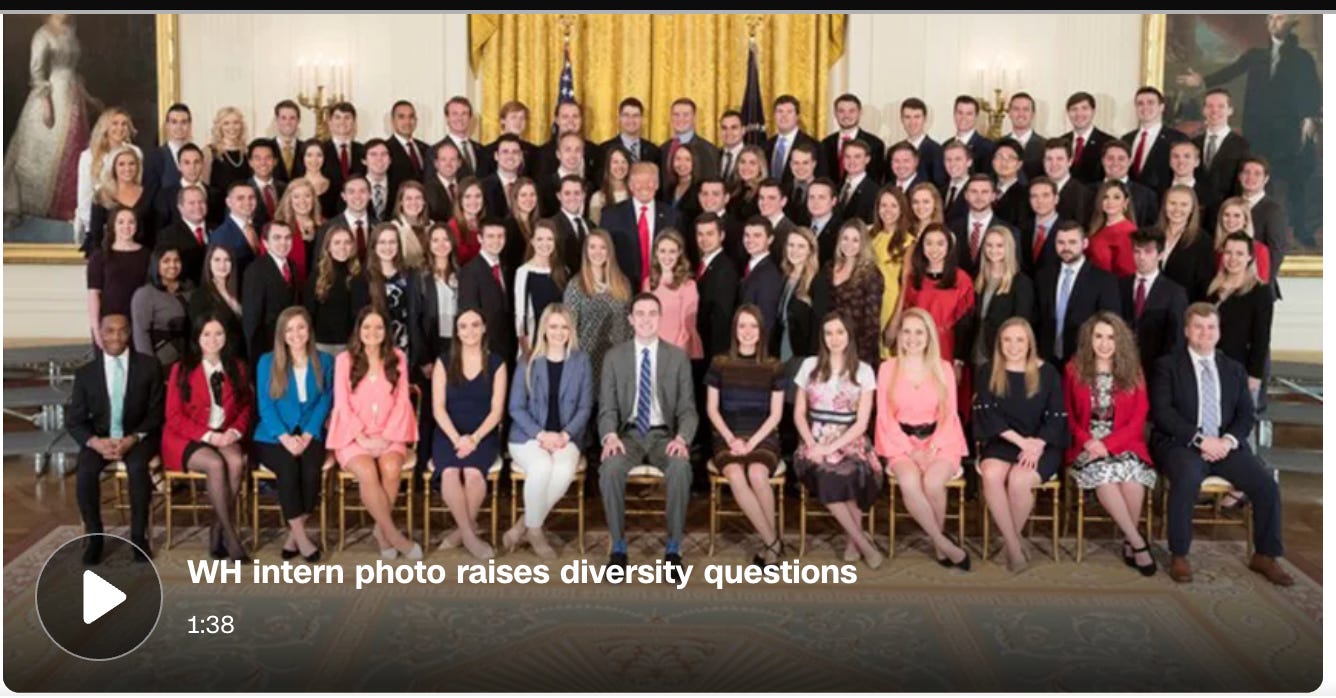
This idea of an all-White governing class was tested in Trump’s first term, as I warned in a 2018 CNN essay on White House interns.
There will also be a ramping up of removals of non-White immigrants from the public sphere, as the massive Amazon-style warehouses ICE is repurposing for people would indicate.
Our Identities Cannot Be Erased
This administration will never succeed in wrecking our multiracial and multifaith society, no matter how much damage it does to our democratic political system. It is who we are. Our identities cannot be taken away from us. And the attempts at mass disenfranchisement will backfire; a new civil rights movement is already starting.
In trying to create a homogeneous society and ban talk of diversity, this government is merely drawing attention to what makes the United States special, and the power of our roots, identities, and traditions. These will serve us well in the coming years as we pursue peaceful resistance to restore our democracy.
Under a single spotlight, a tall figure in a hooded robe strutted onto the stage, their back to the audience. After a suspenseful beat, three words in large bolded lettering lit up the screen behind them: “NATURE IS GAY.”
With a twirl to the crowd, Pattie Gonia unveiled their ginger-red hair and matching mustache, dancing in an earthy blue-and-green crop top and skirt barely covering their chiseled body. The crowd of over a thousand broke into roaring applause.A 2019 video of Bill Nye the Science Guy, pulled from his appearance on John Oliver’s “Last Week Tonight,” punctuated the dramatic reveal. “By the end of the century, if emissions keep rising, the average temperature on Earth could go up another 4 to 8 degrees,” Nye said. “What I’m saying is, the planet’s on fucking fire.”
These are just the first few seconds of environmental activist and drag queen Pattie Gonia’s “Save Her” tour, a one-of-a-kind show that calls for the protection of the dolls — and the planet. The drag queens and kings who created and star on the tour aim to counter the exclusion of their communities by promoting the inclusion of everyone.
For eight years, Pattie Gonia, who goes by Wyn Wiley out of drag, has amassed an impressive following of over 2 million people across their social channels and through their environmental activism on and off the stage. They’ve pushed boundaries, set records and earned accolades, including being featured as one of TIME’s most influential creators in 2025, named as one of National Geographic’s 33 “agents of change” and invited to speak at TED Talk. They have also raised millions of dollars for environmental and social justice non-profits, co-founded the environmental equity organization Outdoorist Oath and a job board to help the queer community and allies find work in the environmental sector.
Last year, Pattie Gonia completed a 100-mile trek from Point Reyes National Seashore to San Francisco’s Golden Gate Bridge in full drag — hair, heels and all — to raise $1 million for non-profit environmental and social justice organizations.
Pattie Gonia performs at the “Save Her! Environmental Drag Show” during Climate Week, Tuesday, Sept. 24, 2024, in Brooklyn, New York. (Alyssa Goodman/AP Photo)
Last month, they did it again, completing a five-day hike at Yosemite.
As show attendee and D.C. drag king Lionel Bitchie said, “She’s not one of the most followed drag queens for no reason.”
But they haven’t done all this work without ruffling a few orange-tinted feathers — and sparking division even among their own fans. During the 2024 presidential campaign season, they were targeted in a Trump campaign ad. Most recently, Pattie Gonia has been in the news for getting sued by the clothing brand Patagonia.
The lawsuit arose after Pattie Gonia filed a trademark application for exclusive rights to use the Pattie Gonia brand on commercial products and events, a move that Patagonia claims would compromise its brand identity. The drag queen responded on social media, posting that suing a climate activist is a “betrayal” of Patagonia’s core mission. Patagonia, for its part, acknowledged their shared goal of caring for the planet and the outdoors, but has held firm on the conditions to end the litigation.
Online, people in Pattie Gonia’s own fanbase have expressed conflict. While some view the lawsuit as harmful to the queer community and stopped using Patagonia’s products as a result, others disagree the clothing brand unfairly sued the drag artist.
Pattie Gonia said the timing of the lawsuit, filed on January 21, hits especially hard because it has come at a time when marginalized communities have been under fire. Several climate, gender and equity-related terms have been erased and banned from federal agencies. The Trump administration has rolled back key protections and visibility for LGBTQ+ communities, including limiting access to gender affirming care, removing mentions of LGBTQ+ history in national parks and banning transgender service members in the military. It also has slashed environmental safeguards for clean air and water, gutted funding for national parks and public lands, and expanded the use of polluting fossil fuel industries.
All the while, Pattie Gonia has embraced their own form of protest in the national “Save Her” tour, focusing it on climate activism and partnering with local drag queens at each of the tour’s stops, in more than 20 cities. At the 9:30 Club in Washington, D.C. — a historically inclusive space for Black performers steps from U Street’s former Black Broadway and a 20-minute drive from the White House — artists and attendees weren’t afraid to get political.
“A lot of time drag can be escapist, and not confronting the reality of dealing with fascism and climate decline, so I like drag that is a call to action and inspiring,” local drag artist and attendee Brooke N. Hymen said. “Pride month can be a celebration and it should be, but it should also be resistance against the forces that want to see us eliminated. And I feel like climate activism goes hand in hand with trans and queer activism.”
“Drag is political, so in a way this is like a rally,” Lionel Bitchie added.
One by one, each act gave their own climate-themed performance, with the majority of them stripping down to their “Fuck Donald Trump” pasties and underwear. Between acts, a parodied Smokey the Bear logo on stage read: “Only you can prevent fascist liars.”
Drag artists Brooke N. Hymen (left) and Lionel Bitchie (right) attended Pattie Gonia’s 9:30 Club show. “Drag is political, so in a way this is like a rally,” Bitchie said. (Jenae Barnes for The 19th)
“It’s a fantastic outlet for joy and rage all in one,” said attendee Kirby Callaway, who works in the environmental space. She said when she saw Pattie Gonia perform at a previous drag show, her “cheeks were hurting because I was smiling so much.”
“It’s so unique, [and] so much of the way that I interact with it in the real world is very doom and gloom,” Callaway said. “I don’t feel like a lot of places get to celebrate and find joy and laugh at these issues.”
Co-headliner and drag queen Sequoia (yes, like the tree) donned an upcycled outfit made of clothing relics from their closeted past and did a performance about the gender fluidity of plants and animals. The screen behind them displayed the words, “Nature is queer, and so am I.”
Going for a wildly humorous take on the issue, drag king Uncle Freak shuffled on stage to perform a striptease as a geriatric man, complete with a fake white mustache and a receding hairline that even NASA couldn’t find on the Hubble telescope. The environmental theme? How climate change worsens the effects of aging.
“Climate change accelerates biological aging in older adults by increasing vulnerability to extreme heat, dehydration and air pollution,” read the screen they pointed at with their cane on the stage.
But the show wasn’t all fun, games and nipple tassels. D.C. drag royalty King Molasses performed to Phil Collins’ ‘80’s hit “In the Air Tonight,” using the tune’s famous crescendo of intensity to parallel the “rising tension” of the climate crisis.
“In the Air felt very correct, in the sense of this urgency that we are now as a people finding ourselves in when it comes to saving the planet. By saving, I mean the impact of technology, of data centers, the climate skewing hotter, the ice caps melting, storms getting more severe,” the inaugural winner of the “King of Drag” reality TV show told The 19th. “There are so many things that are becoming more and more pressing at an alarming rate. And there will be a point where the consequences of our actions will be impossible to ignore.”
King Molasses performs to Phil Collins’ ‘80’s hit “In the Air Tonight.” (Maya Lopez)
Pattie Gonia came on and sang a heartfelt “bird song” about resilience and visibility in times of hardship. “No one can erase us, we’re here and we’re staying, we sing cause we made it, we made it through the night,” they sang as the crowd softened during the piano-accompanied tune and several people melted with tears and hugs.
Co-headliners Sequoia and Vera! joined Pattie at the climax of the show to perform a piece on social justice in front of the backdrop of an American flag. Written on each stripe, a different call to action: “Eat the rich. Protect the dolls. Free Palestine. Black lives still matter. No one is illegal on stolen land.”
Amid rampant erasure, censorship and oppression of the queer community and environmental advocates, the tour is more than a late-night rendezvous; it’s a rallying cry, Molasses said.
“The opportunity that this tour gives all of us artists is that drag allows us to play and show something that feels like entertainment,” Molasses said. “But if we can do it in a particular way, we are able to not only entertain but are able to call our community to action.”