I’m so glad the newsletter is back! I’d missed it in my Inbox. Although, we can see all of it anytime we want to, at The Year In Peace & Justice History. That’s where I got them for a few months before I took a break on them. I figure it’s a sign I should pick it back up, that I’m getting newsletters again.
October 6, 1683 Thirteen Mennonite families from the German town of Krefeld arrived in Philadelphia on the ship Concord. Having endured religious warfare in Europe, the Mennonites were pacifists, similar to the Society of Friends (often known as Quakers) who opposed all forms of violence. The first Germans in North America, they established Germantown which still exists as part of Philadelphia. Modern Mennonite peace activism: (The page is from Quaker History.) More about the Mennonites in America
October 6, 1955 Poet Allen Ginsberg read his poem “Howl” for the first time at Six Gallery in San Francisco. The poem was an immediate success that rocked the Beat literary world and set the tone for confessional poetry of the 1960s and later. “Howl and Other Poems” was printed in England, but its second edition was seized by customs officials as it entered the U.S. City Lights, a San Francisco bookstore, published the book itself to avoid customs problems, and storeowner (and poet) Lawrence Ferlinghetti was arrested and tried for obscenity, but defended by the American Civil Liberties Union (ACLU). Working on Howl in San Francisco, circa June, 1956 Following testimony from nine literary experts on the merits of the book, Ferlinghetti was found not guilty. Lawrence Ferlinghetti outside City Lights More about City Lights Read Howl Read more about Allen Ginsberg
October 6, 1976 An airliner, Cubana Airlines Flight 455, exploded in midair, killing 73 mostly young passengers including the entire Cuban youth fencing team. The plot was engineered by Orlando Bosch and Luis Posada Carriles, a Cuban former CIA agent, who was based in Venezuela at the time. The Posada Carriles file from the National Security Archive (It’s still there!)
October 6, 1978 346 protestors were arrested at the site of the proposed Black Fox Nuclear Power Plant in Inola, Oklahoma. In 1973 Public Service of Oklahoma announced plans to build the Black Fox plant about 15 miles from Tulsa. It was also near Carrie Barefoot Dickerson’s family farm. She became concerned, as a nurse and a citizen, about the potential health hazards. Carrie Barefoot Dickerson Through her group, Citizens’ Action for Safe Energy (CASE), and the consistent opposition of informed and persistent allies, the project was canceled in 1982. There are no nuclear plants in the state of Oklahoma, and no nuclear plant has been built in the U.S. since then. Carrie Dickerson Foundation
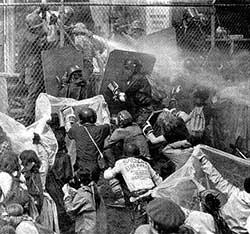
October 6, 1979 Seabrook Nuclear Power Plant protest – late 1970s Over 1400 were arrested at Seabrook, New Hampshire, the construction site of two new nuclear power plants. The occupation was organized by the Clamshell Alliance. Clamshell history
(Needless to say, state Republican legislators, with their supermajority here, are working to gerrymander her district to oblivion before the midterm filing deadline.)
The letter includes links for answers and help regarding the shutdown, seen below. If you click, those links will help all; Rep. Davids is a U.S. Rep and these are U.S. resources.
My actual rep did not send anything today. Over the weekend he referred to the “Schumer Shutdown” as if it was an inevitability; I’m sure he saw it that way as he’s all in on this administration’s actions (yep, Republican.) Anyway, here is this:
I know many people are worried and upset about this government shutdown. I am doing everything I can to push for a bipartisan solution to end this crisis as quickly as possible. I understand Kansans are frustrated with Washington and are demanding solutions instead of more partisanship.
Right now, many government agencies unfortunately may be operating with limited staff. This will impact a variety of crucial services people depend on. My team created this web page to help answer questions, connect people with assistance, and to ask for your thoughts.
This is an evolving situation, so my team will continue to update this page as events warrant. Please know that we’re here to help however we possibly can. You can find the below menu to get answers to your questions. Please also feel free to call my office at (913) 621-0832.
“I think there’s two things that are happening at once: one, there absolutely is an unprecedented abuse of power, destruction of norms, erosion of our government and our democracy in order to prop up an authoritarian style of governance however, they are weaker than they look, and it is important that we remember that because what they rely on is the impression of power, the perception of inevitability in us giving up in advance. Donald Trump is at record levels of unpopularity in his tenure. the Republican house is at record levels of unpopularity. they are underwater across the board and they know it. and that is causing them to double down in public. but it is backfiring. that is why whether it’s a shutdown, whether it’s all of this, they want us to blink first and we have too much to save.”
LGBTQ+ people were scapegoated in elections in 51 countries last year.
John Russell (He/Him)September 11, 2025, 2:00 pm EDT
Shutterstock
Politicians across the globe used anti-LGBTQ+ rhetoric in their campaigns last year, according to a new report from LGBTQ+ rights NGO Outright International.
The organization’s just-released report “Queering Democracy: The Global Elections in 2024 and How LGBTIQ People Fared” examines “how LGBTIQ people navigated, participated in, and shaped electoral processes” in 60 countries and the European Union last year. Among its key findings, the report says that anti-LGBTQ+ hate became a widespread campaign strategy around the world even as queer and trans people made gains in some of the same countries.
Outright International describes 2024 as a “super election year” in which more than 1.5 billion people in 73 countries voted. But, they say, “this historic moment also came at a time of democratic backsliding, when LGBTIQ communities and other marginalized groups were among the first to feel the impacts of shrinking freedoms.” The organization describes LGBTQ+ communities as “canaries in the coal mine — among the first targets when democratic norms erode.”
According to Outright International, “In at least 51 of the 61 jurisdictions studied, political candidates weaponized anti-LGBTIQ rhetoric for electoral gain.” Politicians, the organization found, “demonized ‘gender ideology,’ labeled LGBTIQ people as ‘foreign agents,’ and scapegoated sexual and gender minorities to deflect from policy failures. In some countries, elections devolved into what one observer called ‘a competition of who was the most homophobic.’”
Insights for the LGBTQ+ community
Subscribe to our briefing for insights into how politics impacts the LGBTQ+ community and more.
Email *
* * *
Frequency *
Daily Brief
Week in Review
Week in Good News
Sign Up
The report cites leaders in Jordan, Czechia, Portugal, and Namibia among those who scapegoated LGBTQ+ people in an attempt to distract voters from their own governance failures. Uruguay, Panama, Australia, Moldova, and the United Kingdom were among 27 countries in which politicians explicitly used the specter of so-called “gender ideology,” “gender madness,” and “indoctrination” to demonize LGBTQ+ people and particularly transgender people.
And leaders across Eastern Europe, Africa, and the Middle East stoked both xenophobia and anti-LGBTQ+ sentiment by describing gender and sexual diversity as the result of malign foreign influence. According to the report, anti-LGBTQ+ political rhetoric led to social media harassment and calls for violence as well as real-world crackdowns on the LGBTQ+ communities in Tunisia and Romania.
“You talk with a politician from Peru… or Hungary or the UK, you start to see common trends and you realize that it’s a global, coordinated and increasingly well-funded effort to diminish LGBTIQ people,” Outright International’s Alberto de Belaúnde told The Guardian.
Even ostensibly pro-LGBTQ+ parties and politicians in some countries appeared to turn on the community. As the report notes, Greek Prime Minister Kyriakos Mitsotakis claimed his New Democracy party “certainly suffered political damage” for supporting marriage equality. And in the U.S., some Democrats “blamed the party’s crushing defeat on the party’s perceived support for trans people’s rights, despite surveys showing that these issues were not a primary concern for voters.”
The report also includes a four-page case study on Republicans’ anti-trans messaging and misinformation during the 2024 U.S. election cycle, including the GOP candidate’s campaign’s $17 million investment in anti-trans ads. It concludes that the 2024 election cycle “highlights the vulnerability of marginalized communities to targeted misinformation, underscoring an urgent need for ongoing vigilance and robust advocacy to protect human rights amid escalating political adversity.”
The report also found that, while there was no evidence of laws explicitly denying LGBTQ+ people the right to vote, the community nonetheless faces significant barriers to participating in the democratic process around the world — fear of violence, political disillusionment, and lack of legal gender recognition among them.
Despite those barriers, Outright International says that LGBTQ+ communities consistently came out to defend democracy in the face of authoritarian movements in their home countries, most notably in Bangladesh, Türkiye, and Georgia.
Alongside its dire warnings about what de Belaúnde called a “weaponization” of anti-LGBTQ+ hate, the Queering Democracy report also highlighted significant political gains for LGBTQ+ people around the world. LGBTQ+ candidates ran for office in 36 countries last year, including for the first time in Botswana, Namibia, and Romania. It also notes trailblazing transgender candidates in Venezuela, El Salvador, Sri Lanka, Indonesia, and the U.S., where Rep. Sarah McBride (D-DE) became the first openly trans member of Congress.
The report includes a long list of recommendations for electoral management bodies, election monitoring organizations, political leaders, and candidates on how to combat anti-LGBTQ+ tactics. These include holding political parties and candidates accountable for hate speech, engaging with LGBTQ+ communities in developing political platforms, and supporting queer candidates.
Subscribe to the LGBTQ Nation newsletter and be the first to know about the latest headlines shaping LGBTQ+ communities worldwide.
This story came first, then the second article. It’s interesting, because it’s not a protest, or anything, it’s simple local ordinance. (Ordinances = the law here.)
TOPEKA — The U.S. Department of Justice on Tuesday joined a private prison company in its legal fight with Leavenworth city officials, accusing the city of “aggressive and unlawful” interference with immigration enforcement.
The DOJ filed a statement of interest in the case in U.S. District Court, signed by the assistant U.S. attorney general’s office.
“The United States has a strong interest in countering state and local efforts to harass federal contractors, in the proper application of the Constitution and its Supremacy Clause, and in the foundational principles that protect the Federal Government from unconstitutional state and local interference,” the filing said.
A statement of interest authorizes the U.S. attorney general to become a non-party in a suit pending in any court in the country, the filing said.
CoreCivic and the city of Leavenworth have been fighting in court for months over the city’s requirement that CoreCivic go through its development process to receive a special use permit before reopening its prison facility at 100 Highway Terrace.
Nashville-based CoreCivic announced in March that it would reopen the prison facility, which closed in 2021, to house Immigration and Customs Enforcement detainees.
CoreCivic and the city have a hearing scheduled Wednesday in U.S. District Court in Topeka as part of an appeal of a Kansas court’s decision barring CoreCivic from housing ICE detainees while the case about the development permit is being heard.
CoreCivic has alleged in multiple filings that Leavenworth officials are violating the supremacy clause of the U.S. Constitution and interfering with the operations of the federal government. That clause sets federal laws as supreme over state laws.
The U.S. government’s statement Tuesday pushed that argument forward, saying that it is “especially true” in relationship to immigration.
“Defendants have violated the Supremacy Clause by attempting to stymie the Federal Government’s immigration-related operations at 100 Highway Terrace,” the federal filing said, citing multiple cases to support its arguments that federal contractors are free from state control.
“This well-settled principle has been consistently applied to invalidate state and local laws that impose requirements on federal contractors,” the filing said.
The city’s efforts to prevent CoreCivic from housing immigration detainees at its prison, recently renamed the Midwest Regional Reception Center, is an attempt to regulate the federal government’s efforts to house detainees at that facility and violates the supremacy clause, the filing said.
TOPEKA — Leavenworth officials aren’t backing down from holding private prison company CoreCivic accountable to development regulations even after the U.S. Department of Justice jumped into the case Tuesday.
The DOJ filed a statement of interest in the U.S. District Court case between Nashville-based CoreCivic and Leavenworth, arguing the city was violating the supremacy clause in the U.S. Constitution.
“The federal government’s filing does not change our view of the case or the approach we plan to take,” said W. Joseph Hatley, a Kansas City, Missouri, attorney representing the city of Leavenworth. “The arguments in that filing mirror arguments CoreCivic has previously made, without success.”
The clause says federal laws are supreme over state laws, and in its filing, the DOJ said Leavenworth is interfering in the federal government’s immigration enforcement efforts.
Leavenworth Mayor Holly Pittman has said the city’s fight over reopening CoreCivic’s prison isn’t driven by politics, despite repeated outcry from Leavenworth residents against housing U.S. Immigration and Customs Enforcement detainees.
She said the city is concerned about holding businesses accountable to their development regulations, which would require CoreCivic to apply for a special use permit.
Earlier this year, CoreCivic announced it planned to reopen its prison facility in Leavenworth to fulfill an ICE contract that would pay the company $4.2 million per month. But Leavenworth officials contend the company must follow the city’s revised development process and apply for a special use permit.
In court filings, the city’s attorneys highlighted issues with CoreCivic’s operation of its previous prison, which closed in 2021, including failing to cooperate with Leavenworth police and failure to report the death of an inmate for six days. Leavenworth officials have said a special use permit would allow them to address such problems.
U.S. District Judge Toby Crouse on Wednesday set a hearing on a CoreCivic motion for a preliminary injunction for 3 p.m. Nov. 25, Hatley said.
CoreCivic is appealing a Kansas district court decision to stop the company from housing ICE detainees as the legal disagreement with Leavenworth goes through the courts.
It’s Thursday. There are 404 days until the midterm elections. Disinformation from Dallas, Kimmel’s big ratings and making us defend Jim Comey. Read on Substack
Note: Well, Sexy Patriots, we went from the Tylenol meltdown to the UN pants-shittening to a total goddamn presidential freakout over a broken fucking escalator. We assume for today that Trump will be walking around with both of his feet and his head stuck in buckets of some kind. Despite all the dumb, we actually have some good news. One of the creepiest goddamn weirdos of all time will no longer be in a position to fuck with kids…
Na-na-na-na. Na-na-na-na. Hey Hey Hey. Goodbye! We’ve been kinda sorta paying attention to this freakshow’s tenure as superintendent and we have wondered for a while just how dumb the kids in Oklahoma must be by now. The poor little morons have been forced to eat Trump Bibles for months, half of them think Be Best is good grammar and the rest think 2 + 2 = Bigly. Plus, doesn’t this dude put off all the vibes of someone whose hard drive would get them sent away for life? That moustache definitely used to hang out on Epstein’s island. Dude is out here looking like Jim Dangle from Reno 911.
Anyway, congratulations to the children of Oklahoma who would be bursting out in song today if their music programs hadn’t been cut in favor of Trump Appreciation Class. As for Ryan, well, he can kiss our asses, eat shit and fuck all the way off. Goddamn weirdo. Y’all have a blessed day.
Note two: This has nothing to do with anything, but remember those switchblade combs? Those were cool. We want to bring those back in style. Also, we did a therapy session yesterday and you can catch it here if you missed it live.
Note three: We’re getting closer to a government shutdown, and the White House’s big threat is that they would use a shutdown to fire federal workers. Someone should tell these assholes they already did that and they’re currently busy trying to rehire them all. Idiots. More: NBC News
Note four: We have got to hand it to the Onion. They made an Epstein documentary. Wired describes it as “absolutely unhinged.” It’s called “Jeffrey Epstein: Bad Pedophile.” It says a lot about where we are as a country that we rely on the Onion for this stuff instead of CNN. More: Wired
Note five: We wish we were kidding about our dumbshit president totally freaking out about a stopped escalator. He’s calling for investigations and Fox News has his back. It reminds us of the line from Ace Ventura — “Had I been drinking from the toilet, I could’ve been killed.” For a big tough guy, Trump sure is a whiny little bitch.
Note six: Senate Democrats are out with a report about what Elon Leon’s DOGE d-bags were really up to and it is infuriating. We can’t wait for a Democratic administration to lock these little shits up. More: Wired
Note seven: The French sentenced Sarkozy to five years. How the hell does every other country know how to do this except ours? More: NBC News
Note eight: Gross Stephen Miller’s gross wife is talking about having gross sex with him. Here’s a link, but we don’t recommend clicking on it. More: HuffPost
Note nine: Trump is upset that people are upset about his friendship with Epstein and the ensuing cover-up. He says Palm Beach in the 90s was a “different time.” Motherfucker child rape was still bad in the 1990s. More: Mediaite
Note 10: After a couple weeks off, South Park returned last night and Kyle’s mom (who is Jewish) went off on Bibi Netanyahu.
Note 11: The New York Times was very worried that a Trump official might get booed during one of their ass-kissing sessions. To that, we say BOOOOOOOOO!!!!! More: Mediaite
Note 12: The Tylenol thing was such a fucking disaster that Trump’s own allies are walking it back. Can you imagine the coverage if Biden… More: Independent
Note 13: Please don’t forget we have some big elections coming up in New Jersey, Virginia, California and Pennsylvania! Please get involved however you can. Those candidates need some Sexy Patriot energy. More: Pix11
Note 14: It’s honestly wild how much of a disconnect there is between Democratic leadership in D.C. and Democrats in the states. And it’s not hard to see which one is actually in touch with what voters are demanding. More: NBC News
Note 15: Just a reminder that before Kimmel was put through the ringer, plenty of corporate media outlets fired Black women with little to no public outrage. Thank you to Karen Attiah, formerly of the Washington Post, for firing back. And thanks to our friend Katie Phang for helping her.
Note 16: Two things to look forward to — Taylor Swift has a new album out next week, and the second part of Wicked will be out soon. Also, we don’t know about y’all, but we can’t freaking wait to see that new Paul Thomas Anderson movie. It seems pretty timely. More: USA Today
Note 17: It is fucking wild how hard the White House and the Republican Party are working to keep the Epstein files hidden. It’s even wilder how the people who used to want to see them don’t seem to give a shit anymore. More: CNN
Note 18: We’re starting to have a little hope that our country isn’t as dumb as it seems. The brain worm guy’s polling numbers are in the shitter. Which means he’ll probably swim in them. More: CNN, WSAV
Note 19: For today’s Happy Ending, we’re going back to South Park. If we’ve learned anything this week, it’s that comedy is leading the resistance while other institutions bend the knee and kiss the ass. We picked this clip because the Don Jr. impression had us fucking howling…
Note 20: And on that note, let’s go do some news! We sure hope y’all are having a great week. Except Ryan Walters. That dude and his creepy stache can smooch our taints. Love y’all! (snip-MORE news on the page)



 Shutterstock
 Scottie's Playtime