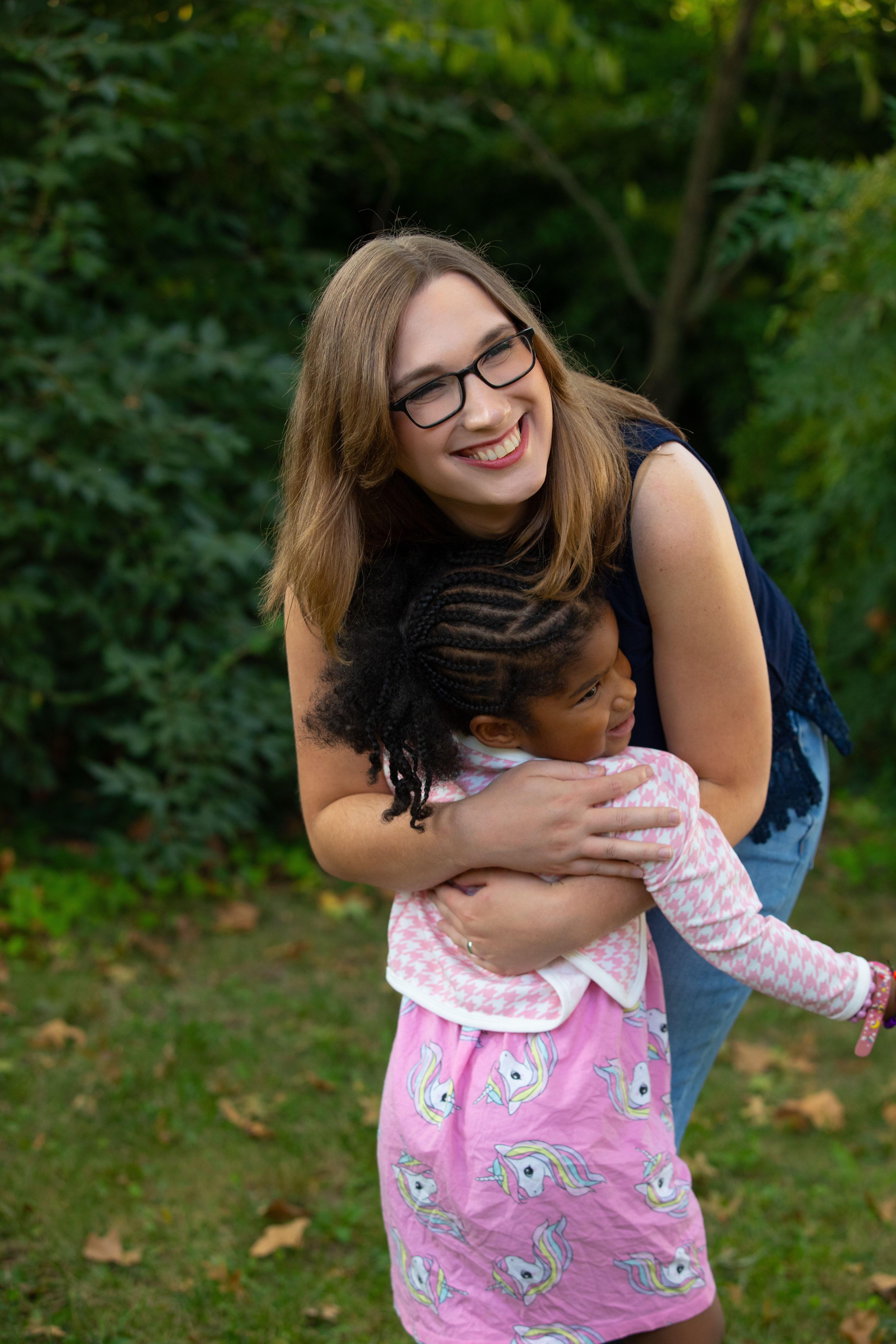
Lovable policy dork and new US Congresswoman Sarah McBride gives a hug to the kid who stole my pink unicorn dress. Yes, I will sue.
How do you do, fellow Wonks! It is I, your friendly neighborhood trans woman who is happy about a thing!
What? What is with those faces? Did something bad happen? No matter! For it is my job to give you the good news, with a spring in my step and a song in my heart and I am going to fucking do that because it is my job, melonfuckers, and I will not neglect my professional duty to be happy about a happy thing. Or three!
Yesterday, for those not in the know, the United States had an election. And during this election the transgenders worked their genderqueer asses off, not only running for election to the local sixth-grade softball team but also to at least 35 political positions around the country. And while we here at Wonkette salute every single one of those eager beavers, a couple stand out for their prominence and their victories.
No trans star shines brighter in, lo, these early morning hours as I write you this, than Sarah McBride. While McBride was not the first trans person to be elected to any ol’ thing, she was not elected to any ol’ thing. She was elected to the actual Congress of the US America. That’s right! We’re talking about the very same federal legislature made famous in Schoolhouse Rock’s song “I’m Just A Bill.”
This is not particularly surprising, as like some San Franciscans we could name, she was very well qualified for the position she sought. Before coming out or even turning 20 years old she worked as a junior staffer for Delaware Governor Jack Markell’s campaign in 2008 and Attorney General Beau Biden’s campaign in 2010. Next she lobbied for adding gender identity to Delaware’s equal protection law and interned at the White House in 2012 before graduating from college. She was on this shit young, I tell ya. And after she came out that year, her story was featured on American University Radio (later rebroadcast on NPR) including an anecdote about Beau telling her that after coming out she “was still part of the Biden family.”
After graduating she went to work as an activist with Equality Delaware and used her relationships to help pass positive bills before she became the first ever out trans speaker at a major party political convention in 2016 — something she’s sure as hell going to do again now. She then went on to write a book (foreword by some dude named “Joe Biden”), work for the Human Rights Campaign as their spokesperson, and then spend the most recent four years representing 50,000 Delawareaniteishers in the state Senate.
With her resumé and the Blue-leaning makeup of the state electorate, she had this. And it showed both during her campaign and in her 57/42 victory. (Which won me five bucks.) And now she’s going to Congress to make sure that Republican dickweasel bigots have to look a trans person in the eye as they ban driving through McDonalds while trans or whatever evil-ass bill they’re proposing next January. She lists her top two priorities as universal healthcare and reproductive rights, with other big ticket items like the John Lewis Voting Rights Act, the union-friendly PRO Act, curbing climate change, ending mass incarceration and more. She sounds too good to be true, but she’s real and she’s going to be kicking Matt Gaetz ass in just eight weeks.
Still convinced there’s a catch? Like maybe she’s great but replaced someone greater? Worry not: The woman she’s replacing is now your new US Senator from Delaware Lisa Blunt Rochester, making all kinds of demographic firsts from a state previously obsessed with sending only white men to the Senate but which has now elected a Black woman 56/39/4.
Yeah, we could use a lot more Delawares right now.
But if you’ll excuse Hawaii for not being Delaware, there’s also some good shit doing down on the islands. Over the last few decades indigenous Hawaiians have become homeless at a horrible rate — yes, this started long before Lahaina burned to the ground. The primary culprit is a tourism-first legislature full of corporate Democrats who never met a bit of housing they couldn’t rezone for rental to visiting mainlanders. Along with other forces making housing expensive even on the continent, this has made trying to find a place to live in the state a genuine crisis, especially for the people working those low-paying service jobs catering to tourists.
While Kim Coco Iwamoto isn’t the only Hawaiian to notice the problem, she made it her mission to knock off the incumbent Speaker of the Hawaiian state House in the Democratic primary. It took three tries, but this year she managed it and put the game away in the general last night. She only takes over the district of Scott Saiki, not his speakership, and the still pro-corporate Dem majority is certain to elect another tourism-pleasing Speaker, but Iwamoto becomes a trans voice against homelessness and for affordable housing. Iwamoto didn’t start off in politics going straight after Saiki. She was actually the first out trans person ever to hold statewide office anywhere in the US as she was elected to an at-large position on the Hawaii Board of Education and then later appointed to the state Civil Rights Commission. She is experienced and determined, she knows Hawaii politics, and she’s going to get things done.
Our third and final Trans Nice Times! for this morning comes to you from Los Angeles, where for the first time ever a trans-centric non-profit was designated a voting center. You may be used to voting in gymnasiums and churches, but yesterday in West Hollywood if you wanted to drop off your ballot (or fill one out if you hadn’t had a chance to vote from home as is the norm in California these days), your home precinct was The Connie Norman Transgender Empowerment Center where instead of having to to look at posters saying, “Jesus dies a little every time you touch your cooter! Don’t be chewed bubblegum!” as you walk through the lobby to cast your vote, you instead got to see signs saying, “Trans joy **is** resistance!” Won’t that just be a hoot for the two conservatives who still live in West Hollywood?
In summary and conclusion, there is still joy in this world, like trans people who kick ass and golden retrievers who know just a little too much English.
Now ain’t that some nice times?
Send this post to a friend who needs to read it! (I thought we all needed this here. -A)
Was talking with Jarret Berenstein today and he made an excellent point I hadn’t realized. Trump will finish with about the same number of votes as he did in 2020. While commentators were stumbling all over themselves to give Trump credit for reaching new voters and forming coalitions and all kinds of other stuff that never happened, the truth is that Trump won because 15 million people who voted for Biden didn’t vote for Harris. The good news is that the feeling of dread from Trump growing his base is unfounded. But that doesn’t change the outcome. 15 million people made the choice to let someone else decide this for them and the rest of us have to live with that choice. My predictions for this were wrong. I’m not upset about being wrong but I am upset about why. 15million people decided that apathy or “protest” or indecision was more important than being a part of democracy. There are no more Trumpers than there were 4 years ago. But something I couldn’t predict was 15 million non-Trumpers who simply couldn’t be bothered. Any emotion you’re feeling today is valid. I am a mix of sad and angry and frustrated and a dozen other things. Sending all my love and support to those in marginalized communities who need it most. And blocking those who don’t. Hugs, -Steve
Ron and I stayed up until 4 am watching the election results. We got about an hours worth of sleep. Then we got up and sat stunned. I am sorry this is going to take me a long time to understand and bounce back from. So many people of this country are so uninformed and so many thought sending a message by not voting for Harris would somehow be better for the Palestinians. What this means for Gaza and the West bank is no more restraints on Israel, no aid for Ukraine. More right wing ideologue justices who rule not by law but by ideology and feelings. Thomas and Alito have hinted that if tRump won and had the Senate they would retire so he could fill their seats with 40 year olds to be there for generations. What this means for other countries and our relationships with them … who knows. But what this means for the LGBTQ+ community is clear. We have large targets on us now. Sad hugs
FILE – Texas Gov. Greg Abbott speaks at a news conference in Austin, Texas on June 8, 2021. (AP Photo/Eric Gay, File)
By THE ASSOCIATED PRESS
Updated 7:10 AM EST, November 1, 2024
Texas hospitals must ask patients starting Friday whether they are in the U.S. legally and track the cost of treating people without legal status following an order by Republican Gov. Greg Abbott that expands the state’s clash with the Biden administration over immigration.
Critics fear the change could scare people away from hospitals in Texas, even though patients are not required to answer the questions to receive medical care. The mandate is similar to a policy that debuted last year in Florida, where Republican Gov. Ron DeSantis is also a frequent critic of the federal government’s handling of illegal crossings along the U.S.-Mexico border.
Texas hospitals have spent months preparing for the change and have sought to reassure patients that it won’t affect their level of care.
Here’s what to know:
Required to ask, not required to answer
Under the executive order announced by Abbott in August, hospitals must ask patients if they are citizens in the U.S. and whether they are lawfully present in the country.
Patients have the right to withhold the information and hospital workers must tell them their responses will not affect their care, as required by federal law.
Tracking hospital costs and patient data
Hospitals are not required to begin submitting reports to the state until March. An early draft of a spreadsheet made by state health officials to track data does not include fields to submit patient names or personal information.
Providers will fill out a breakdown of visits by inpatient and emergency care patients and document whether they are lawfully present in the country, citizens or not lawfully present in the U.S.
The reports will also add up costs for those covered by Medicaid or the Children’s Health Insurance Program, known as CHIP; and the cost for patients without it.
“Texans should not have to shoulder the burden of financially supporting medical care for illegal immigrants,” Abbott said when he announced the policy.
Texas is following Florida’s lead
Florida enacted a similar law last year. Health care advocates contend the law has made immigrants who need of emergency medical care fearful and led to fewer people seeking help, even from facilities not subject to the law.
Florida’s early data is — by the state’s own admission — limited. The data is self-reported. Anyone can decline to answer, an option chosen by nearly 8% of people admitted to the hospital and about 7% of people who went to the emergency room from June to December 2023, according to Florida’s state report. Fewer than 1% of people who went to the emergency room or were admitted to the hospital reported being in the U.S. “illegally.”
Texas hospitals have been preparing
Immigrant and health care advocates have sought to educate the Texas public about their rights. In Florida, groups used text messages, posters and emails to get the word out. But advocates there have said they didn’t see fears subside for about a year.
Health care providers received directives from the state and guidance from the Texas Hospital Association.
“The bottom line for patients is that this doesn’t change hospital care. Texas hospitals continue to be a safe place for needed care,” said Carrie Williams, spokesperson for the hospital association.
While much of the contiguous United States is talking about Puerto Rico after comedian Tony Hinchcliffe referred to the archipelago as a “floating pile of garbage” at Donald Trump’s campaign rally at Madison Square Garden on October 27, the people of Puerto Rico have another election on their minds: a historic gubernatorial race. For the first time in history, a pro-independence candidate could win the election for the head of the government in the U.S. territory.
Since the mid-20th century, Puerto Rico has been governed by the pro-statehood New Progressive Party (PNP) or the pro-commonwealth Popular Democratic Party (PPD). While third-party candidates have run, none has been able to garner enough votes to threaten Puerto Rico’s two-party system. But this election season, Puerto Rico’s Pro-Independence Party and its new Citizen’s Victory Movement — an anti-colonial party founded in 2019 — have come together under a coalition called La Alianza de País, or Alianza, and its nominee — Juan Dalmau — has gained enough support in the polls to potentially defeat the two traditional parties.
At the time of writing, Jenniffer González, the candidate from the incumbent pro-statehood party, is leading Dalmau by just about 2 to 8 percentage points, according to NBC News. However, political scientists on the archipelago believe it’s a lead that Dalmau could eclipse on Election Day, especially if young voters make it out to the polls and if older, religious Puerto Ricans cast their ballot for the emerging Christian party Project Dignity’s nominee Javier Jiménez. But Pro-Trump comedian Hinchcliffe delivered Dalmau another advantage: Some long-term PNP voters riled by the disparaging “joke” could reconsider their support as González, Puerto Rico’s current resident commissioner, is a Republican and staunch Trump ally.
PHOTO: COURTESY OF JUAN DALMAU.
For decades, the United States, which invaded and colonized Puerto Rico in 1898, has used fear as a tool to thwart pro-independence movements on the archipelago. While masterminding the lie that Puerto Rico could not exist without its colonial relationship with the U.S., the government on the archipelago, then led undemocratically by non-Puerto Rican U.S.-appointed governors, used violence to ensure it doesn’t.
During a peaceful civilian march organized by Puerto Rico’s Nationalist Party to commemorate the abolition of slavery on the archipelago on March 21, 1937, police opened fire, killing 17 civilians. When the party’s leader, Pedro Albizu Campos was arrested on October 30, 1950 after pro-independence revolts in Jayuya, Utuado, and the governor’s mansion in Old San Juan, he alleged that the state subjected him to human radiation experiments that could have later contributed to his death. In 1948, the legislature passed the Gag Law, which made it illegal to own or display a Puerto Rican flag, sing or write a patriotic song or literature, or convene in favor of Puerto Rican independence. The law wasn’t repealed until 1957.
In more recent years, both the PNP and the PPD have sustained this fear by spreading misinformation about pro-independence parties. During the ongoing gubernatorial race, for instance, González has used political ads to liken Dalmau’s social democracy platform to communism, a popular strategy used by Republicans in the contiguous United States to manipulate the traumas of people who fled authoritarian communist or socialist governments, including those in Puerto Rico’s neighboring Cuba.
“
“Puerto Ricans have found that betting on themselves, their community, their land, and their autonomy could be a more fruitful path forward.”
RAQUEL REICHARD
”
But Puerto Ricans are increasingly reconsidering the story the ruling governments on the archipelago and in the U.S. have been telling them. Amid recent back-to-back financial, natural, and political disasters, many have come to the conclusion that their colonial relationship is actually holding them back from prospering in their own homeland. From its 2015 financial crisis, which led the U.S. Congress to create the undemocratic fiscal control board that cut budgets and caused job losses, and the 2017 hurricanes, which revealed devastating state corruption, to the ousting of then-Governor Ricardo Rosselló, which helped many islanders recognize and utilize their own power, many Puerto Ricans have found that betting on themselves, their community, their land, and their autonomy could be a more fruitful path forward.
This growing sentiment was on display on November 3 during Alianza’s Festival of Hope at Lot 4 near the Pedro Rosselló Convention Center in Santurce, where more than 50,000 people holding Puerto Rican flags and green and white Patria Nueva flags gathered to support Dalmau and the Alianza movement. Among them were party leaders like Dalmau, Ana Irma Rivera Lassen (running for resident commissioner), Manuel Natal Albelo (running for mayor of San Juan); U.S. Congresswoman Nydia M. Velázquez (D-New York); and popular music artists like Rauw Alejandro, Residente, iLe, and Bad Bunny, who closed out the event announcing his official endorsement of Dalmau.
“I dream of a prosperous and dignified Puerto Rico like the one we deserve. That my people have the quality of life we deserve, a better quality of life. I dream of a Puerto Rico where the education of our boys and girls is a priority and not a dirty system of corruption. I dream of a Puerto Rico where young people do not have to leave to fulfill their duties. I dream of a functional and accessible health system for the love of God. I dream of a road where I don’t have a tire blow out every time I go outside. I dream of something as basic as not having the power go out every day in my country,” Bad Bunny said in a 20-minute long speech. “I dream of a people who are awake and who recognize the strength we have, that here the people rule, that here you, we, the people rule and not the political parties.”
“
“I dream of a people who are awake and who recognize the strength we have, that here the people rule, that here you, we, the people rule and not the political parties.”
BAD BUNNY
”
While it was the first time the artist, who went on to perform his song “Una Velita,” publicly endorsed Dalmau, this election year he has been vocal about local politics. In June, the rapper, born Benito Antonio Martínez Ocasio, announced a buy-one-get-one-free concert ticket deal for his Most Wanted Tour stops in Puerto Rico to locals who showed their voter registration card. The initiative aimed to improve voter turnout. For decades, the archipelago had impressively high voter turnouts of 73% to 89%, but starting in 2016, it dropped to 55% as Puerto Ricans grew increasingly apathetic about the traditional parties. Additionally, in September, Bad Bunny purchased billboards across San Juan that criticized the pro-statehood party and has consistently used his social media accounts to spread educational information about Dalmau and his anti-corruption platform.
At a time when Trump’s camp refers to Puerto Rico as a “pile of garbage” — essentially calling the archipelago’s people who make up the land trash, repeating language that has been used by the U.S. colonial state to dehumanize Puerto Ricans for more than 100 years — Puerto Ricans are eager to support a government that could, if even symbolically, actually challenge that colonial power.
Ahead of Puerto Rico’s November 5 gubernatorial election, we spoke with islanders about the historic support for a pro-independence candidate and what an Alianza governorship could symbolize and accomplish.
Mayra Díaz-Torres
Why do you think there is so much support for Juan Dalmau?
For me it’s important to talk about the context. After Hurricane Maria, Puerto Rico has experienced great sorrows. Puerto Rico has experienced natural and political onslaughts. Not long after the storm, we dealt with the blows from then-Governor Ricky Rosselló, and the entire PNP, which represents a corrupt class — that withheld first-aid goods even though there were people dying. I think that from all of this heartbreak and all of this rage that we experienced from Maria and the aftermath of that hurricane, that corruption we endured from the PNP and the PPD, too — the failures of this two-party system has elevated us. I’m hopeful that it has brought us as a people to rage and to turn our hurt into solutions. And I believe that’s the result of this revelation, one that Indigenous and Afro-descendants have always talked about, that we have been domesticated, and that there is no greater form of domestication than colonialism. Puerto Rico has been a colony of the U.S. for more than 100 years.
Most recently, look at the Trump rally, where the comedian [Hinchcliffe], who by the way is a pendejo, and others have tried to tell us that the way they speak about us and treat us are all jokes and that we have to lighten up, to have a better sense of humor. But that’s not true. That’s the systemic racism and colonialism we’ve experienced for many years. And I feel like this anger and pain — especially in the last five years from the colonial, racist, and anti-democratic Financial Oversight and Management Board (La Junta) — is pushing us to restore our dignity, humanity, and utilize our power.
What would a pro-independence governorship symbolize for Puerto Rico?
For me, the idea that a pro-independence candidate could win the governorship in Puerto Rico is historic. As a colony, we have a lot of trauma and a lot of fears that the United States have told us and that the criollo class here has repeated to us: the lie that we aren’t anything without the United States. This language is abusive. This is what a man who abuses and violates a woman tells her: “You can’t exist without me.” This is the language that an abusive father tells his children: “You are no one.” Thinking about this cycle of violence we have experienced under colonialism for hundreds of years, seeing us in this moment brings me enthusiasm. I’m trying to be cautious, but I am enthusiastic. Yes, there are things we need to look at and preoccupy ourselves with, but I think this election is historic for us as a country.
“
“This colonial fallacy that we are nothing without the United States doesn’t work on us anymore. It’s a mantra that has kept us subjugated.”
MAYRA DÍAZ-TORRES
”
Of course, though, when the leading parties see that the people they want to oppress are finding their dignity and realizing this treatment is criminal, the ammo, the response to that, is to create fear. And I think the traditional parties are inciting fear around independence because historically in Puerto Rico conversations around independence have been criminalized. They don’t want us to know or accept Puerto Rico’s history struggling for independence. We have rebelled, many times, in many decades, and under many contexts. There has been state prosecution against pro-independence movement leaders in an effort to thwart the revolution and criminalize even the idea of independence, from Pedro Albizu Campos to the Ponce massacre. Historically, we’ve seen this ideology be treated as criminal, something to not be taken seriously, and now we’ve seen the traditional parties taking advantage of that narrative to stir fear in this moment. But fear doesn’t work on us anymore. This colonial fallacy that we are nothing without the United States doesn’t work on us anymore. It’s a mantra that has kept us subjugated.
What would you say to someone fearful of pro-independence leadership in Puerto Rico?
Liberation is coming. It’s unavoidable. Because no nation can be subjugated forever under imperialism. People are leaving Puerto Rico, not because we want to but to seek opportunities, because these opportunities are not available to us here due to the policies of the PNP and the PPD. The aftermath of Maria taught us so much. We know that despite more than 100 years of colonialism, we have so much love for our country, our culture, and our people. I think that if you consider that love we have for ourselves and for our land, a land they’re trying to displace us from, I think we are moving. I think this is a critical moment. There’s going to be fear and hardships, but we haven’t succeeded under this colonial regime. Yes, we have cultural prominence globally; we are talented. But we are not happy. We are struggling. This isn’t just about status; it’s also about great corruption from the traditional parties. Liberation is destined. Every nation deserves and needs freedom to prosper.
Ale Figueroa
Why do you think there is so much support for Juan Dalmau?
We are at a turning point. I work as a digital strategist to transform the narrative for societal change, and this has been a long time coming. It may seem like it’s coming out of the blue, but it’s something that has been simmering since about the 2008 election, when the plan was set into motion to make Puerto Rico be in the service of millionaires, billionaires, and Wall Street, at the expense of locals.
A group of people, an entire society, have been promised things that just never arrived. Growing up, we were told, “you take these steps, and it’ll lead to success.” But millennials are the first generation in Puerto Rico to really encounter dystopia and lies. We never saw prosperity. We never saw this future that they boasted about and benefited from in the past. It’s taken a toll on our ability to even be part of our own community and participate in our own country. The impacts of colonialism means that everyday people will have to say goodbye to their homes, communities, and families, just so they can find a means to survive. We are a generation that is split, that is fragmented, and is dispersed throughout the world. It is not untrue that there are more Puerto Ricans living outside of Puerto Rico than on the islands, and that is a testament to the sacrifices that people have had to make while still being deeply connected to their culture and communities.
What would a pro-independence governorship symbolize for Puerto Rico?
It symbolizes a change. I think if we are honest we know that nothing can change overnight, even if we have a pro-independence governor in power. That decision is ultimately not up to the people of Puerto Rico because of our colonial situation with the United States. Ultimately, who decides whether or not Puerto Rico becomes independent or a state of the U.S. union is the United States Congress.
“
“If what we create and bring to the world is this rich in these conditions, I can’t begin to imagine how incredibly beautiful and magical it is for ourselves and the rest of our global community for us to thrive, and for people like us across the world to thrive. “
ALE FIGUEROA
”
But I think it means something a lot more meaningful, something that will take generations to build upon, but it is the promise of something new. It’s the promise of being able to — and for the first time in our history — finally have a say and decide what we want. It is an opportunity for Puerto Ricans to know and understand that our future is in our hands and that we have complete authority and autonomy for ourselves without intervention. And we deserve a future where our people and communities can thrive. If what we create and bring to the world is this rich in these conditions, I can’t begin to imagine how incredibly beautiful and magical it is for ourselves and the rest of our global community for us to thrive, and for people like us across the world to thrive.
What would you say to someone fearful of pro-independence leadership in Puerto Rico?
I would ask them if they think it’s worth it to continue going through what we’re going through to the point of normalizing, to the point of expecting future generations to not believe that they deserve better. I’d ask them to take a chance on themselves and their futures, not because this would be independence for Puerto Rico but because it would mean independence for us to finally have a seat at the table, to be represented, and make the decisions we want to make when the time comes, while still keeping our mouths fed, our bodies clothed, our families sheltered, and our culture and our people thriving.
Aliana Margarita Bigio-Alcoba
Why do you think there is so much support for Juan Dalmau?
The Patria Nueva project as well as the Alianza de País continue to gain momentum because people see in Juan Dalmau and the rest of the candidates a hopeful, inclusive vision for Puerto Rico. This campaign is driven by a clear path toward a Puerto Rico for all — not just for tax dodgers and gentrifiers.
Unlike others, Dalmau has shown his dedication by engaging directly with communities through forums and town halls, positioning himself as the people’s candidate and the best choice for Puerto Rico’s future.
What would a pro-independence governorship symbolize for Puerto Rico?
I was born and raised in a household that supported statehood for Puerto Rico, and I saw what assimilation did to my parents. They shared stories of not being allowed to have a Puerto Rican flag in their rooms, cars, or school notebooks. Showing love for your country was frowned upon, labeled as “terrorist” or “communist.” These are the effects of colonialism; it’s not just political — it’s personal.
“
“Many former statehood supporters now support Dalmau because his campaign with La Alianza de País proposes an Asamblea Constituyente, one that would include everyone, offering Puerto Rico a respectful, dignified, and binding decolonization process.”
ALIANA MARGARITA BIGIO-ALCOBA
”
Now, at 26, watching my loved ones support Dalmau and the possibility of an Alianza de País victory brings immense joy and a show of radical hope.
What would you say to someone fearful of pro-independence leadership in Puerto Rico?
I’d encourage people to review our history, to resist the collective amnesia the powerful try to impose on us.
The status of Puerto Rico won’t be resolved through non-binding plebiscites with Congress. Many former statehood supporters now support Dalmau because his campaign with La Alianza de País proposes an Asamblea Constituyente, one that would include everyone, offering Puerto Rico a respectful, dignified, and binding decolonization process.
November 5, 1872 Susan B. Anthony and a few other women in Rochester, New York, voted in the presidential election, all of them for the first time. Susan B. Anthony She wrote later that day to her fellow suffragist Elizabeth Cady Stanton, “If only now—all the women would work to this end of enforcing the existing constitution—supremacy of national law over state law—what strides we might make . . . .” Anthony’s vote went to U. S. Grant and other Republicans, based on that party’s promise to consider the legitimacy of women’s suffrage. Elizabeth Cady Stanton Read Susan B. Anthony’s speech On Women’s Right to Vote
November 5, 1949 The Peace Pledge Union in Great Britain set up the Non-Violence Commission to study nonviolent resistance and how the ideas of Gandhi could be used to reach the Union’s goals of getting U.S. troops out of Britain and to end production of nuclear weapons there.
November 5, 1969 Bobby Seale Bobby Seale, a founder of the Black Panther Party, was sentenced to four years in prison on sixteen counts of contempt of court during the federal Chicago Eight trial in Chicago; he was charged for his insistent claims to the right to choose his own lawyer, or to represent himself. After the Chicago Eight verdict, the contempt charges were withdrawn.
November 5, 1982 36 were arrested in a demonstration at Honeywell, Minnesota’s largest defense contractor. The “Honeywell Project,” a local campaign against the arms maker, dogged the company for over three decades, at times with success. It continues today, targeting Alliant Technologies, the arms-making branch of Honeywell that was spun off in the 1990s. Protests at Alliant continue today. Alliant is the manufacturer for the Pentagon of artillery shells made with depleted uranium (DU or U-238, a by-product of uranium enrichment) which have been used extensively in Iraq and Kosovo. The Defense Department denies any health effects from use of DU (though army manuals warn soldiers of its toxicity), and contests accusations of DU’s role in Gulf War Syndrome. More about the Honeywell project from War Resisters’ international
November 5, 1987 Govan Mbeki, an early leader of the African National Congress, was released from South Africa’s Robben Island prison after serving twenty-four years (for treason). He served his sentence alongside Nelson Mandela, Walter Sisulu and many others who fought apartheid. Govan Mbeki His son, Thabo Mbeki, was elected in 1998 (and force to resign in 2008) to succeed Mandela, who was the first president elected following a new constitution which granted the right to vote to the entire non-white population, comprising 85% of the country’s population. Read more about Govan Mbeki
A broken window on an LGBTQ fashion boutique storefront in Manhattan, New York on June 12, 2023.Photo: Shutterstock
There has been a 112% increase in documented attacks on LGBTQ+ people nationwide, according to a newly unveiled Anti-LGBTQ Extremism Reporting Tracker (ALERT) from the queer media watchdog organization GLAAD. GLAAD hopes to use the tracker to provide comprehensive reporting and analysis detailing anti-LGBTQ+ hate in the U.S. and the specific communities and targets affected by it.
ALERT recorded 524 such incidents between June 2022 and 2023 and 1,109 incidents from June 2023 to 2024. These attacks have included over 450 protests, 330 propaganda drops, 320 acts of vandalism, 200 bomb & mass shooting threats, 130 assaults, and 45 cases of arson that have resulted in at least 161 injuries and 21 deaths, GLAAD’s ALERT Desk reported.
While the cases focus on drag bans and trans protections, they address larger issues of free speech and civil rights.
The attacks have also included over 567 attacks on transgender and gender non-conforming people, 360 incidents targeting educational institutions and libraries, 325 incidents targeting Pride flags and other LGBTQ+ community symbols, 160 protests and violent threats against drag performers, and 140 incidents targeting health care providers of gender-affirming care and their patients.
The tracker, which will be updated quarterly, includes data on criminal and non-criminal acts of hate from sources like news media, partner organizations (like the Human Rights Campaign or Anti-Defamtion League’s Center on Extremism), right-wing forums on social media sites like Gab or chat apps like Telegram as well as incident reports submitted via GLAAD’s website. All documented incidents must occur against groups or individuals within the U.S. and must include harassment, threats, or actual violence specifically targeting LGBTQ+ people.
GLAAD’s ALERT team will verify the validity of each incident to maintain credibility, remove duplicates, and exclude spam and trolling, the organization said.
“The ALERT Desk tells a story not entirely captured by the FBI’s hate crime statistics because many of these incidents, like protests at Pride events, don’t meet the criteria necessary to bring legal charges [and] aren’t included in most official hate crime counts,” GLAAD wrote in its recently released report on ALERT’s findings. “However, we must recognize that the impact of these acts on local LGBTQ communities is felt regardless of whether or not the incident is prosecuted.”
“We must recognize that the impact of these acts on local LGBTQ communities is felt regardless of whether or not the incident is prosecuted.”
GLAAD’s 2024 report on ALERT’s findings
During a press call, Barbara Simon, senior director of news and campaigns at GLAAD, noted that ALERT seeks to contextualize anti-LGBTQ+ incidents to help media and other experts understand larger systems of violence.
“[Recently], there was a bomb threat against a library in Massachusetts,” Simon said, a threat against a Drag Queen Story Hour at the public library in Somerville. “But it’s not just about that library. It’s not just about the inclusive materials and programs they had, about how the bomb squad had to come in and sweep the library, how children and families and patrons had to evacuate the library.”
“Our data shows how that incident is connected to the bigger picture, which is more of a broad-based, systemic attack against LGBTQ people, our visibility, our equality and our allies,” Simon added. “It is one of 365 attacks nationwide against drag artisan events. It’s one of 63 anti-LGBTQ attacks in Massachusetts alone, one of 15 attacks specifically against drag in Massachusetts.”
The quarterly reports will also include stories from those affected by the incidents.
GLAADA bar graph showing anti-LGBTQ+ hate incidents from GLAAD’s ALERT Desk. | GLAAD
For example, Dr. Jack Turban, pediatric psychiatrist and director of the gender psychiatry program at the University of California in San Francisco, said during the press call that bans on gender-affirming care for youth in 26 states have worsened the mental health of his young trans patients even though they live in a state where such health care is protected. Their mental health has been worsened, Turban said, because of an increase in anti-trans rhetoric nationwide whose indirect effects cross state lines.
“Kids are hearing things like being trans is a mental illness, or being trans is bad, or you shouldn’t be allowed to use the bathroom that aligns with your gender identity because trans people are sexual assaulters, or you shouldn’t be allowed to play on sports teams with your friends because you’re going to physically hurt them,” Turban said. “My patients know that none of those things are true, right? They can know that, but if you’re hearing it every single day, all over social media and all over the news and now right in their communities, even it’s impossible to not be impacted by that.”
GLAAD pointed out that media coverage tends to falsely frame medical care for transgender people as a “debate” despite every major medical association supporting the care. This coverage compounds the effect of hateful rhetoric from anti-trans politicians, protestors, and pundits.
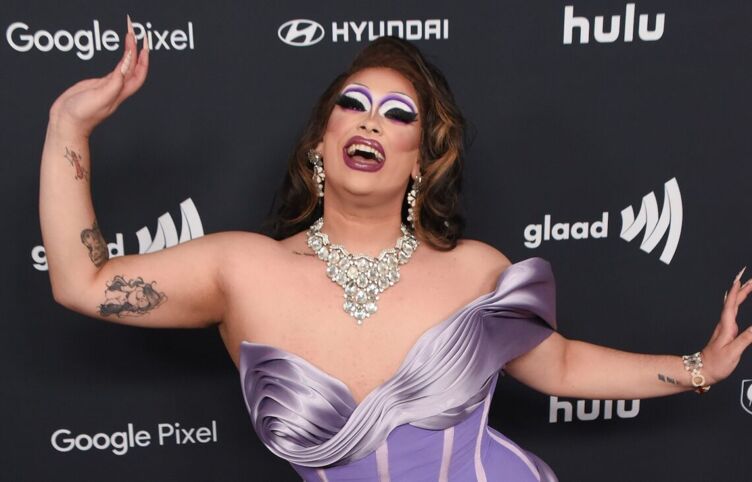
ShutterstockSalina EsTitties attends the 35th Annual GLAAD Awards on March 14, 2024 in Beverly Hills, California. | Shutterstock
The hateful rhetoric affects even LGBTQ+ celebrities and their fans, like Salina EsTitties, a competitor who appeared in Season 15 of RuPaul’s Drag Race. EsTitties told the press call that she’s generally insulated from hatred against gender non-conforming people since she lives in the very gay city of West Hollywood, California. However, she sees its impact whenever she travels to other states or posts social media videos about LGBTQ+ issues.
“There’s comments every single day of people being like, ‘This is not what God created. God created two genders. Oh, they keep adding alphabets. Oh, just shoot it between the eyes and get rid of it,’” EsTitties said. “The online hate is insane and there’s so much of it, and people are so willing to just let it all out, but it’s a clear representation of how people actually feel in America and across, you know, the U.S. here.”
“Not only are our LGBT community dealing with having to be their authentic selves,” she continued. “Being their authentic selves with just who they are outside of their queer identity is a lot to navigate, and it’s not easy, especially when people are telling you, ‘You’re the Devil, you’re a demon,’ or ‘It’s not acceptable to be that.’”
Hate crimes typically increase during presidential election years. Marie Cottrell, executive director for the New Jersey-based LGBTQ+ advocacy center Out Montclair, said she hopes that increased awareness of anti-LGBTQ+ hate incidents will empower communities to build intersectional coalitions between other demographic groups whose members are targeted by similar hate.
“I think that it’s really important that you be the person that the community needs,” Cottrell told the press call. “They need to see you stand for and with them. Find folks who in your community who will stand with you in the face of intolerance, build a community of support within your township — whether that’s forging a relationship with your LGBTQ liaison within the local police department … working with the township, the mayor, the town council, and really having open conversations … having conversations that address really hard questions and topics and that starts the process of understanding and healing in your community.”
“It’s a small step, but it’s a step forward and a step forward in helping others understand the community,” she said.
Subscribe to the LGBTQ Nation newsletter and be the first to know about the latest headlines shaping LGBTQ+ communities worldwide.
November 4, 1811 A group of men in Bulwell, near Nottingham, England, armed with hammers, axes and pistols in the dark of night, broke into the workshop of a master weaver named Hollingsworth and smashed six weaving machines the men thought threatened their jobs. They and their supporters opposed the industrialization that had turned home-based sustainable textile work into factory work with significant loss of jobs through mechanization (and those at much lower wages), as well as the attendant air and water pollution. Luddites smashing loom. They called themselves followers of the probably fictional General Ludd and continued their attacks for months, with over a thousand knitting machines destroyed. In response, thousands of troops were sent to stop the rebellion, and Parliament passed a law making destruction of weaving machines a hanging offense. Luddites has since become a term used for those who oppose technology.
November 4, 1956 Two hundred thousand Russian troops with 1000 tanks stopped an anti-Stalinist uprising in Hungary and installed a new pro-Soviet government. Although civilians had set up barricades along all the major roads leading to Budapest, the Soviet air force bombed the capital and troops poured into the city in a massive dawn offensive. Hungarian Army and National Guard troops participated in the resistance; only Communist Party functionaries and security police fought alongside the Warsaw Pact troops. The help promised from the U.S. to protect and aid the anti-Stalinists never came. 20,000 Hungarians ultimately died as a result (as well as 4000 troops), and ten times that many left the country permanently. Hungarian ‘freedom fighters’ temporarily forced back Soviet tanks and troops. Soviet tanks in Budapest. Pictorial history of the Hungarian Uprising
November 4, 1984 The first free elections in Nicaraguan history were held. Nicaragua’s ruling Sandinista Front claimed a decisive victory (70%), defeating six other parties, in the country’s first elections since the revolution the Sandanistas had led five years previous. The high-turnout election (83%) was monitored by 400 independent election observers who said the election had been fair. Read more
November 4, 1995 Israeli Prime Minister Yitzhak Rabin was fatally shot minutes after speaking at a peace rally held in Tel Aviv’s Kings Square in Israel. The rally in Kings of Israel Square Yitzhak Rabin Read more
November 4, 2008 The first African American ever nominated by a major political party as candidate for president went before the electorate. Senator Barack Obama of Illinois and his Democratic vice-presidential running mate, Senator Joseph Biden of Delaware, faced Republican Senator John McCain of Arizona and Alaska Governor Sarah Palin; independent candidates Ralph Nader and Matt Gonzalez; Green Party candidates former Representative Cynthia McKinney and Rosa Clemente; and former Repepresentatives Bob Barr and Wayne Allyn Root.
The stakes in United States v. Skrmetti are even higher than most Americans realize and could have wide-reaching consequences if the court rules to keep the ban on gender-affirming care in place.
This piece was published in partnership with The 19th, a nonprofit newsroom covering gender, politics, and policy. Sign up for their newsletter here.
A Supreme Court case that will decide whether Tennessee can continue to ban gender-affirming care for transgender youth could imperil the ability of all Americans to make decisions about their health care, experts say. The outcome depends on how far the court is willing to stretch its ruling that overturned federal abortion rights.
In United States v. Skrmetti, the court has agreed to take up the question of whether gender-affirming care bans for trans youth are unconstitutional, in response to the Biden administration petitioning on behalf of trans youth and their families in Tennessee — one of 26 states that has bannedsuch care for minors. The outcome of the case will grant much-needed clarity in a political landscape that has thrown the lives of trans people across the country into turmoil, as hospitals turn patients away, pharmacies deny prescriptions and families travel hundreds of miles to find care.
But with the case set for oral arguments on December 4, the stakes are even higher than most Americans realize, legal and policy experts say. Tennessee has banned gender-affirming care, such as puberty blockers and hormone replacement therapy, for a specific demographic — trans youth — while allowing those same treatments for cisgender youth. If the Supreme Court allows the state to keep its ban in place, that could imperil everyone’s access to health care.
“What the state of Tennessee is arguing is really dangerous for any person who has any sort of medical condition,” says Ezra Young, a civil rights lawyer and constitutional scholar. Tennessee is dictating what medical treatments people should or should not be allowed to have, Young said; that goes well beyond states’ authority to regulate medicine, specifically because giving health care to trans people is not a public health concern.
“The state can make sure that the doctor you see has a medical degree and has an active medical license, for instance,” he says. “What the state can’t do is micromanage the medical decision-making of patients or doctors, and that’s for good reason. Bureaucrats or lawmakers aren’t medical experts.”
Yet in half of U.S. states, Republican lawmakers have banned or restricted medical care that many trans people need to live, over the protests of the American Medical Association, American Psychiatric Association, and other leading medical groups. Federal judges have attempted to block these bans from taking hold, finding them to be likely unconstitutional. Appeals court judges have disagreed and overturned those decisions. Now, the Supreme Court will have the final say.
“If we don’t win here, it’s going to be open season on any health care related to transgender people,” says Shannon Minter, legal director of the National Center for Lesbian Rights. If the Supreme Court holds that banning gender-affirming care is not discriminatory, then trans people would no longer be protected under the Affordable Care Act, he argues. States and private insurers would be able to exclude gender-affirming care from coverage plans.
“It would be devastating. I mean, absolutely catastrophic,” Minter says.
Ultimately, the outcome of this case will have a wider impact beyond gender-affirming care. A Supreme Court ruling endorsing Tennessee’s argument that the state can ban safe medical care — just because it disagrees with who that treatment is being given to — would enable the government to control people’s health decisions and enact other blatantly discriminatory policies, legal experts say.
“I think this case has bigger and broader implications than a lot of people realize, even frankly within the legal community,” says Michael Ulrich, an associate professor of health law, ethics and human rights at Boston University’s School of Public Health and School of Law. If the Supreme Court agrees with Tennessee’s ban, there’s nothing stopping states from banning or restricting other kinds of health care, he said — like what gets covered under Medicaid.
Solicitor General Elizabeth Prelogar’s office, representing the Biden administration, will split argument time before the Supreme Court with Chase Strangio, co-director of the American Civil Liberties Union’s LGBTQ & HIV Project.
The United States v. Skrmetti case is focused on whether Tennessee’s gender-affirming care ban violates the 14th Amendment’s equal protection clause, which prohibits discrimination on the basis of sex. The state insists that its ban has nothing to do with sex and that it does not target trans people. Instead, the law “sets age and use-based limits,” Tennessee’s attorney general argues. Minors can still access hormones and puberty blockers for medical purposes, as long as those treatments are not being used as part of a gender transition or to alleviate gender dysphoria. The state claims such a distinction is not based on sex because “neither boys nor girls can use these drugs for gender transition.”
In Dobbs v. Jackson Women’s Health Organization, the Supreme Court found that there is no constitutional right to an abortion in the United States. This ruling overturned Roe v. Wade, the landmark case that had guaranteed the right to an abortion since 1973. When writing the majority opinion in Dobbs, Supreme Court Justice Samuel Alito briefly addressed a theory that suggests abortion could be covered under the 14th Amendment’s equal protection clause. This idea is not part of Roe, or at issue in Dobbs, but was invoked in a separate “friend of the court” brief. Alito dismissed it, saying that state regulations on abortion do not discriminate based on sex.
“So that’s what the state of Tennessee is now latching on to, this passing reference, this brief statement in Dobbs, and they’re pinning their whole argument on it,” says Minter. “Everything hinges on it.”
In Dobbs, Alito wrote that abortion cannot be protected under the 14th Amendment’s equal protection clause, citing the arcane Geduldig v. Aiello — a case about pregnancy-related disability benefits — and Bray v. Alexandria Women’s Health Clinic, a case dealing with the rights of anti-abortion protesters. These rarely cited cases found that state regulations on abortion and pregnancy, or opposing abortion, are not sex discrimination. Tennessee is now using this framework to argue that “any disparate impact on transgender-identifying persons” caused by its law does not single trans people out for discrimination in ways covered by the 14th Amendment.
If the state’s gender-affirming care ban is found by the Supreme Court to be discriminatory under the 14th Amendment, it is subject to heightened scrutiny — a more rigorous review to determine whether a law is constitutional or not. In that scenario, Tennessee is more likely to lose.
Using abortion case law to support bans on gender-affirming care is especially dangerous, experts say. Tennessee is taking the Supreme Court’s own decision in Dobbs out of context, according to lawyers who have worked in LGBTQ+ rights cases for decades. And, if the justices read Tennessee’s law, it is obvious that banning gender-affirming care for trans people is discriminating based on sex, they say.
The United States v. Skrmetti case is focused on whether Tennessee’s gender-affirming care ban violates the 14th Amendment’s equal protection clause, which prohibits discrimination on the basis of sex. The state insists that its ban has nothing to do with sex and that it does not target trans people. Instead, the law “sets age and use-based limits,” Tennessee’s attorney general argues. Minors can still access hormones and puberty blockers for medical purposes, as long as those treatments are not being used as part of a gender transition or to alleviate gender dysphoria. The state claims such a distinction is not based on sex because “neither boys nor girls can use these drugs for gender transition.”
But, although the question before the court has become more specific, this ruling still has the potential to broadly set back LGBTQ+ rights.
Tennessee argues that the Supreme Court’s 2020 ruling in Bostock v. Clayton County, which found that employment discrimination against LGBTQ+ workers is sex-based discrimination prohibited under the Civil Rights Act, has nothing to do with this case. But going down this road leads to more questions, Ulrich says: Is discriminating due to sexual orientation also not considered sex-based discrimination?
“Then you can see just a proliferation of discriminatory laws that are coming out thereafter,” he says. “That’s a really dangerous proposition for the entire LGBTQ+ community and it’s setting us back significantly.”
Sruti Swaminathan, an ACLU staff attorney who has been counsel in this case from the beginning, said United States v. Skrmetti will test how far the Supreme Court is willing to stretch its Dobbs decision. They are well aware that the outcome of this case could curtail bodily autonomy for everyone. And taking this challenge before a conservative-majority Supreme Court has stoked fears among trans people of worst-case scenarios.
“We’re already at the place where half the country has banned this care. We need to not let the 6th Circuit decision stand idly and be utilized in the way it has,” Swaminathan says.
But Tennessee’s tactics, and the consequences that they could have during a time when laws targeting reproductive and transgender health care are proliferating, still worry them.
“I’m terrified. What we learned from Dobbs is that these attacks won’t stop with abortion,” Swaminathan says. “Banning abortion seems to be one pillar of an effort to write outdated gender norms into the law.”
U.S. v. Skrmetti began as a lawsuit against Tennessee’s ban on gender-affirming care for minors.
Tennessee’s argument in this case illustrates a larger coordinated effort to attack abortion access alongside gender-affirming care, says Logan Casey, director of policy research at the Movement Advancement Project, a nonprofit that tracks LGBTQ+ legislation.
States across the country have attempted to define sex based on reproductive capacity at birth. These efforts open transgender people up to discrimination and ignore the realities of intersex people, as well as cisgender women with conditions like primary ovarian insufficiency. Proponents of gender-affirming care bans inaccurately portray the effects of hormone replacement therapy on trans people’s reproductive ability by conflating the treatment with sterilization.
This Supreme Court case exemplifies a much larger argument that’s been a through line across attacks on transgender care and trans issues across the country, Casey says: What is sex, and who is protected when we think about that?
“Many of these state actors and politicians and extremists are clearly very invested in the concept of sex and defining sex in a very restricted and extraordinarily old-fashioned way that focuses only on people’s reproductive capacity, and then they use that argument in whatever context they can to advance the policies that would match that worldview,” he says.




 Susan B. Anthony
 Elizabeth Cady Stanton
 Bobby Seale
 Protests at Alliant continue today.
 Govan Mbeki


 Luddites smashing loom.
 Hungarian ‘freedom fighters’ temporarily forced back Soviet tanks and troops.


 Yitzhak Rabin
 Scottie's Playtime