The democrats have to stand on this issue. Why have a budget if all the constitutional rights and laws of our country can just be ignored by the current administration? Hugs
They want guardrails on immigration agents. The issue has risen to the fore ahead of a key Jan. 30 deadline after an ICE officer shot and killed an American woman in Minneapolis.
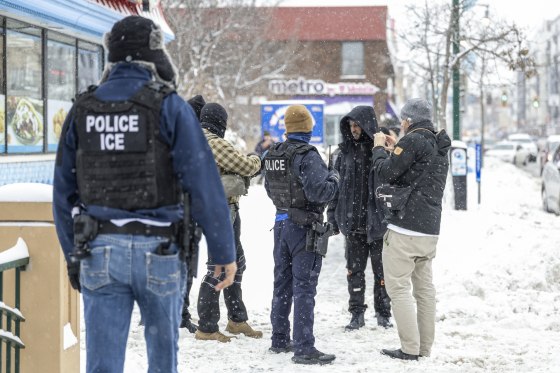
ICE officers question a man’s status on Lake Street near Karmel Mall in Minneapolis in 2025.Christopher Juhn / Anadolu via Getty Images file
WASHINGTON — Democrats are wrestling with whether to use a key Jan. 30 deadline to demand constraints on President Donald Trump’s immigration crackdown after an Immigration and Customs Enforcement officer shot and killed an American woman in Minneapolis.
Progressives in the House and Senate are calling on their party to hold firm in opposition to a funding bill for the Department of Homeland Security unless it comes with conditions — such as requiring agents to wear identification, limiting Customs and Border Protection agents to the border and requiring judicial warrants to arrest suspects in immigration cases.
They say Trump is using autocratic tactics by deploying masked agents in cities to intimidate Americans who don’t support him.
“Democrats cannot vote for a DHS budget that doesn’t restrain the growing lawlessness of this agency,” Sen. Chris Murphy, D-Conn., the top Democrat on the Appropriations subcommittee overseeing DHS, wrote on X after the Minneapolis shooting.
The Congressional Progressive Caucus announced Tuesday that its members have formally voted to oppose any bill to fund DHS “unless there are meaningful and significant reforms to immigration enforcement practices.”
The blowback from Democrats to the Minnesota ICE shooting, which Homeland Security Secretary Kristi Noem and the White House have defended, may pose a problem for Republicans in Congress who will need at least some Democratic votes to fund the government — including DHS — before Jan. 31 or risk a shutdown.
Democratic opposition has already frozen a DHS measure that was slated to be added to an appropriations package getting a Senate vote this week. Republicans control Congress and have largely stood by Trump on ICE deployments across the country, but such a bill requires 60 votes to pass the Senate.
Congress may have to fall back on a stopgap bill to prevent a funding lapse for DHS. That’s where things get trickier for Democrats. If House Republicans pass a continuing resolution on their own, which would keep DHS running on autopilot, Senate Democrats would again have to choose between accepting it and forcing a partial shutdown.
Senate Majority Leader John Thune, R-S.D., wouldn’t say whether he’s open to guardrails on immigration enforcement when asked Tuesday by NBC News.
But he called on Democrats not to allow another shutdown.
“I think government shutdowns are stupid. I don’t think anybody wins. I hope the Democrats share that view,” he said, while acknowledging that DHS funding is “the hardest one, and it’s possible that if we can’t get agreement, there could be some sort of a CR that funds some of these bills into next year.”
The record-long shutdown last fall, triggered over a health care dispute, yielded no concessions for Democrats. And unlike the Affordable Care Act, a winning issue for Democrats, some in the party are more leery of a standoff over immigration. The center-left group Third Way is encouraging Democrats to steer clear of reviving the “abolish ICE” discourse.
And some Democrats note that the $170 billion infusion of funding for immigration enforcement was approved by Republicans on a party-line basis in Trump’s “big, beautiful bill” last summer. That wouldn’t be affected even if DHS funding through the normal appropriations process expires.
One Democratic aide, discussing the sensitive topic on condition of anonymity, noted that a stopgap funding bill for DHS would provide fewer guardrails and more flexibility for Noem to move money around as she sees fit.
Senate Minority Leader Chuck Schumer, D-N.Y., sidestepped questions about whether he favors withholding DHS funding to slap restrictions on ICE, calling it “one of the major issues that appropriators are confronting right now.”
“The appropriators are working on that right now with the four corners and trying to come up with an agreement,” he said.
House Democrats’ strategy on ICE was a major topic of conversation during a closed-door party meeting Tuesday, according to attendees. But the conversation focused more on finding ways to hold the Trump administration accountable, other than withholding money for the agency.
One example of how they plan to do that: Democrats on the House Judiciary Committee will hold a field hearing in the Minneapolis area on Friday, where they plan to highlight the impact of ICE in the community.
“That was a big bulk of what we talked about,” said Rep. Becca Balint, D-Vt., who plans to attend the hearing. “The plea was to the caucus was that we have to hold people accountable. We have to do oversight when our colleagues won’t do it.”
Rep. Pramila Jayapal, D-Wash., the ranking member of the House Judiciary subcommittee overseeing immigration and former Progressive Caucus chair, said that if Democrats wait until next year, “a lot of people are going to die between now and then, because this is now a federalized military force that’s being unleashed.”
“Obviously, the Senate has more leverage than the House, but I do think it’s also critically important for us to be on the record against this amount of funding, number one, and funding without any accountability or guardrails,” she said. “So we have a list of guardrails that we have been working with our leadership and the Senate.”
House Minority Leader Hakeem Jeffries, D-N.Y., slammed ICE and Noem as “totally out of control” and in need of “commonsense” restraints that reflect law enforcement conduct.
“What’s in front of us right now is a spending bill that will go either one of two ways,” he told reporters. “Either Republicans will continue their ‘my way or the highway’ approach as it relates to the Homeland Security bill, and if that happens, then it’s going to be on them to figure out a path forward.”
Before the Minneapolis shooting, a national poll by The Associated Press found last month that just 38% of U.S. adults approve of Trump’s handling of immigration, while 60% disapprove.
A YouGov/Economist poll taken Jan. 9-12, after the Minneapolis shooting, found that 69% of American adults said they saw video of it, while another 22% said they had heard about it. Seventy-three percent said ICE agents should wear uniforms during arrests, and 56% said they shouldn’t be allowed to wear masks while arresting people. A plurality said ICE was making the U.S. “less safe.” And respondents said 46%-43% they support “abolishing ICE,” within the survey’s margin of error.
So far, the Justice Department has released only about one percent of the files it has on Jeffrey Epstein, Donald Trump’s involvement with the serial child molester, and the government’s failure to hold Epstein accountable. It’s the sort of thing Congress should be demanding action on, but the House Oversight Committee was instead planning to spend this week grilling Bill and Hillary Clinton about their long-ago contacts with Epstein, because that would take the spotlight off Trump.
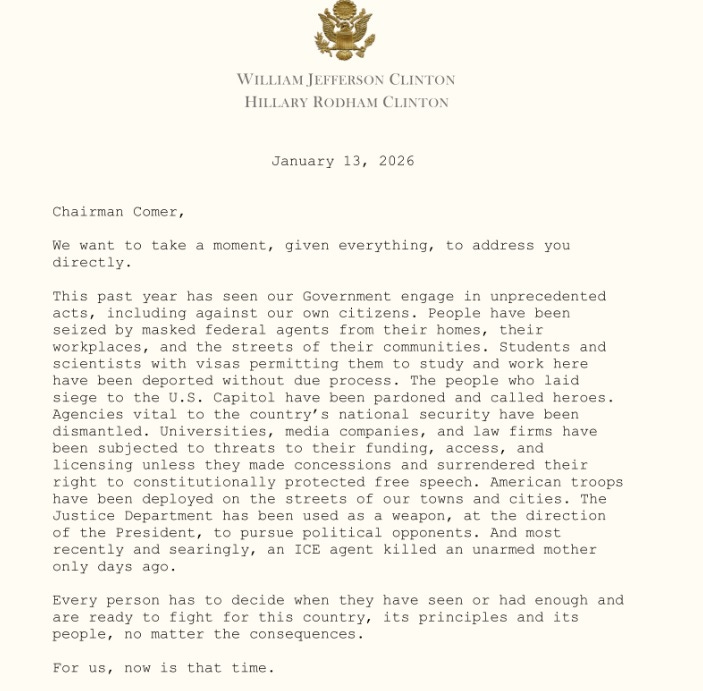
Yesterday, the Clintons sent a scathing four-page letter (New York Times archive link) to committee chair James Comer (R-Kentucky) telling him why they wouldn’t be playing along, arguing that instead of demanding the Justice Department comply with the law requiring release of the Epstein Files, Comer and the Oversight Committee “have prevented progress in discovering the facts about the government’s role.”
You should definitely give the full Clinton letter a read, because it lays out not just why the Clintons won’t go along with Comer’s attempt to shift attention away from Trump and the DOJ’s foot-dragging, but also why this government’s corruption must be resisted wherever possible, from the streets to closed-door hearing rooms. The letter, not from their attorneys but from the Clintons themselves, starts by laying out the unprecedented attacks on the rule of law by Trump’s government, and sums up:
Every person has to decide when they have seen or had enough and are ready to fight for this country, its principles and its people, no matter the consequences.
For us, now is that time.
The letter also notes, again, that Bill Clinton has repeatedly called for the DOJ to release every last bit of information about him from the Epstein Files, which isn’t exactly what somebody trying to hide something would say. As opposed to, let’s say, a president who has fought every single attempt to release everything.
Separately, the Clintons’ attorneys sent Comer a more conventional letter explaining why they consider the committee’s subpoenas “invalid and legally unenforceable,” which may be useful if Comer follows through on his threat to charge the Clintons with contempt of Congress. But the Clintons’ letter, like Comer’s attempt to drag them before the committee for show, is openly and unabashedly political.
In what may have been a deliberate throwback, the Clinton letter is in good old-fashioned typewriter text (or a digital recreation of it), not a more obvious laser-printed Times New Roman or Arial, as if to suggest that in contrast to a clumsy Twitter message or a random email blast, the IBM Selectric is an elegant communications device for a more civilized age:
While Comer accepted sworn, written declarations from eight other people the committee subpoenaed, he’s only demanded that the Clintons show up in person to be grilled behind closed doors. But no thanks, they write, we aren’t going to help you create a sideshow that detracts from the administration’s stonewalling on releasing the files:
We have tried to give you the little information that we have. We’ve done so because Mr. Epstein’s crimes were horrific. If the Government didn’t do all it could to investigate and prosecute these crimes, for whatever reason, that should be the focus of your work — to learn why and to prevent that from happening ever again. There is no evidence that you are doing so.
Predictably, Comer is now rattling on about charging Bill Clinton with contempt of Congress for not appearing Tuesday, and Hillary as well, since there was little chance she’d show up for her scheduled deposition today. Anticipating that, they basically tell him in the letter, BRING IT:
Despite everything that needs to be done to help our country, you are on the cusp of bringing Congress to a halt to pursue a rarely used process literally designed to result in our imprisonment. This is not the way out of America’s ills, and we will forcefully defend ourselves.
Indeed, bringing the Republicans’ cruel agenda to a standstill while you work harder to pass a contempt charge against us than you have done on your investigation this past year would be our contribution to fighting the madness.
If that’s the direction Comer goes, the letter warns, get ready, because while they’re still willing to testify in a public hearing, the Clintons will also “defend ourselves in the public arena and ensure this country knows exactly why you are doing so, instead of helping the American people who need this Congress’s work and protection.”
The letter closes with another warning, with a nice jab at MAGA obsessions with the perfectly legal and cromulent use of autopens on official documents, which is fun to read in a letter that looks as if it came from a typewriter. (Are the signatures here digital or handwritten, and does anyone care?)
It’s a hell of a read, and it matters because unlike all the ways Trump and his sycophants have thrown norms (and the law) under the bus, this letter makes clear that the Clintons are defying the subpoenas not out of contempt, but to highlight that the GOP “investigation” is itself a political act aimed at intimidating Trump’s enemies. This isn’t an attempt to escape answering tough questions — they’ll happily do that in the open and in a sworn written statement. It’s civil disobedience, because this is a goddamned emergency.
Rebecca Solnit writes that we need to see more of this from people whose privilege usually protects them. They could testify in private and ride out the political screeching (neither would be at any risk) but they’re instead saying hell no and courting a contempt charge because it would bring attention to Trump’s crimes:
It’s significant that they’ve come out fighting. This is specifically about James Comer’s attempt to force them to testify about all things Epstein, even as this administration covers up for Epstein’s best friend, refuses to release 95% of the Epstein files, etc. What’s striking here is that the Clintons articulate it’s all of a piece with all the other appalling and lawless things the Trumpists are doing. That these supremely status quo/high status people see themselves as under attack in illegitimate ways and are now fighting back with broad accusations matters, not least because it may shake up some other people with high status/status quo positions, including high up in the Democratic Party.
We also wholeheartedly endorse Solnit’s caution that “I don’t really want or need to hear about why you don’t like the Clintons,” because yes, that conversation has been ongoing for 35 years, but this is something new, and because hey, did you notice the whole building is on fire?
Warren was my preferred candidate in 2020. I would vote for her again if she runs. The country needs progressives who understand how hard it is for the average person in the US today. Due to the strangling of wages/ incomes for the majority and the increasing moving of all the countries wealth upward to the top few, people can not survive in this society. Hugs
Supporting and learning from trans people is essential in fostering an inclusive and compassionate world. Members and allies of the trans community recognize the unique struggles and challenges that trans individuals currently face: discrimination, marginalization, and dangerous legislation.
By actively supporting and learning from trans activists and leaders, we can better understand these challenges and work together to create an environment where everyone is treated with respect and dignity, regardless of their gender identity.
We’ve compiled a list of impactful quotes from trans activists to foster understanding and appreciation for the trans community.
Please share and utilize these quotes to promote support for trans people and create a more inclusive, respectful, and supportive environment for everyone.
Explore inspirational transgender quotes and captions — to help celebrate trans liberation & fight for trans rights
“I’ve never been interested in being invisible and erased.” — Laverne Cox
“Trans people are extraordinary, strong, intelligent, persistent and resilient. We have to be. And we will not stand for the picking and choosing of rights. We still have hope.” — Grace Dolan-Sandrino
“Despite the constant hatred we face as the LGBTQ+ community, we must stand united and strong in spreading our message of love.” — Jazz Jennings, in a tweet
“I think trans women, and trans people in general, show everyone that you can define what it means to be a man or woman on your own terms. A lot of what feminism is about is moving outside of roles and moving outside of expectations of who and what you’re supposed to be to live a more authentic life.” — Laverne Cox
“They can try to ban us. They can try to get rid of our health care. They can try to deny us housing, credit, and public accommodations. They can try to shame us. They can try all they want to erase us, but at some point, they will realize the trans community is never going away. Trans people are everywhere. Every country, every race, every ethnicity, every religion, every socioeconomic level, every period of human history — we are everywhere. We are natural. You can’t rid of what’s natural. I think they know that, and it terrifies them.” — Charlotte Clymer
“I want to make a difference in the world by speaking out and spreading hopeful messages. I want to send the message of “you are not alone and you are safe” to other transgender kids.” — Rebekah Bruesehoff
“We have to be visible. We are not ashamed of who we are.” — Sylvia Rivera
“Being transgender is not just a medical transition. … [It’s about] discovering who you are, living your life authentically, loving yourself, and spreading that love towards other people and accepting one another.” — Jazz Jennings
“We have to remain visible. They have to see us, they have to know that we’re not going [nowhere], that we’ve been here ever since God made man and woman, and they have to get over it. I don’t need their permission to exist; I exist in spite of them. I want you to train and teach and love on and create families within my community and gender non-conforming people, so that we can understand that we have a culture, we have a history, we have a reason to be here. We have a purpose. We’re entitled to be loved, and seek happiness, and share that with the people that we care about.” — Miss Major Griffin-Gracy
Snip-There are a few more, and some graphics with the quotes that we can snag and share, too.
to spread brightness in as much space around us as we can, especially if we’re in an area endangered by the Trump enforcement brigades we’re seeing. But even if we’re not, we can extend these actions locally to build community so we’ll be safer when it is our turn.
“We, at Wrecktangle, at all locations for the rest of the weekend, are going to donate one pizza for every single pizza sold, to families and friends that are affected by the increased ICE presence in Minneapolis,” one representative said.
In the caption, they noted that they are “set on volunteers” who would deliver pizza and other goods to people unable to leave home, but added: “We could really use some help raising funds to keep the momentum and keep people safe inside during these disturbing and uncertain times.”
Wrecktangle leaders said they started with $2,000 in donations from family and friends, and figured if they posted their Venmo information, they might be able to double that.
The support exceeded their expectations.
In addition to the collection of non-perishable foods and home essentials, two days later, they announced that they had received over $83,000 in donations.
Along with the donations, the local chain sold 2,291 pizzas between Thursday and Sunday.
During this time, they distributed 600 pizzas, non-perishables, and toiletries to vulnerable families, adding that “we have been working only with volunteers we personally know and trust to ensure the safety of our community.”
But thousands more meals are being made and prepared for free delivery as quickly as possible.
Wrecktangle co-owner Breana Evans told Bring Me The News that nearly every local restaurant in their area has been negatively impacted by the presence of ICE.
“We have staff, coworkers who are directly affected and scared to come to work,” Evans said. “It’s not fair for our friends to be scared to provide for their families and make a living. We know how to make food. So, we said, let’s just start making food.”
The company began donating their 13-inch frozen pizzas privately by connecting with their network of neighboring businesses and organizations. But then they realized the community could expand their efforts even wider.
Trusted volunteers were sent off to deliver free pizzas and meal kits, and others came to the shop to help assemble the goods.
“I think that’s a testament to our community and that there’s more good in the world than this horrible bad that they’re making us go through,” Evans said.
After meeting an immediate need to distribute food, Wrecktangle owners are working to figure out how to best use the funds they raised to help the community.
A screenshot of an Instagram story from Wrecktangle, sharing a weekend total of donated pizzas. Photo courtesy of Wrecktangle/Instagram
“We are working hard with nonprofit organizations to make sure these funds do the most good. We have not yet touched a cent,” they shared on social media. “As soon as we have updates as to specifically where your kindness is going, outside of purchasing food and home products, we will keep you thoroughly updated.”
And on Sunday, to finish out the campaign, Wrecktangle encouraged supporters to spend their money with other local restaurants. For one day only, they accepted emails containing a photo of a receipt from any Minnesota restaurant, and an additional meal was donated on their behalf.
“A lot of our community wants to come back to work, and we need to make sure these restaurants can help support their staff,” Evans said in a social media video. “We need you to be there.”
s of Monday morning, Wrecktangle shared on an Instagram story that they received 176 emailed receipts, which translates to 176 more meals for vulnerable community members.
“This week has spread so much love and friendship,” the company added in an Instagram story. “And we couldn’t be more grateful.”
There was little warning. Officers tumbled into the newsroom all at once, guns drawn, shouting into the common spaces. In the kitchen, someone was in the middle of drawing an espresso; overflowing coffee and steam began to drip onto the floor. Then, there was silence as the men took tactical positions in corridors and cubicles, opening closed doors and forcing the occupants of privacy rooms onto the main floor.
They lined up the editors first, zip tying their hands together and leading them into vans downstairs. Then they began to gather the rest of the journalists. Laptops were gathered from desks. The server room, such as it was in the wake of zero trust and enterprise cloud services, had its door kicked in, switches and rack servers ripped out of their frames. One IT support engineer objected and found a gun in his face, the safety off, its owner ready to make them into an example.
The people of color were led into one van; the white journalists into another. All were driven away.
The newsroom’s infrastructure was decommissioned that same day. The website was taken offline. Email accounts and cloud storage were trespassed, their contents downloaded for rapid analysis by the authorities using some central AI system; maybe Palantir, maybe something else.
Ostensibly, there would be a trial. In reality, everyone knew, the point was the intimidation, the unpublishing, the detainment of the people responsible for criticism. There was no time for due process, the administration argued. Across newsrooms, universities, activist organizations, there were too many people. As the newsroom sat chained to their seats, being driven to some incarceration center somewhere, they wondered how long it would be before their families knew. How long before the remote journalists were picked up in similar ways, perhaps in front of their children, their homes trashed.
It didn’t take long for the authorities to gain access to the devices they had taken. They forced journalists to open their phones and laptops at gunpoint; they’d all been trained not to use biometric IDs, that nobody could force them to provide their passwords and PINs, but none of that matters when you have a weapon in your face. The hard drives, though encrypted, were unlocked and accessed, the data on them cloned.
They expected to find source information: the identities of people within the government who had leaked information about detainment sites and immigration enforcement activities.
They found nothing.
The files were all gone. The emails were all redacted. The devices were as good as empty.
And no matter what they did, no matter who they threatened, nobody could restore them. Not a single member of the newsroom gave up their private information.
They couldn’t.
And for all they did to bring the website down, they couldn’t stop the journalism. There was no way to take it offline. Within moments, other newsrooms seemed to have become aware of the raid, and were pointing to the articles. Interest had increased, not decreased.
The newsroom had planned for this.
For months, all its journalism had been mirrored elsewhere. It had always been available under a Creative Commons license for anyone to republish for free — a model pioneered by ProPublica and then followed by The 19th, Grist, The Marshall Project and more, which this newsroom had used for years. But in that model, another outlet needed to choose to republish an individual article.
In contrast, this new active mirroring left nothing to chance. An independent group in Switzerland intentionally syndicated all non-profit journalism onto its servers, located in Switzerland and subject to Swiss law, out of reach by the US administration. The pieces were also, after a time delay to account for post-publishing edits, syndicated to IPFS, the censorship-resistant peer-to-peer content delivery network. Together, these measures meant that it was impossible to fully redact American non-profit journalism in the public interest. The website was gone, but the articles lived on.
The group had another purpose. Beyond mirroring the newsroom’s articles, it had access to its cloud storage, its email accounts, its databases, its infrastructure. It maintained independent offsite backups of the site and every custom application, all in Switzerland. And most importantly, it had a kill switch.
When the newsroom was raided, monitoring systems in Switzerland noticed an anomaly and automatically shut down the newsroom’s systems within seconds. Email accounts and cloud storage were drained, information was locked down. Now, it was fully under their control: no-one in the US could compel them to restore it all.
Instead, two people in Switzerland, employed by a Swiss organization, needed to independently determine that it was safe to restore data. They sat in two separate clean, glass offices. To restore the data and systems, they would need to speak to the employees in the US, monitor the sensors and the security footage from the US offices, and make their own decision. If they did determine that it was safe, they would do so quickly, but it was their choice. They had full, independent authority to keep data from the newsroom until they could make that determination.
And in this case, they could not.
Because the newsroom used cloud services with zero trust, with data shared using the principle of least privilege, the seized laptops and servers contained very little usable information. Where they did contain local data, it was encrypted using keys that were kept in Switzerland and withheld with the rest of the cloud-hosted data. There was almost nothing that the authorities could use.
There were collaborators: people on the inside who provided information. Some did it because they truly believed in the administration’s cause; some simply wished to ingratiate themselves to power. Even they could not provide more access to the data; they could not lead authorities to sources or compromise the investigations of other newsrooms. In the event, they were not spared. They, too, rode in the van.
Word spread quickly. Details of the intrusion were saved to an indelible ledger of newsroom raids, violence against journalists, and other threats that was peered with newsrooms worldwide. Notifications were sent to leaders at partner newsrooms within seconds.
Those partner newsrooms — protected by similar remote kill switch with other, similar Swiss groups — were able to access source information that had been set aside in advance so that stories in progress could continue to be reported. Some of those newsrooms were in the US; some were in other countries, so that if every newsroom in the US was compromised, others would still be able to pick up the stories elsewhere.
The people in the van did not disappear. Their names, identities, and job titles were all recorded and broadcast to other newsrooms. There would be pressure for their release. Some of them were dual nationals or foreign citizens, and their respective governments would add to the pressure. It wasn’t going to be an easy road, but the truth would endure. Their sources remained safe. Their work could continue. And it would not be in vain.
tRump has never purchased anything personally like normal people. He doesn’t go to stores and shop. He has always been a pampered rich boy even in bankruptcy. I don’t know about anyone else but Ron and I have to stretch our first half of the month income to be able to afford groceries and medications. We ended last month with $30 in the checking account. This month is always bad for us. So I want to know where this lowering of costs are. Ron wears me and the car outgoing from store to store to get the best deals. We suffer in too cold or too warm a house to keep the electric bill down. But yes Florida is a high cost of living state, would love to move, but … yup we can’t afford it. Hugs.
Donald Trump’s claims about bringing down prices comes just weeks after he told families to limit the number of presents that they buy for their children
When I first posted this I was rushing to do a lot of things. I failed to post the entire article. So this is try two to see if I can do it correctly this time. Here is the rest of the story. Hugs.
There are videos at the web page of the article linked below. Sorry I do not trust or give credit to the words / stories from the government. It is just sending the message to ICE thugs that the government have their backs when they terrorize, harass, and kill people. Instant obedience to their self created authority / power grab is what they want. Let’s not give it to them, but do try to stay safe when using your right to protest. Hugs
Federal immigration agents shot and wounded two people in a vehicle outside a hospital in Portland on Thursday, a day after an officer fatally shot a woman in Minnesota, authorities said.
The shooting drew hundreds of protesters to the U.S. Immigration and Customs Enforcement building at night, and Oregon Attorney General Dan Rayfield vowed to investigate “whether any federal officer acted outside the scope of their lawful authority” and refer criminal charges to the prosecutor’s office if warranted.
The Department of Homeland Security said the vehicle’s passenger was “a Venezuelan illegal alien affiliated with the transnational Tren de Aragua prostitution ring” who was involved in a recent shooting in the city. When agents identified themselves to the occupants during a “targeted vehicle stop” in the afternoon, the driver tried to run them over, the department said in a statement.
“Fearing for his life and safety, an agent fired a defensive shot,” it said. “The driver drove off with the passenger, fleeing the scene.”
There was no immediate independent corroboration of that account or of any gang affiliation of the vehicle’s occupants. During prior shootings involving agents from President Donald Trump’s immigration crackdowns in U.S. cities, including the fatal one Wednesday in Minneapolis, video evidence has cast doubt on the administration’s characterizations of what prompted the shootings.
Law enforcement officials work the scene following reports that federal immigration officers shot and wounded people in Portland, Ore., Thursday, Jan. 8, 2026. (AP Photo/Jenny Kane)
Trump and his allies have consistently blamed the Tren de Aragua gang for being at the root of violence and drug dealing in some U.S. cities.
According to the Portland Police bureau, officers initially responded to a report of a shooting outside Adventist Health hospital at 2:18 p.m. Thursday.
A few minutes later, police received information that a man who had been shot was asking for help in a residential area a couple of miles away. Officers went there and found a man and a woman with gunshot wounds. Officers determined that they were injured in the shooting with federal agents, police said.
Law enforcement officials work the scene following reports that federal immigration officers shot and wounded people in Portland, Ore., Thursday, Jan. 8, 2026. (AP Photo/Jenny Kane)
Their conditions were not immediately known. Portland police said officers applied a tourniquet to one of them.
City Council President Elana Pirtle-Guiney said during a meeting that “as far as we know, both of these individuals are still alive, and we are hoping for more positive updates throughout the afternoon.”
At a nighttime news conference, Police Chief Bob Day said the FBI was leading the investigation and he had no details about the events that led to the shooting.
Mayor Keith Wilson and the City Council called on ICE to end all operations in Oregon’s largest city until a full investigation is completed.
Multnomah County District Attorney Nathan Vasquez, center, speaks to the media following reports that federal immigration officers shot and wounded people in Portland, Ore., Thursday, Jan. 8, 2026. (AP Photo/Jenny Kane)
“We stand united as elected officials in saying that we cannot sit by while constitutional protections erode and bloodshed mounts,” they said in a statement. “Portland is not a ‘training ground’ for militarized agents, and the ‘full force’ threatened by the administration has deadly consequences.”
Wilson also suggested at a news conference that he does not necessarily believe the federal government’s account of the shooting: “There was a time we could take them at their word. That time is long past.”
Democratic State Sen. Kayse Jama, who lives near where it took place, said Oregon is a welcoming state — but he told federal agents to leave.
“You are not welcome,” Jama said. “You need to get the hell out of Oregon.”
The city officials said “federal militarization undermines effective, community‑based public safety, and it runs counter to the values that define our region. We’ll use every legal and legislative tool available to protect our residents’ civil and human rights.”
They urged residents to show up with “calm and purpose during this difficult time.”
Several dozen people gathered in the evening near the scene where police found the wounded people.
“It’s just been chaos,” said one, Anjalyssa Jones. “The community is trying to get answers.”
U.S. Sen. Jeff Merkley, an Oregon Democrat, urged protesters to remain peaceful.
“Trump wants to generate riots,” he said on the social platform X. “Don’t take the bait.”
___
Johnson reported from Seattle. Associated Press writer Audrey McAvoy in Honolulu contributed.



![Screenshot of Clinton letter: 'Continue to mislead Americans about what is truly at stake, and you will learn that Americans are better at finding the truth than you are at burying it. Continue to pursue autopens instead of penning laws Americans need, and you will learn that you are signing away any remaining chance of being on the right side of history. Continue to abet the dismantling of America, and you will learn that it takes more than a wrecking ball to demolish what Americans have built over 250 years. Sincerely, [signatures] Bill Clinton / Hillary Rodham Clinton'](https://substackcdn.com/image/fetch/$s_!_WOJ!,f_auto,q_auto:good,fl_progressive:steep/https%3A%2F%2Fsubstack-post-media.s3.amazonaws.com%2Fpublic%2Fimages%2F6516cc3d-9699-4259-9e53-77fab75b5f17_747x548.jpeg "Screenshot of Clinton letter: 'Continue to mislead Americans about what is truly at stake, and you will learn that Americans are better at finding the truth than you are at burying it. Continue to pursue autopens instead of penning laws Americans need, and you will learn that you are signing away any remaining chance of being on the right side of history. Continue to abet the dismantling of America, and you will learn that it takes more than a wrecking ball to demolish what Americans have built over 250 years. Sincerely, [signatures] Bill Clinton / Hillary Rodham Clinton'")