I love watching Heather Digby Parton. Hugs
H

I love watching Heather Digby Parton. Hugs
H
Science-y, funny, not as or at all funny, plus a big surprise. Enjoy!
“I expected this tomato to grow,” James Prigioni said, “but I did not expect this.”
By Annie Reneau
In many ways, fast-food restaurants feel like the opposite of a backyard vegetable garden. But one gardener has tied a McDonald’s hamburger directly to a garden harvest in a way that even surprised him.
James Prigioni makes popular gardening videos on YouTube. In one, he wanted to see if he could grow a whole tomato plant by planting the seeds from a tomato on a McDonald’s burger. He picked up a Deluxe Quarter Pounder with cheese, pulled out a tomato slice, and removed two seeds. After rubbing the seeds on a paper towel to remove the protective coating, which can inhibit sprouting, they were ready to plant.
But like any good scientist, Prigioni wanted to try a different method for testing McDonald’s tomato seeds. So he pulled a slice of tomato from a second Quarter Pounder and, instead of extracting the seeds, planted the entire slice.
With the help of a heat mat and a grow lamp, both sets of seedlings germinated and sprouted in soil-filled red Solo cups in about a week. After they were fully established, Prigioni separated the plants so they could thrive individually before being planted outside.
He planted one of the plants in the ground outside and another in a 5-gallon bucket. He then showed how he culled the lower leaves as they developed blight and used a tomato cage to support the plants as they produced fruit and grew heavier. He also added extra fertilized soil and mulch to the bucket plant.
After three months, the plants were producing abundant fruit. The bucket plant didn’t perform as well as the in-ground plant, which Prigioni said was due to insufficient watering during very hot days. The bucket plant also ripened faster, likely due to the stress it had been under. Still, it was an impressive harvest, especially for a plant that started on a McDonald’s burger.
The in-ground McDonald’s plant was even more incredible, with dozens of tomatoes dripping from it.
“I expected this tomato to grow,” Prigioni said, “but I did not expect this.”
The fruit from both plants tasted good and sweet, he said. By the fourth month, the in-ground plant was starting to struggle with its health, but not with its fruit production.
“The plant had so many tomatoes on it that it seemed like it was having a little difficulty ripening that much fruit at one time,” Prigioni said. “I mean, I have had some plants with a lot of tomatoes on them, but never in my life have I seen a single tomato plant with this much fruit on it. I was completely blown away.”
He said one of his favorite parts of the experiment was seeing what kind of tomatoes would grow from the seeds. He thought it might be a beefsteak variety, but it turned out to be a Roma type. However, he surmised that the McDonald’s tomato was likely a hybrid, based on its ripening characteristics.
Prigioni also shared how the McDonald’s tomato plants compared with his other tomato plants.
“In another area of the garden, I grew Roma tomatoes that I got from Lowe’s, and I planted them at the same time as the McDonald’s tomatoes,” he said. “The harvest from them wasn’t quite as large, but the fruit ripened way more evenly, and I was able to harvest a lot more fresh fruit right off the vine that was ripe.”
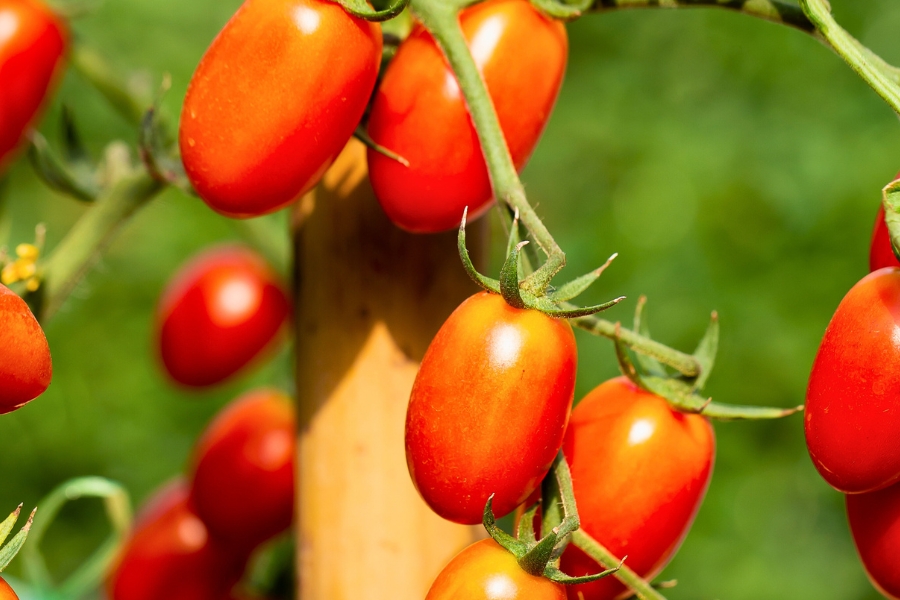
“Overall, I was shocked with the level of production,” he continued. “And this is probably my favorite experiment that I’ve ever done. I mean, to be able to take a cheeseburger, grab a tomato from it, then grow a tomato plant, and then harvest pounds and pounds of tomatoes from it is just such a unique and refreshing experience.”
Perhaps an unexpected result, but a great way to challenge our assumptions and demonstrate the power of nature, even in the context of fast food.
You can follow The Gardening Channel with James Prigioni on YouTube for more gardening education.
Abraham Lincoln’s faith in the Declaration of Independence ultimately influenced Walt Whitman’s harsh but optimistic appraisal of the American experiment.
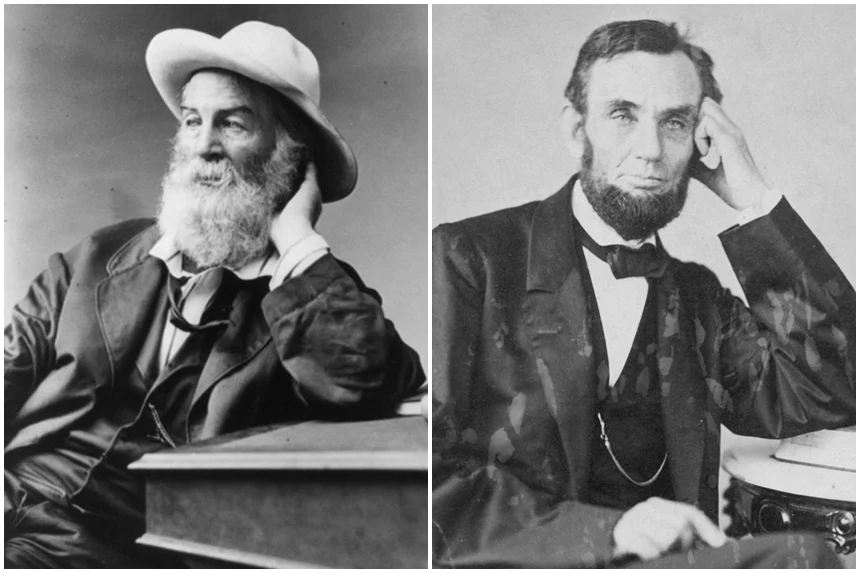
Walt Whitman and Abraham Lincoln (Library of Congress)
“The United States are destined either to surmount the gorgeous history of Feudalism, or else prove the most tremendous failure of time,” wrote American poet Walt Whitman in his 1871 work, Democratic Vistas. Despite writing in the wake of a brutal civil war and a failing Reconstruction Era, Whitman remained optimistic. “Not the least doubtful am I on any prospects of their material success.”
Known more for his poetry, exemplified by Leaves of Grass (1855), Whitman’s dark 1871 treatise on the nation remains a harsh but ultimately optimistic appraisal of the American experiment. It serves as a useful tool for thinking about the nation’s current state on the 250th anniversary of the Declaration of Independence.
Whitman’s revolutionary patriotism had long been part of his worldview. He celebrated the Declaration of Independence and the Revolution in the preface to Leaves of Grass, noting that a poet must “enter the essences of the real things and past and present events,” among them “the haughty defiance of ’76, and the war and peace and formation of the constitution.”
But for all his celebration of the Declaration and the nation’s founding, he did not mince words regarding the nation’s failings. He wrote of a “hollowness” at the center of American life at the time, calling the business classes depraved and the government saturated in corruption. (snip-go see the rest!)

Donald Trump is threatening to bomb Iran back to the Stone Age, which, if he does, would be a war crime.
Trump’s chosen war is with the government of Iran, not the people, yet he continues to threaten to destroy its infrastructure. The more Donald Trump and Pete Hegseth brag about their success in the war, the more it seems that Iran fights back.
Trump tells us that the war is won and that Iran’s ability to wage war is nearly depleted if not already destroyed, yet missiles still rain on Israel and our other allies in the Gulf. And if Iran doesn’t have any weaponry left, then how did they shoot down two American jets? If the war is already won, then why are we still fighting? (snip-click on the title to get the rest!)
Because of Mamdani’s policies being for the people to help the people and his huge popularity is going to affect or should affect how other democrats run their races. The people respond to taxing the wealthy more and using those funds to help the lower incomes. Maybe the young today don’t remember how it was before Reagan slashed the taxes on the wealthy when infrastructure was maintained, services for the public were available, when schools were properly funded and higher education was inexpensive and government offices to serve the public were fully staffed along with so much more. But the more the upper incomes take of the country’s money the less is available for the rest of the people. A large part of the democratic party became addicted to that big money from corporate and wealthy donors so they did not fight for the people as they should have instead helping companies and businesses to make more profit. The people saw the shift by the democrats and stopped supporting them. Mamdani has shown how to get the voters back on the democrats side again. Hugs
You could tell he did not want to do this endorsement. Hugs
The problem is the money AIPAC uses to either entrap politicians and these podcasters / influencers or uses its money to threaten and punish them. Hugs
This one is especially funny!
This is a great clip on the situation with the democratic party, democratic leadership, and the democratic message. Also the polls on democratic leader ship is in the negative numbers. One reason is the Israeli genocide in Gaza and the minority leader in the Senate, Chuck Schumer has said his number 1 priority is making sure the left keeps supporting israel. The democratic party leadership has been totally captured by the big money donors, corporations, and large lobbying groups like the Israeli lobby AIPAC. It doesn’t make the people feel they are important to him or the party leaders. Hugs
Scottie mentions restroom etiquette sometimes. Turns out, there’s an actual etiquette, as he says, and here’s a story about it!
The “buffer urinal” is more important than we realize.
By Evan Porter
There’s a theory that most men, and people in general, intuitively understand “urinal etiquette.” It’s the art and science of where to stand in relation to other men when using a public restroom. Stand too far away, and you risk coming across as standoffish or rude. Stand too close, and you’ll make the other person uncomfortable.
Most people prefer to have a “buffer” between themselves and strangers, and it’s not limited to urinals or public restroom stalls. When given the option, most of us will sit at least one seat away from the nearest stranger in a movie theater or auditorium. We’ll leave a bench or treadmill between ourselves and a fellow gym-goer.
The buffer may seem like common decency and consideration for the people around us, but there could be more to it than that, according to a decades-old research study.
In 1976, a team of researchers actually got the idea to test whether the proximity of a stranger had an effect on the way men urinated. Yes, really.
More specifically, they wanted to test what happens when someone invades your personal space. Do you just feel awkward or uncomfortable, or are there more measurable things happening in the body.
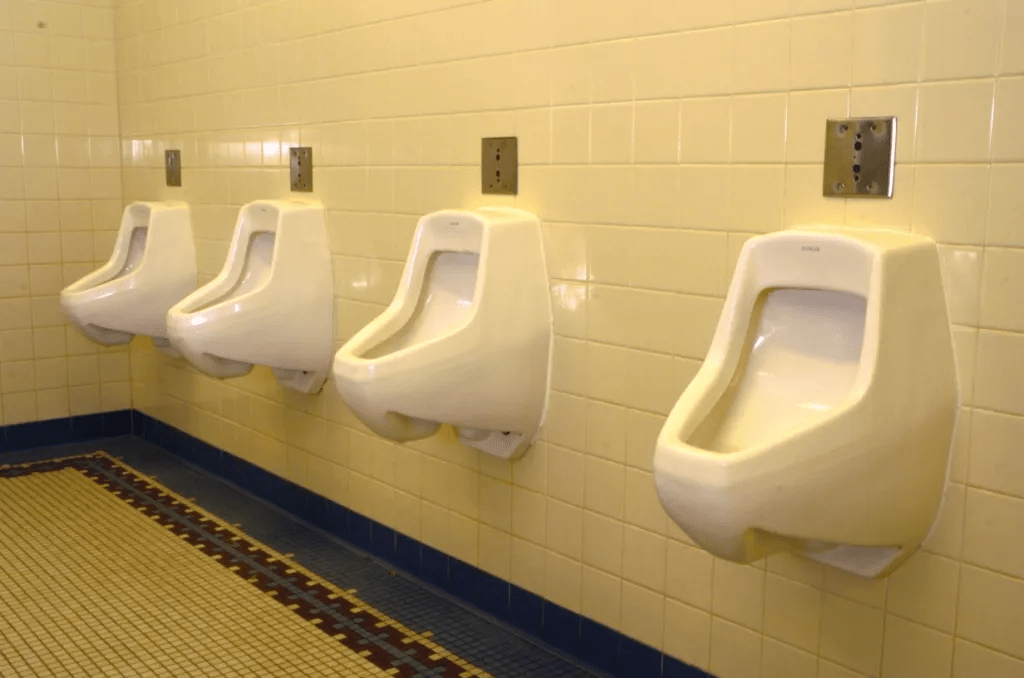
Objectively, the worst kind of urinal. Photo Credit: Photo credit: Wikimedia Commons
For the experiment, researchers began with a pilot study in a men’s public restroom. An observer stood by the sink, appearing to busy himself with washing and grooming, all while secretly keeping tabs on the men who entered. The published study takes it from there:
“When a potential subject entered the room and walked to a urinal, the observer recorded the selected urinal and the placement of the next nearest user. He also noted (with a chronographic wristwatch) and recorded the micturation delay (the time between when a subject unzipped his fly and when urination began) and the micturation persistence (the time between the onset and completion of urination). The onset an cessation of micturation were signaled by the sound of the stream of urine striking the water in the urinal.”
Ethical concerns about observing unsuspecting men in a restroom aside, the study found that none of the 48 subjects chose to stand directly next to another “user” at the urinal banks. The data also showed that men urinated longer the farther they were from the nearest person.
The study was repeated, but this time, confederates were involved. Volunteers were stationed at specific distances from unsuspecting bathroom users, while another observer hid in a nearby stall and used a “periscope” to get a clear sightline of the urine stream.
Once again, the data was extremely conclusive: men who stood directly next to a confederate while urinating took longer to begin and also urinated for longer overall.
“These findings provide objective evidence that personal space invasions produce physiological changes associated with arousal,” the authors noted in their abstract.
It was an important, if controversial, study in advancing the field of proxemics—the study of physical space in human nonverbal communication. Research like this unusual bathroom study has helped us understand “intimate distance,” a space very close to our bodies that we reserve for romantic partners, children, and close friends.
Research in the field has also mapped the “personal bubble,” or “personal distance,” typically reserved for family members and friends. However, when strangers invade this space—in a crowded elevator, a packed subway car, or by standing next to us at the urinal—that’s when things get really interesting.
Our bodies respond, and MIT Press notes that people often deal with an invasion of personal space by “psychologically removing themselves from the situation” by listening to music or staring blankly at a wall.
Now we know a little more about the physiological response behind this aversion, and it makes urinal etiquette make much more sense. It’s not just “machismo” or homophobia—it’s a way of avoiding a serious stress and anxiety trigger. Or, at the very least, a way to have a much more satisfying pee.


