
Tag: Comedy
“‘Cool, sing to yourself. You’re a grown woman.’”
Taylor Tomlinson Turns Purity Culture Baggage Into Comedy
By Emma Cieslik
It has been a joy to deconstruct my religious trauma alongside 32-year-old comedian Taylor Tomlinson. Four years ago, as I was coming out as queer to my family, I found her Netflix special Taylor Tomlinson: Look at You to be a warm welcome into the community of formerly Christian queer kids and purity culture survivors. Dark humor gave all of us a silly sort of grace, a space where we could grieve and grow.
Tomlinson, who was raised in a conservative Christian household in Temecula, Calif., got her start in stand-up through the church comedy circuit. But as she grew up, she began deconstructing how her conservative Christian upbringing was hurting her mental health and sexual development, deciding instead to be a “secular” comic.
Her new Netflix special Prodigal Daughter was filmed inside Fountain Street Church in Grand Rapids, Mich., which welcomed her not despite but rather because of her comedy. On her aptly named “Save Me” tour, Tomlinson builds on a foundation of jokes about toxic Christian culture to call out not just people who weaponize religion as a tool for bigotry but also the people who make fun of those who still believe in God.
“Because if God does exist, he does not exist to make you feel better than other people. He exists to make you better for other people,” she said. “We judge each other’s coping mechanisms. Like, ‘You’re a quitter if you get on antidepressants. You’re stupid if you believe in God. B—-, I’m on mood stabilizers, you’re on Jesus. We’re all trying to get to ‘dead with Daddy.’”
In fact, Tomlinson recognizes the people in her life—her grandparents, aunt, and uncle, himself a pastor—“who are using religion correctly.”
“There are a lot of people who are using religion as a tool for community and connection and compassion and comfort,” she says, “and when I was writing this hour, I was thinking about those people.”
Cheekily, Tomlinson compares her own stand-up specials to her uncle’s Christian services. “We’re both out here on the weekends, changing lives.”
But the comedian is not here to absolve all the sins of Christianity or its effects on her.
“When you grow up in a religious environment, you spend a lot of your young adulthood untangling who you are from who they wanted you to be,” she says. For Tomlinson, this is best represented by her “late” coming out at age 30.
Tomlinson explains that she has so many queer friends who are open and free about their sexualities—the “Samanthas” of the group—but she didn’t see anyone else who, like her, was nervous entering the queer dating scene. “We need more gay prude representation,” she chuckles, making those of us coming out at an older age and experiencing a real queer second adolescence feel less alone.
A second adolescence refers to how many LGBTQ+ people didn’t have the chance to experience the joys of teenage years. Because of rampant queerphobia inside and outside religious communities, we didn’t have access to the romantic and sexual “firsts”—first crush, first kiss, first sexual encounter—that many heterosexual people did because we were told repeatedly that our love and our bodies were shameful and had to be hidden.
While she doesn’t explicitly name “second adolescence,” the significance of coming-of-age as a queer person runs throughout her special.
According to Adam James Cohen, a therapist specializing in helping LGBTQ+ patients, adolescence is critical to developing and cementing a person’s identity and sense of self. For those who missed out on that true identity formation earlier in life, second adolescence offers a mental and physical stage of healing and liberation, often involving people deconstructing their internalized anti-queerness and religious trauma. Sometimes this liberation happens through comedy, sometimes through therapy, or as Tomlinson discusses in her special, sometimes both. During this formational time, adults reckon with the grief of missing adolescence, and make up for lost time.
Second adolescence isn’t just a uniquely queer experience. Many people raised in far-right Chrisitan environments experience a new phase of psychosocial development after they leave their conservative Christian homes. For people raised in purity culture, their second adolescence can be a time of sexual exploration, experimentation, and liberation during and after deconstructing harmful theologies of the body.
For the queer Christian kids like Tomlinson, we were robbed of moments of bodily and social experimentation and generation, so experiencing our second adolescence is like coming home to our bodies, an emotional rebirth or reversion, to put it in Christian terms, of learning and loving to be a queer child and queer teenager again. For trans and nonbinary people undergoing gender affirming medical care, second adolescence can be even more physical, as hormone therapy brings about a second puberty.
And for many of us, this second adolescence is characterized by an eagerness—and joy—to accept and share the possibilities that many never questioned. As Tomlinson joked, “When I started dating women, it was the closest I’d come to feeling religious in a long time because my friend would complain about their boyfriends and husbands and I was like, ‘Have you heard the good news? You don’t have to live like this. There’s a better way.’”
Second adolescence is especially common among people who have a later-in-life realization or acceptance of their LGBTQ+ identity, often called a “queer awakening” or “second coming out,” just like Tomlinson. There is no time limit on coming out or discovering and affirming gender or sexuality, but as Tomlinson jokes in her special, “coming out as bisexual at 30 feels like saying to a waiter, ‘By the way, it’s my birthday.’ They’re like, ‘Cool, sing to yourself. You’re a grown woman.’”
Tomlinson’s special portrays this second adolescence with a humor, grace, and visibility I hadn’t encountered before but am deeply indebted to. Prodigal Daughter, and her comedy as a whole, carries special poignancy for the formerly queer Christian kids coming of age through humor and deconstruction.
Josh Day, Next Day
Josh Day, Next Day
No oopsies on posting Josh Johnson! Remember device/keyboard protective protocols.
Remember Stormy Daniels?
Here’s an update.
“Never Forget!
Good News Here!
A safe baby, and record Girl Scout cookies sales for trans Scouts! I remember seeing the story about the young man saving the baby last week on local TV news (through a national network affiliate.) No mention of anything but his heroism and his humility about doing what anyone else would have done.
Heroic Chicago trans comedian recalls saving infant from ice-cold Lake Michigan: ‘I guess I’m going in’
“The most important part of this entire story is that the baby is okay,” Lio Cundiff told The Advocate.
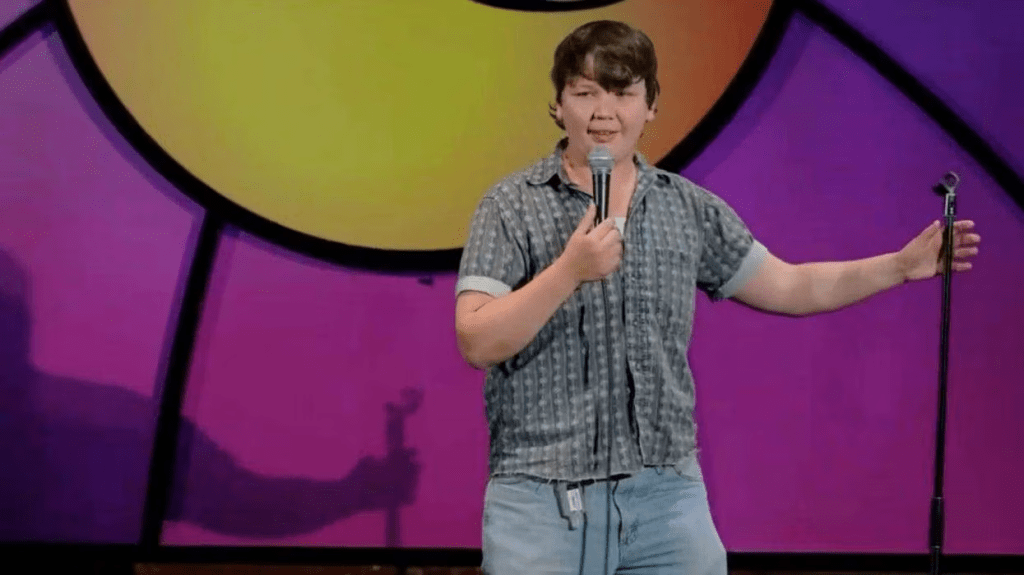
A Chicago comedian is speaking out about a daring rescue that left him in the freezing waters of Lake Michigan, and saving an infant from drowning.
Six days before his February 24 birthday, on a bright winter afternoon along Chicago’s Lake Michigan waterfront, Lio Cundiff had a thought that now reads like a setup to a joke. “I was on the phone with my friend, looking at the water, and I was like, ‘Man, that looks so beautiful. I just want to jump in,’” he told The Advocate in an interview on Friday. Little did he know.
Cundiff, 31, had arrived early for work on February 18 near Belmont Harbor and wandered down to the water, as he often does. He loves the lake. He loves floating in it in the summer — ideally, he says, “with a beer.” He had been taking phone calls, sitting on a bench, “vibing,” he said.
Then he heard screaming. “I just look up, and I’m like, ‘Oh my God.’ I just saw a stroller headed straight to the lake, just blown by the wind,” he recalled.
In that instant, the punchline vanished. There was no bit to craft, no self-deprecating aside about his baby face or his anxiety about sending emails, both staples of his stand-up. There was only motion. He threw down his jacket and phone and ran.
“I was like, ‘I guess I’m going in.’ And I jumped in and just tried to keep us afloat as much as possible,” he said.
Early media reports suggested that Cundiff did not know how to swim. He bristles at that characterization. “I can swim,” he said, explaining that in the hospital he told a reporter he wasn’t the strongest swimmer and preferred “to float with a beer in my hand.” “They ran with, ‘I can’t swim,’” he said.
“I can swim. I just prefer not to,” he said through a chuckle.
The baby, eight months old, was zipped inside the stroller. Cundiff had to keep the entire frame buoyant while treading freezing cold water. At one point, both of their heads went under. He describes the memory in fragments, as though replaying a film whose ending he already knows but still cannot quite believe.
“There were a few minutes where I didn’t know if we were going to be able to keep afloat,” he said. “I grabbed her hand for a second. Her tiny little fingers. I rubbed them for two seconds, and I was like, ‘Okay.’ … ‘All right, we got to keep going.’”
A bystander named Lou dropped a jacket; later, a life buoy arrived. They were about thirty feet from a ladder. Cundiff’s muscles were tightening. When they finally reached it, and the baby began to cry, he felt something like release.
“As long as she’s crying, when she gets out, that’s all I needed,” he said. (snip-MORE on the page)
Trans Girl Scouts Sell 330,000 Boxes Of Cookies In Public Outpouring Of Support
The total boxes sold is the highest in the history of EITM’s trans girl scout cookie list.
Erin Reed Mar 05, 2026
Five years ago, as anti-trans legislation first began spreading across the United States, I kept thinking about the kids caught in the middle of it—transgender children suddenly facing a wave of hostility simply for existing. That year, I started something small in response: a trans Girl Scout cookie list. Only three scouts were on it. The internet responded immediately, helping them sell out their entire quota. Every year since, I’ve made the list again, and every year it has grown larger. Now, in 2026, the list has reached a staggering scale: 220 transgender Girl Scouts participating—and together they have already sold more than 330,000 boxes of cookies, with the number still climbing every minute.
One scout hoping to fund a troop trip to Alaska—and assemble backpacks for foster children—has sold 2,500 boxes of cookies, bringing those plane tickets within reach. Another scout, a competitive soccer player, was raising money so her troop could attend scouting camp without worrying about the cost; she has now sold 4,500 boxes, ensuring that trip is covered. One troop made up of transgender Girl Scouts set their sights on learning horseback riding and attending summer camp together—and sold 22,000 boxes to make it happen. And Pim, who simply wanted to go to Niagara Falls and to take her troop camping, has sold more cookies than the website can even track: more than 100,000 boxes.
And while we can’t know exactly how many of those sales came directly from our yearly list, we do know that these trans Girl Scouts have taken the internet by storm. Posts about them have racked up millions of impressions on Facebook and gone repeatedly viral on Bluesky. In the process, countless people looking for their next box of cookies discovered a cause worth supporting—and a group of scouts they were excited to cheer on.
The news about their staggering success comes during a broader regression around scouting organizations with respect to transgender people. In December, the United Kingdom’s Girlguiding—the British equivalent of the Girl Scouts—banned transgender girls from joining, reversing a policy that had been in place since 2018. In the United States, Defense Secretary Pete Hegseth forced Scouting America to agree to classify members by sex assigned at birth, eliminate diversity initiatives, and effectively out and segregate transgender scouts from their peers. Girl Scouts of the USA, however, has yet to see the same regression—the organization still stands by its transgender inclusion policy.
For these kids, that transgender inclusion policy has given them hope. At a time when thousands of anti-LGBTQ+ bills are being proposed and passed across the country, the cookie list is proof that people out there care. When every force in the world is acting against them, for once, their identity is not treated as a curse by society, but a blessing. Parents have told me that their children have been overwhelmed with joy watching the numbers climb, realizing that strangers across the country support them. And that’s worth protecting. (snip-MORE on the page)
Your Josh Day Next Day!
To Begin Our Afternoon, Now
and go on about our day being peaceful, in order to bring about peace. (I have a dental appt. to finish what was begun a couple of weeks ago at that dental appt. I feel all pure-white-dovey inside.)
Josh Day Next Day
I almost posted this last night for those who might have wanted a funny alternative to the SOTU, but here’s hoping you all found what you wanted to watch. Randy posted, and I wanted that to stay on top, because he’s been busy and tired and not able to get around to posting. Of course, this is Josh Johnson: no matter the subject, guard your device from whatever beverage you may be taking in as you relax and listen and laugh!
 Scottie's Playtime