ICE is a totally out of control rogue government agency that is simply lawless thugs. This was a civilian in medical distress in the ambulance. In a worse medical emergency the person could have died. The person was not in custody and a citizen but ICE demanded to be allowed to control them. Wake up people we have crossed all the lines. We barely have a functioning democracy. We all need to do what we can to fight this. Incredibly scary. ICE did not have the authority to hold the ambulance up but they did so at the point of a gun. What does that say about where the US is as “a nation of laws” and the republicans who for 50 years called themselves the party of law and order? Hugs
Late on Oct. 5, a Portland ambulance crew informed dispatchers over the radio that it was attempting to transport a patient from U.S. Immigration and Customs Enforcement to Legacy Emanuel Medical Center but that ICE officers were impeding its departure. Six minutes later, at 9:40 pm, according to publicly archived radio records, the medic driving the vehicle delivered an update: “We are still not being allowed to leave by ICE officers.”
Two confidential incident reports obtained by WW offer insight into what was going on inside the South Portland ICE facility at the time. The written accounts were filed by the ambulance crew members shortly after the incident—one report to their employer, American Medical Response, and another to a union representative—as documentation, as one report puts it, of a “conflict with federal agents.”
The two reports, filed by different medical workers, mirror each other’s accounts, and are consistent with publicly available audio recordings of emergency medical services radio communications, as well as 911 calls and dispatch reports obtained under public records law.
Both reports say that federal agents, in an effort to block the ambulance’s departure, stood directly in front of the vehicle. As the delay dragged on, according to the reports, the ambulance operator put the vehicle into park, causing it to lurch forward slightly.
The reports indicate the federal agents did not like this—so much so that an agent threatened to shoot and arrest the driver. The driver, frightened, asked why. An agent, according to the reports, responded that the driver had attempted to hit him with the ambulance.
“I was still in such shock,” the driver later wrote, “that they were not only accusing me of such a thing, but crowding and cornering me in the seat, pointing and screaming at me, threatening to shoot and arrest me, and not allowing the ambulance to leave the scene. This was no longer a safe scene, and in that moment, I realized that the scene had not actually been safe the entire time that they were blocking us from exiting, and that we were essentially trapped.”
The incident occurred at a contentious spot in the city. The ICE facility on South Macadam Avenue has in recent months been the scene of frequent and persistent protests, typically small in scale, which President Donald Trump has lately used to justify his effort to deploy military troops to Portland to protect federal facilities and the personnel that work in them.
Meanwhile, many, including Portland city officials, have alleged that federal agents have in several cases needlessly intensified situations that might have easily remained far more calm.
The incident described in the crew members’ two reports suggests that such hostility has been directed not only at demonstrators, but at first responders who were asked by the feds to assist. The ambulance was eventually allowed to leave the building with the patient. But the crew’s written reports of the preceding minutes offer a small but revealing sign of how on edge some federal agents working in the ICE facility are feeling—and how quick they are to take an aggressive posture when they perceive a physical threat, even from a fellow emergency worker.
WW first contacted U.S. Immigration and Customs Enforcement about the incident early last week. When WW followed up Friday, Oct. 10, with more details about what it planned to report, an ICE spokesperson wrote: “Please contact the Federal Protection Services for response.”
A subsequent email that day to the U.S. Federal Protective Service went unanswered. A media contact for the U.S. Department of Homeland Security, which contains FPS and ICE, did not respond to a request for comment either. None of the agencies responded to a follow-up email Oct. 11 asking for comment.
WW also sought comment from the ambulance crew members, the ambulance company, and the union representing the workers. None denied that the incident had occurred as described in the documents. The union added that when armed agents interfere with medical transport, they “cross a moral line.”
Public records provide greater context to the incident detailed in the crew members’ reports. The ambulance was called late in the evening on Oct. 5 to the ICE facility at 4310 S Macadam Ave. According to a publicly available dispatch document, the crew was responding to a medical call for a protester with a broken or dislocated collar bone.
By 9:13 pm, the ambulance was en route. According to a dispatch document, federal officials suggested at first that the ambulance enter the ICE facility through a side door, but then determined it should come in the main gate. The ambulance arrived on scene at 9:19. By 9:22, it had entered the building.
AMR ambulance on NE 82nd Avenue (Brian Burk)
A two-member crew was aboard. Both later documented the event in confidential reports. One record, reviewed by WW, appears on an event summary form produced for American Medical Response—the company that contracts to run ambulance services in Multnomah County. The document lists Oct. 5—the same day as the incident in question—as the “date submitted.” The other document is an email, sent by a crew member to a union representative. It is time-stamped the evening of Oct. 6.
The reports indicate that when the ambulance arrived, the patient was transferred into the vehicle without issue, and soon the crew was preparing to depart. This is consistent with other publicly available records. At 9:30 pm, the ambulance operator indicated plans over the radio to head to Legacy Emanuel Medical Center. Around 9:33 pm, dispatch records say, the ambulance seemed to be getting ready to bring the patient out.
And yet it was not emerging. What was going on? One crew member worked largely in the rear of the ambulance, while the other was sitting in the driver’s seat. Their respective reports offer consistent accounts from different vantages.
An initial delay, the driver’s report indicated, stemmed from federal agents’ desire to ride in the ambulance to the hospital. The driver recalls responding that, in the absence of arrest paperwork, officers could not ride in the ambulance, and that an agent responded this was OK—that agents would follow the ambulance to the hospital instead.
But the point was evidently not resolved. Before long, a report says, an agent again said the ambulance needed to wait for an agent who would ride along.
“I repeated again,” the driver’s report recounts, “that no officer is permitted to ride in the ambulance and that they can meet us at the hospital and that we needed to be let out of the facility. Officers then began walking away from me whenever I spoke. At that point, a group of 5-8 civilian-dressed men walked into the garage and just stared at me. No identification on any of them. I walked back to the ambulance and got into the driver’s seat. I flipped the emergency lights on and put the car into drive. I inched forward slowly out of the garage.”
At this point, a report says, a man in civilian clothes with a neck wrap covering the lower part of his face stepped in front of the ambulance and told the driver to halt. The ambulance driver, in the report, recalls telling the man not to stand in front of the ambulance, and that the man then yelled at the driver to stop, citing the risk of hitting federal agents.
The driver recalled expressing skepticism about the risk of hitting the large group of officers in full riot gear, in plain view, about 15 feet in front and to the left of the ambulance. Sensing that departure was imminent, the driver inched forward further: “The group of about 30 officers in front of the ambulance were lining up in what I assumed to be preparation for the gate to open so they could escort the ambulance off of the property,” the report says.
Time went by. The crew was anxious to get the patient to the hospital. But they were still being impeded. Several federal agents, many in riot gear, moved to stand “incredibly close” to the front of the ambulance, the driver’s report recounts. An agent approached to inform the driver of the presence of “violent protesters” outside—a new reason the ambulance could not yet leave.
Around this time, dispatchers received one of the crew’s radio messages: The ambulance was still being held up.
Public records document this period as well: “50-60 fed agents completely blocking the road,” a dispatch report said at 9:39 pm, “but AMR still not driving out yet.”
The gate to the ICE facility had opened and dozens of officers in riot gear had marched out, revealing a clear exit path. Still, according to an incident report, the smaller group of officers continued to stand directly in front of the ambulance.
Around this time, the crew member in the rear, having determined, as a report says, that the “yelling and aggressive nature of the officers had created a scene safety issue,” exited the ambulance to have a word with them.
“My partner was still in the driver’s seat,” the crew member wrote, “and I left the ambulance to attempt to calm and deescalate the situation.”
In the other report, the driver recalled observing this and moving to secure the vehicle before also getting out: “I then placed the ambulance into park, took my foot off the brake, undid my seat belt and opened the driver’s side door. I looked up and suddenly the entire group of officers…were crowded around the open car door, some of them leaning forward towards me, inches from my face.”
An agent, the driver recalled, “pointed his finger at me in a threatening manner and began viciously yelling in my face, stating, ‘DON’T YOU EVER DO THAT AGAIN, I WILL SHOOT YOU, I WILL ARREST YOU RIGHT NOW.’”
According to the driver’s report, the crew member who had been in the rear of the ambulance told the agent that the vehicle rolled forward when the driver put it in park, and that no one was trying to hit him.
To this, the report recounts, another agent replied that this was not the first time this had happened.
According to the medics, the agents continued to yell. There was also further chatter of riding in the ambulance, but in time an accord was reached: Feds would follow along in their own car.
By 9:42 pm, a crew member radioed in: They were finally en route to the hospital. The driver, in the report, recounts making this radio call, and that dispatch copied. The report says an unmarked vehicle with state license plates followed closely behind the ambulance, and upon arriving at the hospital, multiple men in civilian dress exited the vehicle and walked in.
Presented by email with details of this story, a spokesperson for Global Medical Response, the parent company of American Medical Response, did not answer WW’s questions, but said, “We are reviewing the specifics of the situation and committed to a thorough review.”
WW reached out to the two ambulance crew members. Both declined to comment.
Asked for incident reports tied to the medical call, Austin DePaolo, a spokesman for Teamsters Local 223, which represents the ambulance workers, said in an email that the union “doesn’t have any incident reports that members have given us permission to share.”
DePaolo added: “Our Teamster EMS workers answer every call with courage and compassion. When armed agents interfere with medical care, they cross a moral line that could put lives at risk. We stand firmly behind our members who work in EMS.”
Andrew Schwartz writes about health care. He’s spent years reporting on political and spiritual movements, most recently covering religion and immigration for the Chattanooga Times Free Press, and before this as a freelancer covering labor and public policy for various magazines. He began his career at the Walla Walla Union-Bulletin.
Willamette Week’s reporting has concrete impacts that change laws, force action from civic leaders, and drive compromised politicians from public office.
Following the assassination of Turning Point USA (TPUSA) co-founder Charlie Kirk on Sept. 10, there’s been significant posthumous discussion about who he was and what he left behind. President Trump and the Republican Party have described him as a martyr, making his funeral into a 200,000-person event comparable to those of deceased presidents, while calling for retribution against the “radical left” and trans people, despite the fact that the man who killed him is cisgender and his political affiliation is unclear.
Some liberals have mourned Kirk, casting him as a champion of civil dialogue. Meanwhile, critics of his often hateful beliefs have faced repercussions, with retaliatory firings of educators, writers and reporters.
Given the volume of discussion about Kirk and his legacy surrounding LGBTQ issues, Uncloseted Media decided to assemble the receipts. Here’s a track record of Kirk and TPUSA’s actions and statements on the queer community.
Oct. 4, 2016
TPUSA co-founder Charlie Kirk publishes a manifesto that outlines the group’s vision and political strategy, where he complains that “personal and overall freedom” are being lost in “exchange for ‘micro’ freedoms like taxpayer-funded contraception and gay marriage.”
He writes that TPUSA’s strategy is inspired by what he describes as the LGBT movement:
“We are using the same message delivery methods and many of the same organizing tactics. They use social media, rallies, and pop-culture messaging, just like we do. Despite our very different agendas, there is no question we have adapted our movements into the times in which we live.”
Kirk also references Jonathan Haidt, a professor of ethical leadership at New York University Stern School of Business, who has likened being a conservative graduate student on campus today to being a closeted gay student in the 1980s.
Nov. 21, 2016
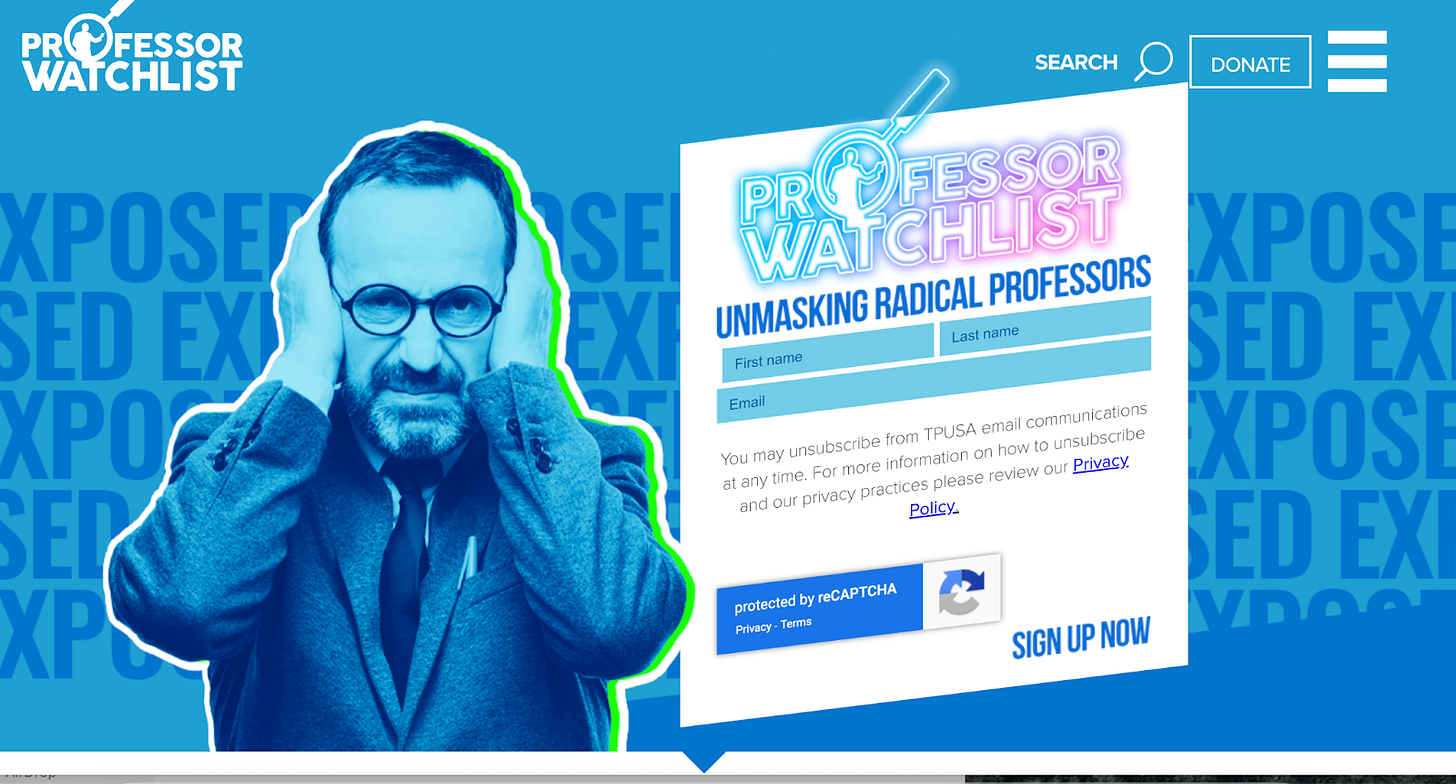
Screenshot of Professor Watchlist.
TPUSA launches the Professor Watchlist, a database cataloging “anti-conservative” college professors. Many targeted professors later face harassment. A gay professor says that when they were placed on the watchlist, they began receiving anti-LGBTQ emails on their work account. And a tenured professor at the University of Florida who was placed on the watchlist and tagged with sharing a “racial ideology” says that all four professors at her university who are on the watchlist are either a person of color or someone who identifies as LGBTQ.
Subscribe
Jan. 25, 2017
TPUSA co-hosts an event with College Republicans at CU Boulder called “Why Ugly People Hate Me.” The event features far-right provocateur Milo Yiannopoulos, who was in the middle of his Dangerous Faggot Tour which challenged “political correctness” on college campuses. Yiannopoulos claims to be an “ex-gay,” born-again Christian who “demoted” his husband to “housemate.”
April 25, 2018
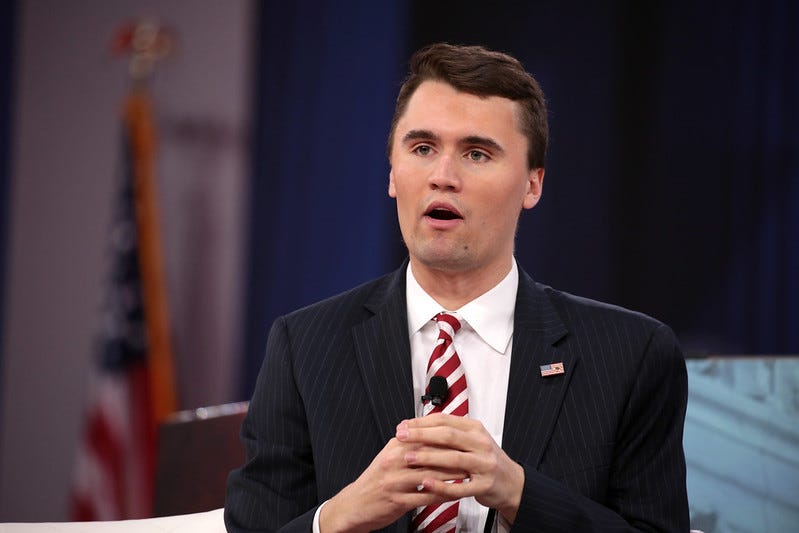
Kirk at the Conservative Political Action Conference in 2018. Photo by Gage Skidmore.
A Huffington Post report finds that Shialee Grooman, then TPUSA’s national field director, had a long history of racist and homophobic posts, including one that read, “Okay. All of you are f*ggots.” In a statement to HuffPost, Kirk says Grooman is a “former employee,” and TPUSA issues a company-wide memo announcing social media background checks and offers to assist employees in making their social media posts less public.
Nov. 22, 2019
At a TPUSA event called “Culture War” in Florida, Kirk addresses a heckler who accuses him of betraying conservatism by tolerating gay and transgender individuals and warns of a slippery slope to normalizing pedophilia. Kirk tweets, “I believe marriage is one man one woman biblically” but goes on to say that he doesn’t think gay people should be excluded from the conservative movement.
Sept. 14, 2020
TPUSA launches TPUSA LIVE, a new media hub that they say provides “daily conservative content” that includes “hot takes, opinions, and reactions to breaking news.”
Other articles include transphobic headlines inspired by conspiracy theories that trans women are actually male creeps trying to invade women’s spaces. Some headlines include:
TPUSA launches the School Board Watchlist, modeled after their Professor Watchlist, to monitor high school officials they deem too progressive. The watchlist now seems to be defunct.
Oct. 14, 2021
Kirk publishes an op-ed titled “On Sexual Anarchy” that is rife with anti-LGBTQ animus. He writes:
“The facts that there are only two genders; that transgenderism and gender ‘fluidity’ are lies that hurt people and abuse kids; and that God’s good, loving, and joyful ideal for our lives is for a man and woman to be joined in a lifelong marriage covenant—these are all under official opprobrium in 2021.”
Feb. 18, 2022
A University of South Carolina student posts screenshots of racist and homophobic messages from two group chats affiliated with the school’s TPUSA chapter. The president of the chapter later releases a video apology, saying that “these remarks have no place being made in our organization,” though this video would later be taken down.
Subscribe for accountability journalism.
Subscribe
April 8, 2022
On his podcast, Kirk says: “[Gay people] are not happy just having marriage. Instead, they now want to corrupt your children.”
In another episode the following week, Kirk falsely links trans people to inflation.
“There’s a direct connection to inflation and the trans issue. You say, ‘Charlie, come on. They couldn’t be further apart.’ No, they’re exactly the same. They’re the same in this aspect—when you believe that men can become women, why wouldn’t you also believe that you could print wealth?”
June 2022
Drew Hernandez, host of TPUSA FRONTLINE on YouTube, spends Pride Month calling LGBTQ people “mentally ill” and dubs it “groomer month.” Hernandez also says parents who bring their children to Pride events should be arrested. Months later, YouTube would remove the videos.
July 6, 2022
On his podcast, Kirk rejects a previous perspective he held: “There is no separation of church and state. It’s a fabrication. It’s a fiction. It’s not in the Constitution. It’s made up by secular humanists.”
Oct. 12, 2022
The Student Government Association at Maryland’s Towson University formally condemns the university’s TPUSA chapter after leaked messages show the group’s members allegedly using racist, homophobic and ableist slurs. Some of the messages refer to Pride Month as “f*ggot month” and the monkeypox outbreak as the “f*ggot virus.”
Feb. 17, 2023
Discussing trans women in women’s bathrooms, Kirk says, “These people are sick. … I blame the decline of American men. … Someone should’ve just took care of it the way we used to take care of things in the 1950s or 60s.” Journalist Erin Reed, whose reporting focuses on the trans community, responds to Kirk’s remarks by saying he is “openly calling for the lynching of transgender individuals.”
May 28, 2023
Kirk defends TPUSA’s partnership with Shawn Bergstrand, a registered sex offender who served time in federal prison for attempted “coercion and enticement” after trying to persuade “a minor female” to “engage in sexual activity.”
He defends Bergstrand on X and simultaneously attacks Target for selling Pride merchandise: “I’m told … that he’s a nice person who did something wrong over a decade ago, and unlike Target, he repented and the experience led him to his faith. Good for him. That’s the Gospel.”
Sept. 11, 2023
Screenshot of 2023 speech.
In a speech, Kirk describes transgender people as a “throbbing middle finger to God” and trans swimmer Lia Thomas as “an abomination to God.”
Oct. 11, 2023
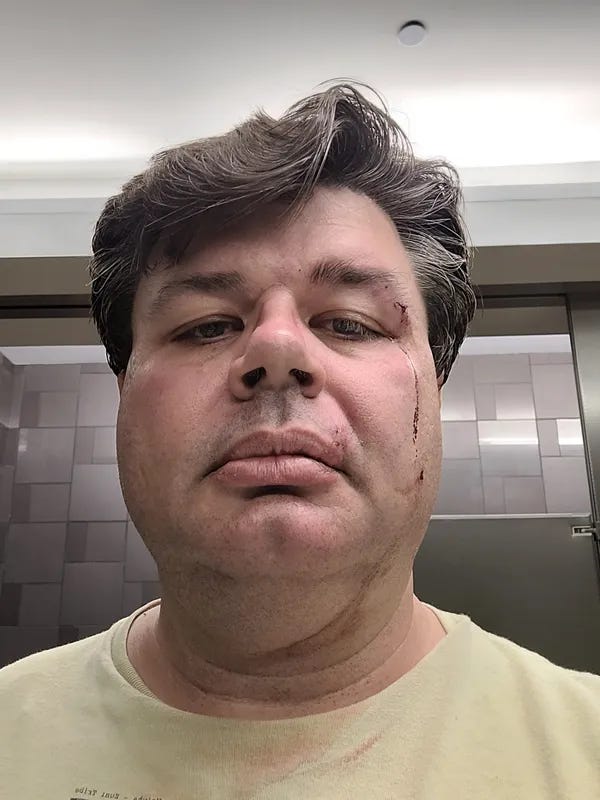
David Boyles, an instructor at Arizona State University, posts a photo of his injuries on Instagram. Photo courtesy of David Boyles.
A TPUSA-affiliated crew assault David Boyles, a queer Arizona State University professor who teaches English and is a co-founder of Drag Story Hour Arizona. The crew shouts accusations about drag shows and sexuality, “accusing [him] personally of pedophilia and hating America,” and ultimately shove him to the ground after he tries to block their camera from recording. Campus police say they investigated the interaction as a “potential bias or prejudicially motivated incident.” Both suspects would plead guilty in court. The professor had been featured on TPUSA’s Professor Watchlist in part for teaching an LGBTQ-themed class on pop culture and politics.
Subscribe for LGBTQ journalism.
Subscribe
March 20, 2024
In a debate, Kirk says, “I believe marriage is between one man and one woman, but if you ask me do I have hate in my heart for somebody that doesn’t choose the [heteronormative] lifestyle … of course not.”
April 1, 2024
Kirk calls for gender-affirming clinics to be banned: “We need to have a Nuremberg-style trial for every gender-affirming clinic doctor.”
June 6, 2024
Trump has spoken at multiple TPUSA events through the years. Trump appears here at the 2019 TPUSA Teen Student Action Summit. Photo by Gage Skidmore.
Trump appears at a TPUSA event, signaling collaboration with Kirk’s organization for his second presidential campaign, which was centered around anti-trans ads. Trump delegates many campaign responsibilities to Turning Point Action, the political advocacy arm of TPUSA. Trump tells the crowd, “Arizona is being turned into a dumping ground for the dungeons of the third world.”
June 8, 2024
Speaking on a podcast, Kirk attacks Ms. Rachel for quoting “love your neighbor” to defend Pride celebrations on “Songs for Littles,” her YouTube series that uses music and games to help toddlers develop language and social skills.
“Ms. Rachel, you might wanna crack open that Bible of yours. … Leviticus 18 [says] that ‘thou shall lay with another man, shall be stoned to death.’ … Ms. Rachel, you quote Leviticus 19, ‘love your neighbor as yourself.’ The chapter before affirms God’s perfect law when it comes to sexual matters.”
When opining about how Christians should act towards gay people, Kirk calls homosexuality an “error” and equates it to an addiction: “How do you love somebody? You love them so much to correct their error. … If you meet an alcoholic or you meet a drug addict, do you affirm their struggle? No! You say, ‘You’re better than this, let’s get you free from that.’”
When speaking about LGBTQ rights advocates, Kirk says, “First, they wanted you to affirm, and then they wanted you to celebrate and then they wanted you to participate. And if you don’t, they are willing to destroy your life.”
Oct. 28, 2024
Kirk wears a T-shirt with the slogan “xy = man” at an election rally in Arizona, referencing that sex and gender are biological and insinuating that trans people don’t exist.
Jan. 10, 2025
TPUSA and The Daily Wire release Identity Crisis, a documentary that cherry picks stories from detransitioners and parents fighting to protect children from gender ideology. The main expert in the documentary is Dr. Drew Pinsky, a TV personality who is not a gender specialist.
March 3, 2025
Kirk speaks at the 2025 TPUSA Young Women’s Leadership Summit in Texas. Photo by Gage Skidmore.
When asked by a gay conservative college student for advice, Kirk responds, “You are a complete human being. … We act as if the most important part of your identity is what you do in the bedroom. It doesn’t mean that much to me. If you asked from a perspective as a Christian, I don’t agree with that lifestyle.”
Aug. 25, 2025
“While we’re talking about flags, we should work to overturn every conviction for those arrested, fined, or otherwise harassed for the ‘hate crime’ of doing donuts over Pride flags painted on public streets,” Kirk writes on X, referencing a teenager who was arrested in St. Petersburg for doing circular “doughnut-burnouts” on a rainbow pride mural.
In a separate post, Kirk writes that “it should be legal to burn a rainbow or BLM flag in public.”
Sept. 10, 2025
Charlie Kirk is shot and killed while speaking at a TPUSA event at Utah Valley University in Orem, Utah. In the moments leading up to his death, Kirk is speaking about gun violence.
The mainstream media spreads disinformation based on falseleaks from the Bureau of Alcohol, Tobacco, Firearms, and Explosives that say the shooter had “expressions of transgender and anti-fascist ideology” written on the bullets.
Trans hate has risen since Kirk’s death, and trans students unaffiliated with the shooting have been doxxed and harassed.
“[People online] were asking for my class schedule,” Simone Goodheart, a trans woman and UVU alum, told Uncloseted Media. “A few of them made awful comments about my appearance and who I am as a person.”
Sept. 12, 2025
Kirk’s widow, Erika, issues a statement at the TPUSA headquarters in Phoenix, Arizona, signaling an escalation of tension:
“If you thought that my husband’s mission was powerful before, you have no idea. You have no idea what you just have unleashed across this entire country, and this world. … You have no idea the fire you’ve ignited within this wife. The cries of this widow will echo around the world like a battle cry.”
Two weeks after Kirk’s assassination, a Texas man faces charges for threatening to open fire at the Abilene Pride Parade as “revenge” for Kirk’s death. In Facebook messages, he urges a friend to “lock and load and pay them back” and suggests they go “hunting fairies.” The FBI says his threats were targeted toward Pride participants.
Sept. 30, 2025
TPUSA returns to Utah for the first time since Kirk’s death to host a panel at Utah State University.
The panel discusses political tolerance. Jason Chaffetz, a former Utah State Representative, says, “I worry that we’re putting too much tolerance. You do not need a man with junk in a woman’s bathroom. End of story.”
When discussing LGBTQ allies who lit up the iconic Brigham Young University’s “Y” in the color of the trans flag, the moderator calls it “some of that evil that’s just seeping in throughout the state.”
If objective, nonpartisan, rigorous, LGBTQ-focused journalism is important to you, please consider making a tax-deductible donation through our fiscal sponsor, Resource Impact, by clicking this button:
Sakler says she was white knuckling it, trying to get through life as a “shell of a person.” She began cutting, hitting and hating herself because of the rejection from her church community.
He was given a treatment plan that involved limiting time with LGBTQ affirming friends, reading articles designed to redirect his attractions, and practicing what the therapist called “male characteristic activities,” such as taking charge and asserting control. He told his therapist that his marker of when things would be better was “life [going] back to normal.”
The therapist also worked with his parents, telling them they had failed by allowing the “gay agenda” to threaten their family and “let the devil get into the house.”
Editor’s note: This article includes mention of suicide and self-harm. If you are having thoughts of suicide or are concerned that someone you know may be, resources are available here.
“You don’t feel secure in your masculinity,” Sam Nieves remembers his licensed therapist telling him at Brigham Young University in Provo, Utah. “Go grab a Playboy and find a way to enjoy it,” the Mormon therapist told him.
“He told me I can’t be straight if I don’t go fishing with my dad,” says Nieves, who was 20 at the time. “He told me I needed to play more sports, listen to country music, stuff like that. He told me something was wrong with me.”
After these sessions, which lasted about a year and a half, Nieves started experiencing crippling shame and self-loathing. He eventually developed excruciating migraines and memory loss.
“My therapist just helped me find better ways to help me to hate myself,” Nieves, now 41 and living in Seattle, Washington, told Uncloseted Media.
Sam Nieves as a young adult. Photo courtesy of Nieves.
Fourteen countries have a national conversion therapy ban, while many more have state or provincial bans. In the U.S., religious leaders can practice nationwide, though licensed therapists are not allowed to apply it to kids in 23 states.
While research around torture and mental health consistently suggests the practice should be banned, almost 700,000 LGBT adults have received conversion therapy at some point in their lives, including about 350,000 who received it as adolescents.
Despite all of this, on Oct. 7 the Supreme Court heard arguments in Chiles v. Salazar, a case that challenges Colorado’s conversion therapy ban and—if overturned—would have implications for the rest of the states with bans in place.
While the verdict will likely not be announced until June, the court seems poised to overturn it, suggesting that restrictions on therapists might violate the First Amendment’s free-speech clause.
“I’m emotionally devastated for the children who will lose the protections we fought so hard to give them,” says Nieves.
Conversion Therapy and Self-Hate
Unlike many young Americans who are forced into the practice by their parents, Nieves—who was raised Mormon—opted to see a conversion therapist because his church community said that if he didn’t change his sexuality, he was letting them down.
“I actively didn’t want to be attracted to guys,” he says. “And so it was always this confusing, gaslighting situation where they would tell me to stop being gay, even if I wasn’t doing anything. I was trying really hard not to. That’s when [the church] referred me to conversion therapy.”
Sam Nieves in his 20s. Courtesy of Nieves.
Nieves’ therapist insisted that his mom was too overbearing and his dad was not actively parenting, causing him to be gay. As his therapist continued to recommend that he engage in stereotypically masculine activities, he began to withdraw, cutting off friendships and avoiding community gatherings. His Mormon upbringing had taught him to feel shame, but conversion therapy solidified it.
“Conversion therapy gave me validation for why I hate myself. It was just building on top of what the church had already taught me,” he says.
Subscribe
Links to Dissociative Identity Disorder
Nieves became depressed and eventually developed a mild type of dissociative identity disorder (DID), where he experienced one persona that carried shame and recognized he was gay, and another that tried to act straight. Headaches and mental fog were persistent. Thoughts of ending his life flickered through his mind.
“It was just nonstop, massive disassociation,” he says. “There was the Straight Sam and the Gay Sam. And the whole time, everyone was telling me Satan was working on me because something inside me was trying to be gay. So it was insane making. They were making me clinically insane.”
According to medical experts, repeated trauma like medical procedures, war, human trafficking, conversion therapy and terrorism can cause DID when it overwhelms a child’s ability to cope, causing their sense of self to fragment into distinct identity states as a survival mechanism. The trauma disrupts the normal integration of self, leading to symptoms like memory gaps, dissociation and distinct personality states.
When Hunter Moore, a 29-year-old queer woman now living in Washington, was subjected to conversion therapy from her church and parents, she developed DID.
Raised in rural Idaho and immersed in an Independent Fundamental Baptist church that condemned queerness as sinful, the constant fear and shame brought on by her church’s conversion therapy program fractured her sense of self. She attributes her condition to repeated trauma that caused her brain to wall off painful memories.
“I didn’t know how to handle it other than just to check out,” Moore told Uncloseted Media. “I still have a lot of memory gaps from the conversion therapy because of how intense it was. … Once I didn’t have the restraints of that church anymore, the memories started to return.”
Fear, Shame and Suicidal Ideation
Similar to Nieves and Moore, Addy Sakler, who grew up in a conservative Protestant community in Ohio, says conversion therapy was “slowly killing” her.
“I figured I liked girls in kindergarten but did not have the language to describe it,” she told Uncloseted Media.
Sakler knew she wouldn’t be accepted at her church, so she put herself in conversion therapy throughout her young adulthood.
But it didn’t work. Sakler remembers the first sneaking moments of affection between grad school classes with her first crush. But after each kiss, the joy was followed by shame.
“We’d feel a lot of guilt and break up and immediately go repent,” she says. Both women were part of a church ministry that promised to “pray away the gay,” a 12-week program of lessons and deliverance sessions meant to convert them to heterosexuality. Instead, Sakler says, it nearly destroyed her.
Addy Sakler and her boyfriend before she came out. Photo courtesy of Sakler.
“I felt like a zombie walking around. I was depressed and I tried to commit suicide,” she says. “I was in the hospital for a month, two different times. It created a lot of trauma.”
Sakler says she was white knuckling it, trying to get through life as a “shell of a person.” She began cutting, hitting and hating herself because of the rejection from her church community.
Addy Sakler as an adult. Courtesy of Sakler.
“You believe what they’re saying. They’re telling you you’re broken and to be right with God you have to be heterosexual and if you’re not changing, then you’re being attacked by Satan.”
For nearly 15 years, Sakler attended conversion therapy conferences across the country, including one put on by the now dissolved Exodus International.
According to the Williams Institute, LGBTQ adults who have undergone conversion therapy have nearly twice the odds of attempting suicide and 92% greater odds of lifetime suicidal ideation compared to those who haven’t. Among LGBTQ youth, the numbers are higher, with 27% of those who experienced conversion therapy attempting suicide in the past year.
In addition, survivors experience disproportionately high rates of depression, PTSD and substance abuse. According to the findings from one Stanford Medicine study, the psychological harm caused by conversion therapy mirrors that of other severe traumas known to cause PTSD—like sexual or physical assault, the loss of someone close, or even experiences of war and torture.
Isolation and Families Torn Apart
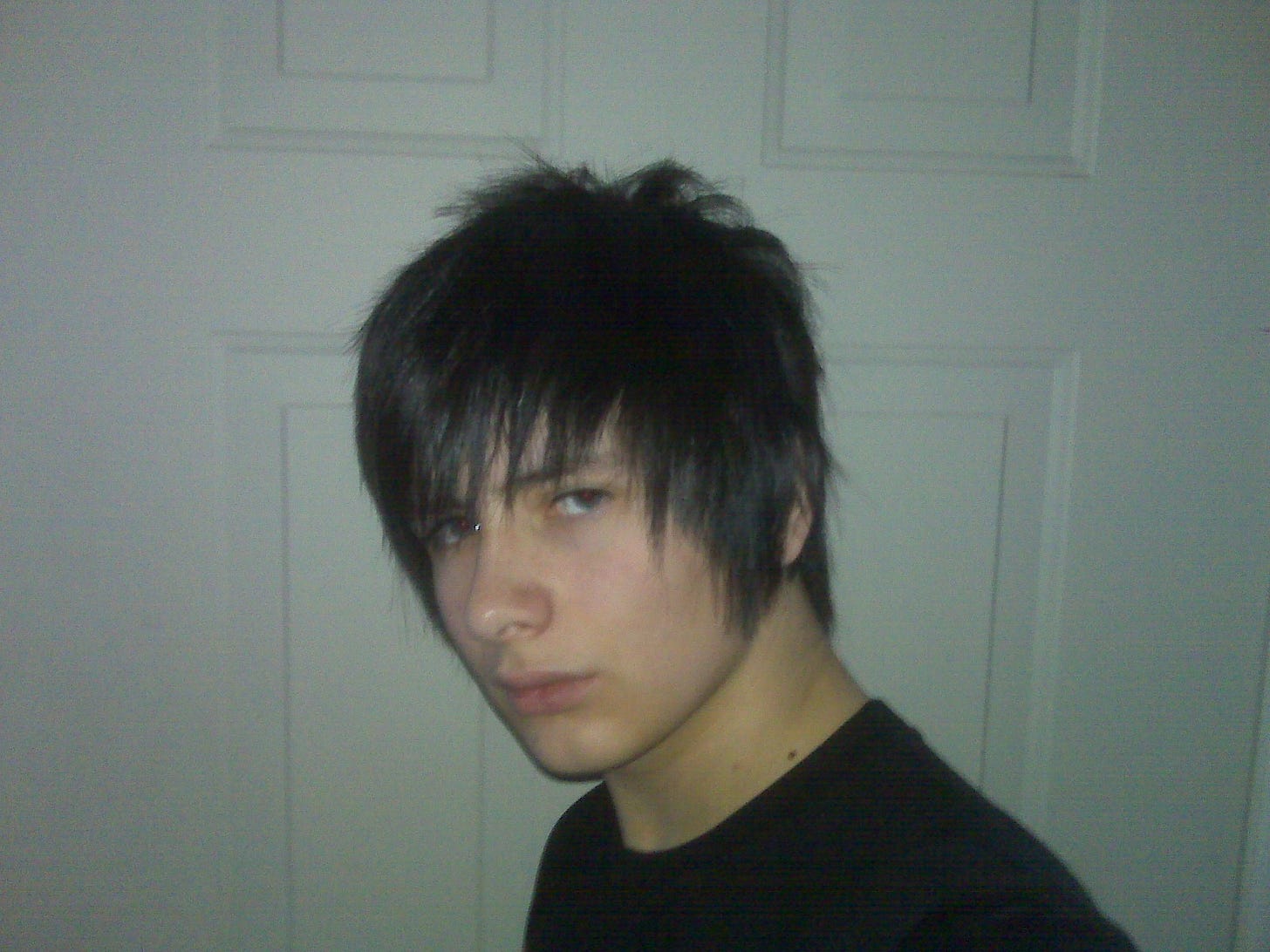
When Curtis Lopez-Galloway told his parents he was gay at 16, they drove him two hours away from his house in southern Illinois to a conversion therapist who used the sessions to berate him for not trying hard enough to change into “the man that God wanted” him to be.
Curtis Lopez-Galloway as a teenager. Photo courtesy of Lopez-Galloway.
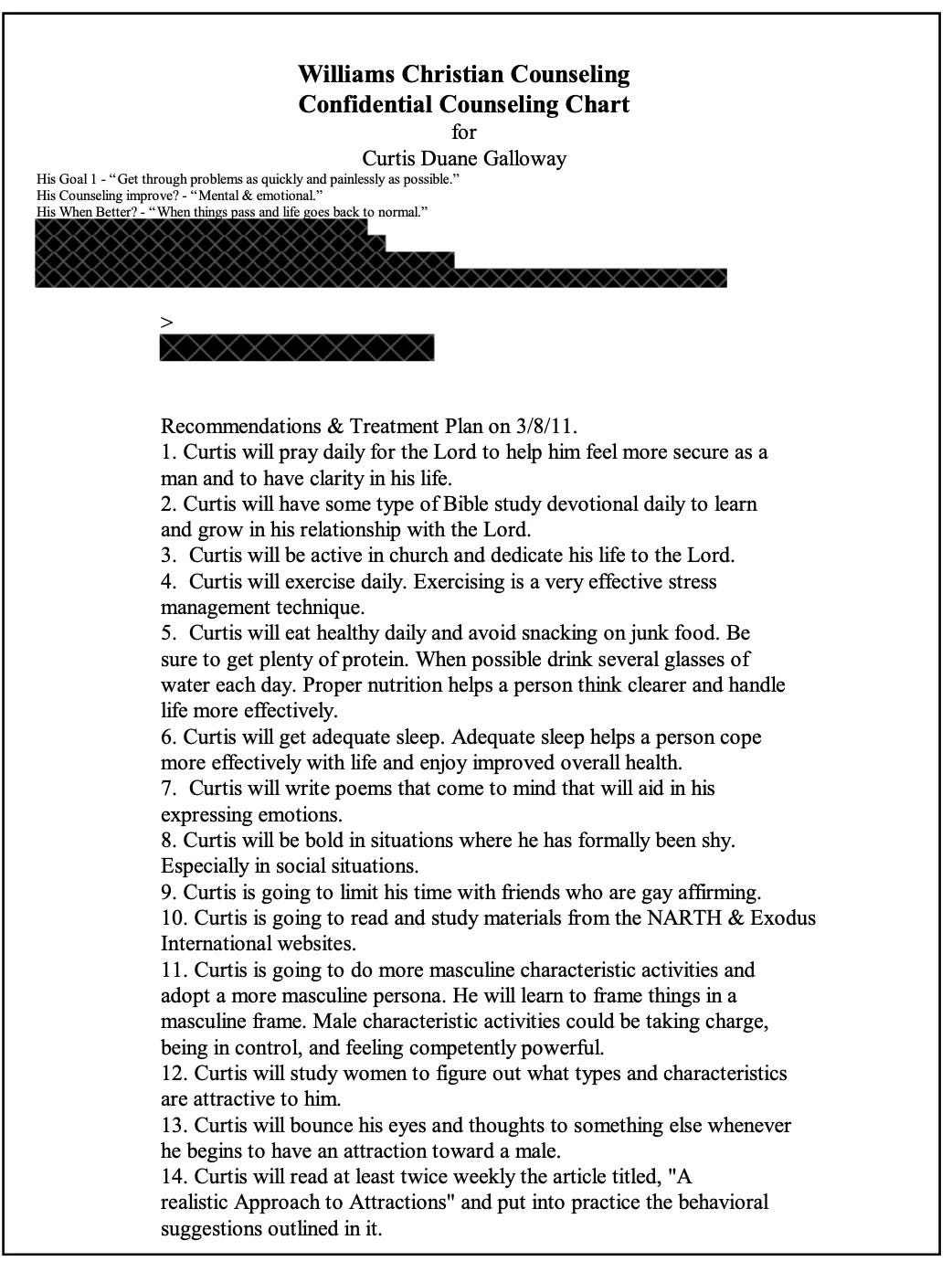
Lopez-Galloway remembers being told that his attractions to other men were a symptom of a deeper lack of masculinity, that he needed to “study women to understand what kind of man he was supposed to be” and that he should “bounce his eyes, and change his thoughts to something else whenever he begins to have an attraction toward a male.”
Curtis Lopez-Galloway’s treatment plan, courtesy of Lopez-Galloway.
He was given a treatment plan that involved limiting time with LGBTQ affirming friends, reading articles designed to redirect his attractions, and practicing what the therapist called “male characteristic activities,” such as taking charge and asserting control. He told his therapist that his marker of when things would be better was “life [going] back to normal.”
The therapist also worked with his parents, telling them they had failed by allowing the “gay agenda” to threaten their family and “let the devil get into the house.”
Lopez-Galloway, who now runs the Conversion Therapy Survivor Network, a nonprofit that connects survivors of the practice, recalls frustration and shame spilling into screaming matches that tore his family apart. “My parents were miserable, I was miserable, and we would just take it out on each other,” he says. “I went to [my therapist] for six months, and he just abused me and made life worse. It pushed me deeper into the closet and made me anxious and depressed.”
Curtis Lopez-Galloway as a teenager. Courtesy of Lopez-Galloway.
“[My therapist] would use therapeutic ideas but twist them in a way that was trying to change sexuality. … He would try to manipulate me in that sort of way and really broke me down as a person,” says Lopez-Galloway.
We reached out to the center Lopez-Galloway went to for treatment but they did not respond to a request for comment. Lopez-Galloway says his parents now acknowledge the harm the therapy caused, and he says their relationship has improved.
Subscribe
Life After Conversion Therapy
For many survivors of conversion therapy, the trauma can last a lifetime.
Even 21 years later, Nieves still gets triggered. He dropped out of college during his last semester of counseling school because the practices were too similar to those manipulated and weaponized by his therapist. “The hardest part was fighting … to no longer be suicidal every single day,” he says. “I would say that’s the hardest part. … It’s the suicidality that you fight with once it’s over.”
Nieves and Moore have both found support in Lopez-Galloway’s survivor network, where they meet weekly and heal together in community. Sakler has found healing in therapy for PTSD, and has found acceptance with her wife and her queer community in Sacramento, California.
Despite this, the trauma often requires undoing self-hatred and discovering self-worth.
“[We’re] constantly saying, ‘We don’t know who we are,’” Nieves says. “We don’t know how to enjoy life. We don’t know what the meaning of life is. We’re like The Walking Dead. Because just like how you break a horse, they broke our spirits. They told us everything about us was wrong and we needed to conform. But no matter what we did, we couldn’t conform.”
Even with these survivors’ experiences, along with countless testimonies from other Americans over decades, the Supreme Court looks poised to overturn Colorado’s ban, with multiple justices describing it as “viewpoint discrimination.”
Nieves strongly disagrees and advises kids who are experiencing conversion therapy right now to stay strong and ask for help when possible. “This may very well be the most difficult time of your life. For many of you, it’s going to feel like a living hell, and you may even pray for death every night. I know this, because this is how [I] felt too,” he says. “Often, [conversion therapists] break other laws. If you think someone might be breaking the law during your conversion therapy, please seek out a trusted adult and let them know,” he says.
Above all, Nieves tells kids to push through no matter what. “It can and will get better if you promise yourself that you deserve authentic joy, free of lies and coercion. Community is out there waiting for you, if you can just hold on for one more day, one more hour, or even just for one more minute.”
If objective, nonpartisan, rigorous, LGBTQ-focused journalism is important to you, please consider making a tax-deductible donation through our fiscal sponsor, Resource Impact, by clicking this button:
Listen to the illegal actions Israeli took in other countries. They are a rogue nation who feel the rules do not apply to them. They can do anything they want. Plus the lies and misinformation they put out is horrific. Hugs
We need to get this information out. This morning I heard from Alison Gill on the Daily Beans news podcast that ICE agents lied about a woman they shot ramming them. Turns out body camera videos shows ICE ramming the woman, cutting her off and screaming at her “do something about it bitch” then shooting her. I watched on The Majority report as ICE pepper sprayed a school, local police officers, and arrested an alderman official who was demanding to see the warrant in a hospital. Legally ICE is required to have a warrant on private property like a hospital, but they manhandled the woman and arrested her. They were in civilian plain clothes and had no identification. This is the Proud Boy thug gang being let loose on the public with no controls. We are not a free people. Get the word out to anyone and everyone because most mainstream media is not showing this. Hugs
Investigative journalist, Ken Klippenstein joins the show to discuss the Trump administration’s manipulation of recent shootings to bolster their war on trans people. Live-streamed on September 25, 2025
An ICE agent’s lies were exposed in the fatal shooting of 38-year-old Silverio Villegas González. Dr. Rashad Richey and Jamie Lowe discuss on Indisputable. Tell us what you think in the comments below.
“The fatal shooting of a Mexican immigrant by an Immigration and Customs Enforcement officer has left a community “shaken” and in need of transparency, Illinois Gov. JB Pritzker said on Monday, after police bodycam videos of the incident emerged. “Two weeks ago, a man was shot and killed by ICE in Franklin Park, Illinois. Shortly after, ICE issued a statement justifying the killing, saying the federal agent was ‘seriously injured,’’’ Pritzker said, referring to a statement from the Department of Homeland Security.”
I just read how Pete Hegseth has decided that the best military in the world is “too woke and not male enough to have the warrior ethos”. He wants a military modeled off the 1940 model with all male white straight cis people. A few women in the offices are OK but none of that integrated military that Eisenhower did, whites and blacks serve in different military units and of course now being Christian is going to be a new requirement. I don’t know if Hegseth is paid by Russians or if his Christian nationalism is causing him to idealize the very Russian military propaganda of a male only hyper aggressive military … the same military that has been getting its ass kicked in the Russian war against Ukraine. We are witnessing the dismantling of 80 plus years of integration and what made the US military so powerful. Think of how warfare is done today. With drones and weapons that reach targets over the horizons. You don’t need to be a Rambo for those tasks. I worked in a satellite intel unit. We were not really soldiers. When I was in the Navy we did not have the requirements for PT that the Army did, but we were still as deadly or even more so. This fixation of purging the military of the LGBTQ+ and female members is destroying what makes our military so great. Ask countries that have those people in their military like Israel! Their LGBTQ+ and female members are just effective as the men. But it doesn’t fit with the Christian Nationalist identity that Hegseth and his ilk are trying to push the US into.
Recently the heritage foundation pushed the idea of a trans terrorist idealization that was behind the public shootings and they used faked data that they created to prove their point. It is all to further the push of theirs to make the US a Christian Theocracy where only the biblical pairings they consider hole to be accepted. But in truth the bible allows for a male to have as many sexual partners as he wishes and only constrains the females from having sex with anyone but their husbands or their owners. The entire Christian teachings these people push is constriction for females and complete freedom for males on the issue of sex and marriage. Hugs
The Federal Bureau of Investigation is reportedly preparing to categorize transgender people as “violent extremists,” a categorization supported by organizations affiliated with Project 2025.
The most important LGBTQ+ news and politics stories delivered straight to your inbox
According to a September 18 report by independent journalist Ken Klippenstein, two anonymous national security officials said that the Bureau is discussing treating trans subjects as a subset of its new threat category, “Nihilistic Violent Extremists” (NVEs), which was created earlier this year. The Bureau defines “Nihilistic Violent Extremism” as “criminal conduct… in furtherance of political, social, or religious goals that derive primarily from a hatred of society at large and a desire to bring about its collapse by sowing indiscriminate chaos.”
Officials said that such a classification would give the Trump administration “political (and media) cover” as they escalate their anti-trans campaign in the aftermath of right-wing pundit Charlie Kirk’s death.
“They are cynically targeting trans people because the shooter’s lover was trans,” an unnamed senior intelligence official told Klippenstein. “The administration has convinced itself that the Charlie Kirk murder exposes some dark conspiracy.”
Last week, the false claim that there were “transgender” engravings on the bullets that suspect Tyler Robinson allegedly used to shoot Kirk began circulating widely, boosted by anti-LGBTQ+ conservatives like Rep. Nancy Mace and Steven Crowder. Utah Gov. Spencer Cox later confirmed that there was “no indication that the ammunition included transgender references.” On Sunday, Cox told Meet the Press that Robinson was allegedly in a romantic relationship with a roommate who is trans, providing no additional public corroborating data or information of the roommate’s gender. The authorities have stipulated the roommate has been cooperating with the investigation and was not aware of the shooting prior to its occurrence.
Despite no evidence linking an alleged trans roommate to Robinson’s motivation for shooting Kirk, right-wingers are nevertheless attempting to use this detail to push an anti-trans agenda. In a petition launched on Thursday, the Heritage Foundation — the far-right think tank behind the derided and controversial Project 2025 — and its spin-off group, the Oversight Project, asked the FBI to designate “Transgender Ideology-Inspired Violent Extremism” (TIVE) as a domestic terrorism threat category.
The group defines “TIVE” as “the belief that violence is justified against people who oppose [the trans community],” as well as the belief that opposing trans rights “itself constitutes a form of violence towards people who identify as [trans or gender nonconforming]… or poses an imminent threat to such persons’ emotional, psychological, or physical safety, including through self-harm or suicide.”
As The Independent noted, if such a category is adopted by the FBI, it could be applied to rhetoric used by activists, writers, and allies speaking out against anti-trans policies and rhetoric.
At least a dozen hoaxes have claimed trans people were responsible for mass shootings and other incidents since 2012.In reality, there is no evidence suggesting significant patterns of violence committed by trans people. In 2024, The Gun Violence Archive’s Executive Director, Mark Bryant, said that out of 5,000 mass shootings tracked by the archive, the number of trans or LGBTQ+ suspects is in “the single digit numbers.”








 Scottie's Playtime