Immigrants without criminal backgrounds have been among the fastest-growing groups of ICE detainees. Less than a third of ICE detainees, 28.5%, are convicted criminals, according to the data. Another quarter have pending criminal charges and the rest have no criminal histories.
We rely on your support to make local news available to all
Make your contribution now and help Gothamist thrive in 2025. Donate today
Gothamist is funded by sponsors and member donations
———————————————————————————————————-
Immigrants being detained in federal holding rooms in Lower Manhattan have complained of being unable to bathe or change clothes, cramped conditions, sometimes being provided just one meal a day, and sleeping on concrete benches or the floor.
Some immigrants staying at U.S. Immigration and Customs Enforcement holding rooms at 26 Federal Plaza also report stays lasting days at a time — as many as 10 days in one case referenced in a court filing.
“ There’s no room to sit down – standing room only,” said Rebecca Rubin, an immigration attorney for the New York Legal Assistance Group, who has had at least three clients detained in the cells.
The allegations came in court papers filed by lawyers representing immigrants held at the Lower Manhattan facility and in interviews with immigrants who said they were detained there.
Congressmembers, who for weeks have been refused entry at the site on the ground that the facilities are not “detention centers” but rather off-limits “processing centers,” have also raised concerns.
“Do not go treating people subhumanly — treating immigrants, simply because they are not born here — as if they are second class, as if they are not human,” Rep. Dan Goldman, a New York Democrat, told reporters Tuesday in a press conference outside the facility. “That is not what this country’s about.”
DHS Assistant Secretary Tricia McLaughlin, in a statement, dismissed the complaints in their entirety: “Any claim that there is overcrowding or subprime conditions is categorically false. All detainees are provided with proper meals, medical treatment, and have opportunities to communicate with their family members and lawyers.”
She added: “As we arrest and remove criminal illegal aliens and public safety threats from the U.S., ICE has worked diligently to obtain greater necessary detention space while avoiding overcrowding.”
In a previous statement, McLaughlin said, “26 Federal Plaza is not a detention center. It is a Federal building with an ICE law enforcement office inside of it.”
The holding areas are guarded rooms on the 10th floor of the federal government office building, just steps away from state and federal courthouses and City Hall. Those being detained include immigrants taken into custody after immigration court hearings in the same building.
The rooms used to be temporary holding areas where immigrant detainees were held for a few hours before being transferred to larger, more permanent and resourced detention centers, according to local immigration attorneys. But the lawyers said in recent months, detainees have been sleeping overnight in overcrowded facilities, some for days.
“In the past… it was sort of understood that (detainees) weren’t going to be spending any sort of meaningful time there,” said Harold Solis, co-legal director of Make the Road New York, the local chapter of the national immigrants’ rights advocacy group. “This is definitely a different reality that people are experiencing there.”
S. Michael Musa-Obregon, a New York-based immigration attorney, added, “It used to be a holding pen, like a central booking. Now it’s becoming a temporary jail.”
Several members of New York’s congressional delegation, including Reps. Nydia Velázquez, Adriano Espaillat, Jerry Nadler and Goldman, all Democrats, have tried in recent weeks to inspect the holding areas but were denied entry.
Federal law allows lawmakers to inspect detention facilities, with no notice needed. But in a conversation with Nadler and Goldman, ICE Deputy Field Office Director William Joyce said the site was a temporary “processing center,” not a detention facility and not subject to inspection.
In the June 18 exchange with the two lawmakers, recorded by Gothamist in a hallway at 26 Federal Plaza, Joyce said the holding areas were “approaching capacity.”
He added that detainees were being held overnight, but that claims of migrants staying for a week or more were “an exaggeration.”
‘These conditions are inhumane’
Immigration lawyers contend, based on ICE’s public detainee tracking system, that a detainee named Joselyn Chipantiza-Sisalema had been detained inside the facility for 10 days.
Make the Road NY filed a lawsuit on July 3 against the federal government, advocating for her release.
Lawyers for Chipantiza-Sisalema, a 20-year-old high school student, wrote in a court filing, “She has told her parents that her conditions of confinement are extremely distressing: she is sleeping on the floor, she is in the same clothes she was detained in and the food she is provided is inadequate.”
Chipantiza-Sisalema wasn’t allowed to call or visit with a lawyer, she wasn’t allowed to call anyone but her parents and she had spoken with her family only three times, for a minute each time, according to the court filing.
Chipantiza-Sisalema was transferred to another detention facility on Friday, according to Solis.
“These conditions are inhumane as individuals detained do not have access to beds, regular meals, or communication with loved ones or counsel,” lawyers wrote in Chipantiza-Sisalema’s case. “Detainees also report that they are not able to bathe or change clothes; that the temperature can be extremely hot or cold; and that medical care is not provided.”
Another detainee, Derlis Snaider Chusin Toaquiza, a 19-year-old high school student, was fed one to two meals a day and “forced to sleep sitting up for lack of space,” his attorneys wrote in a lawsuit demanding his release from ICE detention. Toaquiza was held for two days in a small room with over 60 people, according to the filing.
“The room was so crowded that he could not lie down and he had to sleep sitting up,” the filing said.
Enrique, 52-year-old former detainee from Peru who asked not to share his last name for fear of retaliation against his family still living in the United States, said he slept in a holding cell at 26 Federal Plaza for six days in late June.
Enrique said that when he first entered the roughly 5 by 10 meter room, there were about 30 people. Guards gave him an aluminum blanket to stay warm.
By the time he was transferred to another detention center, six days later, he said there were 100 people and not enough blankets to go around.
“We were on top of each other,” Massamba Gueye, a 29-year-old detainee from Senegal, told Gothamist. He said he was detained with about 30 men in a room for one night in early June. Gueye said while he was there, another man fainted, hit his head and started bleeding — but guards didn’t respond.
“Nobody was bothered to even try to help him,” Gueye, who has since been transferred to another ICE facility, said in a phone interview.
‘They’re killing us. My liver is killing me.’
Immigrants detained at 26 Federal Plaza and their relatives also complain about lack of medical care.
Samara Simone de la Cruz Gooden, 22, said her husband Joan Paul Alcivar de la Cruz, a 27-year-old from Ecuador, was detained at 26 Federal Plaza for at least four to five days in late June. Gooden said most of her husband’s liver had been removed before his detention and he requires a special diet, which he didn’t receive while staying in the holding cell.
“He broke down,” Gooden said. “He was like, ‘They’re killing us. My liver is killing me. I’m pooping out a lot of blood. I’m so scared.’”
De la Cruz didn’t receive any medical help while he was detained at 26 Federal Plaza, Gooden said. Eventually, he was rushed to the hospital, she said, where she wasn’t allowed to speak with him.
De la Cruz was eventually transferred to a facility in Louisiana, where he is currently being held. Attorneys at the New York Legal Assistance Group have filed a lawsuit advocating for his release.
Concerns have arisen about ICE detaining immigrants for days in short-term holding facilities elsewhere across the country.
A lawsuit filed last week in California claims that ICE is holding immigrants in another “processing center” in a basement in downtown Los Angeles — in what the lawsuit describes as “dungeon-like facilities,” with overcrowded, windowless rooms holding dozens of detainees.
Some rooms are so cramped that detainees can’t sit or lie down for hours at a time, the lawsuit alleges. The lawsuit also alleges that detainees lack necessary food, medical care and access to legal counsel. New York Attorney General Letitia James and attorneys general for 17 states filed a brief in support of that lawsuit.
More detention space is coming
On Tuesday, New York City Comptroller Brad Lander, Public Advocate Jumaane Williams and Goldman observed immigration court hearings and arrests inside 26 Federal Plaza.
While speaking to members of the press outside afterward, Goldman shared testimonies of migrants he said had been detained inside, who complained of overcrowded conditions and insufficient food and water.
Lander and Williams urged New Yorkers and elected officials to visit the building and observe immigration court hearings and subsequent ICE arrests. Lander was arrested last month while escorting a man away from his immigration court hearing.
Under President Donald Trump, ICE has ramped up immigration arrests, while at once contending with a shortage of detention space. As of the end of June, nearly 58,000 people were being held in ICE detention centers, according to the latest agency data — far exceeding ICE’s current detention capacity of 41,000 beds.
Immigrants without criminal backgrounds have been among the fastest-growing groups of ICE detainees. Less than a third of ICE detainees, 28.5%, are convicted criminals, according to the data. Another quarter have pending criminal charges and the rest have no criminal histories.
Trump’s signature “big, beautiful” domestic policy bill, recently signed into law, includes about $170 billion to support the administration’s immigration crackdown. That includes about $45 billion for immigration detention centers, which the American Immigration Council estimates will allow ICE to expand its detention capacity to 116,000 beds.
Jessica Gould contributed reporting.
This story was updated with comment from the Department of Homeland Security.
One voice was yelling he was a US citizen. The conditions are horrible. They get their drinking water from the toilet. Maxwell Frost is a progressive treasure. Hugs
I could have written large parts of this myself. It is scary to be in our position and at the mercy of those who have so much money they will never understand our needs or it seems even care. Most of congress are multimillionaires. They see their jobs not to look out for people like me, but to gain ever more wealth and power for themselves. Which leads to the billionaire bailout bill the republicans are pushing to pass right now. Hugs
The author asserts cuts to programs such as Social Security Disability Insurance will make it difficult for her to afford basic necessities The program provides month payments to people who have a disability that stops or limits their ability to work. (Dreamstime/TNS)
Being a care provider in a nursing home is backbreaking work. It includes heavy lifting and spending all day on your feet, helping patients eat, dress and use the bathroom while keeping track of dozens of patients who all have different needs, medicines and preferences. It’s never easy, but during my career I held myself to the standard of providing the care I would want someone to give to one of my family members.
I was a certified nursing assistant and medication aid in nursing homes before retiring due to health problems. I loved my job. It provided me with more than a paycheck; it gave my life meaning. It felt good to be someone people could depend on, especially in times of need. I loved being the first face my patients would see in the morning and the last at night. It was physically and emotionally draining at times, but always worth it. I’ve learned that anything in life worth having is a struggle to obtain. I miss working every day.
Now, my main source of income is Social Security Disability Insurance. Without it, I wouldn’t be able to cover my rent or help take care of my daughters, grandchildren or father. My monthly disability check, which I put toward rent, laundry, bills and other necessities, goes fast. The only way I am able to cover the rest of my expenses each month is through programs such as the Supplemental Nutrition Assistance Program and the Low Income Energy Assistance Program and Medicaid.
I’m prediabetic, so I have to be mindful about what I eat. SNAP is the only way I am able to afford healthy food. Lately, the price of everything in the grocery store has gone up. I shop carefully, but some weeks I have to forego buying meat to save money. My SNAP benefits have gone down significantly in recent months, which has already made it harder for me to afford the food I need. Across Pennsylvania, over 2 million people receive SNAP benefits. That’s thousands of families in our state, just like me, who depend on this program to put food in the mouths of their children.
I’ve received Medicaid on and off for over 20 years. It has helped me pay for important surgeries including a vision surgery, cystoscopy and a hysterectomy. Medicaid helps me cover copays and deductibles and access mental health services. Losing Medicaid would mean sacrificing health care and having to pay my medical costs out of my own pocket, which I cannot afford.
Every winter, LIHEAP benefits help me keep my home warm. It keeps my heating bill manageable so that I don’t have to use the stove to generate heat. Without LIHEAP, I would need to make tough decisions about which bills to pay, whether that’s rent, electricity or gas. It would be a situation of robbing Peter to pay Paul. My monthly budget is extremely fragile and the possibility of losing LIHEAP, which provides me about $200 each winter, is enough to put my whole financial situation at risk. When I hear that politicians in Washington want to make billions of dollars worth of cuts to SNAP, Medicaid, LIHEAP and other programs, it makes me incredibly anxious. Without these programs, I wouldn’t be able to stock my fridge, go to the doctor or heat my home.
I spent decades caring for patients in need and did it with pride. No one ever expects to be disabled and suddenly have to stop working. You never know what could happen and never think it could happen to you until it does. I didn’t think I would ever need back the tax dollars I put into the system. But God had a different plan for me. These programs are so important for me and millions of Americans.
But the programs are also part of what makes America a great and a caring nation. They ensure that any American — our neighbor, our family member, or a co-worker — who gets sick can live with dignity in the richest nation on earth. It seems like Republicans in Congress have no interest in supporting everyday people. They just want to make the rich richer.
By voting in favor of cuts to Medicaid and SNAP, my Congressional representative, Rep. Ryan Mackenzie, voted to turn his back on constituents like me. With these cuts, people will suffer and end up on the streets. People like me, who are already doing everything we can to make it work, will struggle even more.
I am calling on Sens. Fetterman and McCormick to chart a different path and put an end to these proposed cuts. Lives are on the line. It’s time for our leaders to show that they care and that they are willing to stand up against billionaires. On behalf of the millions of Pennsylvanians who rely on these SNAP, Medicaid and LIHEAP, I urge you to protect these programs and our ability to provide for our families.
This is a contributed opinion column. Pamela Berman is a Bethlehem resident and former certified nursing assistant. The views expressed in this piece are those of its individual author, and should not be interpreted as reflecting the views of this publication. Do you have a perspective to share? Learn more about how we handle guest opinion submissions at themorningcall.com/opinions.
Israeli ministers said the settler outpost at Homesh will be retrospectively legalised (file photo from May 2023)
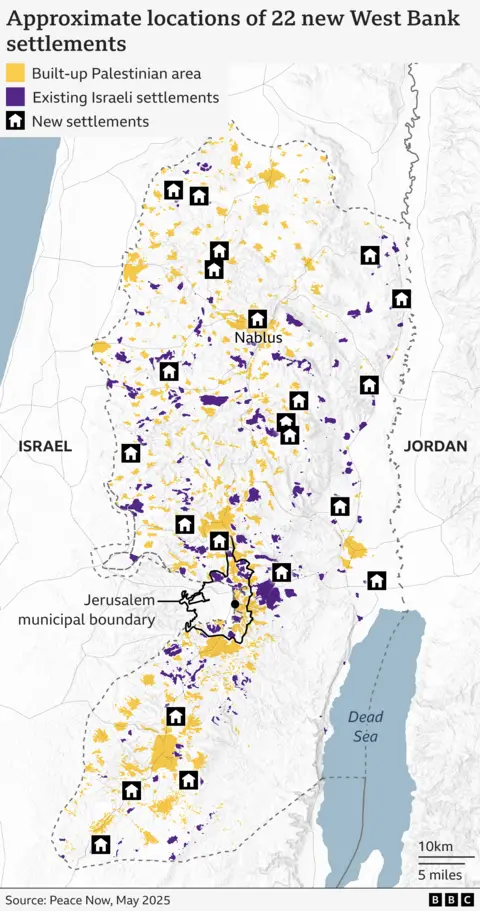
Israeli ministers say 22 new Jewish settlements have been approved in the occupied West Bank – the biggest expansion in decades.
Several already exist as outposts, built without government authorisation, but will now be made legal under Israeli law. Others are completely new, according to Defence Minister Israel Katz and Finance Minister Bezalel Smotrich.
Settlements – which are widely seen as illegal under international law, though Israel disputes this – are one of the most contentious issues between Israel and the Palestinians.
Katz said the move “prevents the establishment of a Palestinian state that would endanger Israel”, while the Palestinian presidency called it a “dangerous escalation”.
The Israeli anti-settlement watchdog Peace Now called it “the most extensive move of its kind” in more than 30 years and warned that it would “dramatically reshape the West Bank and entrench the occupation even further”.
BBC team’s tense encounter with sanctioned Israeli settler while filming in West Bank
Israeli settlers are seizing Palestinian land under cover of war – they hope permanently
Israel has built about 160 settlements housing some 700,000 Jews since it occupied the West Bank and East Jerusalem – land Palestinians want, along with Gaza, for their hoped-for future state – in the 1967 Middle East war. An estimated 3.3 million Palestinians live alongside them.
Successive Israeli governments have allowed settlements to grow. However, expansion has risen sharply since Prime Minister Benjamin Netanyahu returned to power in late 2022 at the head of a right-wing, pro-settler coalition, as well as the start of the Gaza war, triggered by Hamas’s 7 October 2023 attack on Israel.
On Thursday, Israel Katz and Bezalel Smotrich – an ultranationalist leader and settler who has control over planning in the West Bank – officially confirmed a decision that is believed to have been taken by the government two weeks ago.
A statement said they had approved 22 new settlements, the “renewal of settlement in northern Samaria [northern West Bank], and reinforcement of the eastern axis of the State of Israel”.
It did not include information about the exact location of the new settlements, but maps being circulated suggest they will be across the length and width of the West Bank.
Katz and Smotrich did highlight what they described as the “historic return” to Homesh and Sa-Nur, two settlements deep in the northern West Bank which were evacuated at the same time as Israel withdrew its troops and settlers from Gaza in 2005.
Nine of the settlements would be completely new, according to the watchdog. They include Mount Ebal, just to the south of Homesh and near the city of Nablus, and Beit Horon North, west of Ramallah, where it said construction had already begun in recent days.
The last of the settlements, Nofei Prat, was currently officially considered a “neighbourhood” of another settlement near East Jerusalem, Kfar Adumim, and would now be recognised as independent, Peace Now added.
Katz said the decision was a “strategic move that prevents the establishment of a Palestinian state that would endanger Israel, and serves as a buffer against our enemies.”
“This is a Zionist, security, and national response – and a clear decision on the future of the country,” he added.
Smotrich called it a “once-in-a-generation decision” and declared: “Next step sovereignty!”
But a spokesperson for Palestinian Authority President Mahmoud Abbas – who governs parts of the West Bank not under full Israeli control – called it a “dangerous escalation” and accused Israel of continuing to drag the region into a “cycle of violence and instability”.
“This extremist Israeli government is trying by all means to prevent the establishment of an independent Palestinian state,” Nabil Abu Rudeineh told Reuters news agency.
Lior Amihai, director of Peace Now, said: “The Israeli government no longer pretends otherwise: the annexation of the occupied territories and expansion of settlements is its central goal.”
Elisha Ben Kimon, an Israeli journalist with the popular Ynet news site who covers the West Bank and settlements, told the BBC’s Newshour programme that 70% to 80% of ministers wanted to declare the formal annexation of the West Bank.
“I think that Israel is a few steps from declaring this area as Israeli territory. They believe that this period will never be coming back, this is one opportunity that they don’t want to slip from their hands – that’s why they’re doing this now,” Mr Ben Kimon told the BBC’s Newshour programme.
Israel effectively annexed East Jerusalem in 1980, in a move not recognised by the vast majority of the international community.
AFP
Israeli soldiers accompanied settlers establishing the Homesh outpost in May 2023
This latest step is a blow to renewed efforts to revive momentum on a two-state solution to the decades-old Israel-Palestinian conflict – the internationally approved formula for peace that would see the creation of an independent Palestinian state alongside Israel – with a French-Saudi summit planned at the UN’s headquarters in New York next month.
Jordan’s foreign ministry condemned what it called a “flagrant violation of international law” that “undermines prospects for peace by entrenching the occupation”.
UK Foreign Office Minister Hamish Falconer said the move was “a deliberate obstacle to Palestinian statehood”.
Since taking office, the current Israeli government has decided to establish a total of 49 new settlements and begun the legalisation process for seven unauthorised outposts which will be recognised as “neighbourhoods” of existing settlements, according to Peace Now.
Last year, the UN’s top court issued an advisory opinion that said “Israel’s continued presence in the Occupied Palestinian Territory is unlawful”. The International Court of Justice (ICJ) also said Israeli settlements “have been established and are being maintained in violation of international law”, and that Israel should “evacuate all settlers”.
Netanyahu said at the time that the court had made a “decision of lies” and insisted that “the Jewish people are not occupiers in their own land”.
I have very few photos of me as a child. I only have these few. I wish I had more. I did have a small book given to me by someone who knew my adopting adults but hurricane Ian took them from me and I did not have them saved digitally. Notice that until I was 17 and in the church boarding school was I allowed to have long hair. Hair was used as a way to set me apart from other kids, to reenforce the idea that I was less than the others, I was the one to be hurt and used. As I have mentioned while the other kids could have their hair the current style I was required to have my hair as short as possible. When I was young my adopting father cut it himself and would often leave bald spots and make it as ugly as possible. Hugs
Me at 7 months
These two pictures below I do not know how old I am, but again notice the hair. In the top picture we are at the large farm my grandparents owned. It was a place the entire family gathered at holidays. I was happy to be outside because inside the big farm house with a dozen bedrooms I was constantly being raped or made to please “my” siblings, cousins, and uncles. Even at that age of 4 or 5 I was no stranger to the emotional, physical, and sexual abuse that started at age 3. The clothing was always decent when we were there, to be taken from me once we left. At the farm house I had food to eat when hungry, and grandmother was always talking to me, hugging me, and just letting me stay near her. No one yelled at me even though I was scared of some of the adult men. But when we left the good times stopped and the abuse began.
The lower one I think was taken after we have had moved to the small cow town to evade the abuse charges against the adults. I think this might have been my second grade school photo. By now the light was going from my eyes and I learned not to talk. I simply looked at everyone as possibly the next one I would have to “make happy” or perform for. It was now happening at school, by the one of the town police officers, and of course at home. My siblings would drug me and take me to parties or simply have them at the house we lived in and I would be a party favor.
In this picture below I am about 11 or 12. I am about to go to be taken somewhere to some event to be displayed. I think it might have been to church where for a while the adopting adult female and her daughters were going to hopefully to buy their way past their guilts. The pastor there was regularly abusing me, I have talked about that before. I was grateful he only wanted to play with my nude body or have me suck him, never put something in my butt as normally I would have been raped at least once before getting ready for church. By now I had no fight left in me. Notice the always long sleeves to cover the marks and bruises and the long pants to cover the welts and marks. Again notice the short hair at a time when longer flowing hair was being worn by boys my age in school. This would have been in the early 1970s. By now at this age I had accepted I was a toy to be used or displayed, moved and directed by them. I had no agency, no authority, no say in my life. My retreat was in my head, the place I lived, the dreams and stories I told myself that no one else could hear.
Below is me at 18 at the church boarding school. This is the first time in my life I was allowed to grow my hair out. The adopting adults hated it. The adopting adult female constantly bitching and insulting me over. At this point the adopting male refused to speak to me or be in any room I was in if I had to be at their home during the school year. I tried to remain at the school as much as possible.
Below is me at age 23 or early 24 when I had just gotten out of the military. I had already started to let my hair grow over my ears. This was the way I kept my hair most of my life just longer on the sides and back. Parted on the left and swept to the right. Hugs
This is me at age 23 or early 24 when I had just gotten out of the military. I had already started to let my hair grow over my ears. This was the way I kept my hair most of my life just longer on the sides and back. Parted on the left and swept to the right. Hugs
People shop in a supermarket in New York City on Feb. 20, 2025.
Charly Triballeau/AFP via Getty Images
The Department of Agriculture is demanding states hand over personal data of food assistance recipients — including Social Security numbers, addresses and, in at least one state, citizenship status, according to emails shared with NPR by an official who was not allowed to speak publicly.
The sweeping and unprecedented request comes as the Trump administration ramps up the collection and consolidation of Americans’ sensitive data, and as that data has been used to make misleading claims about people in the U.S. illegally accessing public benefits and committing fraud, and to build a greater capacity to deport them.
The emails obtained by NPR also show the nationwide directive regarding the Supplemental Nutrition Assistance Program, or SNAP, follows a request by federal auditors for information that included citizenship data but not other data typically used to verify financial eligibility for the program.
The latest data demands are “absolutely alarming,” and “reckless” and likely violate the Privacy Act and other statutes, said John Davisson, senior counsel and director of litigation at the nonprofit Electronic Privacy Information Center. He and other advocates warn the data could be used to enable deportation and mass surveillance efforts and would do little to address improper payments.
“It is an unprecedented extension of the administration’s campaign to consolidate personal data,” Davisson said.
USDA’s unusual data request
SNAP, formerly known as food stamps, is a federal program. Each state administers the program and enrolls participants based on eligibility determined by Congress. While the USDA and its Office of Inspector General can audit state SNAP programs, participants’ personal data typically remains under the state’s control.
In March, the USDA’s Office of Inspector General notified California, Florida, New York and Texas of inspections of their SNAP programs to see if the states were improperly using administrative funds to pay out benefits, the emails show.
That ultimately led to a request for detailed sensitive data — including citizenship status and addresses — of all SNAP participants in the previous year from at least one of the states.
A sign outside of a grocery store welcomes those on food assistance in a Brooklyn neighborhood that has a large immigrant and elderly population on Oct. 16, 2023 in New York City.
Spencer Platt/Getty Images
An April 2 update the state received from the OIG’s office added a new objective: performing analytics on participant data to “evaluate its quality and integrity.” Yet the watchdog ultimately declined to request participants’ employment status or income — which are key for determining financial eligibility for food assistance and detecting possible fraud.
Instead, the request prioritized other data fields, including name, date of birth, address, contact information, Social Security number, citizenship status and information about household members, the emails show.
At an initial joint video conference, the states learned the inspections had been requested by Secretary of Agriculture Brooke Rollins, according to an official who attended the meeting but was not authorized to discuss the matter. Trump fired existing inspectors general across the federal government when he took office, including at the USDA where a new permanent leader of the office has yet to be confirmed.
Earlier this week, the USDA escalated its quest for data further.
In a May 6 letter to all states, an adviser for Food, Nutrition and Consumer Services said the federal agency would be seeking personally identifiable information for SNAP applicants and recipients, including, but not limited to, “names, dates of birth, personal addresses used, and Social Security numbers” going back to Jan. 1, 2020. USDA did not answer NPR’s questions about the full extent of personal data it was requesting.
The letter said USDA is asking private contractors that process SNAP payments for states to turn over that data, and will use it to “ensure program integrity, including by verifying the eligibility of benefit recipients.” The directive comes as Republican lawmakers in Congress are proposing deep cuts to the food assistance program that would reduce the number of people who participate in it.
DOGE’s role
The May 6 letter cited President Donald Trump’s March 20 executive order, “Stopping Waste, Fraud, and Abuse by Eliminating Information Silos,” which calls on agencies to ensure the federal government “has unfettered access to comprehensive data from all state programs that receive federal funding “including from “third-party databases” in order to identify fraud and overpayments.
Fidelity Information Services, a vendor used by some states to process electronic bank transfer transactions for SNAP programs, told its state partners the day before USDA’s letter to states that the agency and its DOGE team contacted them in connection to the executive order, and that “no proprietary, confidential, or personally identifiable information” was shared, according to emails obtained by NPR.
A customer shops for eggs at a grocery store on March 12, 2025 in Chicago.
Scott Olson/Getty Images
“FIS values its close working relationship with both USDA and its state partners and is committed to supporting efforts to improve program efficiency and reduce fraud,” reads a statement the company provided to NPR. “As agreed with the USDA and in compliance with federal regulation, FIS has notified States of the USDA’s request and is working with both to determine the most efficient manner to respond with the requested information.”
Wired, the Washington Post and CNN have reported that DOGE is also combining sensitive data from across agencies, including Social Security Administration, Department of Homeland Security and the Internal Revenue Service, to create a data tool that can help the federal government track and arrest immigrants they want to remove.
More than a dozen federal lawsuits allege DOGE staffers have been illegally granted permission to view databases with personal and financial information the government maintains, and multiple federal judges have expressed concern about what information DOGE has accessed and why. Late last month, DHS announced a DOGE-led overhaul of its Systematic Alien Verification Entitlements (SAVE) database, making the system free for state and local governments to use and promising a “single, reliable source for verifying non-citizen status nationwide.”
Davisson, the privacy attorney, said the SNAP data being requested could be used to make exaggerated allegations of fraud, and that combining the information with other DOGE-obtained data could be used for immigration enforcement efforts.
“What they’re building is a surveillance weapon and it can be put to all sorts of adverse uses in the future,” said Davisson.
NPR asked the USDA if the agency would be following protocols outlined in the Privacy Act, such as publishing a privacy assessment and System of Records Notice for the new dataset. An unnamed spokesperson using a USDA press email account told NPR the agency’s general counsel is determining whether that is required.
“All personally identifiable information will comply with all privacy laws and regulations and will follow responsible data handling requirements,” the email said.
Fraud and abuse with SNAP benefits are rare
After Trump issued an executive order in February aimed at ensuring immigrants without legal status are not receiving federal benefits, Agriculture Secretary Rollins made combatting alleged mispayments to ineligible immigrants a focus.
“The days in which taxpayer dollars are used to subsidize illegal immigration are over,” Rollins said in a February press release.
Most of the improper payments in 2022 were due to unintentional mistakes by state workers or households, rather than intentional fraud, according to an analysis of the data by the left-leaning Center for Budget and Policy Priorities.
Only 50% of eligible noncitizens (which includes refugees and green card holders) and 59% of eligible children living with noncitizen adults participated in SNAP in 2022, according to a USDA report. Overall, advocates said participation among those who are entitled to receive this benefit is low due to fears that it may have a negative impact on immigration proceedings.
A sign alerting customers about SNAP food stamps benefits is displayed in a Brooklyn grocery store on Dec. 5, 2019 in New York City.
Scott Heins/Getty Images
Even though immigrants without legal status are not eligible to receive SNAP or other federal benefits, SNAP data does include the names and addresses of people who could be subject to deportation now or in the future, or who share a household with people who could be.
Some legal immigrants who receive SNAP benefits may lose their legal status in the future given that the administration is trying to reverse Biden-era immigration programs that granted hundreds of thousands of people the ability to live and work in the U.S.
For years, advocates and state agencies have tried to reassure immigrant families that it is safe for them to sign up for assistance if they met the eligibility requirements.
“People seeking services need to know that their information will be used only to administer the program — and won’t put them or their family members at risk,” said Tanya Broder, an attorney with the National Immigration Law Center.
“But the federal government’s demand for ‘unfettered’ access to sensitive data across multiple agencies, and its aggressive pursuit of immigrants, raise serious privacy concerns and the potential that information will be weaponized against people who would go hungry without assistance.”
On an FAQ page to sign up for food assistance from California, the site currently says the state will not report applicants’ immigration status to authorities and information is used only to determine eligibility.
“Authorities cannot use this information to deport you unless there is a criminal violation,” the state website says.
New York’s website says: “Applying for or receiving SNAP will not affect your ability to remain in the United States.”
Advocates NPR spoke with said it is important for SNAP participants to understand that it is not yet known at this point how states will handle the USDA’s pending data requests.
Esther Reyes with Protecting Immigrant Families, a coalition of 700 groups across the country that help eligible immigrants access services, is urging states to check with their congressional delegations about whether the data requests are legal before responding.
As for people who may feel fearful about enrolling in SNAP given concerns over data, Reyes said, “We really encourage families and communities to talk to enrollment workers and the people that they trust before acting on that fear.”
NPR’s Ximena Bustillo contributed reporting.
Have information you want to share about SNAP, DOGE access to government databases and immigration? Reach out to these authors through encrypted communication on Signal. Stephen Fowler is at stphnfwlr.25, Jude Joffe-Block is at JudeJB.10 and Ximena Bustillo is at ximenabustillo.77. Please use a nonwork device.
Correction May 9, 2025
An earlier version of this story misspelled John Davisson’s name.


AFP
Israeli ministers said the settler outpost at Homesh will be retrospectively legalised (file photo from May 2023)AFP







 Scottie's Playtime