The U.S.A. now, and then,

from Heather Cox Richardson. Though our current president has little respect for U.S. veterans, that is not true of anybody I know. Even anti-war I believe our current service people and our veterans are deserving of all benefits of their citizenship and especially added benefits of their service to the U.S. Many readers here are military veterans. My mother’s brother-in-law, my (favorite!) Uncle Jack, served as a U.S. Marine in WWII. My father served in the U.S. Army during the Korean conflict. All of us know and love someone who’s served us in this honorable and unique fashion. While our president doesn’t think to respect that, or even think about it at all, the rest of us do. I know we are thankful. And now, from Heather Cox Richardson, history expert,

June 5, 2025 by Heather Cox Richardson
Read on Substack

Today the U.S. political world was consumed today by a public fight between President Donald J. Trump and his former sidekick, billionaire Elon Musk. Musk invested about $290 million into the 2024 election, vowing to elect Trump in order to get rid of government investigations into his businesses he worried would “take [him] down.”

When Trump took office, Musk became a fixture in the White House, attending Cabinet meetings and heading the “Department of Government Efficiency.” That group set out to kill government programs by withholding congressionally approved funds at the same time that its staff sucked up information on Americans that could feed the training of artificial intelligence and killed the investigations into his businesses Musk had worried about.

In February, Musk posted on social media: “I love [Donald Trump] as much as a straight man can love another man.”

But Musk overstepped boundaries and overstayed his welcome even as his antics hurt sales of his signature car, the Tesla, inspiring Trump to do a car commercial for him on the White House grounds. Just a week ago, Musk officially left the White House on the same day that an article in the New York Times documented his heavy drug use on the campaign.

Then, on Tuesday, June 3, he took a public stand against the omnibus bill Trump desperately wants Congress to pass, posting on X: “I’m sorry, but I just can’t stand it anymore. This massive, outrageous, pork-filled Congressional spending bill is a disgusting abomination. Shame on those who voted for it: you know you did wrong. You know it.”

And with that, the falling out began.

This morning, Trump told reporters he was “disappointed” in Musk. Ron Filipkowski of Meidas followed the saga from there.

“Without me, Trump would have lost the election, Dems would control the House, and the Republicans would be 51–49 in the Senate,” Musk wrote. “Such ingratitude.”

Trump then suggested that “The easiest way to save money in our Budget, Billions and Billions of Dollars, is to terminate Elon’s Governmental Subsidies and Contracts. I was always surprised that Biden didn’t do it!”

Musk promptly said he would begin decommissioning SpaceX’s spacecraft, which supply the International Space Station.

The two men continued to go back and forth, with Musk saying that “Donald Trump is in the Epstein files,” a reference to the records compiled by convicted sex offender Jeffrey Epstein, with whom Trump was friendly. Musk also said Trump’s tariffs will cause a recession, and agreed with another poster who suggested that Trump should be impeached and replaced with Vice President J.D. Vance.

Trump responded to that attack far more weakly than one would have expected, simply turning back to the omnibus bill and insisting it “is one of the Greatest Bills ever presented to Congress.”

Musk’s behavior is erratic in its own right, but if there is anything but pique behind it, it appears he is threatening Trump by making a play to control the Republican Party. In response to a post by conspiracy theorist Laura Loomer suggesting that Republican lawmakers are unsure if they should side with Trump or Musk, Musk wrote: “Oh and some food for thought as they ponder that question: Trump has 3.5 years left as President, but I will be around for 40+ years.”

It’s quite a gamble, since Trump controls the government contracts on which Musk’s fortune was built and on which he still relies. Some MAGA loyalists appear to see the fight as a victory for Trump and are thrilled to see Musk’s star fall. MAGA influencer Steve Bannon told Tyler Pager of the New York Times that he has advised Trump to cancel all of Musk’s federal contracts and launch a formal investigation of his drug use and his immigration status.

Kylie Robison and Aarian Marshall of Wired noted that TrumpCoin lost more than $100 million in value during the fight. Tesla stock lost $152 billion of value from its market capitalization, prompting Filipkowski to note that the total came to about $9 billion per tweet.

Economist Robert Reich had perhaps the best summary of the fight today when he noted, “That any of us have to care about the messy breakup of these two massive narcissists—and that they both individually wield such massive power—is an indictment of our political system and further proves the poisonous influence of Big Money on our democracy.”

Indeed, today’s White House and today’s America are very different from what they were eighty-one years ago.

President Franklin Delano Roosevelt gave his twenty-ninth Fireside Chat on June 5, 1944, and had good news for the American people. The day before, on June 4, Rome had fallen to Allied troops. “The first of the Axis capitals is now in our hands,” Roosevelt said.

The president pointed out that it was “significant that Rome has been liberated by the armed forces of many nations. The American and British armies—who bore the chief burdens of battle—found at their sides our own North American neighbors, the gallant Canadians. The fighting New Zealanders from the far South Pacific, the courageous French and the French Moroccans, the South Africans, the Poles and the East Indians—all of them fought with us on the bloody approaches to the city of Rome. The Italians, too, forswearing a partnership in the Axis which they never desired, have sent their troops to join us in our battles against the German trespassers on their soil.”

This group of ordinary men from many different countries had worked together to defeat the forces of fascism.

But FDR warned Americans that the fall of Rome was only the beginning. “We shall have to push through a long period of greater effort and fiercer fighting before we get into Germany itself,” he said. [T]he victory still lies some distance ahead. That distance will be covered in due time—have no fear of that. But it will be tough and it will be costly.”

FDR knew something his audience did not. On the other side of the Atlantic, paratroopers, their faces darkened with cocoa, were already dropping into France, and the soldiers, sailors, and airmen of the Allies were on their way across the English channel.

The order of the day from their commander Dwight D. Eisenhower that day had read: “You are about to embark upon the Great Crusade, toward which we have striven these many months. The eyes of the world are upon you. The hopes and prayers of liberty-loving people everywhere march with you. In company with our brave Allies and brothers-in-arms on other Fronts, you will bring about the destruction of the German war machine, the elimination of Nazi tyranny over the oppressed people of Europe, and security for ourselves in a free world.

“Your task will not be an easy one,” it read, but it assured the troops that the Germans had suffered great defeats and Allied bombing had reduced German strength, while “[o]ur Home Fronts have given us an overwhelming superiority in weapons and munitions of war, and placed at our disposal great reserves of trained fighting men. The tide has turned! The free men of the world are marching together to Victory!”

Eisenhower’s public confidence did not reflect his understanding that the largest amphibious invasion in military history was a gamble. On June 5, in pencil on a sheet of paper, he had written a message to be communicated in case the invasion failed.

“Our landings in the Cherbourg-Havre area have failed to gain a satisfactory foothold and I have withdrawn the troops,” it read. “My decision to attack at this time and place was based upon the best information available. The troops, the air and the Navy did all that bravery and dedication to duty could do. If any blame or fault attaches to the attempt it is mine alone.”

On the morning of June 6, 1944, five naval assault divisions stormed the beaches of Normandy. Seven thousand ships and landing craft operated by more than 195,000 naval personnel from eight countries brought almost 133,000 troops to beaches given the code names UTAH, OMAHA, GOLD, JUNO, and SWORD. By the end of the day, more than 10,000 Allied troops were wounded or killed, but the Allies had established a foothold in France that would permit them to flood troops, vehicles, and supplies into Europe. When FDR held a press conference later that day, officials and press alike were jubilant.

Notes:

https://millercenter.org/the-presidency/presidential-speeches/june-5-1944-fireside-chat-29-fall-rome#dp-expandable-text

https://catalog.archives.gov/id/186470?objectPanel=transcription

http://docs.fdrlibrary.marist.edu/04DD009.HTML

https://www.reuters.com/world/us/elon-musk-leaving-trump-administration-white-house-official-confirms-2025-05-29/

Donald J. Trump, Truth Social post, June 5, 2025, 2:37 p.m.

Donald J. Trump, Truth Social post, June 5, 2025, 4:06 p.m.

​​https://www.politico.com/news/2025/06/05/elon-musk-donald-trump-recession-impeachment-00390762

https://substack.com/home/post/p-165259717

https://www.wired.com/story/musk-trump-breakup-tesla-stock-price/

https://www.washingtonpost.com/technology/interactive/2025/elon-musk-business-government-contracts-funding/

X:

elonmusk/status/1929954109689606359

Bluesky:

rbreich.bsky.social/post/3lqviu2yptg2o

mehdirhasan.bsky.social/post/3lqvfy7tcx22n

kyledcheney.bsky.social/post/3lquxzrhire2y

helenkennedy.bsky.social/post/3lqvacgftv22r

noturtlesoup17.bsky.social/post/3lqv4x6tp3c2y

I am going to be doing dishes so enjoy some The Majority Report clips I found informative. Hugs


Queer History from Wendy The Druid

(https://www.peacebuttons.info/)

Some bits from each one since the last time. Still NSFW. Tissue alert for some.

Queer History 128: The Day The Initiative Died by Wendy🏳️‍⚧️🏳️‍🌈🌈

Also The Day California Told Bigots to Go Fuck Themselves Read on Substack

How Teachers, Ronald Reagan, and Harvey Milk Crushed the Most Dangerous Anti-Gay Ballot Measure in American History

Picture this: It’s 1978, and a conservative state legislator from Orange County wants to ban every gay and lesbian teacher in California. Not just fire the ones who are out—he wants to hunt down anyone who might be gay, anyone who supports gay rights, anyone who so much as suggests that maybe gay people deserve basic human dignity. This wasn’t just about removing teachers. This was about erasing an entire community from public life.

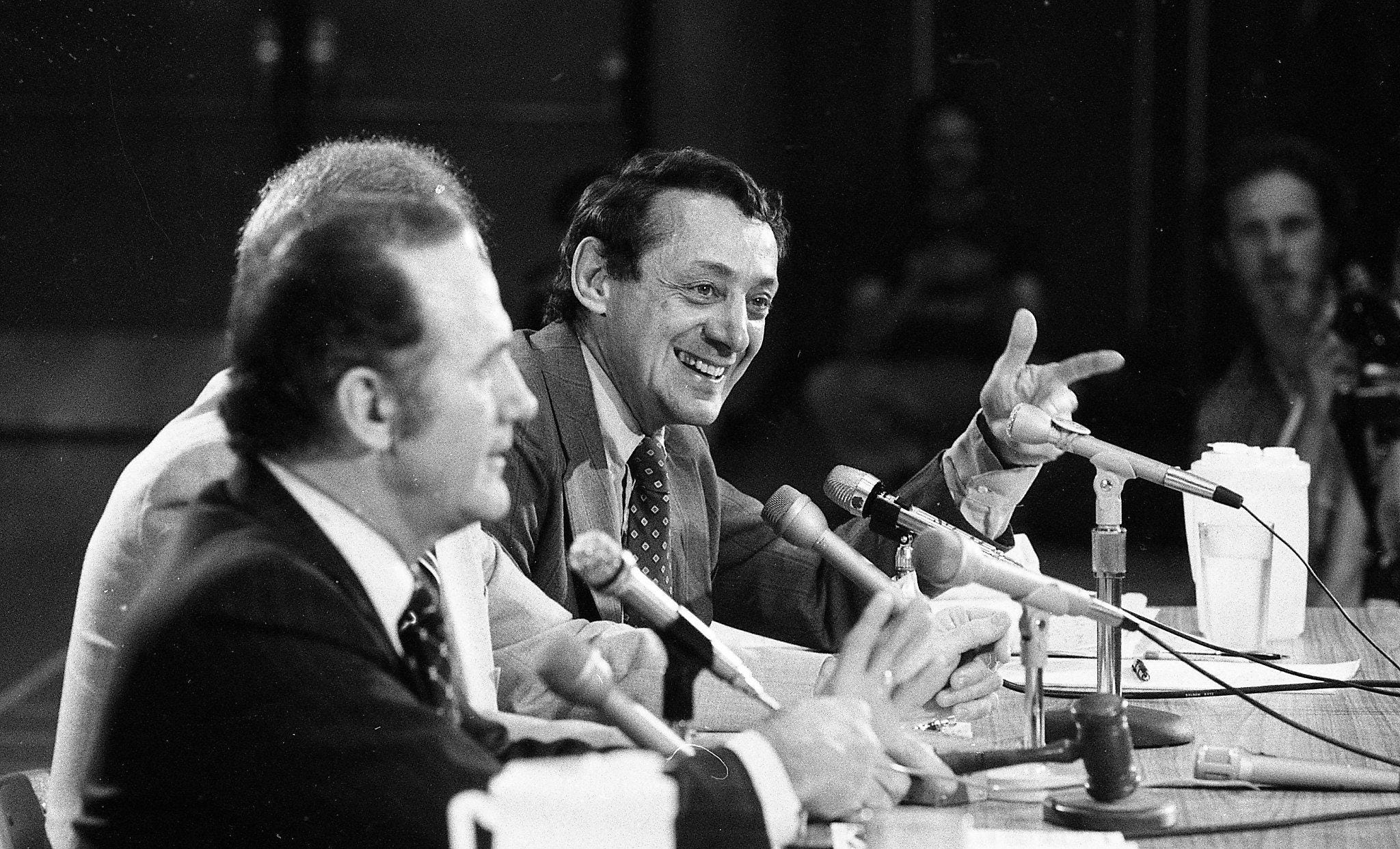
Harvey Milk's last fight: Found photos from landmark debate over gay  teachers

John Briggs thought he had the perfect plan. Fresh off Anita Bryant’s homophobic “Save Our Children” crusade in Florida, he figured California would be easy pickings. He was dead fucking wrong. On November 7, 1978, California voters didn’t just reject Proposition 6—they obliterated it. The Briggs Initiative went down by more than a million votes, losing even in Briggs’s own conservative Orange County stronghold.

Behind that victory was one of the most unlikely coalitions in American political history: a martyred gay supervisor, a future Republican president, grassroots activists, Catholic bishops, and thousands of teachers who refused to let fear win. This is the story of how they did it—and why it matters more than ever today. (snip-MORE)

Queer History 131: Michelangelo by Wendy🏳️‍⚧️🏳️‍🌈🌈

The Divine Cock: Why Michelangelo Was Almost Certainly Gay as Hell Read on Substack

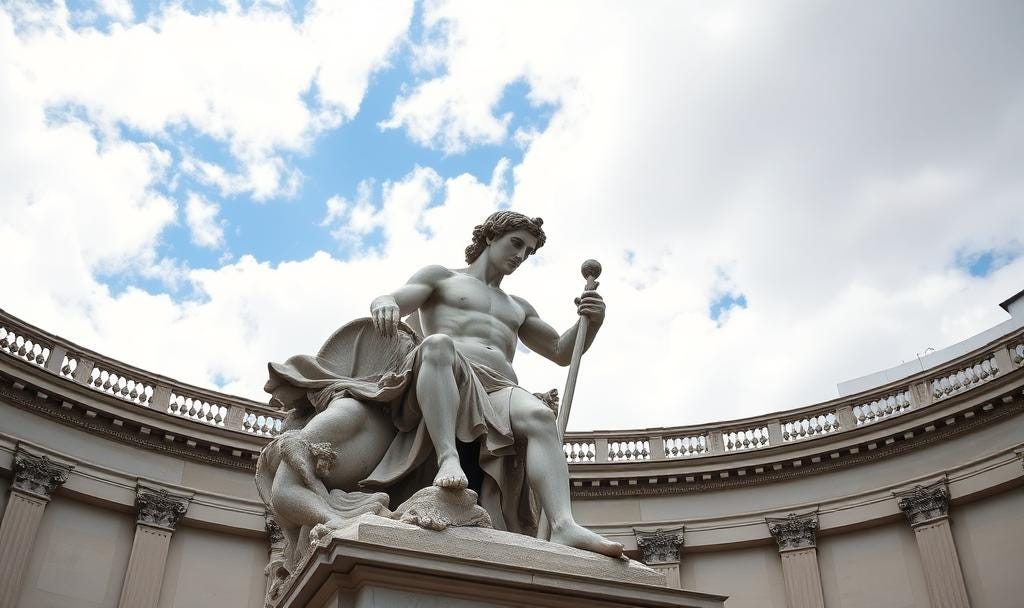
You think you know Michelangelo? The guy who painted the Sistine Chapel ceiling and carved David from a massive chunk of marble? Here’s what they don’t teach you in art history class: the Renaissance master was probably queer as a three-dollar bill, and the evidence is splattered all over his life’s work like paint on a studio floor.

michelangelo

For nearly 250 years, Michelangelo’s own family censored his love letters and poems, changing every masculine pronoun to feminine ones to hide the uncomfortable truth that the “divine one” was divinely attracted to other men. When scholars finally uncovered the original texts in the 1890s, they found a treasure trove of homoerotic passion that would make even modern romance novels blush. (snip-MORE-do go read it!)

Queer History & Culture 127: Alan Turing by Wendy🏳️‍⚧️🏳️‍🌈🌈

A tortured genius whose code-breaking saved millions, only to be destroyed by the very society he protected Read on Substack

The bastards killed him. Not with bullets or blades, but with something far more insidious—the slow, methodical destruction of a man’s soul through legal persecution, chemical castration, and the systematic erasure of his humanity. Alan Mathison Turing didn’t just die on June 7, 1954; he was murdered by a society so goddamn backward that it chose to destroy one of the greatest minds in human history rather than accept that he loved men.

Alan Turing: A Strong Legacy That Powers Modern AI | AI Magazine

(snip)

The Making of a Revolutionary Mind

Born in 1912 to a British colonial family, Turing’s brilliance blazed early and fierce. At Sherborne School, while other boys were playing cricket and learning to be proper English gentlemen, young Alan was already wrestling with mathematical concepts that would have made university professors weep. His first love affair wasn’t with numbers, though—it was with Christopher Morcom, a fellow student whose death from tuberculosis would haunt Turing for the rest of his tragically short life.

That early loss carved something deep into Turing’s psyche. Here was a boy-genius, already grappling with his sexuality in an era when homosexuality was not just taboo but literally criminal, watching the person he loved waste away and die. The philosophical implications would torment him: if consciousness could be snuffed out so easily, what made it real in the first place? This question would drive his later work on artificial intelligence, but it also planted the seeds of a profound existential loneliness that would follow him like a shadow.

At King’s College, Cambridge, Turing found his intellectual home among the mathematical elite, but he also found something else: a community of gay men who lived in the shadows, speaking in codes, loving in secret. The irony is fucking brutal—here was a man who would become history’s greatest codebreaker, learning his first lessons in cryptography from the necessity of hiding his own identity. (snip-MORE, it should be known)

Queer History 129: The Genital Mutilation of the 1880s by Wendy🏳️‍⚧️🏳️‍🌈🌈

Read on Substack

In the fucking darkness of the 1880s, American medicine—that supposed bastion of healing and hope—turned into a goddamn chamber of horrors for LGBTQIA+ people. What began as medical “curiosity” quickly devolved into systematic torture disguised as treatment, launching over a century of medical persecution that would destroy countless lives and shatter the trust between queer people and healthcare forever.

The medical establishment, drunk on its newfound authority and desperate to appear scientific, decided that love between same-sex individuals was a disease to be cured. These weren’t healers—they were executioners in white coats, armed with instruments of torture and backed by the full weight of societal approval. The brutality that followed would make the Inquisition blush. (snip-MORE)

Queer History 130: The Lavender Scare by Wendy🏳️‍⚧️🏳️‍🌈🌈

When Joe McCarthy Declared War on America’s LGBTQIA+ Read on Substack

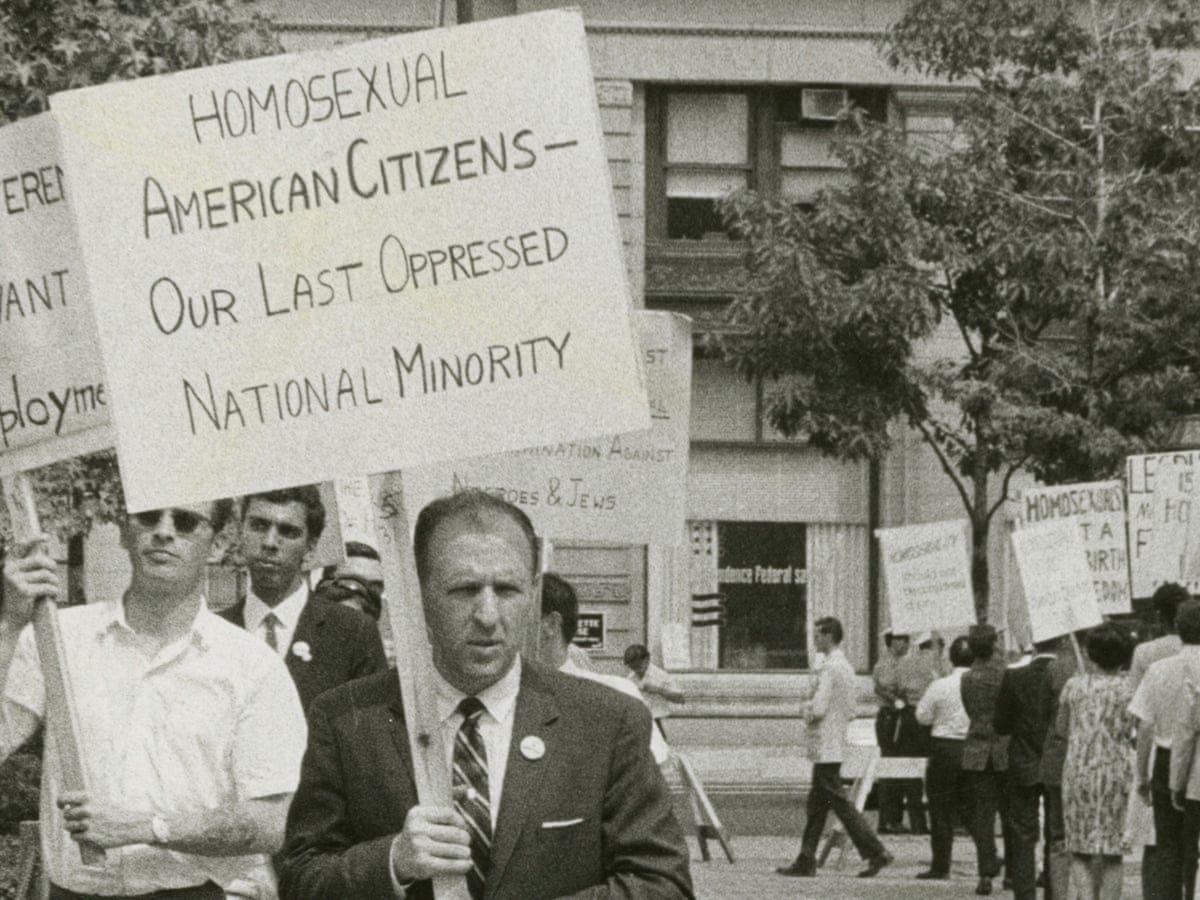
n 1950, Senator Joseph McCarthy stood before a crowd in Wheeling, West Virginia, and launched what would become the most sustained attack on LGBTQIA+ Americans in the nation’s history. While his speech focused on supposed Communist infiltration of the State Department, McCarthy’s paranoid rantings about “security risks” would soon expand into a full-scale witch hunt against homosexual federal employees. This wasn’t just political theater—this was the birth of the Lavender Scare, a systematic campaign of terror that would destroy thousands of lives and poison American democracy for decades.

The Lavender Scare: the shocking true story of an anti-LGBT witch-hunt |  Documentary films | The Guardian

McCarthy didn’t just stumble upon anti-gay persecution as a political tool—he weaponized it with surgical precision. The bastard understood that while Americans might eventually get tired of hunting Communists, they would never tire of persecuting queers. Homophobia was the gift that kept on giving, a renewable resource of hatred that could fuel his political ambitions indefinitely. What began as anti-Communist hysteria quickly metastasized into something far more insidious: the systematic elimination of LGBTQIA+ people from American public life. (snip-MORE)

Peace & Justice History for 6/6

(https://www.peacebuttons.info/)

June 6, 1936

First issue of Peace News published in England.
PeaceNews home page 
(Peace News subscriptions are no longer available. See this blog entry. -A. There is still useful information on its home page, etc.)
June 6, 1949
George Orwell’s dystopian novel, Nineteen Eighty-Four, was published.
It described a world in which totalitarian government controls the behavior of all, including the way one thinks.

This was summed up in the government’s slogans: War Is Peace, Freedom Is Slavery, Ignorance Is Strength.


George Orwell
More about George Orwell 
June 6, 1966
James H. Meredith, the first African American ever to attend the University of Mississippi, was shot by a sniper in the back and legs while on a lone “March Against Fear.”
 
He was walking the 220 miles from Memphis, Tennessee, to Jackson, Mississippi, to encourage others to stand up for their rights and self-respect, and to register to vote. Law enforcement officers and reporters following him witnessed the attack, and the shooter was arrested.

Read more 
June 6, 1968

Comedian Dick Gregory began a hunger strike in the Olympia, Washington, jail after his arrest with others at a fish-in, an act of civil disobedience in support of the fishing rights of the Nisqually Indian Tribe.
See what happened after his arrest  
June 6, 1971
40 members of the American Indian Movement camped in the sacred Black Hills, or Paha Sapa, atop Mount Rushmore; 20 were arrested. They were demanding the U.S. honor the terms of the 1868 treaty with the Sioux Nation granting them the Black Hills territory.
Read more 
June 6, 1989
The FBI and the Department of Energy, tipped off by plant workers, raided the Rocky Flats nuclear production facility. They found numerous violations of federal anti-pollution laws including massive contamination of water and soil. Rockwell International, the operator of the facility, was fined $18.5 million.

https://www.peacebuttons.info/E-News/peacehistoryjune.htm#june6

A Good One From Sojo

Queerness Is a Calling Every Person Should Aspire To

By Brandan Robertson

“Queer” is not about who you’re having sex with (that can be a dimension of it), but “queer” as being about the self that is at odds with everything around it and has to invent and create and find a place to speak and to thrive and to live.”
—bell hooks

I’ve always been queer, but it took me a while to realize it. Even after coming out as gay, I still struggled with the language of “queer” because I grew up hearing it used as a slur. In many places, it still is. I remember the shocked look on the faces of a lecture audience in rural England when I said “queer” — as if I had uttered a curse word.

This is how the word sits with many people — even within the LGBTQIA+ community. But over the years, as I’ve wrestled with my identity, learned the history of LGBTQIA+ liberation, and developed my beliefs, I’ve come to resonate deeply with being queer, just as much as with being Christian.

In fact, for me, to be an authentic Christian — one who seeks to follow the life and teachings of Jesus — is to be queer. Let me explain.

To be queer generally means one of two things. First, it’s a catch-all phrase for the LGBTQIA+ community — those who embrace a non-heterosexual orientation and/or non-cisgender identity. Second, queer also means to disrupt arbitrary norms, making space for diverse, often marginalized, expressions to flourish.

To be queer means resisting the repression of our true selves and the forces that demand we conform to others’ ideas of who we should be. It’s a declaration of our commitment to live authentically — who God created us to be — not who society or religion says we must become.

In this sense, queerness is holy. It affirms that God doesn’t make mistakes — that our unique expression reflects God’s creativity — and refuses to blaspheme the Creator by suppressing that divine image. When seen this way, queerness is a calling every person should aspire to.

To follow Jesus is to refuse conformity, as Paul wrote: “[to] be transformed by the renewing of your mind” (Romans 12:2). This means shifting how we see ourselves and others — removing the masks we were taught to wear, the roles we were conditioned to play. In this way, queerness is deeply aligned with the way of Jesus.

bell hooks defines queerness as “being at odds with everything around it.” That feels exactly right. We live in a world shaped by systems built to benefit particular people. What’s considered “normal” is often an invention — crafted to maintain control and marginalize difference. Nothing has always been the way it is, and it shouldn’t remain the same.

Today, there’s a rising awareness of the value of diversity and pluralism by many in society (while diversity is also demonized by many). More people are becoming suspicious of those who demonize difference and cling to the status quo. The past century has shown us that the status quo is often built on lies that lead to oppression.

Our society was set up by people who established norms to benefit themselves. But as the world grows more connected and aware of diverse ways of being, movements of resistance have chipped away at this conformity and demanded a new, inclusive path. These movements are “queering” society — questioning and resisting what’s been called normal — and they’ve made the world more just and diverse.

One of the most resistant institutions to queering has been Christianity. This isn’t surprising. Religion resists change, and Christian institutions have fought nearly every cultural shift from desegregation to women’s voting rights to rock music. Those willing to reform are often labeled heretics and excluded from church power. But every so often, resistance sparks reform in the church. The Protestant Reformation, the abolitionist movement, and the fight for women’s rights have all queered Christianity by disrupting norms and pushing forward new expressions of faith.

The inclusion of queer people in Christianity is another such movement. Today, nearly every mainline Protestant denomination in the U.S. officially affirms queer people. We can serve as clergy, marry, and be fully embraced. While there are many local congregations in each denomination that resist these changes, the movement for inclusion is well underway. This is a remarkable shift.

Just last year, Pope Francis announced that Catholic priests may bless same-sex couples. A few months before, he said transgender people could be baptized and serve as godparents. Though these don’t change Catholic doctrine, they marked major steps forward that made many lay queer Catholics feel more included in their churches.

Still, there is much work to do. The truth remains that most Christians worldwide still uphold anti-queer theology. Many still preach that homosexuality is an abomination. Many still teach that women must submit to men and cannot lead.

Progressive Christians sometimes believe the church is rapidly changing, but that’s often just the view from our bubble. Most Christians still cling to rigid, patriarchal theology. And I’ve come to believe that the only way to challenge that resistance is through queering.

Not every LGBTQIA+ Christian agrees with this strategy. There are many queer Christians who would prefer to simply shift the church’s understanding of the six clobber passages and be accepted into the traditional Christian institution with its traditional sexual ethics, understanding of relationships, and devotion to conservative theology otherwise. I understand that desire; I once had it too. But I’ve come to believe it’s actually counterproductive to our flourishing as queer people.

The more I’ve studied Scripture and listened to queer stories, the more convinced I’ve become: The issue isn’t a few misinterpreted Bible verses — it’s that Christianity was institutionalized. A few hundred years after Jesus, his radical movement was merged with the Roman Empire and transformed into rules, dogma, and rigid orthodoxy.

Other perspectives were labeled heresy, punished, and driven underground. What remained became dominant: a version of Christianity that, frankly, looks nothing like Jesus.

When I became a Christian, it was because I wanted to follow Jesus — not an institution. But I was quickly taught that faithfulness to Jesus meant faithfulness to the church. I learned the doctrines and ethics of my church and saw that the more I conformed, the more I was accepted — and even celebrated.

From adopting the politics of my pastors to unquestioningly espousing conservative theology, to even dressing in ways that mirrored the evangelical subculture, I learned that through conforming and contorting myself to look, believe, vote, and act like what was seen as normative for evangelical Christians, my inclusion would be solidified.

I gained status and privilege. I was affirmed by my church and I believed that this meant I was close to God. But I felt uneasy, even early on. As I read Scripture, I struggled to see our theology or ethics reflected in Jesus’ life. Jesus lived on the margins of religious and political power. He constantly challenged the status quo and resisted exclusionary doctrine.

I came to see that neither I nor my church looked like Jesus. That realization was unsettling. Eventually, it led me to believe that queering Christianity wasn’t just permissible — it was necessary. Not only for LGBTQIA+ inclusion, but for everything and everyone.

Rather than blindly accepting church authority, I began to pursue truth wherever it led and invited others to do the same. My ministry became about queering Christianity, not just including queer people in the traditional frameworks of the church.

That meant challenging every theology and ethic that doesn’t reflect Jesus’ ethic of love. It meant reimagining how we follow Jesus — beyond traditional Christianity.

This is, I believe, the most faithful path. But it’s also the hardest. It requires us to stop seeking the affirmation of and inclusion in the old structures and instead focus on building subversive, queerly spiritual communities that reflect the Spirit of Christ.

It means being open to truth from everywhere and everyone — because all truth is God’s truth — and letting it shape our spiritual journeys.

It means getting used to being called heretics. Excluded even from some so-called affirming churches that find our vision too radical. But our goal isn’t to be welcomed because we conform — it’s to create a community that welcomes all expressions and beliefs, grounded in the love and example of Jesus in whatever form that takes.

Our goal isn’t even to be “Christians,” really. Jesus never used that word. Never spoke a Christian doctrine. Never stepped inside a Christian church. So inclusion in the traditional institutions of Christianity isn’t the point.

The point is a truly queer revolution of faith that liberates us all to show up authentically, that remains open to the voice of our still-speaking God in the most unlikely people and places, and that understands that the Kingdom of God that Jesus preached and embodied can never be contained in the rigid boundaries of any institution, but is found among the diversity, complexity, and beauty of all of our human experiences.

Editor’s note: This essay is an adaptation from Queer & Christian: Reclaiming the Bible, Our Faith, and Our Place at the Table. It has been adapted with the permission of St. Martin’s Essentials.

Peace & Justice History for 6/5

June 5, 1851
Uncle Tom’s Cabin or, Life Among the Lowly began to appear in serial form in the Washington National Era, an abolitionist weekly.
The novel by Harriet Beecher Stowe, a tear-jerking tale of the hardships of slavery, became a central reference point in the national debate over the issue.

 
Read more 
June 5, [since 1972]

World Environment Day was established by the U.N. General Assembly to commemorate the opening of the Stockholm Conference on the Human Environment in Sweden.
The United Nations Environment Program (UNEP) was established as a result of the conference.
The 1972 Stockholm conference 
UNEP’s mission: To provide leadership and encourage partnership in caring for the environment by inspiring, informing, and enabling nations and peoples to improve their quality of life without compromising that of future generations.
Each year World Environment Day adopts a different theme.
June 5, 1989
Just a few days before the first fission reaction was to be allowed at New Hampshire’s Seabrook Station nuclear power plant, hundreds breached the security fence, leading to 627 arrests. They carried signs reading, “In Mourning for the Late, Great State of New Hampshire,” and “Remember Chernobyl.”
Led by the Clamshell Alliance, their concern was for the safety of local residents in the event of a nuclear accident, as well as environmental pollution and the unsolved problem of safe disposal of nuclear waste generated by the reactor. There were also concerns for increased electricity rates to cover the costs of the project. Repeated significant protests occurred as early as 1976 at the beginning of construction when sometimes more than a thousand would be arrested.
Ron Sher, a Seabrook spokesman, termed the demonstrators “very vocal but a small minority . . . They don’t represent the millions of people in New England that recognize that nuclear energy is a viable energy option.” The plant was projected to produce up to 1.15 gigawatts, enough for one million homes.
June 5, 1993
Thousands marched to protest neo-Nazi violence against foreigners, particularly ethnic Turks, living in Germany.

https://www.peacebuttons.info/E-News/peacehistoryjune.htm#june5

We Know What To Do-

Some Clay Jones Work

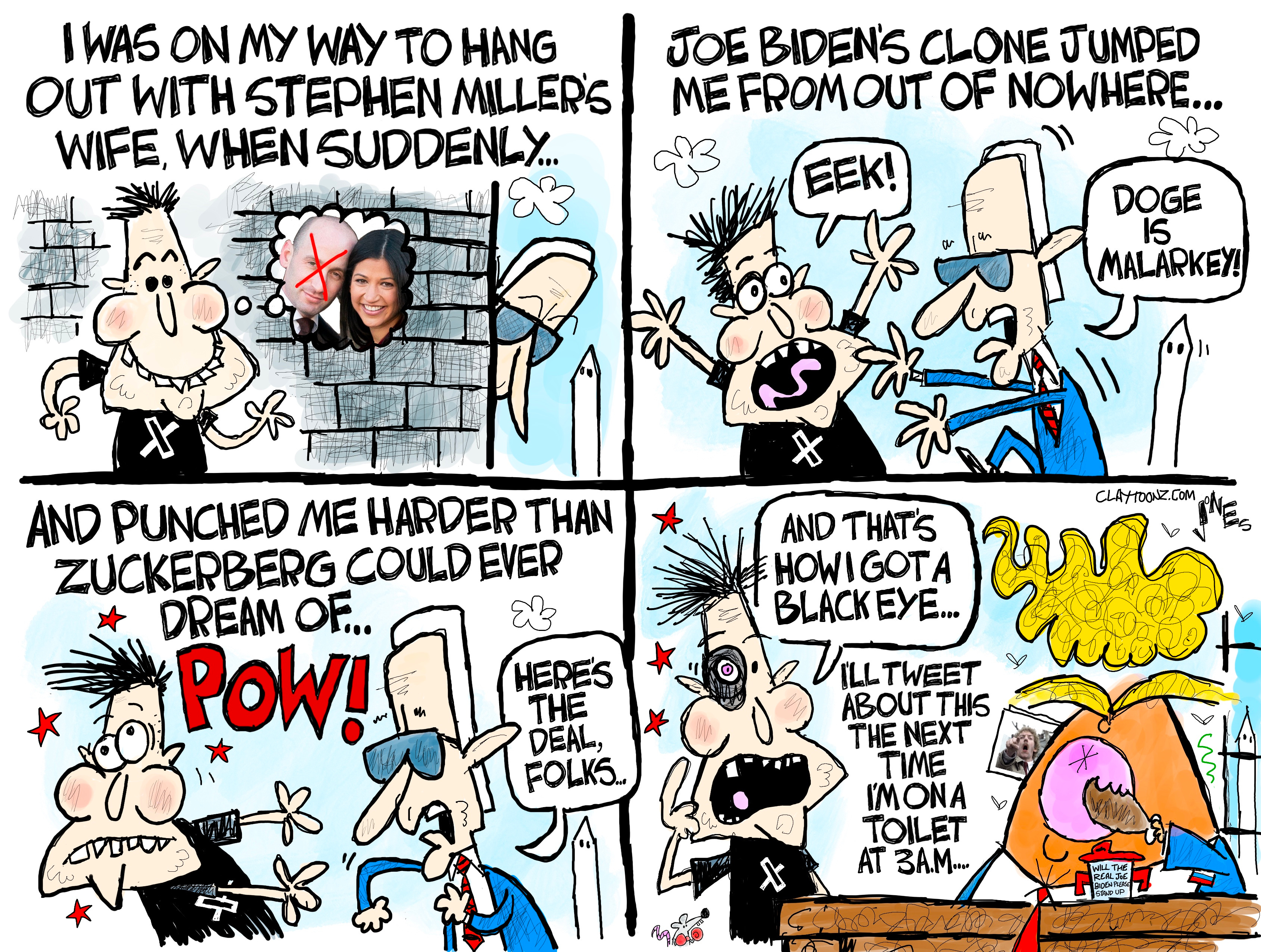
Black Eye Clones by Clay Jones

There are a lot of weird things going on Read on Substack

There are other issues I should be drawing about, but how can I resist a second Biden Clone cartoon? This shit is cray-cray, yo? Do the kids still say “cray-cray?” Anywhosies, I drew a second Biden clone cartoon. The bad thing is, I have at least two more ideas on Biden Clones that I should at least sketch out for the Blog O’ Roughs, which is long overdue.

Since we talked about Biden Clones yesterday, we’re going to talk about the other shit in this cartoon.

Elon says he’s leaving Washington, and he’s taking Stephen Miller’s wife with him. Whaaaaat?

Katie Miller, the wife of Baby Goebbels, has left her position as adviser and spokesperson for the Department of Government Efficiency (DOGE) to work full-time for Musk and his companies. I don’t know what position she’ll be assuming for Elon, but I heard she bought some knee pads. Wow, I’m a horrible person. But, Baby Goebbels doesn’t want to talk about it. (snip-MORE, and oh, do go read it!)

Biden Clone by Clay Jones

It’s extremely difficult to out-crazy the shit that comes out of the Trump White House Read on Substack

Late last night, around the time a person would tweet while on a bender or call up an ex-girlfriend for a booty call, Donald Trump posted to Truth Social that Joe Biden was executed in 2020 and replaced with clones and robots. (snip-MORE, and it’s also very good)

The Soylent Green Party by Clay Jones

Not to give the GOP any ideas Read on Substack

Republicans suck. They suck with compassion. They suck with empathy. Lord knows they suck with humor. And yet, voters believe the GOP connects more with average Americans than Democrats do, never mind that their leader craps in a golden toilet.

Iowa Senator Joni Ernst is a great example. She ignored Republican advice against holding town halls and learned the hard way that her constituents don’t like the current MAGA agenda. Probably because it sucks. You don’t need a think tank to run a bunch of surveys to know that the majority of voters don’t want to lose their Medicaid coverage or health insurance. And, they don’t want it to be more difficult with loops to jump through to keep their coverage.

During Joni’s town hall last Friday, she was grilled by her voters about the “One Big Beautiful Bill,” which the House barely passed 215-214, and will cut Medicaid along with a lot of government health programs, along with SNAP, and make Medicaid tougher to keep, all so billionaires retain their huge 2017 MAGA tax cuts while adding trillions to the debt.

Grams might have to eat generic cat food, not even the good cat food, while your boss will get to purchase his fourth yacht, which Republicans are trying to make tax-deductible, along with private jets and trophy wives, like Melania. (snip-yes, MORE that’s good to read!)

Peace & Justice History for 6/4

June 4, 1939
During what became known as the “Voyage of the Damned,” the SS St. Louis, carrying more than 900 Jewish refugees from Germany to the U.S., was turned away from the Florida coast. The ship, also denied permission to dock in Cuba, eventually returned to Europe; many of the refugees later died in Nazi concentration camps.

The reality of what happened 
The movie based on the history 
June 4, 1972
Angela Y. Davis, a former philosophy professor at the University of California, outspoken black leader and self-proclaimed communist, was acquitted on charges of conspiracy, murder, and kidnapping by an all-white jury in San Jose, California.

More on Angela Davis
 
Angela Davis wearing a peace button from peacebuttons.info, speaking at The Grays Harbor Institute, Hoquiam, Washington April, 2007
  
June 4, 1987

New Zealand passed legislation declaring itself nuclear-free. In 1986, New Zealand had banned the entry of U.S. Navy ships from their ports in the belief that they were carrying nuclear weapons or were nuclear-powered. U.S. government protests of the policy led to breakup of the ANZUS (Australia-New Zealand-United States) defense alliance.The New Zealand Nuclear Free Zone, Disarmament and Arms Control Act of 1987 (which ratified the Nuclear Non-Proliferation Treaty) prohibits the:
•   manufacture, acquisition, possession, control of any nuclear explosive device
•   aiding, abetting or procuring any person to manufacture, acquire, possess, or have control over any nuclear explosive device
•   transport, stockpiling, storage, installation, or deployment of any nuclear explosive device.
June 4, 1989
Hundreds of civilians were shot dead by China’s People’s Liberation Army during a bloody military operation in Beijing’s Tiananmen Square. Students and workers had become part of a growing pro-democracy movement, gathering there continuously for weeks. The Chinese government still officially denies any deaths occurred; thousands who were arrested “disappeared” and remain unaccounted for.
“… deaths from the military assault on Tiananmen Square range from 180 to 500; thousands more have been injured . . . thousands of civilians stood their ground or swarmed around military vehicles. APCs [armored personnel carriers] were set on fire, and demonstrators besieged troops with rocks, bottles, and Molotov cocktails.”* 

*From a comprehensive overview prepared by the National Security Archive
based on formerly classified U.S. Government documents

https://www.peacebuttons.info/E-News/peacehistoryjune.htm#june4

More PRIDE

(https://www.peacebuttons.info/)

It’s been stormy/flooding/messy all day long, Ollie is not happy with the weather so I’ve been busy keeping him busy, we’ve still got about an hour to go with the weather, and now I can’t recall where, this morning over breakfast, I read this about Compass Group promoting PRIDE. But, the tab is still up there, so here it is at not quite suppertime!

https://www.compass-usa.com/happy-pride-month-2025

Happy Pride Month 2025!

June 02, 2025

2025 Happy Pride Month from Compass Group USA

June is here, and with it comes Pride Month – a powerful celebration of love and authenticity. It’s a time to recognize the rich history of the LGBTQ+ community while embracing the voices that make our workplace stronger, more inclusive, and deeply connected.

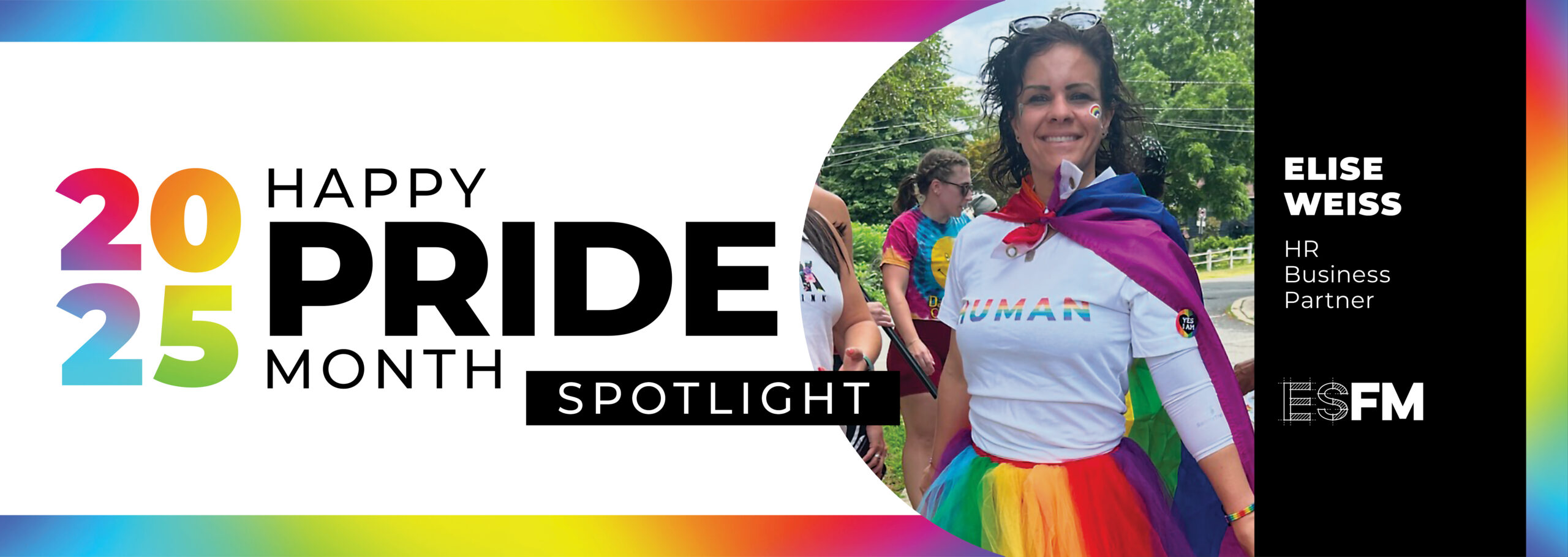
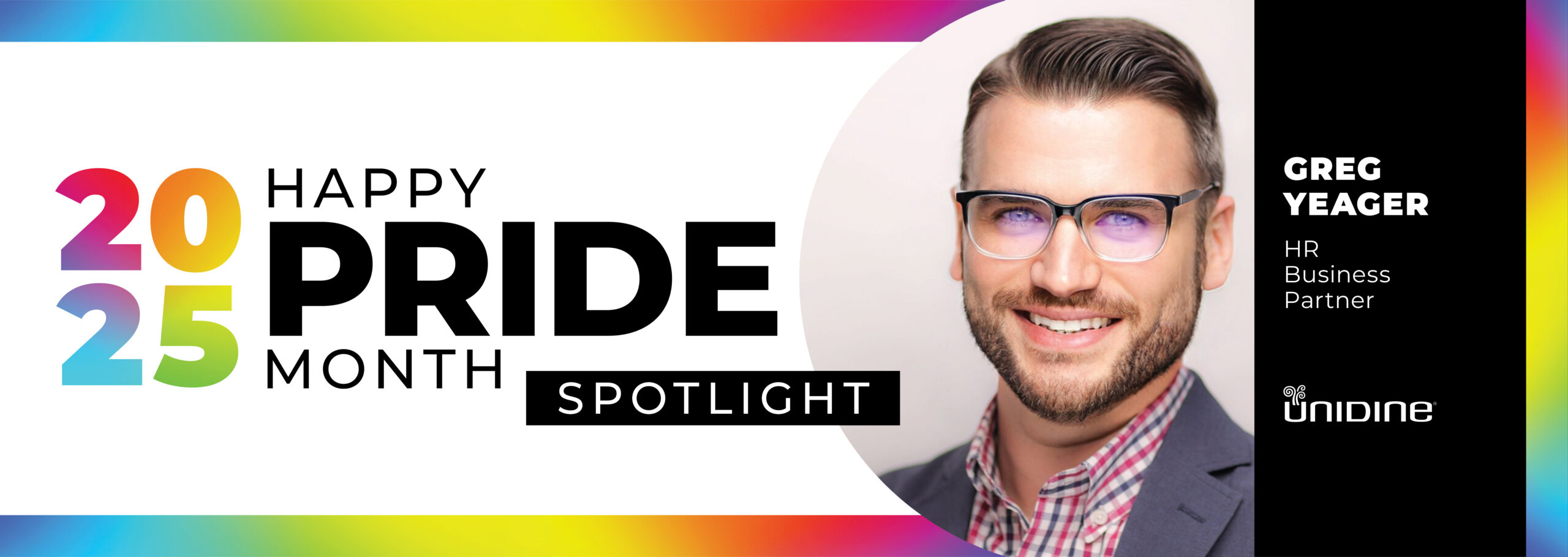
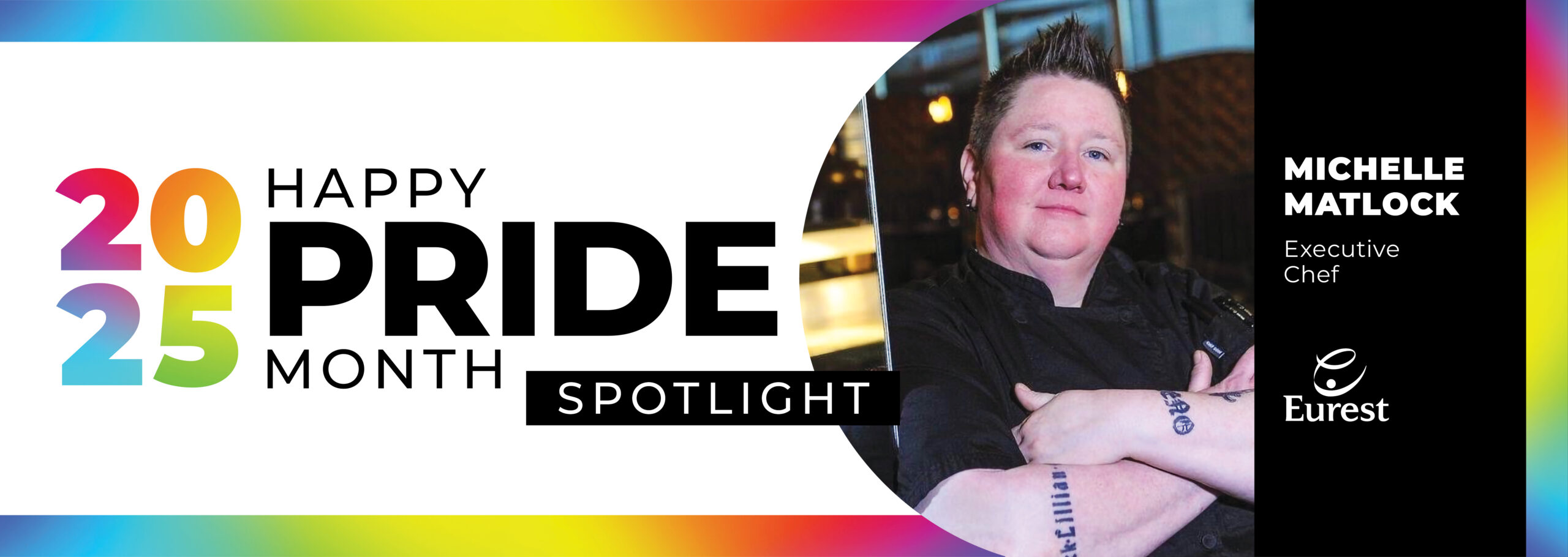
Meet three inspiring associates from across Compass Group’s family of businesses – Elise, Greg, and Chef Michelle – whose journeys of inclusion and belonging enrich our organization in meaningful ways. Through their work, passion, and personal experiences, they continue to cultivate spaces where everyone can thrive.

An Image of Elise Weiss, HR Business Partner from ESFM for Pride Month 2025

Elise Weiss has been with ESFM for seven years. The best part of her job as an HR business partner is building relationships, fostering strong team dynamics, and simplifying tough situations. Education and empowerment drive her. Leading ESFM’s Global University of Lifelong Learning (GULL) program as well as serving as co-chair of its Diversity & Inclusion Action Council (DIAC) make her work deeply fulfilling.

“Pride Month means LOVE is LOVE! Accepting everyone as they are so that no one fears loving who they truly love,” Elise says.

An Image of Greg Yeager, HR Business Partner from Unidine for Pride Month 2025
Greg Yeager has been with Unidine for eight years and currently serves in strategic dining services and national accounts as the HR business partner. Making a difference in people’s lives – with the support of his incredible team – is what he loves most about his position

“Pride is a reminder of both the progress made and the work still needed to ensure equal rights and respect for everyone,” Greg adds. “It’s also a deeply personal time when I acknowledge and celebrate my own growth, embracing who I am unapologetically.”

An Image of Chef Michelle Matlock, Executive Chef from Eurest for Pride Month 2025
Chef Michelle M. Matlock CEC has been with Compass for three years, and for the past year has been an Executive Chef in Atlanta with Eurest.

“What I love most about my job is spending my life’s energy within a group that supports diversity, equality and inclusion,” Chef Michelle declares. “I love being able to mentor our young chefs and leaders. I adore my leadership and believe in their life’s work so much, find our corporate goals so similar, it keeps me going.”

Greg, Chef Michelle, and Elise’s respective journeys have been shaped by many people, and their experiences within the LGBTQ+ community have influenced their careers.

“I often wonder if I’ve done enough, because just living openly doesn’t always feel like enough,” Greg notes. “Getting into HR grounded me, showing me that I could be the person I had always needed – a representative living openly.” Greg hopes to be that person for future generations entering the hospitality industry.

A pivotal figure in Chef Michelle’s life was Charlene Schneider, who opened the first LGBTQ+ tavern in New Orleans in the 1950s. She was a “Den Mother” to many LGBTQ+ youth, offering acceptance, guidance, and life skills. She once told Michelle, “People walk through this world every day, just hoping someone will smile their way. BE THAT PERSON.” She taught Michelle honor, ethics, never to hide, and to BE SEEN.

Elise’s path has also been influenced by people who embody authenticity, strength, acceptance, empathy and love – qualities she strives for. Her most life-changing discovery, however, is yoga. “The inward journey transformed me, replacing fear with acceptance and love,” she says.

Each has precious advice to share with colleagues striving to be more inclusive.

Chef Michelle considers herself an “Elder” in the LGBTQ+ community and shares this impassioned message: “TO OUR BEAUTIFUL LGBTQ+ YOUTH – TO ‘B’ – Sometimes the world swings ugly and sometimes it swings back to beauty. In all these times, you are loved, you are important, you are beautiful EXACTLY as you are, and you MATTER. Know your history, get involved, define our community for US so that others can’t define it for YOU.”

Elise advises her teams to lead with vulnerability and humility. “Show up, listen, and be present. People feel that, and it matters,” she says. “In the photo, my shirt says ‘HUMAN,’ because kindness is what matters, not labels. Live in the energy of love, and never forget our shared humanity – we are all equal.”

And Greg encourages open and honest conversations. “Understanding comes from curiosity and the willingness to learn; I always tell friends and family to ask me anything,” he adds. “If it helps bridge the gap in understanding that our lives aren’t so different, then that’s one more educated mind shaping a better future.”

As Pride Month unfolds, let’s celebrate the progress made while recommitting to the work still ahead. Elise, Greg, and Chef Michelle remind us that inclusion is about people, actions, and creating spaces where everyone feels seen, valued, and empowered to be their authentic selves. Their stories illuminate the power of representation, resilience, and genuine connection. As we honor Pride, let’s continue building a workplace – and a world – where acceptance isn’t just a celebration for one month, but a commitment we carry every day.

Happy Pride from your Compass colleagues!