I’m skipping down to the part about the candidate. We’ve all seen the clip of Sen. Ernst. But I remember the statements of Zach Wahls; I bet we all do! -A.
Anyway, while Sen. Ernst may not care if your loved ones don’t have the lifesaving health care they need, I do bring good news: there’s a leader in Iowa who does.
You may remember Zach Wahls; he’s the young man who went viral many years ago when he delivered a deeply moving testimony to the Iowa Legislature about growing up with two mothers, as lawmakers were considering support for marriage equality.
Well, Mr. Wahls has been serving in the Iowa State Senate since 2019—including a few years in tenure as the Minority Leader—and he’s public exploring a run against Sen. Ernst in next year’s election.
I have rarely been as impressed with an elected official as I am with Mr. Wahls. He’s exactly the kind of leader you’d hope would be dedicated to fighting the good fight and having the kind of good sense necessary to bring folks together for common sense solutions.
Sen. Ernst was already looking at a competitive fight before her “we are all going to die” honesty this morning, and I have to imagine the math ain’t looking great for her against Mr. Wahls moving forward.
If you’d like to throw a donation to Mr. Wahls in what I believe would be a successful campaign, I’d be grateful.
I’ll end this on a note of reason and empathy. When word of Sen. Ernst’s comment reached the great Senator Tina Smith of Minnesota, her response couldn’t have summed it up better:
“I thought my job as Senator was to try to keep my constituents alive.”
In keeping with the FAFO world we seem to be living in, just how far down the drain does this polished turd have to take our country before people call it enough. Remove the poison that is maga. Vote out these scum bags who enable him.
May 31, 1955 The U.S. Supreme Court ordered (in a unanimous decision known as Brown II after the 1954 decision Brown v. Board of Education) that school integration be implemented “with all deliberate speed,” ordering the lower federal courts to require the desegregation of public schools. Between 1955 and 1960, federal judges held more than 200 school desegregation hearings. The decision reiterated “the fundamental principle that racial discrimination in public education is unconstitutional . . . . All provisions of federal, state or local law requiring or permitting such discrimination must yield to this principle.” A timeline of school integration
May 31, 1957 U.S. playwright Arthur Miller was convicted of contempt of Congress for refusing to reveal the names of associates who were alleged to be Communists. The conviction was ultimately set aside on appeal. More about Arthur Miller
May 31, 1966 Nguyen Thi Can, a 17-year-old Buddhist girl, committed suicide by setting herself afire (self-immolation) on a street in the city of Hue, Vietnam. She was protesting against the South Vietnamese regime and the war being waged by the U.S., the separate armies of the north and south, and the insurgent Viet Cong; it was the fifth such death in three days.
May 31, 1973 A bipartisan majority (69-19) of the U.S. Senate voted to cut off funds for the bombing of Cambodia (Vietnam’s neighbor) despite pleas from U.S. President Richard Nixon’s Secretary of State, Henry Kissinger.
Erin In The Morning is a reader-supported publication. To receive new posts and support my work, consider becoming a subscriber.
Subscribe
Inch by inch, day by day, and legal battle after legal battle, trans Montanans are dismantling the unconstitutional laws proposed by Republicans meant to destroy trans lives, and indeed, trans life itself.
Last week, they were able to let out a sigh of relief—for now. A Montana judge issued a preliminary injunction on HB 121, which would ban trans and intersex people from using gender-separated public facilities, such as bathrooms or changing rooms, that differ from their sex assigned at birth.
This decision follows a temporary restraining order (TRO) on the law from earlier this year, instituted after legal rights groups like the ACLU challenged it in court for violating Montanans’ right to privacy under the state constitution. A preliminary injunction is a more steadfast barrier—it means the law won’t take effect until after legal proceedings conclude, if ever.
The Attorney General for the State of Montana, like many anti-trans actors, is defending HB 121 using the thinly-veiled premise of “protecting women” from sexual violence. But the injunction filings indicate that the judiciary isn’t buying it.
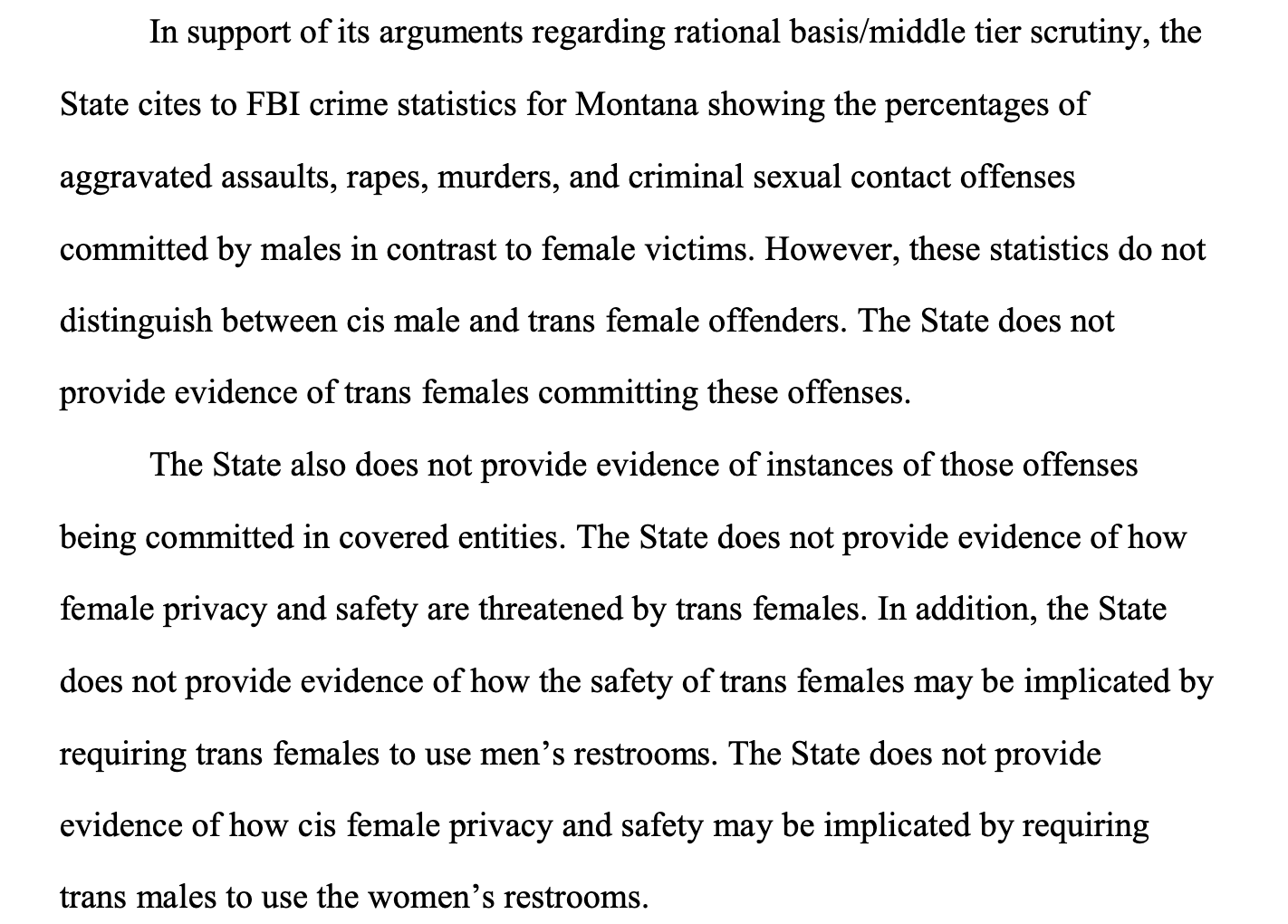
“The State has not shown even a rational basis for the Act,” wrote Judge Shane A. Vannatta, who oversees a Montana District Court. “The State does not provide evidence of trans female offenses against [cis] women or evidence of offenses being committed in covered entities to support the necessity of immediate implementation of the Act.”
Instead, the court found that anti-trans bathroom bans do not protect women from harm. It only serves to stoke violence against trans women and cis women alike—everyone’s gender and sex becomes subject to public debate when these laws are put in place.
“Each individual observed walking into a restroom of a covered entity does directly and indirectly disclose that individual’s transgender or intersex identity, anatomy, and genetics,” the filing said. “All Montanans regardless of gender […] will not be subject to the prying eyes of others or to governmental snooping or regulation.”
Vannatta further notes that it is already illegal for people of any gender or sex to commit a sex crime, and that there is “no evidence” to support the notion that trans or intersex people “have a predisposition toward such offenses.”
He added that the state’s purported concerns were “disingenuous” and purely “conjecture.”
In reality, trans women—especially those of color—are more likely than any other demographic to be the victims of violent crime. And by using the law to force trans people to out themselves every time they use a public restroom, or to embolden self-deputized gender police, so-called “trans bathroom bans” create a greater risk of violence for everyone. There are countless stories of cis and trans people alike being accosted in bathrooms precisely because of the anti-trans panic these policies create.
The filing further concluded that trans women have been relentlessly targeted by the state government and are in dire need of protection. “Transgender Montanans have been subjected to such a history of purposeful unequal treatment and have been relegated to such a position of political powerlessness as to command extraordinary protection from the majoritarian political process,” Vannatta noted.
The fight against HB 121 is not over, but State Representative Zooey Zephyr—who would be legally forced into the men’s room under the bill her colleagues passed—says she is hopeful.
“The Montana Supreme Court has been clear: every law that targets the trans community is a clear invasion by the government into the privacy of transgender people,” she told Erin in the Morning. “These laws are driven by animus against the community. I expect this law—like all laws driven by the anti-trans fervor—to be struck down by Montana’s courts.”
(Editor’s Note: For transparency, Erin in the Morning founder Erin Reed is the loving wife to the aforementioned Rep. Zooey Zephyr.)
Erin In The Morning is a reader-supported publication. To receive new posts and support my work, consider becoming a subscriber.
May 30, 1868 Memorial Day, originally known as Decoration Day, was first observed some say [see May 1, 1865] when two women in Columbus, Mississippi, placed flowers on the graves of Civil War soldiers, both Confederate and Union. War widow Augusta Murdoch Sykes, one of the Columbus planners, pointed out that “after all, they are somebody’s sons.” It is now celebrated to honor all those who have died in America’s wars. “The 30th day of May, 1868, is designated for the purpose of strewing with flowers, or otherwise decorating the graves of comrades who died in defense of their country….” -from an order from the Grand Army of the Republic ========================================================= May 30, 1937 1000 striking steel workers (and members of their families), on their way to picket at the Republic Steel plant in south Chicago where they were organizing a union, were stopped by the Chicago Police. In what became known as the “Memorial Day Massacre,” police shot and killed 10 fleeing workers, wounded 30 more, and beat 55 so badly they required hospitalization. More on the incident Watch a video of oral history with historic footage
(Both important stories. Of course, language alert, but definitely good reading here. -A)
Queer History 124: Virginia Woolf & Vita Sackville-West by Wendy🏳️⚧️🏳️🌈🌈
How an aristocratic garden-loving poet inspired the 20th century’s most experimental “love letter” ….. Read on Substack
When Virginia Woolf first met Vita Sackville-West at a dinner party in 1922, neither woman could have possibly predicted that their relationship would produce one of the most revolutionary novels of the 20th century. On the surface, they seemed like complete opposites: Virginia—brilliant, fragile, middle-class, and sexually timid; Vita—aristocratic, confident, adventurous, and sexually voracious. Yet their decade-long affair transcended a simple romance to become one of the most creatively fertile partnerships in literary history, producing a groundbreaking gender-bending masterpiece that still feels radical nearly a century later.
Let’s cut through the academic bullshit that often sanitizes their relationship and explore what really happened between these remarkable women. Their letters reveal a passionate connection that was intellectual, emotional, and unmistakably physical. “I am reduced to a thing that wants Virginia,” Vita wrote in one letter. Not exactly the chaste “friendship” that some literary historians tried to paint it as for decades. Their affair challenged the conventions of their time, their social circles, and ultimately, the very form of the novel itself.
The Women Behind the Legend: Who They Really Were
(snip-More; it’s really good!)
Queer History 125: The Raw, Unfiltered History of Sapphic and Platonic Queer Cultures by Wendy🏳️⚧️🏳️🌈🌈 Read on Substack
The Goddamn Poetry of Desire: An Introduction
The ancient world was no fucking stranger to same-sex love. While modern society often frames homosexuality as a contemporary phenomenon—something that emerged from the shadows of the closet into the damn light of day during the liberation movements of the 20th century—the historical record tells a far more complex and fascinating story. Long before we had Pride parades and marriage equality, we had Sappho of Lesbos and Plato of Athens, two figures whose works and philosophies have profoundly shaped how we understand same-sex desire.
Sappho Lesbos
The rocky shores of Lesbos and the philosophical gardens of Athens—separated by the azure waters of the Aegean—gave birth to two distinct yet equally significant homosexual cultural traditions that continue to echo through the halls of queer history. These traditions, one centered on the passionate lyrical expressions of a woman poet, and the other on the philosophical musings of a male thinker, offer us a window into the complex ways same-sex desire was articulated, celebrated, and sometimes condemned in ancient Greek society.
Standing on the windswept cliffs of Lesbos, one can almost hear the lyrical whispers of Sappho’s poetry carried on the salt-laden breeze—fragments of desire that have survived over two and a half millennia. Meanwhile, in the once-bustling agora of Athens, the philosophical dialogues of Plato still reverberate, offering a theoretical framework for understanding male same-sex love that has influenced Western thought for centuries.
This analysis isn’t just about ancient history—it’s about the living, breathing legacy of these traditions and how they’ve been twisted, reimagined, and reclaimed through the bloody centuries. It’s about the raw power of words to shape how we understand our deepest desires and most intimate connections. It’s about the tension between poetic expression and philosophical reasoning in articulating the ineffable experiences of love and longing.
So let’s cut through the academic bullshit and get to the heart of the matter. Let’s explore the goddamn fascinating parallels and divergences between these two seminal traditions—one rooted in the fragmented verses of a woman whose very name has become synonymous with female homosexuality, and the other in the philosophical dialogues of a man whose ideas about love between men have shaped Western thought for millennia.
The Lyrical Fucking Fire: Sappho and Her Sacred Circle
On the sun-drenched isle of Lesbos, around 630-570 BCE, Sappho created a world of women that would reverberate through time like a pebble dropped in still water, its ripples still touching distant shores millennia later. The island’s rugged landscapes and azure waters formed the sensuous backdrop to her life and work—a physical paradise that mirrored the emotional and erotic paradise she created in her verses. (snip-More important history)
Palantir employees, including CEO Alex Karp, made millions in campaign donations in 2024. In April, the company won a $30 million contract to develop software to help ICE manage deportations. (Photo by Kevin Dietsch/Getty Images)
In early April, hundreds of military and tech companies exhibited their products at the Border Security Expo, which brought “government leaders, law enforcement officials, and industry innovators” together. During the two-day event in Phoenix, Immigration and Customs Enforcement Acting Director Todd Lyons said he would like ICE to operate more like a business: “like [Amazon] Prime, but with human beings.” He added that “the badge and guns” should do “the badge-and-gun stuff, everything else, let’s contract out.”
The event illustrates how companies are rushing to secure government contracts as the Trump administration ramps up its spending on ICE to reach its deportation goals. The House approved a spending bill in early May that sets aside $175 billion for immigration enforcement – about 22 times ICE’s annual budget – and includes $45 billion for detention, $14.4 billion for transportation and removal operations and $8 billion for hiring new ICE staff. The Trump administration ordered DHS to hire an additional 20,000 ICE officers.
OpenSecrets previously reported on the private prisons and air carriers that are poised to benefit from President Donald Trump’s plans to increase deportation. This final article in the series focuses on other for-profit companies benefiting from deportations.
New contracts
In April, ICE awarded software company Palantir Technologies a $29.8 millioncontract for developing ImmigrationOS, a tool to help ICE with identifying and prioritizing the deportations of individuals who are considered a risk, such as violent criminals; tracking who is self-deporting; and managing cases from the individual’s entry through detention, hearing and deportation. Palantir is expected to provide a prototype of the ImmigrationOS tool by Sept. 25. The tool is an extension of systems that Palantir has already delivered as part of its almost $128 million contract signed in 2022.
Deployed Resources, an emergency management company that has provided mobile restrooms, sinks and tents to music festivals such as Lollapalooza and emergency relief following the Sept. 11, 2001, terrorist attacks and Hurricane Sandy, has been awarded over $4 billion in government contracts to build and operate border tents since 2016, according to ProPublica. The company earned a $3 billion contract with ICE in 2022 for running tent detention facilities around the border. On April 11, ProPublica reported that ICE awarded a new contract worth up to $3.8 billion to Deployed Resources. On April 17, however, the billion-dollar contract was canceled for reasons unknown. The next day, ICE submitted a $5 million proposal for Deployed Resources to deliver unarmed guard services for 30 days at an ICE facility in El Paso, Texas. ProPublica also revealed that ICE has housed detainees at a tent facility in El Paso operated by Deployed Resources since March. The facility was previously used by the U.S. Customs and Border Protection, but the Trump administration used the Department of Defense to award Deployed Resources an unannounced $140 million contract to run the site for ICE, citing the declaration of an emergency at the southern border. The facility can house up to 1,000 detainees, and ICE started transferring detainees on March 10, according to ProPublica.
Axon Enterprise, a company that develops technology and weapons for public safety, law enforcement and the military, took part in the Border Expo. The company was awarded a year-long $5.1 million contract on March 10 to deliver body cams and equipment. A day later, the company was awarded a $22,376 contract to deliver tasers that have been used specifically in deportations. ICE’s Enforcement and Removal Operations division bought $2.6 million worth of Axon tasers in 2020 and 2021.
Parsons Government Services, a “technology provider,” was also at the Border Expo. The company was awarded a contract worth up to $8.9 million for COVID-19 testing supplies in February, as well as an $87,467 contract in March and a $118,758 contract in April with ICE, both to provide “mobile biometric collection devices in support of the biometric identification transnational migration alert program.” The company is already wrapping up a one-year, $4.2 million contract for the transportation and guard services of ICE detainees in Newark.
General Dynamics, a weapons company, was awarded new $101,034 and $80,050 contracts in March to purchase non-lethal ammunition for training purposes for ICE’s Office of Firearms and Tactical Programs.
Sig Sauer Inc., a firearms company, was awarded more than $200,000 worth of contracts with ICE for firearms and firearm accessories in the first months of 2025: $57,163 in February, and $19,824, $35,106 and $90,854 contracts in April.
Paragon Professional Services, was awarded a $1.1 million contract on April 1 for transporting people who are detained by ICE in the New York City area and a $458,400 month-long contract to provide transportation of ICE detainees in Baltimore on April 17.
Follow the money
Palantir spent $5.8 million on lobbying the federal government in 2024. The company’s employees also made almost $5 million in campaign contributions during the 2024 elections. The largest contributions included $1 million to Make America Great Again Inc, $1 million to MAGA Inc and $344,914 to the Republican National Committee. Palantir’s CEO, Alexander Karp, contributed to Democratic as well as Republican candidates during the 2024 elections. In 2023, Karp contributed $163,800 to the Democratic Congressional Campaign Committee and the Democratic Senatorial Campaign Committee and $154,920 to their Republican counterparts. Karp increased his contributions to the Republican Party after Trump was elected: On Dec. 12, 2024, Karp contributed $1 million to MAGA Inc., the Trump-supporting super PAC. In the first months of 2025, Karp contributed $360,000 to Speaker Mike Johnson’s (R-La.) Grow the Majority PAC and a combined $310,100 to the National Republican Congressional Committee. Palantir also spent $170,000 on lobbying in the first quarter of 2025.
Even though the company has no lobbying history, Deployed Resources has hired more than a dozen former government insiders, according to ProPublica, including some high-ranking ICE officials. Marlen Pineiro joined Deployed recently, after working for the Department of Homeland Security in Central America developing policies with Panama, and a decade as a senior official at ICE, according to her LinkedIn profile. A month after Trump’s victory, former ICE field office director Sean Ervin announced he was joining Deployed Resources as a senior adviser for strategic initiatives.
Axon Enterprise contributed to both the Democratic and Republican parties. The CEO, Patrick Smith, donated $25,000 to the Scalise Leadership Fund of 2024, a joint fundraising committee run by House Majority Leader Steve Scalise (R-La.). James Norton, the vice president of the company, contributed several thousand dollars to Republicans in the past two years. Axon Enterprise spent $1.5 million on lobbying in 2024 and $510,000 in the first quarter of 2025, a $180,000 increase compared to Q1 2024. One of Axon’s lobbyists, Helen Tolar, also served as a transition advisor to Doug Collins, Trump’s secretary of veterans affairs.
Employees and PACs related to Parsons Government Services’ mother corporation, Parsons Corporation, contributed $592,053 in the 2024 elections, with $27,715 to Kamala Harris and $13,076 to Donald Trump. The company spent $950,000 on lobbying in 2024, mostly on defense issues. In the first quarter of 2025, the company ramped up its lobbying to $590,000, a $370,000 increase from the same quarter in 2024. Parsons Corporation has its own PAC, which spent $247,600 on Republican federal candidates in the 2024 elections, and $151,250 on Democratic candidates.
Sig Sauer Inc.’s PAC contributed $87,715 in the 2024 elections, mostly to Republican candidates. The company’s CEO, Ron Cohen, contributed $25,000 in 2024 to Preserve America, a super PAC supporting Donald Trump. The company spent $530,000 on lobbying in 2024 and $260,000 in the first quarter of 2025, a $180,000 increase from the first quarter in 2024. It did not lobby on specific bills in 2024.
General Dynamics contributed $3.4 million in the election, both to Republicans as well as Democrats. The company also spent $12.2 million on lobbying in 2024, mostly regarding defense issues. It spent $3.3 million on lobbying in the first quarter of 2025, a $340,000 increase from the previous year.
Paragon Professional Services LLC is a subsidiary of Bering Straits Assn., which contributed $15,305 in the 2024 elections, both on Democratic as well as Republican candidates. The company lobbied to the tune of $280,000 in 2024, mostly on the Coast Guard Authorization Act and the Department of Defense Appropriations Act. It has spent $60,000 on lobbying in 2025 so far. CEO Gail Schubert spent several thousand dollars on Republican candidates in Alaska.
Why does it matter?
(snip-It Matters! MORE on the page; click through above on the article headline.)
May 29, 1932 In the depths of the Great Depression, the “Bonus Expeditionary Force,” a group of 1000 World War I veterans seeking to cash in their veterans’ bonus certificates, arrived in Washington, D.C. Though issued to the veterans in 1924, the certificates were not scheduled to be paid until 1945. By mid-June, the vets had set up a massive “Hooverville,” a contemporary term for an encampment of the homeless. The St. Louis contingent of the Bonus Expeditionary Force is pictured here as it starts for Washington, D.C., in May 1932. One month later, other veteran groups made their way to the nation’s capital, swelling the Bonus Marchers to nearly 20,000 strong, most of them unemployed veterans in difficult financial straits. President Herbert Hoover ordered the Army to clear out the veterans when they resisted being evicted by Washington police. Infantry and cavalry supported by six tanks were dispatched with Chief of Staff General Douglas MacArthur in command. Major Dwight D. Eisenhower served as his liaison with Washington police and Major George Patton led the cavalry. This was a direct violation of the Posse Comitatus Act, which prohibits the armed forces’ being used against U.S. citizens. More on the Bonus Army
May 29, 1965 In one of the first demonstrations promoting equal treatment of homosexuals, Jack Nichols, Barbara Gittings and others picketed in front of the White House. Her sign read, “Sexual preference is irrelevant to federal employment.” More about Barbara Gittings
May 29, 1986 The Christic Institute filed a lawsuit charging U.S. government complicity in an assassination bombing at La Penca, Nicaragua, and that the CIA had a role in smuggling cocaine into the U.S. to fund the Contras, an insurgent military force working to bring down the government of Nicaragua. Find out more about the Christic Institute
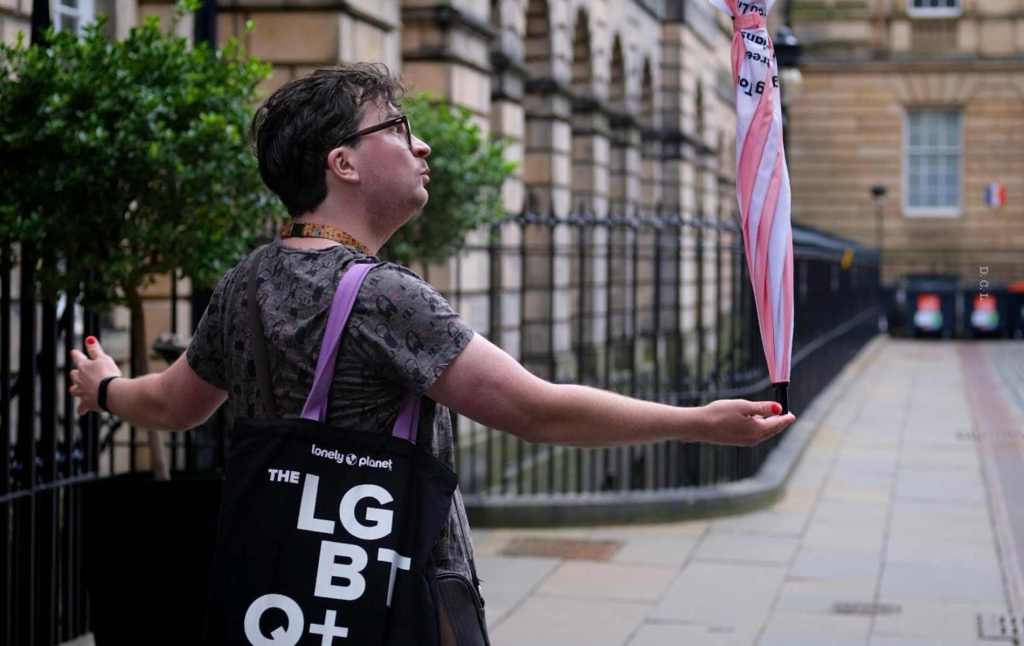
Fraser Horn is dropping Harry Potter tours from his roster (Dan Chiu-Lezeau)
The decision to drop Harry Potter tours in Edinburgh was not an easy one to make, but was necessary, says guide and Edinburgh Street Historians founder Fraser Horn, writing exclusively for PinkNews.
I was about 11 when I first got into Harry Potter, the kid looked a lot like me at the time.
My mum gave me a copy [of one of the books] and, like so many others, I felt the series captured the mood at the time: a sense of peril, mixed with optimism that the world could turn out OK if people stood up for what was right against what was wrong.
It was an instant classic of a kids book and that’s probably why so many millennials still hold such affection [for it] to this day. But we all grew after the series finished, some of us into decent people and others into cartoon villainy.
This is why today I’m announcing that following the success of the LGBTQ+ tour replacing Harry Potter, come July, the Harry Potter tour will not be coming back.
Fraser Horn. (Dan Chiu-Lezeau)
This decision was not made lightly. Although I wanted out of Potter ever since JK Rowling’s essay in 2020, the simple fact of the matter is that the story is so deeply ingrained in the Edinburgh tourism industry that it feels almost impossible to dislodge.
The connections between Edinburgh and Harry Potter very clearly involve Rowling, since it was [here] that the series was written. The films make demand stronger, bringing in a new audience, and repeat showings keep young people interested. With the new TV show, I expect Potter tourism to increase [here] and across the UK.
If any of those tourists are queer and want a tour that’s more important, they can book the LGBTQ+ one here.
I have been a guide since 2019 but went independent in February. Street Historians was a name that came from the idea that we would be like street magicians, but of history rather than magic. We’re fun, different and the best way to see Edinburgh, in my view.
The initial plan was to do a couple of tours – Edinburgh’s Old Town and Harry Potter – on a free/pay-what-you-want basis. I planned on doing this because I knew it worked. It was around March that I got in touch with LGBT Health and Wellbeing, a Scottish charity which focuses on supporting the health and wellbeing of LGBTQ+ adults. I wanted to discuss donating money from my Harry Potter profits to them but I also [said] I had offered an LGBTQ+ tour privately in the past.
They were particularly interested in the LGBTQ+ tour so I decided to run that every Friday at 6pm. It involves medical innovators, spies and [the] Aids [crisis], as well as how activists helped reshape society for the LGBTQ+ community. It is essential stuff.
I was motivated to drop Potter for Pride month because of the recent Supreme Court decision which will make our trans siblings unsafe. Rowling has confirmed she donated money to the organisation that advocated for the court decision and celebrated with a cigar picture on a boat, which made me want to drop Potter even more.
The Harry Potter tour will be replaced with a queer-related one. (Dan Chiu-Lezeau)
The response – both to the original LGBTQ tour and to replacing Potter with it – has been overwhelming.
People who have come on the LGBTQ+ tour love having an event which is a bit different from the standard fare, both in terms of walking tours and queer events. Guests have been making friends and these are the kind of life-long connections from which community is made. The decision to drop Potter for LGBTQ+ history has been a success and most have been positive about it.
However, some thought I was doing it for the wrong reason: rainbow capitalism, or purely to make money for Pride, before switching back to the Potter tours. It’s fair that the community might expect this sort of thing because as we’ve seen, companies change very quickly. A great example of this would be Barclays Bank, which has a very proud LGBTQ+ section. Then I read how they are banning trans people from using the toilets of their gender, based on the court ruling.
To reassure people, Potter will not be coming back to the Street Historians roster. We have been looking for more interesting stories to tell, for example on forgotten women.
Even with significant economic considerations, it seems necessary for me to drop Potter. The series may be a draw for other people but it is proving harder as time goes by to conjure up enthusiasm. Some may be upset, but I guess that’s the lesson I took from the sort of books I read growing up. We have to take a stand eventually or nothing will ever change.
Share your thoughts! Let us know in the comments below, and remember to keep the conversation respectful. (snip)


















 Scottie's Playtime