
Tag: Human Rights
National Coming Out Day In Peace & Justice History For 10/11
| October 11, 1987 |
| More than half a million people flooded Washington, D.C., demanding civil rights for gay and lesbian Americans, now celebrated each year as National Coming Out Day. Many of the marchers objected to the government’s response to the AIDS crisis, as well as the Supreme Court’s 1986 decision to uphold sodomy laws in Bowers v. Hardwick. |  |
 | The NAMES Project AIDS Memorial Quilt was first displayed there, bringing national attention to the impact of AIDS on gay communities, a tapestry of nearly two thousand fabric panels each a tribute to the life of one who had been lost in the pandemic. |
| <–The AIDS quilt, first displayed in 1987 in Washington, DC |
https://www.peacebuttons.info/E-News/peacehistoryoctober.htm#october11
Greta Thunberg Exposes More Israeli Abuse And Calls For End To US Complicity
U.S. Atomic Secrets Shared Exclusively, Solidarnos’c’ Banned; in Peace & Justice History for 10/8
| October 8, 1945 President Harry S. Truman announced that the secret of the atomic bomb would be shared only with Great Britain and Canada.  |
| October 8, 1982 The Polish Parliament overwhelmingly approved a law banning Solidarnos´c´ (Solidarity), the independent trade union that had captured the imagination and allegiance of nearly 10 million Poles.  Solidarnosc leader Lech Walesa, 1982 The law abolished all existing labor organizations, including Solidarity, whose 15 months of existence brought hope to people in Poland and around the world but drew the anger of the Soviet and other Eastern-bloc (Warsaw Pact) governments. The parliament created a new set of unions with severely restricted rights. |
https://www.peacebuttons.info/E-News/peacehistoryoctober.htm#october8
A Sad Anniversary This Date In Peace & Justice History
| October 7, 1989 Tens of thousands (estimates ranged from 40,000 to 150,000) from all over the country marched on Washington, lobbied Congress and Housing Secretary Jack Kemp to provide affordable housing for the homeless. Some of the signs read, “Build Houses, Not Bombs.” Kemp signed a letter committing the George H.W. Bush administration to several steps to help the homeless, including setting aside about 5000 government-owned single-family houses for them. |
October 7, 1998 Matthew Shepard Matthew Shepard, a gay student at the University of Wyoming, was beaten, robbed and left tied to a wooden fence post outside Laramie, Wyoming; he died five days later. His death helped awaken the nation to the persecution of homosexuals and their victimization as objects of hate crimes. A play about the incident, and later an HBO movie, “The Laramie Project,” has been performed all over the country. Watch a preview MatthewShepard.org Matthew’s Place |
https://www.peacebuttons.info/E-News/peacehistoryoctober.htm#october7
About The ADL & The SPLC
This is bad news, probably very bad news. SPLC and ADL do so much work against anti-semitism, and SPLC lobbies against and informs of hate of all people. I do lobbying work with SPLC. Maybe the Quakers are more gentle than SPLC, but only by a hair! So this is bad news for many reasons now.
FBI cuts ties with Southern Poverty Law Center, Anti-Defamation League after conservative complaints
By ERIC TUCKER
WASHINGTON (AP) — FBI Director Kash Patel says the bureau is cutting ties with two organizations that for decades have tracked domestic extremism and racial and religious bias, a move that follows complaints about the groups from some conservatives and prominent allies of President Donald Trump.
Patel said Friday that the FBI would sever its relationship with the Southern Poverty Law Center, asserting that the organization had been turned into a “partisan smear machine” and criticizing it for its use of a “hate map” that documents alleged anti-government and hate groups inside the United States. A statement earlier in the week from Patel said the FBI would end ties with the Anti-Defamation League, a prominent Jewish advocacy organization that fights antisemitism.
The announcements amount to a dramatic rethinking of longstanding FBI partnerships with prominent civil rights groups at a time when Patel is moving rapidly to reshape the nation’s premier federal law enforcement agency. The organizations over the years have provided research on hate crime and domestic extremism, law enforcement training and other services but have also been criticized by some conservatives for what they say is an unfair maligning of their viewpoints. snip-MORE on the page)
Republicans In Other Times, & Demos Against Use of Cassini in Peace & Justice History for 10/4
| October 4, 1976 Earl Butz resigned as President Gerald Ford’s agriculture secretary with an apology for what he called the “gross indiscretion” of uttering a racist remark. |
| October 4, 1997 Demonstrations across the country occurred protesting the scheduled launch of the space probe Cassini because its power source was three plutonium-fueled Radioisotope Thermoelectric Generators.The probe carried 72.3 pounds of plutonium, the most ever put on a device to be launched into space. The concern was for an accidental release in the event of a launch mishap. Plutonium is the most toxic substance known.  “It is so toxic,” says Helen Caldicott, president emeritus of Physicians for Social Responsibility, “that less than one-millionth of a gram is a carcinogenic dose. One pound, if uniformly distributed, could hypothetically induce lung cancer in every person on Earth.”  The Risk of Cassini Probe Plutonium An interview with Dr. Caldicott |
https://www.peacebuttons.info/E-News/peacehistoryoctober.htm#october4
Flowers & The Military
Maybe we all live in red states, and this won’t be a thing with which we deal (just maybe.) But, just in case, here is a pointer for coping. Pass it along!
As the Military Occupies your Town, Give them Flowers and a Note
Arnold Oliver 10/02/2025
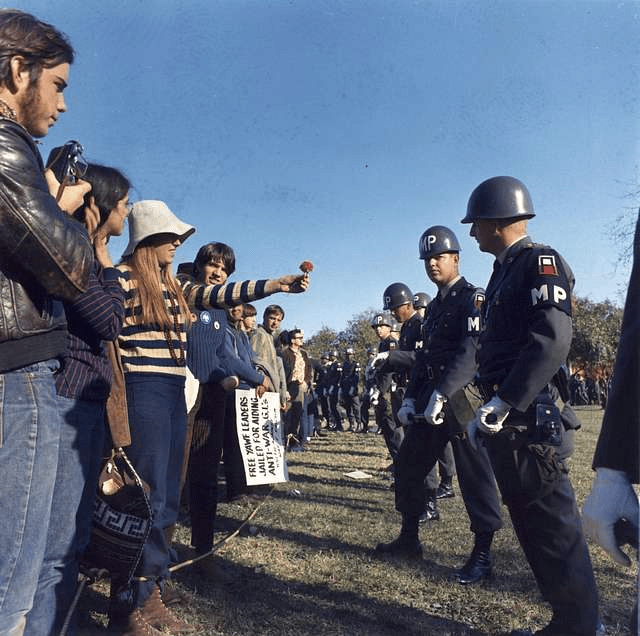
An anti-Vietnam demonstration. Arlington, Virginia, USA. By S.Sgt. Albert R. Simpson. Department of Defense. Department of the Army. Office of the Deputy Chief of Staff for Operations. U.S. Army Audiovisual Center. – This media is available in the holdings of the National Archives and Records Administration, cataloged under the National Archives Identifier (NAID) 594360. Public Domain. Via Picryl.
Tiffin, Ohio (Special to Informed Comment; Feature) – During some of the large anti-war demonstrations during the 1960’s some of the protesters gave flowers to the troops faced off against them. In the 1967 March on the Pentagon it was the 503rd Military Police Battalion, and elsewhere the National Guard was deployed. An iconic photo from 1967 shows a young man placing a flower into a soldier’s gun barrel during the protest. Let’s bring that custom back when the US military occupies your town in 2025, but this time let’s include a note along with the flower.
Allow me to explain.
The demonstrators of the 1960’s understood that the soldiers faced off against him were not the enemy. Nearly all of the soldiers were young and patriotic and trying to do the right thing. Many of them were under economic hardship and wanted help paying for their education. The flower symbolized the protesters’ belief that the soldiers were not their enemies, and they did not wish to be theirs. And in fact, as the almost entirely peaceful protests grew, many soldiers came to sympathize and began to actively oppose the war as well.
Now we have federalized Guard troops being called out by President Trump in Washington, DC, Los Angeles, Portland with other cities soon to follow. Chicago is likely next. The authority for this is said to be Title Ten of the US Code which says that the president may federalize the National Guard if the US “is invaded or is in danger of invasion by a foreign nation; there is a rebellion or danger of a rebellion . . or the president is unable with the regular forces to execute the laws of the United States.”
Legitimate grounds for a US military or National Guard deployment do not exist. The claim that crime is spiraling out of control is false, and those pushing for the deployments know it. There is zero credible proof that crime is increasing. According to a recent FBI report (August, 2025) robbery, assault, rape and murder all continued a decline that began post-covid. We are not being invaded, there is no rebellion, and the laws are being enforced about as well as ever.
A second reason against deploying the military on our streets is that the Posse Comitatus act of 1878 forbids the use of US military forces within the country for active law enforcement except in exceptional circumstances such as insurrection, and explicitly approved by Congress. The military is forbidden from making arrests, conducting searches, issuing warrants, or interfering with local law enforcement. The law also applies to National Guard forces unless approved by state governors. No governors this year have made any requests for federalized National Guard troops.
And it is worth noting that Trump’s military forays into cities are only being used in areas run by Democratic officials. High crime in red state cities is ignored. And the Trump administration refuses to realize the obvious danger of political violence and threats from MAGA and the American right which are much higher than those from the left, according to the Anti-Defamation League (ADL), the Center for Strategic and International Studies (CSIS) and others. Antifa is officially (and improperly) designated as domestic terrorists while violent right wing groups get a pass from the administration.
The President’s rhetoric seems aimed at inflaming and dividing. The “enemy from within”, “full force”, “thugs”, “vermin”, and much more. And there is hardly a peep of protest from the Republican party.
So this time around, how about if we give the troops a note along with the flower? You could use wording such as this:
Dear US soldier –
Your service oath included a pledge to uphold the US constitution, and your training taught you to disobey illegal orders.The orders sending you here (insert name of your city or town) are unlawful and unjust. You have a legal obligation to disobey.
We encourage you to go home, and we will support you in that decision.
About the Author

Arnold Oliver is an emeritus professor of political science at Heidelberg University in Tiffin, Ohio. A Vietnam veteran, he belongs to Veterans For Peace, and can be reached at soliver@heidelberg.edu.
Sharing A Snippet From Rep. Ocasio-Cortez
Click on the link to read the whole thing which is funny/scary/as only-Jeff-Tiedrich can do it; I’m sharing the message as snipped below.
dunk-tank clown and demented pantload lecture actual soldiers on soldiering by Jeff Tiedrich
what the fuck was that? Read on Substack
(snip)
look, this is all scary shit — so here’s AOC to talk us all down off the ledge.
“I think there’s two things that are happening at once: one, there absolutely is an unprecedented abuse of power, destruction of norms, erosion of our government and our democracy in order to prop up an authoritarian style of governance however, they are weaker than they look, and it is important that we remember that because what they rely on is the impression of power, the perception of inevitability in us giving up in advance. Donald Trump is at record levels of unpopularity in his tenure. the Republican house is at record levels of unpopularity. they are underwater across the board and they know it. and that is causing them to double down in public. but it is backfiring. that is why whether it’s a shutdown, whether it’s all of this, they want us to blink first and we have too much to save.”
steady on, folks. we will get through this.
FBI to Categorize Trans People As “Nihilistic Violent Extremist” Threat Group, Report Says
I just read how Pete Hegseth has decided that the best military in the world is “too woke and not male enough to have the warrior ethos”. He wants a military modeled off the 1940 model with all male white straight cis people. A few women in the offices are OK but none of that integrated military that Eisenhower did, whites and blacks serve in different military units and of course now being Christian is going to be a new requirement. I don’t know if Hegseth is paid by Russians or if his Christian nationalism is causing him to idealize the very Russian military propaganda of a male only hyper aggressive military … the same military that has been getting its ass kicked in the Russian war against Ukraine. We are witnessing the dismantling of 80 plus years of integration and what made the US military so powerful. Think of how warfare is done today. With drones and weapons that reach targets over the horizons. You don’t need to be a Rambo for those tasks. I worked in a satellite intel unit. We were not really soldiers. When I was in the Navy we did not have the requirements for PT that the Army did, but we were still as deadly or even more so. This fixation of purging the military of the LGBTQ+ and female members is destroying what makes our military so great. Ask countries that have those people in their military like Israel! Their LGBTQ+ and female members are just effective as the men. But it doesn’t fit with the Christian Nationalist identity that Hegseth and his ilk are trying to push the US into.
Recently the heritage foundation pushed the idea of a trans terrorist idealization that was behind the public shootings and they used faked data that they created to prove their point. It is all to further the push of theirs to make the US a Christian Theocracy where only the biblical pairings they consider hole to be accepted. But in truth the bible allows for a male to have as many sexual partners as he wishes and only constrains the females from having sex with anyone but their husbands or their owners. The entire Christian teachings these people push is constriction for females and complete freedom for males on the issue of sex and marriage. Hugs
https://www.them.us/story/trump-admin-fbi-trans-nihilistic-violent-extremists-terrorist
The choice is being championed by the Heritage Foundation, which is behind Project 2025.
The Federal Bureau of Investigation is reportedly preparing to categorize transgender people as “violent extremists,” a categorization supported by organizations affiliated with Project 2025.
The most important LGBTQ+ news and politics stories delivered straight to your inboxBy signing up, you agree to our user agreement (including class action waiver and arbitration provisions), and acknowledge our privacy policy.According to a September 18 report by independent journalist Ken Klippenstein, two anonymous national security officials said that the Bureau is discussing treating trans subjects as a subset of its new threat category, “Nihilistic Violent Extremists” (NVEs), which was created earlier this year. The Bureau defines “Nihilistic Violent Extremism” as “criminal conduct… in furtherance of political, social, or religious goals that derive primarily from a hatred of society at large and a desire to bring about its collapse by sowing indiscriminate chaos.”
Officials said that such a classification would give the Trump administration “political (and media) cover” as they escalate their anti-trans campaign in the aftermath of right-wing pundit Charlie Kirk’s death.
“They are cynically targeting trans people because the shooter’s lover was trans,” an unnamed senior intelligence official told Klippenstein. “The administration has convinced itself that the Charlie Kirk murder exposes some dark conspiracy.”
Last week, the false claim that there were “transgender” engravings on the bullets that suspect Tyler Robinson allegedly used to shoot Kirk began circulating widely, boosted by anti-LGBTQ+ conservatives like Rep. Nancy Mace and Steven Crowder. Utah Gov. Spencer Cox later confirmed that there was “no indication that the ammunition included transgender references.” On Sunday, Cox told Meet the Press that Robinson was allegedly in a romantic relationship with a roommate who is trans, providing no additional public corroborating data or information of the roommate’s gender. The authorities have stipulated the roommate has been cooperating with the investigation and was not aware of the shooting prior to its occurrence.
Despite no evidence linking an alleged trans roommate to Robinson’s motivation for shooting Kirk, right-wingers are nevertheless attempting to use this detail to push an anti-trans agenda. In a petition launched on Thursday, the Heritage Foundation — the far-right think tank behind the derided and controversial Project 2025 — and its spin-off group, the Oversight Project, asked the FBI to designate “Transgender Ideology-Inspired Violent Extremism” (TIVE) as a domestic terrorism threat category.
The group defines “TIVE” as “the belief that violence is justified against people who oppose [the trans community],” as well as the belief that opposing trans rights “itself constitutes a form of violence towards people who identify as [trans or gender nonconforming]… or poses an imminent threat to such persons’ emotional, psychological, or physical safety, including through self-harm or suicide.”
As The Independent noted, if such a category is adopted by the FBI, it could be applied to rhetoric used by activists, writers, and allies speaking out against anti-trans policies and rhetoric.
At least a dozen hoaxes have claimed trans people were responsible for mass shootings and other incidents since 2012.In reality, there is no evidence suggesting significant patterns of violence committed by trans people. In 2024, The Gun Violence Archive’s Executive Director, Mark Bryant, said that out of 5,000 mass shootings tracked by the archive, the number of trans or LGBTQ+ suspects is in “the single digit numbers.”
Get the best of what’s queer. Sign up for Them’s weekly newsletter here.
Abby Monteil is a New York-based writer. Her work has also appeared in The Daily Beast, Insider, Elite Daily, Thrillist, and others. … Read More


