I admit my life was different but from the time I was five I knew I was attracted to males. Specifically both sexually and emotionally. One of the hell spawn female siblings even held me down to pound the point that I was “queer” into me. I did not understand why it was wrong, after all they were the ones telling me what to do and farming me out to their teen boyfriends. I craved being held by the boys and not so much the girls. But all the other gay and lesbian people I have talked to knew early also. Preteen time frame. 7 or 8 and up they knew they were gay and either knew they had to hide it or knew they couldn’t so had to live with being attacked for it. These people who think it is a choice, a fad, or a phase need to ask themselves the famous question. When did they know they were cis and straight and was it a choice they made. No they just felt it all their lives, they simply knew it. Same for the LGBTQ+. The only difference is straight cis kids see themselves everywhere from birth. Mommies and daddies, they see themselves in the older kids around them, in the news, movies, TV shows, and the books they read. It feels so natural to them they just don’t question it. They are lucky. Until recently like in the last decade LGBTQ+ kids did not see themselves reflected in society. No movies had kids like them, no books in the library had kids like them. Some kids did not even know the words for how they felt. It was changing in the last ten years. Schools made a push for inclusion and tolerance, movies showed LGBTQ+ kids, books had them as plots or characters. Kids could see themselves and be proud. That is what the haters, the anti-trans / anti-gay bigots want to remove. The ability of kids who are different from the majority to see themselves represented positively in society. It is why they write and pass don’t say gay bills, and why they ban books. It is why they try to ban drag shows and pride events. These people who demand a straight cis world with only them showing in public are terrified of a world where people can be different. To them those who are the other must be destroyed, ideas of acceptance and tolerance must be erradicated and removed. All because they don’t feel different from the majority so the difference must not be real. But it is and we need to realize the scars left on kids who grew up in the times when they never seen themselves represented in society. We must not go backward in time, regressing to a time of hate. Hugs
LGBTQ+ youth advocates gathered outside the Monmouth County Courthouse in Freehold on Tuesday, Aug. 15, 2023, where a school policy that would impact lesbian, gay, bisexual, transgender and queer youth was being reviewed in Superior Court. | Amanda Oglesby / Asbury Park Press / USA TODAY NETWORK
A new poll from Pew Research Center sheds some light on just how early LGBTQ+ people are aware of their identities. The study of LGBTQ+ adults in the U.S. found that most respondents understood their identity before the age of 14, with a substantial portion knowing about their identities before the age of 10.
Among gay and lesbian adults, 36% said that they felt they were gay or lesbian before the age of 10 and 35 first felt they were gay or lesbian from ages 10 to 13. Only a minority – 29% – had their first feelings about their sexuality after the age of 14.
The numbers were similar for transgender people. Approximately 33% felt they might be transgender before age 10, and 25% felt the same way between ages 10 to 13. Only 19% had their first feelings about being transgender after the age of 18.
Bisexual people tended to know the latest, but even a majority of bisexual people said that they had their first thoughts about being queer before age 18. Half – 50% – had their first feelings of being bisexual before age 14.
The question often comes up in discussions of LGBTQ+ youth, with many on the right insisting that people can’t know their identities before adulthood. Often, these people claim that only LGBTQ+ people can’t know their identities before adulthood, but then support heterosexuality and cisgender identities in young people.
But these statements fly in the face of LGBTQ+ people’s lived experiences, which often include years of hiding their identities before they create a safer space for themselves to live authentically as adults.
While LGBTQ+ respondents generally first thought about their queer identities when they were very young, most waited until they were older to tell others. While 71% of gay and lesbian people said that they first knew about their sexuality before age 14, only 13% said that they told someone before that age. Approximately 58% of trans people first thought they might be trans before age 14, but only 15% told someone before that age.
This also contradicts the rightwing narrative that young people are saying that they are trans or gay to gain social acceptance and not because they actually identify as such. In reality, young people are saying that they’re straight or cisgender when they actually aren’t, likely to try and get social acceptance.
Pew broke down the results even more and showed that gay men generally felt that they were gay at a younger age than lesbian women, with 40% saying they were younger than 10 years old when they first thought they were gay, as opposed to 29% of lesbian women.
| Pew Research Center
Bisexual women, on the other hand, likely knew earlier than bisexual men. 53% of bi women said they felt they might be bi before they were 14 years old, while just 40% of bi men said the same.
| Pew Research Center
The poll was conducted in January of this year and involved a sample of 3,959 adult LGBTQ+ Americans. The survey asked about a wide variety of topics, including support from family and friends, ties to the larger LGBTQ+ community, and social acceptance.
Subscribe to the LGBTQ Nation newsletter and be the first to know about the latest headlines shaping LGBTQ+ communities worldwide.
Blanche last appeared here when he sanctioned the American Bar Association because its lawyers have failed to show suitable obedience to Glorious Leader.
By: Susan J. Kressly, MD, FAAP, president, American Academy of Pediatrics
“The American Academy of Pediatrics (AAP) is deeply alarmed by the report released by the U.S. Department of Health and Human Services (HHS) today on medical care for transgender and gender-diverse individuals and the process that informed its development. For such an analysis to carry credibility, it must consider the totality of available data and the full spectrum of clinical outcomes rather than relying on select perspectives and a narrow set of data.
This report misrepresents the current medical consensus and fails to reflect the realities of pediatric care.
As we have seen with immunizations, bypassing medical expertise and scientific evidence has real consequences for the health of America’s children. AAP was not consulted in the development of this report, yet our policy and intentions behind our recommendations were cited throughout in inaccurate and misleading ways. The report prioritizes opinions over dispassionate reviews of evidence.
Patients, their families, and their physicians—not politicians or government officials —should be the ones to make decisions together about what care is best for them based on evidence-based, age-appropriate care.
We urge government officials and policymakers to approach these conversations with care, humility, and a commitment to considering the full breadth of peer-reviewed research. The AAP remains focused on supporting pediatricians in delivering the best possible care to every child, informed by science and the lived experiences of patients and families. We will continue to support the well-being of all children and access to high-quality care that meets their needs.”
So what is the goal here, to save money, or ultimately to kill unhealthy Americans that Republicans think are a drag on their wallets? Inside U.S. health agencies, workers confront chaos and questions as operations come ungluedflip.it/3rz_Ee
Most brain surgery requires doctors to remove part of the skull to access hard-to-reach areas or tumours. It’s invasive, risky, and it takes a long time for the patient to recover.
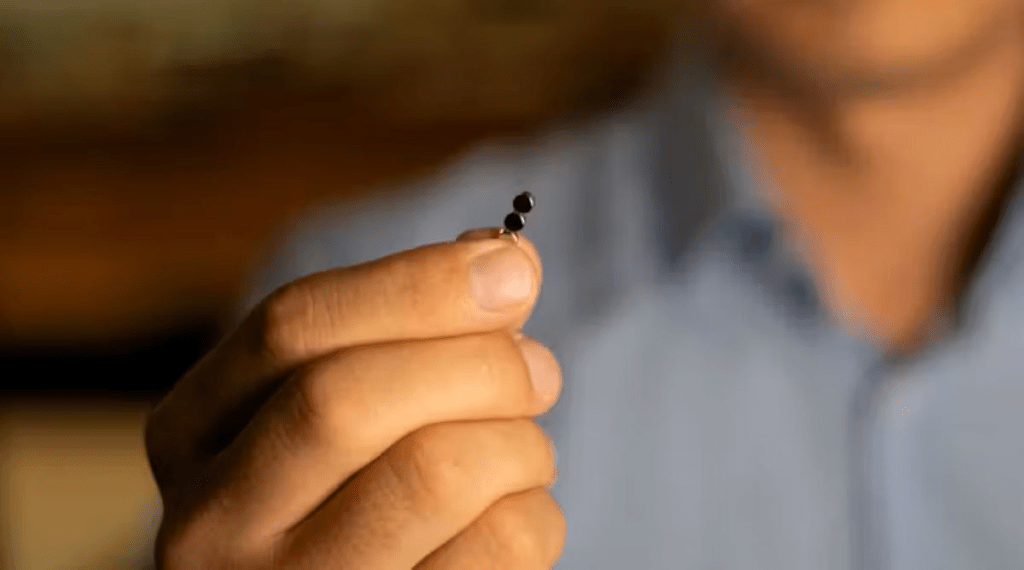
We have developed new, tiny robotic surgical tools that may let surgeons perform “keyhole surgery” on the brain. Despite their small size, our tools can mimic the full range of motion of a surgeon’s wrist, creating new possibilities for less-invasive brain surgery.
Robotic surgical tools (around 8 millimetres in diameter) have been used for decades in keyhole surgery for other parts of the body. The challenge has been making a tool small enough (3mm in diameter) for neurosurgery.
In a project led by the University of Toronto, where I was a postdoctoral fellow, we collaborated with The Hospital for Sick Children (SickKids) in Canada to develop a set of very small neurosurgery tools.
Their extremely small size is possible as they are powered not by motors but by external magnetic fields.
Three magnetic tools: a cutter, a gripper and forceps. Changyan He
Current robotic surgical tools are typically driven by cables connected to electric motors. They work in much the same way as human fingers, which are manipulated by tendons in the hand connected to muscles in the wrist.
However, pulleys smaller than several millimetres wide to control the instruments are weak and prone to friction, stretch and fracture. This creates challenges in scaling down the instruments, because of difficulties in making the parts of the system, assembling the mechanisms and managing friction in the cables.
Magnetic controls
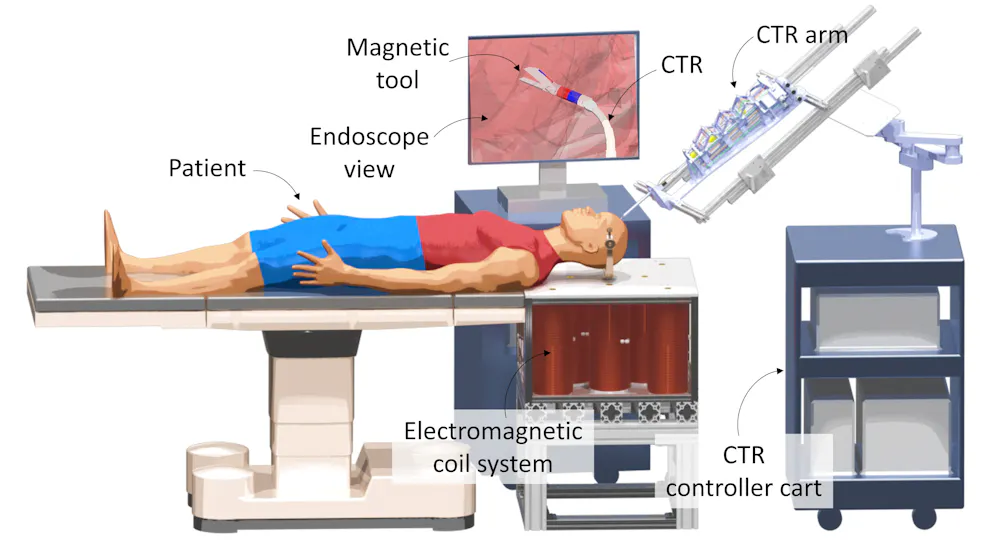
The new robotic system consists of two parts. The first is the tiny tools themselves: a gripper, a scalpel and a set of forceps. The second part is what we call a “coil table”, which is a surgical table with several electromagnetic coils embedded inside.
In this design, the patient would be positioned with their head on top of the embedded coils, and the robotic tools would be inserted into the brain via a small incision.
Patients would lie on a ‘coil table’ containing magnets which are used to control the surgical tools. Changyan He
By altering the amount of electricity flowing into the coils, we can manipulate the magnetic fields, causing the tools to grip, pull or cut tissue as desired.
In open brain surgery, the surgeon relies on their own dexterous wrist to pivot the tools and tilt their tips to access hard-to-reach areas, such as removing a tumour inside the central cavity of the brain. Unlike other tools, our robotic neurosurgical tools can mimic this with “wristed” movements.
Surprising precision
We tested the tools in pre-clinical trials where we simulated the mechanical properties of the brain tissue they would need to work with. In some tests, we used pieces of tofu and raspberry placed inside a model of the brain.
We compared the performance of these magnetically operated tools with that of standard tools handled by trained surgeons.
We found the cuts made with the magnetic scalpel were consistent and narrow, with an average width of 0.3–0.4mm. That was even more precise than those from traditional hand tools, which ranged from 0.6 to 2.1mm.
The magnetic scalpel, shown slicing some tofu inside a model of the brain, can make cuts more precise than those done with traditional tools. Changyan He
As for the grippers, they could pick up the target 76% of the time.
The magnetic grippers (shown here picking up some raspberry) were successful 76% of the time. Changyan He
We were surprised by how well the robotic tools performed. However, there is still a long way to go until this technology could help patients. It can take years, even decades, to develop medical devices, especially surgical robots.
This study is part of a broader project based on years of work led by Eric Diller from the University of Toronto, an expert on magnet-driven micro-robots.
Now, the team wants to make sure the robotic arm and magnetic system can fit comfortably in a hospital operating room. The team also wants to make it compatible with imaging systems such as fluoroscopy, which uses x-rays. After that, the tools may be ready for clinical trials.
We’re excited about the potential for a new era of minimally invasive neurosurgical tools.