October 7, 1989 Tens of thousands (estimates ranged from 40,000 to 150,000) from all over the country marched on Washington, lobbied Congress and Housing Secretary Jack Kemp to provide affordable housing for the homeless. Some of the signs read, “Build Houses, Not Bombs.” Kemp signed a letter committing the George H.W. Bush administration to several steps to help the homeless, including setting aside about 5000 government-owned single-family houses for them.
=============== October 7, 1998 Matthew Shepard Matthew Shepard, a gay student at the University of Wyoming, was beaten, robbed and left tied to a wooden fence post outside Laramie, Wyoming; he died five days later. His death helped awaken the nation to the persecution of homosexuals and their victimization as objects of hate crimes. A play about the incident, and later an HBO movie, “The Laramie Project,” has been performed all over the country. Watch a preview MatthewShepard.org Matthew’s Place
The Smithsonian National Museum of American History houses thousands upon thousands of artifacts. Here are some of the more unusual items from their collection.
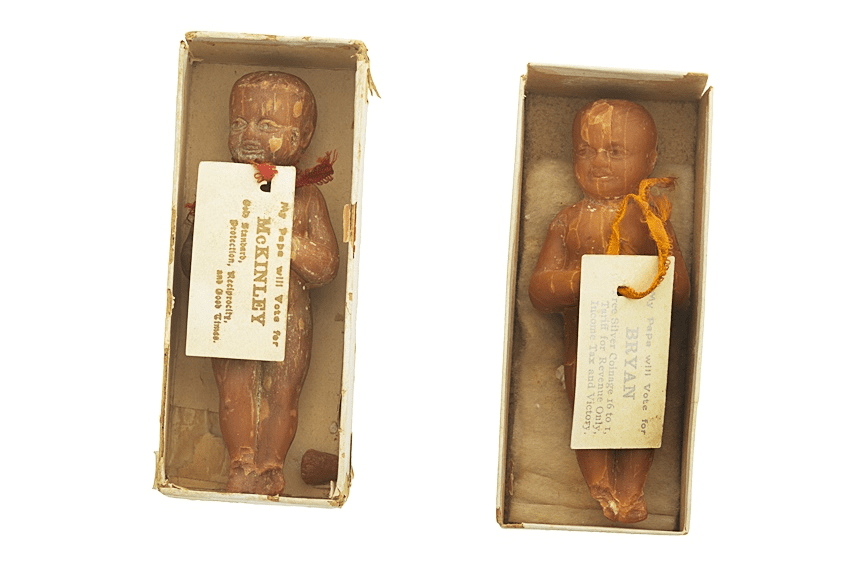
Soap babies of Republican William McKinley and Democrat William Jennings Bryan from the 1896 election (The Smithsonian National Museum of American History)
The Smithsonian Institution in Washington, D.C. was formally established on August 10, 1845, and over the years has amassed more than 157 million items across 21 museums and galleries. The Smithsonian National Museum of American History houses artifacts related to national elections and the presidency. We offer a look at some of the most unusual.
All images courtesy of The Smithsonian Institution unless otherwise noted
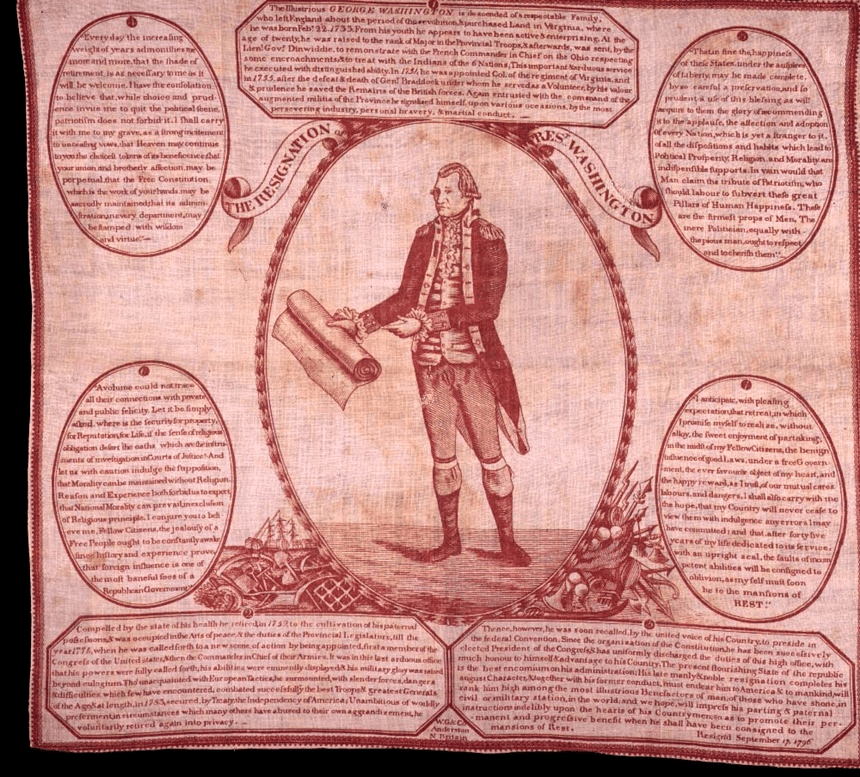
1. Bandana Featuring Excerpts from George Washington’s Farewell Address
In which Washington encouraged all Americans to put aside regional and party divisions in support of the newly formed republic. Observed Washington, “Your Union ought to be considered as a main prop of your liberty, the love of the one ought to endear you to the preservation of the other.”
2. Presidential Hair Cabinet
John Varden, keeper of collections for the National Institute for the Promotion of Science at the U.S. Patent Office, began collecting locks of hair from prominent individuals in 1850 and quickly amassed a collection that included presidents, senators, artists, and other luminaries. Varden’s presidential hair collection includes strands from George Washington and Franklin Pierce.
Brain drain could undermine the country’s hi-tech economy as liberal families conclude social contract has been broken
This summer, the Nobel laureate Prof Aaron Ciechanover joined a group of prominent Israelis gathered in the ruins of the Nir Oz kibbutz to demand a hostage release and ceasefire deal.
Nir Oz was the worst hit of all the communities targeted by Hamas on 7 October, with a quarter of its residents kidnapped or killed. Twenty-nine are still in Gaza.
If the hostages were not brought back, the basic social contract that underpinned Israeli society would unravel, the 77-year-old professor of medicine warned – with catastrophic consequences for the entire country.
He cited an accelerating “brain drain” of doctors and other professionals as a worrying sign that some of Israel’s elite already feel they no longer have a future in the country. And without them, Israel itself might struggle to have a future.
Ciechanover is a long-term critic of Benjamin Netanyahu and joined protests against his government before the war. But concern about this trend is not limited to political opponents of the Israeli leader. Earlier this year, Netanyahu’s former chair of the National Economic Council, Eugene Kandel, joined forces with the administrative expert Ron Tzur to warn that Israel faces an existential threat.
In a paper calling for a new political settlement, they warned that under a business-as-usual scenario “there is a considerable likelihood that Israel will not be able to exist as a sovereign Jewish state in the coming decades”. (snip)
The problem precedes the 7 Octoberattacks and the war that followed, as demographic and political shifts have prompted some secular, liberal Israelis to question their future in a state increasingly dominated by religious traditionalists.
Noam is a father of three with businesses that include a PR consultancy and a cannabis pharmacy. He expected that his 40s would be a time of “less doing, more enjoying”, after decades of hard work.
Instead, he and his wife spend evenings poring over school options in European countries as they weigh up where to start a new life. The war increased the urgency of the search, but it has been a decision born out of longstanding concerns.
“The main reason we are leaving is that we are seeking a better future for our children. Even if peace can be brokered tomorrow, we still can’t see a future we want to be a part of,” Noam said. “The demographics speak for themselves.”
Before internet memes, postcards offered a popular, accessible, shareable means to combine image and word. Messages could be as simple as “wish you were here,” but in their “golden age” (circa 1898–1917), postcards provided a powerful way to promote political agendas, writes scholar Kenneth Florey. The golden age neatly coincided with the height of the women’s suffrage movement in the United States and Britain. More than a thousand varieties of pro- and anti-suffrage-themed postcards were produced then, 200 of which are included in “Votes and Petticoats,” a Johns Hopkins University digital collection available on JSTOR. Of these, a significant number, curiously, depict cats—both as women’s pets and as women.
Associations between ladies, cats, and cat ladies—childless and otherwise—are rooted in a long, complicated cultural history. In Edwardian times, cats were linked to women as creatures of the domestic domain: woman was Angel of the House, the cat her companion, both of them sweet, warm, helpful, and cute. At the same time, animal lovers, “spinsters,” and suffragists represented overlapping, suspect categories of womanhood. It’s the perennial paradox in which women find themselves: somehow looked down upon while also placed on a pedestal.
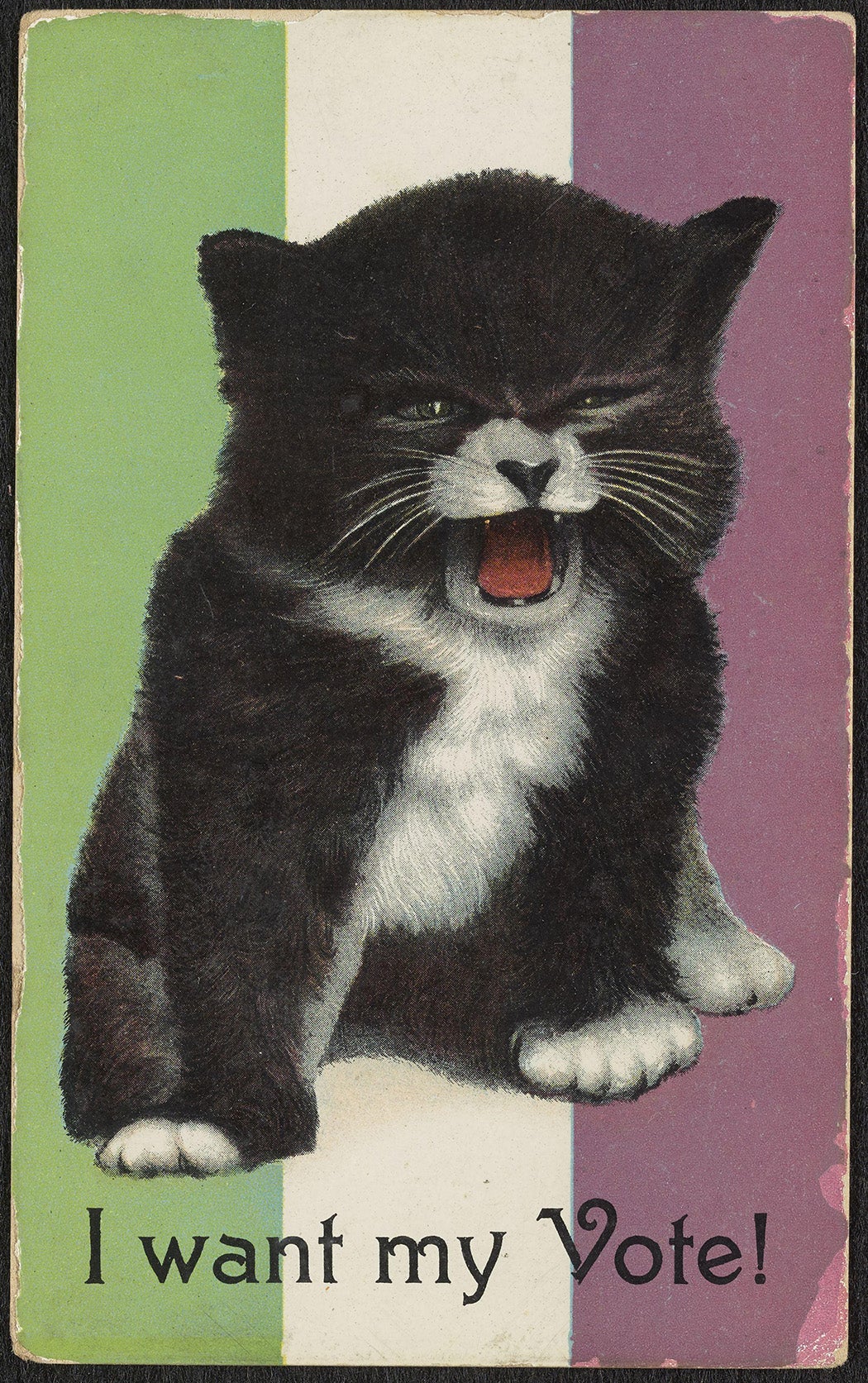
I Want My Vote! Courtesy Votes and Petticoats: Postcards, The Sheridan Libraries, Johns Hopkins University.
This postcard captures many of the themes that recur across the collection: it suggests that a woman demanding the vote is as silly as a kitten so doing, their protests as ineffective as the kitten’s mewls. The green, white, and purple stripes behind the kitten were the colors of the Women’s Social and Political Union (WSPU), one of the more militant British suffrage societies. Historian Krista Cowman interprets the sexism in this postcard as infantilizing though not especially cruel. Similarly, Florey describes the use of cats in suffrage postcards as softening a message that might otherwise seem harsh.
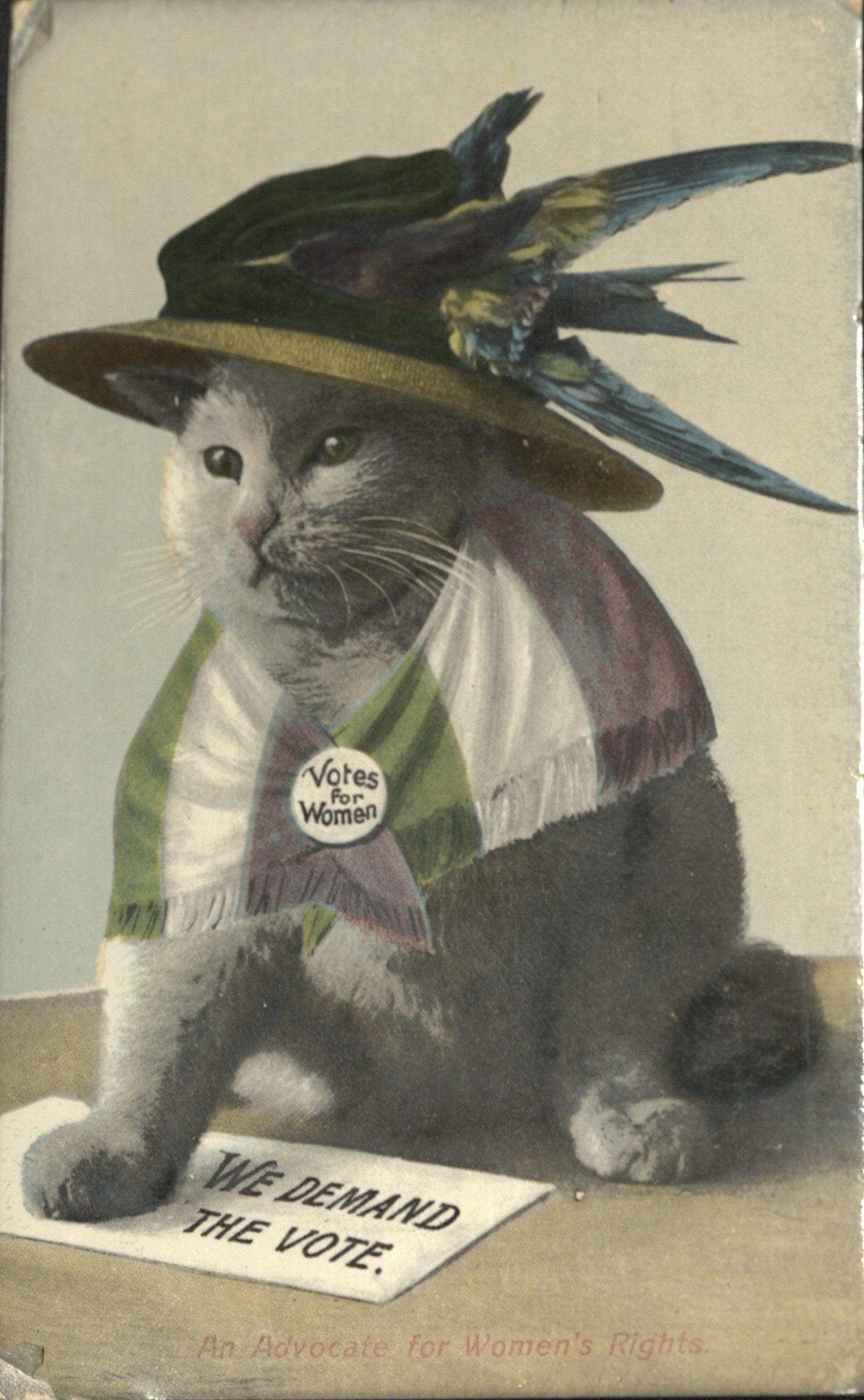
We Demand the Vote: An Advocate for Women’s Rights. Courtesy Votes and Petticoats: Postcards, The Sheridan Libraries, Johns Hopkins University.
In a similar vein, this cat is draped in the colors of the WSPU and wearing a fashionably magnificent hat. The message is ambiguous: Larissa Schulte Nordholt contends that it’s probably meant to satirize the concept of women participating in politics, the well-groomed, fat feline playing on the perception of suffragists as spoiled. It was published by a company that produced other, more clearly anti-suffrage postcards. But there’s a certain dignity in the cat’s determined forward gaze and assertive paw that perhaps suffragists could have embraced, regardless of the creator’s intention. Then again, that seriousness can also be interpreted as the very thing an anti-suffragist postcard maker was mocking by attaching it to a fluffy house cat.
Less whimsically, other postcards feature cats as pets in human scenes.
Courtesy Votes and Petticoats: Postcards, The Sheridan Libraries, Johns Hopkins University.
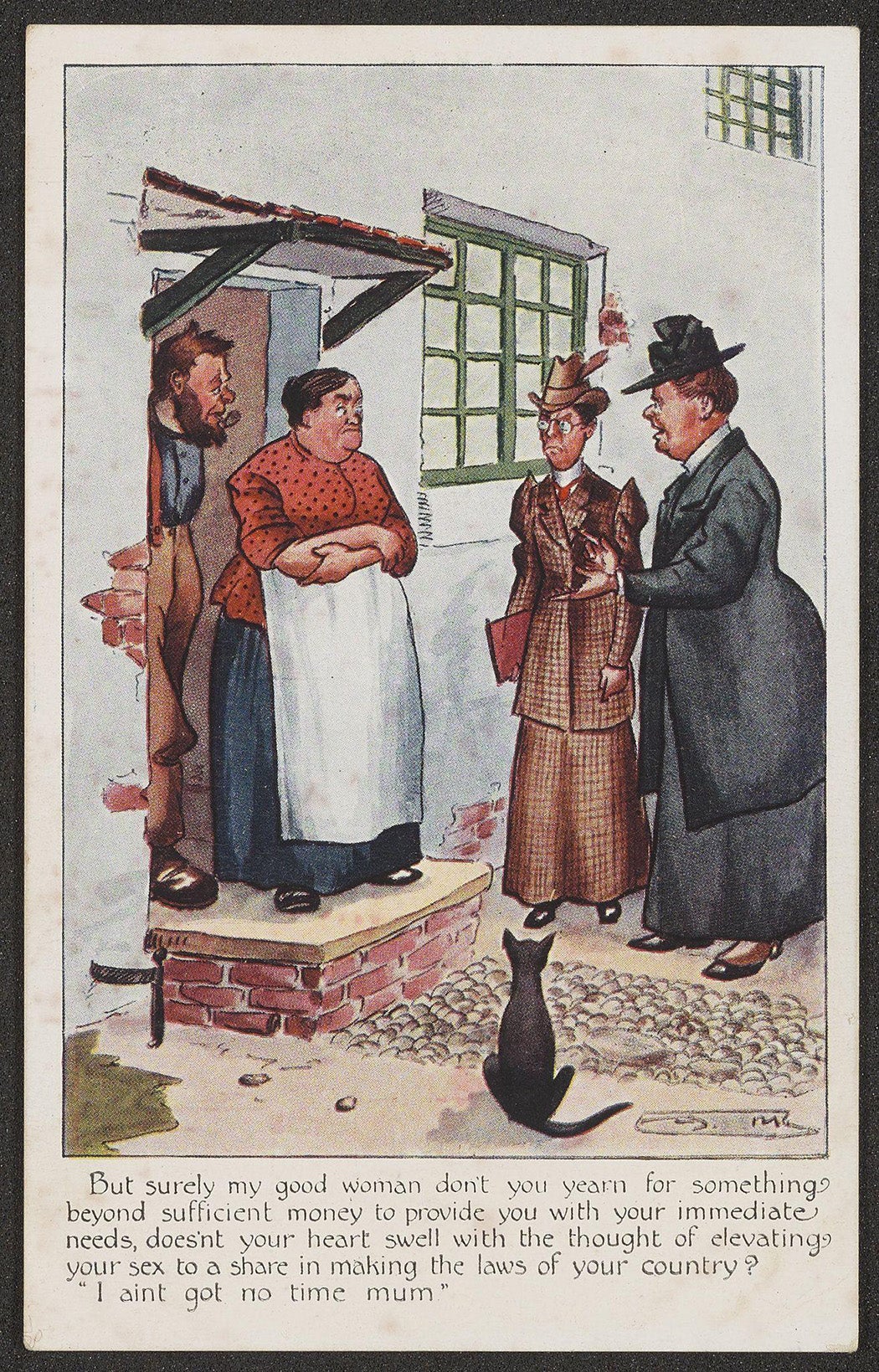
Here, the suffragists portrayed are mannish and middle-aged, typical of many negative suffragist depictions, stereotyping them as unsexed spinsters. While the housewife they address isn’t an idealized Angel of the House, she has a traditionally “motherly” figure and wears more feminine clothing. The suffragists, the viewer thus understands, are out of touch with what “real” working women want. If the suffragists had families to occupy them, they wouldn’t worry about the vote. And if lower-class women had the vote, they wouldn’t care to exercise it.
The cat in this postcard is outside the house and thus linked to the suffragists (it sits slightly apart, but arguably that positioning is dictated by compositional rather than symbolic reasons). The suffragists are “outdoor cats,” less benign and more feral—less feminine—than their indoor counterparts. It’s also worth noting that the cat is black, which taints it, and thus the suffragists, with associations of witchcraft and bad luck.
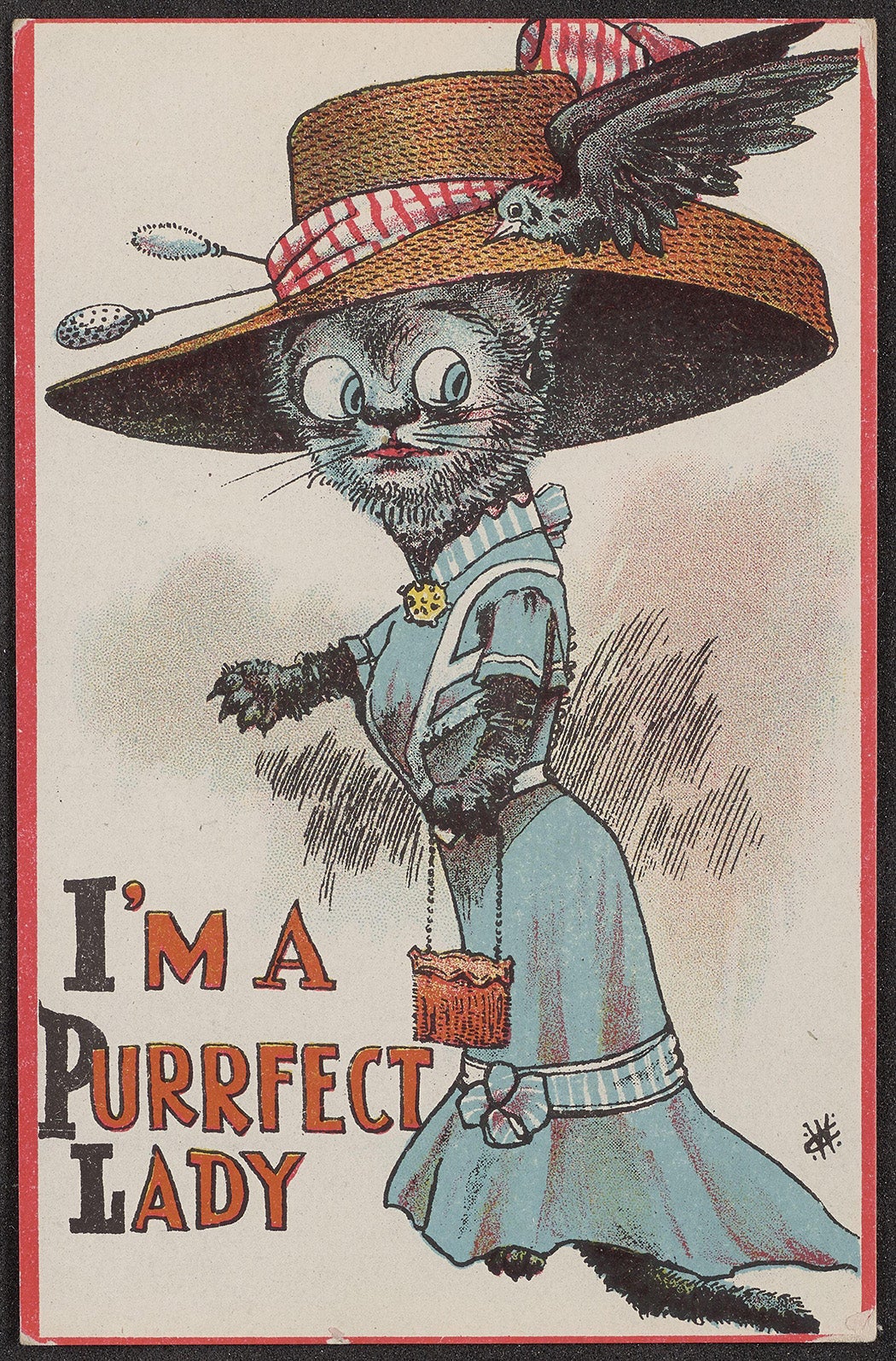
I’m a Purrfect Lady. Courtesy Votes and Petticoats: Postcards, The Sheridan Libraries, Johns Hopkins University.
Here too the suffragist is associated with a black cat, to unflattering, ridiculous effect. Although it was considered appropriately feminine for women to care for animals, women and femininity were also considered weaker, sillier, and more frivolous than men and masculinity; caring too much for other creatures came was considered a sign of fragility and triviality.
Tobias Menely has traced the disparagement of animal welfare through the evolution of gender norms in the modern period. As an early example, he cites a 1786 Scottish magazine story about a “Mrs. Sensitive” who dotes on a menagerie of pets yet cares little for “poor Christians.” In Menely’s analysis, Mrs. Sensitive is “immoral and unnatural, an ancestor of our own crazy cat ladies, women whose maternal instincts, we are led to believe, have been attenuated by an affinity for animals.”
By 1909, around the time these postcards were produced, sensitivity to animals was fully pathologized, as Menely relates: one doctor, Charles Dana, called it “zoöphilpsychosis” and published an article about it in the Medical Record. A case study pronounced a “childless woman who transformed her house into a hospital for sick felines” as “beyond medical redemption.” Sufferers of “zoöphilpsychosis” were described as “sentimental,” “weak,” and “hysterical”—terms loaded with sexist connotations.
These stereotypes are further repeated in conversations surrounding the anti-vivisection movement, another woman-dominated cause that reached its height in the Victorian and Edwardian eras.
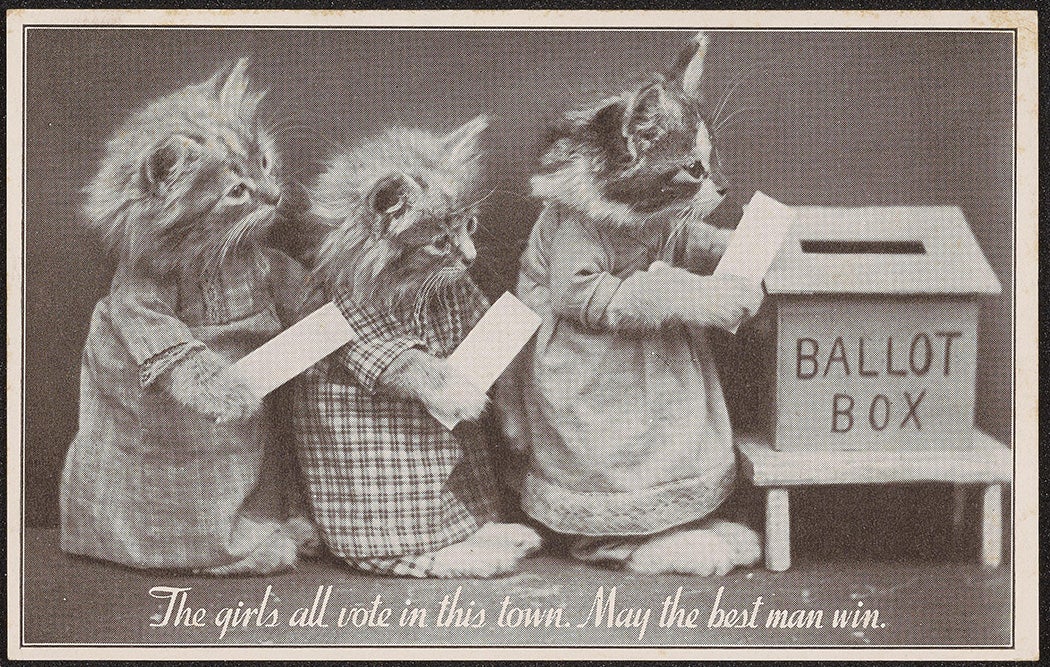
The Girls All Vote in This Town. May the Best Man Win. Courtesy Votes and Petticoats: Postcards, The Sheridan Libraries, Johns Hopkins University.
This is one of several suffrage postcards that feature photographs of live and presumably taxidermized kittens dressed up and posed. Although this postcard’s message could be interpreted multiple ways, Nordholt points out that the use of taxidermy speaks to the “synchronous oppressions of women and cats.”
Indeed, Susan Hamilton quotes a contemporary critic of anti-vivisection using misogyny to defend animal cruelty:
Is it necessary to repeat that women—or rather, old maids—form the most numerous contingent of [antivivisectionists]? Let my adversaries contradict me, if they can show among the leaders of the agitation one young girl, rich, beautiful, and beloved, or some young wife who has found in her home the full satisfaction of her affections!
Although suffragettes and antivivisectionists didn’t always align, the two movements had much in common, including the consistent stereotyping of their members as spinsters. And as we have seen in “But Surely My Good Woman…,” spinsters were objects of mistrust and derision.
Courtesy Votes and Petticoats: Postcards, The Sheridan Libraries, Johns Hopkins University.
It wasn’t always that way. For a time in the nineteenth century, single women could claim feminine power through the “Single Blessedness” movement. Where women had long been shamed or pitied for not marrying, they began to frame their singleness as reflective of a higher calling: still nurturing, still Christian, but outside of marriage. Harriet Tubman, for example, spent eighteen of her most productive and prominent years without a husband. As a Black woman, Tubman faced extra scrutiny for being unmarried. She leveraged the concept of Single Blessedness for respectability.
As women began to agitate more for equal rights, however, Single Blessedness fell out of favor. Lee Chambers-Schiller provides an overview, writing that
[a]s the century wore on, spinsters were increasingly defined as unacceptable childcare providers, guardians, or even teachers of children. Their spinsterhood took on an ominous cast, their celibacy no longer evidence of pure, Christian love, but now suggestive of physical, emotional, and intellectual degeneracy.
It wasn’t just that spinsters lacked the feminine graces needed to attract a man—their “degeneracy” was a result of their childlessness:
The woman whose reproductive organs went unused would experience their atrophy and derangement, together with a painful menopause and general physical and mental deterioration. A spinster could look forward to a shortened life span and quite possibly insanity.
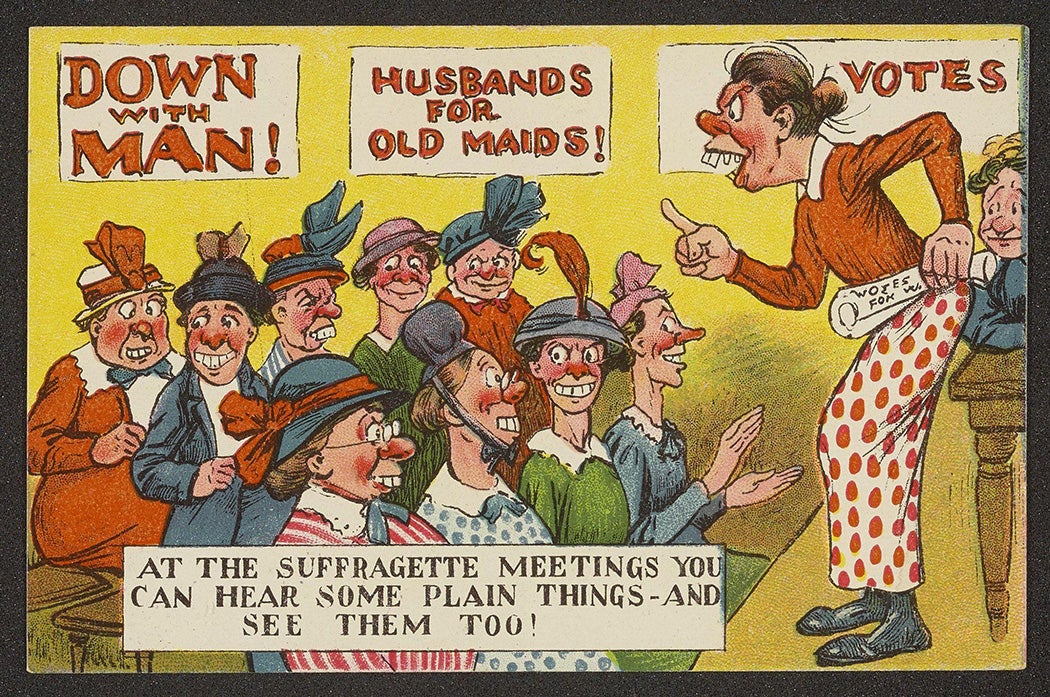
Courtesy Votes and Petticoats: Postcards, The Sheridan Libraries, Johns Hopkins University.
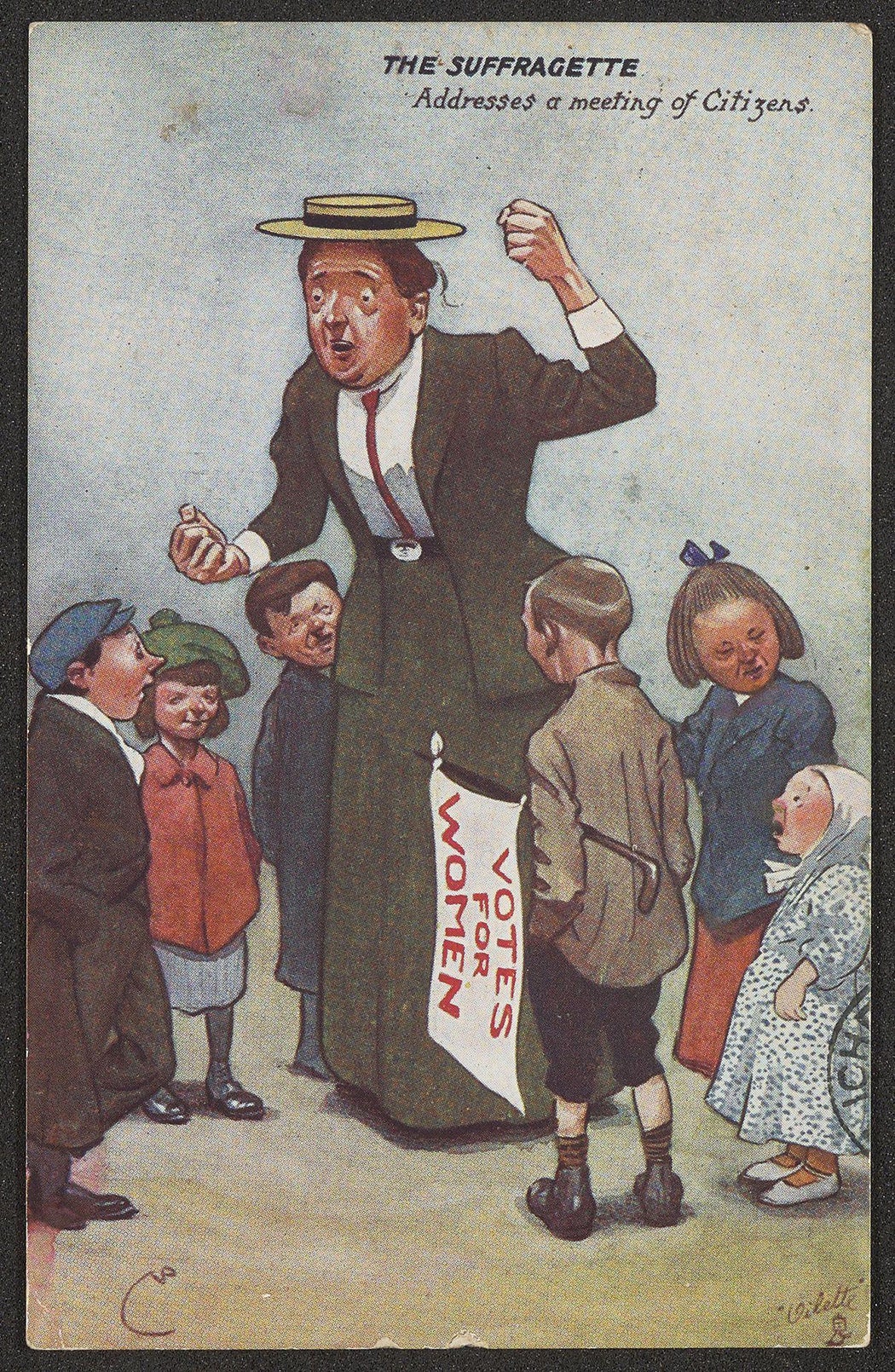
The suffragist in this postcard is marked as a spinster; her masculine features, hat, and clothing tell us as much. Wild-eyed and staring off the page, she’s so out of touch with reality and with her maternal instincts that she doesn’t even realize her audience of “Citizens” consists only of confused children.
Opponents of women’s suffrage argued that banning women from voting was actually a way of protecting them and preserving their angelic femininity. Politics, they claimed, was a nasty business that would take women away from their divine calling in the home, to the detriment of the race.
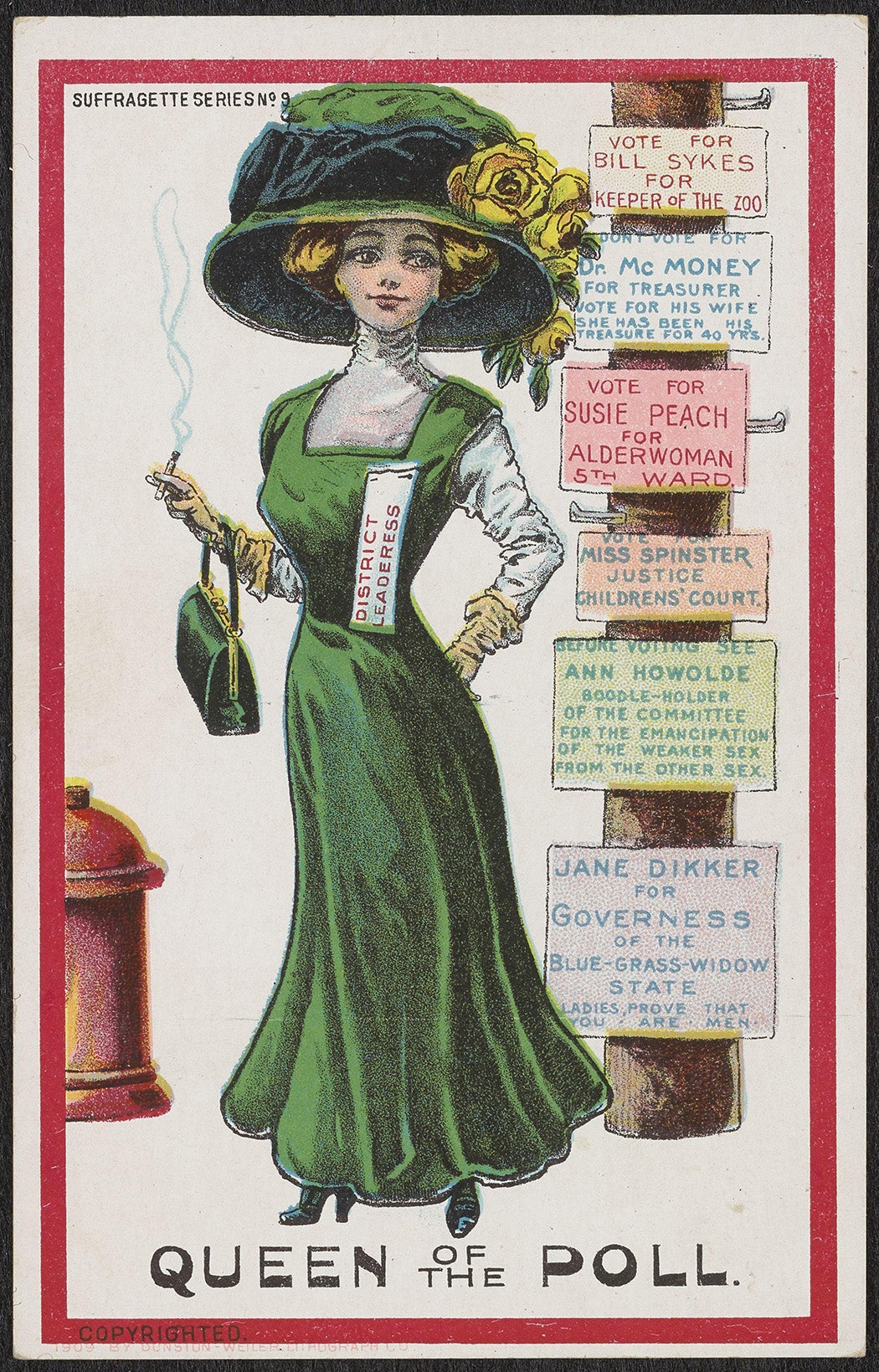
The Queen of the Polls. Courtesy Votes and Petticoats: Postcards, The Sheridan Libraries, Johns Hopkins University.
This woman represents anti-suffragists’ fears of what society would look like if women gained the vote. In contrast to the depictions of suffragists as dowdy old maids, the woman portrayed in this postcard is conventionally attractive and fashionably dressed. But her decadent New Woman status is given away by her cigarette—proper women didn’t smoke!—and her “District Leaderess” sash. The pole behind her is covered in campaign signs for mostly female candidates, including “Miss Spinster” for justice of the children’s court, which viewers are of course meant to interpret as an outrageous irony.
The role-reversal that women’s suffrage would supposedly bring about is communicated in several postcards, once again, through cat imagery.
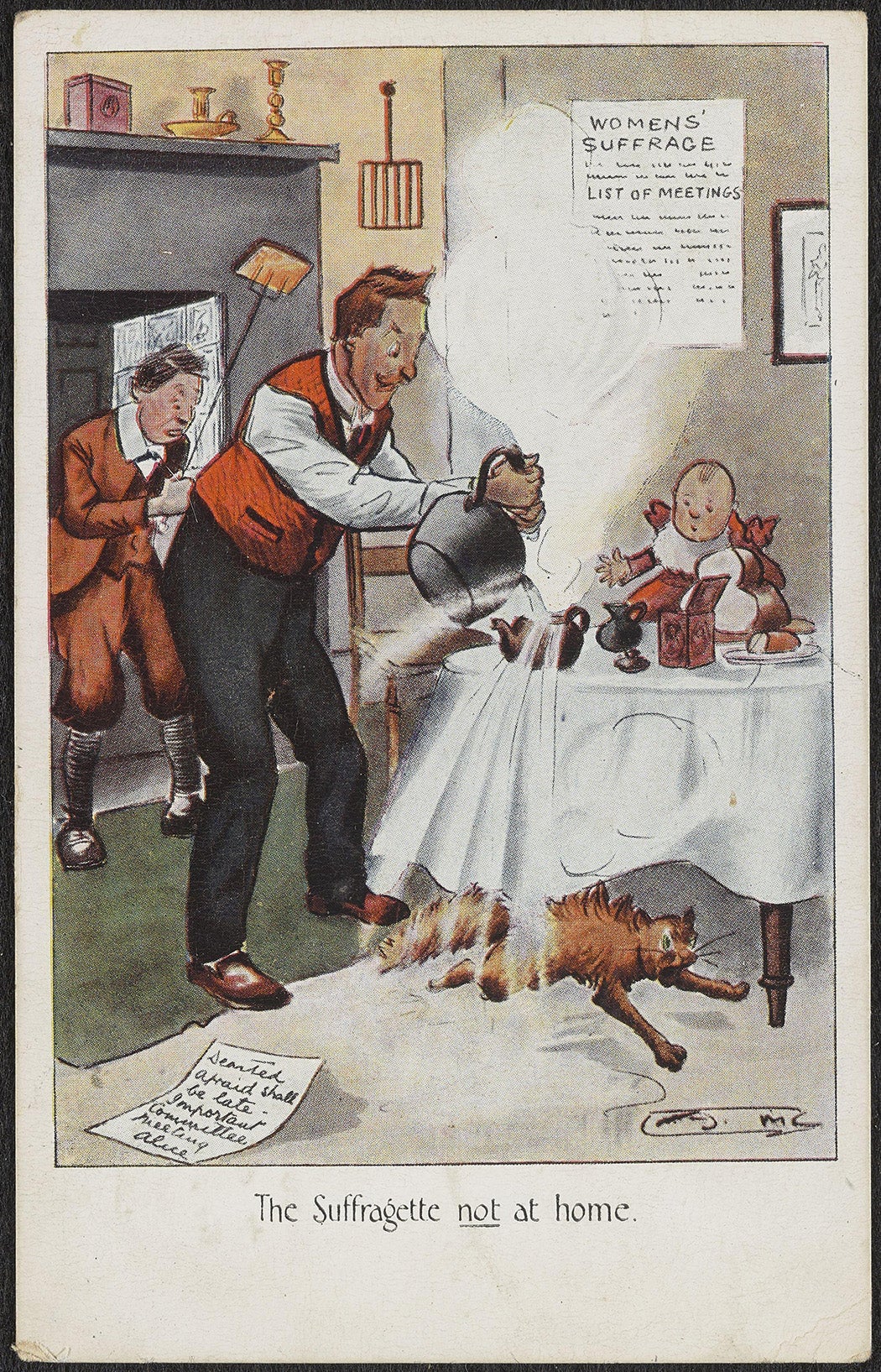
The Suffragette Not at Home. Courtesy Votes and Petticoats: Postcards, The Sheridan Libraries, Johns Hopkins University.Courtesy Votes and Petticoats: Postcards, The Sheridan Libraries, Johns Hopkins University.
Here, the man of the house is substituting for the absent woman by staying home, caring for the children, and making tea. The cat suffers the consequences of his ineptitude in the unnatural role.
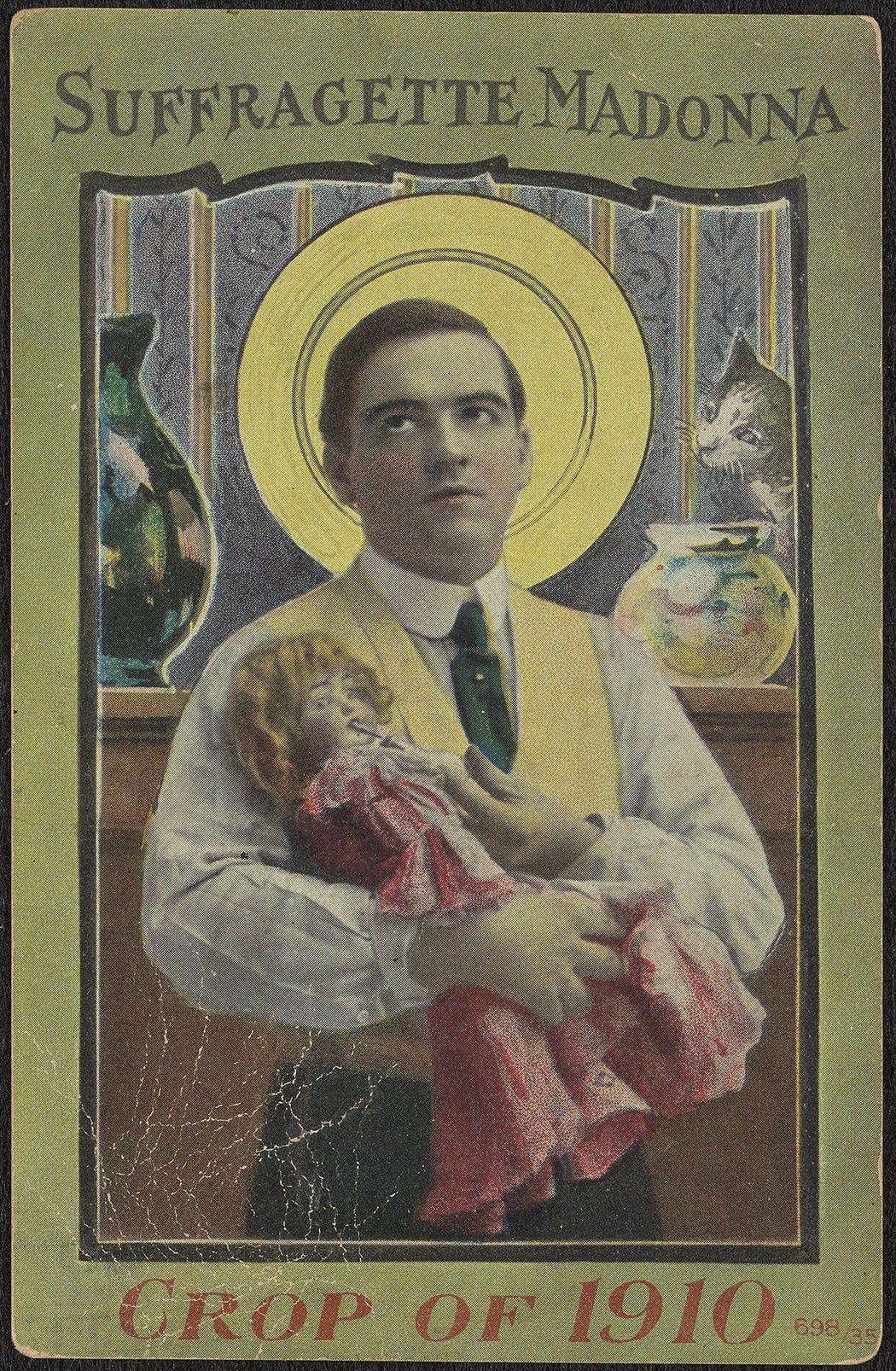
Suffragette Madonna Crop of 1910. Courtesy Votes and Petticoats: Postcards, The Sheridan Libraries, Johns Hopkins University.
Alternately, this man is taking good care of the home and family for his suffragist wife, but he’s thus emasculated. The halo of the golden plate, evoking the Virgin Mary, as well as the cat on the hearth behind him, emphasize his domesticity.
The absurdity of men in the women’s/cats’ sphere is surpassed by the absurdity of women/cats in the men’s sphere.
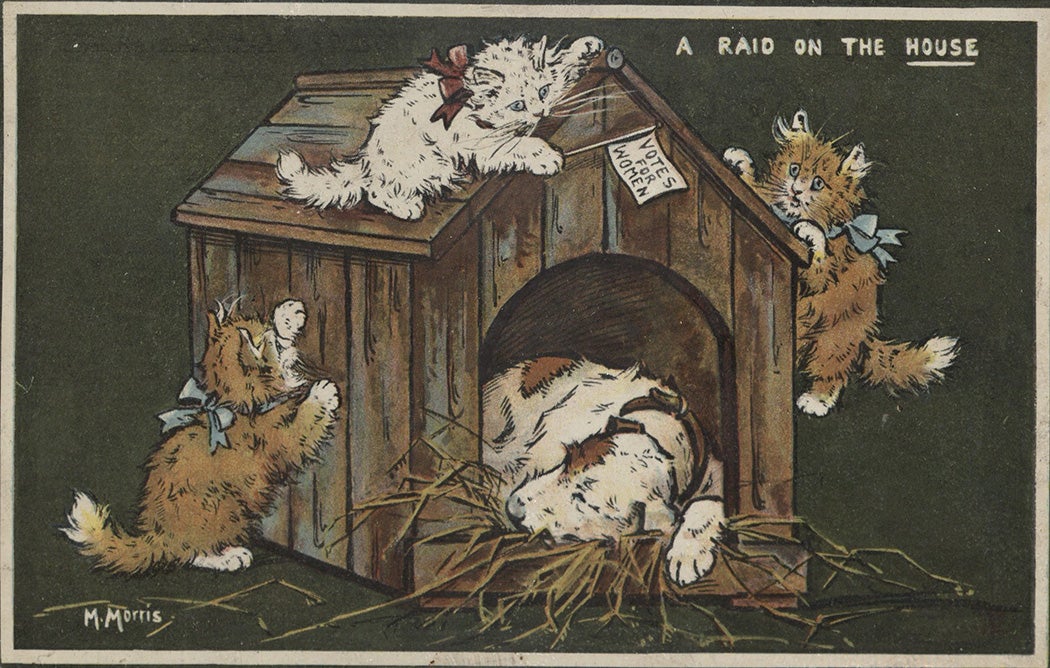
A Raid on the House. Courtesy Votes and Petticoats: Postcards, The Sheridan Libraries, Johns Hopkins University.
This British postcard seems to reference suffragists’ “raids” on the Houses of Parliament, during which women attempted to occupy the legislative chambers to protest their exclusion from them. The symbolism of this image is a striking echo of how the Daily Express described a suffrage raid in 1907: “[T]he sight reminded one very much of the removal of naughty kittens from a room in which they had been disporting themselves freely.” Cowman cites this description as example of voices in the press that often made light of the women’s suffrage movement, thus “making it appear over-feminine and consequently somewhat frivolous.”
Like “I Want My Vote!”, both this postcard and the Daily Express article infantilize women by portraying them as kittens. Viewers are meant to chuckle at the silly kittens’ attempt to infiltrate the doghouse—the kittens are cute, but they’ll never displace or even disturb the dog, who sleeps through their efforts.
“A Raid on the House” is particularly insulting when contrasted with the reality of the women’s suffrage movement, in which participants faced violent attacks. One march on the House of Commons in 1910 became known as “Black Friday” when suffragists were brutally beaten by police.
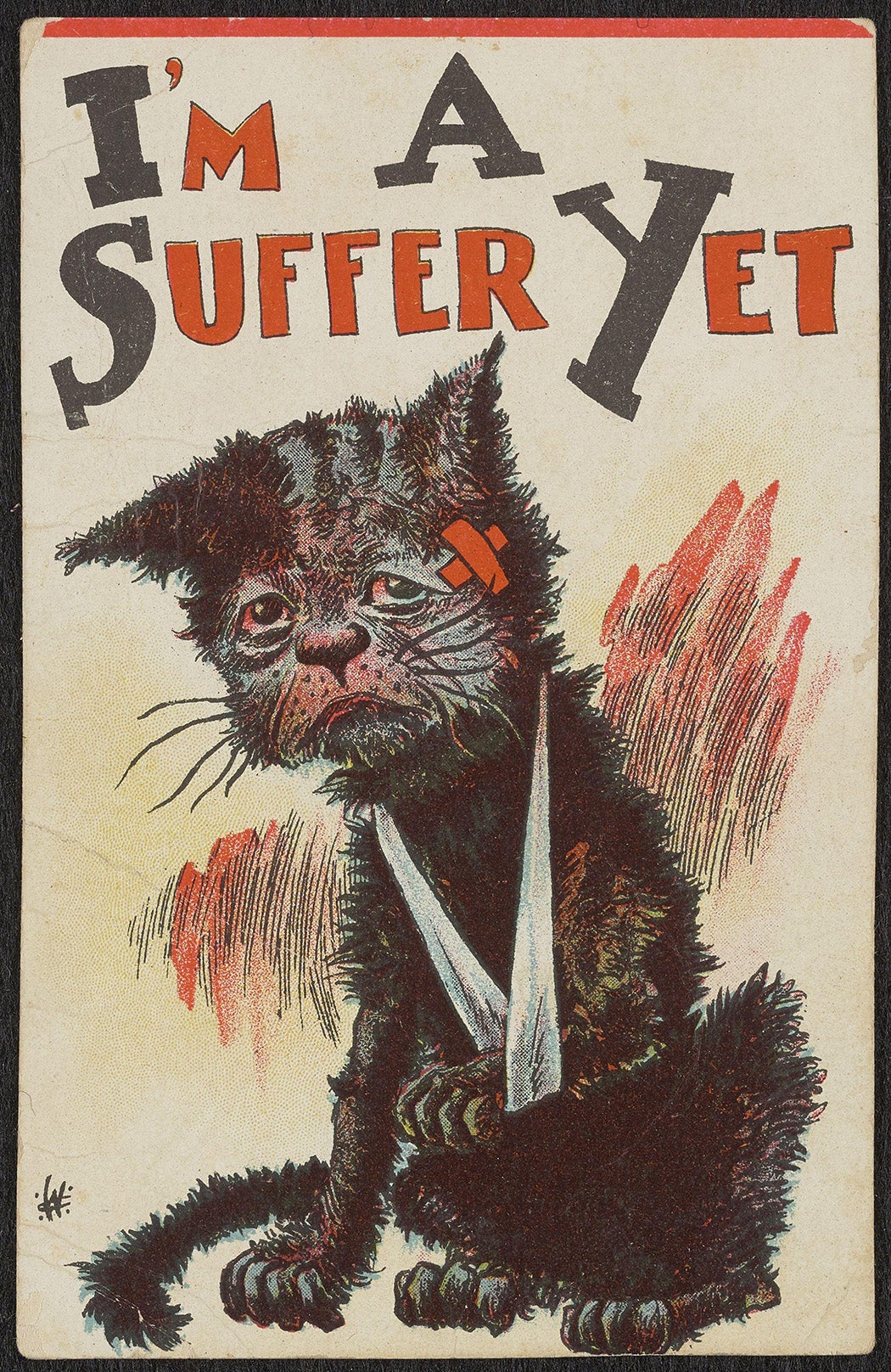
I’m A Suffer Yet. Courtesy Votes and Petticoats: Postcards, The Sheridan Libraries, Johns Hopkins University.
Bandaged and bruised, this bedraggled cat seems to represent a suffragist who has been beaten but is still dedicated to the cause. Whether the cat’s determination makes it sympathetic or stupid is a matter of interpretation.
Cats, as it turns out, are difficult to pigeonhole. So are women. According to Alleyn Diesel, the association between cats and women goes back at least as far as Ancient Egypt. Goddesses in ancient and contemporary religions have frequently been portrayed as either part-cat or accompanied by cats. And when it comes to goddesses, being catlike doesn’t mean being sweet and domestic. On the contrary, feline-linked deities are known for “self-reliance, elegance, and… willingness to be tamed strictly on their own terms”: powerful qualities that patriarchal societies mistrust in women.
When JD Vance questioned why a childless person would want to be a teacher or a leader, infamously calling Kamala Harris and her ilk “miserable” and “childless cat ladies,” he was invoking old, sexist stereotypes. The Harris campaign responded by selling “childless cat lady” merch. This tactic of reclaiming an insult and turning it into a badge of honor also has rich historical precedent.
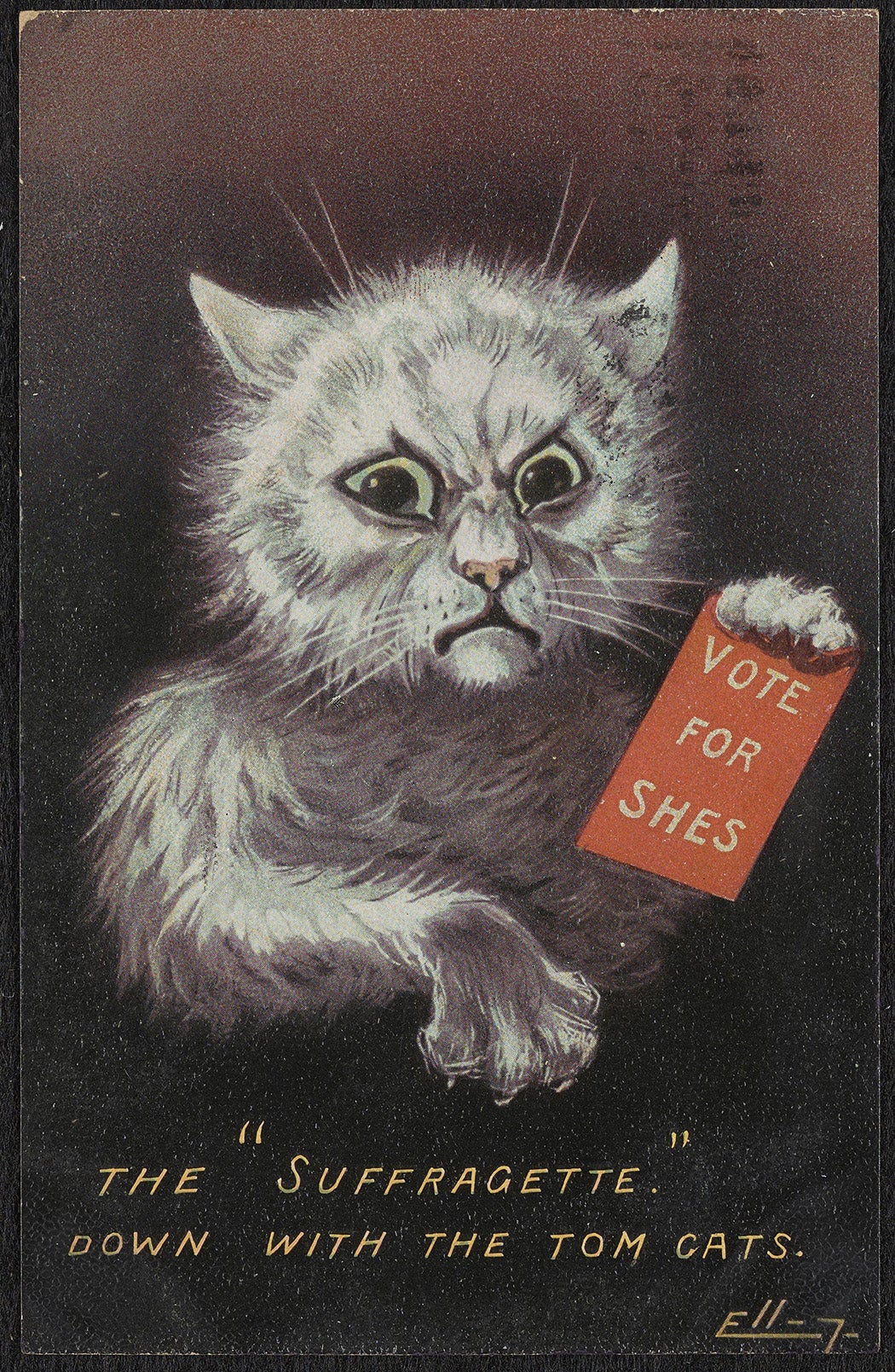
The Suffragette Down with the Tom Cats. Courtesy Votes and Petticoats: Postcards, The Sheridan Libraries, Johns Hopkins University.
The intention behind this final postcard may have been, yet again, to paint the fight for suffrage as absurd, to make suffragists seem like willful, unfeminine animals.
But the sender of the postcard wrote on the back, “See the expression: In town for the fight. Have used my night off for training my guns in the new campaign. Ha! Ha! You will see the signs soon.” We can’t be sure, but the writer seems to have been a suffragist, claws out.
Editor’s Note: Harry Whittier Frees, the likely photographer of the image depicting clothed kittens in line to vote, used live animals in his work, not taxidermy. The text has been amended to account for this fact.
Benny Briolly beams as she strides through the concrete favela alleyway of Brazil’s city of Niteroi in a snow-white ball gown, onlookers proudly wave campaign flags emblazoned with her face. The city councilwoman and nearly 1,000 other transgender politicians are running Sunday in every one of Brazil’s 26 states, where the number of transgender politicians has tripled since the last elections four years ago.
“Nothing I have experienced prepared me for the very public and relentless implosion of my father’s life,” writes Caroline Giuliani, announcing her support for Kamala Harris.
I am constantly asking myself how America is back here, even considering the possibility of electing Donald Trump again, after all of the damage he has caused, both in office and since. While Kamala Harris has gained extraordinary momentum by infusing this election with vitality and hope, I worry that too many Americans remain disconnected from the visceral, psychologically draining memory of Trump’s deeply destabilizing presidency. If enough people truly remembered what that chaos felt like, another Trump term wouldn’t even be on the table. But for those open to seeing the bare and unvarnished truth, there are unmistakable reminders of Trump’s destructive trail all around us, and it has broken my heart to watch my dad become one of them.
As Rudy Giuliani’s daughter, I’m unfortunately well-suited to remind Americans of just how calamitous being associated with Trump can be, even for those who are convinced he’s on their side. Watching my dad’s life crumble since he joined forces with Trump has been extraordinarily painful, both on a personal level and because his demise feels linked to a dark force that threatens to once again consume America. Not to disregard individual accountability in the slightest, but it would be naive for us to ignore the fact that many of those closest to Trump have descended into catastrophic downward spirals. If we let Trump back into the driver’s seat this fall, our country will be no exception.
My dad and I have a cartoonishly complicated relationship. But he is still my father, and despite his faults, I love him. I’ve seen him experience surreal heights, and, now, unfathomable lows. The last thing I want to do is hurt him, especially when he’s already down. Plus we never know how much time we have left with our parents. The totality of that makes this the most difficult piece I’ve ever written. Yet this moment and this election are so much bigger than any of us.
From reproductive rights and the economy, to foreign and environmental policy, we need experienced, sane, and fundamentally decent leaders who will fight for us instead of against us—who will safeguard our democracy rather than dismantle it. And as a recently engaged-to-be-married, 35-year-old who hopes to feel more joyous than fearful about the potential of becoming a parent myself, I need to advocate for a future worth bringing children into, which is why I am voicing my adamant support for Kamala Harris and Tim Walz. (snip-MORE) This is a worthy read, and it’s free.
Through public remarks, Truth Social screeds and more than 100 preemptive lawsuits, Donald Trump is assembling a detailed catalog of excuses for rejecting the results of the 2024 election — if he loses.
Why it matters: The Trump-aligned efforts to overturn the 2020 election — both overtly and covertly, peacefully then violently — shocked the American public. No one should be surprised this time around.
Listen to Trump: The former president, who risks jail time and more criminal trials if he loses, has expanded his range of baseless attacks on U.S. voting procedures in recent weeks and months.
Overseas voting: Trump falsely claimed Monday that Democrats are exploiting an overseas ballot program for expats and military members in order to circumvent “any citizenship check or verification of identity.”
Early voting: At a rally in Pennsylvania last week, Trump denounced what he called the “stupid” concept of voting 45 days before the election — floating conspiracy theories about his loss in the crucial swing state four years ago.
Mail-in voting: Trump has long despised mail-in ballots. He’s recently attacked the U.S. Postal Service as incompetent and untrustworthy — even as the GOP has pushed its voters to embrace the practice.
Zoom in: The millions of undocumented migrants who have crossed into the U.S. during the Biden administration are a top campaign issue. They’re also being used to fuel new voter fraud conspiracy theories.
Earlier this month, Trump demanded that House Republicans use the threat of a government shutdown to pass a measure requiring proof of citizenship to register to vote in federal elections.
That effort failed, but it gave Trump and Republicans a new excuse to claim election fraud — even though it’s already illegal and exceedingly rare for non-citizens to vote in U.S. elections.
Between the lines: Even without evidence of voting irregularities, Trump is preparing to deploy broader rhetorical arguments for why the election was fundamentally unfair.
The former president has accused Democrats of “cheating” by swapping out President Biden for Vice President Kamala Harris in June, and engaging in “lawfare” through criminal prosecution.
“If there was no cheating — if God came down from on high and said ‘I’m going to be your vote tabulator for this election,’ I would leave this podium right now,” Trump said Sunday at a rally in Pennsylvania.
“We have to have a landslide because they cheat so damn much.”
The big picture: Since 2020, the Republican Party apparatus has been reorganized — from the top down — to give credence to Trump’s false claims that election fraud is a scourge on American politics.
Trump’s campaign and the Republican National Committee say they’ve built a network of about 175,000 volunteer poll watchers and poll workers, part of a relentless focus on “election integrity.”
In Georgia, a hard-right election board has passed new rules that Democrats fear could be used to undermine confidence in the results if Trump loses the critical battleground state.
House Speaker Mike Johnson (R-La.) drew outrage last week by pledging to certify the 2024 election and “follow the Constitution” only if it’s a “free, fair and safe election.”
What to watch: On Nov. 1, 2020, Axios reported that Trump had privately told confidants he planned to prematurely declare victory on election night if it looked like he was “ahead.”





/2024/09/27/1727456622728.gif?w=1920)

