August 11, 1894 Federal troops forced some 1,200 jobless workers across the Potomac River and out of Washington, D.C. Jack London Led by an unemployed activist, “General” Charles “Hobo” Kelly, the jobless group’s “soldiers” included young journalist Jack London, known for writing about social issues, and miner/cowboy William ”Big Bill” Haywood who later organized western miners and the Industrial Workers of the World (IWW). “Big Bill” Haywood Read about “Big Bill”
August 11, 1958 A drugstore chain in Wichita, Kansas, agreed to serve all its customers after weeks of sit-ins at Dockum’s lunch counter by local African-Americans who wanted an end to segregation. On this day, as several black Wichitans were sitting at the counter even though the store refused to serve them, a white man around 40 walked in and looked at them for several minutes. Then he looked at the store manager and said, simply, “Serve them. I’m losing too much money.” He was the owner, Robert Dockum. That day the lawyer for the local NAACP branch called the company and was told by the a vice president ”he had instructed all of his managers, clerks, etc., to serve all people without regard to race, creed or color,” statewide. This was the first success of the sit-in movement which soon spread to Oklahoma City and other towns in Kansas, but is often thought to have started in Greensboro, North Carolina, in 1960.
August 11, 1984 Prior to his weekly radio address, unaware that the microphone was open and he was broadcasting, President Ronald Reagan joked, “My fellow Americans, I’m pleased to tell you today that I’ve signed legislation that will outlaw Russia forever. We begin bombing in five minutes.” Many Americans and others throughout the world were concerned about the President’s apparently flippant attitude towards nuclear war at a time of increasing tension between the two major nuclear powers. Among other things, the U.S. had begun a major strategic arms buildup, adding many thousands of additional nuclear warheads along with a broad range of new delivery systems: long-range bombers including 100 B-1B stealth bombers and MX (10-warhead) ICBMs, considered first-strike weapons; intermediate-range missiles to be deployed in Europe; 3000 cruise missiles; and Trident nuclear submarines with sea-launched cruise missiles. Additionally, Reagan had proposed building the space-based Strategic Defense Initiative of anti-ballistic missiles, a destabilizing influence on the nuclear balance. The Nuclear Arms Control Legacy of Ronald Reagan
August 10, 1883 Adrian “Cap” Anson refused to field his visiting Chicago White Stockings team in an exhibition baseball game if the Toledo Mud Hens included star catcher Moses Fleetwood Walker in their lineup. Chicago’s Captain Anson, who grew up in slaveholding Iowa, said he wouldn’t share the diamond with a non-white player. After more than an hour’s delay, Charlie Morton, the Toledo manager, insisted that if Chicago forfeited the game, it would also lose its share of the gate receipts; Anson relented. Moses Fleetwood Walker Morton had not planned to have Walker catch due to injury, but insisted on putting him in at centerfield, despite Cap Anson’s objections.
August 10, 1948 Gay rights activist Harry Hay organized what later became the Mattachine Society (originally ~ Foundation), a groundbreaking 1950s gay rights organization. The group was named after the Mattachines, a medieval troupe of men who went village-to-village advocating social justice. Mattachine: Radical Roots of Gay Liberation
August 10, 1984 Two Plowshares activists, Barb Katt and John LaForge, damaged a guidance system for a Trident submarine with hammers at a Sperry plant in Minnesota. In sentencing them to six months’ probation, U.S. District Judge Miles W. Lord commented, “Why do we condemn and hang individual killers, while extolling the virtues of warmongers?” Barb Katt More on the Sperry Software Pair More plowshares actions
August 10, 1988 President George H.W. Bush signed legislation apologizing and compensating for the World War II internment of Japanese Americans. President Franklin Roosevelt had authorized the round-up of hundreds of thousands of Americans of Japanese ancestry, some of whom were American citizens, as security risks. Most lost all their property and were moved to relocation camps for the duration of the war (though not in Hawaii, then not yet a state, where public opposition would not allow it).
August 10, 1993 Ruth Bader Ginsburg is sworn in as the second woman and 107th Justice to serve on the U.S. Supreme Court.
August 10, 2005 Mehmet Tarhan was sentenced to four years’ imprisonment on two charges of “insubordination before command” and “insubordination before command for trying to escape from military service” because he refused to serve in the Turkish Army. He would not sign any paper, put on a uniform, nor allow his hair and beard to be cut. He went on two extended hunger strikes to protest his arrest and abuse while in Sivas Military Prison. War Resisters International has supported his efforts throughout his ordeal. He was released unexpectedly from prison after one year. Read more
This is hugely pertinent to our interests. And the history callback of Dobbs/Roe is spot on!! This needs we the people’s work sooner rather than later. The story linked within is important background for working on this. Seriously: pick one or two (or more!) rights organizations and do what you can with them, now, while it’s not still too late, and stick with it until the other side is defeated. Please don’t wait until this is in court. Then:
A very sound scheme is to check in with your states on their legislative websites, see what the laws are right now, and what’s in the chute. Overturning Obergefell can’t/won’t change state laws regarding marriage, just as overturning Roe didn’t change state laws regarding repro rights. But knowing what could be coming, especially in red states, is imperative for getting ourselves protected, and protecting others. If your state is safe, well, pick another state that isn’t, and help them out. If your state has no law at all, lobby hard to get one, ASAP. And thanks!-A.
Some of Trump’s judicial nominees have refused in confirmation hearings to acknowledge that the Supreme Court’s 2015 decision in Obergefell v. Hodges, striking down state bans on same-sex marriage as unconstitutional, was correctly decided. According to an analysis by JP Collins at the legal website Balls and Strikes, Eric Tung, who Trump nominated to the U.S. Court of Appeals for the Ninth Circuit, said only, “the Supreme Court granted such a right.” William Mercer, a nominee to the U.S. District Court for the District of Montana, said Obergefell is “binding precedent,” but declined to “grade the Supreme Court.”
As Collins points out, these verbal gymnastics to avoid saying the case was correctly decided mirror those of Trump’s first term Supreme Court nominees who said Roe v. Wade was precedent but would not say it was correctly decided — and then voted to overturn it.
One might say marriage equality is different from abortion. Obergefell is just 10 years old, and Roe was decades old. But the most important feature that both decisions share is the enmity of the Christian right, and its determination to overturn them, no matter how many years or decades it takes.
Even before the court decided Obergefell in 2015, the Christian right was already planning to treat it just like Roe. The Supreme Court’s 1973 decision, they argued, was not the end of the abortion issue but rather the beginning. They used money, media, political might, religion, and relentless organizing to use abortion to drive politics and shape the judiciary. Their plans for Obergefell and LGBTQ rights are no different.
Photo by Astrid Riecken For The Washington Post via Getty Images
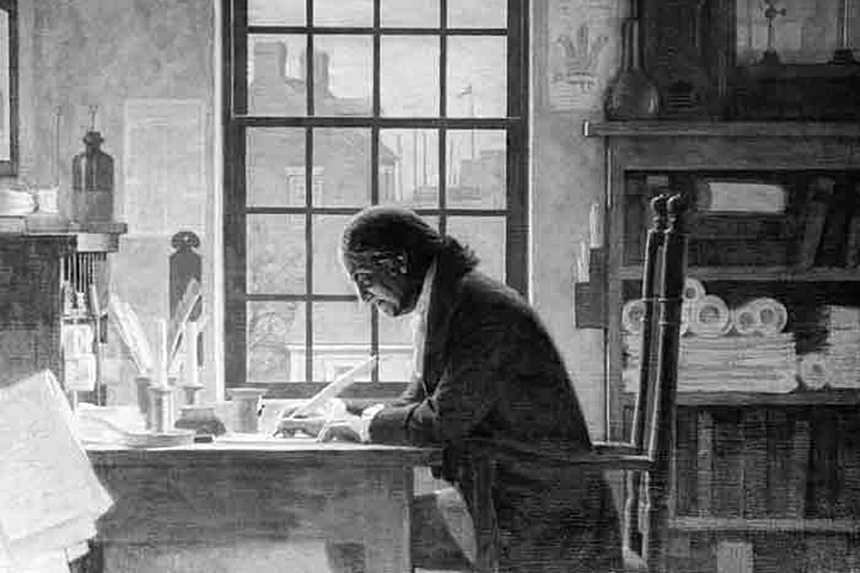
Ben Franklin and his role as the postmaster general of the U.S. Postal Service embodied a combination of individual and communal ideals that was at the heart of America’s founding.
This series by American studies professor Ben Railton explores the connections between America’s past and present.
By late July 1775, the military conflict between American colonials and English troops that would come to be known as the American Revolution was fully underway. The April battles at Lexington and Concord had blossomed into a war on many fronts, including the even more substantial Massachusetts Battle of Bunker Hill, Ethan Allen and his Green Mountain Boys seizing New York’s Fort Ticonderoga, and George Washington being appointed Commander in Chief by the newly convened Second Continental Congress.
Amid the growing war, on July 26th, that same body voted to establish a national mail service, the U.S. postal system, with Ben Franklin as the first postmaster general.
Portrait of Ben Franklin by Joseph-Siffred Duplessis, ca. 1785 (Wikimedia Commons)
That might seem like a profoundly mundane action to take during the fraught military battles and campaigns of an unfolding Revolution. But it represented an important way for the Continental Congress to amplify the emerging identity of a newly unified United States: It embodied a combination of individual and communal ideals that was at the heart of the American founding and that the USPS continues to exemplify today.
As we see in the official transcript of the Second Continental Congress, the creation of a national postal system was part of an important overarching conversation throughout the week of July 24-28, 1775; on Monday July 24th, “the Congress then resolved themselves into a committee of the whole to take into consideration the state of America.” Those considerations included establishing a medical department and new hospitals (which were connected to the war effort of course, but also comprised a communal good far beyond that immediate cause), printing currency out of a new continental treasury, and, as decided on Wednesday July 26th, responding to “the report of the Committee on the post office” by creating “a line of posts … from Falmouth in New England to Savannah in Georgia,” appointing a postmaster General for the United Colonies, and unanimously electing Benjamin Franklin, Esq. to serve in that role.
By 1775, Ben Franklin had been involved in the creation of mail services for nearly four decades, and as was so consistently the case with Franklin, those efforts reflected both his pursuit of individual self-interests and his dedication to the communal good. In 1737, when Franklin was only 30 years old, he was appointed postmaster of his adopted home city of Philadelphia. In his autobiography he freely admitted that he took the job largely to support his own newspaper, the Gazette, writing, “tho’ the salary was small, it facilitated the correspondence that improv’d my newspaper, increased the number demanded, as well as the advertisements to be inserted, so that it came to afford me a considerable income.” But even if Franklin was mercenary about this new role, he was too much of an inventor not to innovate in it as well, and his most lasting and collectively meaningful such innovation was printing in the newspaper lists of people who had letters waiting for them at the post office, a practice that many other papers would take up for decades to come.
A painting by Charles Mills of young Ben Franklin working his printing press in Philadelphia (Library of Congress)
After a decade and a half in that important local role, the ever-ambitious Franklin was ready to move up. When Postmaster General for the Crown Elliott Benger became ill in 1753, Franklin lobbied for his overarching role. Eventually both he and a friend and fellow journalist, Virginia public printer William Hunter, were chosen as Joint Postmasters for the Crown, a role that Franklin would hold for the next two decades. He would bring a number of his Philadelphian innovations to that national role, including the aforementioned printed newspaper lists (which he instructed postmasters around the country to do). But he would also add successful new ideas, such as implementing nighttime service that led to far faster mail delivery. Ever the successful businessman, Franklin had the British Crown Post registering its first profit by 1760.
In 1774, after more than 20 years in that role, Franklin was dismissed by the British government for being too sympathetic to the colonies. But as he seemingly always did, Franklin parlayed this temporary setback into even more substantial long-term success, securing the July 1775 election to Postmaster General for the United Colonies with (again quoting the Continental Congress transcript) its accompanying “salary of 1000 dollars per an. for himself.” In case Franklin wasn’t able to make this new national postal system as profitable as the Crown’s had become under his leadership, Congress protected both the system and Franklin financially, adding that “if the necessary expense of this establishment should exceed the produce of it, the deficiency shall be made good by the United Colonies, and paid to the postmaster general by the continental Treasury.”
At least since the posthumous 1791 publication of his mythmaking autobiography, Ben Franklin had somehow embodied both self-made individual success and selfless philanthropy for the communal good. But contradictory as that duality may seem, it is also at the heart of America’s founding, as reflected in the opening passages of our two most famous framing documents. The Declaration of Independence begins with the “self-evident truths” that among each individual’s “unalienable Rights” are “Life, Liberty, and the pursuit of Happiness.” While the Constitution’s Preamble focuses on collective goals for “We the People” that include “forming a more perfect Union” and “promoting the general Welfare.”
In order for a society to endure, I would argue that it has to genuinely ensure both of these founding American ideals: that each individual in that nation has the opportunity to pursue their own dreams; and at the same time that the communal good remains an overarching collective goal. Since its July 1775 establishment, the United States Postal Service has impressively embodied both layers: offering mail service to every individual, in every corner of this giant nation; and doing so not as a corporation, but as a non-profit public good. Here on its 250th anniversary, let’s celebrate this continued reflection of our founding ideals.
Here’s to people staying off Democrats’s necks as they fight this in the same fashion. Gerrymandering hurts my heart; I live in a state gerrymandered to just barely inside the law. I don’t like it for any state no matter the majority, but. If one’s gonna do it, they all ought to.
Of course, if we had instant runoff voting and no parties, this wouldn’t be a thing. Everyone would have someone to vote For. And we’d be a democratic republic today. -A
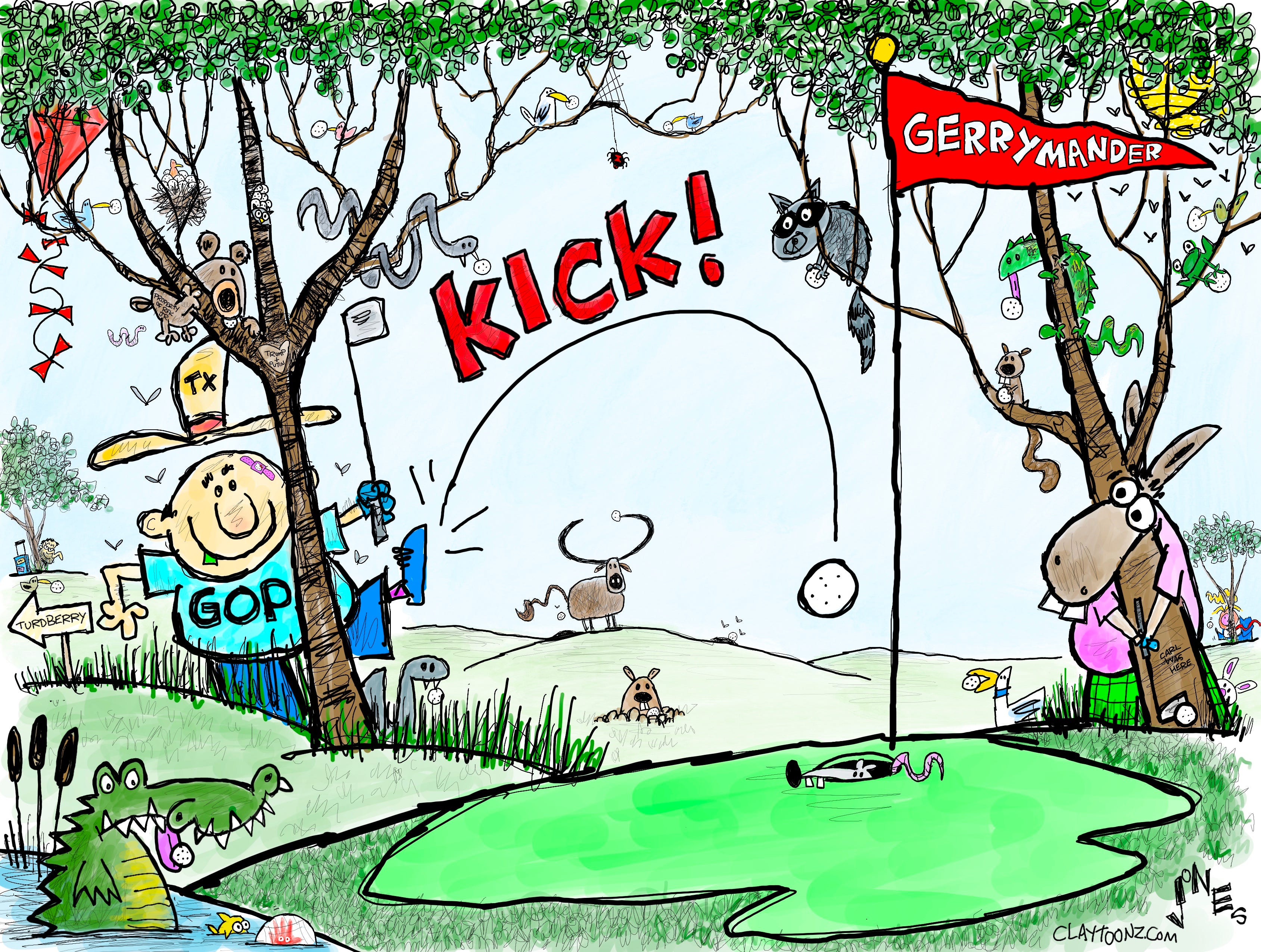
What do Republicans cheat at more, golf or elections? It’s a tough call. But cheating at one of those things means that they’ll cheat at the other.
Republicans in Texas are trying to reshape their congressional districts, even though it’s not the time redistricting is normally done. Usually, that’s shortly after the results of the census are published (which is once a decade), and states redistrict according to the new population size, and to fit with possible changes, such as new districts or losing them.
During the last census, Texas picked up two congressional seats because its population grew during the 2010s. Since the Texas legislature is controlled by Republicans, they were able to draw up the district maps. Naturally, they redraw them to favor Republicans. It’s not like they would do it honestly. They’re Republicans.
This is called gerrymandering, and Texas is one of the most gerrymandered states in the nation. Wisconsin is number one.
Texas now has 38 congressional districts, with 25 of them going to Republicans, 12 going to Democrats, and one is currently vacant. But even after winning a huge majority after gerrymandering, 25 congressional seats are not enough for Texas Republicans, so they want to redraw the lines again in their favor.
Texas will be blue someday, or at least a swing state. The best way to keep people from sending Democrats to Congress is to take away Democratic candidates. After gerrymandering, voters are not choosing the candidate. The candidates are choosing the voters. It’s horrible, rotten, unfair, and neither party should do it. But Republicans don’t care if they cheat.
After Joe Biden won the presidency in 2020 in what experts say was the most secure election in American history, Republicans cried foul and set out to change election laws in every state. In Georgia, for example, where Biden won in 2020, and Blue areas are growing, Republicans changed voting laws, and Trump won over Kamala Harris in 2024 by just 2.20 percent. In Texas, they focused on changing the laws, not for every district, just the districts that had a majority of Black voters. They tried to make it as hard as hell to vote in Houston.
Republicans said all these changes were for election “integrity.” But how much integrity do you have when you make it illegal to give an old lady a bottle of water while she’s waiting in line for nine hours in the Georgia heat? It’s a fact that when fewer people vote, Republicans win.
The 2024 election, which Trump “won,” had fewer voters than in 2020, when Biden won. (snip-MORE)
Next month, beauty brand Ami Colé will shutter, marking an unfortunate reality for many Black-owned businesses — what happens when financial interest dries up?
Founder Diarrha N’Diaye-Mbaye’s July announcement, which she detailed for The Cut, shocked many across the beauty space.
In the piece, N’Diaye-Mbaye outlined the journey of starting her business, from growing up in her mother’s Harlem braiding salon to pitching Ami Colé — known for their innovation in lip oils and shade-inclusive makeup — to over 150 investors in 2019. After a surge in support for Black entrepreneurship following the murder of George Floyd in Minneapolis in 2020, N’Diaye-Mbaye said she received more interest in the brand, becoming one of 30 Black women to raise $1 million for her start-up within months.
But four years after her official launch, N’Diaye-Mbaye said growth at Sephora couldn’t compete with corporate brands, and scaling up production to meet potential demand came at a steep cost when online influence fluctuated.
“Instead of focusing on the healthy, sustainable future of the company and meeting the needs of our loyal fan base,” N’Diaye-Mbaye wrote, “I rode a temperamental wave of appraising investors — some of whom seemed to have an attitude toward equity and ‘betting big on inclusivity’ that changed its tune a lot, to my ears, from what it sounded like in 2020.”
This sentiment isn’t unique among Black entrepreneurs. Five years after venture capital firms, investors and consumers alike followed a wave of support for Black-owned businesses, interest in diverse brands has waned significantly. Through TikTok and other social media platforms, access to an audience has never been greater, but the capital needed to sustain brands at a high profile has dropped off.
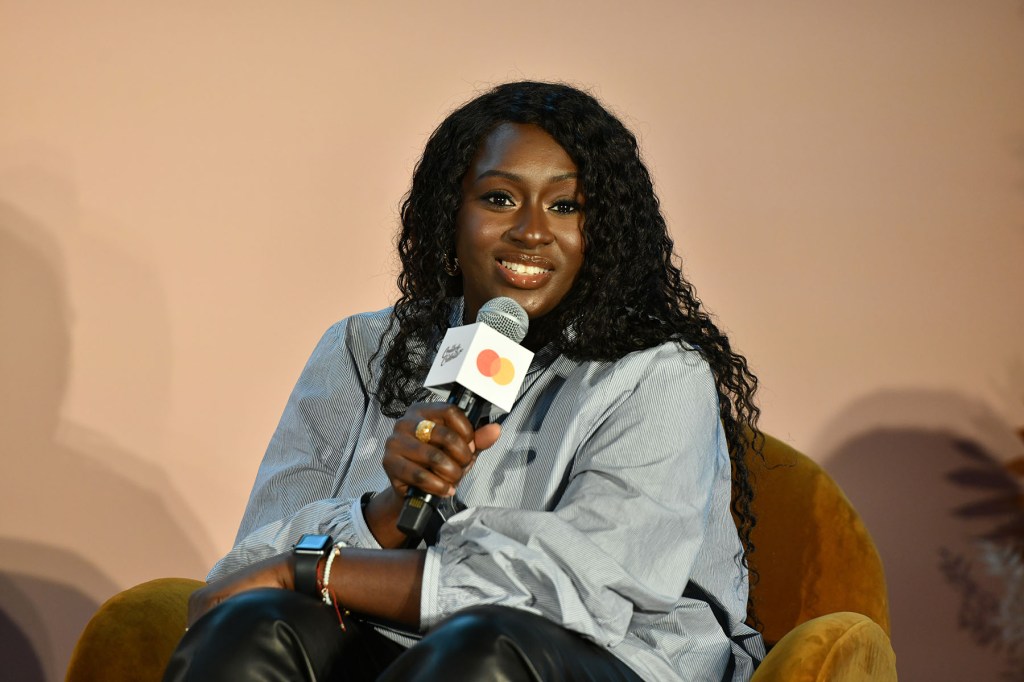
Diarrha N’Diaye-Mbaye, Founder and CEO of Ami Colé speaks at an event on October 15, 2022 in New York City. (Craig Barritt/Getty Images)
Nationally, there has been a societal swing — in tandem with pressure from President Donald Trump’s administration — against intentional incorporation of diversity, equity and inclusion (DEI) in creators’ paths, with waning urgency to support these businesses en masse. And the amount of money flowing to Black-founded companies has hit a multiyear low, according to the business publication Crunchbase News. Only $730 million — 0.4 percent of all funding — went to startups with a Black founder or co-founder last year, down more than two-thirds from 2021. The startups that did receive funding were mostly in the tech or health spaces.
Esthetician and beauty influencer Tiara Willis said she has noticed that cultural shift in support over the last five years. Brands rushed to onboard diverse creators in the summer of 2020. Now, the long-term partnerships, increased shade ranges and targeted marketing seem to have wavered. N’Diaye-Mbaye’s struggle to meet demand as influencers promoted her products is something that would have been covered by investors who were in it for the long haul, Willis said.
She pointed to celebrity founders like Hailey Bieber, whose Rhode makeup and skin care brand began with millions of dollars to swing big while starting her business. Rhode was acquired by e.l.f Beauty for $1 billion in May.
“They rarely ever start by themselves, like the rest of us do — they already have someone on their team,” Willis told The 19th. “Trying to build your own brand while trying to compete with companies who are able to launch products every two seconds, and are able to fill retail space and have less obstacles than brands like Ami Colé — it’s not entirely surprising she wasn’t able to keep up.”
Black creators voiced concern immediately following N’Diaye-Mbaye’s announcement, calling her brand’s shuttering “disheartening” and indicative of larger trends in the Black beauty space. Being able to trust that a brand like Ami Colé would have inclusive shade ranges and products by virtue of their leadership made shopping simpler, some said on social media.
Sephora store shelves reflect a mad dash to support Ami Colé and restock on favorites before the brand officially closes in September. Sales associates told The 19th that the lip oils had sold out online and in store immediately following the announcement, though the demand for other products has slowed since.
But consumers should not feel the pressure to support Black-owned businesses when the larger issue is who has access to capital and investors, some creators pointed out. The issue isn’t the lack of customers, Javon Ford, a cosmetic chemist and entrepreneur, said in a recent TikTok video.
“That is not a sustainable business model. The issue is money. It’s capital. Operating in a retailer like Sephora is expensive,” Ford said. “That’s how cutthroat retail is when you scale to a certain extent, and this is also why exit strategies are important, because it’s really hard to keep up with legacy brands.”
Willis echoed the unstable environment in which Black influencers like herself find themselves: “It creates financial insecurity, where I get the most support of brands based on what’s going on in the news, versus getting support because of my work and my talent and the things I provide to the table.”




































 Scottie's Playtime

