Belle talks about how tRump and his supporters build his fake image of being a superpower in the world. They take stuff that tRump had nothing to do with and claim it only happened because of him. They depend on people not knowing the subject they are talking about. Hugs
if we all click our heels together three times, everything will be okay Read on Substack (Language NSFW, as always with Jeff Tiedrich’s writing)
the worthless scribblers of the corporate-controlled media utterly failed us during the 2024 campaign season.
New York Times executive editor Joe Kahn came right out and said it: defending democracy is a ‘partisan act,’ and we won’t do it — and, fuck us all, the press kept their word, and didn’t do it. they enthusiastically put their fingers on the scale for Donny Convict.
arguably, the media’s worst transgression was the sanewashing — the cleaning-up of Donny’s incomprehensible blitherings, to hide his obvious cognitive disintegration and make him sound coherent.
a minutes-long disjointed word-salad about how tariffs on Chinese goods were going to lower the cost of childcare became “a major economic speech.”
Donny’s inability to keep his increasingly-demented mind on the topic at hand — his crazypants pinballing from they’re eating the dawgs to Hannibal Lecter wants to have you for dinner to would you rather be eaten by a shark or electrocuted — was explained away by Donny as his brilliant “weave.”
[Wishcasting is] the act of interpreting information or a situation in a way that casts it as favorable or desired, despite the fact that there is no evidence for such a conclusion; a wishful forecast.
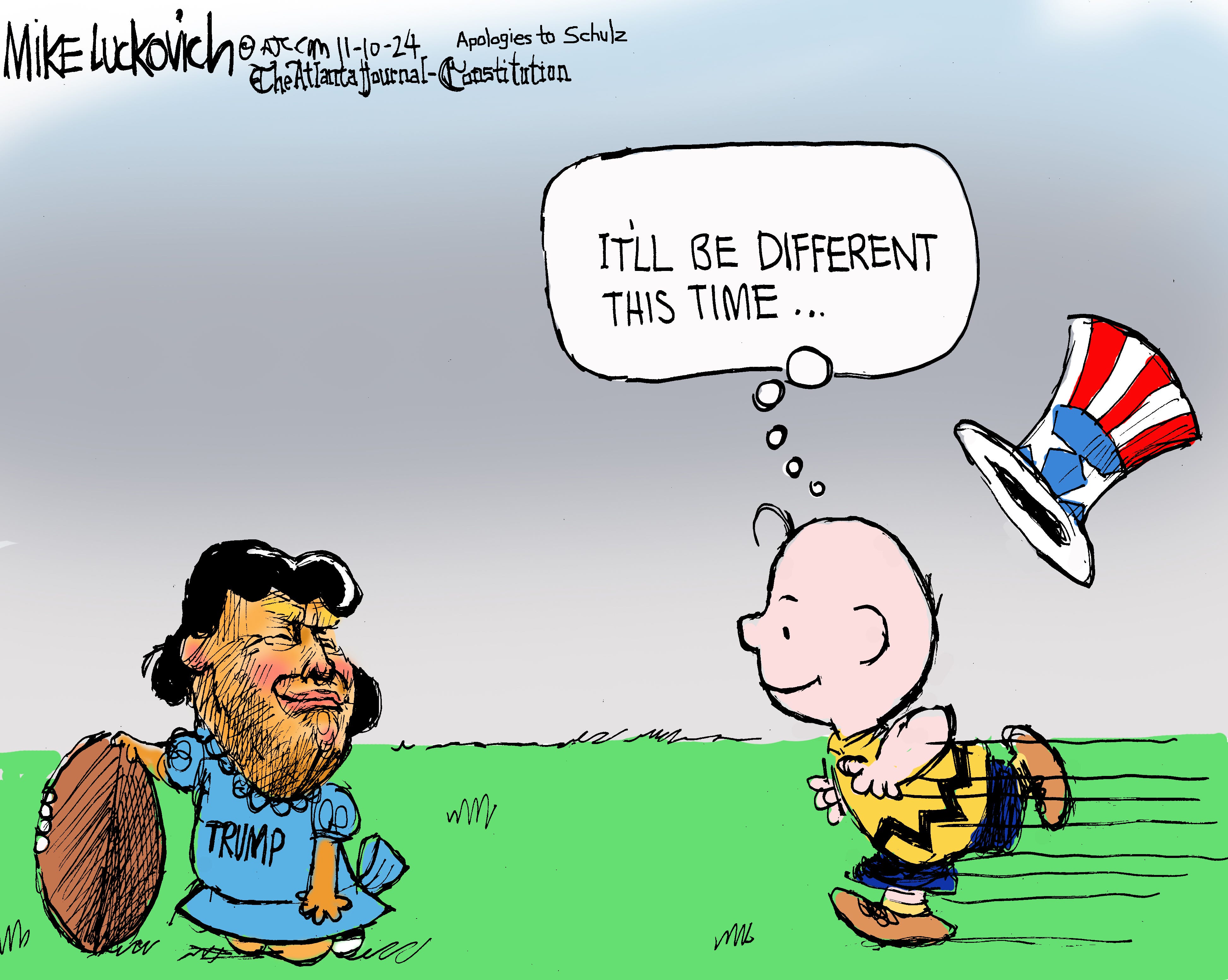
sure enough, the media has now gone into overdrive, churning out piece after piece in which they promise us that if we all click our heels together three times, everything will be okay.
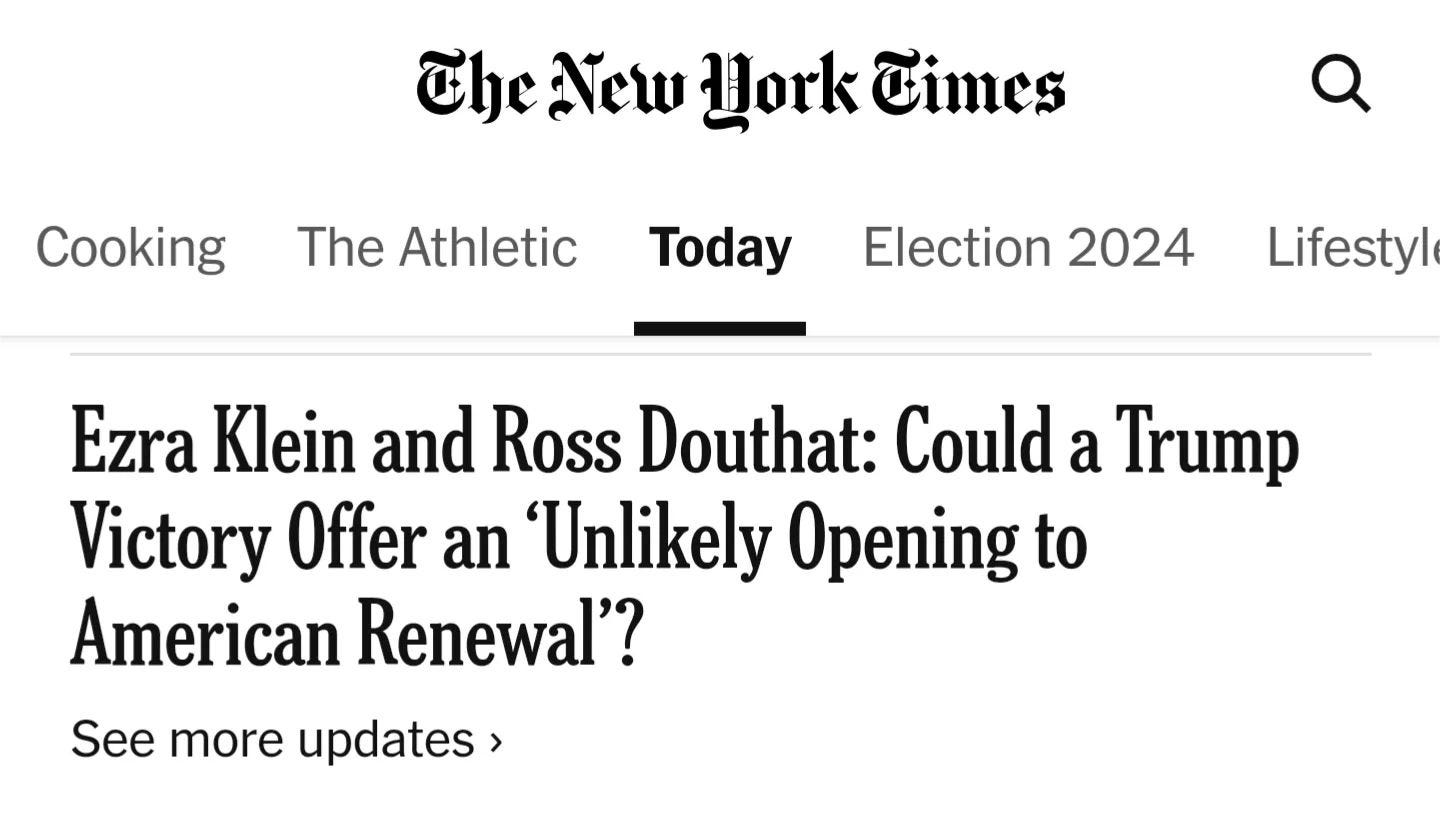
not twelve hours after the election had been called for Donny, the Times wasted no time in assuring us that the election of a vindictive fascist is an amazing opportunity for vindictive fascism not to happen.
what kind of magical, everybody-gets-a-pony thinking is this? just fucking stop it.
did Ezra Klein and Ross Douthat both experience some kind of recent head trauma that has caused them to forget the years 2017 through 2020? Donny’s first presidency was a dumpster fire of corruption, mismanagement and mass death — but somehow now, given a second chance to fuck shit up worse, Donny’s going to bring us an “American renewal”?
anything’s possible, right? overnight, Donny Convict could magically become a wise and fair statesman — also, technicolor pigs could fly out of my ass.
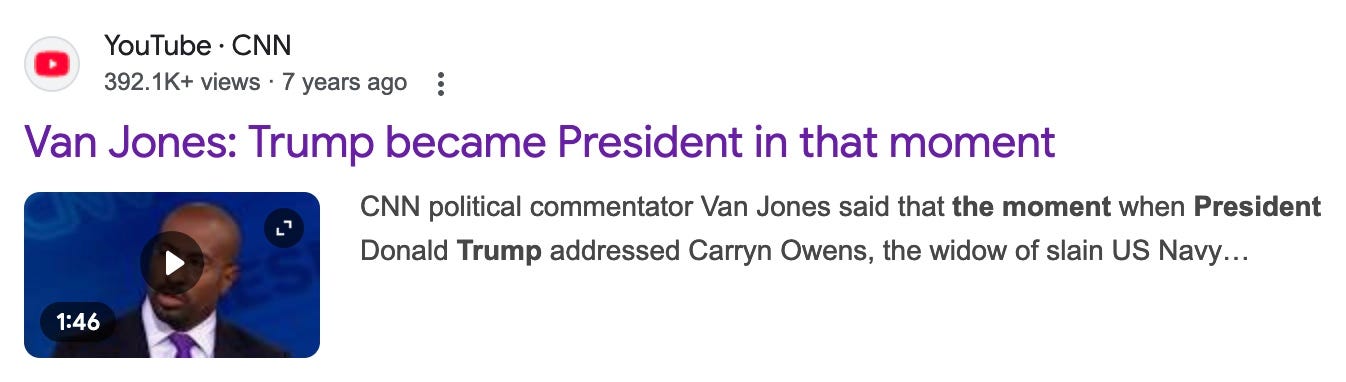
oh my god, the media never stops imagining that Donny is going to somehow become presidential. during his first term — over and over — every time Donny stopped short of taking out his dick and pissing on the floor, the press would fall all the fuck over itself in a mad dash to proclaim him presidential.
spoiler alert: Donny never became presidential. not from the the first time he threw a ketchup-hurling tantrum in the White House, to the moment he absconded back to his Florida golf motel, taking with him boxes of stolen classified documents.
the premise here is that if we’re respectful to Donny — if we fucking kowtow to him, and stop opposing him — he’ll be nice to us in return. he’ll become — dare I say it? — presidential.
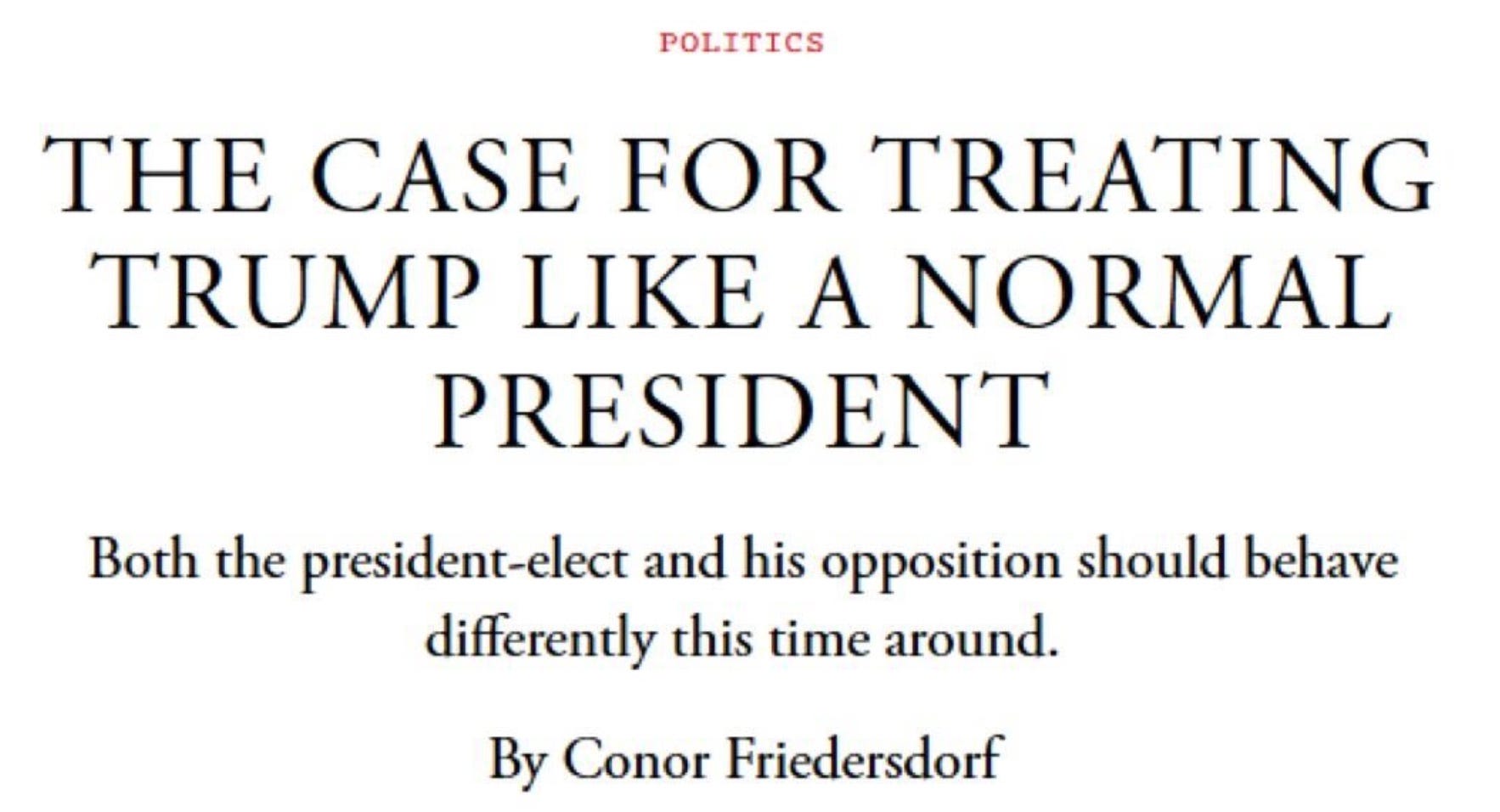
Stop indulging the fantasy that outrage, social stigma, language policing, a special counsel, the Twenty-Fifth Amendment, or impeachment will disappear him. And stop talking as if normal political opposition is capitulation.
Everyone should normalize Trump. If he does something good, praise him. Trump is remarkably susceptible to flattery.
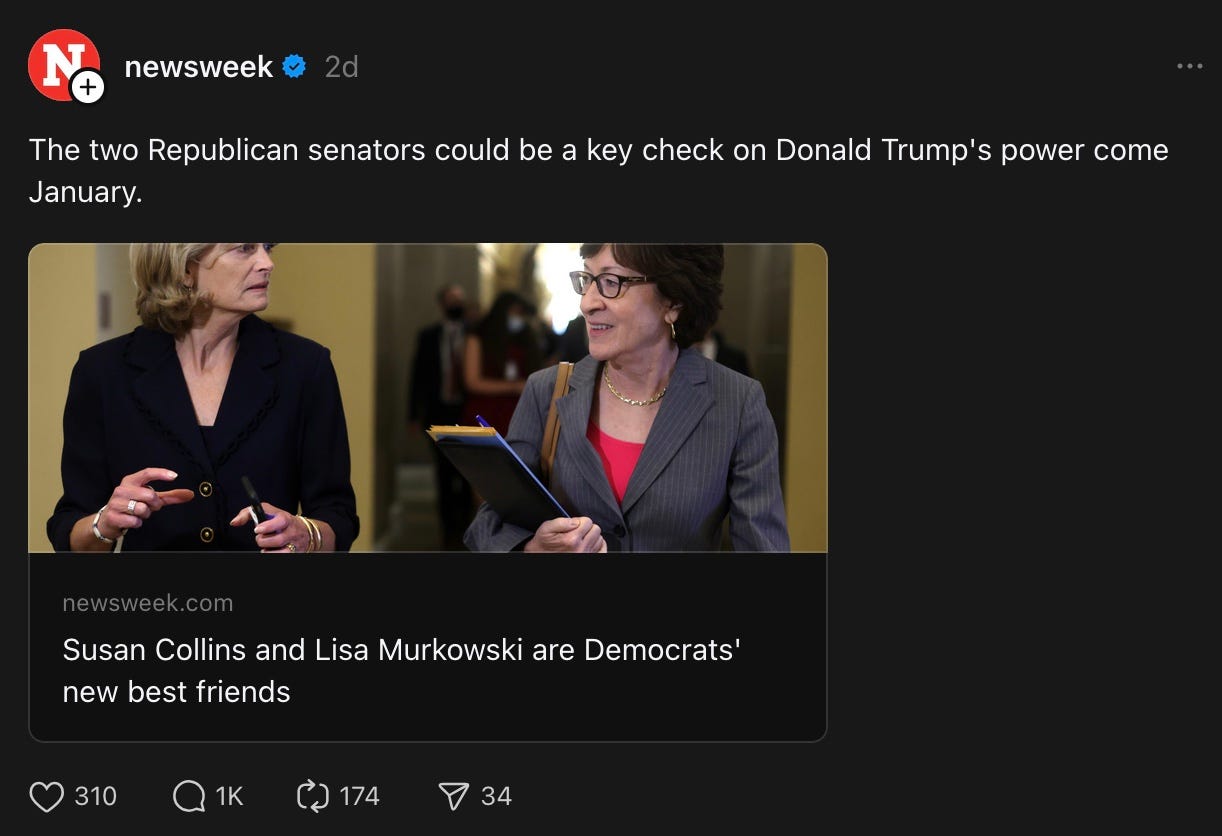
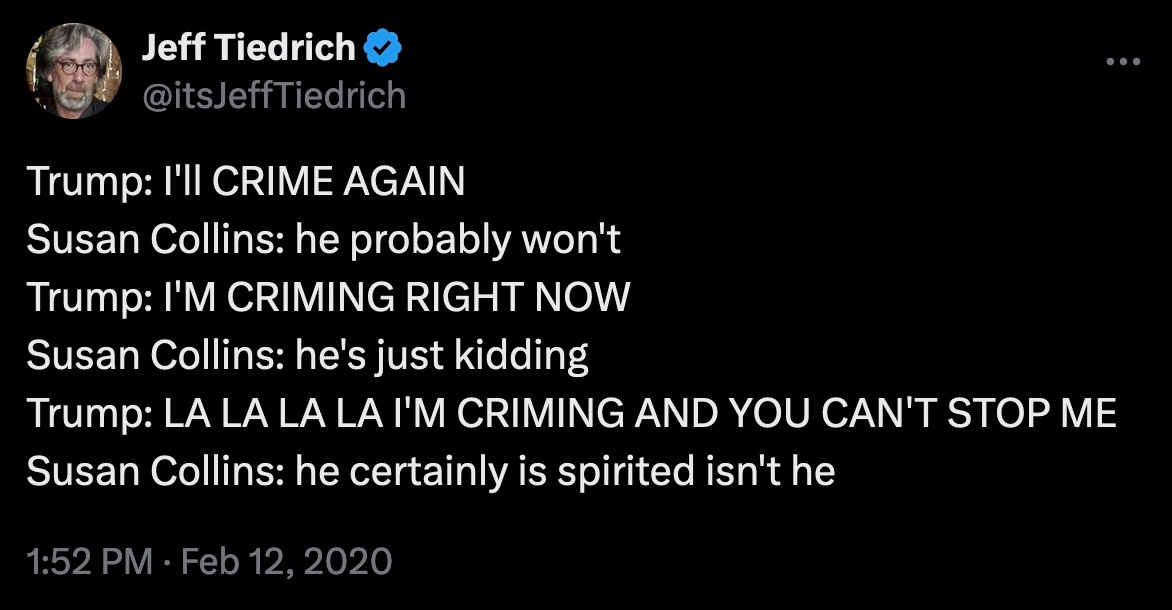
okay, I will grant that Newsweek may be half right. Lisa Murkowski seems to genuinely loathe Donny, and we can probably count on her to vote against the worst of his fuckery — but Susan Collins? the credulous naïf who assured us over and over again that Donny had learned his lesson, and would never transgress again?
now, let’s bask under some rays of hope from people who aren’t just blindly wishcasting, but are actually offering reasoned arguments.
in the middle of a fairly clear-eyed assessment of the Trumpian horrors to come, the Guardian gives us this:
Elaine Kamarck, a former official in the Bill Clinton administration, said: “For him to expand presidential power, Congress has to give up power and they’re not in the mood to do that. They’ve never done that. There are plenty of institutionalists in Congress.”
Kamarck also expressed faith in the federal courts, noting that judges appointed by Trump only constitute 11% of the total placed on the bench by former presidents. A Trump dictatorship is “not going to happen,” she added. “Now, there might be things that the president wants to do that people don’t like that the Republican Congress goes along with him on but that’s politics. That’s not a dictatorship.”
Paradoxically, however, Trump’s reckless venality is a reason for hope. Trump has the soul of a fascist but the mind of a disordered child. He will likely be surrounded by terrible but incompetent people. All of them can be beaten: in court, in Congress, in statehouses around the nation, and in the public arena. America is a federal republic, and the states—at least those in the union that will still care about democracy—have ways to protect their citizens from a rogue president. Nothing is inevitable, and democracy will not fall overnight.
Americans cannot vote themselves into a dictatorship any more than you as an individual can sell yourself into slavery. The restraints of the Constitution protect the American people from the unscrupulous designs of whatever lawless people might take the reins of their government, and that does not change simply because Trump believes that those restraints need not be respected by him. The Constitution does not allow a president to be a “dictator on day one,” or on any other day. The presidency will give Trump and his cronies the power to do many awful things. But that power does not make them moral or correct.
I sure hope to fuck they’re right.
This is going to be my closing message for the foreseeable future:
practice self-care. do what you need to do to keep sane. if that means disengaging with my daily posts for a while, I get it. this community of ours will still be here when you return.
to all the people who have signed on in the days since the election, welcome aboard. settle in as we all try to deal with the shitfuckery that’s ahead of us.
we are all in this together, and we are all here for each other.
One of the reasons given by people that voted for tRump, that he would lower prices of stuff. Yup that was dumb. They also claim that he speaks like they do so they understand him. I ask why do you speak as hateful as him? They also think he cares about them, a man who was a born millionaire and who lives in golden penthouses is just a man of the people? A man who thinks money is the most important thing in life doesn’t care if poor people live or die. Hugs
As President-elect Donald Trump readies to return to the Oval Office, U.S. retailers that depend on foreign suppliers are prepared to pass along the cost of his proposed import tariffs to consumers, potentially leading to higher prices for a range of products.
Americans stand to lose between $46 billion and $78 billion in spending power each year on products including apparel, toys, furniture, household appliances, footwear and travel goods due to the new tariffs, the National Retail Federation stated in findings released Monday.
“Retailers rely heavily on imported products and manufacturing components so that they can offer their customers a variety of products at affordable prices,” NRF Vice President of Supply Chain and Customs Policy Jonathan Gold said in a statement. “A tariff is a tax paid by the U.S. importer, not a foreign country or the exporter. This tax ultimately comes out of consumers’ pockets through higher prices.”
For example, a $40 toaster oven would retail for $48 to $52 after the tariffs, while a $50 pair of running shoes would jump to to $59 to $64, according to the industry trade group. A $2,000 mattress and box spring set would cost $2,128 to $2,190, the NRF said.
During President-elect Trump’s first term in office, his administration imposed tariffs of up to 25% on more than $360 billion in products from China. President Joe Biden’s White House kept most of those tariffs and added more onto goods including Chinese electric cars and microchips.
Now, Trump has said he plans to impose a 60% tax on goods from China and a 10% to 20% levy on all of the $3 trillion in foreign goods the U.S. imports annually. Such sweeping tariffs would reignite inflation, as they would mostly be paid by U.S. consumers, Treasury Secretary Janet Yellen has warned, offering a general view widely shared by other economists on both sides of the political aisle.
“A consistent theoretical and empirical finding in economics is that domestic consumers and domestic firms bear the burden of a tariff, not the foreign country,” the nonpartisan Budget Lab at Yale University stated in an analysis published in mid-October.
Trump has repeatedly contended that foreign companies would foot the bill, telling a gathering last month at the Economic Club of Chicago that “the countries will pay” the tariffs. In reality, American importers pay the tariffs to the U.S. Customs and Border Protection agency when their goods cross the border.
“These policy steps would amount to regressive tax cuts, only partially paid for by regressive tax increases,” and cost a typical middle-income household about $1,700 in increased taxes a year,” according to economists at the Peterson Institute for International Economics. The proposed tariffs would shift tax burdens from the well-off to lower-income Americans, the nonprofit also stated in a policy brief published in August.
For now, it is unclear when the new Trump regime could seek to stiffen tariffs. The process to complete legislation required to raise the levies could take nearly a year, so any adverse impact might not be felt until 2026, according to Oxford Economics.
Harvard University professor and former U.S. Treasury Secretary Lawrence Summers questioned the wisdom of taxing imports, noting the potential impact on prices. “For parents, we’re coming up on the holiday season and most of our toys are imported from China,” Summers tweeted on Thanksgiving Day.
Trump has argued that tariffs compel American companies to make goods on U.S. soil rather than purchasing from foreign suppliers.
But some companies have other plans.
“If we get tariffs, we will pass those tariff costs back to the consumer,” Philip Daniele, CEO of vehicle parts supplier AutoZone, told Wall Street analysts in an earnings call in late September. “We’ll generally raise prices ahead of — we know what the tariffs will be — we generally raise prices ahead of that,” Daniele said.
Major suppliers to AutoZone include companies based in China, India and Germany, according to the company.
Stanley Black & Decker CEO Donald Allan Jr. said last week his tool-producing company has been planning for the possibility of additional tariffs on imports since the spring. “Obviously, coming out of the gate, there would be price increases associated with tariffs that we [would] put into the market.”
Allan downplayed the idea of moving manufacturing back to the U.S., saying it would not be cost-effective. The company’s options could include “moving production and aspects of the supply chain to different parts of the world,” including from China to other parts of Asia and possibly Mexico, the executive said.
Such a shift has already been made by Shelton, Connecticut-based Acme United, which now has its Westcott brand products like rulers made in Thailand and the Philippines, avoiding the tariffs targeting China, CEO Walter Johnsen said in an October earnings call.
Acme has switched production of certain medical products to India, Egypt and U.S. plants in Florida, North Carolina and Washington state, the executive said.
Businesses have also stocked up, placing bigger-than-usual import orders ahead of new tariffs taking hold, as the U.S. imported 11% more Chinese products in July and August than they did during the same two-month period a year ago, according to the Census Bureau.
As Donald Trump readies to return to the Oval Office, U.S. retailers that depend on foreign suppliers are prepared to pass along the cost of his proposed import tariffs to consumers, potentially leading to higher prices for a range of products. https://t.co/FnazDzizgT
Special counsel Jack Smith delivers remarks about an unsealed indictment against former President Donald Trump on Aug. 1, 2023, in Washington, D.C.
Drew Angerer/Getty Images
Donald Trump started this year fighting two federal prosecutions that threatened to send him to prison. But he will end it free and clear of his most significant criminal legal problems.
With his resounding victory at the polls, and a longstanding Justice Department policy against prosecuting a sitting president, the key question is not if, but when, prosecutors move to dismiss or delay his federal election interference case in Washington, D.C.
Trump recently said he would fire special counsel Jack Smith “within two seconds” after he returned to the White House. Now, that won’t be necessary to bring his federal criminal troubles to an end.
Smith is taking steps to end both federal cases against Trump before the president-elect takes office, according to a source familiar with the Justice Department deliberations.
1. What are the outstanding cases the federal government has lodged against Trump?
A grand jury in Washington indicted Trump this year on four felony charges in connection with his effort to cling to power in 2020, culminating in the violent siege on the U.S. Capitol on Jan. 6, 2021.
Judge Tanya Chutkan had set a trial date for March 2024, but that date came and went, after the Supreme Court accepted the case and ultimately handed Trump significant immunity from prosecution for official actions he took in the White House.
The judge is just now beginning to consider what parts of the prosecution’s case amount to official acts, and which are private conduct of a person seeking rather than holding office.
The Justice Department has appealed in a separate criminal case against Trump that accuses the former president of hoarding classified documents at his Mar-a-Lago resort and refusing to the return them to the FBI.
Judge Aileen Cannon, who was appointed to the bench by Trump, dismissed the documents case on July 15, the first day of the Republican National Convention this year, reasoning that the way the special counsel had been appointed violates the Constitution. The Justice Department has been seeking review by a higher court, the U.S. Court of Appeals for the Eleventh Circuit.
2. What does Trump’s election victory mean for these cases?
They’re on life support and likely to end even before the inauguration in January.
On the campaign trial, now President-elect Trump has vowed to fire the special counsel, Jack Smith, on his first day in office. But Trump would not need to dismiss Smith or order any new DOJ officials to fire Smith in order to end the criminal prosecutions.
President-elect Donald Trump delivers remarks during the Georgia state GOP convention in June 2023 after a grand jury indicted him on 37 felony counts in Special Counsel Jack Smith’s classified documents probe.
Anna Moneymaker/Getty Images
In 2000, a lawyer in the Justice Department’s Office of Legal Counsel, which advises the federal government on its powers and boundaries, concluded that a sitting president could not be indicted or prosecuted because that “would unconstitutionally undermine the capacity of the executive branch to perform its constitutionally assigned functions.”
Administrations led by Republicans and Democrats have adopted the DOJ policy against prosecuting presidents.
The Florida case involving classified documents is a bit more complicated. DOJ could file notice with the appeals court that it is abandoning the appeal. But that case involves two other defendants, Walt Nauta and Carlos de Oliveira.
Dismissing the appeal outright would also mean walking away from cases that prosecutors built against those two defendants, Trump’s personal aide and the property manager at Mar-a-Lago.
What’s more, the federal government may have a broader interest, because Cannon’s reasoning could upend the way special prosecutors have been appointed for decades.
But one DOJ veteran who wasn’t authorized to speak publicly told NPR that Cannon’s ruling would not be considered binding precedent, so the stakes could be lower.
Former Attorney General William Barr says voters have evaluated the allegations against Trump—and decisively rendered their own verdict.
“Further maneuvering on these cases in the weeks ahead would serve no legitimate purpose and only distract the country and the incoming administration from the task at hand,” Barr said in a written statement first reported by the Guardian.
3. What happens to the special counsel, Jack Smith?
Special counsels are obligated to file a report on their actions with the Attorney General when they finish their work. The current attorney general, Merrick Garland, has pledged to make most of those reports public.
If Smith’s written report is not complete by Inauguration Day, it will be up to new DOJ leaders to decide its fate.
Mike Davis, a Trump ally, told a conservative interviewer this week that the attorney general “is probably President Trump’s most important appointment.”
Davis told the interviewer that Smith’s entire office should be fired and said, “After today, Jack Smith, you’re going to be the hunted: legally, politically and financially. So lawyer up, buddy.”
4. Trump also faced criminal charges in two states, New York and Georgia. How will the election reshape those cases?
A jury in New York this year convicted Trump on 34 criminal charges related to bookkeeping for an alleged hush money payment to an adult film actress shortly before the 2016 election.
Justice Juan Merchan scheduled a hearing for Nov. 12 to assess how the Supreme Court’s immunity decision might affect that case. It’s not clear whether the criminal sentencing for Trump set for Thanksgiving week will occur. Trump’s lawyers may seek to stop it given the election results.
The case against Trump in Fulton County, Ga., over alleged election interference, has been on pause for months while a higher court considers possible conflicts of interest involving District Attorney Fani Willis. There’s a hearing scheduled in that appeal Dec. 5.
It, too, could be overtaken by events — and a strategy of delay and deflection by Trump’s lawyers that appears to have succeeded beyond imagination.
In Italy on Wednesday, the Italian Senate pushed forward the West’s most restrictive ban on international surrogacy, making it a crime punishable by prison time for Italians to use surrogates in another country. The move closes the door on same-sex couples’ last, best option to start a family in the country.
The far-right government of Prime Minister Giorgia Meloni had already banned both surrogacy and domestic or international adoption by same-sex couples in Italy.
The legislation amending existing Italian law would classify surrogacy as a universal crime transcending borders and impose a two-year prison sentence and a million-euro fine for defying it. The law also criminalizes work by Italian doctors, nurses and technicians in foreign fertility clinics that provide surrogacy services.
Last year, Meloni’s government barred Italian cities and towns from accepting birth certificates that list same-sex parents, denying their children access to citizenship, public schooling and healthcare. That edict is tied up in court.
The Senate’s passage of the anti-surrogacy law, 84 to 58, follows approval by the government’s lower house last year, virtually assuring its enactment.
Meloni has made “traditional values” a cornerstone of her tenure leading the Brothers of Italy party, despite being a single mother who never married. The far-right populist league was founded on the ruins of Benito Mussolini’s Republican Fascist Party in the aftermath of World War II.
“It’s like a truck hitting us in the face,” Pierre Molena, a gay man pursuing surrogacy abroad with his partner, told The New York Times.
“We are worried about our future and that of our children,” he said.
“It is nature that decides this, not us,” Sen. Susanna Campione, who voted in favor of the law, told the The Washington Post.
“This is a civilized law that safeguards the child but also the woman, since we believe that surrogacy essentially reduces a woman to a reproductive machine.”
While most U.S. states and Canada allow the practice, surrogacy has become a flashpoint in Europe. Germany and France ban domestic surrogacy, while it’s legal in the United Kingdom and Greece under certain circumstances. Pope Francis has labeled the practice “womb renting,” and called for a global ban.
About 250 couples a year in Italy pursue international surrogacy, according to legal experts. Ten percent of those couples are same-sex.
“This law is disgusting,” Salvatore Scarpa told the The Post. The gay dad and his partner had a daughter with a surrogate based in California last year and plan to have a second child with the same woman. They have an implantation planned for this month.
“They cannot stop our family. How dare they judge us,” he said.
Alessandra Maiorino, a member of Italy’s anti-establishment Five Star Movement, said the new law stigmatizes children already born to gay couples as well, telling lawmakers who voted for it: “It looks like you don’t realize these people already exist.”
Subscribe to the LGBTQ Nation newsletter and be the first to know about the latest headlines shaping LGBTQ+ communities worldwide.
The NSW equality bill brings the state into line with others. Photograph: Dean Lewins/AAP
Rights and protections for LGBTQ+ people in New South Wales have been strengthened with the passing of a bill in the state parliament late on Thursday, after the legislation was watered down to gain Labor support.
The equality bill will give transgender people the ability to have their sex changed on their birth certificates without undergoing invasive surgery, bringing the state in line with others, and non-binary will become a gender option for birth certificates.
There were cheers in the chamber when the bill passed about 8.40pm. The independent MP Alex Greenwich, who introduced the package a year ago, embraced the leader of the government in the upper house, Penny Sharpe after the vote that succeeded without the opposition’s support.
Greenwich said the changes would “improve LGBTIQA+ dignity, safety and equality” and thanked Sharpe for her work getting the legislation through the upper house.
“We’ve got more work to do and we start that work now with new confidence from these significant wins for our community,” he said on Thursday night.
After months of stagnation, Greenwich convinced the premier, Chris Minns, to support the bill by making a number of major concessions, including dropping changes to the anti-discrimination act.
While advocates welcomed the remaining elements of the bill, many also raised concerns that protections for LGBTQ+ teachers and students at private schools had been dumped.
The Equality Australia chief executive, Anna Brown, thanked community members who shared their stories and all those who campaigned to garner support for the changes.
“These new laws will have no impact on the lives of most people in our state, but for a small number of people it will make their lives immeasurably better,” she said after the bill passed.
“It’s a journey that continues as we turn our attention to the state’s anti-discrimination laws and our ongoing efforts to protect vulnerable teachers and students in religious and private schools across the state.”
Greenwich had hoped the Coalition would allow MPs a conscience vote on the bill but earlier in the week the opposition leader, Mark Speakman, confirmed his party would stand against the reforms.
Despite that, the Liberal MP for the North Shore, Felicity Wilson, crossed the floor.
“Just because your party doesn’t have a conscience vote doesn’t mean you don’t have a conscience,” she told ABC Radio Sydney earlier in the week.
Greenwich said on Wednesday that the Coalition was moving further to the right and “using my community as a political football, as a political punching bag”.
“I am concerned that we are seeing a rightwing trend developing within the Coalition,” he said. “No other leader has denied their members a conscience vote on LBGT issues.”
The opposition attorney general, Alister Henskens, held a news conference with religious figures and community members opposed to the reforms earlier in the week.
Among the concerns he raised was about the “impact upon the privacy of women’s spaces”.
“It’s moving too far and it’s moving too quickly,” he said.
But the attorney general, Michael Daley, said the opposition was misrepresenting the package.
The bill also repealed offences for living off the earnings of a sex worker and made threatening to “out” a person’s LGBTIQA+ status an offence.
A broken window on an LGBTQ fashion boutique storefront in Manhattan, New York on June 12, 2023.Photo: Shutterstock
There has been a 112% increase in documented attacks on LGBTQ+ people nationwide, according to a newly unveiled Anti-LGBTQ Extremism Reporting Tracker (ALERT) from the queer media watchdog organization GLAAD. GLAAD hopes to use the tracker to provide comprehensive reporting and analysis detailing anti-LGBTQ+ hate in the U.S. and the specific communities and targets affected by it.
ALERT recorded 524 such incidents between June 2022 and 2023 and 1,109 incidents from June 2023 to 2024. These attacks have included over 450 protests, 330 propaganda drops, 320 acts of vandalism, 200 bomb & mass shooting threats, 130 assaults, and 45 cases of arson that have resulted in at least 161 injuries and 21 deaths, GLAAD’s ALERT Desk reported.
While the cases focus on drag bans and trans protections, they address larger issues of free speech and civil rights.
The attacks have also included over 567 attacks on transgender and gender non-conforming people, 360 incidents targeting educational institutions and libraries, 325 incidents targeting Pride flags and other LGBTQ+ community symbols, 160 protests and violent threats against drag performers, and 140 incidents targeting health care providers of gender-affirming care and their patients.
The tracker, which will be updated quarterly, includes data on criminal and non-criminal acts of hate from sources like news media, partner organizations (like the Human Rights Campaign or Anti-Defamtion League’s Center on Extremism), right-wing forums on social media sites like Gab or chat apps like Telegram as well as incident reports submitted via GLAAD’s website. All documented incidents must occur against groups or individuals within the U.S. and must include harassment, threats, or actual violence specifically targeting LGBTQ+ people.
GLAAD’s ALERT team will verify the validity of each incident to maintain credibility, remove duplicates, and exclude spam and trolling, the organization said.
“The ALERT Desk tells a story not entirely captured by the FBI’s hate crime statistics because many of these incidents, like protests at Pride events, don’t meet the criteria necessary to bring legal charges [and] aren’t included in most official hate crime counts,” GLAAD wrote in its recently released report on ALERT’s findings. “However, we must recognize that the impact of these acts on local LGBTQ communities is felt regardless of whether or not the incident is prosecuted.”
“We must recognize that the impact of these acts on local LGBTQ communities is felt regardless of whether or not the incident is prosecuted.”
GLAAD’s 2024 report on ALERT’s findings
During a press call, Barbara Simon, senior director of news and campaigns at GLAAD, noted that ALERT seeks to contextualize anti-LGBTQ+ incidents to help media and other experts understand larger systems of violence.
“[Recently], there was a bomb threat against a library in Massachusetts,” Simon said, a threat against a Drag Queen Story Hour at the public library in Somerville. “But it’s not just about that library. It’s not just about the inclusive materials and programs they had, about how the bomb squad had to come in and sweep the library, how children and families and patrons had to evacuate the library.”
“Our data shows how that incident is connected to the bigger picture, which is more of a broad-based, systemic attack against LGBTQ people, our visibility, our equality and our allies,” Simon added. “It is one of 365 attacks nationwide against drag artisan events. It’s one of 63 anti-LGBTQ attacks in Massachusetts alone, one of 15 attacks specifically against drag in Massachusetts.”
The quarterly reports will also include stories from those affected by the incidents.
GLAADA bar graph showing anti-LGBTQ+ hate incidents from GLAAD’s ALERT Desk. | GLAAD
For example, Dr. Jack Turban, pediatric psychiatrist and director of the gender psychiatry program at the University of California in San Francisco, said during the press call that bans on gender-affirming care for youth in 26 states have worsened the mental health of his young trans patients even though they live in a state where such health care is protected. Their mental health has been worsened, Turban said, because of an increase in anti-trans rhetoric nationwide whose indirect effects cross state lines.
“Kids are hearing things like being trans is a mental illness, or being trans is bad, or you shouldn’t be allowed to use the bathroom that aligns with your gender identity because trans people are sexual assaulters, or you shouldn’t be allowed to play on sports teams with your friends because you’re going to physically hurt them,” Turban said. “My patients know that none of those things are true, right? They can know that, but if you’re hearing it every single day, all over social media and all over the news and now right in their communities, even it’s impossible to not be impacted by that.”
GLAAD pointed out that media coverage tends to falsely frame medical care for transgender people as a “debate” despite every major medical association supporting the care. This coverage compounds the effect of hateful rhetoric from anti-trans politicians, protestors, and pundits.
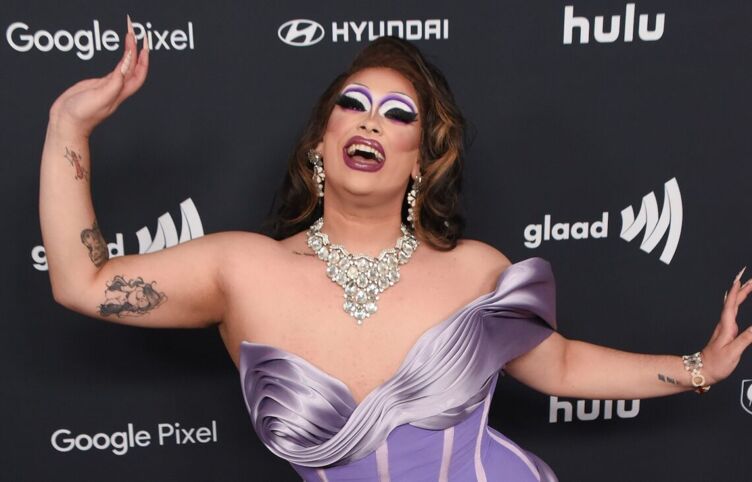
ShutterstockSalina EsTitties attends the 35th Annual GLAAD Awards on March 14, 2024 in Beverly Hills, California. | Shutterstock
The hateful rhetoric affects even LGBTQ+ celebrities and their fans, like Salina EsTitties, a competitor who appeared in Season 15 of RuPaul’s Drag Race. EsTitties told the press call that she’s generally insulated from hatred against gender non-conforming people since she lives in the very gay city of West Hollywood, California. However, she sees its impact whenever she travels to other states or posts social media videos about LGBTQ+ issues.
“There’s comments every single day of people being like, ‘This is not what God created. God created two genders. Oh, they keep adding alphabets. Oh, just shoot it between the eyes and get rid of it,’” EsTitties said. “The online hate is insane and there’s so much of it, and people are so willing to just let it all out, but it’s a clear representation of how people actually feel in America and across, you know, the U.S. here.”
“Not only are our LGBT community dealing with having to be their authentic selves,” she continued. “Being their authentic selves with just who they are outside of their queer identity is a lot to navigate, and it’s not easy, especially when people are telling you, ‘You’re the Devil, you’re a demon,’ or ‘It’s not acceptable to be that.’”
Hate crimes typically increase during presidential election years. Marie Cottrell, executive director for the New Jersey-based LGBTQ+ advocacy center Out Montclair, said she hopes that increased awareness of anti-LGBTQ+ hate incidents will empower communities to build intersectional coalitions between other demographic groups whose members are targeted by similar hate.
“I think that it’s really important that you be the person that the community needs,” Cottrell told the press call. “They need to see you stand for and with them. Find folks who in your community who will stand with you in the face of intolerance, build a community of support within your township — whether that’s forging a relationship with your LGBTQ liaison within the local police department … working with the township, the mayor, the town council, and really having open conversations … having conversations that address really hard questions and topics and that starts the process of understanding and healing in your community.”
“It’s a small step, but it’s a step forward and a step forward in helping others understand the community,” she said.
Subscribe to the LGBTQ Nation newsletter and be the first to know about the latest headlines shaping LGBTQ+ communities worldwide.
(I don’t know if this is gonna work; I’m not on Instagram, but I went there, and could see, hear, read, and got the embed link. MomsRising is asking for shares, so if anyone cares to share, thank you!)
November 2, 1920 Socialist Party candidate Eugene V. Debs received nearly one million votes for President though he was serving a prison sentence at the time for his criticism of World War I and his encouraging resistance to the draft. More on Debs
November 2, 1982 Voters in nine general elections passed statewide referenda supporting a freeze on testing of nuclear weapons. Only Arizona turned it down. Dr. Randall Forsberg, a key person behind the Freeze movement Dr. Randall Forsberg
November 2, 1983 A bill designating a federal holiday honoring Dr. Martin Luther King, Jr. (to be observed on the third Monday of January) was signed by President Ronald Reagan. King was born in Atlanta in 1929, the son of a Baptist minister. He received a doctorate degree in theology and in 1955 organized the first major protest of the civil rights movement: the successful Montgomery Bus Boycott. Influenced by Mohandas Gandhi, he advocated nonviolent civil disobedience of the laws that enforced racial segregation. The history of Martin Luther King Day (pdf)





 Italian Prime Minister Giorgia Meloni

 A broken window on an LGBTQ fashion boutique storefront in Manhattan, New York on June 12, 2023.Photo: Shutterstock


 Scottie's Playtime