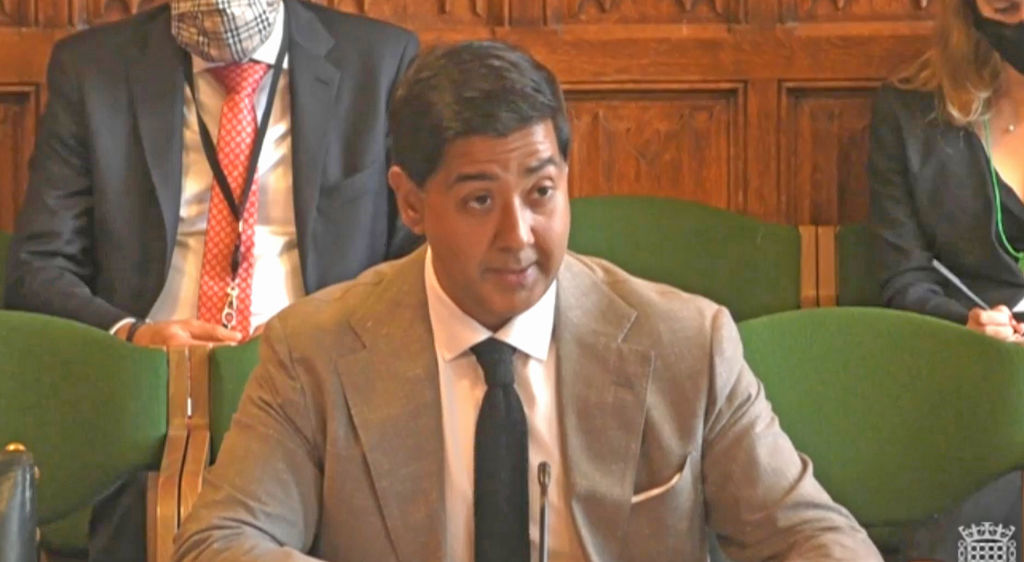
Imran Ahmed, the founder of the Center for Countering Digital Hate (CCDH), giving evidence to joint committee seeking views on how to improve the draft Online Safety Bill designed to tackle social media abuse. Credit: House of Commons – PA Images / Contributor | PA Images
Imran Ahmed’s biggest thorn in his side used to be Elon Musk, who made the hate speech researcher one of his earliest legal foes during his Twitter takeover.
Now, it’s the Trump administration, which planned to deport Ahmed, a legal permanent resident, just before Christmas. It would then ban him from returning to the United States, where he lives with his wife and young child, both US citizens.
After suing US officials to block any attempted arrest or deportation, Ahmed was quickly granted a temporary restraining order on Christmas Day. Ahmed had successfully argued that he risked irreparable harm without the order, alleging that Trump officials continue “to abuse the immigration system to punish and punitively detain noncitizens for protected speech and silence viewpoints with which it disagrees” and confirming that his speech had been chilled.
US officials are attempting to sanction Ahmed seemingly due to his work as the founder of a British-American non-governmental organization, the Center for Countering Digital Hate (CCDH).
“An egregious act of government censorship”
In a shocking announcement last week, Secretary of State Marco Rubio confirmed that five individuals—described as “radical activists” and leaders of “weaponized NGOs”—would face US visa bans since “their entry, presence, or activities in the United States have potentially serious adverse foreign policy consequences” for the US.
Nobody was named in that release, but Under Secretary for Public Diplomacy, Sarah Rogers, later identified the targets in an X post she currently has pinned to the top of her feed.
Alongside Ahmed, sanctioned individuals included former European commissioner for the internal market, Thierry Breton; the leader of UK-based Global Disinformation Index (GDI), Clare Melford; and co-leaders of Germany-based HateAid, Anna-Lena von Hodenberg and Josephine Ballon. A GDI spokesperson told The Guardian that the visa bans are “an authoritarian attack on free speech and an egregious act of government censorship.”
While all targets were scrutinized for supporting some of the European Union’s strictest tech regulations, including the Digital Services Act (DSA), Ahmed was further accused of serving as a “key collaborator with the Biden Administration’s effort to weaponize the government against US citizens.” As evidence of Ahmed’s supposed threat to US foreign policy, Rogers cited a CCDH report flagging Robert F. Kennedy, Jr. among the so-called “disinformation dozen” driving the most vaccine hoaxes on social media.
Neither official has really made it clear what exact threat these individuals pose if operating from within the US, as opposed to from anywhere else in the world. Echoing Rubio’s press release, Rogers wrote that the sanctions would reinforce a “red line,” supposedly ending “extraterritorial censorship of Americans” by targeting the “censorship-NGO ecosystem.”
For Ahmed’s group, specifically, she pointed to Musk’s failed lawsuit, which accused CCDH of illegally scraping Twitter—supposedly, it offered evidence of extraterritorial censorship. That lawsuit surfaced “leaked documents” allegedly showing that CCDH planned to “kill Twitter” by sharing research that could be used to justify big fines under the DSA or the UK’s Online Safety Act. Following that logic, seemingly any group monitoring misinformation or sharing research that lawmakers weigh when implementing new policies could be maligned as seeking mechanisms to censor platforms.
Notably, CCDH won its legal fight with Musk after a judge mocked X’s legal argument as “vapid” and dismissed the lawsuit as an obvious attempt to punish CCDH for exercising free speech that Musk didn’t like.
In his complaint last week, Ahmed alleged that US officials were similarly encroaching on his First Amendment rights by unconstitutionally wielding immigration law as “a tool to punish noncitizen speakers who express views disfavored by the current administration.”
Both Rubio and Rogers are named as defendants in the suit, as well as Attorney General Pam Bondi, Secretary of Homeland Security Kristi Noem, and Acting Director of US Immigration and Customs Enforcement Todd Lyons. In a loss, officials would potentially not only be forced to vacate Rubio’s actions implementing visa bans, but also possibly stop furthering a larger alleged Trump administration pattern of “targeting noncitizens for removal based on First Amendment protected speech.”
Lawsuit may force Rubio to justify visa bans
For Ahmed, securing the temporary restraining order was urgent, as he was apparently the only target currently located in the US when Rubio’s announcement dropped. In a statement provided to Ars, Ahmed’s attorney, Roberta Kaplan, suggested that the order was granted “so quickly because it is so obvious that Marco Rubio and the other defendants’ actions were blatantly unconstitutional.”
Ahmed founded CCDH in 2019, hoping to “call attention to the enormous problem of digitally driven disinformation and hate online.” According to the suit, he became particularly concerned about antisemitism online while living in the United Kingdom in 2016, having watched “the far-right party, Britain First,” launching “the dangerous conspiracy theory that the EU was attempting to import Muslims and Black people to ‘destroy’ white citizens.” That year, a Member of Parliament and Ahmed’s colleague, Jo Cox, was “shot and stabbed in a brutal politically motivated murder, committed by a man who screamed ‘Britain First’” during the attack. That tragedy motivated Ahmed to start CCDH.
He moved to the US in 2021 and was granted a green card in 2024, starting his family and continuing to lead CCDH efforts monitoring not just Twitter/X, but also Meta platforms, TikTok, and, more recently, AI chatbots. In addition to supporting the DSA and UK’s Online Safety Act, his group has supported US online safety laws and Section 230 reforms intended to protect kids online.
“Mr. Ahmed studies and engages in civic discourse about the content moderation policies of major social media companies in the United States, the United Kingdom, and the European Union,” his lawsuit said. “There is no conceivable foreign policy impact from his speech acts whatsoever.”
In his complaint, Ahmed alleged that Rubio has so far provided no evidence that Ahmed poses such a great threat that he must be removed. He argued that “applicable statutes expressly prohibit removal based on a noncitizen’s ‘past, current, or expected beliefs, statements, or associations.’”
According to DHS guidance from 2021 cited in the suit, “A noncitizen’ s exercise of their First Amendment rights … should never be a factor in deciding to take enforcement action.”
To prevent deportation based solely on viewpoints, Rubio was supposed to notify chairs of the House Foreign Affairs, Senate Foreign Relations, and House and Senate Judiciary Committees, to explain what “compelling US foreign policy interest” would be compromised if Ahmed or others targeted with visa bans were to enter the US. But there’s no evidence Rubio took those steps, Ahmed alleged.
“The government has no power to punish Mr. Ahmed for his research, protected speech, and advocacy, and Defendants cannot evade those constitutional limitations by simply claiming that Mr. Ahmed’s presence or activities have ‘potentially serious adverse foreign policy consequences for the United States,’” a press release from his legal team said. “There is no credible argument for Mr. Ahmed’s immigration detention, away from his wife and young child.”
X lawsuit offers clues to Trump officials’ defense
To some critics, it looks like the Trump administration is going after CCDH in order to take up the fight that Musk already lost. In his lawsuit against CCDH, Musk’s X echoed US Senator Josh Hawley (R-Mo.) by suggesting that CCDH was a “foreign dark money group” that allowed “foreign interests” to attempt to “influence American democracy.” It seems likely that US officials will put forward similar arguments in their CCDH fight.
Rogers’ X post offers some clues that the State Department will be mining Musk’s failed litigation to support claims of what it calls a “global censorship-industrial complex.” What she detailed suggested that the Trump administration plans to argue that NGOs like CCDH support strict tech laws, then conduct research bent on using said laws to censor platforms. That logic seems to ignore the reality that NGOs cannot control what laws get passed or enforced, Breton suggested in his first TV interview after his visa ban was announced.
Breton, whom Rogers villainized as the “mastermind” behind the DSA, urged EU officials to do more now defend their tough tech regulations—which Le Monde noted passed with overwhelming bipartisan support and very little far-right resistance—and fight the visa bans, Bloomberg reported.
“They cannot force us to change laws that we voted for democratically just to please [US tech companies],” Breton said. “No, we must stand up.”
While EU officials seemingly drag their feet, Ahmed is hoping that a judge will declare that all the visa bans that Rubio announced are unconstitutional. The temporary restraining order indicates there will be a court hearing Monday at which Ahmed will learn precisely “what steps Defendants have taken to impose visa restrictions and initiate removal proceedings against” him and any others. Until then, Ahmed remains in the dark on why Rubio deemed him as having “potentially serious adverse foreign policy consequences” if he stayed in the US.
Ahmed, who argued that X’s lawsuit sought to chill CCDH’s research and alleged that the US attack seeks to do the same, seems confident that he can beat the visa bans.
“America is a great nation built on laws, with checks and balances to ensure power can never attain the unfettered primacy that leads to tyranny,” Ahmed said. “The law, clear-eyed in understanding right and wrong, will stand in the way of those who seek to silence the truth and empower the bold who stand up to power. I believe in this system, and I am proud to call this country my home. I will not be bullied away from my life’s work of fighting to keep children safe from social media’s harm and stopping antisemitism online. Onward.”
Ashley is a senior policy reporter for Ars Technica, dedicated to tracking social impacts of emerging policies and new technologies. She is a Chicago-based journalist with 20 years of experience.
I had a recorded video to go with this post but I can’t access it right now. But think of what this will let happen giving Russian military free rein over elections and disinformation. The conspiracy shit and hate pitting one group against the other will destroy the country in 4 years. Hugs
I appreciate that Ten Bears adds his thoughts here. I have taken great value from his comments and his posts. I admit I don’t know enough about social media and these spoofing of names / IDs online. I don’t comment much and I doubt I am important enough for anyone to do this horrible thing to me. I imagine finding others posting as Scotties Playtime, as me saying things I do not agree with nor would ever say and the thought of it would not only anger me but how to explain to people now angry it was not me who felt that way. So this is a repost to let people know if they read something that sound off from what you know I would say, what others you follow would say, please think about if it is really them saying that thing. Hugs
Now it turns out that he not only did his big set of moderation changes to please Trump, but did so only after he was told by the incoming administration to act. Even worse, he reportedly made sure to share his plans with top Trump aides to get their approval first.
That’s a key takeaway from a new New York Times piece that is ostensibly a profile of the relentlessly awful Stephen Miller. However, it also has a few revealing details about the whole Zuckerberg saga buried within. First, Miller reportedly demanded that Zuckerberg make changes at Facebook “on Trump’s terms.”
Mr. Miller told Mr. Zuckerberg that he had an opportunity to help reform America, but it would be on President-elect Donald J. Trump’s terms. He made clear that Mr. Trump would crack down on immigration and go to war against the diversity, equity and inclusion, or D.E.I., culture that had been embraced by Meta and much of corporate America in recent years.
Mr. Zuckerberg was amenable. He signaled to Mr. Miller and his colleagues, including other senior Trump advisers, that he would do nothing to obstruct the Trump agenda, according to three people with knowledge of the meeting, who asked for anonymity to discuss a private conversation. Mr. Zuckerberg said he would instead focus solely on building tech products.
Even if you argue that this was more about DEI programs at Meta rather than about content moderation, it’s still the incoming administration reportedly making actual demands of Zuckerberg, and Zuckerberg not just saying “fine” but actually previewing the details to Miller to make sure they got Trump’s blessing.
Earlier this month, Mr. Zuckerberg’s political lieutenants previewed the changes to Mr. Miller in a private briefing. And on Jan. 10, Mr. Zuckerberg made them official….
This is especially galling given that it was just days ago when Zuckerberg was whining about how unfair it was that Biden officials were demanding stuff from him (even though he had no trouble saying no to them) and it was big news! The headlines made a huge deal of how unfair Biden was to Zuckerberg. Here’s just a sampling.
Also conveniently omitted was the fact that the Supreme Court found no evidence of the Biden administration going over the line in its conversations with Meta. Indeed, a Supreme Court Justice noted that conversations like those that the Biden admin had with Meta happened “thousands of times a day,” and weren’t problematic because there was no inherent threat or direct coordination.
Yet, here, we have reports of both threats and now evidence of direct coordination, including Zuckerberg asking for and getting direct approval from a top Trump official before rolling out the policy.
And where is this bombshell revelation? It’s buried in a random profile piece puffing up Stephen Miller.
It’s almost as if everyone now takes it for granted that any made-up story about Biden will be treated as fact, and everyone just takes it as expected when Trump actually does the thing that Biden gets falsely accused of.
With this new story, don’t hold your breath waiting for the same outlets to give this anywhere near the same level of coverage and outrage they directed at the Biden administration.
It’s almost as if there’s a massive double standard here: everything is okay if Trump does it, but we can blame the Biden admin for things we only pretend they did.
I’m used to hypocrisy in the political world, but this is beyond ridiculous. It’s now being made clear that the Trump admin is actually doing the exact thing that people were (falsely, misleadingly) blaming Biden for.
And it’s just a random aside in a story, and no one seems to be calling it out. Other than us here at Techdirt.
Personally, I don’t think it’s surrender on the part of Meta, nor any of the other media moguls. It’s all of one piece-they’re all in it together with the new 47th president. I’ve read this from others, too, both last night and this morning. We the people are not part of the club. Anyway, here is this.
Donald Trump’s surprising victory in the 2016 US presidential election sparked a backlash against tech platforms in general and against Meta in particular. The company then known as Facebook was battered by revelations that its network dramatically amplified the reach of false stories about Trump and his opponent, Hillary Clinton, and was used as part of a successful effort by Russia to sow division in US politics and tilt the election in favor of Trump.
Chastened by the criticism, Meta set out to shore up its defenses. It hired 40,000 content moderators around the world, invested heavily in building new technology to analyze content for potential harms and flag it for review, and became the world’s leading funder of third-party fact-checking organizations. It spent $280 million to create an independent Oversight Board to adjudicate the most difficult questions about online speech. It disrupted dozens of networks of state-sponsored trolls who sought to use Facebook, Instagram, and WhatsApp to spread propaganda and attack dissenters.
CEO Mark Zuckerberg had expected that these moves would generate goodwill for the company, particularly among the Democrats who would retake power after Trump lost in 2020. Instead, he found that disdain for the company remained strongly bipartisan. Republicans scorned him for policies that disproportionately punished the right, who post more misinformation and hate speech than the left does. Democrats blamed him for the country’s increasingly polarized politics and decaying democracy. And all sides pilloried him for the harms that his apps cause in children — an issue that 42 state attorneys general are now suing him over.
Last summer, the threats against Zuckerberg turned newly personal. In 2020, Zuckerberg and his wife had donated $419.5 million to fund nonpartisan election infrastructure projects. (Another effort that had seemingly generated no goodwill for him or Meta whatsoever.) All that the money had done was to help people vote safely during the pandemic. But Republicans twisted Zuckerberg’s donation into a scandal; Trump — who lost the election handily but insisted it had been stolen from him — accused Zuckerberg of plotting against him.
“We are watching him closely,” Trump wrote in a coffee-table book published ahead of the 2024 election, “and if he does anything illegal this time he will spend the rest of his life in prison.”
By the end of 2024, Zuckerberg had given up on finding any middle path through the polarized and opposite criticisms leveled against him by Republicans and Democrats. His rival Elon Musk had spent the past year showing how Republican party support can be bought — cheaply.
In business and in life, Zuckerberg’s motivation has only ever been to win. And a doddering, transactional Trump presented Meta with a rare opportunity for a fresh start.
All they would have to do is whatever Trump wanted them to do.
Ending its fact-checking program, which funds third-party organizations to check the claims in viral Facebook and Instagram posts and downrank them when they are found to contain falsehoods. It will be replaced with a clone of Community Notes, X’s volunteer fact-checking program.
Eliminating restrictions on some forms of speech previously considered harmful, including some criticisms of immigrants, women, and transgender people.
Re-calibrating automated content moderation systems to prioritize only high-severity violations of content policy, such as those involving drugs and terrorism, and reviewing lower-severity violations only when reported by users. (This sounds boring but might be the most important change of all, as we’ll get to)
Re-introducing discussion of current events, which the company calls “civic content,” into Facebook, Instagram, and Threads.
Moving content moderation teams from California to Texas to fight the perception that Meta’s moderation reflects a liberal Californian bias. (Never mind that the company has always had content moderation teams based in Texas, or that it was Zuckerberg and not the moderators who set the company’s policies.)
Zuckerberg announced these changes in an Instagram Reel; Joel Kaplan, a Republican operative and longtime Meta executive who last week replaced Nick Clegg as the company’s president of public policy, discussed the changes in an appearance on “Fox and Friends.” (See transcripts of both here.)
One way to understand these changes is as a marketing exercise, intended to convey a sense of profound change to an audience of one. In this, Meta appears to have succeeded; Trump today called the company’s changes “excellent” and said that the company has “come a long way.” (“Mr. Trump also said Meta’s change was ‘probably’ a result of the threats he had made against the company and Mr. Zuckerberg,” dryly noted the Times’ Mike Isaac and Theodore Schleifer.)
Whether this will be enough to get Trump to end the current antitrust prosecution against Meta, or otherwise advocate for the company in regulatory affairs, remains to be seen. By the cynical calculus of the company’s communications and policy teams, though, one assumes that Trump’s comments inspired a round of high-fives in the company’s Washington, DC offices.
But these changes are likely to substantially increase the amount of harmful speech on Meta’s platforms, according to 10 current and former employees who spoke to Platformer on Tuesday.
Start with the end of Meta’s fact-checking partnerships, which perhaps generated the most headlines of the company’s changes on Tuesday. While the company has been gradually lowering its investment in fact-checking for a couple years now, Meta’s abandonment of the project will have real effects: on the fact-checking organizations for whom Meta was a primary source of revenue, but also in the Facebook and Instagram feeds of which Meta is an increasingly begrudging steward. (snip-MORE. Go read; he left Substack because of the nazis, and made Platformer to get his writing to people. It’s free to read, and you don’t have to subscribe, either.)
For months, Meta has been restricting content with LGBTQ-related hashtags from search and discovery under its “sensitive content” policy aimed at restricting “sexually suggestive content.”
Posts with LGBTQ+ hashtags including #lesbian, #bisexual, #gay, #trans, #queer, #nonbinary, #pansexial, #transwomen, #Tgirl, #Tboy, #Tgirlsarebeautiful, #bisexualpride, #lesbianpride, and dozens of others were hidden for any users who had their sensitive content filter turned on. Teenagers have the sensitive content filter turned on by default.
When teen users attempted to search LGBTQ terms they were shown a blank page and a prompt from Meta to review the platform’s “sensitive content” restrictions, which discuss why the app hides “sexually explicit” content.
Meta reversed the restrictions on LGBTQ search terms after User Mag reached out for comment, saying that it was in error. “These search terms and hashtags were mistakenly restricted,” a Meta spokesperson said. “It’s important to us that all communities feel safe and welcome on Meta apps, and we do not consider LGBTQ+ terms to be sensitive under our policies.”
User Mag is a 100% reader-supported publication. To receive new posts and support my work, become a free or paid subscriber.
Subscribe
Under mounting pressure from lawmakers and amidst a moral panic about young people’s social media use, last year, Meta introduced a new set of “sensitive content” restrictions across Instagram, Facebook, and Threads, aimed at teenagers. “We will start to hide more types of content for teens on Instagram and Facebook,” the company said at the time.
In September, Meta doubled down, forcing users under the age of 18 to use “Instagram Teen Accounts,” a setting which could only be reversed by a parent or guardian. The goal of this change, in Meta’s words, was to “limit … the content [teenagers] see, and help ensure their time is well spent.”
These changes quickly resulted in LGBTQ+ content getting restricted across Meta apps. Meanwhile, heterosexual content, tradwife content, and content featuring straight cisgender couples (even those engaged in romantic activities) has flourished.
“Meta categorizing LGBTQ hashtags as ‘sensitive content’ is an alarming example of censorship that should concern everyone,” said Leanna Garfield, social media safety program manager at GLAAD.
Some LGBTQ teenagers and content creators attempted to sound the alarm about the issue, but their posts failed to get traction. For years, LGBTQ creators on Instagram have suffered shadow bans and had their content labeled as “non-recommendable.” The restrictions on searches, however, are more recent, coming into effect in the past few months. Meta said it was investigating to find out when the error began.
“A responsible and inclusive company would not build an algorithm that classifies some LGBTQ hashtags as ‘sensitive content,’ hiding helpful and age-appropriate content from young people by default,” a spokesperson for GLAAD said. “Regardless of if this was an unintended error, Meta should… test significant product updates before launch.”
Subscribe
Several LGBQT teenagers I spoke to said that they weren’t even aware of the sensitive content restrictions, but said that they struggled to find other LGBTQ young people to connect with through Instagram.
“For many LGBTQ people, especially youth, platforms like Instagram are crucial for self-discovery, community building, and accessing supportive information,” Garfield said. “By limiting access to LGBTQ content, Instagram may be inadvertently contributing to the isolation and marginalization of LGBTQ users.”
The downranking and hiding of LGBTQ+ content comes as LGBTQ rights across the country are under attack.
On December 4th, the Supreme Court heard a major case on banning healthcare for trans youth. Trump has pledged to roll back protections for LGBTQ students, and right wing groups like the Heritage Foundation are working together with Democrats to dismantle civil liberties and restrict young people from accessing social media under dangerous proposed legislation such as the very poorly named Kids Online Safety Act (KOSA).
KOSA co-sponsor Rep. Marsha Blackburn claimed that it’s essential to restrict teens access to social media to “protect minor children from the transgender [sic] in this culture and that influence.”
One of the most prominent voices pushing legislation like KOSA and boosting policies like Meta’s sensitive content restrictions is NYU Stern School of Business professor Jonathan Haidt, whose dubious book, The Anxious Generation falsely ties social media use to teen mental health issues in order to push a moral panic about kids and technology use. This moral panic is then used to justify harmful laws that restrict speech and civil liberties online, and do immense harm to marginalized LGBTQ youth.
“Meta categorizing LGBTQ hashtags as ‘sensitive content’ is an alarming example of censorship that should concern everyone”
Mark Zuckerberg recently dined at Trump’s Mar-a-Lago club in Florida and is seeking an “active role” in Trump tech policy as the two are “now warming to each other,” according to The Guardian.
The increased censorship of LGBTQ content online is already having devastating effects on young people. For queer teens who rely on social media to connect with their peers and find support, these policies are cutting off vital access to community and representation.
“Meta should not only stop suppressing LGBTQ content in this way, it should also clarify how and why [this error occurred],” said Garfield.
User Mag is a 100% reader-supported publication. To support my work, become a free or paid subscriber. I could not do this work without your support.
Also, we here will be pleased when people share their happiness. The poem makes good sense to me from what I see around me here in town, but it isn’t true of absolutely everyone and everywhere. Though I do strongly urge that people don’t disclose they’re travelling until they arrive back home! 🌞
Please watch this. This is Vaush. He points out that of the top left wing streamers. Streamers make an hour to 3 hour content on schedule. A lot of them clip their streams to smaller 10 minute clips or so that they can post. Of the top ten who many are right wing media? 9. Yes 9 out of 10 most popular streamers on social media which includes YouTube, Twitch, other smaller streaming services. The amount of money pumped into the right wing media is incredible as I have been saying. Look at the graph of incomes. The one that was leftist was Hessian and he doesn’t lean towards either democrats or republicans. He once worked for TYT and left to make millions streaming. This is about 20 minutes long but it describes the cumulative power of everyone left of center right now is drowned out (tRumped) by 5 to 10 Nazis from the right. If we want to win we must reach people where they are, and to do that we must be on the media they us. Much more covered in the video. Hugs















 Scottie's Playtime