The democrats have to stand on this issue. Why have a budget if all the constitutional rights and laws of our country can just be ignored by the current administration? Hugs
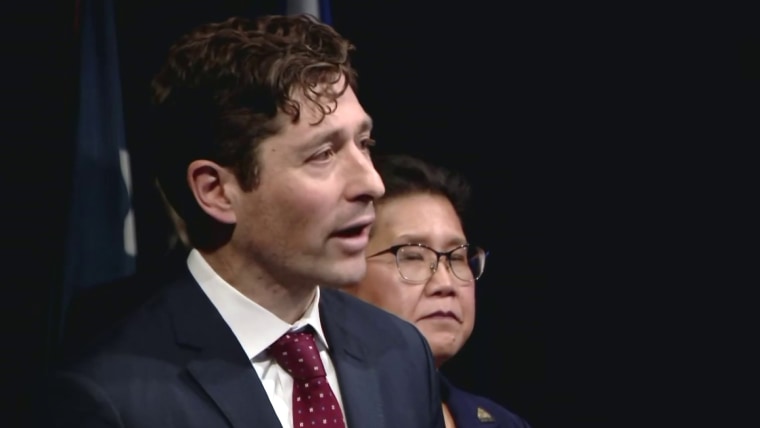
They want guardrails on immigration agents. The issue has risen to the fore ahead of a key Jan. 30 deadline after an ICE officer shot and killed an American woman in Minneapolis.
ICE officers question a man’s status on Lake Street near Karmel Mall in Minneapolis in 2025.Christopher Juhn / Anadolu via Getty Images file
WASHINGTON — Democrats are wrestling with whether to use a key Jan. 30 deadline to demand constraints on President Donald Trump’s immigration crackdown after an Immigration and Customs Enforcement officer shot and killed an American woman in Minneapolis.
Progressives in the House and Senate are calling on their party to hold firm in opposition to a funding bill for the Department of Homeland Security unless it comes with conditions — such as requiring agents to wear identification, limiting Customs and Border Protection agents to the border and requiring judicial warrants to arrest suspects in immigration cases.
They say Trump is using autocratic tactics by deploying masked agents in cities to intimidate Americans who don’t support him.
“Democrats cannot vote for a DHS budget that doesn’t restrain the growing lawlessness of this agency,” Sen. Chris Murphy, D-Conn., the top Democrat on the Appropriations subcommittee overseeing DHS, wrote on X after the Minneapolis shooting.
The Congressional Progressive Caucus announced Tuesday that its members have formally voted to oppose any bill to fund DHS “unless there are meaningful and significant reforms to immigration enforcement practices.”
The blowback from Democrats to the Minnesota ICE shooting, which Homeland Security Secretary Kristi Noem and the White House have defended, may pose a problem for Republicans in Congress who will need at least some Democratic votes to fund the government — including DHS — before Jan. 31 or risk a shutdown.
Democratic opposition has already frozen a DHS measure that was slated to be added to an appropriations package getting a Senate vote this week. Republicans control Congress and have largely stood by Trump on ICE deployments across the country, but such a bill requires 60 votes to pass the Senate.
Congress may have to fall back on a stopgap bill to prevent a funding lapse for DHS. That’s where things get trickier for Democrats. If House Republicans pass a continuing resolution on their own, which would keep DHS running on autopilot, Senate Democrats would again have to choose between accepting it and forcing a partial shutdown.
Senate Majority Leader John Thune, R-S.D., wouldn’t say whether he’s open to guardrails on immigration enforcement when asked Tuesday by NBC News.
But he called on Democrats not to allow another shutdown.
“I think government shutdowns are stupid. I don’t think anybody wins. I hope the Democrats share that view,” he said, while acknowledging that DHS funding is “the hardest one, and it’s possible that if we can’t get agreement, there could be some sort of a CR that funds some of these bills into next year.”
The record-long shutdown last fall, triggered over a health care dispute, yielded no concessions for Democrats. And unlike the Affordable Care Act, a winning issue for Democrats, some in the party are more leery of a standoff over immigration. The center-left group Third Way is encouraging Democrats to steer clear of reviving the “abolish ICE” discourse.
And some Democrats note that the $170 billion infusion of funding for immigration enforcement was approved by Republicans on a party-line basis in Trump’s “big, beautiful bill” last summer. That wouldn’t be affected even if DHS funding through the normal appropriations process expires.
One Democratic aide, discussing the sensitive topic on condition of anonymity, noted that a stopgap funding bill for DHS would provide fewer guardrails and more flexibility for Noem to move money around as she sees fit.
Senate Minority Leader Chuck Schumer, D-N.Y., sidestepped questions about whether he favors withholding DHS funding to slap restrictions on ICE, calling it “one of the major issues that appropriators are confronting right now.”
“The appropriators are working on that right now with the four corners and trying to come up with an agreement,” he said.
House Democrats’ strategy on ICE was a major topic of conversation during a closed-door party meeting Tuesday, according to attendees. But the conversation focused more on finding ways to hold the Trump administration accountable, other than withholding money for the agency.
One example of how they plan to do that: Democrats on the House Judiciary Committee will hold a field hearing in the Minneapolis area on Friday, where they plan to highlight the impact of ICE in the community.
“That was a big bulk of what we talked about,” said Rep. Becca Balint, D-Vt., who plans to attend the hearing. “The plea was to the caucus was that we have to hold people accountable. We have to do oversight when our colleagues won’t do it.”
Rep. Pramila Jayapal, D-Wash., the ranking member of the House Judiciary subcommittee overseeing immigration and former Progressive Caucus chair, said that if Democrats wait until next year, “a lot of people are going to die between now and then, because this is now a federalized military force that’s being unleashed.”
“Obviously, the Senate has more leverage than the House, but I do think it’s also critically important for us to be on the record against this amount of funding, number one, and funding without any accountability or guardrails,” she said. “So we have a list of guardrails that we have been working with our leadership and the Senate.”
House Minority Leader Hakeem Jeffries, D-N.Y., slammed ICE and Noem as “totally out of control” and in need of “commonsense” restraints that reflect law enforcement conduct.
“What’s in front of us right now is a spending bill that will go either one of two ways,” he told reporters. “Either Republicans will continue their ‘my way or the highway’ approach as it relates to the Homeland Security bill, and if that happens, then it’s going to be on them to figure out a path forward.”
Before the Minneapolis shooting, a national poll by The Associated Press found last month that just 38% of U.S. adults approve of Trump’s handling of immigration, while 60% disapprove.
A YouGov/Economist poll taken Jan. 9-12, after the Minneapolis shooting, found that 69% of American adults said they saw video of it, while another 22% said they had heard about it. Seventy-three percent said ICE agents should wear uniforms during arrests, and 56% said they shouldn’t be allowed to wear masks while arresting people. A plurality said ICE was making the U.S. “less safe.” And respondents said 46%-43% they support “abolishing ICE,” within the survey’s margin of error.
Warren was my preferred candidate in 2020. I would vote for her again if she runs. The country needs progressives who understand how hard it is for the average person in the US today. Due to the strangling of wages/ incomes for the majority and the increasing moving of all the countries wealth upward to the top few, people can not survive in this society. Hugs
Simply very bad news. Precisely what Project 2025/Agenda 47/Republican National Platform said they want to do. I’m sorry; I don’t like to bring bad news. But people need to prepare. This is written in editorial/opinion style, but facts are within and there are citations. For people like us who need time to prepare for austerity, it’s news we ought to read.
Also, there are Senator names included for who we should write to regarding this bill. That’s our last chance. Shutdown is on Republicans, not Democrats, no matter how they try to deflect. We need to tell the Dem senators to speak what’s in this bill, every chance they get, and to refuse to vote in favor, pointing at Republicans the entire time.
There are parts in the article complaining about Democrats and their choices, etc., et. m. Read it if you want (you’ll have to click through for it,) but it won’t help anyone to read more complaining about Democrats. We the people need to energize Dem. Senators to speak out, and to vote no. Especially the speak out portion; Sen. Mark Kelly does that especially well, and is among those the author of this piece feels is wavering. I intend to start first thing in the morning, and I hope all of us will devote some time to this. It’s vital.
Without the luxury of Republicans falling apart, Democrats in the Senate need to decide whether to prevent a dangerous and harmful budget that shrinks the power of Congress in the government. Since operating on principle goes against their “adults in the room” mindset, they are wavering on what to do. But it should be an open-and-shut case.
A normal continuing resolution funds the government at the same level as the previous budget. This bill does not. It cuts non-defense discretionary spending by $13 billion below last year’s level, while increasing military spending by $6 billion. It zeroes out funding for programs that fund homeless shelters and prevent child abuse. It cuts health care funding for clinics and hospitals, emergency preparedness for communities, clean water projects and tribal assistance. Meanwhile, it adds money for mass deportations, just as Immigrations and Customs Enforcement has illegally detained a green card holder for his political beliefs.
Most of the budget cuts are achieved by removing earmarks, which members of Congress put in to direct projects. But usually when earmarks are removed, the money goes back to the agency to decide how to distribute it. This maneuver cuts the earmarks and the money.
The House Republican bill also fails to fix a carryover of a $20 billion rescission to IRS money from the Inflation Reduction Act, effectively doubling that cut. This was kind of pre-ordained when Democrats punted on this in a prior continuing resolution last December, but it still means that practically all of the IRA’s funding for greater enforcement of tax collection is now gone.
The bill not only adds $6 billion to the Department of Defense’s enormous budget, but adds $8 billion in “transfer authority” that allows the agency to shift spending where they deem important, a flexibility no other agency gets.
While Republicans tout a $6 billion increase in veterans health care in the bill, they neglect to mention the removal of a $23 billion appropriation to the Toxic Exposure Fund to implement the PACT Act, which cares for veterans exposed to burn pits and other cancer-causing chemicals. While there’s an extra $2.2 billion for the Federal Emergency Management Agency’s disaster relief fund, there’s no additional money to support the rebuilding in southern California after the January wildfires.
But most important, the bill grants an open invitation to Trump and Elon Musk to continue to ignore Congress and toss out disfavored spending. Vice President JD Vance, while selling the deal to House Republicans, stated outright that “Trump would continue cutting federal funding with his Department of Government Efficiency initiative and pursue impoundment — that is, holding back money appropriated by Congress.” This has been reiterated by others in the Trump administration.
In fact, the House Republican bill gives the president more leeway to move money around. It appropriates money for things that Musk has eliminated, meaning that money can operate as a floating slush fund for Trump’s priorities, as long as the courts don’t roll back the illegal impoundments.
… The Trump administration is saying that they will sign a bill appropriating specific funding, and then go about cutting funding anyway. If you’re a member of Congress, you’re being told that your work product doesn’t matter, that the constitutional power of the purse doesn’t matter, and that there’s no guarantee that anything you pass will actually reach the people you serve.
I can see why Republicans would take this deal: they want budget cuts but know they don’t have the votes for them, so they’re plenty happy to outsource that to the president, even if it turns Congress into a separate and unequal branch of government. But why would Democrats willingly submit to a fake budget on paper that can be so easily circumvented? As Rep. Greg Casar (D-TX), chair of the Congressional Progressive Caucus, said on X, “The Republican spending plan will supercharge Musk’s theft from working people to pay for billionaire tax cuts. Senate Democrats must stop it.”
…
So far, only Sen. John Fetterman (D-PA) has committed to voting yes. But as Josh Marshall has documented at Talking Points Memo, a number of Senate Democrats have stated no position on the bill, leaving their options open. In general, senators have been hedging their bets until forced to make a decision. That time has come.
Credible sources indicate that the most likely Democrats to offer up the remaining seven votes to avoid a shutdown are Mark Kelly (D-AZ), Ruben Gallego (D-AZ), Michael Bennet (D-CO), John Hickenlooper (D-CO), Jon Ossoff (D-GA), Gary Peters (D-MI), Elissa Slotkin (D-MI), Maggie Hassan (D-NH), and Mark Warner (D-VA).




 Scottie's Playtime