He has additionally espoused a view of the United States as a white, Christian nation, claiming that white people are undergoing a “cultural genocide” and deliberate replacement.
Multiple Trump nominees have had histories of racist, violent, white supremacist, and even pro-Nazi tweets. But almost all of them still end up being confirmed by Senate Republicans.
NPR identified more than a dozen files released by the DOJ on Friday that are no longer available Saturday afternoon, including one that shows President Trump’s photo on a desk among several other photographs. The removed files also show various works of art, including those containing nudity.
A video posted to Instagram by the University of South Florida’s Muslim Student Association (MSA) shows three men interrupting students during their morning prayer, spitting and yelling at them, and waving strips of bacon at them. USF said that their police department is currently gathering evidence and anticipates asking the state attorney to bring criminal charges.
Last Tuesday morning, Nov. 18, several MSA members gathered on top of a parking garage on USF’s Tampa campus for Fajr, Islam’s morning prayer. A livestream by Warriors for Christ—an organization recognized by the SPLC as a hate group—shows Muslim students kneeling in prayer as one of the men, identified in the video only as Ricardo, approaches with a painted cardboard box that reads “KAABA 2.0 JESUS IS LORD.” The Kaaba is a stone building at the center of the holiest site in Islam. While praying, Muslims face the geographical direction of the Kaaba.
The man sets up the box in front of the crowd while two other men, identifiable via their social medias (where they posted the video along with many other similar videos at other locations) as Richard Penkoski of Oklahoma and Christopher Svochak of Illinois, start to “insult” the Muslim prophet, Muhammad, in obscene and sexual ways. One of the men calls them all terrorists. “Go back to Mecca,” he shouts.
At one point, Penkoski brings out a small Wawa container with bacon in it and waves it around while snacking from it.
“We do care about you, so we brought you some bacon,” Penkoski says. “It’s really good. Bacon? Bacon? Anybody?”
Like all pork products, bacon is considered haram, meaning Islam’s rules forbid eating it. All of the students remain kneeling and continue on with their prayer.
“I spit on the grave of Muhammad,” the man identified as Ricardo says before spitting on the ground within a few feet of the students, who are still praying on the ground.
“Take that towel off of your head,” he says, pointing to a woman in the back wearing a religious head covering. At this point, after several minutes of the men shouting at the largely silent students, Ricardo lunges towards a student and points his finger in his face, prompting the student to briefly grab his wrist. Immediately, all three Christian men say this is evidence that Islam is a violent religion.
“This is not how you preach,” one of the students can be heard saying. “Brother, you’re harassing us,” he says to Penkoski.
“You’re not my brother,” Penkoski responds. “This isn’t harassment; this is free speech. But thank you for doing what you did to give us more ammo to prove you’re a bunch of violent psychopaths.”
The video continues like this until the students leave and the Christian content creators do the same. “That was awesome. That was fun,” one of the men can be heard saying as they walk away.
“By the way, don’t ever spit on the ground. It’s actually illegal,” one of the Christians says to the man identified as Ricardo. “What? Spitting on the ground?” “Yes, it’s illegal.” “Well, uh, I didn’t know that.”
Penkoski later posted a screenshot from the MSA group chat, in which one member gives an update on legal proceedings with the state attorney’s office.
“It’s not a hate crime,” Penkoski writes in the caption. “For a ‘hate crime’ to exist, there has to be an actual crime first.”
Florida Statute 871.01, which makes disrupting religious assembly a crime, reads: “Whoever willfully and maliciously interrupts or disturbs any school or any assembly of people met for the worship of God, … commits a misdemeanor of the first degree.” In Florida, a first-degree misdemeanor is punishable by up to a $1,000 fine and one year in prison.
Florida Statute 775.085 contains rules for hate crime enhancement when there is evidenced prejudice against “race, color, ancestry, ethnicity, religion, sexual orientation, national origin, homeless status, or advanced age of the victim.” This bumps first-degree misdemeanors up to third-degree felonies. Third-degree felonies are punishable by up to $5,000 in fines and five years in prison.
Florida Statute 784.0493 deals with harassment based on religious or ethnic heritage. It makes it illegal (first-degree misdemeanor) to “willfully and maliciously harass or intimidate another person based on the person’s wearing or displaying of any indicia relating to any religious or ethnic heritage.”
The man, identified as Ricardo repeatedly told two women with religious head coverings to “get that towel off your head,” and called one a “wicked woman” and a “Jezebel dog.”
As the men left the parking garage, Svochak spoke to the camera, saying Jesus helped him and Penkoski beat drug addiction.
“What did he save you from?” Penkoski asks Ricardo. “I used to be a heathen,” Ricardo replies.
The state attorney typically decides what initial charges to bring. The 13th Circuit State Attorney’s Office has plans to speak with Creative Loafing Tampa Bay this morning, but as a policy it waits to start a case until police send investigative information along.
A statement issued by USF says that campus police are still trying to identify the men in the video. USF also said that it has reached out to the affected students, and will issue trespass warnings to the men who interrupted the prayer. They anticipate referring the perpetrators to the state attorney for criminal charges.
This wouldn’t be the first time Penkoski found himself in court over a stunt. The Christian content creator takes videos of himself and others “street preaching,” often insulting and demeaning nearby targets. Penkoski uploads the videos to his social media accounts and makes other targeted posts and includes a donation link through a Venmo account under his wife’s name.
In 2022, Penkoski was accused of targeting two leaders of Oklahoma for Equality, who later filed for a protective order against him. They were granted the protective order, but it was overturned on appeal by the Oklahoma Supreme Court in a 5-4 decision, since Penkoski was targeting organizations rather than individuals.
Penkoski has also been the plaintiff in several legal battles, including an attempt to overturn federal marriage equality for gay couples, a suit against the mayor of Washington D.C. for allowing a “Black Lives Matter” mural, and a lawsuit against a school district that sent his daughter home for wearing a shirt that said “homosexuality is a sin.”
Svochak gave this reporter a statement about his religious beliefs over Instagram DM, but would not answer specific questions. Svochak, who is affiliated with the recognized hate group Warriors for Christ, said that he is trying to spread Jesus’ message of love.
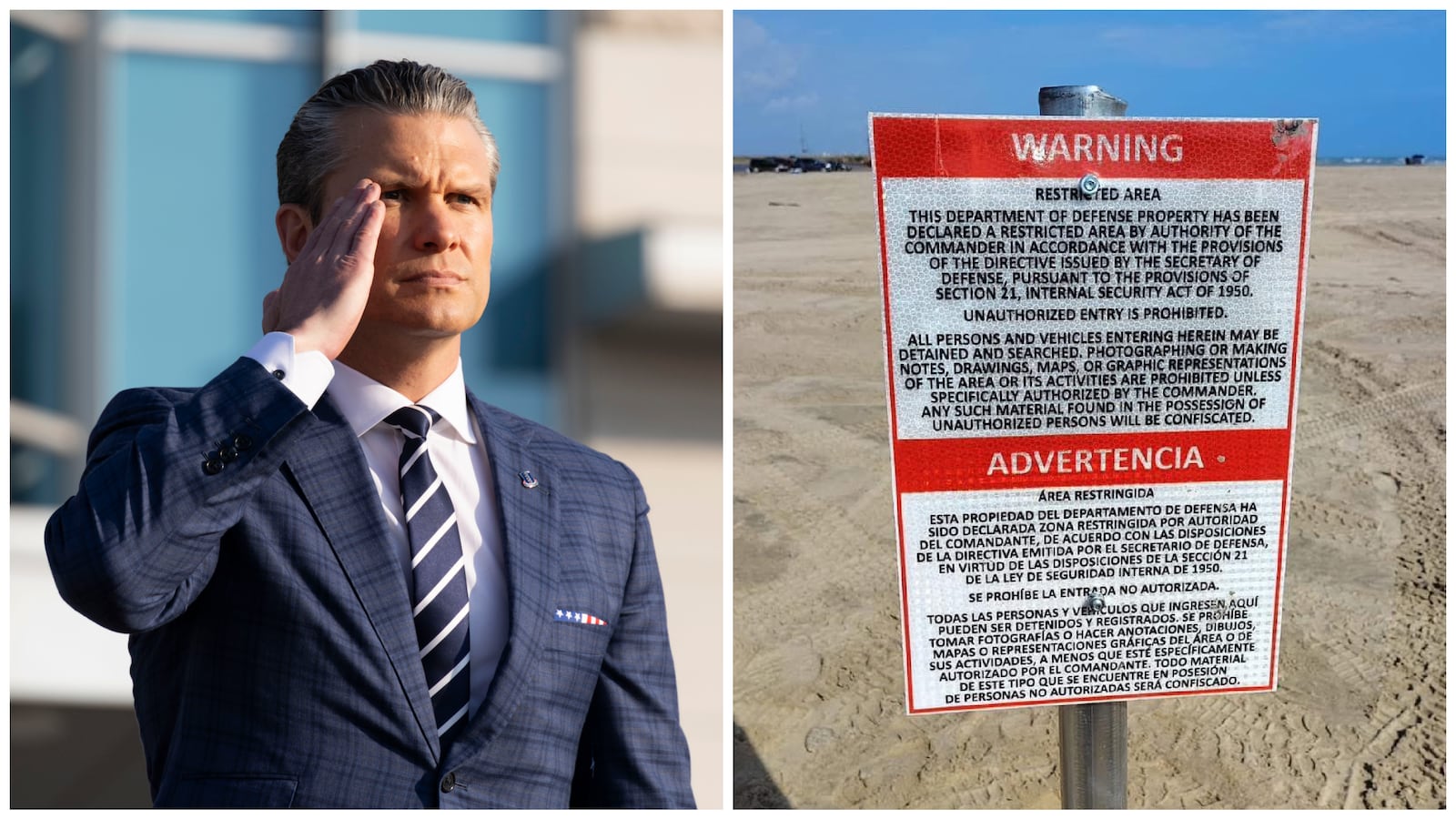
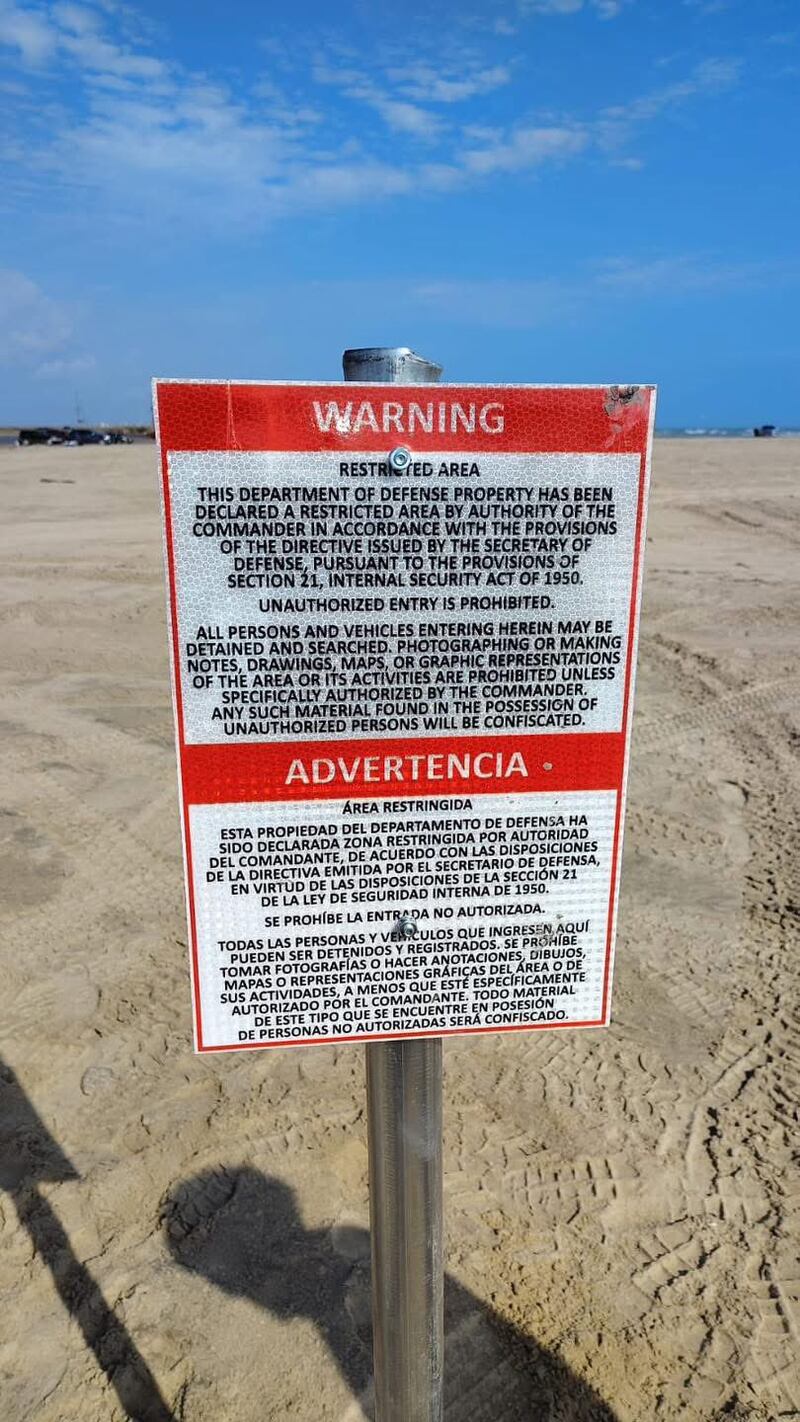
Department of Defense “contractors” landed on a Mexican beach and accidentally declared it United States territory in a bizarre incident on Monday.
A group of unidentified men hammered six signs into a beach near Playa Bagdad in Northeast Mexico on Nov. 17. The signs declared that the area was “Department of Defense property” and had been classified as a “restricted area” by “the commander.” The area is roughly twelve miles south of the U.S.-Mexico border.
Heavily armed Mexican Navy personnel came to investigate the scene and discovered that the men had landed in Mexico by mistake and intended to plant the signs in South Texas. The situation was resolved without violence, and the Mexican Navy removed the signs. Pictures and videos of the incident circulated on social media over the following days.
The sign U.S. contractors were placing on Mexican soil.X / @MORRIS80766176
The accidental annexers were later identified by the Pentagon as “contractors” hired by the Department of Defense to plant the signs on the Texas side of the border to mark “National Defense Area III.” The Pentagon has been installing a series of “National Defense Areas” in 2025 to tighten control of the U.S.-Mexico border.
“Changes in water depth and topography altered the perception of the international boundary’s location,” said the Pentagon in a statement. “Government of Mexico personnel removed six signs based on their perception of the international boundary’s location.”
The statement added that the contractors will “coordinate with appropriate agencies to avoid confusion in the future.”
The Mexican government has begun investigating the incident.
“The Mexican Section of the International Boundary and Water Commission (CILA) will begin technical consultations to fully clarify the incident and will review the maps and instruments that mark the border between both countries, as established by existing boundary and water treaties.”
Armed members of the Mexican Navy arrived to investigate the U.S.’s accidental invasion of Mexico.X /MORRIS80766176
“Would I want strikes in Mexico to stop drugs? OK with me, whatever we have to do to stop drugs,” he said in an appearance alongside FIFA President Gianni Infantino.
Mexican President Claudia Sheinbaum rejected that notion at her Tuesday press briefing, saying it’s “not going to happen.” She also addressed the accidental invasion, saying the International Boundary and Water Commission (IBWC), a binational agency overseeing the U.S.-Mexico border, would get involved in the dispute.
“The river changes its course, it breaks loose, and according to the treaty, you have to clearly demarcate the national border,” she said.
Sheinbaum was referring to the Rio Grande River, which marks the U.S.-Mexican border, per the 1848 Treaty of Guadalupe Hidalgo. The IBWC has had to negotiate additional treaties to mark the border in the years since, as the river has naturally shifted over nearly two centuries. The latest treaty on record was signed in 1970.
U.S. troops’ declaration of a Mexican beach property of the Department of Defense violated that treaty.
The Pentagon, IBWC, and U.S. Embassy in Mexico did not immediately respond to requests for comment.
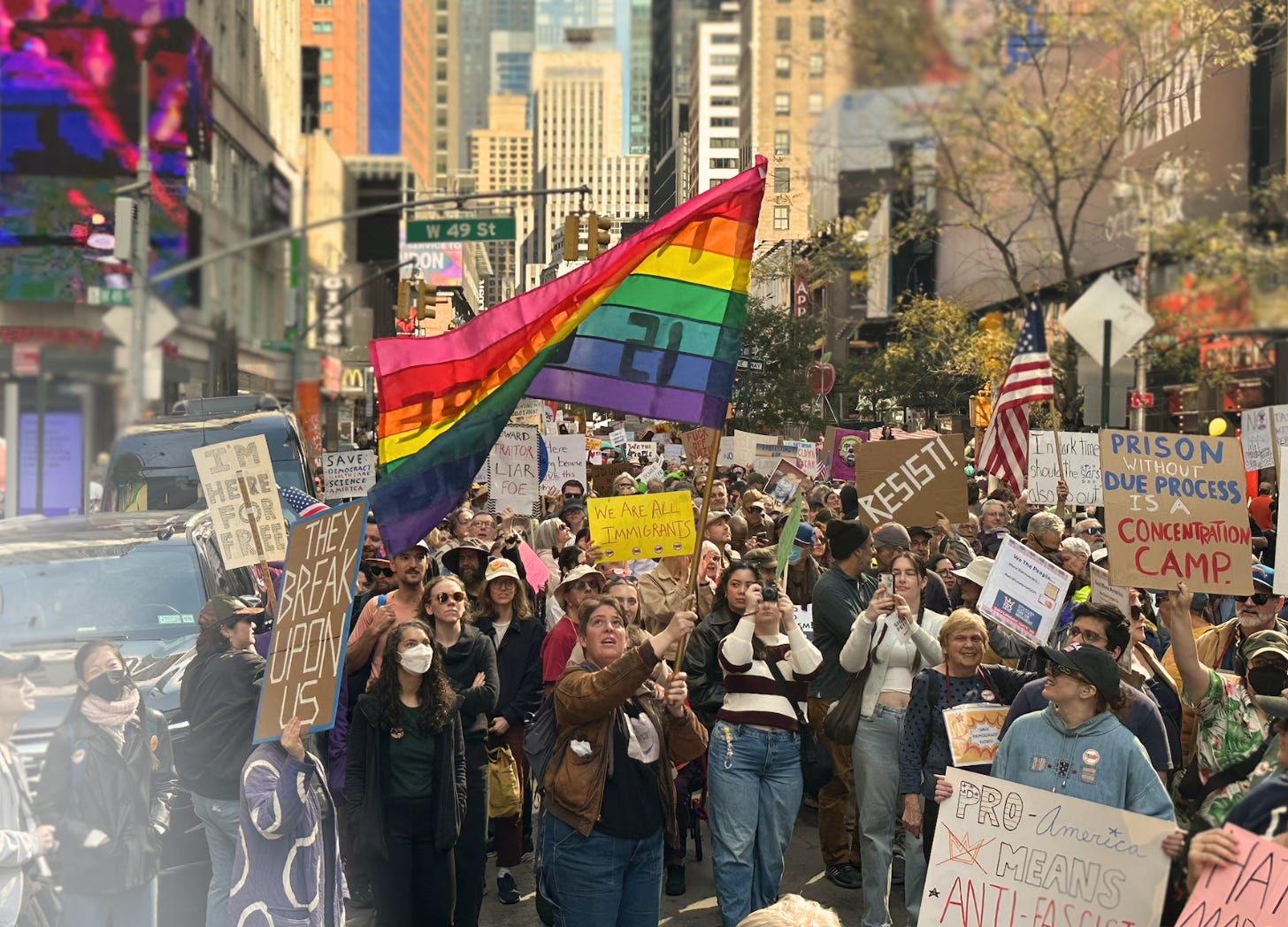
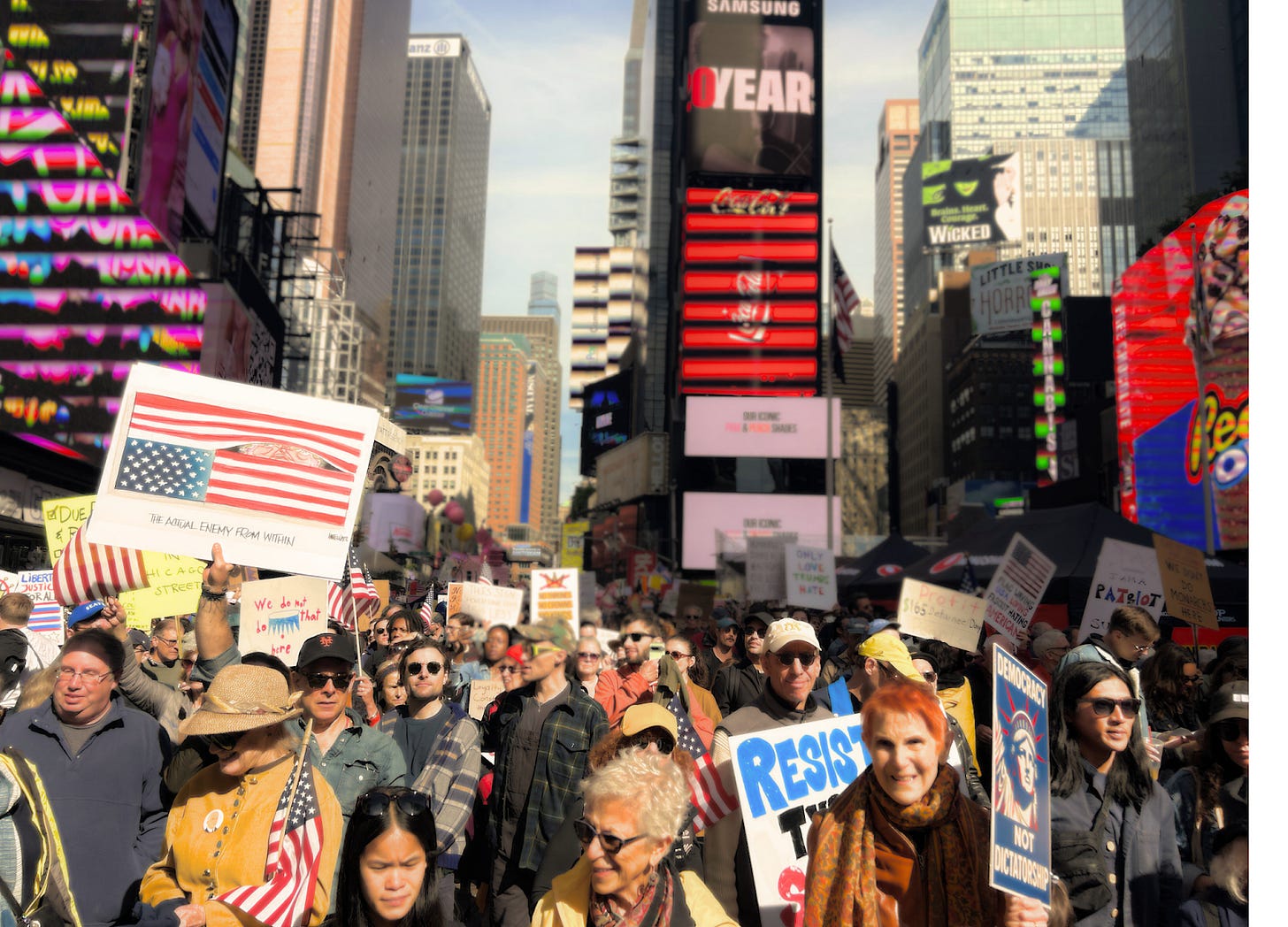
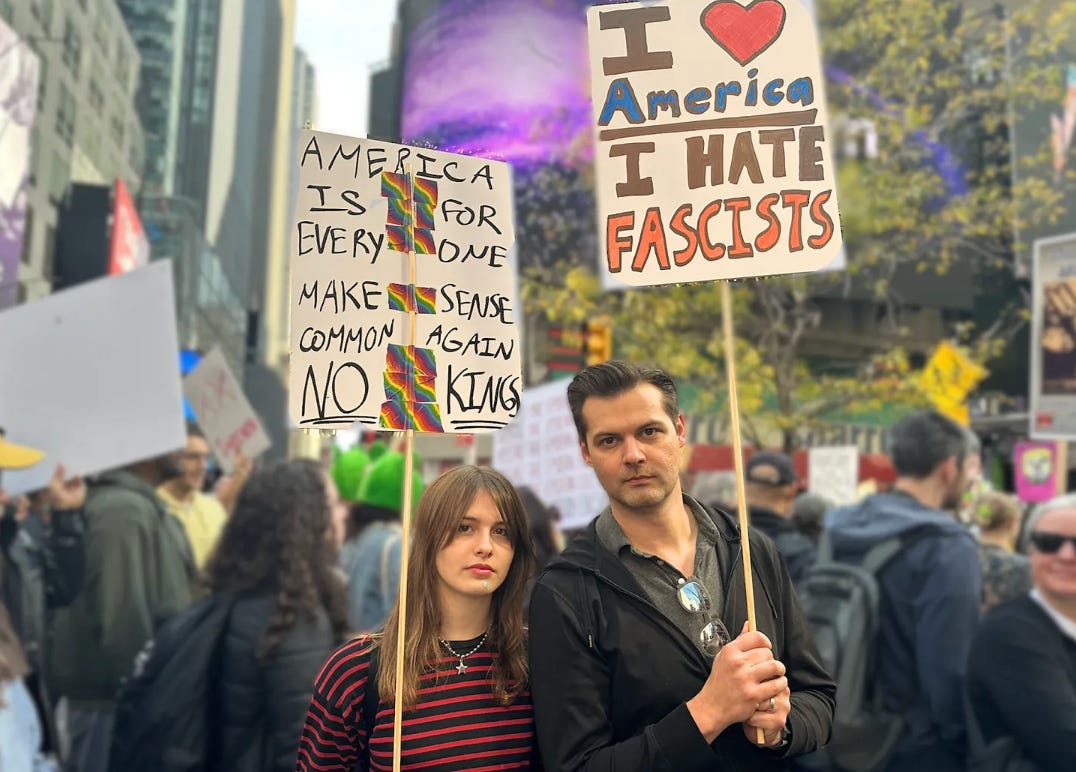
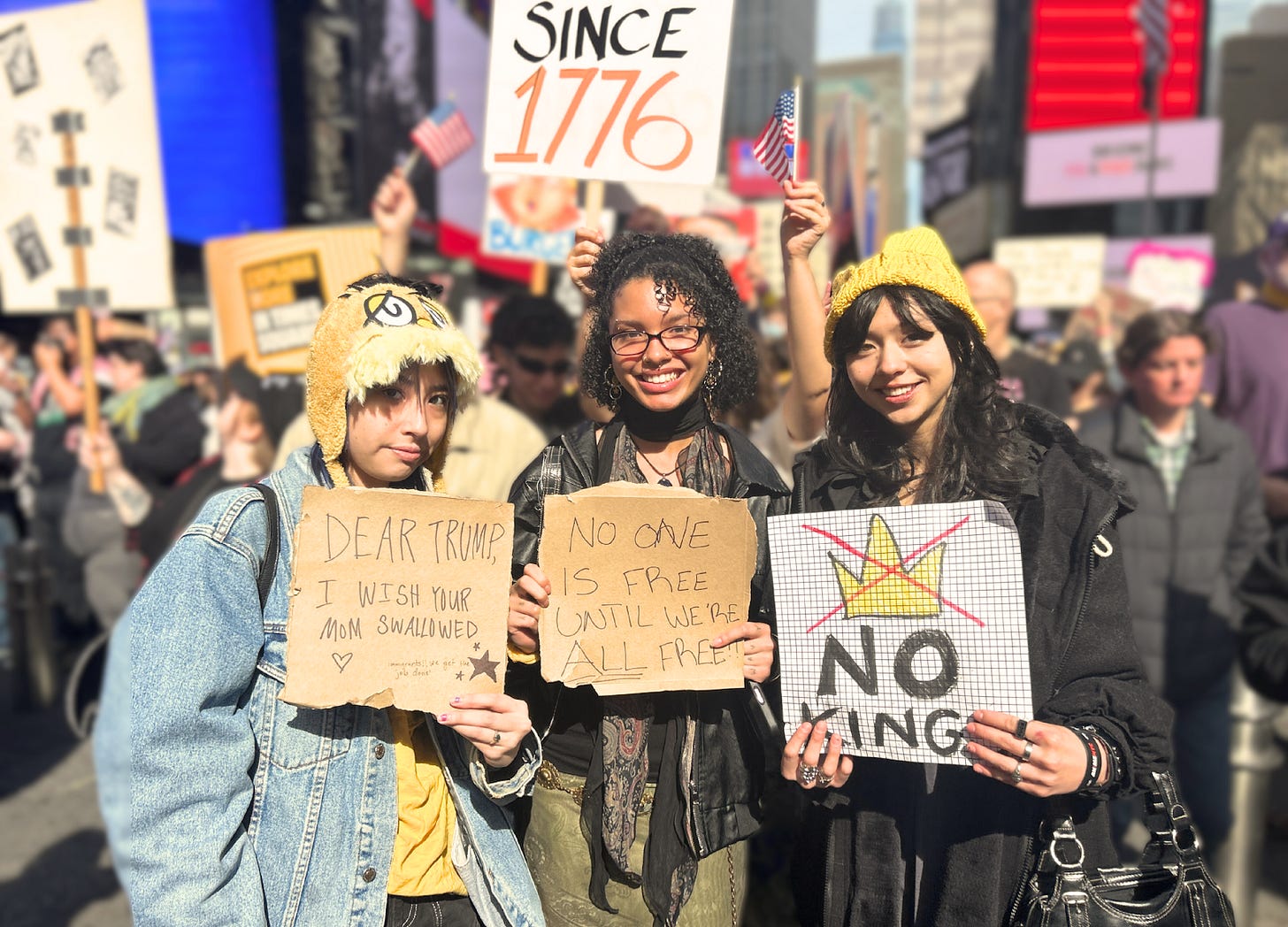
“Hey hey, ho ho, Donald Trump has got to go,” protestors chanted in the middle of Times Square, among a sea of signs that read “love reigns not kings,” “gays against faux-king Trump,” “we stand with … our trans family” and “the future is coming.”
On Saturday, independent analysts estimated that the No Kings March drew between 5 and 8 million people, and organizers say over 7 million people attended 2,700 events across all 50 states. The event, which was organized to push against the rise of authoritarianism in the U.S., was the largest single-day protest in America since 1970.
Over 100,000 New Yorkers marched in all five boroughs in NYC on Saturday. Photo by Jelinda Montes.
Among the crowd were countless LGBTQ people, fighting back against an administration that has introduced a litany of anti-LGBTQ executive orders and used vile rhetoric to denigrate queer people. This backsliding of LGBTQ rights, according to experts, has a deep connection to authoritarianism, with research showing that when governments weaken protections for queer and trans people, they often turn to broader democratic institutions next.
“Threats to democratic institutions and threats to LGBTQ rights are mutually reinforcing, generating a vicious cycle that strengthens authoritarian control,” Ari Shaw, director of International Programs at the Williams Institute, told Uncloseted Media. “Increased persecution of minority groups, including LGBTI people, is itself evidence of democratic backsliding by indicating the erosion of liberal democratic norms [meant to protect] minority rights.”
Legal Abuse of Power
One of the ways the Trump administration’s abuse of power has been most evident is through its legal actions.
He’s also slashed HIV funding at a staggering rate. Uncloseted Media estimates that the National Institutes of Health has terminated more than $1 billion worth of grants to HIV-related research, including 71% of all global HIV grants.
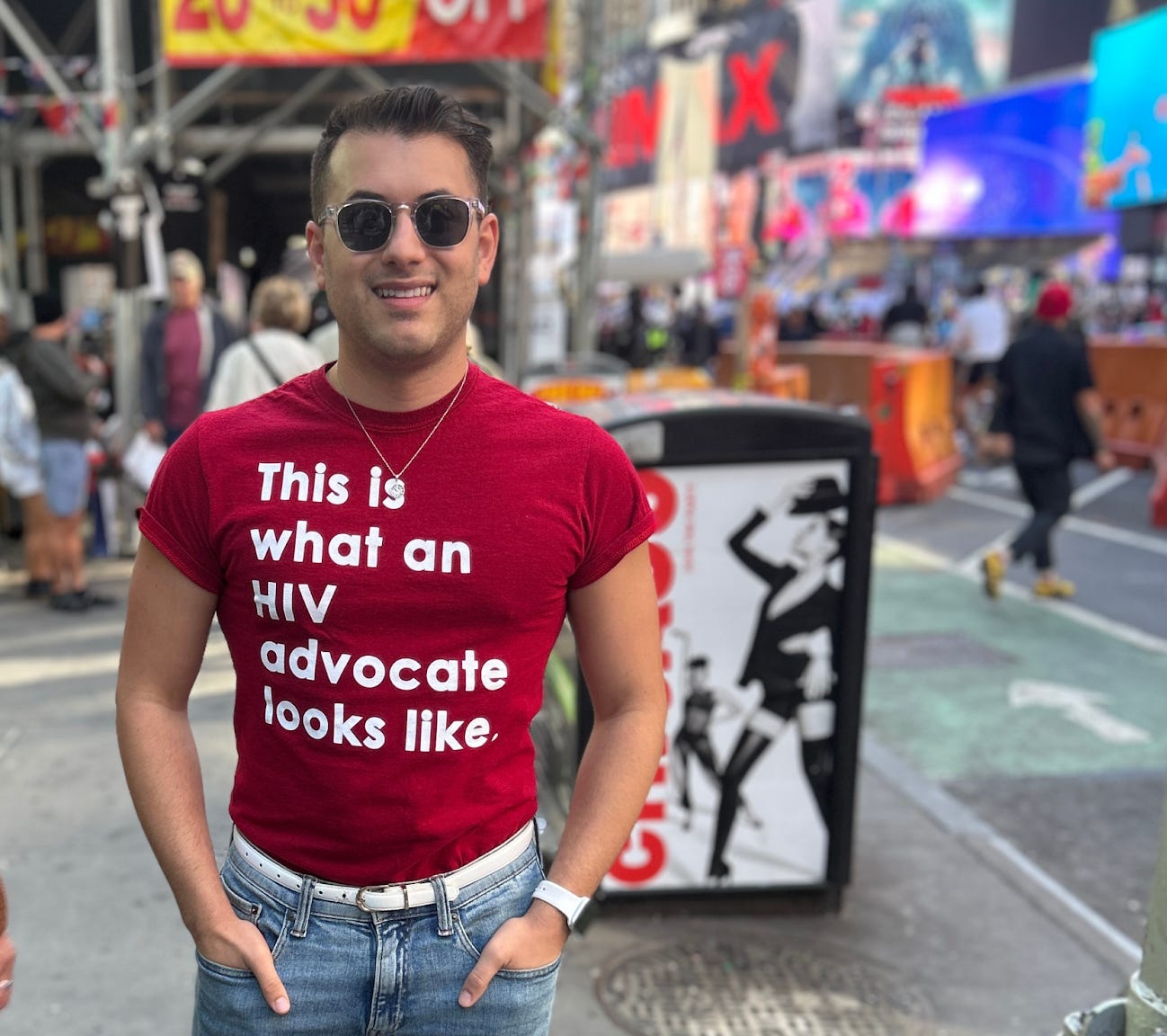
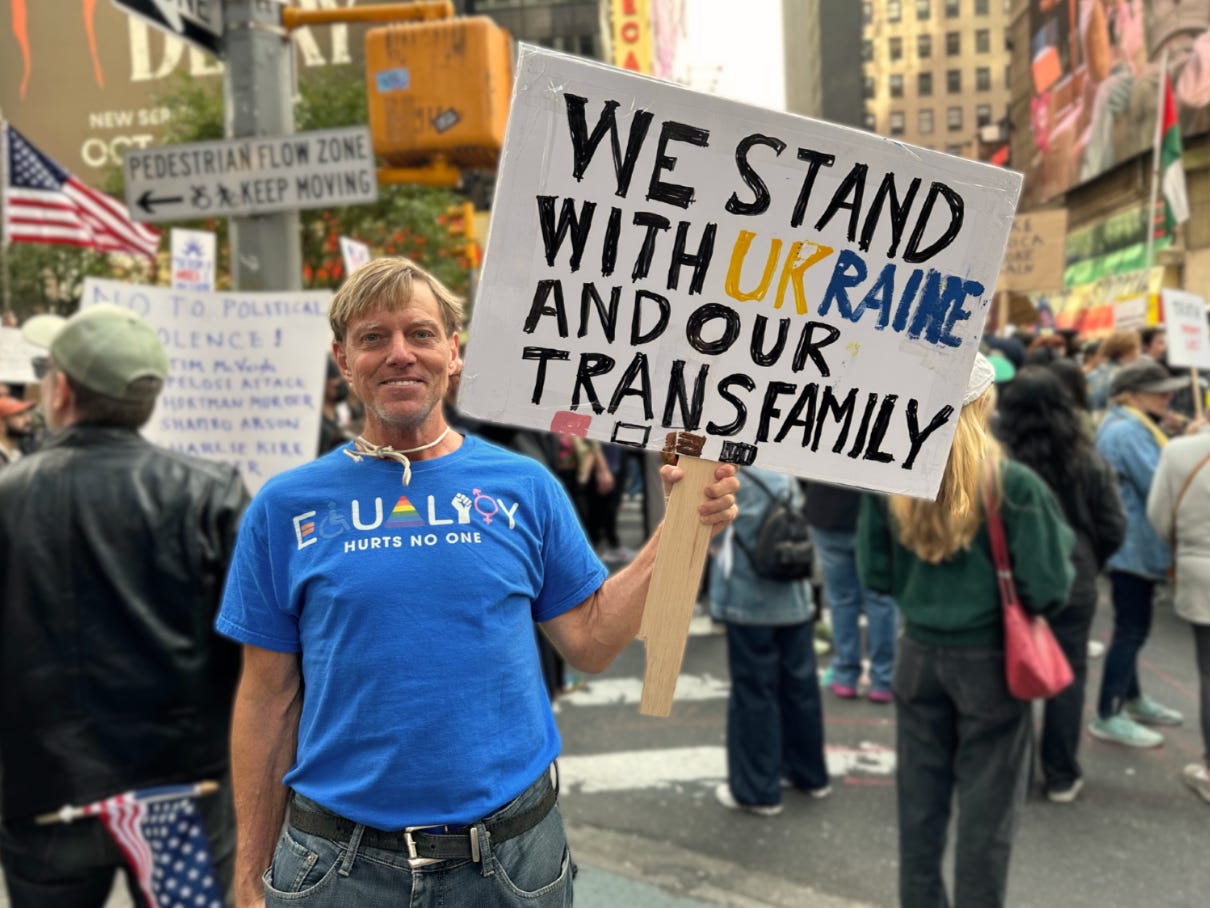
Jeffrey Cipriano at the NYC No Kings protest Saturday. Photo by Jelinda Montes.
It was these cuts that prompted Brooklynite Jeffrey Cipriano to turn out to protest. “The specific reason that I’m protesting is actually on the shirt I’m wearing,” says Cipriano.
“My best friend works for an organization called AIDS United. … His job is to travel the country and help people get AIDS medication, specifically trans and unhoused community members. But his job is at risk,” he says. “The end outcome of his work is that people who have issues in their lives have the issues resolved and that’s going away under the current administration.”
Executive orders are based on powers granted to the president by the U.S. Constitution or by Congressional statutes. The president cannot use an executive order to create new laws or spend money unless Congress has authorized it. They are meant to direct how existing laws are implemented. But Trump has ignored democratic norms, often filling agencies with loyal supporters, using orders to go after political opponents and pushing the limits of what the law allows.
In some cases, he has moved illegally. “The President is directing various executive branch officials to adopt policy that has either not yet been adopted by Congress or is in violation of existing statutory law,” says Jodi Short, professor of law at UC Law San Francisco. “The analogy to a king and what has troubled many about this presidency is the sheer consolidation of executive branch power in one individual.”
Short’s colleague, Dave Owen, agrees. “Illegality has been rampant,” he told Uncloseted Media in an email. “People are often cynical about the government, and they might think what Trump’s doing is nothing new. But most of the time, the executive branch takes the law seriously, and both legal constraints and norms of good governance matter,” he wrote. He says that through history, there’s been “a lot more integrity and a lot less lawlessness than most people realize.”
“This administration has broken with those traditions,” he adds.
Revolt Against Executive Orders
Many Americans have recognized this. A survey from April found that 85% of Americans agreed or strongly agreed that the president should obey federal court rulings even if he doesn’t like them.
In response to Trump’s overreach, more than 460 legal challenges have been filed across the country challenging his executive actions. One of these is a federal lawsuit by Lambda Legal and the Human Rights Campaign Foundation that challenges the constitutionality of the Trump administration’s ban on military service by transgender people. Another lawsuit challenges Trump’s order directing federal agencies to withhold funds from medical providers and institutions that provide gender-affirming medical treatments for people under 19.
Zoe Boik and her father, Derik, protesting on Saturday. Photo by Sean Robinson.
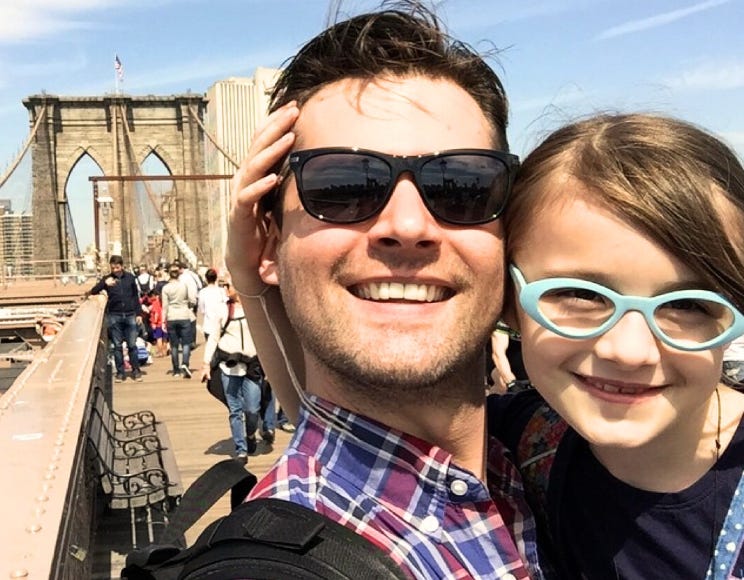
Both of those lawsuits are one reason 17-year-old Zoe Boik came out to protest with her friends and her dad. “Obviously, I’m disappointed and kind of helpless because there’s nothing I can directly do to change or impact anything that’s going on,” says Boik, who identifies as pansexual and gender fluid and is not legally allowed to vote.
Boik—who was seven years old when Trump announced his run for presidency in 2015—says she’s doing a research paper on Trump’s trans military ban and is frustrated because she sees it as inexplicable discrimination. “They’re not letting trans people serve … which doesn’t make any sense.”
Zoe as a child with her dad, Derik. Photo courtesy of Boik.
LGBTQ Rights and Democratic Backsliding
This type of blatant discrimination is often a key sign of a country moving closer to authoritarianism and away from democracy. According to a 2023 research paper by Shaw and his colleagues, anti-LGBTQ stigma may contribute “to the erosion of democratic norms and institutions.”
The paper found that when a country with relatively high acceptance of LGBTQ rights introduces anti-LGBTQ legislation, it clashes with what most people believe and can weaken public trust in democracy, deepen political divides and make it easier for populist or extremist movements to gain power.
“The level of acceptance of LGBTQ people is closely associated with the strength of democracy in a country,” Shaw says. “In some cases, we even saw that rising anti-LGBTQ rhetoric or policies preceded a broader decline in democracy.”
In Brazil, for example, early democratic gains coincided with rising LGBTQ acceptance, including legal recognition of same-sex unions and workplace protections. But as populist President Jair Bolsonaro came into power in 2019, he began questioning—without evidence—the security of Brazil’s voting systems, saying he would only lose his re-election campaign if there were fraud. He was also accused of trying to intervene in operations held by the Federal Police about the alleged criminal conduct of his sons, and he told his ministers that he had the power and he would interfere—without exception—in all cabinet ministries. At the same time, LGBTQ protections were rolled back, and schools and civil society faced censorship, suggesting that falling LGBTQ acceptance may have “preceded Brazil’s democratic erosion,” according to Shaw’s paper. In September of this year, Bolsonaro was sentenced to 27 years in prison for plotting a military coup.
Another example is Poland’s democracy weakening since 2015 under the Law and Justice Party, which consolidated power by undermining the Constitutional Tribunal, installing loyal judges and restricting independent media. Anti-LGBTQ rhetoric became central to the party’s nationalist platform, fueling the creation of nearly 100 “LGBT ideology free zones,” inciting violence against LGBTQ individuals and stymying legal recourse through politicized courts.
When it comes to LGBTQ rights, Trump has mimicked the moves of these leaders even though most of his constituents don’t want it: A 2022 survey from the Public Religion Research Institute found that 80% of Americans favor laws that would protect LGBTQ people against discrimination.
“The definition of an authoritarian system is a system where power is consolidated in one individual whose power is unchecked by any other institution. And I fear that in certain domains, that’s the direction in which this administration is trying to move us,” says Short. “I think it’s incredibly dangerous.”
Attacks on Higher Education
Another common tool in the authoritarian playbook is attacking higher education.
While many universities are rejecting Trump’s demands, others are experiencing a chilling effect, changing their policies before the administration tries to hold up funds.
James Revson, Maddy Everlith and Shay Wingate holding their signs at the No Kings protest. Photo by Jelinda Montes.
“I’m here because I’m angry and I feel that we aren’t angry enough,” Maddy Everlith, a sophomore gender studies major at Pace University, told Uncloseted Media as she marched with her friends. “Being a woman of color in America and having so many intersectional identities is also what affects me. … I want to stand up and advocate for other people.”
Everlith’s university responded to Trump’s threats in September by renaming its DEI office to the “Division of Opportunity and Institutional Excellence.”
“I am beyond horrified how quickly our university was willing to bend the knee on this decision,” Austin Chappelle, a senior at Pace, told the student newspaper. This change comes in the midst of uncertainty under the Trump administration, which has already caused many LGBTQ students to feel uneasy on campus.
“It’s part of an electoral strategy to try to mobilize right-wing voters to distract from other sorts of political or economic scandals,” Shaw says, adding that this tactic is another way to gain power.
Lars Kindem protesting for his trans sister at the No Kings protest. Photo by Sean Robinson.
The pain of this rhetoric has affected millions of trans Americans and allies alike, including Lars Kindem, a 64-year-old retired pilot from Minnesota who was marching to support his transgender sister.
“What Trump has done is he’s taken people that haven’t done anything wrong and has turned them into scapegoats,” he says, adding that Trump’s language is “hateful, petty, mean and hurtful.”
He says his sister and her partner are having issues getting the correct gender markers issued on their passports. Because of the Trump administration’s treatment of the community, they are making plans to move to Denmark, where “there’s a lot more acceptance.”
Christian Nationalism
This scapegoating has played into the hands of Trump’s voter base of white evangelical Protestants, the only major Christian denomination in the U.S. in which a majority believes society has gone too far in accepting transgender people.
Since 2020, Trump has increasingly embraced Christian nationalism in his rhetoric and imagery. He’s sold Bibles, created a federal task force on anti-Christian bias and been intrinsically linked to Project 2025, the 920-page plan calling for the establishment of a government imbued with “biblical principles” and run by a president who holds sweeping executive powers.
Experts say that “a strong authoritarian streak” runs through conservative Christianity. A 2023 study found that supporters of Christian nationalism tend to support obedience to authority and the idea of authoritarian leaders who are willing to break the rules. Nearly half of Christian nationalists support the notion of an authoritarian leader.
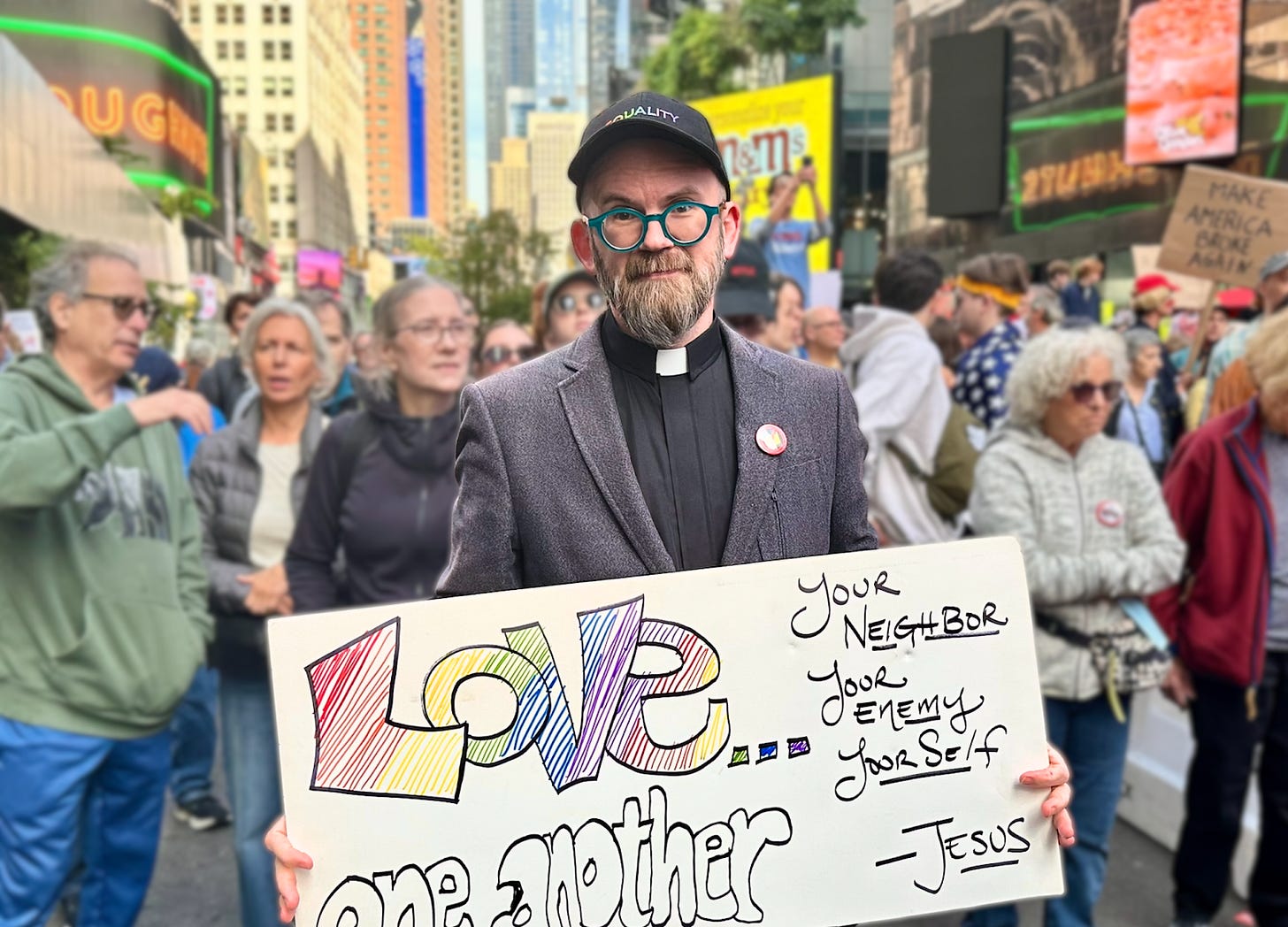
“They are trying to use the language of Christianity, but they are abusing it and misusing it constantly,” Rev. Chris Shelton, a gay pastor at the protest, told Uncloseted Media. “Our faith is all about reaching out to the marginalized, reaching out to the people who are ostracized by society and embracing them and offering love and welcome and a sense of dignity and worth. And to see any human being’s worth being denied is just a mockery of our faith.”
Rev. Chris Shelton marched in Saturday’s NYC protest. Photo by Sean Robinson.
Heidi Beirich, the vice president and co-founder of the Global Project Against Hate and Extremism, says that “the LGBTQ community is the prime target of modern authoritarian regimes.”
“For Christian nationalists, attacking LGBTQ rights is the first pillar in destroying civil rights for all. This has happened in countries like Hungary and Poland as authoritarianism consolidated and now it’s happening here,” Beirich told Uncloseted Media.
Moving Forward
As the country bleeds toward authoritarianism, LGBTQ protestors are encouraging people to use their voice, something the queer community is familiar with doing: One 2012 survey found that queer folks are 20 times more likely to be active in liberal social movements than their straight, cis counterparts.
“It is imperative that people continue to pay attention,” Short says. “There is so much going on, a lot of it is disturbing and intense, and there’s such a strong impulse to look away. But we have to engage in political action and resist inappropriate assertions of authority and continue to show up and vote for our democracy.”
17-year-old Zoe Boik is ready. She remembers being in second grade and crying the day after Trump won his first election in 2016. She couldn’t believe how he could lead the country despite “all the bad things he said.”
Boik can’t wait until the midterm elections, when she will be 18 and finally able to vote. “If we don’t vote, then our voices won’t be heard,” she says.
Despite this, she’s also concerned about her freedom to exercise that right being jeopardized.
“My fears about Trump don’t stem specifically from me being queer, but from his authoritarianism as a whole,” she says. “I am scared about how far he will move into dictatorship, [and] my biggest fear is that our right to vote will be compromised, leaving us no recourse.”
If objective, nonpartisan, rigorous, LGBTQ-focused journalism is important to you, please consider making a tax-deductible donation through our fiscal sponsor, Resource Impact, by clicking this button:
Uthmeier focused on how he’s working to ensure that concerned parents can continue their “movement … based on faith, based on family, ensuring that we have the freedom to raise our kids in God’s image.”
“I’m about eight months on the job now as Attorney General, and as I tell my team every day, our No. 1 priority is, and will always be, protecting our kids. There’s a lot of evil out there. There’s a lot of evil, a lot of danger. There will always be crime, no matter how much we fight it. But our first priority must always be protecting our kids,” he said to applause.
Uthmeier went on to describe his Office’s legal actions against Target for its “transgender children’s clothing line” with “bras for little boys, some tuckable underwear.”
“Gross. Absolutely disgusting,” he said. “We’re going to hit them in their wallets.”
“Predators are all over that app, all the apps, but that one in particular. It’s their preferred vehicle to go after kids,” Uthmeier said.
“And they’re crafty, they’re smart, they’re patient. They’ll use fake pictures. They’ll talk in a dialect. They’ll get your kids to, you know, drop their guard. They’ll tap into their insecurities, and they’re willing to spend weeks or months to develop a relationship before they start soliciting information, soliciting photos, soliciting locations. And since we’ve sued them, we’ve made dozens of arrests of child predators that have gone after kids through this app.”
Uthmeier also described how his Office is able to enforce the law, including by serving as a “law firm for parents out there” who might be concerned by what school districts do.
“If you’re identifying one of these wrongs that’s violating your rights and that’s subjecting our kids to danger and evil, then we want to know about it, and we’re going to bring the heat in court to shut it down.”
The AG also quipped about a recent call to people to report their exes for immigration violations, noting one gender predominantly was dropping the dime on the other.
“Y’all ladies are savage, I’ve got to tell you. These calls come in and these ladies, I mean, they’ve got date of birth, nickname, frequented bars. I mean, all the details. So to the handful of men out there, treat your women right or they will absolutely get you.”
Participants in a World AIDS Day event light candles along a red ribbon. | Shutterstock
The U.S. government will no longer commemorate December 1 as World AIDS Day, the State Department recently notified its workers. The U.S. has commemorated the international observance annually since 1988, including every year of the current president’s first term.
An email to State Department workers notified employees and grant recipients not to publicly promote the day “through any communication channels, including social media, media engagements, speeches or other public-facing messaging” nor to use U.S. government funds towards any World AIDS Day observances, The New York Times reported.
The email said employees and grantees could still mention various anti-HIV programs and attend World AIDS Day events.
The email also reportedly said that the current U.S. government’s policy is “to refrain from messaging on any commemorative days, including World AIDS Day.” However, the current president has signed proclamations for various awareness days and other commemorative observances.
World AIDS Day is an international day for raising awareness about HIV/AIDS, remembering those who have died from it, and celebrating progress in prevention, treatment, and care. Two World Health Organization (WHO) public information officers started World AIDS Day in 1988 as a way to raise awareness about the global health challenge.
The current administration has drastically cut federal funding for HIV prevention worldwide. An estimated 127,073 adult and 13,527 infant deaths have been caused by the effects of HIV/AIDS due to the current president’s cuts in funding for the President’s Emergency Plan for AIDS Relief (PEPFAR), a program that has saved an estimated 25 to 26 million lives since its inception in 2003.
The State Department usually issues an annual PEPFAR report on World AIDS Day. It’s unclear if the department will do so this year.
Subscribe to the LGBTQ Nation newsletter and be the first to know about the latest headlines shaping LGBTQ+ communities worldwide.
Whistleblower Rutherford County Library Systems Director Luanne James claims the RCLS Board Chair, Cody York, instructed her to remove multiple books from the public library system without following the rules to do so.
James claimed York had checked out books he wanted banned and kept the books for so long they were marked as lost and then removed from the system. James also said York asked her to gather a list of library patrons’ personal information, including which books they checked out.
“Names of the patrons, their addresses, their ZIP codes, their barcodes, how many children and how many adults were in each household and what they were checking out,” James told the RCLS Board Monday night.
According to RCLS, James was appointed as the new Library Director, which went into effect on July 28. James claimed she was at her job for only two days before she was instructed to remove books.
During Monday’s meeting, York denied all James’ allegations and denied any wrongdoing, saying he requested patrons’ ZIP codes to see which patrons lived outside the county so they could pay an additional $25 fee to hold a library card. With regard to the missing books, York shifted the blame back to James.
“Does policy allow one board member or the chair to remove books?” York asked James during the board meeting.
“No,” James replied.
“So why did you do it [remove books]?” York said. “…I’m not denying that I told you these books should not be in the library, but I can’t make a decision to remove them — that’s your decision.”
A local advocacy group called the Rutherford County Library Alliance believes the following books listed are missing and had been removed from the library:
“Forever” by Judy Blume
“Over the River and Through the Wood: A Holiday Adventure” by Lisa Marie Francis Child
“The Antiracist Kid” by Tiffany Jewel
“Making a Baby” by Rachel Greener
News 2 hasn’t been able to independently confirm these specific titles are missing.
“If a librarian has put a book in our library, it’s because our community needs it, so by bypassing all of the professionals and saying, ‘Well, I don’t like it, so it should go because I don’t want my kid reading it,’ that goes against the First Amendment,” Keri Lambert, Vice President of the Rutherford County Library Alliance, told News 2.
“I believe it’s all driven by one motive only: to basically eliminate a certain class of people from the library collection as if they didn’t exist … To figuratively put them back in the closet, if you will,” Frank Lambert, a Library and Information Science Associate Professor at Middle Tennessee State University, told News 2.
News 2 reached out to Chair York, who responded with a statement:
“I categorically deny the allegations made against me last night.
The Rutherford County Library System has only two approved methods by which a title may be removed from the collection under our policies. Library staff may remove a title if it no longer meets the collection standard, such as relevance, condition, accuracy, or other established criteria, through the normal weeding process. A title may be removed by a vote of the Library Board, but only after the formal reconsideration process is completed. This process includes a written request, staff review, and a vote in an open public meeting.
Those are the only mechanisms permitted. No board member can direct the Executive Director to bypass either process. Raising questions about whether books in the collection meet our collection standards is not inappropriate.”
When News 2 reached out to the whistleblower, Luanne James, we received an Out of Office email, indicating she may still be employed by the library system.
Item 1 of 2 A general view on the Spasskaya tower of the Kremlin and St. Basil’s Cathedral in Moscow, Russia May 16, 2024. REUTERS/Maxim Shemetov
[2/2] The Russian flag flies on the dome of the Kremlin Senate building behind Spasskaya Tower in Moscow, Russia June 2, 2025. REUTERS/Evgenia Novozhenina
Summary
Kremlin praises US National Security Strategy
Kremlin says NATO statements are encouraging
Kremlin cautions that some in US will see it differently
MOSCOW, Dec 7 (Reuters) – The Kremlin on Sunday welcomed U.S. President Donald Trump’s new national security strategy and said it largely accorded with Russia’s own perceptions, the first time that Moscow has so fulsomely praised such a document from its former Cold War foe.
The U.S. National Security Strategy described Trump’s vision as one of “flexible realism” and argued that the U.S. should revive the 19th century Monroe Doctrine, which declared the Western Hemisphere to be Washington’s zone of influence.
The Reuters Daily Briefing newsletter provides all the news you need to start your day. Sign up here.
The strategy, signed by Trump, also warned that Europe faces “civilizational erasure”, that it was a “core” U.S. interest to negotiate an end to the war in Ukraine, and that Washington wanted to reestablish strategic stability with Russia.
“The adjustments that we see correspond in many ways to our vision,” Kremlin spokesman Dmitry Peskov told state television reporter Pavel Zarubin when asked about the new U.S. strategy.
Such fulsome public agreement between Moscow and Washington on the tectonic plates of global politics is rare, though they did cooperate closely after the 1991 fall of the Soviet Union on returning nuclear weapons from former Soviet republics to Russia, and after the deadly Sept. 11, 2001, attacks on the United States.
TRUMP’S STRATEGY LARGELY ACCORDS TO RUSSIA’S VIEW
During the Cold War, Moscow portrayed the United States as a decadent capitalist empire doomed by the historical certainties of Marxism, while U.S. Ronald Reagan in 1983 called the Soviet Union an “evil empire” and the “focus of evil in the modern world.”
After the Soviet collapse, Moscow expressed hopes for a partnership with the West but as Washington moved to support the enlargement of the NATO alliance, as outlined in President Bill Clinton’s 1994 strategy, tensions began to mount. They were pushed to breaking point under President Vladimir Putin, who rose to the top Kremlin job on the last day of 1999.
Asked about the pledge in the U.S. document to end “the perception, and preventing the reality, of the NATO military alliance as a perpetually expanding alliance”, the Kremlin’s Peskov said it was encouraging.
But Peskov also cautioned that what he said was the U.S. “deep state” saw the world differently to Trump, who has used the term to refer to an allegedly entrenched network of U.S. officials who seek to undermine those who challenge the status quo, including Trump himself.
Critics of Trump say there is no such thing as a “deep state,” and that Trump and his allies are trafficking in a conspiracy theory to justify an executive-branch power grab.
WASHINGTON AND MOSCOW LOOK TO CHINA
Since Russia’s 2014 annexation of Crimea and its 2022 invasion of Ukraine, U.S. strategies have designated Moscow as an aggressor or a threat that was trying to destabilise the post-Cold War order by force.
In comments to the state-run TASS news agency, Peskov said calling for cooperation with Moscow on strategic stability issues rather than describing Russia as a direct threat was a positive step.
The Trump strategy describes what it calls the Indo-Pacific as one of the “key economic and geopolitical battlegrounds”, saying it would build up U.S. and allied military power to prevent a conflict with China over Taiwan.
Russia pivoted to Asia – and China in particular – after the West imposed sanctions on Russia for the war in Ukraine and Europe sought to wean itself off Russian oil and gas.
Trump in March told Fox News that “as a student of history, which I am — and I’ve watched it all — the first thing you learn is you don’t want Russia and China to get together.”
Reporting by Lidia Kelly in Melbourne and Guy Faulconbridge in Moscow; Editing by Jacqueline Wong and Philippa Fletcher
So Ron and his sister arrived two days ago. Lucky for me she is a doer who jumps in to do stuff and doesn’t wait for others to do for her. She has really helped Ron get a lot of stuff done. She helps when my back goes out. She is doing supper right now so I can catch up on the last few days of news. I really hope she finds a place to her tastes here as she is a good influence for Ron. Hugs, loves to all, and best wishes to all who wish them. Scottie
Thanks to Ron’s sister jumping in and doing all the extra stuff I have been trying to do I can rest my back while doing my posting. I could get used to this. Hugs
tRump’s illegal war for profit to please the corporations he told to give him a billion dollars for his campaign and he would do what ever they asked. Wow US military young adults sold for tRump’s profit. Hugs
The $1,776 per person bonuses, unveiled by Trump in his nationwide address Wednesday night, will be covered with funding approved in the Big Beautiful Bill that passed in July, according to the congressional officials and later confirmed by the Pentagon. The payouts — which will cost roughly $2.6 billion — will be a “one-time basic allowance for housing supplement to all eligible service members,” said the official.
The Trump administration announced several moves Thursday that will have the effect of essentially banning gender-affirming care for transgender young people, even in states where it is still legal.
The second would block all Medicaid and Medicare funding for any services at hospitals that provide pediatric gender-affirming care.
Really stupid things say and blame democrats for just because they think it sounds good not realizing how dumb it seems.
As Democracy Docket previously reported, in his previous role as a prosecutor in the Los Angeles district attorney’s office, Neff was put on leave after bringing charges against an election software executive based on information from conspiracy-driven election denier group True the Vote. The saga ultimately cost taxpayers $5 million to settle a lawsuit over the flawed prosecution.
Neff is also affiliated with True The Vote, the far-right QAnon group featured in Dinesh D’Souza’s debunked “2000 Mules” film.
Slumped over in his chair at the Resolute desk, Trump’s face slackened—eyes drooping, the corners of his mouth sagging—as he fought off sleep. The elderly president has now been caught appearing to doze off at four official events in six weeks.

 USF logo. By Seán Kinane/WMNF News (Aug. 2015).
 (L-R) Richard Penkoski, Christopher Svochak, and Ricardo.Credit:

























 Participants in a World AIDS Day event light candles along a red ribbon. | Shutterstock


