A U.S. Army veteran who was arrested during an immigration raid at a Southern California marijuana farm last week said Wednesday he was sprayed with tear gas and pepper spray before being dragged from his vehicle and pinned down by federal agents who arrested him.
George Retes, 25, who works as a security guard at Glass House Farms in Camarillo, said he was arriving at work on July 10 when several federal agents surrounded his car and — despite him identifying himself as a U.S. citizen — broke his window, peppered sprayed him and dragged him out.
In this image taken from video provided by United Farm Workers, George Retes speaks about being arrested at an immigration raid at a Southern California marijuana farm during a press conference held over Zoom in Oxnard, Calif., Wednesday, July 16, 2025. (United Farm Workers via AP)
“It took two officers to nail my back and then one on my neck to arrest me even though my hands were already behind my back,” Retes said.
Massive farm raids led to hundreds being detained
The Ventura City native was detained during chaotic raids at two Southern California farms where federal authorities arrested more than 360 people, one of the largest operations since President Donald Trump took office in January. Protesters faced off against federal agents in military-style gear, and one farmworker died after falling from a greenhouse roof.
The raids came more than a month into an extended immigration crackdown by the Trump administration across Southern California that was originally centered in Los Angeles, where local officials say the federal actions are spreading fear in immigrant communities.
California Gov. Gavin Newsom spoke on the raids at a news conference Wednesday, calling Trump a “chaos agent” who has incited violence and spread fear in communities.
“You got someone who dropped 30 feet because they were scared to death and lost their life,” he said, referring to the farmworker who died in the raids. “People are quite literally disappearing with no due process, no rights.”
Retes was taken to the Metropolitan Detention Center in downtown Los Angeles, where he said he was put in a special cell on suicide watch and checked on each day after he became emotionally distraught over his ordeal and missing his 3-year-old daughter’s birthday party Saturday.
Milk is poured on a protester’s face after federal immigration agents tossed tear gas at protesters during a raid in the agriculture area of Camarillo, Calif., Thursday, July 10, 2025. (AP Photo/Michael Owen Baker)
He said federal agents never told him why he was arrested or allowed him to contact a lawyer or his family during his three-day detention. Authorities never let him shower or change clothes despite being covered in tear gas and pepper spray, Retes said, adding that his hands burned throughout the first night he spent in custody.
On Sunday, an officer had him sign a paper and walked him out of the detention center. He said he was told he faced no charges.
Retes met with silence when seeking explanation
“They gave me nothing I could wrap my head around,” Retes said, explaining that he was met with silence on his way out when he asked about being “locked up for three days with no reason and no charges.”
Tricia McLaughlin, assistant secretary of the Department of Homeland Security, confirmed Retes’ arrest but didn’t say on what charges.
“George Retes was arrested and has been released,” she said. “He has not been charged. The U.S. Attorney’s Office is reviewing his case, along with dozens of others, for potential federal charges related to the execution of the federal search warrant in Camarillo.”
A federal judge on Friday ordered the Trump administration to halt indiscriminate immigration stops and arrests without warrants in seven California counties, including Los Angeles. Immigrant advocates accused federal agents of detaining people because they looked Latino. The Justice Department appealed on Monday and asked for the order to be stayed.
The Pentagon also said Tuesday it was ending the deployment of 2,000 National Guard troops in Los Angeles. That’s roughly half the number the administration sent to the city following protests over the immigration actions. Some of those troops have been accompanying federal agents during their immigration enforcement operations.
Retes said he joined the Army at 18 and served four years, including deploying to Iraq in 2019.
“I joined the service to help better myself,” he said. “I did it because I love this (expletive) country. We are one nation and no matter what, we should be together. All this separation and stuff between everyone is just the way it shouldn’t be.”
Veteran pledges to sue federal authorities for his ordeal
Retes said he plans to sue for wrongful detention.
“The way they’re going about this entire deportation process is completely wrong, chasing people who are just working, especially trying to feed everyone here in the U.S.,” he said. “No one deserves to be treated the way they treat people.”
Retes was detained along with California State University Channel Islands professor Jonathan Caravello, also a U.S. citizen, who was arrested for throwing a tear gas canister at law enforcement, U.S. Attorney Bill Essayli posted on X.
The California Faculty Association said Caravello was taken away by agents who did not identify themselves nor inform him of why he was being taken into custody. Like Retes, the association said the professor was then held without being allowed to contact his family or an attorney.
Caravello was attempting to dislodge a tear gas canister that was stuck underneath someone’s wheelchair, witnesses told KABC-TV, the ABC affiliate in Los Angeles.
A federal judge on Monday ordered Caravello to be released on $15,000 bond. He’s scheduled to be arraigned Aug. 1.
“I want everyone to know what happened. This doesn’t just affect one person,” Retes said. “It doesn’t matter if your skin is brown. It doesn’t matter if you’re white. It doesn’t matter if you’re a veteran or you serve this country. They don’t care. They’re just there to fill a quota.” ___ Associated Press writer Jamie Ding contributed from Los Angeles.
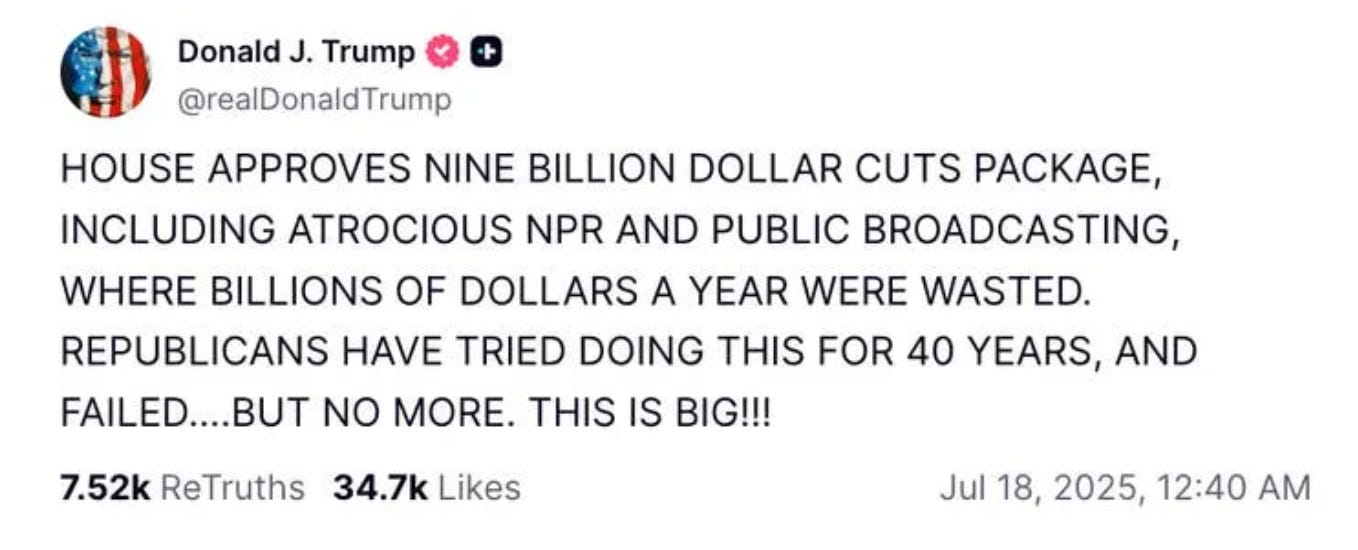
While asshole billionaires are enjoying the continuation of huge tax cuts, Donald Trump and Republicans realized, maybe, that this will actually increase our national debt. Why didn’t somebody say something? So in order to slow down the bleeding, the goons looked for where they could make some cuts and save. No, they did not cut the budgets for ICE, defense, bombs for Israel to drop on the kids in Gaza, Trump golf trips, or Trump birthday parades. Maybe they could sell the plane Qatar bribed Trump with, if anyone else actually wanted it.
Trump and Republicans passed a bill that will cut $1.1 billion in federal funding for PBS and NPR. Trump is all giddy about this and posted to ShitSocial…
Of course, this impacts Sesame Street. What kind of asshole hates Sesame Street? Donald Trump is that kind of asshole. Donald Trump was an asshole millionaire by the time he was 8 years old. His allowance at 3 years old was around $200,000 a year. That explains why he doesn’t have any appreciation for Sesame Street. If nothing else, Sesame Street could have taught him how to count his money and maybe realize that if you spend more than you bring in, you will increase debt. Cookie Monster knows this. You can’t eat more cookies than you have. Maybe if Trump watched Sesame Street, he wouldn’t speak like a drugged-out crackhead and could talk the king’s English as well as the president of Liberia.
Sesame Street might have saved Trump from being the kind of asshole who sexually assaults and rapes women. It could have saved him from being a grifter and a thief. It could have saved him from growing up into a racist liar. Sesame Street could have saved Trump from turning into Trump.
As Matt Hooper said in Jaws while describing a Great White Shark as a machine, “All this machine does is swim and eat and make little sharks, and that’s all.” Trump is also a machine, and all that asshole machine does is grift, sexually assault women, and make little assholes.
By the way, have you seen a photo of Barron Trump lately? He’s cultivating the asshole look. He may be taking grooming tips from older brother, Don Jr. Fortunately, Barron hasn’t developed the coke-up dazed expression yet, so for now, he only has the Christian Bale serial killer look from American Psycho.
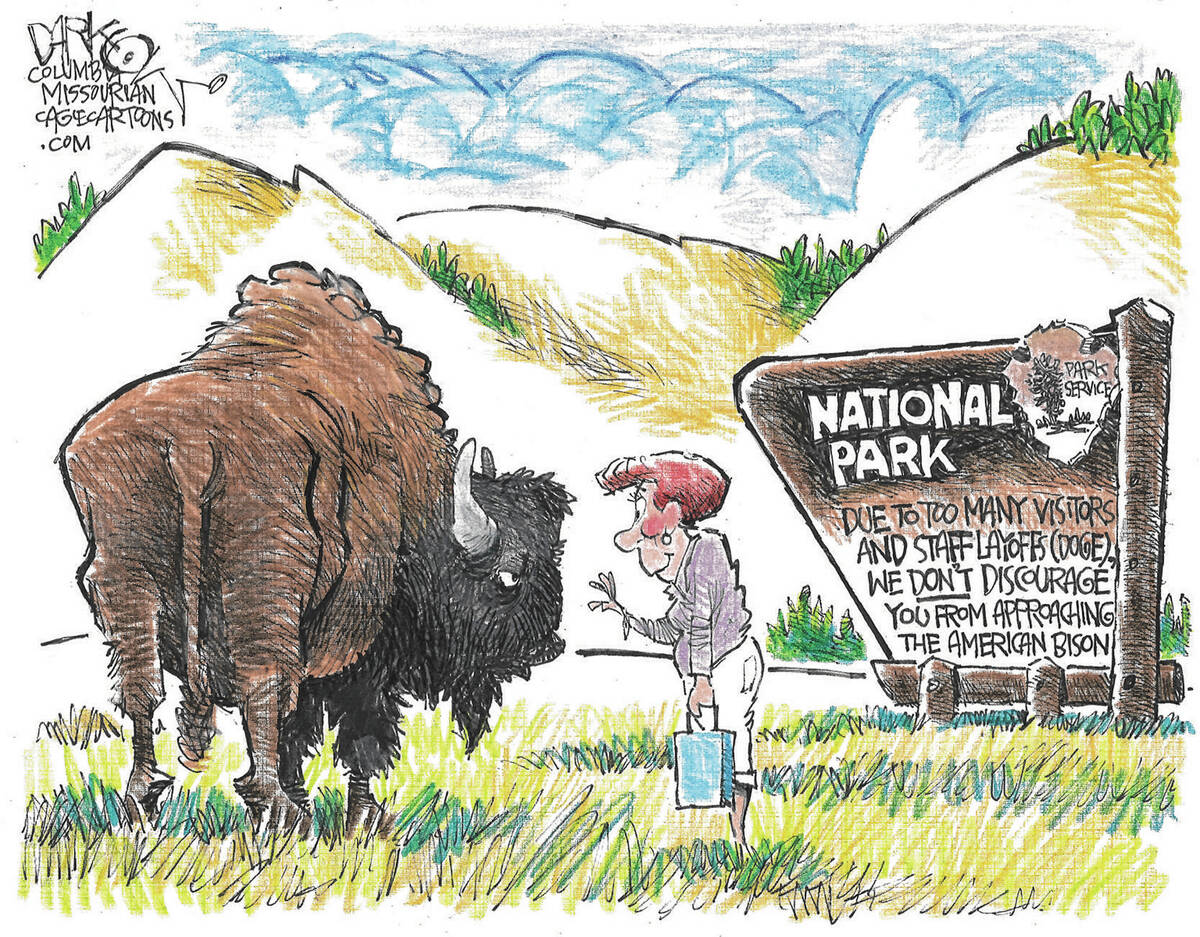
Anyhoosies, we’re supposed to be talking about Big Bird and not Big Turd, the serial killer of democracy. I wanted to avoid drawing Big Bird for a cartoon on this subject, as so many other cartoonists did this week. But after I got the bucket idea, how could I not?
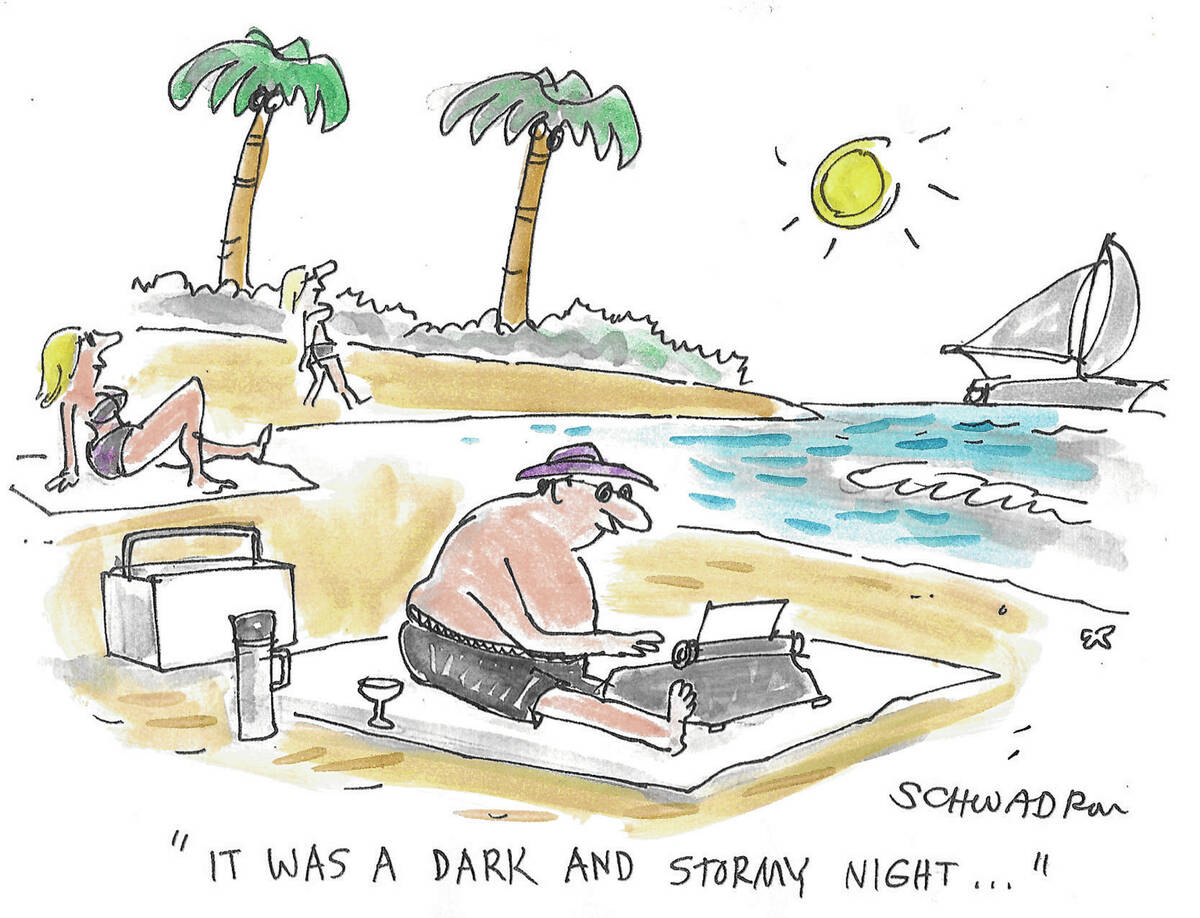
That’s the blog for today, Peezeheads. One of my clients asked for a local cartoon this morning, and he asked about an hour ago if he could have it by 11 a.m. tomorrow. I haven’t even read the article yet, so I should do that. You’re also going to get a blog about Ozzy. Stay tooned. And no talking about Ozzy in the comments until the Ozzy blog. Pretend you’re a Republican and Ozzy is the Epstein Client List. (snip-MORE)
This is a fun half from an Emma Thursday 07-17-2025
This last one is from the Nazi authoritarian cult of tRump maga who I posted a meme of getting fired and asking for money because his boss felt his was not a good fit for the company. FAFO
Allison Gill reported on the newest money runaround the laws on campaign financing. Seems the island of Guam Republican Party got in prior years one donation of $10. This year they got 193 individual donations of $10,000 each. $10,000 is the maximum one person can give to the party. It turns out the donors were all very wealthy republicans many serving in the tRump administration. The island did not suddenly go hard right. No it turns out that the law doesn’t limit party transfers of money between party committees. After the money hit the Guam party coffers, it was transferred to the RNC. Turns out the 193 donors had already maxed out their allowed donations to the RNC. So this was a way to give the RNC an extra 1.93 million for the midterms. Put that with the other ways they plan to rig the election and it seems that the only way they figure they can stay in power is to cheat. Often and repeatedly. Hugs
Trailblazing Illinois Democrat reflects on political career and says party is ‘in a daze’ about how to combat Trump
Carol Moseley Braun speaks after Rahm Emanuel wins Chicago’s mayoral race in February 2011. Photograph: Nam Y Huh/AP
“Oh, I wish I was in the land of cotton … ”
Carol Moseley Braun was riding a lift in the US Capitol building when she heard Dixie, the unofficial anthem of the slave-owning Confederacy during the civil war. “The sound was not very loud, yet it pierced my ears with the intensity of a dog whistle,” Moseley Braun writes in her new memoir, Trailblazer. “Indeed, that is what it was in a sense.”
The first African American woman in the Senate soon realised that “Dixie” was being sung by Jesse Helms, a Republican senator from North Carolina. He looked over his spectacles at Moseley Braun and grinned. Then he told a fellow senator in the lift: “I’m going to make her cry. I’m going to sing Dixie until she cries.”
But clearly, Moseley Braun notes, the senator had never tangled with a Black woman raised on the south side of Chicago. She told him calmly: “Senator Helms, your singing would make me cry even if you sang Rock of Ages.”
Moseley Braun was the sole African American in the Senate during her tenure between 1993 and 1999, taking on legislative initiatives that included advocating for farmers, civil rights and domestic violence survivors, and went on to run for president and serve as US ambassador to New Zealand.
In a wide-ranging interview with the Guardian from her home in Chicago, she recalls her history-making spell in office, argues that sexism is tougher to crack than racism and warns that the Democratic party is “walking around in a daze” as it struggles to combat Donald Trump.
As for that incident with Helms, she looks back now and says: “I had been accustomed to what we now call microaggressions, so I just thought he was being a jerk.”
Moseley Braun was born in the late 1940s in the post-war baby boom. Her birth certificate listed her as “white” due to her mother’s light complexion and the hospital’s racial segregation, a detail she later officially corrected. She survived domestic abuse from her father, who could be “a loving advocate one minute, and an absolute monster the next”, and has been guided by her religious faith.
In 1966, at the age of 19, she joined a civil rights protest led by Martin Luther King. She recalls by phone: “He was a powerful personality. You felt drawn into him because of who he was. I had no idea he was being made into a modern saint but I was happy to be there and be supportive.
“When it got violent, they put the women and children close to Dr King in concentric circles and so I was close enough to touch him. I had no idea at the time it was going to be an extraordinary point in my life but it really was.”
Moseley Braun was the first in her family to graduate from college and one of few women and Black students in her law school class, where she met her future husband. In the 1970s she won a longshot election to the Illinois general assembly and became the first African American woman to serve as its assistant majority leader.
But when she planned a historic run for the Senate, Moseley Braun met widespread scepticism. “Have you lost all your mind? Why are you doing this? But it made sense to me at the time and I followed my guiding light. You do things that seem like the right thing to do and, if it make sense to you, you go for it.”
Moseley Braun’s campaign team included a young political consultant called David Axelrod, who would go on to be a chief strategist and senior adviser to Obama. She came from behind to win the Democratic primary, rattling the party establishment, then beat Republican Richard Williamson in the general election.
She was the first Black woman elected to the Senate and only the fourth Black senator in history. When Moseley Braun arrived for her first day at work in January 1993, there was a brutal reminder of how far the US still had to travel: a uniformed guard outside the US Capitol told her, “Ma’am, you can’t go any further,” and gestured towards a side-entrance for visitors.
At the time she did not feel that her trailblazing status conferred a special responsibility, however. “I wish I had. I didn’t. I was going to work. I was going to do what I do and then show up to vote on things and be part of the legislative process. I had been a legislator for a decade before in the state legislature so I didn’t at the time see it as being all that different from what I’d been doing before. I was looking forward to it and it turned out to be all that I expected and more.”
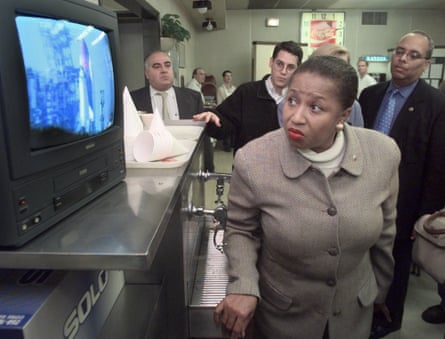
Carol Moseley-Braun watches the delayed launch of the space shuttle Discovery in Chicago in October 1998. Photograph: Michael S Green/AP
But it was not to last. Moseley Braun served only one term before being defeated by Peter Fitzgerald, a young Republican who was heir to a family banking fortune and an arch conservative on issues such as abortion rights. But that did not deter her from running in the Democratic primary election for president in 2004.
“It was terrible,” she recalls. “I couldn’t raise the money to begin with and so I was staying on people’s couches and in airports. It was a hard campaign and the fact it was so physically demanding was a function of the fact that I didn’t have the campaign organisation or the money to do a proper campaign for president.
“I was being derided by any commentator who was like, ‘Look, this girl has lost her mind,’ and so they kind of rolled me off and that made it hard to raise money, hard to get the acceptance in the political class. But I got past that. My ego was not so fragile that that it hurt my feelings to make me stop. I kept plugging away.”
Eventually Moseley Braun dropped out and endorsed Howard Dean four days before the opening contest, the Iowa caucuses. Again, she had been the only Black woman in the field, challenging long-held assumptions of what a commander-in-chief might look like.
“That had been part and parcel of my entire political career. People saying: ‘What are you doing here? Why are you here? Don’t run, you can’t possibly win because you’re not part of the show and the ways won’t open for you because you’re Black and because you’re a woman.’ I ran into that every step of the way in my political career.”
Since then, four Black women have followed in her footsteps to the Senate: Kamala Harris and Laphonza Butler of California, Angela Alsobrooks of Maryland and Lisa Blunt Rochester of Delaware.
Moseley Braun says: “I was happy of that because I was determined not to be the last of the Black women in the Senate. The first but not the last. That was a good thing, and so far the progress has been moving forward. But then we got Donald Trump and that trumped everything.”
Harris left the Senate to become the first woman of colour to serve as vice-president, then stepped in as Democrats’ presidential nominee after Joe Biden abandoned his bid for re-election.
Moseley Braun comments: “I thought she did as good a job as she could have. I supported her as much as I knew how to do and I’m sorry she got treated so badly and she lost like she did. You had a lot of sub rosa discussions of race and gender that she should have been prepared for but she wasn’t.”
Trump exploited the “manosphere” of podcasters and influencers and won 55% of men in 2024, up from 50% of men in 2020, according to Pew Research. Moseley Braun believes that, while the country has made strides on race, including the election of Obama as its first Black president in 2008, it still lags on gender.
“I got into trouble for saying this but it’s true: sexism is a harder thing to change than racism. I had travelled fairly extensively and most of the world is accustomed to brown people being in positions of power. But not here in the United States. We haven’t gotten there yet and so that’s something we’ve got to keep working on.”
Does she expect to see a female president in her lifetime? “I certainly hope so. I told my little grandniece that she could be president if she wanted to. She looked at me like I lost my mind. ‘But Auntie Carol, all the presidents are boys.’”
Still, Trump has not been slow to weaponise race over the past decade, launching his foray into politics with a mix of false conspiracy theories about Obama’s birthplace and promises to build a border wall and drive out criminal illegal immigrants.
Moseley Braun recalls: “It was racial, cultural, ethnic, et cetera, backlash. He made a big deal out of the immigration issue, which was racism itself and people are still being mistreated on that score.
“They’ve been arresting people for no good reason, just because they look Hispanic. The sad thing about it is that they get to pick and choose who they want to mess with and then they do. It’s too destructive of people’s lives in very negative ways.”
Yet her fellow Democrats have still not found an effective way to counter Trump, she argues. “The Democratic party doesn’t know what to do. It’s walking around in a daze. The sad thing about it is that we do need a more focused and more specific response to lawlessness.”
Five years after the police murder of George Floyd and death of Congressman John Lewis, there are fears that many of the gains of the civil rights movement are being reversed.
Over the past six months Trump has issued executive orders that aim to restrict or eliminate diversity, equity and inclusion (DEI) initiatives. He baselessly blamed DEI for undermining air safety after an army helicopter pilot was involved in a deadly midair collision with a commercial airliner. Meanwhile, Washington DC dismantled Black Lives Matter Plaza in response to pressure from Republicans in Congress.
None of it surprises Moseley Braun. “It should have been expected. He basically ran on a platform of: ‘I’m going to be take it back to the 1800s. Enough of this pandering and coddling of Black people.’”
But she has seen enough to take the long view of history. “This is normal. The pendulum swings both ways. We have to put up with that fact and recognise that this is the normal reaction to the progress we’ve made. There’s bound to be some backsliding.
More than 30 years have passed since Moseley Braun, wearing a peach business suit and clutching her Bible, was sworn into the Senate by the vice-president, Dan Quayle. Despite what can seem like baby steps forward and giant leaps back, she has faith that Americans will resist authoritarianism.
“I’m very optimistic, because people value democracy,” he says. “If they get back to the values undergirding our democracy, we’ll be fine. I hope that people don’t lose heart and don’t get so discouraged with what this guy’s doing.
“If they haven’t gotten there already, the people in the heartland will soon recognise this is a blatant power grab that’s all about him and making a fortune for himself and his family and has nothing to do with the common good. That’s what public life is supposed to be about. It’s public service.”
Legacy media is very concerned with the ‘Gen Z Stare’
In the past week, there’s been robust discourse in legacy media about the so-called ‘Gen Z Stare’ and the bursts of generational conflict it reportedly captures.
It’s gotten write-ups by The New York Times, The Washington Post, USA Today, The Boston Globe, NBC News, ABC News, CNBC, Newsweek, Indy100, Axios, Fortune, Vox, Vice, Business Insider, The Independent, Forbes, Buzzfeed, Slate, HuffPost, Glamour, People, and Marie Claire, among others.
As a millennial, I am apparently urged to be concerned about this phenomenon of Gen Z folks supposedly failing to appropriately interact with me through sufficiently pleasant facial expressions, so I thought it might be helpful to offer my thoughts:
The sitting president of the United States is currently covering up a massive sex trafficking operation that targeted children and likely implicates a number of powerful people who are currently out in the world and free to continue preying on children.
The sitting president of the United States just successfully pressured Paramount and CBS to cancel the #1 late-night talk show on broadcast television as part of what appears to be a blatant bribery deal because the host has been critical of him.
The sitting president of the United States just got the extremist Republican majority in Congress to strip 11 million Americans of health care coverage by the end of 2026 and upwards of 17 million Americans when you account for new federal work requirements. (snip-MORE; it’s succinct and quick, and it’s all good facts for grocery/other places lines, for discussion.)