As happens when the Republican elected officials claim that people dressing up in costumes reading to kids in public places with other adults present is child abuse. The thugs (brownshirts) are out to enforce the Republican party line. Again the SCOTUS says we need less gun control. Hugs
A man with a gun turned a children’s reading book event into chaos at the Sparks Library Sunday afternoon. During a Drag Queen Storytime event, a group of Proud Boys protested against LGBTQ+ rights outside of the library.
Our News 4 and Fox 11 crew covering the reading event said when the protest came to an end, a man wearing Proud Boys clothing approached the library while carrying a gun, causing everyone, including children, to run into the library for safety.
The Sparks Police Department monitored the protest from a distance, but left soon after. There were no police presence when the man approached the building.
I truly wish the media would stop calling these assholes protesters. They’re not protesting. Protesters don’t show up armed and in combat gear. This is terrorism. FUCK.
white nationalists don’t target the LGBTQ community because they see it as “weak or powerless.”
“It is targeted because that community has brought inclusion into America, It has opened the space around equity and what it means to be an America that moves forward together across lines of difference. That is what frightens the Patriot Front, Proud Boys and other racist bigoted alt-right organizations.
This shows why sexual education is so desperately needed in all US schools at all levels. Even College and homeschooled kids need to be tested in basic biology and anatomy. Hugs
“Maybe because there’s so much going on in the body. I don’t know. I haven’t, you know, seen any studies. But if I’m processing what you’re saying, it wouldn’t surprise me. Because it’s not something that’s happening organically. You’re forcing it. The individual, the male, is doing it as quickly. And so I can see why there is truth to that. It’s unfortunate.” – Virginia Republican US House nominee Yesli Vega, when asked if she’s also heard that it’s “harder for a women to get pregnant from rape.”
Vega, the chair of Latinos For Youngkin, is running to unseat two-term incumbent Democratic Rep. Abigail Spanberger.
AUDIO: Virginia congressional candidate Yesli Vega doubts pregnancy after rape
It’s cute that you think most Americans were taught anything resembling medical/science-based sex ed in public schools.That’s especially true in the states that will have abortion bans.
That is the core of the misogynist argument here. They also accept that it wasn’t rape if you don’t fight back hard ‘enough’ or if you drank, wore a skirt, were in the wrong place, went on a date, were just too sexy, were just too available, etc.
“Jesus Christ, Lord and Savior, died for our sins. If you accept him into your life, you will not be raped, ever. You will not get unintentionally pregnant. The Angels of Heaven will speak through your mate’s semen and bless you forever and ever, amen.”
Because we learned to get real information about sex and STDs and such instead of believing shit taught to us in right wing churches. I was actually taught that women had one more set of ribs than men because god took a set of ribs from Adam to make Eve. I am not making that up. I was taught that they could tell if a skeleton was male or female that way. There was a very embarrassing moment in HS biology when my teacher corrected me (fortunately this was not in front of the entire class). That was the day I learned to find out science from science books and nowhere else.
Because we had to unlearn all the bullshit we got taught as kids and figure out what’s real.
If there’s one thing we could do for the “straight world”, it’s to help them unlearn all that bullshit about gender roles. I swear, I hear my husband talk about how he and I divvy up household chores with the women he works with and every damn time at least one of them will pipe up with “my husband would never do the laundry” or something idiotic like that. Possession of a vagina is not a requirement to do laundry, folks. Or cook, or pick up the kids, or do grocery shopping. Nor is having a dick a requirement for mowing the yard or doing auto maintenance.
Police in Fort Lauderdale arrested a man they say threatened a security guard with a gun. The incident happened outside a bar in Wilton Manors. According to police, 45-year-old Kenneth Justesen was taken into custody Friday night outside the Gym Sportsbar. Justesen is facing several charges including use of a firearm under the influence of alcohol, according to authorities. Records obtained by Local 10 News indicate this is not Justesen’s first run-in with the law.
People caught Justesen on video approaching and heckling people at the bar. “The gentleman had lost his phone and he was really upset about it, and he started making threats that if he found the person with his phone, he was gonna put a bullet in the back of his head,” said witness Anthony Robinson. He eventually got into an argument and pulled his gun out scaring people at the bar, who quickly called 911. A police report said the firearm was loaded and actively had one round in the chamber and an additional eight rounds in the magazine.
A video obtained by CBS4 shows Justesen wearing a ‘Let’s go Brandon’ t-shirt, which is a profane dig at President Biden, as he had an exchange of words with the bar’s security guard. The exchange soon grew to a verbal altercation in which Justesen is hear saying, “What the (expletive) are you going to do?” Then, the video shows him pulling what appears to be a handgun and holding it beside him. He allegedly told the security guard that he can, “show his gun.”
The story behind this guy is that he shows up for poker nights on Fridays with his girlfriend and tries to talk about Trump at the table. He’s been asked to leave repeatedly and had been kicked out of the bar for belligerent behavior. This is just an escalation of his behavior, Florida-man-style.
Thanks to what Donald J. Trump unleashed on this country, it’s open hunting season on LGBT people and there are no fines for going over the limit of the day.
Yes, the rednecks and bigots have always been here, but trump unleashed them. Not only have they come out of the woodwork, they are vocal and proud. He validated them and emboldened them.
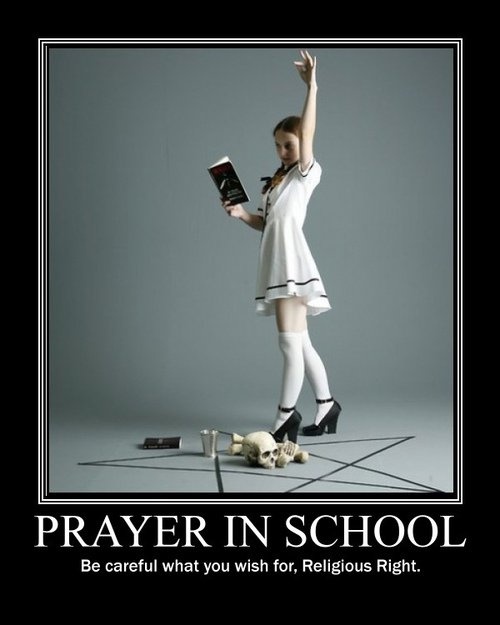
The Supreme Court’s conservatives ruled on Monday for a high school football coach who was reprimanded for leading postgame prayers on the football field’s 50-yard line.
The 6-3 decision marked a win for coach Joseph Kennedy in his dispute with the Seattle-area school district that placed him on paid leave for violating a policy that bars staff from encouraging students to engage in prayer.
Starting in 2008, Kennedy began kneeling on the school football field after games where he would engage in brief prayer. Eventually, many of his players joined him, as did members of opposing teams.
Kennedy had spent those previous six weeks conducting multiple interviews that exacerbated his conflict with the school. Two weeks before the game, he had retained First Liberty, the powerful Christian conservative law firm, in his burgeoning legal battle against the district.
And he intensified the spotlight’s glare before kickoff with a pregame Facebook post, announcing a big night upcoming. In signing off, he asked for prayers.
It’s hard to read that sequence as anything other than performative, a plea for the exact kind of attention likely to add sympathetic supporters to his side. His opponents argue he got exactly what he wanted.
While Kennedy and the district both acknowledge he never required Knights players to join him in his prayers at midfield, some parents said their children felt pressured to participate out of fear they would lose out on playing time.
Kennedy’s practice of praying on the field continued for seven years without incident. But that changed in September 2015, when an opposing team’s coach told Bremerton High School’s principal that Kennedy asked his players to join him for the post-game prayer and “thought it was pretty cool” the district would allow such activity.
The district then launched an investigation into whether Kennedy was complying with the school board’s policy on religious-related activities and practices, and later issued a directive prohibiting on-duty school employees from engaging in “demonstrative religious activity” that is “readily observable to” students and the attending public.
Breaking News: The Supreme Court ruled that a high school football coach had a constitutional right to pray at the 50-yard line after his team’s games. The vote was 6 to 3, with the court’s three liberal members in dissent. https://t.co/8n01cJza0e
🚨BREAKING🚨 — Supreme Court deals another blow to church-state separation, allowing a public school coach to lead students in prayer at the 50 yard line after games. Our full analysis and statement to come. pic.twitter.com/C8USS0Kxt3
— American Atheists (@AmericanAtheist) June 27, 2022
JUST IN: Supreme Court rules that a Washington state high school football coach had a right to pray on the field immediately after games, a decision that could lead to more acceptance of religious expression in public schools. https://t.co/yTwvAe0z2w
Jesus taught, “When you pray, do not be like the hypocrites, for they love to pray standing in the synagogues and on the street corners to be seen by men … but when you pray, go into your room, close the door and pray to your father who is unseen.” But don’t let Jesus get in the way of your theocracy.
But how will people know that someone is a Christian, if they don’t have a fish sticker on their car, a cross tattooed on their forearm, praying on the field….
Maricopa County election workers monitor ballot counting in November 2020.
Gina Ferazzi / Los Angeles Times via Getty Images
The Republican National Committee is telling potential Arizona polling place observers that there are “festering problems” in how elections are run, such as security issues with vote-counting machines and problems with voter rolls, as it trains them for the state’s upcoming primary election.
The RNC training delivers the message that the “2020 election had serious problems,” worrying experienced former election officials and lawyers who have trained observers in the past and who say the point of training should be simply to encourage observers to watch for violations of law at the polls without disturbing the peace.
Republican Maricopa County Supervisor Bill Gates, who as an attorney led Republican observer training in the 2000s, said the messaging concerns him because his focus was always on providing a straightforward picture of what was legal and what was not at the polls.
“It’s not about kind of ginning people up, which is what that sounds like,” Gates said. “That’s the narrative, though.”
Votebeat watched an RNC Zoom training at the invitation of an attendee, and separately received information about an in-person training from an attendee, after an RNC spokesperson said that reporters were not allowed to attend.
Asked about the intention of the messaging, Ben Petersen, the RNC Arizona communications director, said that the committee’s staff and volunteer training “emphasizes the need to comply with federal and state laws protecting voting rights.”
“Any individual participating in our election integrity program who does not follow the law will be promptly dismissed,” Petersen said.
As of 2021, Maricopa County began requiring polling place observers to fill out forms detailing any problems before leaving the polls, a way to avoid unsupported allegations surfacing after the fact. Yavapai County is also doing that, as well as restricting where observers can go within polling places and ensuring that each location has experienced and bipartisan staff prepared to handle any problems.
In response, the Arizona Republican Party says it is concerned that election officials may be attempting to unfairly limit Republican volunteers’ access to the polls. The RNC is asking election officials to provide specific details about hiring practices for poll workers, which are hired and trained by the counties and are separate from poll observers selected by the political parties.
Republican lawyers say it would be unfair, and perhaps even unlawful, for election officials to block workers and observers from the polls just because they believe that the 2020 election was stolen or that widespread voting fraud exists.
Plus, any attempts to limit skeptical workers might backfire, said Republican attorney Kory Langhofer, who represented the Trump campaign in 2020 court challenges in Arizona.
“If your goal is to convince people the election is fair then you want both parties, including people who believe they have been unfair in the past, to participate,” he said. “If you start to not hire those people, that’s a great way to make sure everyone is paranoid about the elections.”
Republican interest in working and observing surges
County election officials across the state say they are hearing from more Republicans who want to work as poll workers or volunteer as poll observers in the upcoming primary.
In Yavapai County in central Arizona, which includes Prescott, the GOP sent a list of potential poll workers to the elections department for the first time in at least 30 years, according to Matt Mortellaro, the county’s elections database programmer.
Arizona election officials are also hearing more directly from county Republican Party officials.
As first reported by the Arizona Agenda, Cochise County Republican Party chair Robert Montgomery messaged elections director Lisa Marra and requested that at least 50% of poll workers be Republican.
She responded to him telling him that isn’t required under state law. “I get that,” he responded, but if Republican workers were to be outnumbered by Democrats, “there will be rage and massive distrust.”
Copies of texts between Cochise County Elections Director Lisa Marra and County Republican Party chairman Robert Montgomery.
Arizona law says the top two officials in charge of each polling place cannot be from the same political party. But it doesn’t require all polling place workers to be evenly split between Republicans and Democrats, and in many counties, there are also third parties entitled to some representation.
Chris DeRose, a Republican lawyer who previously trained Republican observers, said the high interest is fascinating, considering for decades it’s been difficult to get Republicans to work as poll workers or volunteer as observers.
Gates said it was always a struggle to get people involved, and the party was never able to assign volunteers to cover every polling place.
State law allows for one observer from each party at each polling place, but Gates said it was always very rare to see someone from another party at the polling place where you went to observe. It’s a boring job, DeRose said, and the problems that come up are almost always small mishaps, such as unintentional mistakes by poll workers or one-off issues with machines.
There’s also never been this much controversy drawing people in.
The growing number of Republicans interested in watching over the polls coincides with the lifting of a legal restriction that stopped the RNC from training poll observers for decades.
In 1982, amid accusations of voter suppression targeting communities of color, the party was placed under a consent decree that barred it from challenging voter eligibility at polling places. That largely forced the RNC to leave such work to state parties and allied local organizations.
In Arizona, for example, the consent decree meant there wasn’t a formalized process for training Republican observers until the early 2000s, according to several Republican lawyers.
Gates helped the party establish formal observer trainings and procedures starting in 2002, via a group called the Arizona Republican Lawyers Association, before he was a supervisor and before he was appointed to the Phoenix City Council in 2009.
He said that typically meant getting a number of Republican lawyers set up on Election Day to take calls from observers about polling place issues on an Election Day hotline.
A judge lifted the RNC consent decree in 2018, and in 2020 the RNC was back in the observing game. Led by the Trump campaign, the party recruited thousands of poll observers across the country. Headlines warned of disruption at the polls, but those worries mostly did not play out.
Following Election Day, though, Republican observers made a spectacle in Pennsylvania and Michigan, claiming they were unable to properly witness ballot counting. The Pennsylvania Supreme Court ruled that observers had proper access there. In Michigan, reporters and state officials said Republican observers were given appropriate access.
In the end, the party’s thousands of observers across the country were not able to convince any courts of their allegations of widespread fraud or illegal activity.
Now, the RNC has made a “multi-million-dollar investment” for the 2022 cycle that includes 16 state election integrity directors, 26 in-state election integrity counsels and thousands of poll workers and observers, Petersen said.
The process for recruiting poll observers and hiring poll workers varies by state, though the GOP’s Petersen notes states typically require a credential from the state or local party or a candidate in order to serve as a poll observer. In some states, political parties can give local election officials the names of potential poll workers.
In Arizona this year, the RNC is trying to recruit 5,000 poll workers and observers for the primary and general elections, according to a party website promoting the trainings, though poll workers must also be hired and trained by local election officials.
The RNC’s trainings are being led by Tony Sanchez, who introduced himself at a recent training held over Zoom as the state party’s election integrity director. The intention is to build a “grassroots army” of election workers and observers in 2020, Sanchez said.
“Democrats have had a monopoly on poll watching for 40 years, and it speaks volumes that they’re terrified of an even playing field,” Petersen told attendees. “Since the start of this cycle, the RNC has successfully executed our election integrity operation in states that have already held elections like Ohio, Georgia, Wisconsin, Pennsylvania, Texas, Virginia, New Jersey, and others. In all instances, we had 100% coverage at all key polling locations, elections have run smoothly, and turnout has increased.”
The Arizona Democratic Party is also recruiting and training poll workers and poll observers for the upcoming elections through what it calls its voter protection program, said Morgan Dick, the party’s Arizona communications director. The party is hosting trainings in person and virtually in June and July, she said, and described them as “well attended” so far.
Dick said the party’s primary goal is “to ensure that every Arizonan can confidently cast their ballot by mail or in person during the midterm elections.”
Republicans are also partnering with several groups for “election integrity” trainings, according to the website, including America Pack, EZAZ, the Tea Party Patriots, and Turning Point Action. Trainings by third-party groups have been drawing attention elsewhere.
The RNC’s Petersen said the party is working with outside groups but insisted, “The party’s efforts are independent from any outside organization. As such, the RNC is not a part of any formal coalition with outside groups.”
Petersen noted that outside groups often direct attendees of their training to submit their names for poll observer or poll worker positions through the party, which, he says, “is why our state election integrity directors attend events put together by outside organizations.”
EZAZ, a local voter advocacy group on the list of partner organizations included on the Republican party website, is partnering with conservative advocacy group FreedomWorks to host election integrity trainings this year. Peter Vicenzi, aspokesperson for FreedomWorks, said they saw a need to get more active in this realm, where he said Democratic groups have been active for years.
“Republicans deserve to be part of the process too,” Vicenzi said.
The groups partnering for the election integrity trainings in Arizona are making a big recruitment push to go along with the trainings – one that is sure to get the party a wider reach for email marketing – and therefore expand its fundraising abilities.
A text message sent to some Republican voters earlier this month had a Donald Trump caricature dressed and pointing like Uncle Sam with “I want you to be a poll observer,” written underneath. It directed recipients to the state Republican Party’s website for the trainings and told them to enter their information.
A text sent recently to some Arizona Republicans encouraging them to go a website for RNC election integrity trainings.
“The elections in Arizona are just around the corner,” the accompanying message read, “All eyes are on US, and we need YOU to ensure our elections are the safest & most secure in history!”
An email the state party sent to its list on June 20 also directed supporters to the election integrity website — and suggested making a “grassroots contribution” to support “fighters in the Grand Canyon State who don’t look the other way.”
Training tells attendees 2020 election “uncovered festering problems”
The Republican National Committee has so far been hosting the Arizona election integrity trainings for observers, with a national schedule on http://www.gopvictory.com, across Maricopa County and on Zoom since at least April.
For the most part, the trainings are straightforward: They discuss the party’s goals (to increase Republican participation as poll workers and watchers and ensure the upcoming elections are fair) and what the role of an observer is (to ensure election laws are followed at polling places).
One section of the training, in particular, reminds attendees a list of don’ts: don’t be disrespectful, don’t be demanding, don’t interfere or disrupt voting. Another section talks about potential problems to watch for that are relatively straightforward under Arizona law, such as late openings of polling places and long lines.
But in the Zoom training Sanchez also said the 2020 election had “serious problems” even though experts and election officials have repeatedly said it was actually one of the smoothest modern elections in history.
Sanchez said laws were disregarded and many questions are still left unanswered, even though Arizona courts found otherwise.
He told attendees the election “uncovered festering problems,” and said that there are security issues with vote-counting machines. Multiple pre- and post-election audits, done by Maricopa County and contractors the county hired, found that machines counted votes accurately and were not connected to the internet.
DeRose, Gates, and Langhofer all said that the focus of the trainings in the past was always on what was allowed under the law and what wasn’t.
Gates said he believes some of the statements in the RNC training are political, something he always tried to avoid.
“My slides would have said something like the right to vote is fundamental,” Gates said. “And we want to make sure every eligible vote is counted.”
Tammy Patrick, who helped both political parties in Maricopa County train observers for years when she was the county’s compliance officer, called the RNC’s messaging “deeply problematic” because it primes observers to come in believing there are massive problems with the system.
“If you are pre-positioning the observers that there is all this criminal activity they need to uncover, they are going to view what they are seeing from a completely skewed viewpoint,” she said.
Patrick said the intentions of these new poll observers worries her. “They think they are going to find the body,” she said.
DeRose said he didn’t see any major problems with the messaging in the training. But he also said that, when he led the trainings, he tried to screen people who he thought were there with ill intentions.
“I had this guy show up in 2009 with a ‘Don’t Tread on Me’ shirt,” DeRose said of his time training Republican observers in Virginia. “This guy is just going to be trouble. We aren’t going to credential him.”
Langhofer, the Republican attorney who represented the Trump campaign and has also represented Arizona Senate Republicans in their battles over Maricopa County’s ballot review, said the number one thing that is important to do in the training is to “make sure people aren’t overzealous.” Langhofer has been involved in Republican trainings for poll observers since 2012.
“Most people who volunteer to be involved in early voting and election day are very sincere, citizens who just want to help the system run well,” Langhofer said. “But some small percentage of people are overzealous, or emotional, and can be disruptive.”
He said it’s important to train observers to raise problems internally through election officials and “not in some confrontational way inside a polling place or involving voters.”
Election officials respond with rules for observers
With the increased interest and recruitment, Mortellaro in Yavapai County said that the county added a number of new procedures this year for observers for the upcoming elections because “we are a little concerned about them disrupting things this election.”
“We are trying to put procedures in place that would block that before they happened.”
This includes emphasizing that observers are only able to talk to the inspector of the polling place, and never voters, and placing observers in particular spots in vote centers where they are unable to cause a disruption.
Mortellaro said those restrictions would vary by polling place, but generally the county doesn’t want observers near the line of people being checked in, as “that’s a great opportunity for them to talk politics to people in the line.” The county also doesn’t want them where they can look over voters’ shoulders while they are filling out their ballots, and doesn’t want them near voter check-in stations.
“We have to be worried about people messing around with machines,” he said.
Observers will also be required to fill out a form they hand in before they leave that lists any problems they saw that day. If they didn’t see any, they have to write “N/A.”
County Recorder Leslie Hoffman said county officials are hopeful that will prevent people from hearing election fraud claims elsewhere after they leave and then claiming the same problems also happened at their polling place.
“We want to make them accountable,” Hoffman said. “If there is something wrong, we want to make sure we address it. Or, if not, we want to know that too.”
The county got the idea for the form from Maricopa County. Generally, Mortellaro said, county recorders are sharing ideas for ways to prevent disruption in polling places this year.
At the same time, the Arizona Republican Party is concerned that Republicans workers and watchers will be kept from the polls.
Kelli Ward, who chairs the state GOP, tweeted on May 12 that she was “told that Election Departments around Arizona are requiring illegal ‘ideological tests’ of poll workers and that they are actively discriminating against #AmericaFirst Republican applicants.”
A public records request first reported by Arizona Agenda that was filed by attorney Eric Spencer on behalf of the RNC to at least Cochise County – the party didn’t respond to questions about where else they submitted requests – asked election officials to provide documents about party poll observer access and the poll worker hiring process.
This included a request for any documents “describing any limitations to serving as a poll worker or otherwise temporary worker based on political views,” with examples such as “reviewing a prospective worker’s social media” and “making worker assignments based (in whole or in part) on political views.”
Asked about the requests, Petersen, the RNC spokesman, said public records requests related to election administration issues are “nothing unusual and various groups on both sides of the aisle do the same.”
Votebeat did not find any evidence that election officials were unfairly or illegally screening poll workers. But a few election officials did say that, in recent years, it’s become important to watch for red flags when screening workers that could indicate they intend to disrupt or fail to follow applicable laws in the polling place.
Yavapai County, which is hiring about 300 poll workers for the upcoming primary, started interviewing all poll workers for the first time this year, instead of letting the leader at each polling place, the inspector, choose their team. This is to ensure the county has more control over the makeup of workers in each location, Mortellaro said, “to make sure we are getting the kind of people we want.”
Mortellaro said the county doesn’t directly ask for opinions about the fairness of elections during the interview, but sometimes candidates bring up politics.
Hoffman, the county recorder, said an example of a potential issue is a poll worker candidate who, when told they can’t wear political clothes in a polling place — something against the law in Arizona — gets upset about it.
Asked what might prevent them from hiring someone, Hoffman said that might be someone saying, “I want to make sure things are done right — I’m really going to be watching everybody.’”
“At that point, take the training to be an observer instead,” Hoffman said, “Because that’s what they do. If you’re a poll worker, you need to do your job.”
Marra, who is hiring about 250 poll workers for the upcoming primary, said the county asks poll worker applicants to fill out an online questionnaire, which includes a question about why they want to be a poll worker.
Some applications stood out to Marra this year because they said they had never been a poll worker before but wanted to make sure the election was fair. She said she doesn’t see that as harmful, but said there are certain things that would cause concern, such as someone saying something specific about wanting to damage equipment.
She’s also started including more information in trainings about voter intimidation and harassment.
Patrick, the former Maricopa County elections compliance officer, who is now a senior advisor of elections at the nonprofit nonpartisan Democracy Fund, said she doubts election officials would excessively screen election workers, simply because it’s so hard to find enough workers in the first place.
She said it’s important for election directors to ensure that they have experienced workers at each polling place, to balance the numbers of workers by political affiliation, to increase the number of workers roaming polling places for issues, and to review their hotline and communication strategy.
Nonetheless, Republicans are worried their volunteers will be improperly kept out. Langhofer said election officials shouldn’t be disqualifying workers based on their beliefs about the 2020 election, and he believes any discrimination based on political beliefs would be illegal. He also said it’s not a “fringe position” to have concerns about the fairness of the 2020 election.
“This is a common view in American politics,” he said. “You can’t be excluding mainstream views.”
DeRose also said he would be concerned with any attempt to screen poll workers on their beliefs of fairness in the election.
“Who is asking the questions, who is designing them, and who is making the decision?” DeRose said. “That, to me, could be rife with problems. Our system already contemplates that people are going to have views.”
DeRose said, for him, the line would be if someone said they wanted to disrupt the election.
He said that people who think there are problems with how elections are run should work at polling places and see how mundane the process is.
“Come spend the day in the polling place,” he said, “and try to stay awake.”
Freelance reporter Rachel Leingang contributed to this article.
Jen Fifield is a reporter for Votebeat based in Arizona. Contact Jen at jfifield@votebeat.org.
We’ve explained the new Arizona law that would lead to recounts after every election. The governor signed it last week.
Majority Opposes Overturning Roe v. Wade… More than Six in Ten Say Decision Will Push Them to the Polls in November
In a majority decision, the United States Supreme Court on Friday overturned Roe v. Wade which, for nearly fifty years, guaranteed access to abortion in the United States. However, majorities of Americans oppose the Court’s ruling and have concerns that the decision will have broader constitutional implications. Following the decision, President Joe Biden asserted that Roe will be on the ballot in November. 61% of Americans agree, saying the Court’s decision will make them more likely to vote in this year’s midterm elections, and, by a double-digit margin (15 points), they think the decision will motivate them to vote for a congressional candidate who will support federal legislation that will restore the protections of Roe v. Wade.
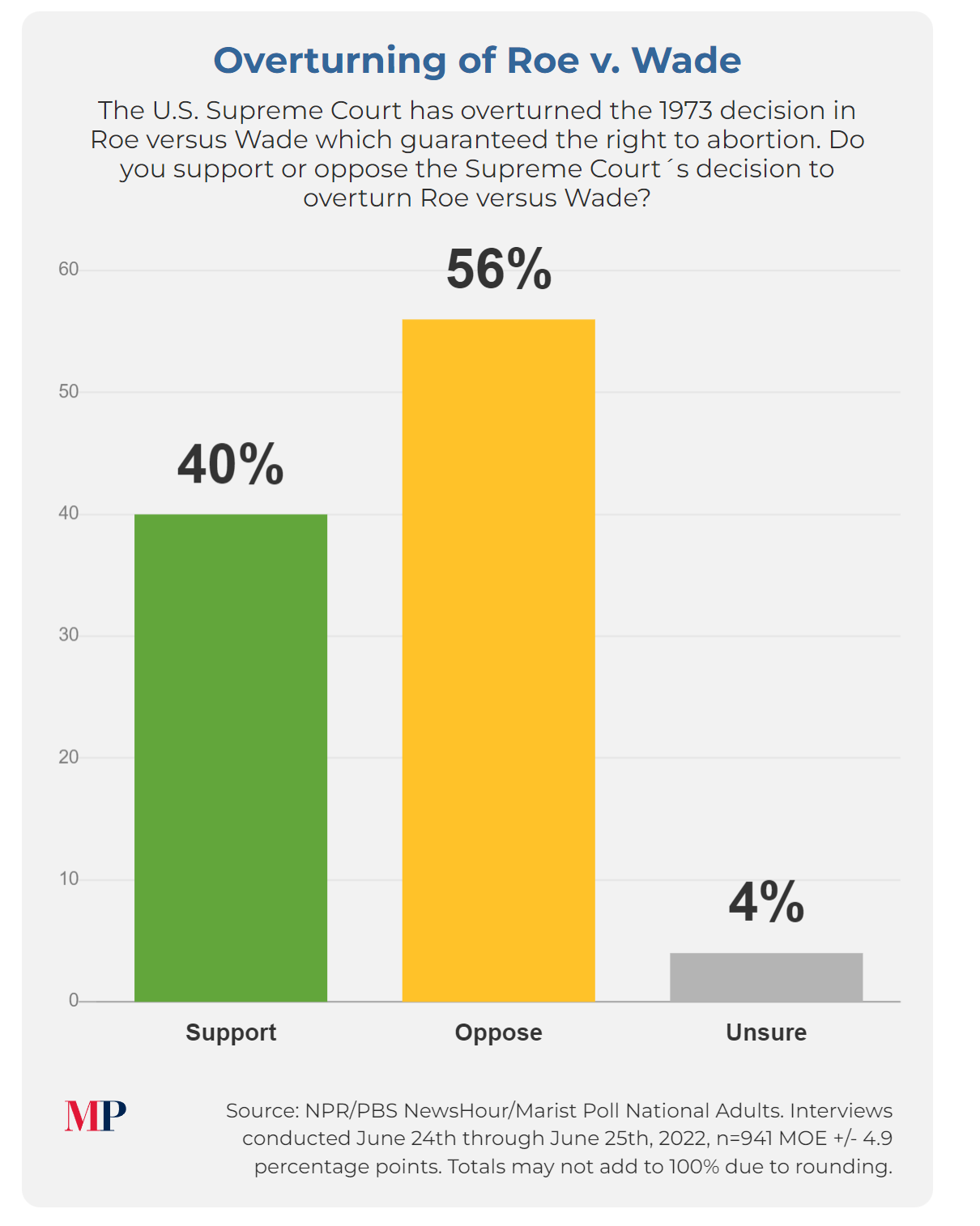
Overturning of Roe v. Wade
The U.S. Supreme Court has overturned the 1973 decision in Roe versus Wade which guaranteed the right to abortion. Do you support or oppose the Supreme Court´s decision to overturn Roe versus Wade?
Source: NPR/PBS NewsHour/Marist Poll National Adults. Interviews conducted June 24th through June 25th, 2022, n=941 MOE +/- 4.9 percentage points. Totals may not add to 100% due to rounding.
With 55% of Americans saying they mostly support abortion rights, 56% of Americans oppose the Supreme Court’s decision to overturn Roe v. Wade. This includes 45% who say they strongly oppose the decision. Democrats (88%) are more than four times as likely as Republicans (20%) to oppose the decision. 53% of independents agree.
56% of Americans are concerned that the Supreme Court’s decision could also jeopardize the rights to contraception, same-sex marriage, or same-sex relationships. This includes a plurality of Americans (42%) who report they are very concerned that the Court will use the decision to reconsider other previous rulings. 89% of Democrats and 55% of independents are either concerned or very concerned about the impact of the decision. A notable 18% of Republicans agree. Women (63%) are more likely than men (49%) to worry about the ripple effects of overturning Roe v. Wade.
A majority of Americans (57%) think the Supreme Court’s decision to overturn Roe v. Wade was politically motivated and not motivated by the law of the land (36%). The debate over abortion rights will most likely play out on the campaign trail. 62% of registered voters say the Supreme Court’s decision will make them more likely to vote in this year’s midterm elections. Democrats (78%) are more motivated by the decision than Republicans (54%) and independents (53%).
51% of voters nationally say the Supreme Court’s decision will make them more likely to vote for a congressional candidate who would back a law that would restore the protections of Roe. 36% would definitely vote against a candidate with that intent, and 13% are unsure. Among independents, a plurality (47%) would vote for a candidate who would restore the protections of Roe. 38% of independents think they will definitely vote against such a candidate.
Democrats (48%) currently have the advantage over the Republicans (41%) among registered voters in the congressional generic ballot question. Their advantage has slightly widened from five points (47% for the Democratic candidate and 42% for the Republican candidate) in May after the leaked draft of the Roe v. Wade decision.
“With the midterm elections less than five months away, the decision by SCOTUS has sent shockwaves through the electorate,” says Lee M. Miringoff, Director of the Marist College Institute for Public Opinion. “Men are +12 points and women are +18 points more likely to support congressional candidates who pledge to codify the protections of Roe v. Wade. Digging deeper, 63% of women, including 74% of suburban women, are also concerned that the Court’s decision is a harbinger of things to come.”
Americans’ Express Low Confidence in Supreme Court
The image of the Supreme Court has further diminished. 39% of Americans say they have either a great deal or quite a lot of confidence in the Supreme Court, comparable to an already dismal 40% in May. Americans’ perceptions of the Supreme Court have plummeted since 2019 when 60% of Americans had confidence in SCOTUS.
Should the U.S. Supreme Court Be Expanded?
Despite the Supreme Court’s decision to overturn Roe v. Wade, a majority of Americans (54%) do not want the Court expanded to include more justices.
President Joe Biden’s Job Approval Rating
President Joe Biden’s job approval rating is 40%, inched up slightly from 38% earlier this month. By more than three to one, Americans are more likely to strongly disapprove (41%) of the job Biden is doing in office than to strongly approve (13%) of his job performance.
Abortion in the United States
About two in three Americans (66%) — including 70% of Democrats, 55% of Republicans, and 74% of independents — say they have a personal connection to someone who has had an abortion. 33% say they do not.
The tech billionaire has been making major contributions to his former employee for his U.S. Senate bid. He might be surprised by Masters’ view on Thiel’s own wedding.
Roger Sollenberger
Political Reporter
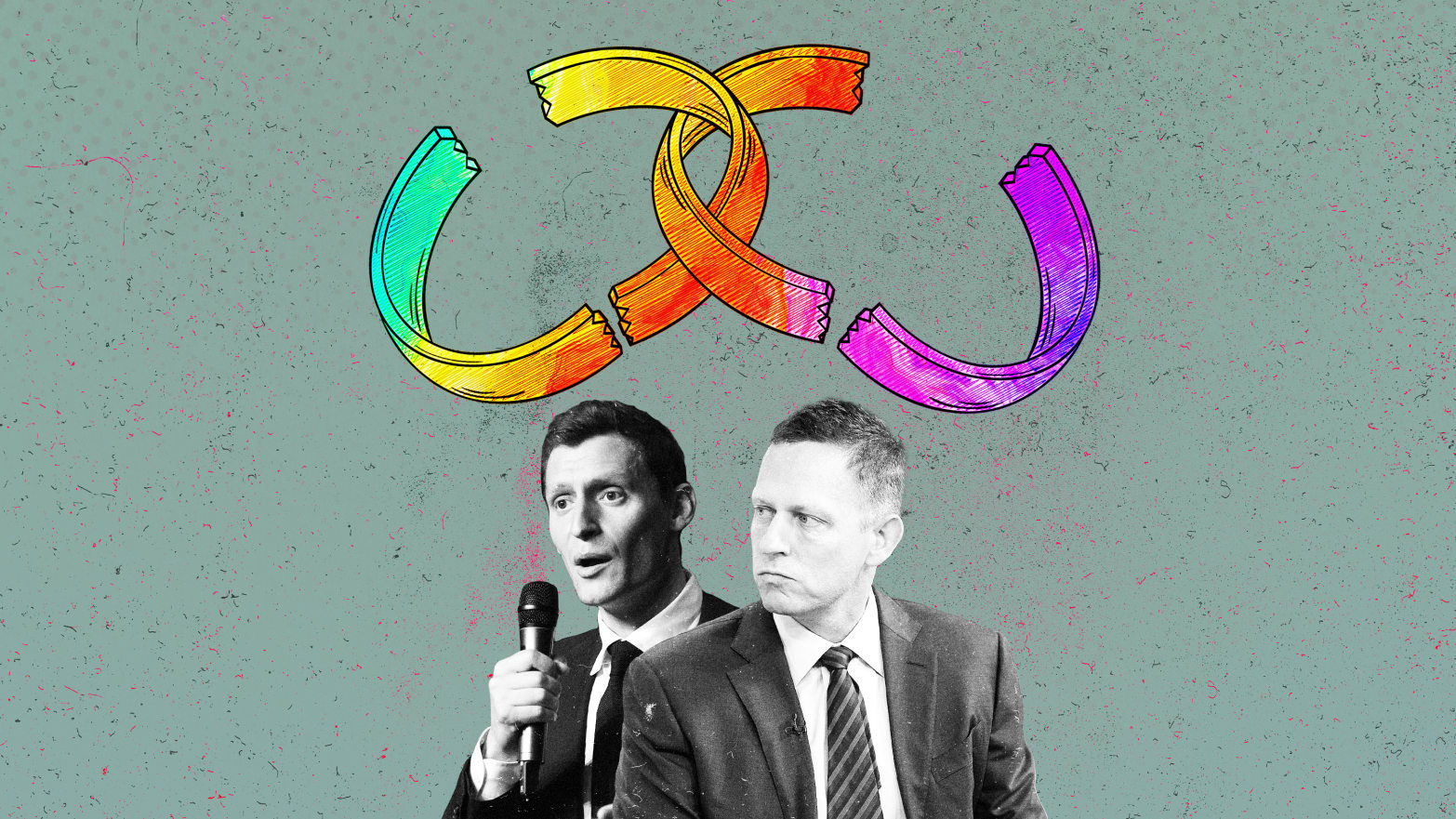
Photo Illustration by Thomas Levinson/The Daily Beast/Getty/Alamy
Republican senatorial candidate Blake Masters enjoys the financial and political support of his longtime friend, mentor, and billionaire business partner Peter Thiel, who is gay. But Masters, who attended Thiel’s wedding, also apparently believes Thiel’s marriage should be illegal.
“It’s not just Disney, you know—‘follow your heart,’” Masters said at a campaign event earlier this year. “It has a point.”
That “point,” he said, is making children. And since there’s no procreation within same-sex marriages, Masters reasoned, those unions don’t have a point—and therefore should be banned.
Masters, 34, shared this perspective in February with an audience at a Republican Women’s Club event in San Tan Valley, Arizona, where he’s running for Senate. The 2015 Supreme Court decision that legalized gay marriage, he told this group, amounted to “squinting and making up so-called rights in the Constitution.”
“The Supreme Court should not be deciding gay marriage. If this country wanted to legalize gay marriage or recognize it, what you would do is you would have a Constitutional amendment. It’s supposed to be hard. It’s supposed to be hard for a reason,” he said. “Frankly, the Supreme Court just squinting and making up so-called rights in the Constitution—the right to privacy that was for abortion, the right to gay marriage—I disagree with that.”
Masters then pivoted to Thiel’s wedding for a real-world example, saying “I wish him well,” while in the next breath declaring that Thiel’s marriage should be against the law.
“My, you know, former boss and mentor Peter Thiel is gay. I went to his wedding like, you know, I’m—it was great, I wish him well. I don’t think the Supreme Court should have decided that case that way,” Masters said. He added that while he doesn’t think gay marriage is “the live issue right now,” he believes “marriage is between a man and a woman.”
Although same-sex marriage may not have been a “live issue” at the time of that event, it certainly grew into one three months later, when the public got a preview of what last week became the momentous Supreme Court decision overturning Roe v. Wade.
That controversial ruling hung on a due process issue, and the court ultimately kicked the decision back to the individual states. But Roe isn’t the only precedent established on those grounds; other major decisions share a similar legal structure, including Obergefell v. Hodges, the case that secured the right for gay people to get married.
The implications were not lost on the court. The court’s three liberal justices—Elena Kagan, Stephen Breyer, and Sonia Sotomayor—raised a warning in their dissent that Obergefell could be next, along with protections for contraceptives and sexual activity generally.
While the majority of the SCOTUS conservatives parried those concerns, Justice Clarence Thomas stated plainly in his opinion that the Court “should reconsider” all similar due process precedents, calling Obergefell out by name.
Masters also called the case out by name, saying that while he had “a lot of problems” with Chief Justice John Roberts, he aligned with Roberts’ “pretty good dissent.”
That’s because marriage, Masters said, “has a point.”
“Marriage is an institution that goes back thousands of years, and it has a point. The point is procreation and creating children,” Masters said.
Thiel’s marriage, in Masters’ view, would seem to have no point.
It’s unclear how this squares with the “great” wedding Masters attended between Thiel and his now husband, Matt Danzeisen.
Thiel, PayPal co-founder and an early Facebook investor, got hitched after Obergefell, though the longtime couple didn’t hold the ceremony in the United States. They instead invited guests to Vienna, Austria, under the aegis of the venture capitalist’s 50th birthday celebration, and surprised them with the wedding. (Location did not matter; there was no overseas loophole when it came to the federal rights extended in Obergefell.)
At the time, Masters was CFO of Thiel Capital Management, making him a colleague not just of Thiel, but also of Danzeisen, who worked there as a portfolio manager. Thiel had taken Masters under his wing a decade ago, and last year poured $10 million into backing the candidacy of his protege—who frequently plugged his then boss’ technology on the campaign trail.
Masters eventually resigned from Thiel Capital this spring amid ethical concerns. He scored former President Donald Trump’s endorsement earlier this month.
But even with Trump out of office, LGBTQ rights are under attack from conservatives across the country. With Democrats controlling the federal legislative and executive branches, the action has been confined at the state level—something Masters would like to change.
So far this year, more than 250 anti-LGBTQ bills have been put forward in 37 states, according to the legislation tracker kept by Freedom For All Americans and the Human Rights Campaign.
Anti-transgender extremism has escalated to the point where parents of transgender children fear for their safety, and the resurgence of archaic homophobic rhetoric around “groomers” and pedophiles—fueled by Republican leaders and conservative media—has stirred anxiety in the LGBTQ community about looming politically motivated violence.
In November, GOP leaders torched Republican National Committee chair Ronna Romney McDaniel for expressing support for gay Republicans at a Mar-a-Lago gala—even calling for her resignation.
Critics say that these developments, like Masters’ comments, show that the Republican Party is winding back the clock. However, when it comes to gay marriage, the GOP’s clock has been stuck in 2016, when the official party platform defined “natural marriage” as between “a man and a woman.”
Because the GOP declined to write a new platform in 2020, the current platform, which will carry through at least the 2024 election, is identical to the one from 2016—the year after Obergefell.
The libertarian Thiel actually spoke at the 2016 convention just a few minutes before Trump took the stage, declaring, “I am proud to be gay.”
“We are told that the great debate is about who gets to use which bathroom,” Thiel said, referencing a controversy over new anti-transgender laws brewing in conservative states.
“This is a distraction from our real problems,” he said. “Who cares?”
T.V.
Arizona Senate Republican Primary Poll
+- Changes from Trafalgar's April Poll Blake Masters 28.9% (+9.5) Mark Brnovich 23.7% (-0.2) Jim Lamon 17.2% (-7.6) Michael McGuire 4.4% (-3.8) Justin Olson 4% (+0.9)@trafalgar_group / June 7-9 / 1,077 LV pic.twitter.com/RZ0ivo1qjW





 Scottie's Playtime