This is an incredibly informative post on how to understand and deal with Christian apologetics anti-trans disinformation and lies. I started following this young person when he first left his church and faith doing videos on how the anti-science he was taught all his life in his church schools was incorrect and wrong. Now he exposes how Frank Turek got his breasts reduced in the Navy because it did not look male enough to him … yet he doesn’t feel that had anything to do with gender. The hypocrisy hits you hard in the face, but Frank can not see it, because he is paid not to. The video also talks about the Littman study and the Cass report in a small section. The video also talks a small amount on how the right / religious people frame their talking points to get sympathy for their views by pretending to save the innocent victims. If there is any doubt I support trans people 100% let that end. Trans rights are human rights. Trans women are simply women, trans men are men. I look forward to the day we don’t need to use the word trans, just as I do the day when we can call same sex marriage just marriage. As I think it was Spock in Star Trek who said a difference that makes no difference is no difference. Hugs
In an age where misinformation and deepfakes blur the lines between fact and fiction, identifying scams has never been more challenging. Falling for a scam can have devastating social, financial, and personal consequences. Over the past year, victims of cybercrime reported losing an average of $30,700 per incident.
Sharif Abuadbba, deepfake expert in CSIRO’s Data61 team, the data and digital specialist arm of the national science agency, highlighted how technology like AI has made deception easier than ever.
“Scammers can quickly and easily create imitations of popular social media influencers. Deepfakes can manipulate a person’s voice, gaze, mouth, expressions, pauses – basically putting words in their mouth that they’ve never said,” Abuadbba says.
“On social media, attackers rely on the viewers believing fake content and sharing it widely.”
You might think you have nothing valuable for a hacker to steal. However, cybercriminals often exploit individuals as gateways to larger targets, including family members, friends or organisations. Identity fraud can also severely damage your professional relationships and reputation with financial services.
As technology becomes more integral to our daily lives, how can we protect ourselves and those we care about from these cyber threats? Here are five expert tips:
1) Have a family safe word
Scammers are increasingly using texts, calls and even video to impersonate loved ones and request money. With AI voice cloning on the rise, these schemes are becoming more and more believable.
Jamie Rossato, CSIRO Chief Information Security Officer, advises setting up a pre-agreed safe word to verify who you’re speaking to. This word should remain private and not be easily discovered through social media or other online sources.
“Use this proactively, rather than waiting until you are suspicious,” Jamie said.
“If my children asked me for money, unless they said our special safe word, I would never transfer funds to them.”
2) Don’t be afraid to hang up
With advances in voice-spoofing technology, fraudsters can convincingly mimic organisations like banks to steal money. Lauren Ferro, Human-centric Security Research Scientist with the Data61 team, recommends verifying caller identities before sharing any information.
“If something seems a bit off, hang up and call the organisation directly using their official number, or go and visit them in person,” Ferro advised.
“They would prefer you to be cautious. It’s far easier to address concerns up front that to recover stolen money or repair reputational damage later.”
3) Enable multi-factor authentication
Identity fraud is the most common self-reported cybercrime this year, making it crucial to protect your personal data online. For example, private or sensitive information stored with Medicare and government accounts.
One effective method to protect your account is enabling multi-factor authentication (MFA) to log in. MFA requires a password and a one-time verification code. Often this is sent as a text message, but Ferrato suggests using authentication apps like Microsoft Authenticator for added security.
“One of the benefits of app-based authenticators is they often use biometric controls, such as face ID or thumbprints to get into the app, before you get to the actual code itself,” Rossato says.
“This creates an extra layer of protection beyond SMS codes.”
4) Turn on banking push notifications
With most people using card and online payments, staying informed about your transactions can help you detect scams. While banks monitor suspicious activity, scammers can bypass these measures by mimicking your usual spending patterns.
Enabling real-time notifications through your banking app allows you to track transactions immediately, adding another layer of security.
5) Be aware of what you are sharing online
Most of us have an online and social media presence, but the photos, videos and information we share can be exploited. These assets can train deepfakes, which, once created and shared, are difficult to detect and remove.
Liming Zhu, Research Director in Data61 stresses the importance of being mindful of what we share online and who can access it. This is especially critical for children.
6) Education is your best form of protection
Ultimately, awareness and proactive protection are key to staying safe online. Educating yourself about cybersecurity is your first line of defence against scams.
and there was quite a comments thread either here or on Jill Dennison’s place, (I think it was a little in both places, and the link to Jill’s is not that thread) about resistance and community teaching. Here’s an example, right there in Florida. All the links within are pertinent and worth clicking to read.
December 27, 1914 The International Fellowship of Reconciliation (IFOR), an inter-religious peace group, was founded in Cambridge, England. “The International Fellowship of Reconciliation (IFOR) is an international spiritually based movement composed of people who commit themselves to active nonviolence as a way of life and as a means of transformation – personal, social, economic and political.” “Your goal is, in my opinion, the only reasonable one and to make it prevail is of vital importance.” –Albert Einstein, in a letter to the FOR Read more
December 27, 1971 Vietnam Veterans Against the War staged a peace protest at historic Betsy Ross House, Philadelphia.
December 27, 2002 North Korea ordered U.N. nuclear inspectors to leave the country and said it would restart the Yongbyon plutonium Plant to meet the fuel needs of its nuclear power reactor. The plant had been shut down and sealed by the U.N. in 1994 in exchange for shipments of fuel oil. When it was discovered that the North Korean had been pursuing a uranium-based weapons program, the U.S. and Japan, South Korea and the European Union suspended the fuel shipments.
December 27, 2002 1500 people gathered in Tel Aviv, Israel, the protest the Israeli military occupation of land beyond the 1948 borders of the country. With the slogans “End the Occupation” and “No to Racism,” and dressed mostly in black, they used a variety of means – drumming, singing, art installations, giving away olives and olive oil – to express their frustration and anger over the ongoing occupation. Alternative Ten commandments at demonstration in Tel Aviv, Israel The Coalition of Women for Peace also showed a movie, Jenin, Jenin, which had been banned for public showing, in defiance of police orders to stop the projector. Shown on a large outdoor screen, it was a narrative about the actions of the Israeli army the previous Spring in the occupied West Bank town of Jenin.
It’s bipartisan and it’s good and nobody fought over it. So the answer is ‘no.’ Read on Substack
Here to warm your heart a little bit is a fable about a magical land called the US Congress, where in the midst of last week’s huge stupid fight about whether to actually have a government anymore, and about whether unelected weirdo billionaires should be able to destroy said government, the Senate passed a little-noticed bill that will update American child welfare laws for the first time in 15 years and help out kids in foster care.
As Gabe Fleisher at Wake Up To Politics points out, there weren’t any big culture war provisions in the bill, and somehow the flaky billionaire with an online propaganda factory didn’t catch wind of it, so the Supporting America’s Children and Families Act passed and was signed into law without getting much attention at all. In fact, when Fleischer wrote about it over the weekend, he noted that “as far as I can tell, not a single other article has been written about this legislation by any news outlet, anywhere.”
Fleischer included a google link so people could check, and I did. Even after his post, nope, nothing much, apart from several social media posts linking to Fleisher, plus the expected press releases from members of Congress who helped pass the bill. The only exception we found was a Yahoo reprint of a brief story from Native News Online, based on a press release from the National Indian Child Welfare Association (NICWA), which advocated for the law because it
increases funding for tribal child welfare programs and courts, reduces administrative burdens, closes a gap in data collection for Native children and families who are in state child welfare systems, and requires the Department of Health and Human Services with the assistance of the Bureau of Indian Affairs to provide needed technical assistance to states and tribal nations to improve implementation of the Indian Child Welfare Act.
So there’s a second article, and now Yr Wonkette makes three. Maybe some bigger outlets should cover this, although that might run the risk of bringing it to the attention of some jerk who thinks kids in the system have it too easy and need to be working overnight shifts.
As Fleisher — who staunchly refuses to have a c in his name no matter how often I misspell it — points out, there are some excellent things in the bill beyond the increase of $75 million a year into the budget for “the federal program tasked with combatting child abuse/neglect and protecting children in the foster care system.”
Among other things, the bill allows states to pass on federal child welfare funds directly to families that have hit an economic rough patch, to “prevent children from being separated from parents solely on the basis of poverty-related circumstances” — instead of declaring the parents “neglectful” and taking their kids away.
Other measures in the law will
expand mental health services for children in foster care; ease the transition out of foster care by offering assistance to former foster children until they reach the age of 26; increase funding for the 2.5 million grandparents and relatives raising children who would otherwise go into foster care; create a new requirement that states consult with affected children and parents when crafting their child welfare policies; seek to improve the relationships between incarcerated parents and their children in foster care; and reduce the administrative burden of child welfare caseworkers by 15%, so they can focus more on children and less on paperwork.
That’s a hell of a lot of good that literally got zero mention in the mainstream press, mostly because the bill was written and passed without any drama or denunciations that it would promote witchcraft, turn children into communists, or force Americans to live under the tyranny of the Metric System. And that, Fleisher says, is a damn shame, because “coverage of the country’s legislative output should not be dictated by how much squabbling went into the passage of the bill.” A media focus on dysfunction might be entertaining, but leads to cynicism and to people never hearing about genuinely worthwhile, honest-to-Crom “bipartisan achievements like the Supporting America’s Children and Families Act.”
We think Fleisher is right, though we’d also add that it would sure help a hell of a lot if our politicians, especially those on one side of the aisle, would actually try to legislate instead of trying to get their scowling faces on Fox News. Oh dear, that wasn’t bipartisan of me at all.
I am glad the Rev. made this post. Nothing made me angrier over the years than Christians thinking this time of year that their celebrations were the start of it all. How ignorant of history. To them the world started and ended with their religion. Every year in our park of homes I saw and still do see lawn signs with “Put Christ back in Christmas”, followed by Christ is the reason why we have Christmas. I lost many fellow neighbors as friends when I pointed out to them that most of the season’s traditions were pagan ones and that people celebrated the season long before their religion started. Blasphemous they would yell at me, why the holiday has his name in it, they would yell. No matter the true history they wouldn’t listen and then would try to spread hate behind my back. Very Christian of them. Early maga before tRump came on the scene, but his type of people. They are sure they are correct as it has always been that way in their life or for them. Hugs. Love.
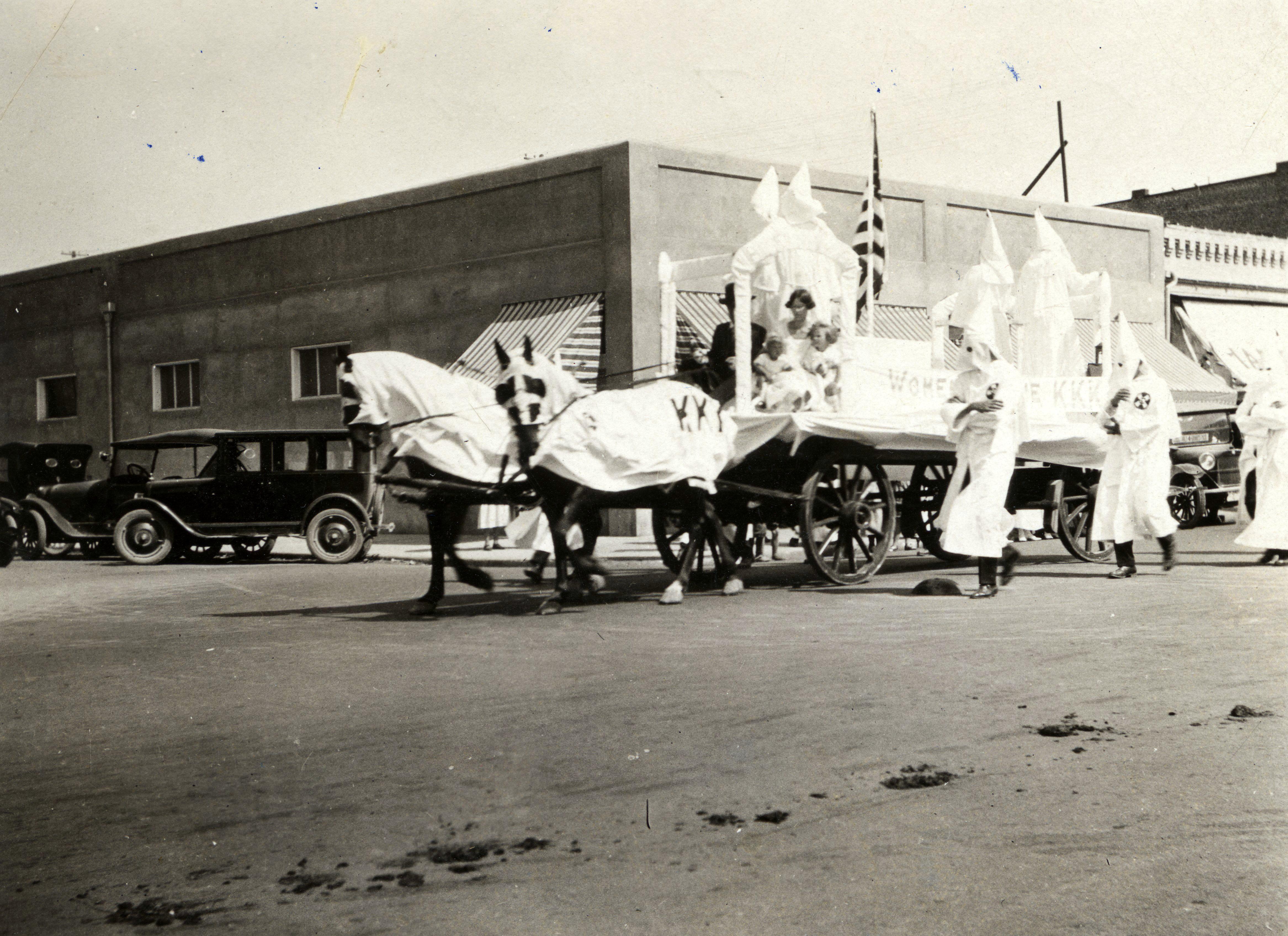
A group of KKK members parades down the streets of Grants Pass, Ore., in the 1920s. The KKK had a strong presence across the state in the early 1900s, with Oregon Klan leaders claiming 35,000 active members in 1923.
Lloyd Smith Collection
These conversations are happening here in Oregon, too, a state that — no matter which way you cut it — has deep roots in racism.
Walidah Imarishais a writer, educator, public scholar and spoken word artist.
Pete Shaw
“[These] laws point to the fact that Oregon was founded as a racist white utopia,” said Walidah Imarisha, a Black studies educator and writer based in Oregon. “The idea was that white folks would come here and build the perfect white society.”
In 1844, when Oregon was still a territory, it passed its first Black exclusionary law. It banned slavery, but it also prohibited Black people from living in the territory for more than three years. If a Black person broke this law, the consequence was 39 lashes, every six months, until they left.
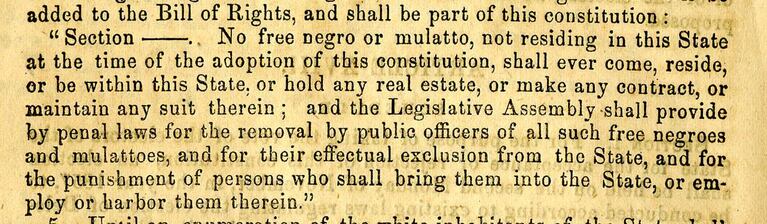
The final exclusion measure made it into the Oregon Constitution as a clause when the territory became a state 10 years later in 1859. This clause went further than the territory’s second law by also prohibiting Black people from owning property and making contracts.
“It speaks very clearly to the ways that this place was founded to center whiteness, not only at the exclusion of folks of color but at the brutalization of folks of color,” said Imarisha.
These laws were rarely enforced but they did the job they were created to do: establish Oregon as a majority white state. And it’s why Portland, the state’s most populous city, is still known as the whitest big city in the United States.
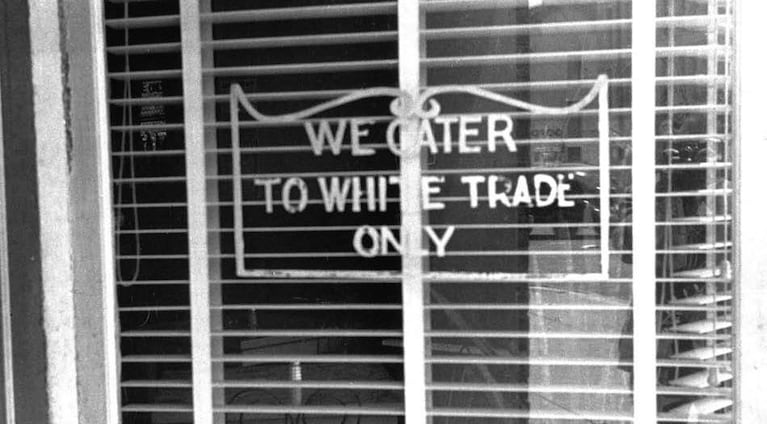
Sign in the window of a Portland restaurant circa 1943
Photo Courtesy of Oregon Historical Society, CN 0034
In 1859, Oregon was the only state admitted to the Union with an Exclusion Clause in its constitution.
Oregon State Archives
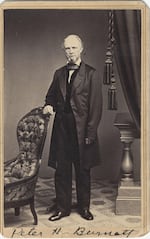
Peter Burnett was the author of the first exclusion law banning blacks in Oregon Territory.
Shew, W. M., photographer. Photo Courtesy of Oregon Historical Society, Orhi 13424
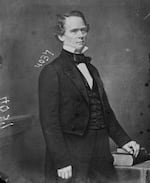
Oregon’s First Territorial Governor, Joseph Lane, supported slavery. In 1860, he was a candidate for vice president against Abraham Lincoln
Photo Courtesy of Library of Congress
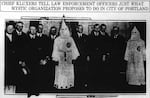
The Portland Telegram published this images of the KKK meeting with Portland leaders in 1921. Included are the city Chief of Police, Captain of Police, the District Attorney and a sheriff
Photo Courtesy of Oregon Historical Society, ba021814
“This is an ideology that is not only alive, it’s serving as the foundation for the institutions of Oregon,” said Imarisha. “Oregon is a useful case study for the rest of the nation because the only thing unique about Oregon is [it] was bold enough to write it down. The same policies, practices and ideologies that shaped Oregon, shaped the nation as a whole.”
“This movement, which is led by Black youth, is incredibly inspiring,” said Imarisha. “I just really want to say thank you to the leadership who have created this movement.”
Ultimately, Imarisha believes this movement and the conversations we’re all experiencing now can bring about profound societal changes for Black people and other people of color.
“If you believe in freedom, if you believe in justice, if you believe in liberation — now is the time to act,” said Imarisha.
Hear the full conversation with Walidah Imarisha in the audio player above.
Ron and I had a wonderful Christmas day. We had good food, we had good times. Here is a couple pictures of me sharping our knives, including serrated ones you can do if you are careful.
Then there was the jolly elf in the kitchen working to prepare enough food for 10 people. How he misses the days we held being holiday gatherings. I helped on and off like doing the cooking and peeling of the eggs for the deviled eggs. Here is the elf at work.
And then there is the result of all the work. The food.
December 26, 1862 38 members of the Santee Sioux tribe were hanged in a public mass execution in Minnesota. 300 members of the band had been convicted of participating the the Minnesota Uprising and ordered to hang. However, all sentences except the 38 had been commuted by President Abraham Lincoln. For decades white settlers had been encroaching on Santee Sioux territory, and they had been victimized by corrupt federal Indian agents on the reservations.In July agents and contractors had withheld food when their demands for kickbacks had been refused. The Indians eventually struck back, killing Anglo settlers and taking some hostages. In two battles with the U.S. Army, they killed or wounded dozens of soldiers, but ultimately lost and were put on trial. America’s only legal mass execution =========================================== December 26, 1966 The first Kwanzaa was celebrated in Los Angeles, California. It was conceived and organized in the wake of the Watts riots by Dr. Maulana (Ron) Karenga, a professor and chairman of Black Studies at California State University at Long Beach. Kwanzaa is a non-religious African-American holiday focusing on family, community, and culture.The name Kwanzaa is derived from the phrase “matunda ya kwanza,” which means “first fruits” in Swahili. The celebrations are expressed through song, dance, drumming, storytelling, poetry and the lighting of candles in a Kinara, all followed by a large traditional meal. The holiday is observed for seven days, each representing a different principle: a Kwanzaa Kinara • Umoja (oo-MO-jah) Unity • Kujichagulia (koo-gee-cha-goo-LEE-yah) Self-Determination • Ujima (oo-GEE-mah) Collective Work and Responsibility • Ujamaa (oo-JAH-mah) Cooperative economics • Nia (NEE-yah) Purpose • Kuumba (koo-OOM-bah) Creativity • Imani (ee-MAH-nee) Faith Ron Karenga lighting the Kinara History, Principles, and Symbols of Kwanzaa ============================================ December 26, 1971 Two dozen members of Vietnam Veterans Against the War “liberated” the Statue of Liberty with a sit-in to protest resumed U.S. aerial bombings in Vietnam. They flew an inverted U.S. flag from the crown as a signal of distress. more on this action ============================================= December 26, 1992 photo: Simran Sachdev Belgrade, 7.2009 Women In Black began campaign against rape during war, Belgrade, Serbia. WIB website Women in Black is a world-wide network of women committed to peace with justice and actively opposed to injustice, war, militarism and other forms of violence. ================================================ December 26, 1999 Alfonso Portillo Cabrera scored a resounding victory (nearly 70% of the vote in the second round) in Guatemala’s first peacetime presidential elections following a 36-year civil war. Alfonso Portillo Cabrera after his election Some perspective

















 Scottie's Playtime