Only white Christian males can create history or do good things. There is no one of importance in the US in their minds. Erase anything that makes white males look bad in comparasion. What the fuck. He has gotten away with changing reality all his life so why not change history in all things. Hugs
The man in the MAGA cap and the “Size Matters” T-shirt allowed me to take his picture. The “size” in question had to do with bullets, represented on the shirt in a line from pistol- to bazooka-grade. Not far from us stood a man in a T-shirt that read “MAKE MEN MEN AGAIN.” Women walked past in red-white-and-blue outfits. Many had Bible verse numbers or slogans on their T-shirts, though quite a few sported images of guns, some of which were aimed at “RINOs.” At a booth nearby, a group of women was raising money for the “patriots” of January 6 incarcerated in “the DC gulag.”
It was a hot summer day in 2023, and there was little new for me at this gathering of right-wing activists in Las Vegas. Yet as I took in the January 6 memorabilia, I couldn’t help thinking back on another, very different event four years earlier. In 2019, I found myself in a seventeenth-century palazzo in Verona, Italy, for a gathering of the World Congress of Families, where I sat in on speeches and discussions with American, Russian, and European political activists on “the LGBT totalitarians” and the evils of “global liberalism.” The message was in some sense the same as the one in Las Vegas, but it’s safe to say that among the well-heeled, stylishly-dressed, highly-educated, and well-traveled participants there, members of the Nevada T-shirt crowd would have stuck out like a platter of corn dogs at a fine Italian trattoria.
The last of the speakers in Verona was a diminutive white-haired academic in a nondescript jacket and tie, the dean of a small law school in California, whose brief tirade about “gender confusion” among the “radical Left” didn’t leave much of an impression on me. I did, however, take note of his name: John Eastman. The same Eastman would later show up at the podium on the White House lawn on the morning of January 6 and he would subsequently turn up as “Co-Conspirator 2” in the federal indictment of Donald Trump for conspiring to overturn the 2020 election. He himself would be indicted in Georgia for the same conspiracy and disbarred in his home state of California. (He’s pled “not guilty” to conspiracy fraud and forgery charges.)
It’s a long way from the palazzo populists of Verona to the RINO hunters of Las Vegas, but they’re clearly part of the same story—the rise of an antidemocratic political movement in the United States. Though diverse and complicated, the movement is united in its rejection of the Enlightenment ideals on which the republic was founded and represents the most serious threat to American democracy since the Civil War.
They don’t want a seat at the table—they want to burn down the house
The American idea, as Abraham Lincoln saw it, is the familiar one articulated in the preamble to the Declaration of Independence. It says that all people are created equal; that a free people in a pluralistic society may govern themselves; that they do so through laws deliberated in public, grounded in appeals to reason, and applied equally to all; and that they establish these laws through democratic representation in government. While the American republic has often fallen short of this idea, many people rightly insist that we should, at the very least, try to live up to it. And in its better moments, the United States and its revolutionary creed have inspired freedom movements around the world.
But in recent years a political movement has emerged that fundamentally does not believe in the American idea. It claims that America is dedicated not to a proposition but to a particular religion and culture. It asserts that an insidious and alien elite has betrayed and abandoned the nation’s sacred heritage. It proposes to “redeem” America, and it acts on the extreme conviction that any means are justified in such a momentous project. It takes for granted that certain kinds of Americans have a right to rule, and that the rest have a duty to obey.
No longer casting the United States as a beacon of freedom, it exports this counterrevolutionary creed through alliances with leaders and activists who are themselves hostile to democracy. This movement has captured one of the nation’s two major political parties, and now controls the Presidency, Congress, and the Supreme Court. It claims to be “patriotic,” and yet its leading thinkers explicitly model their ambitions on corrupt and illiberal regimes abroad that render education, the media, and the corporate sector subservient to a one-party authoritarian state.
How did such an anti-American movement take root in America?
The antidemocratic movement isn’t the province of any single demographic, or even ideology. The real story of the authoritarian Right features a rowdy mix of personalities, often working at odds with one another: “apostles” of Jesus; atheistic billionaires; reactionary Catholic theologians; pseudo-Platonic intellectuals; woman-hating opponents of “the gynocracy”; high-powered evangelical networkers; Jewish devotees of Ayn Rand; pronatalists preoccupied with a dearth of (White) babies; COVID truthers; and battalions of “spirit warriors” who appear to be inventing a new style of religion even as they set about undermining democracy at its foundations.
To repeat the obvious: this movement represents a serious threat to the survival of American democracy. Today’s political conflicts aren’t simply the result of incivility, tribalism, “affective partisanship,” or some other unfortunate trend in manners. All will be well, the thinking goes, if the red people and the blue people would just sit down for some talk therapy and give a little to the other side. In earlier times this may have been sage advice. Today it’s a delusion.
American democracy is failing because it’s under direct attack, and the attack isn’t coming equally from both sides. The authoritarian movement isn’t looking for a seat at the noisy table of American democracy; it wants to burn down the house. It isn’t the product of misunderstandings; it advances its antidemocratic agenda by actively promoting division and disinformation. In my book, Money, Lies and God, I bring the receipts to support these uncomfortable facts.
The fall has been swift, but it was decades in the making
When did the crisis begin? It can sometimes seem that the antidemocratic reaction snuck up on us and suddenly exploded in our living rooms when Donald Trump descended on the escalator and announced his candidacy. Looking back over the decade and a half I’ve spent reporting on the subject, the escalation of the threat is breathtaking. In 2009, I was reporting on an antidemocratic ideology focused on hostility to public education that appeared to be gaining influence on the Right. By 2021, I was writing about an antidemocratic movement whose members had stormed the Capitol—and about a Republican Party whose leadership disgracefully acquiesced in the attempted overthrow of American democracy. Yet the swiftness of the fall should not distract from the long duration of the underlying causes.
The present crisis is deeply rooted in material changes in American life over the past half century. The antidemocratic movement came together long before the 2016 election, and the forces hurling against American democracy will long outlive the current political moment. Their various elements have emerged along the fissures in American society, and they continue to thrive on our growing educational, cultural, regional, racial, religious, and informational divides.
This antidemocratic reaction draws much of its energy from the massive increase in economic inequality and resulting economic dislocations over the past five decades. In the middle of the twentieth century, capitalist America was home to the most powerful and prosperous middle class the world had hitherto seen. By the second decade of the twenty-first century, capitalism had yielded in many respects to a form of oligarchy, and the nation had been divided into very different strata. At the very top of the wealth distribution arose a sector whose aggregate net worth makes the rich men of earlier decades look like amateurs. Between 1970 and 2020, the top 0.1 percent doubled its share of the nation’s wealth. The bottom 90 percent, meanwhile, lost a corresponding share.
For the large majority of Americans, the new era brought wage stagnation and even, within certain groups in recent years, declining life expectancy. In the happy handful of percentiles located just beneath the 0.1 percent, on the other hand, a hyper-competitive group has managed to hold on to its share of the pie even as it remains fearful of falling behind.
While the political conflicts of the present cannot be reduced to economic conflicts, the great disparity in wealth distribution is a significant contributor. It has fractured our faith in the common good, unleashed an epidemic of status anxiety, and made a significant subset of the population susceptible to conspiracism and disinformation.
Different groups, of course, have responded differently. The antidemocratic movement isn’t the work of any one social group but of several working together. It relies in part on the narcissism and paranoia of a subset of the super-rich who invest their fortunes in the destruction of democracy. They appear to operate on the cynical belief that manipulation of the masses through disinformation will enhance their own prosperity. The movement also draws in a sector of the professional class that has largely abdicated its social responsibility. Much of the energy of the movement, too, comes from below, from the anger and resentment of those who perceive that they’re falling behind.
As these groups jockey for status in a fast-changing world, they give rise to a politics of rage and grievance. The reaction may be understandable. But it’s not, on that account, reasonable or constructive. Although the antidemocratic movement emerged, in part, out of massive structural conflicts in the American political economy, it does not represent a genuine attempt to address the problems from which it arose. This new politics aims for results that few people want and that ultimately harm everybody.
The rocket fuel of the new American authoritarianism
What are the main features of this new American fascism grounded in resentment? In America, just as in unstable political economies of the past, the grievances to which the daily injustices of an unequal system give rise inevitably vent on some putatively alien “other” supposedly responsible for all our ills. America’s demagogues, however, have a special advantage. They can draw on the nation’s barbarous history of racism and the fear that the “American way of life” is slipping away, abetted by an out-of-touch elite.
The story of this movement cannot be told apart from the racial and ethnic divisions that it continuously exploits and exacerbates. The psychic payoff that the new, antidemocratic religious and right-wing nationalism offers its adherents is the promise of membership in a privileged “in-group” previously associated with being a White Christian conservative—a supposed “real American”—with the twist that those privileges may now be claimed even by those who aren’t White, provided they worship and vote the “right” way. At the same time, the movement is the result of the concerted cultivation of a range of anxieties that draw from deep and wide roots.
Anxiety about traditional gender roles and hierarchies is the rocket fuel of the new American authoritarianism. Among the bearded young men of the New Right, it shows up in social media feeds bursting with rank misogyny. In the theocratic wing of the movement, it puts on the tattered robes of patriarchy, with calls for “male headship” and female subordination, and relentlessly demonizes LGBT people. On the political stage, it has centered around the long-running effort to strip women of their reproductive health rights and, in essence, make their bodies the property of the state. That effort has had significant consequences at the ballot box—which is why a sector of movement leadership is starting to speak openly about stripping women of the right to vote. The tragedy of American politics is that the same forces that have damaged so many personal lives have been weaponized and enlisted in the service of a political movement that’s sure to make the situation worse.
Expressions of pain, not plans for the future
The bulk of this movement is best understood in terms of what it wishes to destroy, rather than what it proposes to create. Fear and grievance, not hope, are the moving parts of its story. Its members resemble the revolutionaries of the past in their drive to overthrow “the regime”—but many are revolutionaries without a cause.
To be sure, movement leaders do float visions of what they take to be a better future, which typically aims for a fictitious version of the past: a nation united under “biblical law”; a people liberated from the tyranny of the “administrative state”; or just a place somehow made “great again.” But in conversations with movement participants, I have found, these visions quickly dissipate into insubstantial generalizations or unrealizable fantasy. There is no world in which America will become the “Christian nation” that it never actually was; there’s only a world in which a theocratic oligarchy imposes a corrupt and despotic order in the name of sectarian values.
These visions turn out to be thin cover for an unfocused rage against the diverse and unequal America that actually exists. They’re the means whereby one type of underclass can be falsely convinced that its disempowerment is the work of another kind of underclass. They’re expressions of pain, not plans for the future. This phenomenon is what I call “reactionary nihilism.” It’s reactionary in the sense that it expresses itself as mortal opposition to a perceived catastrophic change in the political order; and it’s nihilistic because its deepest premise is that the actual world is devoid of value, impervious to reason, and governable only through brutal acts of will. It stands for a kind of unraveling of the American political mind that now afflicts one side of nearly every political debate.
Yet there is method in this phenomenon. The direction and success of the antidemocratic movement depends on its access to immense resources, a powerful web of organizations, and a highly self-interested group of movers and backers. It has bank accounts that are always thirsty for more money, networks that hunger for ever more connections, religious demagogues intent on exploiting the faithful, communicators eager to spread propaganda and disinformation, and powerful leaders who want more power.It takes time, organizational energy, and above all, money to weaponize grievances and hurl them against an established democracy—and this movement has it all.
To be clear, there’s no single headquarters for the antidemocratic reaction. There are, however, powerful networks of leaders, strategists, and donors, as well as interlocking organizations, fellow travelers, and affirmative action programs for the ideologically pure. That matrix is far more densely connected, well-financed, and influential at all levels of government and society than most Americans appreciate.
History shows, however, that better organization does not always flatten the contradictions. On the contrary, it can sometimes amplify the conflicts. This is perhaps the most difficult to appreciate aspect of the antidemocratic movement—and the source of both its weakness and its strength. This movement is at war with itself even as it wages war on the rest of us. It consists of a variety of groups and organizations, each pursuing its own agendas, each in thrall to a distinct set of assumptions.
Viewed as a whole, it seems to want things that cannot go together—like “small government” and a government big enough to control the most private acts in which people engage; like the total deregulation of corporate monopolies and a better deal for the workforce; like “the rule of law” and the lawlessness of a dictator and his cronies who may pilfer the public treasury; like a “Christian nation” that excludes many American Christians from the ranks of the supposedly righteous. It pursues this bundle of contradictions not merely out of hypocrisy and cynicism but because the task of tearing down the status quo brings together groups that want very different things and are even at odds with one another.
Hope despite—and because of—the chaos
While a survey of the antidemocratic reaction in the United States is bound to provoke alarm and perhaps even a feeling of hopelessness, the self-contradictory nature of this reaction should be a source of hope for those who want to defend American democracy. MAGA is in many regards a weak movement, not a strong one. It draws on multiple factions, including oligarchic funders, the Christian Right, the New Right, libertarians, Q-Anoners, White nativists, “parent activists” radicalized by disinformation, health skeptics, a small segment of the Left, and others, all of whom worked together to bring slim majorities of voters to their side. These groups don’t really belong together, and they probably won’t stay together indefinitely.
In spite of their differences, for now these groups are rowing in the same boat. They told us ahead of the 2024 election that they were going to smash the federal bureaucracy, which they view for ideological reasons as interfering with their agenda. Trump said in no uncertain terms that he would turn the Department of Justice into his personal vendetta machine, and that’s what he’s attempting to do. He promised trade wars and let everybody know he would trash vital international alliances, and that’s what he’s doing.
So this is no time to retreat under the covers. Now is the time for moral courage. There are more Americans who would prefer to live in a democracy than a kleptocratic, Christian nationalist autocracy.We need to come together in broad coalitions and stay focused on organizing—from developing pro-democracy strategies and infrastructure to taking local action to improving voter turnout operations—now and in the long term.
When they lost in 2020, the MAGA movement didn’t roll over. They simply resolved to organize better and fight harder. Above all, they found new populations to evangelize with untruths. We wouldn’t wish to emulate their most craven tactics, of course, but we can learn something from their strategic resolve.
March 28, 1799 The New York state legislature enacted a law mandating the gradual end of slavery. Children of slaves would not be emancipated until they had served their parent’s “holder” and reached their mid-twenties. It was not until 1827 that a subsequent law declared, “every person born within this state, whether white or colored, is free.” ========================================= March 28, 1918 2,000 in the city and province of Quebec, Canada, demonstrated at the culmination of the conscription crisis during the “Great War” (World War I). High casualty rates in Europe forced the Ottawa, Ontario, national government to institute a draft. The Canadiens resisted military service in support of Great Britain’s foreign policy. The protests continued for five days over the Easter weekend. Anti-Conscription Parade in Victoria Square, Montreal, Quebec, May 24, 1917.The gathering in this photo looks calm. Riots nearly a year later resulted in the death of four demonstrators in Quebec City. Read more ========================================= March 28, 1964 Three hundred were arrested during a sit-down protest at U.S. Air Force headquarters in Ruislip, England. The protest was organized by the Committee of 100, a group using nonviolent direct action to campaign for British unilateral nuclear disarmament. Conceived by the president of the Committee for Nuclear Disarmament, Bertrand Russell (he resigned this post soon after), and a young American academic named Ralph Schoenman, they proposed mass civil disobedience in resisting nuclear weapons, challenging the authorities to “fill the jails” with the intention of causing prison overload and large-scale disorder . Police in Ruislip arrested men and women demonstrators indiscriminately. photo: John ‘Hoppy’ Hopkins. They were committed to nonviolence, and on arrest would go limp so as to create maximum disruption without conflict. ========================================== March 28, 1968 Martin Luther King, Jr., led a march in support of striking sanitation workers in Memphis, Tennessee. Shortly after its start, violence broke out followed by looting; one 16-year-old black boy was killed, 60 people were injured, and over 150 arrested. Police dispersed the rioters with mace, batons and teargas. National Guard troops are called in and sealed off black neighborhoods; martial law was declared by nightfall. Despite the violence, King insisted on returning to the city and the sanitation workers’ side the following week. Two alternative views of what happened that day in Memphis, and what followed ========================================== March 28, 1979 In the worst nuclear accident in U.S. history, a cooling system on the Unit Two reactor failed at Three Mile Island (TMI) in Middletown, Pennsylvania. This led to a partial meltdown that uncovered the reactor’s core. Radioactive steam leaked into the atmosphere, prompting fears for the safety of the plant’s 500 workers and the surrounding community. More from nearby Dickinson College Three Mile Island accident timeline with photos ========================================= March 28, 2001 After being delayed by massive anti-nuclear protests en route, 60 tons of nuclear waste arrived by train at Dannenberg, Germany. Though the government has agreed to phase out German reliance on nuclear power, some plants will continue to operate until 2021. The waste fuel rods sent to France for reprocessing had to return to Germany for permanent long-term storage. Transported through Germany by train, and then by truck to their permanent site in Gorleben, movement of the 28 glass casks was considered an unacceptable safety risk to residents. Protesters blocked the tracks, sometimes chaining themselves in place, to stop the shipment. 20,000 police were required to allow the train’s passage. Protester Jürgen Sattari said he considered the operation a success. “We want to stop the convoy,” he said. “Of course we know we can’t halt it indefinitely, but we can drive up the political price.” More on the broad-based struggle against nuclear waste in Germany
Collective action, even on the tiniest scale, is still pretty damn terrific Read on Substack
Many of you know the backstory here, but stick with me. It’s unremarkable on its face, but that’s how metaphors work.
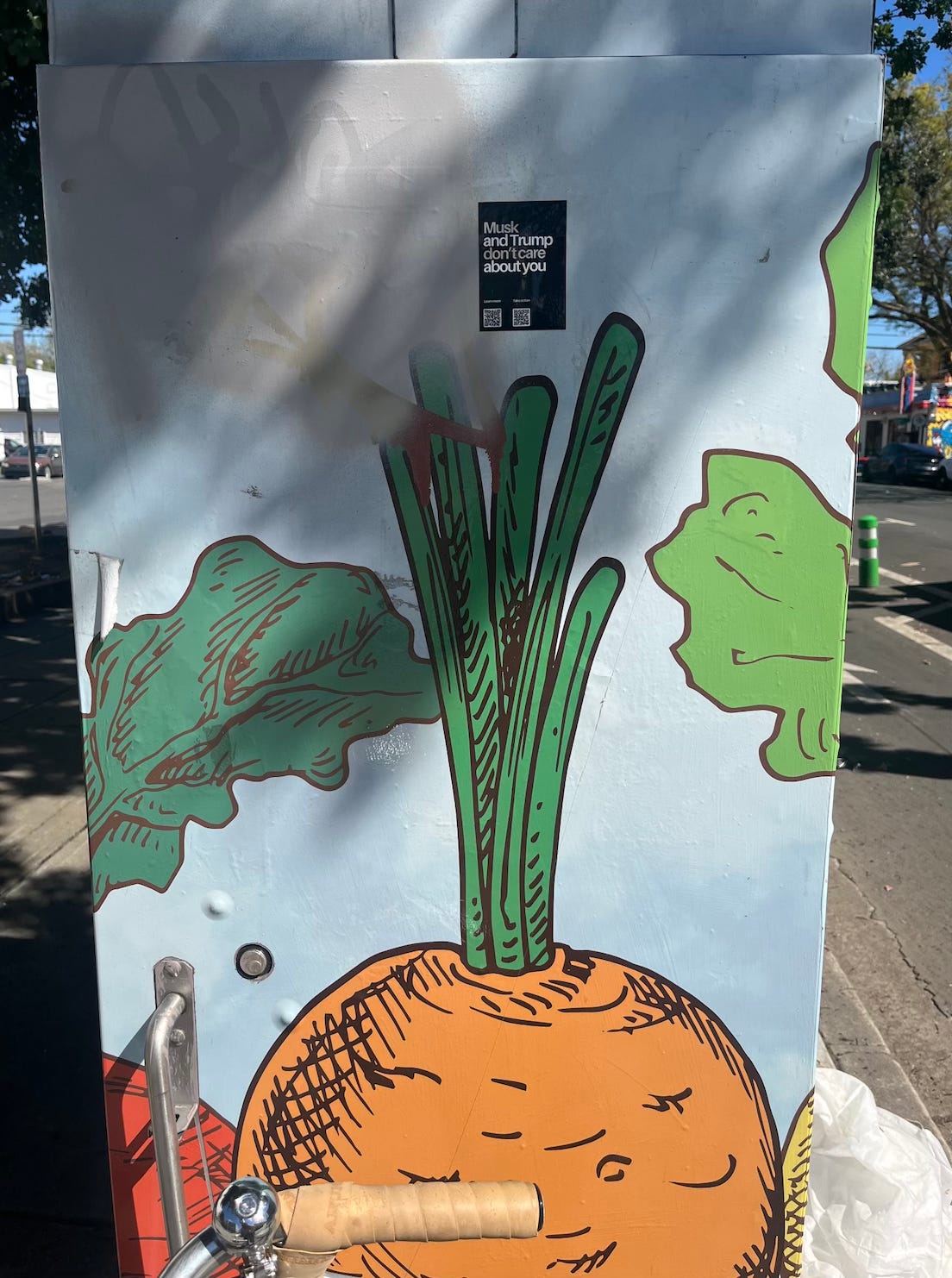
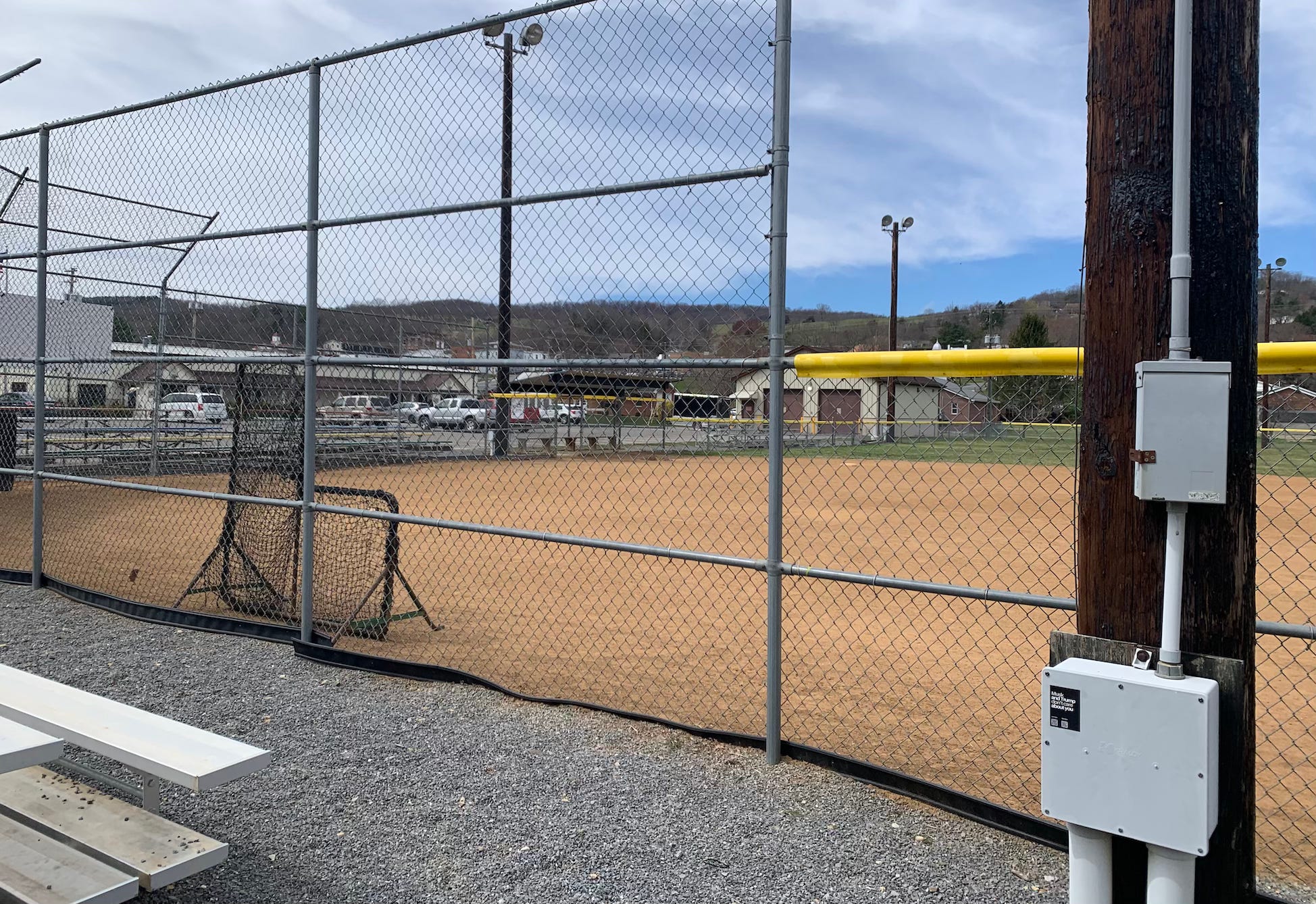
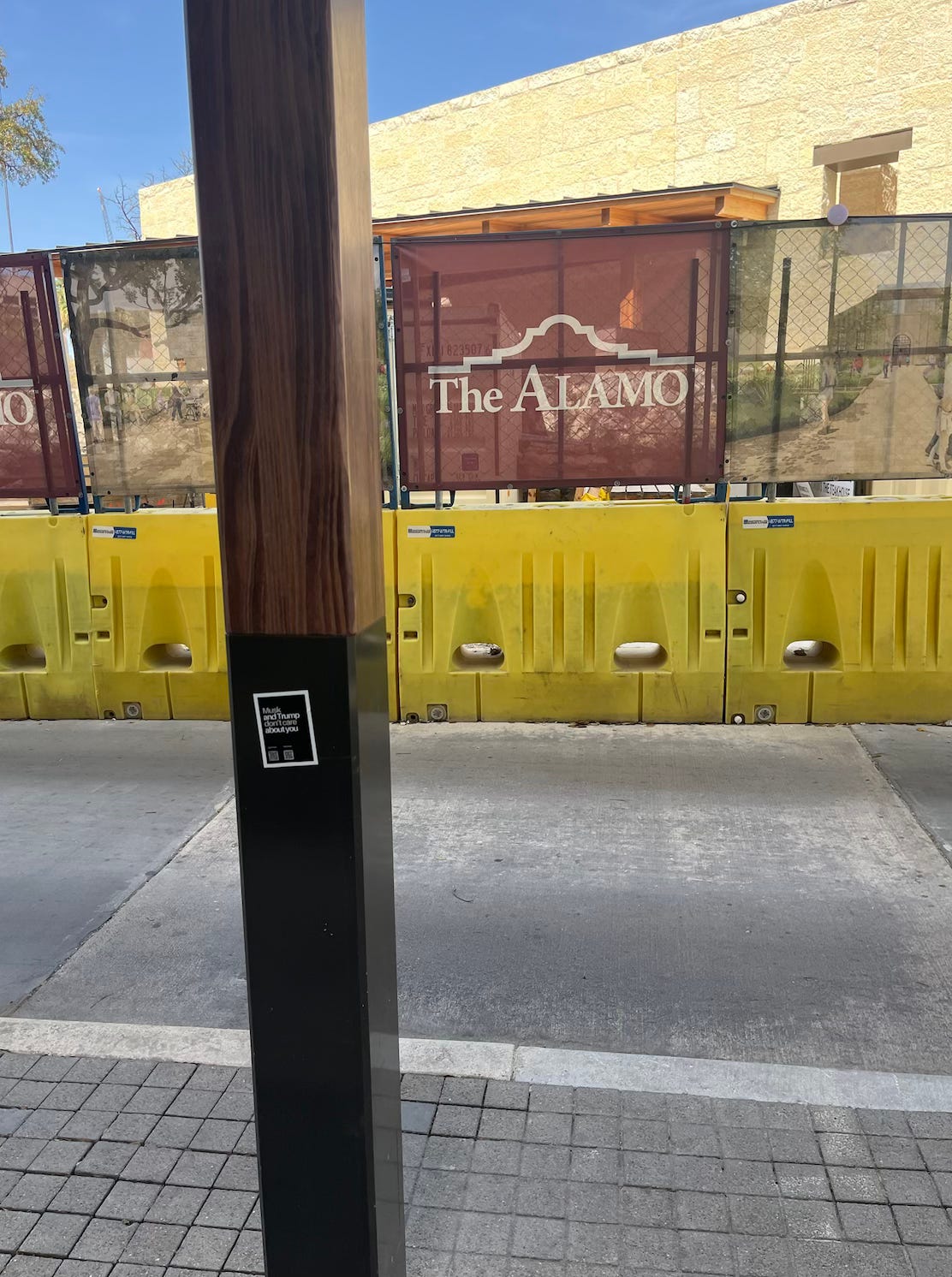
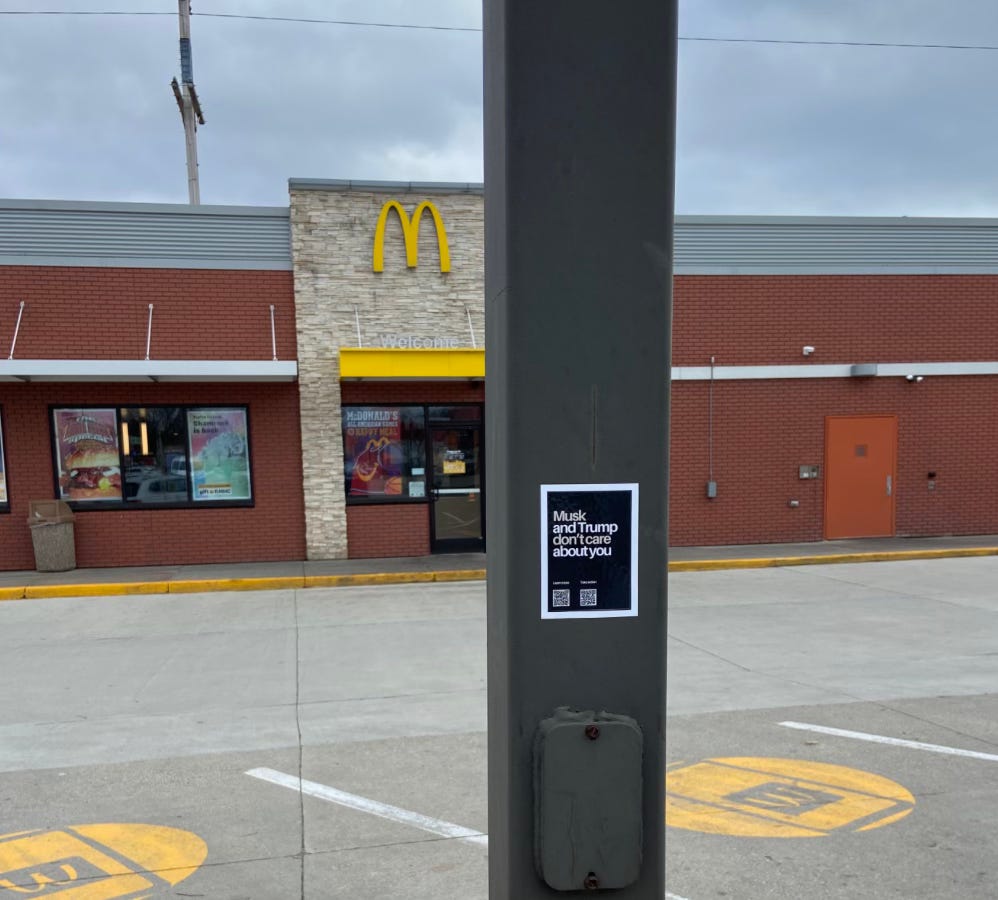
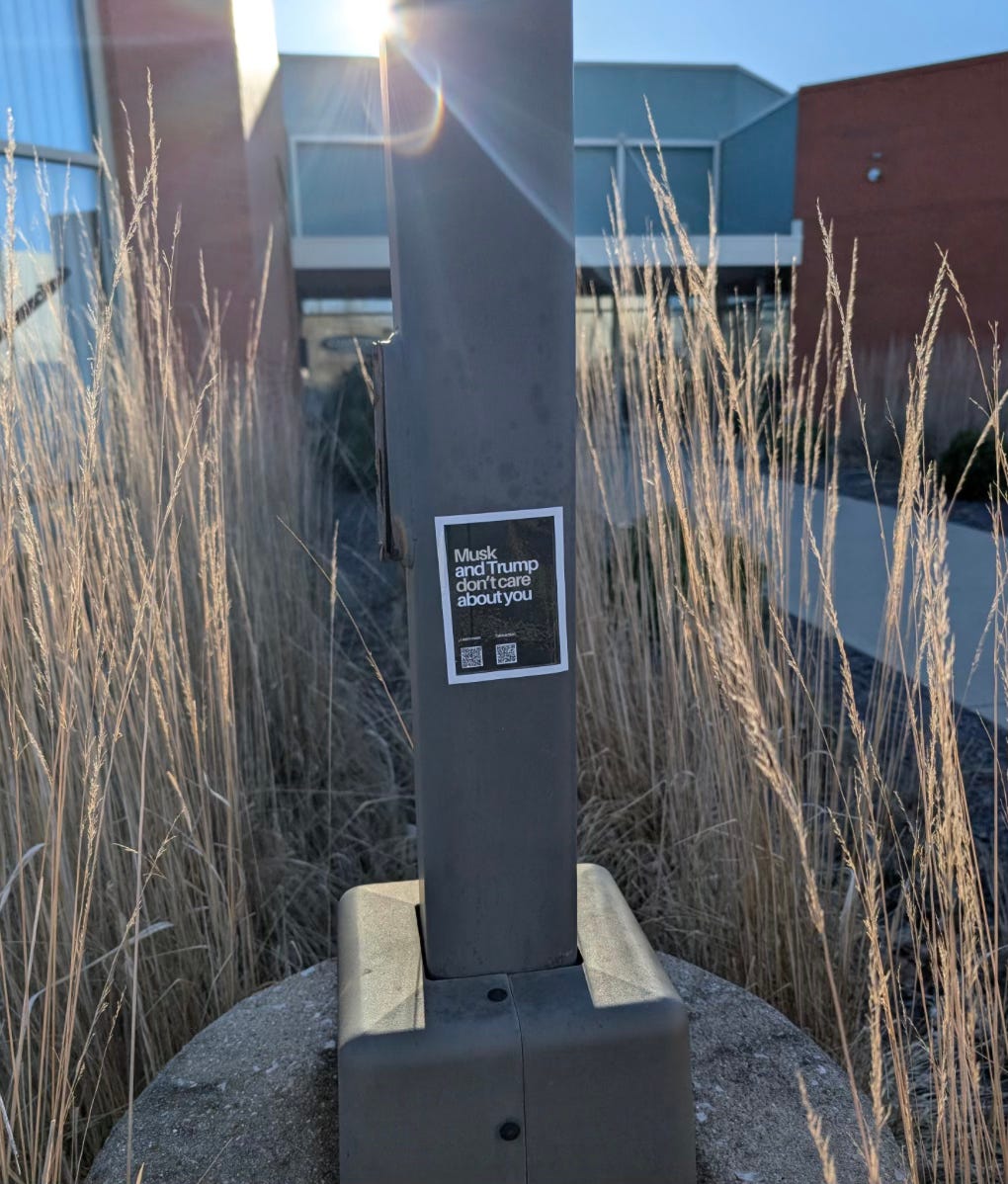
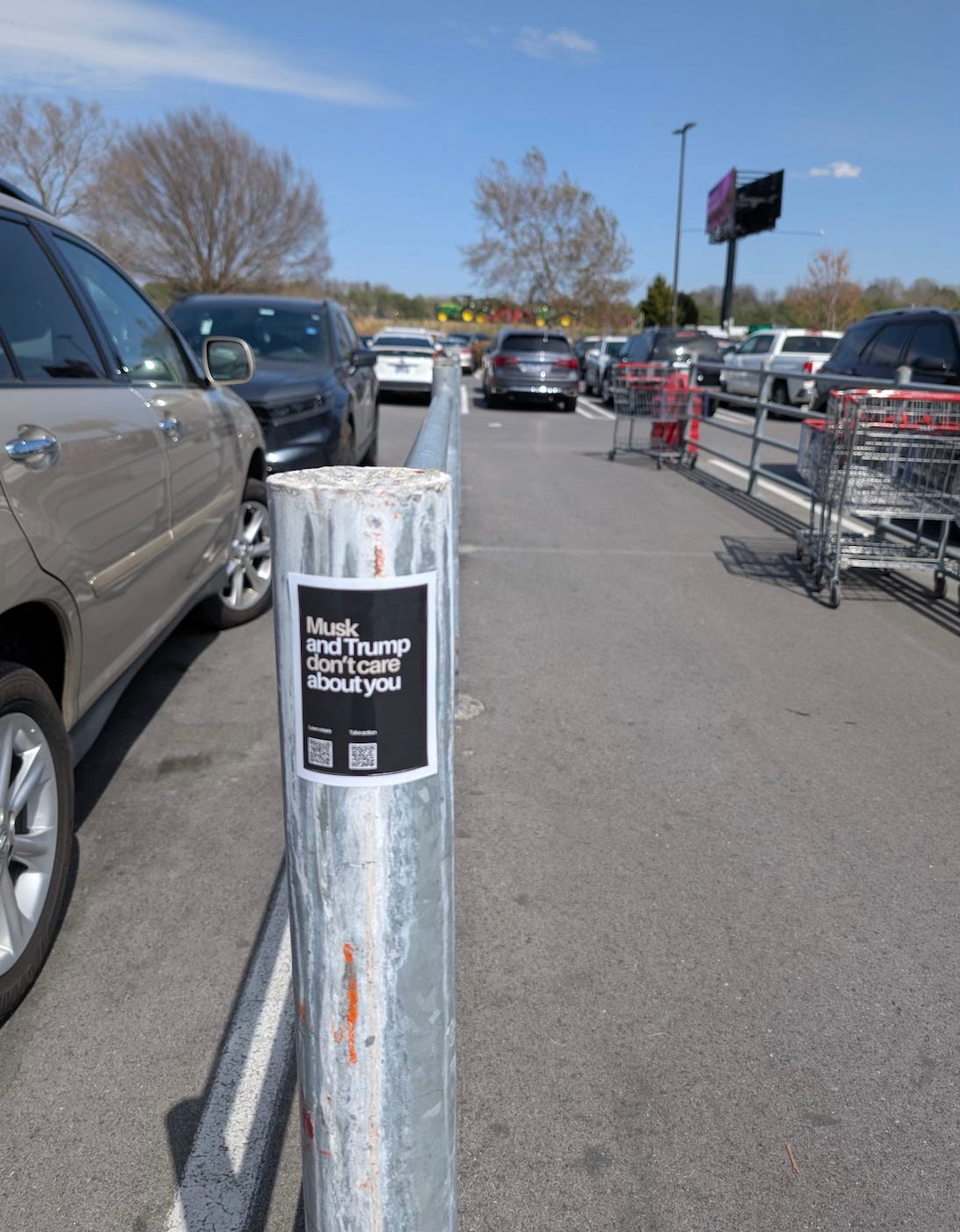
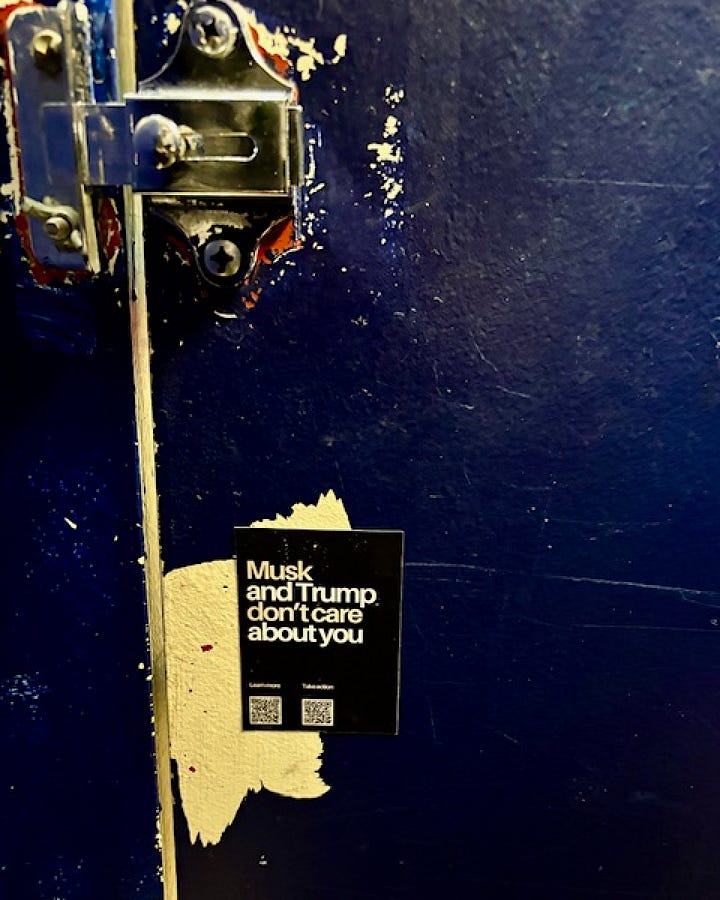
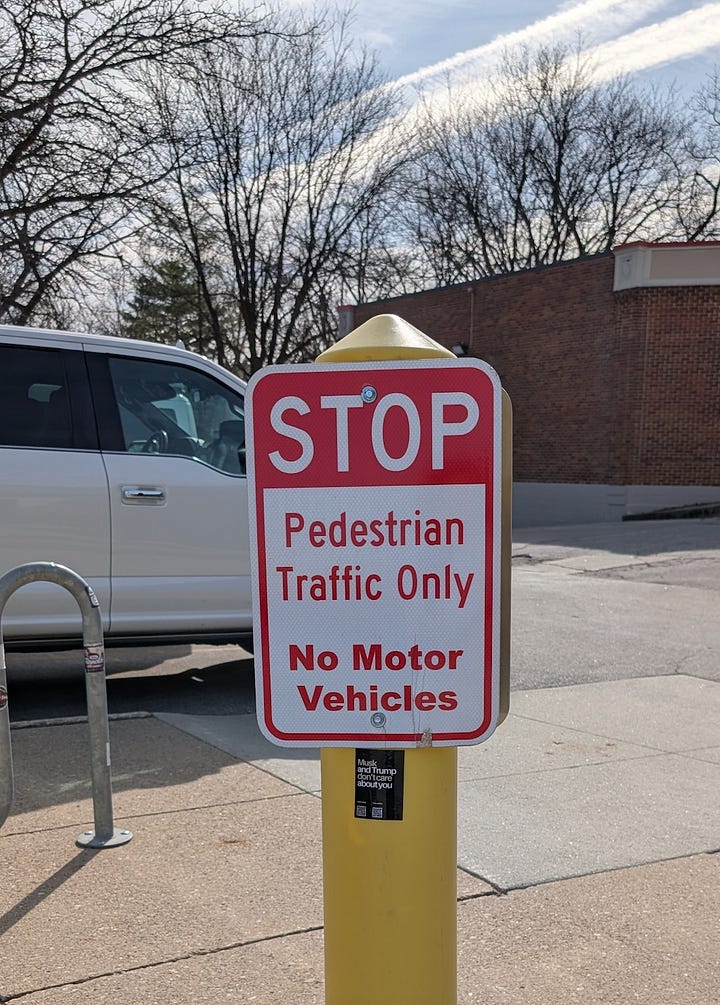
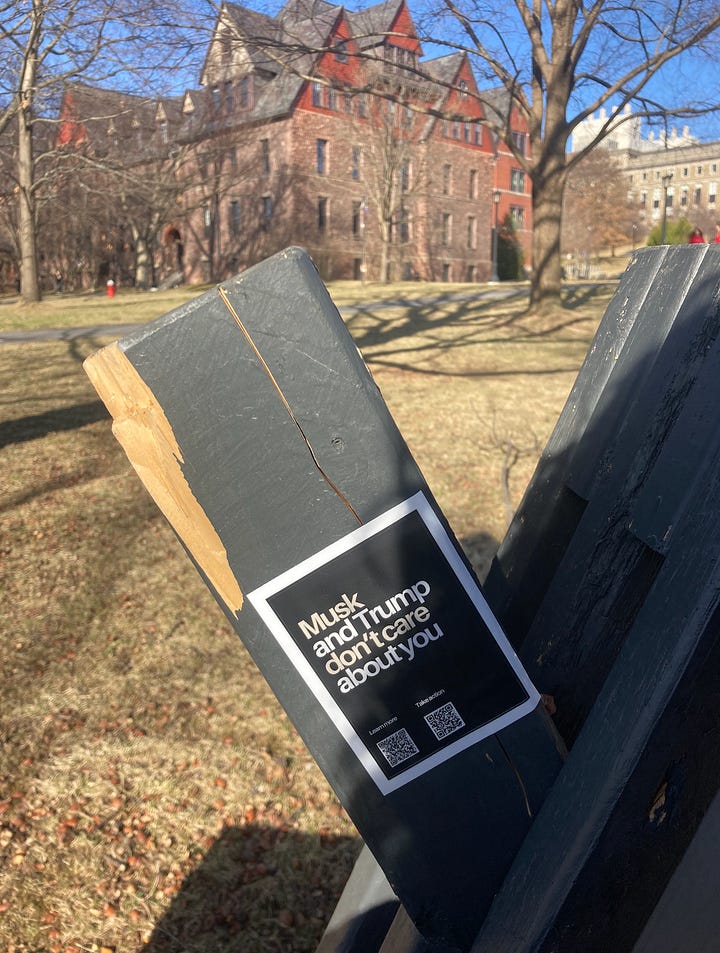
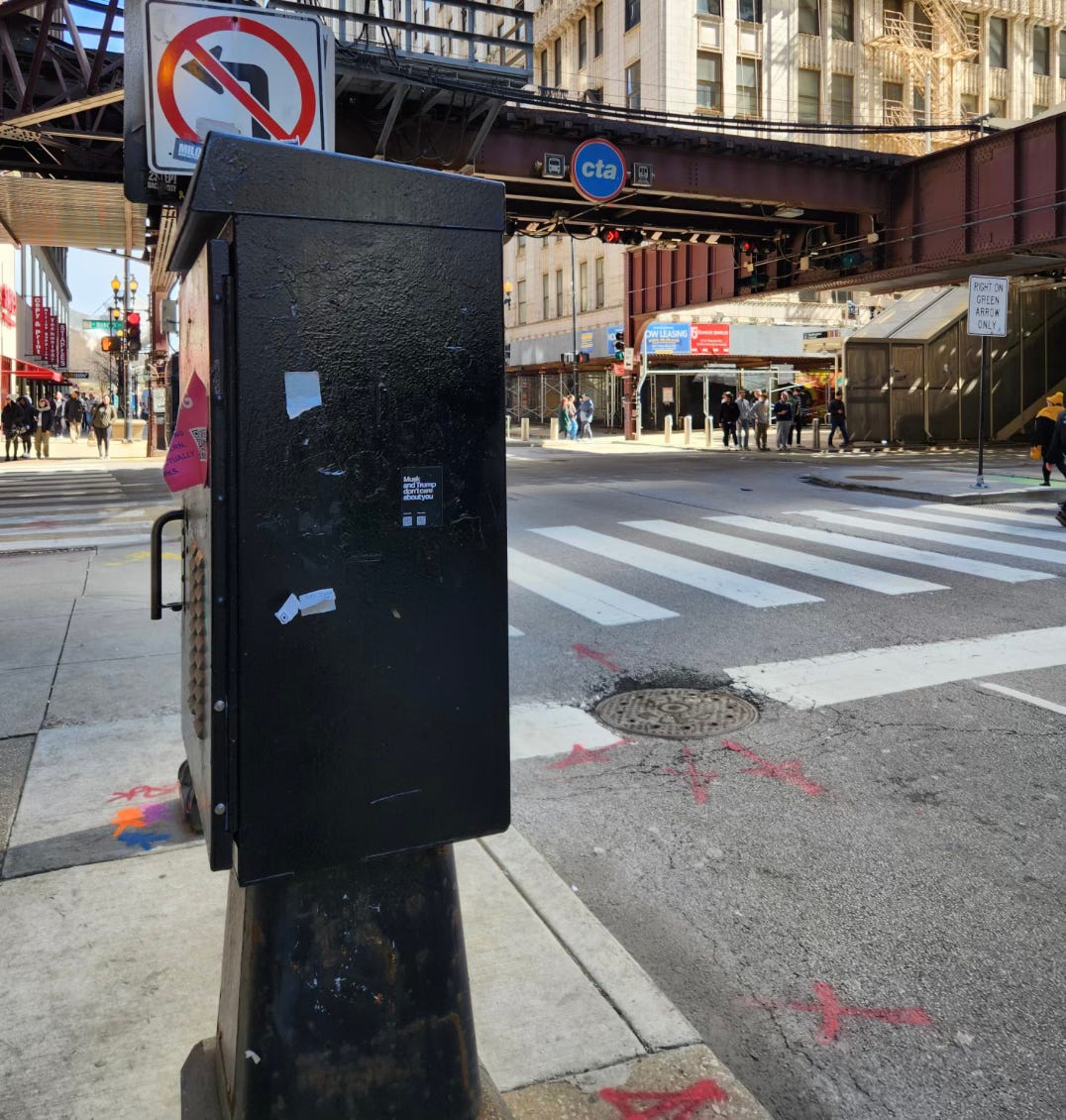
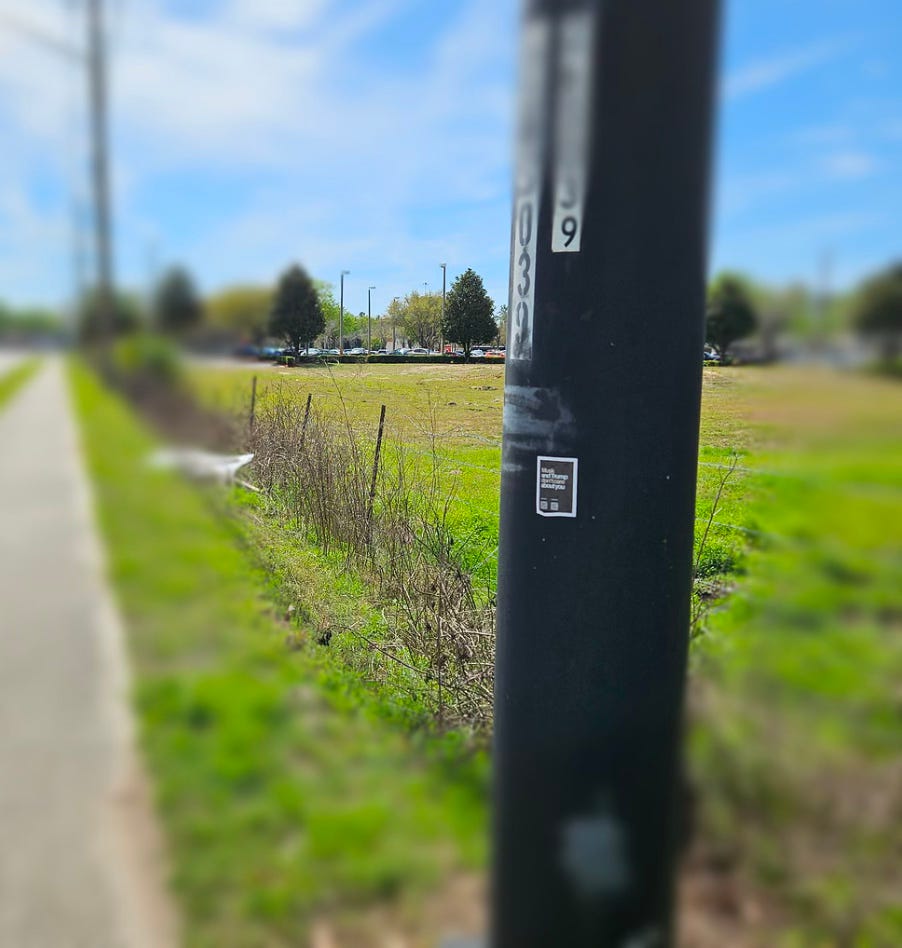
For the last couple weeks, I’ve been the joyful recipient of a steady stream of pictures. They’re all of the same sticker, one that I designed and ordered and likely should have made bigger than I did (I’ve received feedback). The sticker says “Trump and Musk don’t care about you.” There are a couple QR codes— links to learn more and take action— but not much else. It was an extremely simple project, just one of thousands that have been launched across the country since Trump was inaugurated. It will, I’m sure, not bring down a government or prevent a deportation or stop a bomb from falling.
I adore these stickers. They are tiny, on more than one level, but that’s how all impactful things start. Designing them wasn’t hard, nor was tossing off a few messages asking others if they wanted one as well. I said, in essence, “hey you all, this is a thing that I’m doing” And then, when hundreds of people across the country indicated that they would, in fact, like a sticker, they added their voice to mine. “This is a thing I can do as well,” they said, a chorus of beating hearts and frayed nerves. They shouted their reply from tiny towns and large cities, from places where they struggled to find a location that wouldn’t just preach to the choir, as well as places where Trump is worshipped like a God.
They answered, and I felt less alone in hearing their reply.
And then, because this is how trust is built, we kept our promises to one another. I sent out the stickers and they put them up and snapped a picture and then… well, we’ll see. I have no proof whatsoever if the chain will continue, if a teenager playing baseball or a mom returning her cart at Target or a trucker taking a rest break after a long day on the road will see them and be reminded that they too can do something, but if we limited our political imagination to actions whose ripples we could foresee without a shadow of the doubt, we would do so very little.
I have made a number of challenges to myself since Trump’s inauguration. I have challenged myself to counter the false faith of isolation and inhumanity with one of connection and care. I have challenged myself to remember every day how in love I am, how grateful I am, how much I believe in the beautiful counterpoints we have already shouted and the even more beautiful world we will build.
I don’t think I’ve answered any of those challenges in profound ways, but I am trying. And since I am trying, if my heart beams every time I receive another picture of a sticker out in the world, then the least I can do is to share that feeling with you as well.
Do you want to see some of the stickers? I hope so, because if they are out there, that means that we are out there, even when it feels like we aren’t, even if we convince ourselves so frequently that being out there isn’t enough, even when we don’t yet understand why or how our being out there adds up to the world we want to live in together.
So, my friends, here are a few of them…
…on top of a carrot in Sacramento.
..preparing to play ball in a West Virginia County that gave 78% of its vote to Trump in November.
…remembering the Alamo.
…as well as another complicated American icon (in Iowa).
…welcoming visitors to a farm bureau in Illinois.
…and what I’m assured is a “surprisingly scenic” Costco parking lot in Fort Oglethorpe, Georgia.
… in bathrooms (in South Carolina and Phoenix).
…and on signs that, if you read them the right way, also feature messages of opposition (in Des Moines, Iowa and Springfield, Illinois).
…on campus (at Cornell and the University of Tennessee).
…and rivers (the Fox, in Wisconsin).
…and rails (in Chicago).
…and roads (in rural Florida).
As of this writing, there are hundreds of stickers, but millions of American places. A drop in the bucket if ever there was one. But there they are, proclaiming that we’re still here. Connected to each other. Shouting out, “I am doing something. We are doing something. We are here today and we will be here tomorrow.”
I love them, because I love us.
End notes:
I’m letting most of the siblinghood of stickering remain blessedly anonymous, but I hope you read this lovely reflection from Lyndsey Medford (esteemed stickerer of Costco parking lots and one hell of a writer to boot).
It isn’t just stickering, of course. I truly believe that my inbox is one of the most hope-giving spaces on the planet, because it’s full of people telling me about how damn amazing it felt going to one of those (massive) Bernie-AOC rallies or how their Tesla protest tripled in size week to week or how they never expected to find such a powerful political home when they moved to East Tennessee. You all, get a load of us! Trying! Building!
Yes, I have a few more stickers left (though please be patient, I’m away from home this week so will send them out when I get back).
And yes, I don’t just send stickers. I also run trainings (free and virtual!) on how to organize and build community in your part of the world, and next week I’ll be announcing dates and times for the next round so if you’re not on the interest list please get there. (snip-More)
In a quote from the article one legislator lied saying this: We are a state and nation built on ‘In God We Trust,’” Middleton said in a news release following Tuesday’s vote on the school prayer bill. The fact is in god we trust was not the original motto of the nation. E pluribus unum (“Out of many, one”) was adopted by an Act of Congress in 1782 as the motto for the Seal of the United States and has been used on coins and paper money since 1795. The modern motto of the United States of America, as established in a 1956 law signed by President Dwight D. Eisenhower, is “In God we trust”. Want to know why? Because it was a slap at the godless communist of the USSR. Not that we were really a theocratic nation we just wanted to prove to ourselves and kids we were better than the heathens because we have the Christian god. Same shit is going on below.
Here is what it truely is about. “Other bill supporters and lawmakers said that there was a moral and spiritual imperative to introduce children to Christianity. Sen. Tan Parker, R-Flower Mound, cited a study that found around 25% of children have been to church. Other lawmakers similarly invoked declining Christian participation as a reason to support the bills. “There is eternal life,” said Sen. Donna Campbell, R-New Braunfels. “And if we don’t expose or introduce our children and others to that, then when they die, they’ll have one birth and two deaths.”” Forcing more kids / people to be Christians. Specifically forcing people to live by a strict regressive religious view of life. As less people are religious the donations to the church get less and funds dry up, churches have to close. The horror of it, then these people do deviant stuff like living normal lives enjoying sex.Hugs
The vote comes amid a broader push by conservative Christians to infuse more religion into public schools and life.
The Ten Commandments Monument is seen at the Texas Capitol in Austin. A Texas Senate panel on Tuesday advanced a bill Tuesday that would require schools to display the Ten Commandments in classrooms. Credit: Joe Timmerman/The Texas Tribune
The Texas Senate on Wednesday evening passed a bill that would require public school classrooms to display the Ten Commandments.
Senators passed Senate Bill 10 along party lines on a 20-11 vote.
A day prior,the Senate gave final approval to Senate Bill 11, which would allow districts to provide students with time to pray during school hours, on a 23-7 vote. All Republican senators and three Democrats — Royce West of Dallas, Judith Zaffirini of Laredo and Juan Hinojosa of McAllen — voted for the bill.
Both proposals, which are on Lt. Gov. Dan Patrick’s list of priority bills this session, are now headed to the House for consideration.
The votes are the latest sign of confidence by conservative Christians that courts will codify their opposition to church-state separation into federal law and spark a revitalization of faith in America.
That much was clear during the debate on the Senate floor. Several Democrats criticized both bills, saying they would infringe on the religious freedoms of Texans who are not Christian.
“Most Texans are religious,” Sen. Sarah Eckhardt, D-Austin, said on the floor Wednesday evening. “But I would venture that Texans do not want religion crammed down their throat by their government. Texans don’t even want their own religion crammed down their throat by their government.”
Both the school prayer and Ten Commandments bills drew sharp rebukes from Sen. Nathan Johnson, D-Dallas, as well. On the Senate floor Wednesday evening, he read aloud a letter directed to the Texas Legislature and written by 166 faith leaders in the state — including those from Sikh, Baptist, Jewish and Buddhist communities — calling on lawmakers to reject bills requiring the Ten Commandments be posted in public school classrooms.
“We do not need to — and indeed should not — turn public schools into Sunday schools,” wrote the letter, which was issued Tuesday.
Republican Sens. Mayes Middleton of Galveston and Phil King of Weatherford, who authored the bills, have expressed confidence that their legislation would survive in the courts. Religious conservatives see recent court rulings as a sign that legislation putting more religion in public schools will survive legal challenges — though critics of these proposals aren’t so convinced.
“Our schools are not God-free zones. We are a state and nation built on ‘In God We Trust,’” Middleton said in a news release following Tuesday’s vote on the school prayer bill. “Litigious atheists are no longer going to get to decide for everyone else if students and educators exercise their religious liberties during school hours.”
Middleton also thanked President Donald Trump for “making prayer in public schools a top priority.”
Similar arguments to those made on the Senate floor were also echoed during a Senate committee hearing on March 4, as supporters and some lawmakers argued that the legislation would reverse what they see as decades of national, moral decline.
The vote comes amid a broader push by conservative Christians to infuse more religion into public schools and life. In just the last few years, state Republicans have required classrooms to hang donated signs that say “In God We Trust”; allowed unlicensed religious chaplains to supplant mental health counselors in public schools; and approved new curriculum materials that teach the Bible and other religious texts alongside grade-school lessons.
Last month, Texas senators also approved legislation that would allow public taxpayer money to be redirected to private schools, including parochial schools.
Those efforts have come as the Texas GOP increasingly embraces ideologies that argue America’s founding was God-ordained, and its institutions and laws should thus reflect fundamentalist Christians views. Meanwhile, GOP lawmakers and leaders have continually elevated once-fringe claims that the wall between church and state is a myth meant to obscure America’s true, Christian roots. The argument has been popularized by figures such as David Barton, a Texas pastor and self-styled “amateur historian” whose work has been frequently debunked by trained historians, many of them also conservative Christians.
Barton and his son, Timothy Barton, were both invited to testify in favor of the bills on the March 4 hearing. Citing old documents and textbooks that mention the Ten Commandments, they argued that Christianity is the basis for American law and morality, and that their inclusion in classrooms would prevent societal ill such as gun violence.
“It used to be there was a very clear moral standard that we could point to,” Timothy Barton testified, calling it “ironic” that children can be arrested for breaking the law — and thus, he said, the Ten Commandments — but that they should not be able to read them in schools.
Other bill supporters and lawmakers said that there was a moral and spiritual imperative to introduce children to Christianity. Sen. Tan Parker, R-Flower Mound, cited a study that found around 25% of children have been to church.
“It’s absolutely horrific, and something we all need to work on to address,” he said.
Other lawmakers similarly invoked declining Christian participation as a reason to support the bills. “There is eternal life,” said Sen. Donna Campbell, R-New Braunfels. “And if we don’t expose or introduce our children and others to that, then when they die, they’ll have one birth and two deaths.”
Texas is one of 16 states where lawmakers are pursuing bills to require the Ten Commandments in classrooms — pushes that supporters say have been enabled by recent U.S. Supreme Court decisions. In 2019’s Kennedy v. Bremerton School District, for instance, the court ruled in favor of a Washington state football coach, Joe Kennedy, who argued that his employer, a public high school, was violating his religious rights by prohibiting him from leading prayers on the field after games.
Kennedy was among those who testified in support of the Texas bills on March 4. He was joined by Matt Krause, a former state House representative and current lawyer at First Liberty Institute, a Texas-based law firm that represented Kennedy and other high-profile plaintiffs in lawsuits that have allowed for more Christianity in public life.
The Kennedy case, Krause testified, was a “huge paradigm shift” that allowed for the Ten Commandments to be in classrooms because of its historical significance to American law and history. Asked about the recent court decision that blocked a similar Louisiana law, Krause said he expected the Texas bill would be upheld if it were taken to the ultraconservative Fifth Circuit Court of Appeals and, after that, the U.S. Supreme Court.
The bills have been strongly opposed by religious history scholars and some Christian groups, who argue that they are based on mischaracterizations of early American history and amount to a coercion of religion upon students. Opponents also say that the Ten Commandments bill diminishes a sacred text by stripping it of its religious nature, and that introducing more Christianity into schools will exacerbate tensions and isolate Texas’ growing number of non-Christian students.
“Since 2021, this Legislature has used its authority to impose increasingly divisive policies onto school districts, banning culturally relevant curriculum, forcing libraries to purge undesirable books and putting teachers into the crosshairs of overzealous critics,” said Jaime Puente of the nonprofit Every Texan. The bills “are two giant pieces of red meat that will further harm our schools.”
Christian opponents also testified that the bills would erode church-state separations — a cause that has historically been championed by Baptists and other denominations that faced intense religious persecution in early America.
“All Baptists are called to protect the separation of church and state,” said Jody Harrison, an ordained minister and leader of Baptist Women in Ministry. “Is it really justice to promote one type of Christianity over all schoolchildren?”
Harrison’s comments were strongly opposed by Campbell, the senator. “The Baptist doctrine is Christ-centered,” she said. “Its purpose is not to go around trying to defend this or that. It is to be a disciple and a witness for Christ. That includes the Ten Commandments. That’s prayer in schools. It is not a fight for separation between church and state.”
Disclosure: Every Texan has been a financial supporter of The Texas Tribune, a nonprofit, nonpartisan news organization that is funded in part by donations from members, foundations and corporate sponsors. Financial supporters play no role in the Tribune’s journalism. Find a complete list of them here.
Mother Jones illustration; Mark Boster/Los Angeles Times/Getty; Photos courtesy Génesis Lozada, Joseph Giardina, Arturo Suárez, and María Alvarado
Fight disinformation: Sign up for the free Mother Jones Daily newsletter and follow the news that matters.
On Friday, March 14, Arturo Suárez Trejo called his wife, Nathali Sánchez, from an immigration detention center in Texas. Suárez, a 33-year-old native of Caracas, Venezuela, explained that his deportation flight had been delayed. He told his wife he would be home soon. Suárez did not want to go back to Venezuela. Still, there was at least a silver lining: In December, Sánchez had given birth to their daughter, Nahiara. Suárez would finally have a chance to meet the three-month-old baby girl he had only ever seen on screens.
But, Sánchez told Mother Jones, she has not heard from Suárez since. Instead, last weekend, she found herself zooming in on a photo the government of El Salvador published of Venezuelan men the Trump administration had sent to President Nayib Bukele’s infamous Terrorism Confinement Center, or CECOT. “I realized that one of them was my husband,” she said. “I recognized him by the tattoo [on his neck], by his ear, and by his chin. Even though I couldn’t see his face, I knew it was him.” The photo Sánchez examined—and a highly producedpropaganda videopromoted by Secretary of State Marco Rubio and the White House—showed Venezuelans shackled in prison uniforms as they were pushed around by guards and had their heads shaved.
The tattoo on Suárez’s neck is of a colibrí, a hummingbird. His wife said it is meant to symbolize “harmony and good energy.” She said his other tattoos, like a palm tree on his hand—an homage to Suárez’s late mother’s use of a Venezuelan expression about God being greater than a coconut tree—were similarly innocuous. Nevertheless, they may be why Suárez has been effectively disappeared by the US government into a Salvadoran mega-prison.
Mother Jones has spoken with friends, family members, and lawyers of ten men sent to El Salvador by the Trump administration based on allegations that they are members of the Venezuelan organized crime group Tren de Aragua. All of them say their relatives have tattoos and believe that is why their loved ones were targeted. But they vigorously reject the idea that their sons, brothers, and husbands have anything to do with Tren de Aragua, which the Trump administration recently labeled a foreign terrorist organization. The families have substantiated those assertions to Mother Jones, including—in many cases—by providing official documents attesting to their relatives’ lack of criminal histories in Venezuela. Such evidence might have persuaded US judges that the men were not part of any criminal organization had the Trump administration not deliberately deprived them of due process.
On March 14, President Donald Trump quietly signed a proclamation invoking the Alien Enemies Act—a 1798 law last used during World War II. The order declared that the United States is under invasion by Tren de Aragua. It is the first time in US history that the 18th-century statute, which gives the president extraordinary powers to detain and deport noncitizens, has been used absent a Congressional declaration of war. The administration then employed the wartime authority unlocked by the Alien Enemies Act to quickly load Venezuelans onto deportation flights from Texas to El Salvador.
In response to a class action lawsuit brought by the ACLU and Democracy Forward, federal judge James Boasberg almost immediately blocked the Trump White House from using the Alien Enemies Act to summarily deport Venezuelans, and directed any planes already in the air to turn around. But in defiance of that order, the administration kept jets flying to El Salvador. Now Suárez and others like him are trapped in the Central American nation with no clear way to contact their relatives or lawyers.
Suárez, whose story has also been reported on by the Venezuelan outlet El Estímulo, is an aspiring pop musician who records under the name SuarezVzla. His older brother, Nelson Suárez, said his sibling’s tattoos were intended to help him “stand out” from the crowd. “As Venezuelans, we can’t be in our own country so we came to a country where there is supposedly freedom of expression, where there are human rights, where there’s the strongest and most robust democracy,” Nelson said. “Yet the government is treating us like criminals based only on our tattoos, or because we’re Venezuelan, without a proper investigation or a prosecutor offering any evidence.” (All interviews with family members for this story were conducted in Spanish.)
“Well, you’re here because of your tattoos,” the ICE agent reportedly said. “We’re finding and questioning everyone who has tattoos.”
The Justice Department’s website states that Suárez’s immigration case is still pending and that he is due to appear before a judge next Wednesday. Records provided by Nelson Suárez show that Arturo has no criminal record in Venezuela. Nor, according to his family, does Suárez have one in Colombia and Chile, where he lived after leaving Venezuela in 2016. They say he is one of millions of Venezuelans who sought a better life elsewhere after fleeing one of the worst economic collapses in modern history. (Just a few years ago, Secretary Rubio, then a senator from Florida, stressed that failure to protect Venezuelans from deportation “would result in a very real death sentence for countless” people who had “fled their country.”)
The stories shared with Mother Jones suggest that Trump’s immigration officials actively sought out Venezuelan men with tattoos before the Alien Enemies Act was invoked and then removed them to El Salvador within hours of the presidential proclamation taking effect.
“This doesn’t just happen overnight,” said immigration lawyer Joseph Giardina, who represents one of the men now in El Salvador, Frizgeralth de Jesus Cornejo Pulgar. “They don’t get a staged reception in El Salvador and a whole wing for them in a maximum-security prison…It was a planned operation, that was carried out quickly and in violation of the judge’s order. They knew what they were doing.”
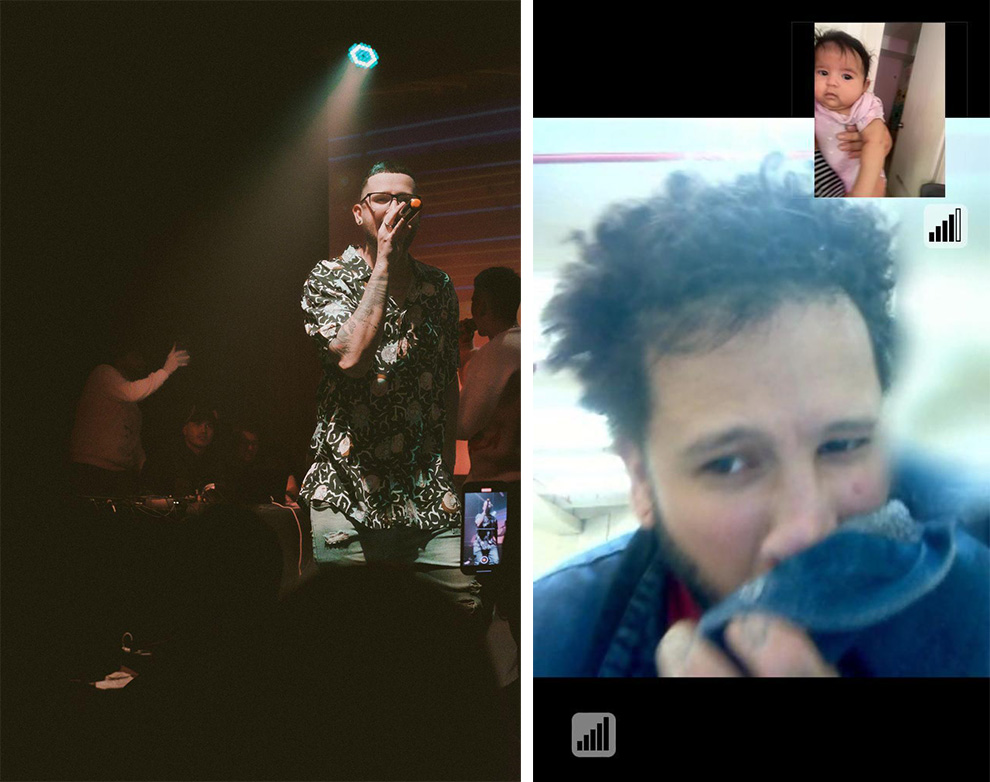
Arturo Suárez performing and speaking with his baby daughter from detention.Courtesy Arturo Suárez
The White House has yet to provide evidence that the hundreds of Venezuelans flown to El Salvador—without an opportunity to challenge their labeling as Tren de Aragua members and “terrorists”—had actual ties to the gang. When pressed on the criteria used for their identification, Press Secretary Karoline Leavitt pointed to unspecified “intelligence” deployed to arrest the Venezuelans she has referred to as “heinous monsters.” Trump’s border czar Tom Homan has insisted—without providing specific details—that the public should trust ICE to have correctly targeted the Venezuelans based on “criminal investigations,” social media posts, and surveillance.
Robert Cerna, an acting field office director for ICE’s removal operations branch, said the agency “did not simply rely on social media posts, photographs of the alien displaying gang-related hand gestures, or tattoos alone.” But Cerna also acknowledged that many of the Venezuelans deported under the Alien Enemies Act had no criminal history in the United States, a fact he twisted into an argument to seemingly justify the summary deportations without due process. “The lack of a criminal record does not indicate they pose a limited threat,” Cerna wrote. “In fact, based upon their association with TdA, the lack of specific information about each individual actually highlights the risk they pose. It demonstrates that they are terrorists with regard to whom we lack a complete profile.”
The relatives who talked to Mother Jones painted a vastly different picture from the US government’s description of the men as terrorists or hardened criminals. Many said their loved ones were tricked into thinking they were being sent back to Venezuela, not to a third country. (The Department of Homeland Security and ICE did not respond to a detailed request for comment asking for any evidence that the Venezuelans named in this articlehave ties to Tren de Aragua.)
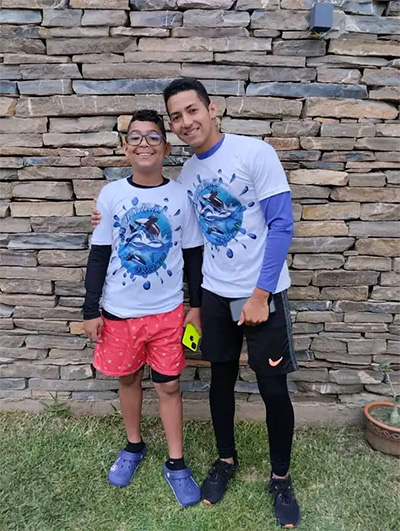
Before leaving for the United States in late 2023, Neri Alvarado Borges lived in Yaritagua, a small city in north central Venezuela. His father is a farmer and his mother supports his 15-year-old brother, Nelyerson, who has autism.
Neri Alvarado with his brother Nelyerson in 2023.Courtesy María Alvarado
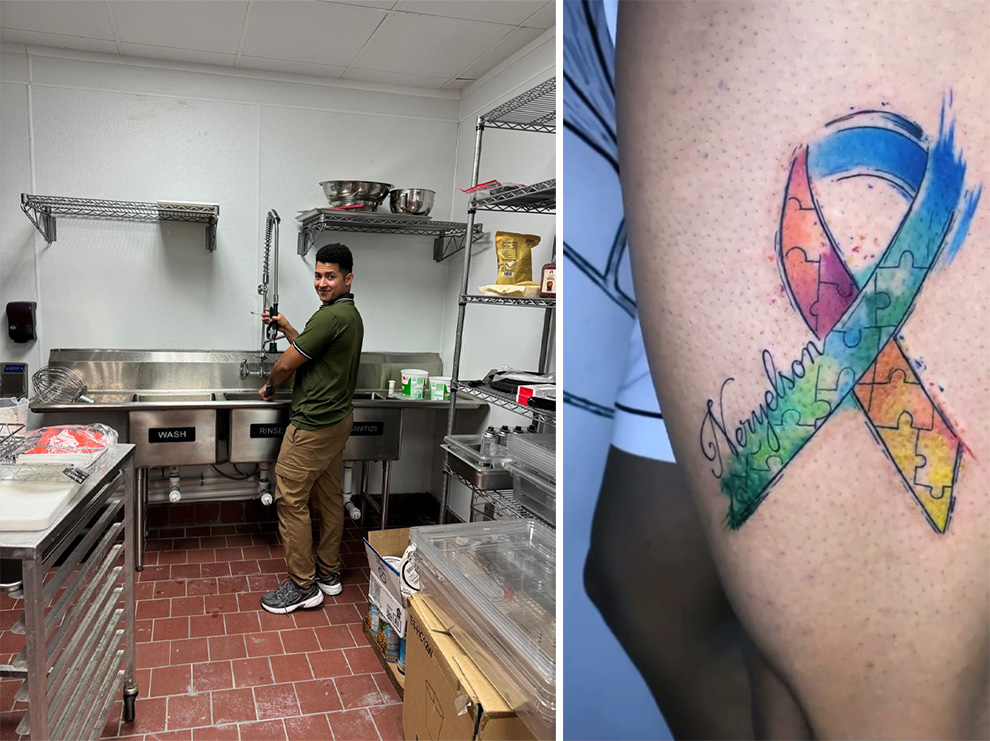
Alvarado’s older sister, María, stressed in a call from Venezuela that her brother has no connection to Tren de Aragua. She said her brother was deeply devoted to helping Nelyerson—explaining that one of his three tattoos is an autism awareness ribbon with his brother’s name on it and that he used to teach swimming classes for children with developmental disabilities.“Anyone who’s talked to Neri for even an hour can tell you what a great person he is. Truly, as a family, we are completely devastated to see him going through something so unjust—especially knowing that he’s never done anything wrong,” María said. “He’s someone who, as they say, wouldn’t even hurt a fly.”
Still, Alvarado was detained by ICE outside his apartment in early February and brought in for questioning, Juan Enrique Hernández, the owner of two Venezuelan bakeries in the Dallas area and Alvarado’s boss, told Mother Jones. One day later, Hernández went to see him in detention and asked him to explain what had happened. Alvarado told Hernández that an ICE agent had asked him if he knew why he had been picked up; Alvarado said that he did not. “Well, you’re here because of your tattoos,” the ICE agent replied, according to Hernández. “We’re finding and questioning everyone who has tattoos.”
The agent then asked Alvarado to explain his tattoos and for permission to review his phone for any evidence of gang activity. “You’re clean,” the ICE officer told Alvarado after he complied, according to both Hernández and María Alvarado. “I’m going to put down here that you have nothing to do with Tren de Aragua.”
For reasons that remain unclear, Hernández said that another official in ICE’s Dallas field office decided to keep Alvarado detained. María Alvarado said her brother told her the same story at the time.
Hernández spoke to Alvarado shortly before he was sent to El Salvador. “There are 90 of us here. We all have tattoos. We were all detained for the same reasons,” he recalled Alvarado telling him. “From what they told me, we are going to be deported.” Both assumed that meant being sent back to Venezuela.
Hernández, a US citizen who moved to the United States from Venezuela nearly three decades ago, searched desperately for Alvarado when he didn’t show up in his home country that weekend. He was nearly certain that Alvarado was in El Salvador when he first spoke to Mother Jones on Thursday. “I have very few friends,” he said. “Very few friends and I have been in this country for 27 years. I let Neri into my house because he is a stand-up guy…Because you can tell when someone is good or bad.” Later that day, on Alvarado’s 25th birthday, Hernández got confirmation that his friend was in El Salvador when CBS News published a list of the 238 people now at CECOT.
A centerpiece of Bukele’s brutal anti-gang crackdown, CECOT is known for due process violations and extreme confinement conditions. Last year, CNN obtained rare access to the remote prison, which can hold up to 40,000 people. The network found prisoners living in crowded cells with metal beds that had no mattresses or sheets, an open toilet, and a cement basin. Visitation and time outdoors are not allowed. A photographer who was allowed into the prison as the Venezuelans arrived earlier this month wrote for Time magazine that he witnessed them being beaten, humiliated, and stripped naked.
The Trump administration has indicated in court records that the El Salvador operation was weeks, if not months, in the making. In a declaration, a State Department official said arrangements with the Salvadoran and Venezuelan governments for the countries to take back US deportees allegedly associated with Tren de Aragua had been made after weeks of talks “at the highest levels”—including ones involving Secretary of State Rubio—and “were the result of intensive and delicate negotiations.”
As part of the deal, the US government will pay El Salvador $6 million to hold the Venezuelan men for at least one year. Calling the agreements a “foreign policy matter,” Rubio has claimed the outsourcing of deportees’ detention to Bukele’s “excellent prison system” is saving money for US taxpayers.
It is unclear if, or when, anyone sent to CECOT will be able to return to Venezuela. A Human Rights Watch program director noted in a declaration that the organization “is not aware of any detainees who have been released from that prison.” During an appeals court hearing on March 24, the ACLU’s lead counsel Lee Gelernt said, “We’re looking at people now who may be in a Salvadoran prison the rest of their lives.”
Neri Alvarado working at the bakery and the autism awareness tattoo with his brother’s name.Courtesy María Alvarado
Joseph Giardina’s client Frizgeralth de Jesus Cornejo Pulgar thought he was set to return to Venezuela on a deportation flight. Carlos, Frizgeralth’s older sibling, said his 26-year-old brother called their sister, who lives in Tennessee, from the El Valle detention center in Texas. He said Frizgeralth told her he was going to be deported to Venezuela later that day. “He was happy that he was going to be here with us,” Carlos said from Caracas in a video call with Mother Jones.
But Frizgeralth never arrived. Eventually, the family heard from the girlfriend of another Venezuelan set to be deported on the same flight as Carlos. She had identified him in videos shared on social media of the men who had been sent to the prison in El Salvador. On March 19, Carlos started scouring the internet and spotted his brother in a TikTok video. In it, Frizgeralth has his freshly shaved head pressed down, a rose tattoo on his neck peeking out from under a white t-shirt.
“We felt very powerless and in a lot of pain,” Carlos said. “To see how they mistreat a person who doesn’t deserve any of that. It’s not fair.”
“I never imagined being imprisoned just for getting a tattoo.”
Frizgeralth arrived in the United States in June 2024 after crossing the Darién Gap and waiting several months in Mexico for a CBP One appointment. The Biden-era program, which the Trump administration has since terminated, allowed migrants to schedule a date to present lawfully at a US port of entry. Carlos said Border patrol agents let Frizgeralth’s girlfriend and their other brother, as well as two friends, through but they held Frizgeralth back. He ended up detained at Winn Correctional Center, an ICE facility in Louisiana.
In messages to his family from detention, Frizgeralth expressed concern he was being investigated because of his tattoos. He explained that none of the 20 or so images—including one on his chest of an angel holding a gun—he has tattooed on his body have any connection to gang activity. He also described feeling discouraged from hearing stories in detention of Venezuelans who had recently been redetained and said ICE agents picked them up over suspicions about their tattoos.
Frizgeralth even had a declaration from his tattoo artist confirming the harmless nature of the artwork. “I never imagined being imprisoned just for getting a tattoo,” Frizgeralth, who owns a streetwear clothing brand with Carlos, wrote. “I never imagined being separated from my family. I wouldn’t wish this on anyone, not even my worst enemy if I had one. It’s horrible, it’s mental torture every day.”
Like Suárez and Alvarado, Frizgeralth had no criminal record in Venezuela, documents show. Giardina said his client also had no known criminal history in the United States. Nor did he have a final deportation order. During his preliminary court hearings, the US government never claimed or presented evidence that Frizgeralth had ties to Tren de Aragua. “He was doing everything he was supposed to do,” Giardina said. “He got vetted and checked when he came into the country. He was in detention the entire time. It’s insanity.” If anything, Giardina said, his client had a strong claim for asylum based on political persecution. He said Frizgeralth was being targeted by the colectivos, paramilitary groups linked to the Maduro regime.
About a week prior to his deportation, they moved Frizgeralth to Texas. His next hearing, which is scheduled for April 10, still appears on the immigration court’s online system. “To detain them in this maximum security prison with no access to lawyers, no charges, just because you’re saying they’re terrorists…,” Giardina said. “I mean, what the hell?”
Génesis Lozada Sánchez said she and her younger brother Wuilliam are from a rural Venezuelan “cattle town” called Coloncito near Colombia. Following Venezuela’s economic collapse, both she and Wuilliam lived in Bogota, where her brother saved up for the journey to the United States by making pants at a clothing factory. After he reached the border last January, Wuilliam was detained for more than a year, Génesis said.
On Friday, March 14, he called a cousin in the United States to say that he was about to be deported to Venezuela. “But to everyone’s surprise, that’s not what happened. They were kidnapped,” Génesis said. “Why do I say kidnapped? These people have no ties to El Salvador. They haven’t committed any crimes there. And they’re not even Salvadoran. They don’t even cross into El Salvador after going through the Darién Gap on their way to the United States. So, it’s a kidnapping. They tricked these guys into signing papers by telling them they were being sent to Venezuela.”
Like other men sent to El Salvador, Wuilliam has tattoos. But Génesis said that they have nothing to do with Tren de Aragua and that her brother has no criminal record. His goal had been to make enough money in the United States to help support their parents and to save up enough to hopefully open a clothing factory back home.
Other reporting and court briefs further support the families’ suspicions that their loved ones were primarily targeted for deportation because of their tattoos. In one instance, a professional soccer player, whose attorney said had fled Venezuela after protesting against the Maduro regime and being tortured, was accused of gang membership based on a tattoo similar to the logo of his favorite team, Real Madrid.
John Dutton, a Houston-based immigration attorney, said that he started noticing ICE officers detaining Venezuelans during check-ins due to their tattoos earlier this year. “If they notice they have a tattoo, they’re just taking them into custody,” he explained. “No more questions to ask.” Dutton estimated he now has about a dozen clients who have been arrested because of tattoos.
One of his clients, Henrry Albornoz Quintero, was due in court for a bond hearing last Wednesday after being taken into detention at a routine ICE check-in. “I show up. The judge asked me where my client is,” the Houston lawyer said. “I asked the same question to the DHS attorney. She looked at her notes, shuffled papers around as if she’s gonna find the answer in there, looks up, and said, ‘Judge, I don’t know.’”
Dutton told the judge that his client might be in El Salvador; his relatives had recognized him in one of the images of people at CECOT. The judge then decided not to hear the case on the grounds that he no longer had jurisdiction. “You could tell he wanted to help me,” Dutton added. “He just couldn’t. There’s nothing he could do.”
The next day, Albornoz’s name appeared on the list of people imprisoned in El Salvador. So far, Albornoz is the only one of Dutton’s clients to be sent there. His wife is nine months pregnant with their first child.
“They didn’t just deport these people and then set them free,” says Ilya Somin, a law professor at George Mason University. “They sent them to El Salvador, where that country, at the behest of the United States, is incarcerating them for at least a year in their prison system.This is not just deportation without due process. This is imprisonment without due process in a foreign prison system that has terrible conditions. That’s a pretty blatant violation of the Fifth Amendment’s due process clause, which says that you can’t take away people’s life, liberty or property without due process of law.”
Until Thursday, March 20, Barbara Alexandra Manzo still wasn’t sure if her brother Lainerke Daniel Manzo Lovera was among those sent to El Salvador and transferred to CECOT. The family hadn’t heard from him since that Saturday, when he called from El Paso, Texas, to say they were deporting him to Venezuela or Mexico. Her confirmation also came when she saw his name on the CBS News list.
Barbara Alexandra told Mother Jones that Lainerke didn’t even have a tattoo before he left Venezuela in December 2023. He got one—a clock on his arm—while living and working in Mexico, waiting for a CBP One appointment. It was a gift from a roommate who had been given a date before he did. Last October, Lainerke showed up at the border and was sent to ICE detention; first in San Diego, then briefly in Arizona. He had a court hearing scheduled for March 26.
“My son went to look for a better future, the American Dream,” his mother Eglee Xiomara said in a video. “And it didn’t come true. That was the worst trip he has ever made in his life.”
Lainerke has yet to meet his six-month-old daughter, who was born in the United States. “He’s never been in prison,” Barbara Alexandra said. “[We’re wondering] if he’s ok or if something is happening to him. And we’ll never know because we have no recourse.”
Nelson Suárez fears that he, too, could meet the same fate as his brother Arturo, the Venezuelan musician. Even during the first Trump administration, the fact that Nelson has Temporary Protected Status and a pending asylum case would have been enough to protect him from deportation. But there are no guarantees that it will be now. If Judge Boasberg’s temporary restraining order is lifted or overturned, he could be immediately deported to Venezuela, or sent to El Salvador, without due process. He doesn’t know if he will walk out of a scheduled check-in with ICE in May free or in chains.
“I’m really scared,” he said last week. “My three daughters are here with me. My wife is here. My kids are in school. I don’t know what could happen. Since this happened to my brother, I really haven’t been able to sleep. I have no peace, no sense of calm. I’m afraid to go out on the street. But at the same time, we have to go out to work and get things done.”



/https://static.texastribune.org/media/files/c7a1696609aad7f3c28290e0789cda42/0606%20Capitol%20File%20JT%20TT%2022.jpg)

 Scottie's Playtime