(Click “Read on Substack”, enjoy! It’s less than 1 minute.)
Has anyone seen Steve???
– In Otter News Read on Substack

(Click “Read on Substack”, enjoy! It’s less than 1 minute.)
Has anyone seen Steve???
– In Otter News Read on Substack
The right to enough to eat. Meanwhile,
October 25, 2025 by Heather Cox Richardson
Read on Substack
Yesterday the Trump administration said it would not use any of the approximately $6 billion the U.S. Department of Agriculture (USDA) holds in reserve to fund the Supplemental Nutrition Assistance Program (SNAP). The government shutdown means that states have run out of funds to distribute to the more than 42 million Americans who rely on SNAP to put food on the table.
Roll Call’s Olivia M. Bridges notes that this position contradicts the shutdown plan the USDA released in late September. Then, it said: “Congressional intent is evident that SNAP’s operations should continue since the program has been provided with multi-year contingency funds that can be used for State Administrative Expenses to ensure that the State can also continue operations during a Federal Government shutdown. These multi-year contingency funds are also available to fund participant benefits in the event that a lapse occurs in the middle of the fiscal year.”
Yesterday’s USDA memo also says that any states that tap their own resources to provide food benefits will not be reimbursed.
Today, in yet another violation of the Hatch Act that prohibits the use of government resources for partisan ends, the USDA Food and Nutrition Service website reads: “Senate Democrats have now voted 12 times to not fund the food stamp program, also known as the Supplemental Nutrition Assistance Program (SNAP). Bottom line, the well has run dry. At this time, there will be no benefits issued November 01. We are approaching an inflection point for Senate Democrats. They can continue to hold out for healthcare for illegal aliens and gender mutilation procedures or reopen the government so mothers, babies, and the most vulnerable among us can receive critical nutrition assistance.”
It appears the administration is using those Americans who depend on food assistance as pawns to put more pressure on Democrats to cave to Trump’s will. Today, Annie Karni of the New York Times reported that Trump has joked, “I’m the speaker and the president,” and Trump ally Steven Bannon calls Congress “the state Duma,” a reference to Russia’s rubber-stamp assembly.
With Republicans refusing to negotiate with Democrats in the normal way, with House speaker Mike Johnson (R-LA) keeping the House out of session, and with Trump leaving for Asia for a week, Republicans are clearly making the calculation that Democrats who refused to give up their demand for the extension of the premium tax credit to stop dramatic hikes in the cost of healthcare premiums will cave when America falls into a hunger crisis.
What are we doing here, folks?
The nation’s nutrition program was once the symbol of government brokering between different interests to benefit everyone. When President Franklin Delano Roosevelt took office in 1933, one of the first crises he had to meet was the collapse of agricultural prices, which had been falling since the end of World War I and fell off a cliff after the stock market crash of October 1929. Farmers reacted to falling prices by increasing production, driving prices even lower.
In summer 1933, the government tried to raise prices by creating artificial scarcity. They paid farmers to plow their crops under and bought and slaughtered six million piglets, turning the carcasses into salt pork, lard, industrial grease, and fertilizer. The outcry over the slaughter of the pigs was immediate, and the escape of some intrepid animals into the streets of Omaha, Nebraska, and Chicago, Illinois, increased the protest at both the slaughter and the waste of food when Americans were going hungry.
So in fall 1933 the administration set up the Federal Surplus Relief Corporation, designed to raise commodity prices by buying surplus production and distributing that surplus through local charities. In a story about the history of nutrition assistance programs, journalist Matthew Algeo noted that in January 1934, the Federal Surplus Relief Corporation bought 234,600 hogs. This time, their meat went to hungry Americans.
But that fall, when officials from the FSRC announced they were planning to open a “goods exchange” or “commissary” outside Nashville, Tennessee, to distribute food directly to those who needed it, grocers protested that the government was infringing on private business and directly competing with them.
The next year, the agency became the Federal Surplus Commodities Corporation and began to distribute surplus food to schools to be used in school lunch programs. Needy students would not otherwise be able to afford food, so providing it for them did not compete with grocers. In 1937, Congress placed that agency within the Department of Agriculture.
To get food into the hands of Americans more generally, officials at the Department of Agriculture came up with the idea of “food stamps.” As Algeo explains, eligible recipients bought orange-colored stamps that could be redeemed for any food except alcohol, drugs, or food consumed on the premises. With the orange stamps, a buyer received blue stamps worth half the value of the orange stamps purchased. The blue stamps could be redeemed only for foods the government said were surplus: butter, flour, beans, and citrus fruits, for example.
Any grocery store could redeem the stamps, and grocers could then exchange all the stamps—orange and blue—for face value at any bank. The Treasury would pay back the banks.
It was a complicated system, but when the government launched it in May 1939 in Rochester, New York, it was a roaring success. By early December, Algeo notes, the government had sold more than a million dollars’ worth of orange stamps. That meant another half-million dollars’ worth of the blue stamps had been distributed, thus pumping a half a million dollars directly into the 1,200 grocery stores in Rochester, and from there into the local economy.
The program spread quickly. In the four years it existed, nearly 20 million Americans received benefits from it at a cost to the government of $262 million. With the economic boom caused by World War II, the government ended the program in 1943.
In 1959, Congress authorized the secretary of agriculture to restart a food stamp program, but it was not until 1961, after seeing the poverty in West Virginia during his campaign, that President John F. Kennedy announced a new program. Since then, the program has gone through several iterations, most notably when the Food Stamp Act of 1977 eliminated the requirement that beneficiaries purchase stamps, a requirement that had kept many of the nation’s neediest families from participating.
In 1990 the USDA began to replace stamps with Electronic Benefit Transfer (EBT) cards, and in 2008, Congress renamed the program the Supplemental Nutrition Assistance Program. In July 2025 the Republicans’ One Big Beautiful Bill Act cut about $186 billion from SNAP programs, and then in September 2025 the USDA announced it would no longer produce reports on food insecurity in the U.S., calling them “redundant, costly, politicized, and extraneous studies” that “do nothing more than fear monger.”
While a great deal has changed in nutrition support programs in the past sixty years, what has not changed is the importance of food assistance programs to retailers, and thus to local economies. In 2020, Ed Bolen and Elizabeth Wolkomir of the Center on Budget and Policy Priorities found that about 8% of the food U.S. families buy is funded by SNAP. In fiscal year 2019, that amounted to about $56 billion. Beneficiaries spent SNAP dollars at about 248,000 retailers. While about 80% of that money went to superstores or supermarkets—in 2025, Walmart alone captured about 25% of that money—the rest of it went to small businesses. Bolen and Wolkomir note that about 80% of stores that accept SNAP are small enterprises. SNAP benefits are an important part of revenue for those smaller businesses, especially in poorer areas, where they generate significant additional economic activity.
Not only will the loss of SNAP create more hunger in the richest country on earth, it will also rip a hole in local economies just as people’s health insurance premiums skyrocket.
And yet, at the same time the Department of Agriculture says it cannot spend its $6 billion in reserves to address the $8 billion needed for SNAP in November, the administration easily found $20 billion to prop up right-wing Trump ally Javier Milei in Argentina.
What are we doing here?
—
Notes:
https://rollcall.com/2025/10/24/usda-says-it-cant-use-contingency-fund-for-food-stamps/
George T. Blakey, “Ham That Never Was: The 1933 Emergency Hog Slaughter,” The Historian 30 (November 1967): 41–57. https://www.jstor.org/stable/24440624?seq=1
https://www.politico.com/f/?id=0000019a-17b3-dc69-abda-fff3f76a0000
https://www.politico.com/news/2025/10/24/snap-food-aid-shutdown-usda-00622690
https://www.jandonline.org/article/S0002-8223(07)01619-7/fulltext
https://www.cbpp.org/research/food-assistance/snap-boosts-retailers-and-local-economies
https://www.cnn.com/2025/10/18/politics/snap-food-stamps-november-government-shutdown
https://www.fns.usda.gov/newsroom/usda-0219.25
October 25, 1955 Sadako Sasaki Sadako Sasaki, following the Japanese custom of folding paper cranes – symbols of good fortune and longevity – persisted daily in folding cranes, hoping to create senbazuru (1000 paper cranes strung together) when a person’s dream is believed to come true, died. The Sadako story  Sadako was two years old when the atom bomb was dropped on Hiroshima and at 12 was diagnosed with Leukemia, “the atom bomb” disease. Children’s Peace Monument in Hiroshima showing Sadako holding a golden crane Photo: Mark Bledstein  |
https://www.peacebuttons.info/E-News/peacehistoryoctober.htm#october25
Beautiful skating, and Elton is tops! 💃 🎶 ⭐
(trying to get a good blood pressure this morning! -A.)
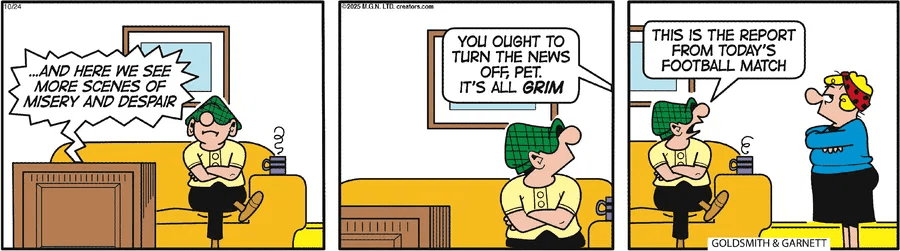
https://www.gocomics.com/andycapp/2025/10/24
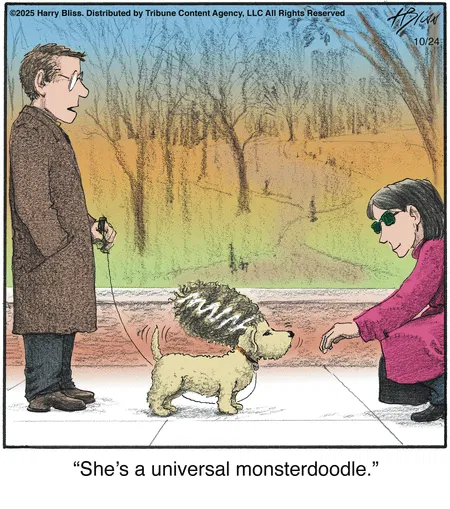
https://www.gocomics.com/bliss/2025/10/24

https://www.gocomics.com/broomhilda/2025/10/24
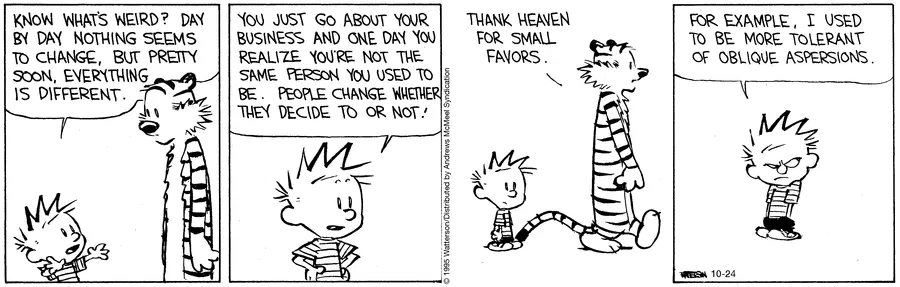
https://www.gocomics.com/calvinandhobbes/2025/10/24
(Whew! 114/71. It’s not 108/68, but it’s still fine. Now I can read some more comics, then the news… )

https://www.gocomics.com/closetohome/2025/10/24

Bestselling author Jodi Picoult pushes back after her musical is canceled by Indiana high school
By MARK KENNEDY
NEW YORK (AP) — Author Jodi Picoult has the dubious honor of being banned in two mediums this fall — her books and now a musical based on her novel “Between the Lines.”
“I’m pretty sure I’m the first author who has now had censorship occur in two different types of media,” Picoult says. “Honestly, I’m not out here to be salacious. I am writing the world as it is, and I am honestly just trying to write about difficult issues that people have a hard time talking about because that is what fiction and the arts do.”
The superintendent of Mississinewa High School in Gas City, Indiana, canceled a production last week of “Between the Lines,” saying concerns were raised over “sexual innuendo” and alcohol references in the musical. Jeremy Fewell, the superintendent, did not respond to a request for comment.
“It’s devastating for us to know that these kids who put in hundreds of hours of hard work had that torn away from them because of the objections of a single parent,” says Picoult.
“What I know, perhaps better than most people, as someone whose books have been banned, is when one parent starts deciding what is appropriate and what is inappropriate for the children of other parents, we have a big problem.”
Picoult noted that the same Indiana high school has previously produced “Grease,” where the sexual innuendo and alcohol abuse is much greater, including a pregnancy scare, sex-mad teens and the line “Did she put up a fight?”
“Between the Lines” centers on Delilah, an outsider in a new high school, who finds solace in a book and realizes she has the power to write her own story and narrate her own life. “It is a very benign message. And it’s actually a really important one for adolescents today,” says Picoult.
The original work, which features a nonbinary character, had already been edited with licensed changes to make it more palatable for a conservative audience, including removing any reference to the nonbinary character’s gender orientation.
The production was scheduled for Halloween weekend at the Gas City Performing Arts Center. The show has music and lyrics by Elyssa Samsel and Kate Anderson, and a story by Timothy Allen McDonald, based on the 2012 novel by Picoult and her daughter, Samantha van Leer. It played off-Broadway in 2022.
Picoult, the bestselling author of “My Sister’s Keeper” and “Small Great Things,” has also written about the moments leading up to a school shooting in “Nineteen Minutes,” which was banned 16 times in the 2024-2025 school year, according to PEN America, making her the nation’s fourth most-banned author.
“I had 20 books banned in one school district in Florida alone because of a single parent’s objection and she admitted she had not read any of the books,” said Picoult, a PEN America trustee. “She said that they were banned for ‘mature content and sexuality.’ There were books of mine that did not even have a single kiss in them.”
The uptick in book banning has spread to stages as well. The Dramatists Legal Defense Fund has documented recently challenged plays and musicals from states including Pennsylvania, Florida, Indiana, Kansas, Ohio and New Jersey after parents or teachers complained that the works’ social themes weren’t appropriate for minors.
The Northern Lebanon High School, in Fredericksburg, Pennsylvania, canceled a 2024 production of “The Addams Family,” citing concerns over scenes with violence, children smoking and subtle queer themes. Paula Vogel’s play “Indecent,” which explores a flashpoint in Jewish and queer theatrical history, was abruptly canceled in Florida’s Duval County in 2023 for “inappropriate” sexual dialogue.
Last year, the Educational Theatre Association asked more than 1,800 theatre educators in public and private schools across the U.S. about censorship. More than 75% of respondents reported pressure to reconsider their play and musical choices during the 2023-24 school year.
“We are not protecting kids,” said Picoult. “We are robbing them of materials that we use to deal with an increasingly complex world.”
things that are just wrong about this; things to be said about him being full of BS; things to be said about him being full of himself; that he presents as if he is actually designing and building these; that he names them Optimus (from Optimus Prime, a hero in “Transformers”), and so on, and so on, and so on…
In a Tesla earnings call Wednesday, the world’s richest man pondered the future of his company’s Optimus robots—and his control over them.
Tesla might be an electric auto maker, but CEO Elon Musk has made clear that he thinks of it as much more: an innovator in artificial intelligence and software, a builder of world-shaking robots. He’s also argued that Tesla should be worth a lot more than it is today: up to $20 trillion, he posted in July, more than five times the current worth of Nvidia.
Musk has also made it clear that he wants to get paid, a lot. In November, Tesla shareholders will vote on the board’s proposal to pay the CEO a remarkable $1 trillion over the next decade. The deal would also increase Musk’s stake in Tesla from 13 percent to a quarter. But Musk would only get that big figure—and the extra control—if he hits a series of ambitious metrics, including 20 million vehicles delivered, 1 million robotaxis in commercial operation, and an $8.5 trillion valuation. And also, 1 million Optimus humanoid robots delivered.
On a call with investors on Wednesday, Musk locked on to that last point to make his most threatening argument for a gigantic payday yet. “My fundamental concern with regard to how much voting control I have at Tesla is, if I go ahead and build this enormous robot army, can I just be ousted at some point in the future?” he said. “If we build this robot army, do I have at least a strong influence over this robot army? Not control, but a strong influence … I don’t feel comfortable building that robot army unless I have a strong influence.”
Generally, Musk talks about Tesla’s Optimus project as more of a force for peace than war. He’s said that Optimus will upend the job market and free humanity from the drudgery of work. (“Working will be optional, like growing your own vegetables, instead of buying them from the store,” he posted this week.) Elsewhere on the investor call Wednesday, he said that Tesla’s robots would “actually create a world where there is no poverty, where everyone has access to the finest medical care.”
Optimus, he added, “will be an incredible surgeon, and imagine if everyone had access to an incredible surgeon.” For Tesla, Optimus will be “an infinite money glitch,” Musk said, arguing that everyone will want a humanoid robot who can do their work for them.
At Tesla events—and at the Tesla Diner in Los Angeles—Optimus robots are usually seen doing service work: serving drinks and popcorn, or entertaining visitors by dancing or playing rock, paper, scissors. (Optimus participants in a 2024 Tesla event were later acknowledged to be not fully autonomous, but remotely operated by humans.)
Whether Optimus chooses to do laundry or battle, Tesla’s vision of a robotic future still seems a ways away. On Wednesday’s call, Musk dwelled on the challenge of building humanoid hands and forearms, seeming to confirm earlier reporting that the features were proving especially hard for Tesla engineers to hack. And while Tesla set internal goals to produce 5,000 Optimus units this year, The Information reported this month that the company scaled down those production plans over the summer. On Wednesday, Musk said Tesla would have a “production-intent prototype” ready by February or March. Full-scale production, he said, would start at the end of next year.
Because it only takes a moment to think.

