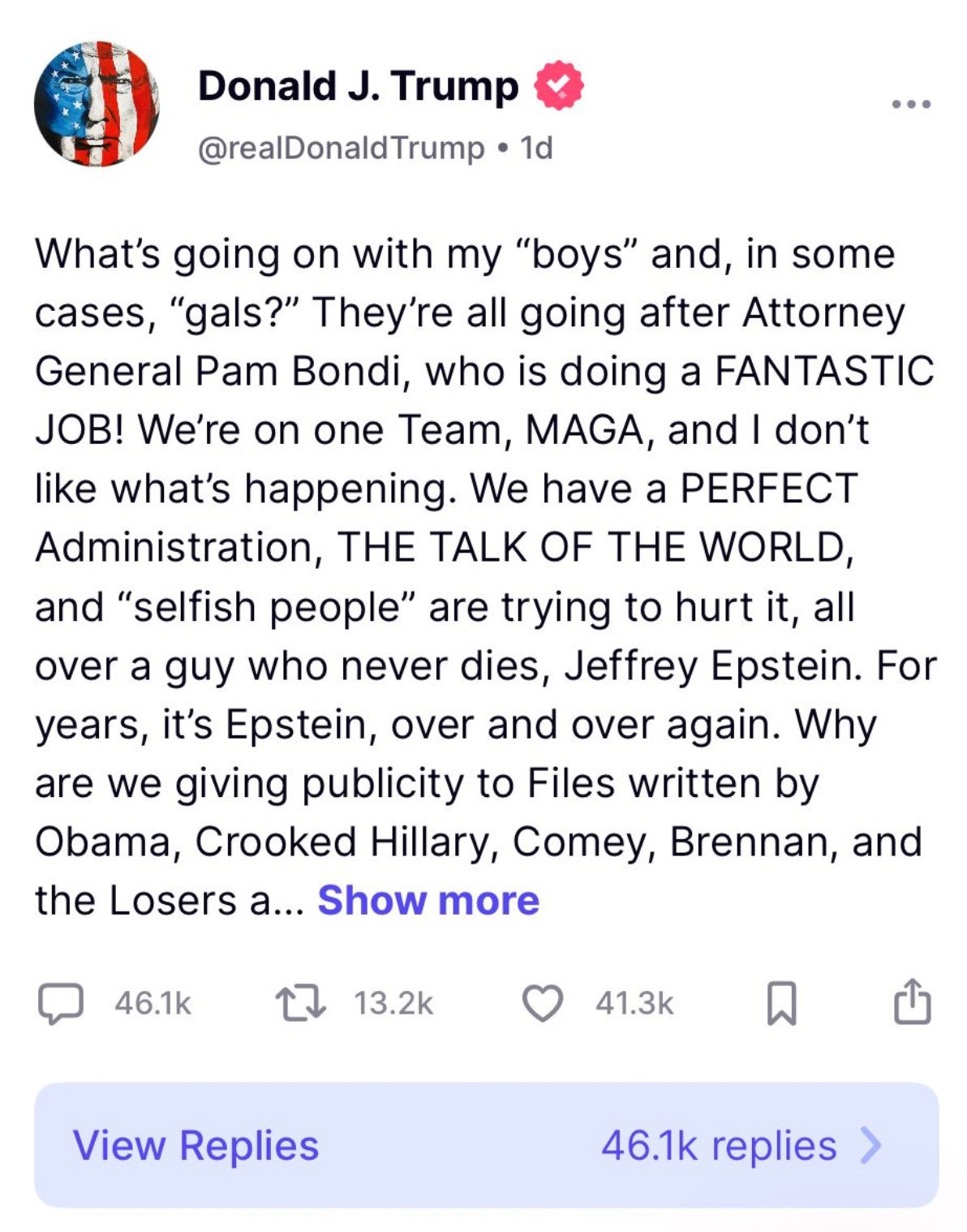
Donald Trump wants you to stop talking about Jeffrey Epstein.
First, what’s with that “boys and girls” crap? Does he still envision himself as the nation’s “daddy?” Second, a perfect administration? Sorry, TACO, but we’ve seen Pete Hegseth, Kristi Noem, Kash Patel, Pam Bondi, JD Vance, and others of your team in action. You have clearly stocked your pond with the least qualified and dumbest fish of all time.
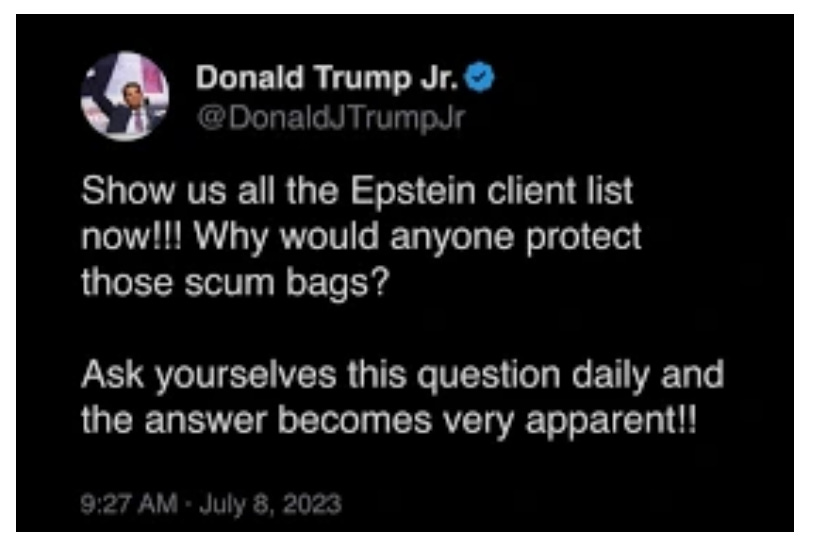
But I get it. Trump wants people to stop talking about Epstein, when previously, he encouraged his cult to talk about Epstein. Look at this tweet from his number one idiot offshoot from 2023.
Is Trump protecting “those scum bags” or is he one of those scumbags? Hmmm? Trump and Jeffers used to party together. Trump told us they were very similar, as they both liked women, with Epstein liking them on the younger side. Was Trump talking about young women, or did he make that statement because he knew about the pedophilia? What did Trump witness, or take part in, when he flew on Epstein’s plane?
Trump talked about his administration being “perfect,” while it was his stupid and unqualified Attorney General who went on Fox News and claimed the Epstein Client List was on her desk, and then later said it never existed. How is that perfect?
But ya know, I don’t think there ever was an Epstein Client List. When did we first hear of this supposed client list?
I believe it was MAGAts who first claimed that there’s an Epstein Client List, because they used it against Biden. But it’s been said so much, “clientlistclientlistclientlistclientlistclientlist,” that it has even gaslighted liberals.
I’m seeing memes from some of my liberal friends asking why Epstein co-conspirator Ghislaine Maxwell is in prison if there’s not a client list. If the only evidence against her is a client list, then she wouldn’t be in prison. How would a client list convict her? There’s a whole hell of a lot more evidence against Epstein than a supposed client list.
And what would the client list be for? He wasn’t in the business of pedophilia, right? It was an activity, a hobby. It was terrible and messed up, but that’s not how Epstein made his millions. I’m sure there is a list of his clients for his finance business.
Now, Trump is being yelled at by MAGAts. How sweet is that? They really want the client list released, which probably doesn’t even exist. It’s not the first time Trump claimed something that’s not true. Trump never did prove that Obama was born in Kenya. He never proved he won the 2020 election. He still hasn’t proven White Genocide in South Africa. We haven’t even seen all the fraud DOGE supposedly found.
But to MAGAts, not releasing the Epstein Client List, or the Epstein Files, makes Trump as bad as the Deep State, which, by the way, also hasn’t been proven to exist.
There are files on Epstein, and Bondi has said she’s not releasing those either. Fuck the client list, let’s see those files. While I don’t believe there is a client list, and feel free to disagree with me, there are Epstein files. Neither Trump nor Bondi has explained to us why those aren’t being released.
The best way to distract a MAGAt is with another conspiracy theory or bigotry. Remember, MAGAts love Trump because they hate the same people. So over the weekend, Trump threatened to revoke Rosie O’Donnell’s citizenship, even though a president doesn’t have that power. Did it work to distract the MAGAts. No, it just gave them something else to rave about while still howling for the Epstein Client List.
Good luck getting your base, Donald, to stop talking about the thing you wouldn’t shut up about. Usually, MAGAts do whatever you say. Maybe you need to remind them that they’re in a cult.
Squirrels: If you’ve ever visited the White House, you probably noticed the squirrels. There are a lot of squirrels at the White House. The fences that keep me and you out are ineffective against squirrel penetration. They go wherever they want. Ronald Reagan used to collect acorns from Camp David to feed the squirrels at the White House. Ike hated them because they would bury acorns in his golf green. But, there aren’t just grey squirrels at the White House, but also black squirrels. To be more specific, black Canadian squirrels.
Things like this fascinate me. I noticed them in Central Park too, but I haven’t researched that yet.
During the Theodore Roosevelt administration, the guy in charge of the National Zoo or the Smithsonian asked Canada for some black squirrels. They’re not native to the United States, though they’re the same squirrels as our grey ones except for the black coats, which might be thicker. It’s cold in Canada, yo.
So, we traded some grey squirrels for their black squirrels, and some either escaped from the zoo, or a few were released. One version explains that they were released at the zoo, with expectations that they would stay on the zoo grounds, but again….fences. Squirrels ignore them.
Today, Washington, DC has black squirrels, and they’re not going anywhere. It’s estimated that half of the squirrels in the city are descendants of the Canadian squirrels, even though the zoo originally only got a few of them. Squirrels are rodents, and rodents screw a LOT.
Not everyone feels the way Ike did, and there’s some civic pride in the black squirrels. There was even a bar in Adams Morgan named the Black Squirrel.
And that’s why there is a black squirrel in today’s cartoon.
What I hope is that Donald Trump notices all the Black immigrants all over his lawn that he can’t do anything about. (snip-MORE)
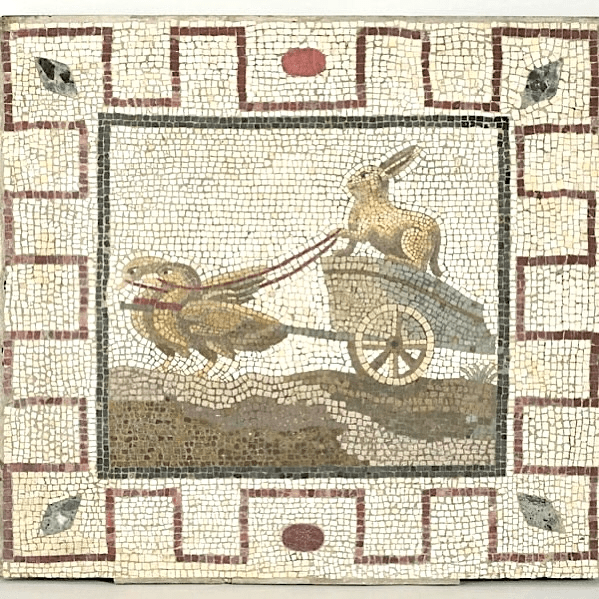
If you head to the Louvre, make sure you visit the Mona Lisa, Venus de Milo, and Liberty Leading the People. But then swing by the Department of Greek, Etruscan, and Roman Antiquities. There you might find (no guarantee!) a Roman mosaic featuring a rabbit riding a chariot pulled by geese. Discovered at Hadrian’s villa in Tivoli, Italy, the mosaic dates back to the 2nd century. About the mosaic, the History Cool Kidswrites:
This kind of humorous scene is an example of asária, a type of ancient visual joke where animals behave like humans (anthropomorphism). Such mosaics were popular in Roman domestic decoration, often as floor or wall panels in villas and bathhouses.
This particular mosaic is part of the Louvre’s extensive collection of Greek, Etruscan, and Roman Antiquities. It illustrates how Roman artists loved playful or satirical imagery alongside more serious mythological and realistic scenes. The rabbit, a symbol often associated with fertility and speed, paired with the absurdity of it driving a chariot of geese, reflects both Roman wit and their fondness for decorative exuberance.
Some scholars believe the mosaic plays on a line in Ovid’s Metamorphoses: “Cytherea [Aphrodite] was riding in her dainty chariot, winged by her swans, across the middle air making for Cyprus, when she heard afar Adonis’ dying groans, and thither turned her snowy birds.” But it’s hard to know for sure.
Noem is more interested in her face than in providing assistance to the Texas flood survivors Read on Substack
ICE Barbie, Kristi Noem, the Director of Homeland Security, is failing at her job miserably.
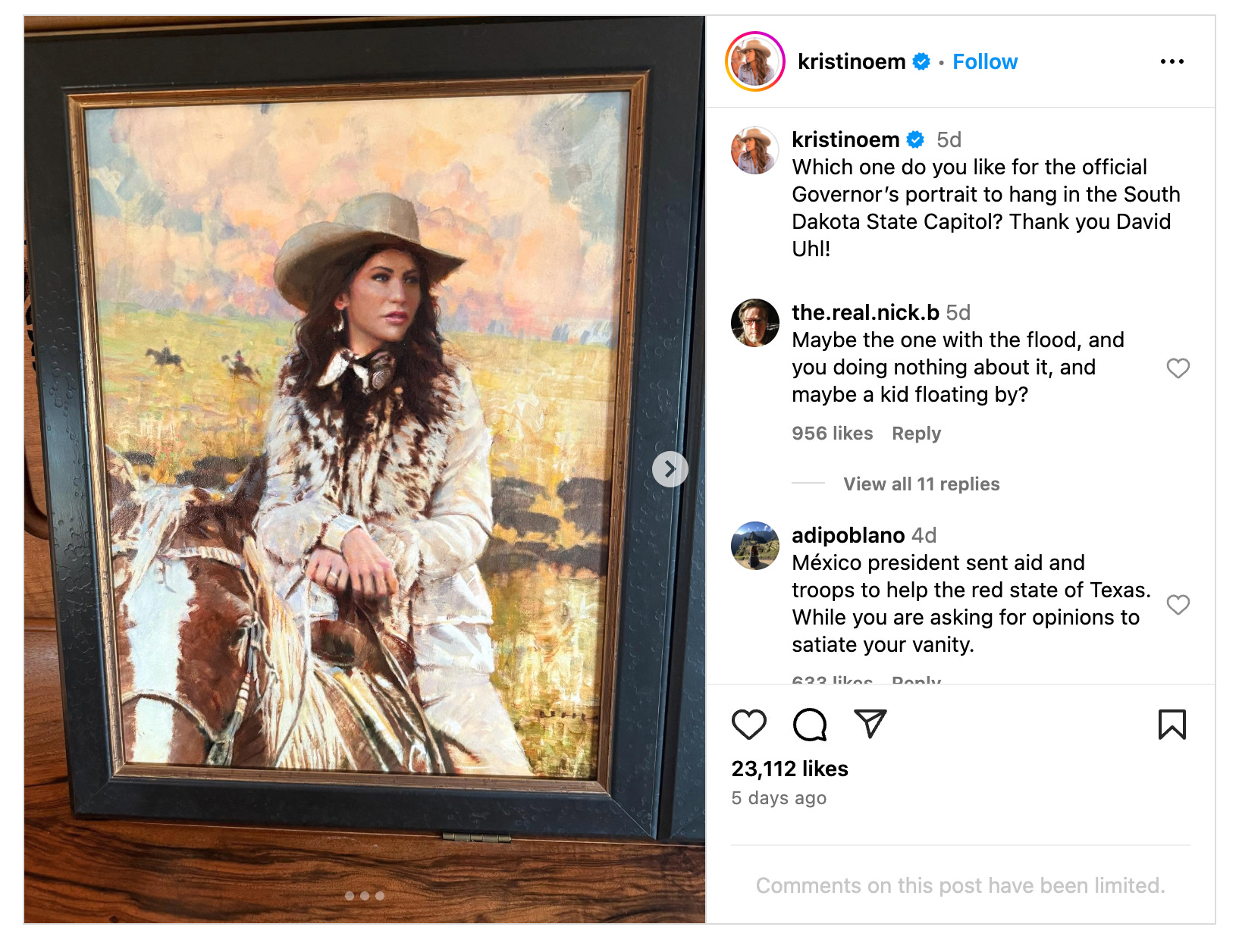
A portrait of Noem is going to be displayed in the South Dakota Capitol building, and there are three options. Who gives a shit, right? Kristi Noem, that’s who. Noem went on Instagram and posted to her creepy followers, “Which one do you like for the official Governor’s portrait to hang in the South Dakota State Capitol? Thank you David Uhl!” She added the three paintings of herself on horseback by artist David Uhl.”
She did this five days ago, during the floods in Texas that have killed at least 120 so far.
Here are the other two portraits.
I wonder how much South Dakota tax money was spent on this.
Before Noem’s survey about herself, Puppy-Killah Kristi did her stupid photo-op in El Salvador with the notorious prison behind her, with Trump deportees as props. She was in full makeup while making sure her shiny $10,000 Rolex was visible, which is probably less than her teeth cost.
She’s done other photos with guns, posing as an ICE agent. In one of them, she wasn’t holding the gun correctly and got roasted for it online. I bet she can’t ride a horse either.
We should be relieved that she didn’t shoot that ICE agent in the face. In her defense, she does know how to shoot a gun because that’s how she murdered her puppy. So there, critics.
Kristi is the kind of person that if you went out to dinner with her, she’d humbly say at some point, “Enough of me talking about myself. Now let’s hear you talk about me.” She can’t get over herself. She might be the female equivalent of Donald Trump. She already has the fake hair, and now she just needs the ridiculous tie, the orange make-up, and an adult diaper that hasn’t been changed since his first flip-flop on tariffs.
Remember, Kristi used to look like this…
…before she looked like this.
She definitely went for the Melania look, which is an improvement over the look for hunting wolves from a helicopter. She even got free dental work while she was governor, on the condition that she make a commercial for the Texas dentist who did her work.
It seems that’s the only time she’s interested in Texas, when she can get free dental work, but not when there’s a disaster.
According to The New York Times, two days after catastrophic floods roared through Central Texas, the Federal Emergency Management Agency (FEMA) did not answer nearly two-thirds of calls to its disaster assistance line.
An anonymous source close to the issue said the lack of responsiveness happened because the agency had fired hundreds of contractors at call centers.
FEMA, which is a part of Homeland Security (I have to include that because trolls are commenting on this cartoon on Facebook asking, “What’s DHS got to do with FEMA?”), laid off the contractors on July 5 after their contracts expired and were not extended, according to the documents and the person briefed on the matter. Noem, who has instituted a new requirement that she personally approve expenses over $100,000, did not renew the contracts until Thursday, five days after the contracts expired, and about a week after the floods started.
Where was ICE Barbie? She was probably spending her time looking at herself in a mirror, or maybe she confused Texas for one of the seven Native American tribes that banned her from their reservations.
Adam Zyglis: There’s a part of this cartoon that is my standing in solidarity with my colleague Adam Zyglis. So what happened with Adam? Adam, who works for the Buffalo News, drew a cartoon mocking Republican hypocrisy, asking for federal aid after protesting against federal disaster relief for other states. This has upset Republicans, which shows more hypocrisy for the gang that shouts “snowflake” at their political opponents. They even cried on Fox News about it.
Now, an event at the Buffalo History Museum by the Buffalo News Guild, which was to feature Adam among other journalists, has been postponed because of “credible” death threats toward Adam and his family.
And just today, a MAGAt posted on one of my client’s shares of a cartoon of mine about how Democrats are the violent ones. (snip-MORE, and it’s great)
There is a video at the link below. I watched this. ICE went in to terrorize and prove they could. They had a military style attack helicopter. This is going to get worse. They are the tRump admin Gestapo, armed thugs who follow no rules attacking people who have violated no criminal laws. Even if they were undocumented they had broken no laws as crossing the border illegally is a civil offense like speeding. Hugs
Border Czar Tom Homan on Friday angrily condemned the violence at a California pot farm as proof anti-ICE protests will turn deadly, blaming the inflammatory rhetoric of Democrats comparing agents to Nazis.
Homan spoke out the morning after protesters were seen hurling rocks — and one even appeared to fire a gun — at agents stamping down on a massive marijuana operation where they found 10 illegal-migrant juveniles, eight of whom were there without an adult.
“What happened in California is just another example of protesters becoming criminals, and they’ve been emboldened by even members of Congress who compare ICE to Nazis and racists and terrorists,” Homan said on “Fox & Friends” Friday morning.
A protester flees as ICE officers fire chemical agents into the crowd during a raid in Camarillo, California.AFP via Getty Images
“I said months ago, it’s going to end up with a loss of life — and we had one the other day in Texas, and it’s not over,” he said, referencing the gunman who opened fire on border patrol agents walking into work in McAllen Monday.
Immigration agents who descended on Glass House Farms in the city of Camarillo — one of the biggest cannabis farms in Southern California — were met by dozens of demonstrators gathered on a road between fields where the uniformed officers stood in a line across from them.
A military-style helicopter flew overhead, video shows.
Tear gas billows from canisters thrown by federal agents toward protesters in Camarillo, California.via REUTERS
Protesters shouted and screeched until agents used canisters with an unknown substance and fired less-than-lethal rounds, forcing them to retreat. Several of the protesters threw what appeared to be rocks back at the officers, according to ABC 7.
As they retreated, a masked man in all black appeared to let off a few shots among a crowd of other protesters scampering away from advancing agents.
The FBI has now launched an investigation into the alleged shooting and is offering a reward up to $50,000 for information leading to a conviction.
An individual was spotted allegedly firing a weapon toward federal agents.ABC 7
The clash lasted four hours as US Customs and Border Protection set up a blockade with military-style vehicles in the pastoral region.
Video from ABC 7 shows numerous workers being taken into custody at the scene. It’s unclear exactly how many were detained.
Five people were taken to the hospital, according to the Los Angeles Times.
The farm is now under investigation for child labor violations, CBP Commissioner Rodney Scott announced late Thursday night after 10 juveniles — “all illegal aliens” — were found at the facility, including eight without an adult, he said.
Protesters stand in front of ICE agents near a pot farm in Camarillo, California.Getty Images
Glass House Farms said it “fully complied with agent search warrants.”
The stand-off drew widespread criticism from California leaders, including U.S. Congressman Salud Carbajal, who was denied entry when he tried to get past federal agents into the farm.
Newsom’s office accused President Trump’s advisor, Stephen Miller, of sparking “terror” in local communities.
A protester washes eye with milk after federal immigration agents tossed tear gas during a raid in Camarillo, California.AP
“There’s a real cost to these inhumane immigration actions on hardworking families and communities, including farmworker communities, across America,” Newsom’s office said.
“Instead of supporting the businesses and workers that drive our economy and way of life, Stephen Miller’s tactics evoke chaos, fear and terror within our communities at every turn.”











 Scottie's Playtime