DHS Tells Police That Common Protest Activities Are ‘Violent Tactics’

That pesky thing called the US CONSTITUTION says that the people have a right to protest the government.  The last ten or more years the federal government has been trying to restrain the rights of the people to protest or have their voices heard.  This is another example.  Hugs

https://www.wired.com/story/dhs-tells-police-that-common-protest-activities-are-violent-tactics/

DHS is urging law enforcement to treat even skateboarding and livestreaming as signs of violent intent during a protest, turning everyday behavior into a pretext for police action.

The Department of Homeland Security is urging local police to consider a wide range of protest activity as violent tactics, including mundane acts like riding a bike or livestreaming a police encounter, WIRED has learned.

Threat bulletins issued during last month’s “No Kings” protests warn that the US government’s aggressive immigration raids are almost certain to accelerate domestic unrest, with DHS saying there’s a “high likeliness” more Americans will soon turn against the agency, which could trigger confrontations near federal sites.

Blaming intense media coverage and backlash to the US military deployment in Los Angeles, DHS expects the demonstrations to “continue and grow across the nation” as protesters focused on other issues shift to immigration, following a broad “embracement of anti-ICE messaging.”

The bulletins—first obtained by the national security nonprofit Property of the People through public records requests—warn that officers could face assaults with fireworks and improvised weapons: paint-filled fire extinguishers, smoke grenades, and projectiles like bottles and rocks.

At the same time, the guidance urges officers to consider a range of nonviolent behavior and common protest gear—like masks, flashlights, and cameras—as potential precursors to violence, telling officers to prepare “from the point of view of an adversary.”

Protesters on bicycles, skateboards, or even “on foot” are framed as potential “scouts” conducting reconnaissance or searching for “items to be used as weapons.” Livestreaming is listed alongside “doxxing” as a “tactic” for “threatening” police. Online posters are cast as ideological recruiters—or as participants in “surveillance sharing.”

One list of “violent tactics” shared by the Los Angeles–based Joint Regional Intelligence Center—part of a post-9/11 fusion network—includes both protesters’ attempts to avoid identification and efforts to identify police. The memo also alleges that face recognition, normally a tool of law enforcement, was used against officers.

Vera Eidelman, a senior staff attorney with the American Civil Liberties Union, says the government has no business treating constitutionally protected activities—like observing or documenting police—as threats.

DHS did not respond to a request for comment.

“Exercising those rights shouldn’t be justification for adverse action or suspicion by the government,” Eidelman says. Labeling something as harmless as skateboarding at a protest as a violent threat is “disturbing and dangerous,” she adds, and could “easily lead to excessive force against people who are simply exercising their First Amendment rights.”

“The DHS report repeatedly conflates basic protest, organizing, and journalism with terroristic violence, thereby justifying ever more authoritarian measures by law enforcement,” says Ryan Shapiro, executive director of Property of the People. “It should be sobering, if unsurprising, that the Trump regime’s response to mass criticism of its police state tactics is to escalate those tactics.”

Fusion centers like JRIC play a central role in how police understand protest movements. The intelligence they produce is rapidly disseminated and draws heavily on open-source data. It often reflects broad, risk-averse assumptions and includes fragmentary and unverified information. In the absence of concrete threats, bulletins often turn to ideological language and social media activity as evidence of emerging risks, even when tied to lawful expression.

DHS’s risk-based approach reflects a broader shift in US law enforcement shaped by post-9/11 security priorities—one that elevates perceived intent over demonstrable wrongdoing and uses behavior cues, affiliations, and other potentially predictive indicators to justify early intervention and expanded surveillance.

A year ago, DHS warned that immigration-related grievances were driving a spike in threats against judges, migrants, and law enforcement, predicting that new laws and high-profile crackdowns would further radicalize individuals. In February, another fusion center reported renewed calls for violence against police and government officials, citing backlash to perceived federal overreach and identifying then-upcoming protests and court rulings as likely triggers.

At times, the sprawling predictions may appear prescient, echoing real-world flashpoints: In Alvarado, Texas, an alleged coordinated ambush at a detention center this week drew ICE agents out with fireworks before gunfire erupted on July 4, leaving a police officer shot in the neck. (Nearly a dozen arrests have been made, at least 10 on charges of attempted murder.)

In advance of protests, agencies increasingly rely on intelligence forecasting to identify groups seen as ideologically subversive or tactically unpredictable. Demonstrators labeled “transgressive” may be monitored, detained without charges, or met with force.

Social movement scholars widely recognize the introduction of preemptive protest policing as a departure from late-20th century approaches that prioritized de-escalation, communication, and facilitation. In its place, authorities have increasingly emphasized control of demonstrations through early intervention, surveillance, and disruption—monitoring organizers, restricting public space, and responding proactively based on perceived risks rather than actual conduct.

Infrastructure initially designed to combat terrorism now often serves to monitor street-level protests, with virtual investigations units targeting demonstrators for scrutiny based on online expression. Fusion centers, funded through DHS grants, have increasingly issued bulletins flagging protest slogans, references to police brutality, and solidarity events as signs of possible violence—disseminating these assessments to law enforcement absent clear evidence of criminal intent.

Surveillance of protesters has included the construction of dossiers (known as “baseball cards”) with analysts using high-tech tools to compile subjects’ social media posts, affiliations, personal networks, and public statements critical of government policy.

Obtained exclusively by WIRED, a DHS dossier on Mahmoud Khalil, the former Columbia graduate student and anti-war activist, shows that analysts drew information from Canary Mission, a shadowy blacklist that anonymously profiles critics of Israeli military action and supporters of Palestinian rights.

In federal court Wednesday, a senior DHS official acknowledged that material from Canary Mission had been used to compile more than 100 dossiers on students and scholars, despite the site’s ideological slant, mysterious funding, and unverifiable sourcing.

Threat bulletins can also prime officers to anticipate conflict, shaping their posture and decisions on the ground. In the wake of violent 2020 protests, the San Jose Police Department in California cited the “numerous intelligence bulletins” it received from its local regional fusion center, DHS, and the FBI, among others, as central to understanding “the mindset of the officers in the days leading up to and throughout the civil unrest.”

Specific bulletins cited by the SJPD—whose protest response prompted a $620,000 settlement this month—framed the demonstrations as possible cover for “domestic terrorists,” warned of opportunistic attacks on law enforcement and promoted an “unconfirmed report” of U-Haul vans purportedly being used to ferry weapons and explosives.

Subsequent reporting in the wake of BlueLeaks—a 269-gigabyte dump of internal police documents obtained by a source identifying as the hacktivist group Anonymous and published by transparency group Distributed Denial of Secrets—found federal bulletins riddled with unverified claims, vague threat language, and outright misinformation, including alerts about a parody website that supposedly paid protesters and accepted bitcoin to set cars on fire, despite a clear banner labeling the site “FAKE.”

Threat alerts—unclassified and routinely accessible to the press—can help law enforcement shape public perception of protests before they begin, laying the groundwork to legitimize aggressive police responses. Unverified DHS warnings about domestic terrorists infiltrating demonstrations in 2020, publicly echoed by the agency’s acting secretary on Twitter, were widely circulated and amplified in media coverage.

Americans are generally opposed to aggressive protest crackdowns, but when they do support them, fear is often the driving force. Experimental research suggests that support for the use of coercive tactics hinges less on what protesters actually do than on how they’re portrayed—by officials, the media, and through racial and ideological frames.


Dell Cameron is an investigative reporter from Texas covering privacy and national security. He’s the recipient of multiple Society of Professional Journalists awards and is co-recipient of an Edward R. Murrow Award for Investigative Reporting. Previously, he was a senior reporter at Gizmodo and a staff writer for the Daily … Read More

YOU HAVE THE LEGAL AUTHORITY, F*****G USE IT

One voice was yelling he was a US citizen.  The conditions are horrible.  They get their drinking water from the toilet.   Maxwell Frost is a progressive treasure.  Hugs

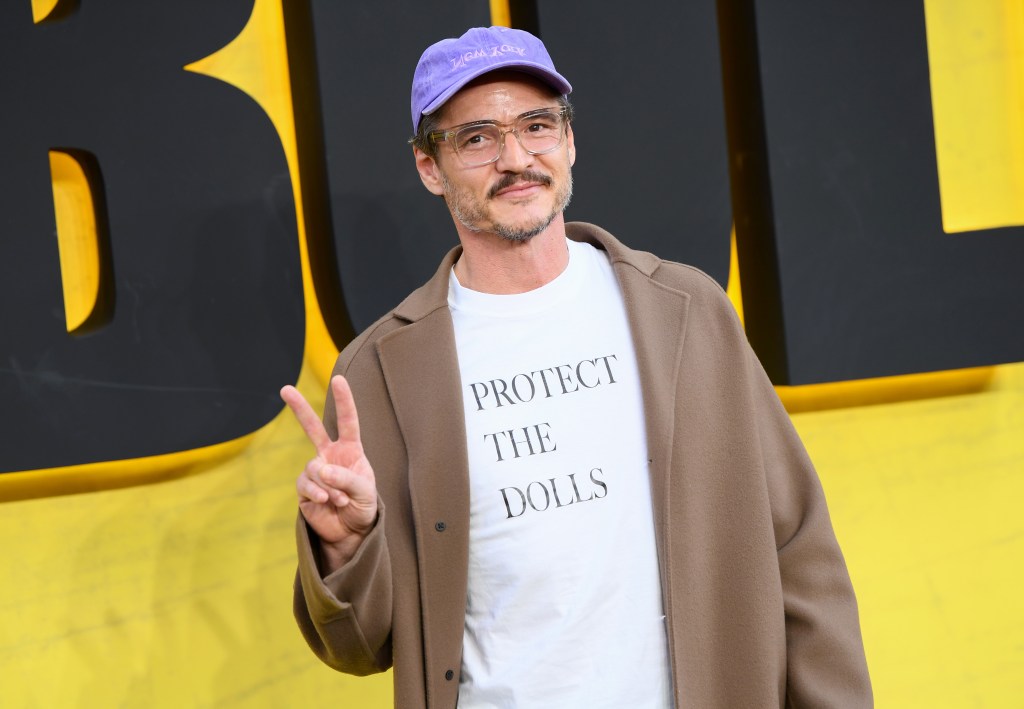
Pedro Pascal comes out swinging for the trans community yet again at Fantastic Four premiere

https://www.thepinknews.com/2025/07/09/pedro-pascal-fantastic-four-trans/

Some clips about how the democratic leadership in the US congress are not getting the message from the people.

The Democratic Party leadership which is made up of all corporate democrats along the manner of Nancy Pelosi.   The idea that a 33 year old Social Democrat like Bernie Sanders and AOC running NY City terrifies them.  Behind the scenes they are trying hard to wing support to Andrew Cuomo who has been accused of being very corrupt instead of a guy who promised to do things that make life better for the working lower incomes.  They are scared that the people will see that they have power and that government CAN work for them.  The democratic leadership totally ignores the fact that Mamdomi raised enough money from small individual donor donations and refused corporate PACs and bribes.    He is the future of the Democratic Party if the democrats ever want to win again.  The videos of the man on the street getting greeted by everyone, he doesn’t put on airs but walks the streets and is like everyone else.   Hugs

In a recent post I posted the news article from Axios about democratic members of congress needing to be more aggressive including being willing to get shot trying to inspect ICE facilities.  It was not about wanting to cause violence nor about wanting to be shot.  The article was about the perception that democratic leadership are too timid and scared to challenge the thuggish ICE and current administration.   The video below goes over the article.   Hugs

Tom Homan rips violent clashes at California pot farm where illegal minors were working, blames Dems’ ‘Nazi’ rhetoric

There is a video at the link below.  I watched this.  ICE went in to terrorize and prove they could.  They had a military style attack helicopter.  This is going to get worse.   They are the tRump admin Gestapo, armed thugs who follow no rules attacking people who have violated no criminal laws.  Even if they were undocumented they had broken no laws as crossing the border illegally is a civil offense like speeding.  Hugs

https://nypost.com/2025/07/11/us-news/tom-homan-rips-violent-clash-at-california-pot-farm-as-proof-ice-protests-will-turn-deadly-blames-dems-nazi-rhetoric/

Clips from The Majority Report on different subjects.


Indiana church tells LGBTQ+ people to kill themselves or face death penalty under Trump

https://www.thepinknews.com/2025/07/07/indiana-indianapolis-sure-foundation-baptist-church-lgbtq/

In 2025, why are men still afraid to come out in professional sports?

There are zero openly gay and bi men actively competing in America’s top pro sports leagues. What’s keeping the closet door shut?

This story was originally reported by Benjamin Land and Spencer Macnaughton, Uncloseted of The 19th. Meet Benjamin and read more of their reporting on gender, politics and policy.

This story was originally published in Uncloseted Media, an LGBTQ-focused investigative news outlet.

When Jason Collins came out in a 2013 Sports Illustrated cover story, he broke down the long-sealed closet in men’s sports by becoming the first openly gay active player in any major league sport. President Barack Obama called him to offer his support, saying he “couldn’t be prouder,” and Oprah Winfrey called him “a pioneer.”

“By not having to hide who I am, just being able to live an authentic life, there’s something powerful about being the one to out yourself and step forward and speak your truth,” Collins told Uncloseted Media. “There’s no greater feeling.”

Many thought that Collins’ announcement would lead to a slew of men coming out in professional sports; commentators called it a “tipping point” and the moment “when things really changed.” But 12 years later, the silence is deafening. Today, there are zero active openly gay or bisexual players in the NFL, NBA, NHL, MLB, MLS, PGA and ATP.

What makes these numbers particularly shocking is that more than 1 in 5 Gen Z adults in the United States identify as LGBTQ+. “It is a legit claim that the last closet for men is sports, especially in the North American context,” says Charlene Weaving, a professor of gender studies at St. Francis Xavier University. “If you look at sport[s], it’s as if what’s happening in society is amplified. Sports is the worst place for sexism and homophobia. … There’s so much pressure to adhere to a heterosexual persona.”

So what’s keeping the closet door shut?

Coaching can help or hurt

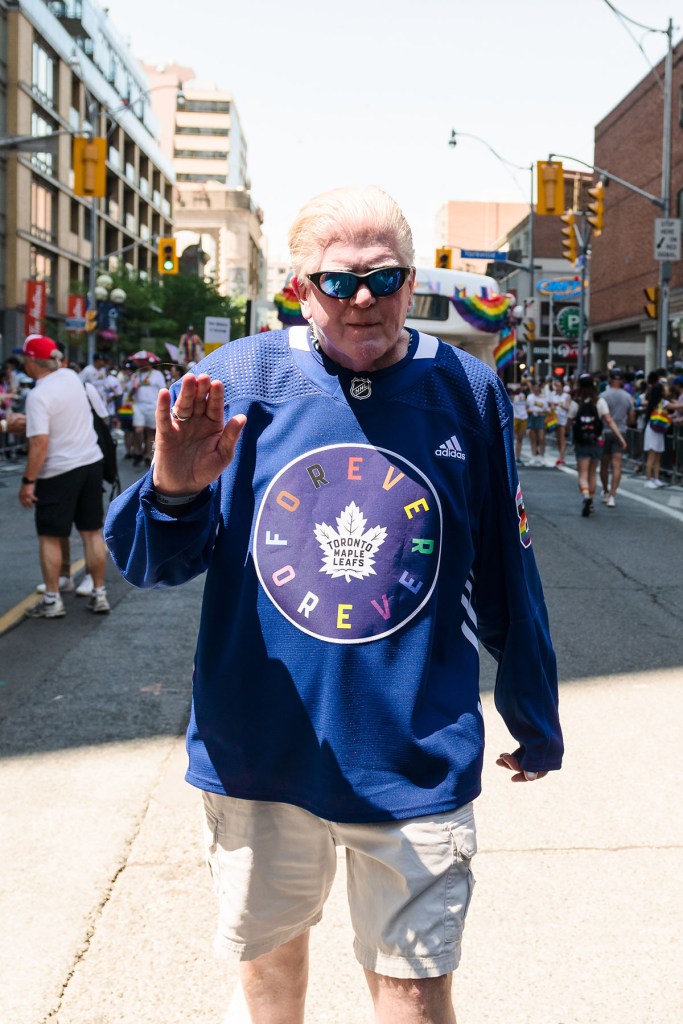
Brian Burke participates in the 2025 Toronto Pride Parade on June 29, 2025.
Brian Burke participates in the 2025 Toronto Pride Parade on June 29, 2025 in Toronto, Ontario. (Harold Feng/Getty Images)

One key element in men’s sports that can help or hinder someone from coming out is the mentors who surround them.

“The coaches create the culture, right? What you say, what you allow [in] your locker room, that’s all on us,” says Anthony Nicodemo, a gay high school basketball coach in Westchester, New York.

He says he intentionally uses LGBTQ-inclusive language with his team to signal that there’s nothing wrong with being gay. “If we had a game on Saturday morning and it’s Friday night, I’d say, ‘Hey go home with your boyfriend or girlfriend tonight, stay in.’ My kids would laugh, of course, but then after I said it a couple times, they didn’t even blink,” he says. “If there was a gay kid on my team, that gay kid knows that he’s welcome.”

A 2016 study by the Journal of Sport and Health Science found that gay and bisexual male teen athletes feel particularly unwelcome when playing in formal sporting environments where there are coaches. The study also found that they were more likely to play on an informal team without a coach, which would lessen their chances of becoming a professional athlete.

“The hope is that you’re going to create inclusive environments that are ultimately going to allow those kids to get to the point in society where we feel comfortable with them coming out and eventually playing at the professional level,” says Nicodemo, who worked with Collins at the Pride Center’s LGBTQ+ inclusion basketball clinic in San Antonio this March.

Nicodemo says we need more role models like Brian Burke, the former president of hockey operations for the Pittsburgh Penguins. After Burke’s gay son passed away in a car accident in 2010, he made it his mission to explicitly advocate for gay men competing in pro hockey. “If you’re a member of the LGBTQ+ community, you are welcome with the Pittsburgh Penguins,” he said at a 2021 Pittsburgh Pride Revolution March. “You’re welcome to come to our games, you’re welcome to play for our team, you’re welcome to work on our staff. You are welcome.”

Research suggests all players want to participate in more inclusive environments. A 2021 study evaluated college coaches who identified as LGBTQ+, as allies, or as anti-LGBTQ+. In every context, students preferred coaches who embraced nondiscrimination, choosing the ally and the LGBTQ+ coach over the anti-LGBTQ+ coach.

Despite this, Nicodemo says he may be an anomaly when it comes to LGBTQ-inclusive coaches. In fact, a 2015 study concluded that the United States was the most homophobic country in the world when it comes to sports and 80 percent of the study’s participants reported witnessing or experiencing homophobia in U.S. sports.

Just this week, the Wake Forest men’s baseball coach Tom Walter issued an apology after cameras caught him using an apparent homophobic slur during an NCAA game.

“There’s a lot of homophobia in our society. There is a lot of homophobia still in sports, in particular, male sports,” says Collins. “We still have a lot of work to do as far as creating those environments that those athletes do feel comfortable to step forward [in] and share who they are. It’s about education and letting them know it’s okay to say, ‘I am gay,’ ‘I am bisexual.’ You know, you name it, but it’s okay. It’s okay to speak your truth.”

Are the leagues pulling their weight?

Beyond the coaches are the leagues. While some of them have taken steps to create inclusive environments, others have gone in a different direction by rolling back their LGBTQ-inclusive policies amid attacks on Diversity, Equity and Inclusion (DEI). In March, the MLB removed references to their “Diversity Pipeline Program,” which outlined their diversity-focused hiring initiatives, from their website.

This may have been in response to external pressure. In October 2023, the conservative public interest organization America First Legal, which was founded by Trump’s Deputy Chief of Staff Stephen Miller, filed a formal complaint against the MLB, blasting the league’s diversity pipeline and related initiatives as blatant examples of racial and sexist discrimination against white men.

And in 2023, the NHL banned all LGBTQ+ symbols from uniforms after a handful of players refused to participate in Pride Nights.

While the ban was lifted after pushback from sponsors, players and fans, Nicodemo believes it sent the wrong message to young male players. “I believe wholeheartedly that Pride nights save lives. I think [about] a gay kid that is watching hockey at home and seeing the rainbow flag and how important that is,” he says. “Gay kids need to see people representing pride. When I was coaching before COVID, when we used to actually wear suits when we coached, I wore a rainbow lapel in every game just to show it was okay.”

Some men’s leagues have done more to promote inclusivity. NBA Cares, the social justice arm of the league’s charitable programming, has prioritized including gay youth and men in their initiatives. Nicodemo has worked with NBA Cares, and Collins has contributed as an ambassador.

“This is very important for coaches, for those people in leadership positions, to think about as far as, ‘How do I get the best possible version of my athlete?’ … One way you do that is by creating a team environment where everyone feels safe,” says Collins.

Homophobia and misogyny in the men’s locker room

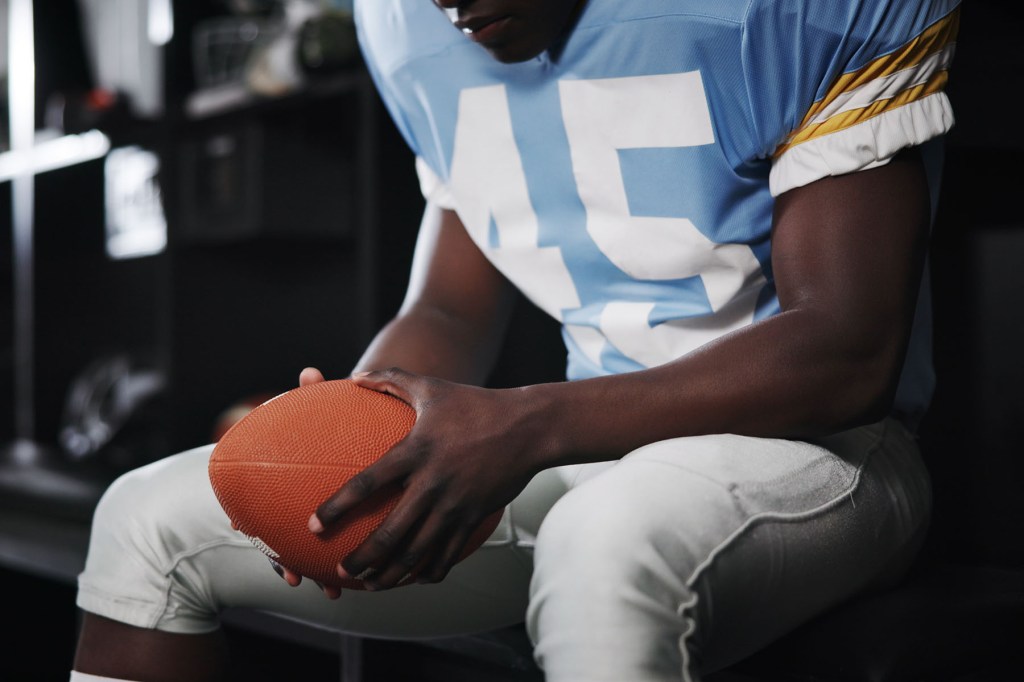
A player with a ball his hand sits in a locker room.
A player with a ball his hand sits in a locker room. (Jacob Wackerhausen/Getty Images)

Unlike men’s leagues, women’s leagues are more accepting of LGBTQ+ players. Billie Jean King, Brittney Griner and Abby Wambach are some of the many women who have thrived while competing as openly gay athletes.

“In the WNBA, [it’s] not an issue,” says Nicodemo, referencing that 29 percent of active WNBA players are openly lesbian.

Homophobia is more common among men. And in the locker room, it isn’t always easy to spot, as it often masks itself in homoeroticism.

“Two male athletes will kiss each other on the lips. And that’s considered to be love and appreciation that you scored that big goal. ‘I’m gonna kiss you and it’s not at all viewed to be perceived to be gay and the grabbing of the bums or the testicle area.’ This idea of showering together, slapping towels, that’s all considered to be like part of men’s sport,” says Weaving. “So it’s this idea where players can be as ‘gay’ as they want and in the context of the field or the locker room, they’re not perceived to be gay. But if they were to act that way outside of that sporting context, then they’re considered to be.”

Collins says this gender divide may be because of sexism and toxic masculinity. This kind of performative homoeroticism is only socially acceptable because it’s understood to be ironic—a joke that relies on not actually being gay. When the behavior slips beyond the bounds of “just joking,” it exposes an undercurrent of homophobia masked as camaraderie.

The financial cost of coming out: something to gain or lose?

Beyond all these pressures lies a monetary component for athletes who are considering opening the closet door while still in uniform. Cyd Zeigler, the cofounder of Outsports, wrote in a 2024 article that he knows “for a fact that agents have told gay athletes to stay in the closet” and that his “best answer has pointed to the agents and managers whose livelihoods depend on athletes maximizing their earning potential in just a few years.”

Weaving agrees. “The general managers and the owners have more traditionally homophobic, sexist thinking. They believe [LGBTQ+ players] will harm viewership,” she says. “It’s still taboo where athletes fear repercussions, predominantly, around sponsorships.”

The fear of losing out on money may be misguided. The first day Jason Collins’ number 98 jersey became available on the NBA website, one year after he came out, it was the top seller of all active NBA players. Carl Nassib’s jersey became a top seller on the NFL’s official online marketplace when he came out in 2021. And Michael Sam, the first gay NFL player, had the second-highest selling jersey in his 2014 rookie class of more than 250 draftees.

The Trump effect on the last closet

Perhaps the biggest factor keeping men in the closet is America’s current political climate, where the Trump administration and corporate America have abandoned DEI and so-called “woke” initiatives.

The Trump administration has also erased many references to LGBTQ+ people from government websites, and at least nine states have introduced measures to overturn marriage equality.

“The Trump administration asks districts to sign attestations to say that they’re not going to do DEI work in schools. That could be a pride flag hanging in the classroom,” says Nicodemo. “If you’re not creating an inclusive environment for these kids, then these kids are never going to feel comfortable coming out.”

What can be done?

As all these factors create a challenging environment for men to feel safe coming out in sports.

Collins says what could move the needle the most is an increase in role models who will make young athletes feel like they’re competing in a safe environment. “It definitely got to very dark, lonely places because I felt like I was going through this alone,” he says. “When I was younger, I was constantly looking for those role models, of people who have sort of been down this path,” he says.

Weaving agrees and says that a lack of LGBTQ-inclusive coaches can be more than just a deterrent for student-athletes seeking to grow their career.

“For many children, it doesn’t only make things uncomfortable, it can push them out of sports altogether,” she says. “Coaches play a big role. Youth sport is the starting point. If you can create positive environments, inclusive cultures at that level, it continues and helps to shift the pro culture.”

Collins remains hopeful that there will be more visibility of gay men in professional sports but underscores the need for role models to step up.

“If you’re a coach or if you’re an athletic director or even a headmaster out of school, you have to seek out help. You have to bring other organizations who have expertise. And it can be as simple as a 30- to 60-minute conversation, but at least you’re laying the groundwork down for educating those players, educating those athletes,” says Collins, a two-time NBA championship finalist who married his partner last month.

Additional reporting by Sam Donndelinger.

Niagara Movement, Dr. Spock, & More, In Peace & Justice History for 7/11

July 11, 1905
The Niagara Movement, precursor of the National Association for the Advancement of Colored People (NAACP), was formed in Buffalo, New York. Meeting at the home of Mary Burnett Talbert were W.E.B. DuBois, John Hope and 30 others who rejected the accommodationist approach of Booker T. Washington (“The wisest among my race understand that the agitation of questions of social equality is the extremest folly . . . .”)

Founders of The Niagara Movement at Niagara Falls
The Niagara Movement’s manifesto was, in the words of DuBois, “We want full manhood suffrage and we want it now . . . We are men! We want to be treated as men. And we shall win.
The Niagara Movement and its founding principles 
July 11, 1968
The American Indian Movement (AIM) was founded in Minneapolis, Minnesota, by George Mitchell, Dennis Banks, Clyde Bellecourt and 200 others.
They gathered to organize in order to deal with widespread and persistent poverty among native Americans, and unjust treatment from all levels of government.


American Indian Movement background 
July 11, 1969

The federal appeals court in Boston reversed the convictions of Dr. Benjamin Spock and Michael Ferber who had been found guilty of conspiring to counsel evasion of the military draft in 1968. The judges considered their activities opposing the Vietnam War covered under the 1st Amendment right to free speech.

Dr. Benjamin Spock and Dr. Martin Luther King Jr.
Read “A Call to Resist Illegitimate Authority” co-authored by Dr. Spock (1967) 

https://www.peacebuttons.info/E-News/peacehistoryjuly.htm#july11

Indiana Has An Asshat, God-Awful, Hateful, Preacher…

I know in the last few days I have posted a lot of what I think is important stuff.  But if you have ever wanted to hear a grand response to a hate preacher calling for the death of gay people then you need to watch this video.  The reverend is as upset and agitated as I have ever seen him.  He not only debunks the hate preachers arguments but uses the verses before and after to show how wrong people that use that to hate on gays are.   Hugs.