Mr. Abrego has filed an amended complaint asking the court to declare the government’s actions unlawful and to order his release. He describes his torture in El Salvador in the complaint.
While Mr. Abrego sits in jail in Tennessee pending a hearing over his disposition in a bogus criminal case brought by a politicized Department of Justice, his lawyers have filed a new complaint amending the original one that sought his return to the United States after the government admitted they had sent him to El Salvador in error.
This new filing not only references the protected whistleblower account of the now-fired Justice Department lawyer Erez Reuveni – who outlined the government’s malfeasance and coverup of the unlawful removal of Mr. Abrego, but it also details the conditions at the CECOT torture prison, where hundreds of people remain trapped incommunicado as their class action works its way through the courts.
The Breakdown is a reader-supported publication. To receive new posts and support my work, consider becoming a free or paid subscriber.
Subscribe
Beginning on page 20 of the 40-page amended complaint, Mr. Abrego’s lawyers outline the reality of life in CECOT. Content warning for inhumane conditions and torture:
Upon information and belief, all Defendants are aware that the government of El Salvador tortures individuals detained in CECOT. Indeed, U.S. President Donald Trump has made comments to the press expressing glee and delight at the torture that the Government of El Salvador inflicts upon detainees in CECOT.
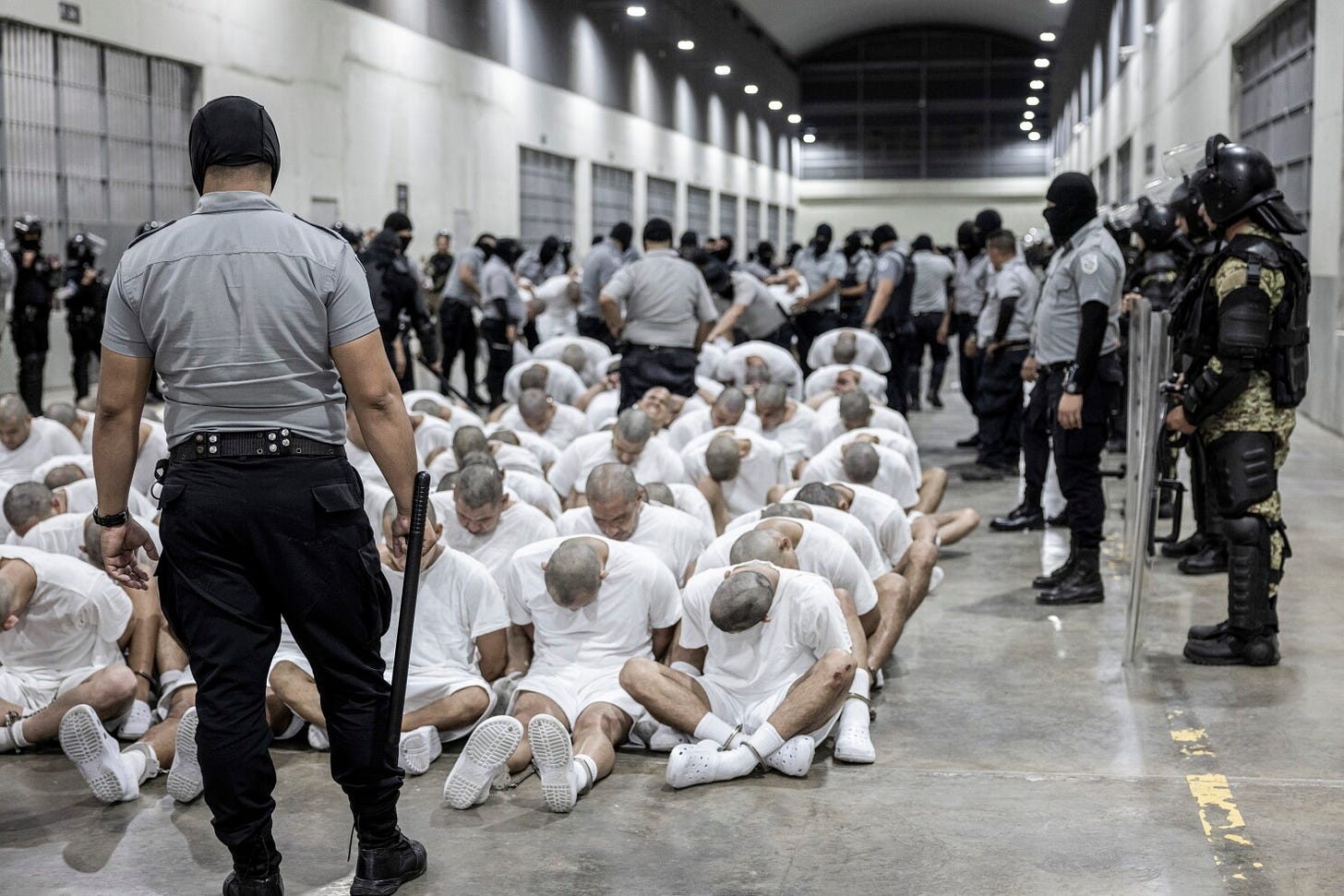
Each of the 256 cells is intended to hold approximately 80 inmates but often holds nearly double. See Ex. F. The cramped cells are equipped with tiered metal bunks without mattresses, two basins for washing, and two open toilets. There are no windows, fans, or air conditioning, despite the region’s warm and humid climate.
Inmates in CECOT are confined to their cells for 23.5 hours daily and cannot go outdoors. They are denied access to reading materials, including even letters from friends or family. Inmates are prohibited from receiving visits from family and friends. Meals are provided through the bars, and the facility enforces strict regulations to maintain order.
In May 2023, Cristosal, a leading human rights organization in El Salvador, released a comprehensive report detailing severe human rights abuses within the country’s prison system, especially CECOT. The investigation documented the deaths of 153 inmates between March 27, 2022, and March 27, 2023, attributing many to torture, beatings, mechanical asphyxiation (strangulation), and lack of medical attention. Autopsies revealed common patterns of lacerations, hematomas, sharp object wounds, and signs of choking or strangulation. Survivors reported being forced to pick food off the floor with their mouths, subjected to electric shocks, and exposed to untreated skin fungus epidemics.
Plaintiff Abrego Garcia reports that he was subjected to severe mistreatment upon arrival at CECOT, including but not limited to severe beatings, severe sleep deprivation, inadequate nutrition, and psychological torture.
Plaintiff Abrego Garcia was the first name called to disembark the plane that transported him to El Salvador on March 15, 2025. As he exited the aircraft, still in chains, two officials grabbed his arms and pushed him down the stairs, forcing his head down
There were strong lights illuminating the area despite it being nighttime, and cameras were filming the detainees’ arrival.
Plaintiff Abrego Garcia was pushed toward a bus, forcibly seated, and fitted with a second set of chains and handcuffs. He was repeatedly struck by officers when he attempted to raise his head.
Upon arrival at CECOT, the detainees were greeted by a prison official who stated, “Welcome to CECOT. Whoever enters here doesn’t leave.” Plaintiff Abrego Garcia was then forced to strip, issued prison clothing, and subjected to physical abuse including being kicked in the legs with boots and struck on his head and arms to make him change clothes faster. His head was shaved with a zero razor, and he was frog-marched to cell 15, being struck with wooden batons along the way. By the following day, Plaintiff Abrego Garcia had visible bruises and lumps all over his body.
In Cell 15, Plaintiff Abrego Garcia and 20 other Salvadorans were forced to kneel from approximately 9:00 PM to 6:00 AM, with guards striking anyone who fell from exhaustion. During this time, Plaintiff Abrego Garcia was denied bathroom access and soiled himself. The detainees were confined to metal bunks with no mattresses in an overcrowded cell with no windows, bright lights that remained on 24 hours a day, and minimal access to sanitation.
While at CECOT, prison officials repeatedly told Plaintiff Abrego Garcia that they would transfer him to the cells containing gang members who, they assured him, would “tear” him apart.
Indeed, Plaintiff Abrego Garcia repeatedly observed prisoners in nearby cells who he understood to be gang members violently harm each other with no intervention from guards or personnel. Screams from nearby cells would similarly ring out throughout the night without any response from prison guards on personnel.
During his first two weeks at CECOT, Plaintiff Abrego Garcia suffered a significant deterioration in his physical condition and lost approximately 31 pounds.
Mr. Abrego’s amended complaint is asking the court for an order:
a) Declaring that Defendants’ actions, as set forth herein, violated the laws of the United States and the Fifth Amendment to the U.S. Constitution;
b) Immediately ordering Defendants to restore the status quo ante, which includes returning Abrego Garcia to Maryland, where he was before being picked up by DHS agents in March, 2025;
c) Issue a writ of habeas corpus ad testificandum, ordering that Plaintiff Abrego Garcia be brought before this Court for a habeas corpus hearing. At the habeas corpus hearing, this Court should order Defendants to show cause why continued detention is lawfully permissible; and if they cannot meet their burden of so showing, issue a writ of habeas corpus and order Plaintiff Abrego Garcia’s immediate release from custody;
d) Order that Defendants return Abrego Garcia to his prior Order of Supervision;
e) Granting Plaintiffs costs and fees under the Equal Access to Justice Act; and
f) Granting such other relief at law and in equity as justice may require.
For in-depth coverage on the case of Mr. Abrego, the case to return all the prisoners sent to CECOT, and other cases of people deported without due process, you can listen to the UnJustified podcast hosted by former Deputy Director of the FBI Andrew McCabe and me.
I am so depressed over the drive of the Fundamentalist Christian rights success at trying to erase the LGBTQ+ people. Now they are trying to again return to the discredited idea that sexual ordination can be changed if you torture a kid badly enough. I read so many horror stories of kids as young as 13 and 14 having their genitals hooked up to electrical shock devices, being beaten, being sexual abused so that they would be turned off by same sex hook ups, being curatively raped for both lesbian and gay boys, and so many more. And it doesn’t work. People can be forced to control behavior and lie about their feelings. But sexual attraction can not be changed.
I keep saying the same question to those straight cis people who think orientation or gender is simply a choice rebellious teenagers make. Can you willingly change your attraction from straight to gay and live that life for a year having sex with your same gender? Can you do happily what same sex couples do to please each other sexually? Can you stop being the gender you were assigned at birth and change every aspect of your gendered life and live that way for a few years to show me it is a choice? They tell me that is stupid and why should they … they are the normal ones!
I feel sorry for the kids because of the stories of abuse I have read about at these conversion camps, at these “therapist offices”. The male survivor site has an entire forum dedicated to this subject. Why is it so important to these people to wipe us out socially / publically. Why can’t they let the kids be, why must they sexually force them to be mini me straight cis clones of the parents.
As I said I don’t understand and I do know it is not all Christians. But seriously we need progressive Christian churches to stand up to these groups. After 9/11 we kept hearing people demand Muslims in the US denounce publically the terrorist act of other Muslims. Recently a Muslim won the democratic nominee for NY City and democratic politicians were demanding he denounce every bad thing ever done by a Muslim. Why is that a one way street? Shouldn’t white people be required to denounce bad white people? Shouldn’t Christians be required to speak out against hateful Christians.
I am seeing a return to the 1970s Anita Bryant rhetoric and no one seems to see the connection. She used her faith to claim that no one wanted to see gay teachers in public schools indoctrinating and recruiting (sexualizing) kids. Well these are the same words used against the gay teachers and trans people today by the republicans and hate Christians. It was the anti-Christian oppression Samuel Alito wrote in his ruling that just having books with people happy to celebrate a same sex wedding was discrimination against Christians who did not want people to be happy at same sex weddings. Read his ruling it really says that kids being read a picture book of people being happy at a same sex wedding is oppression and discrimination against Christians.
I am tired. I am 62 years old. I fought this fight as a child, suffered from it, faced the discrimination, lost jobs, got assaulted at work and school, lost promotions, and had hate poured out on me at every turn for at least 25 years. Hell as I was being raped as a child I had anti-gay bigotry screamed at me. Think on that for a mindfuck. Those raping me screamed I deserved it as a 7 year old because I clearly was a faggot. I lost my right to keep going with my Army career due to a new unit commander who bragged about his deep Christian faith. He called me into his office, told me he knew I was out to my unit and even though I was respected, well liked, and had the skills to save the unit even on the day I was leaving, he was not going to tolerate an “evil deviant homosexual” to be in the army or his unit. I feel so sorry for the kids kicked out of their homes to have to sell their bodies on the street to strangers for food and lodging due to this hate. I am so tired as history is repeating and I need to find the strength to fight for the LGBTQ+ kids once again. I don’t think I can. Hugs
The therapy practice tries to influence gender or sexuality identity and has been denounced by experts for negative effects to patients’ mental or physical health.
From left to right: Family Foundation president Victoria Cobb, Founding Freedoms Law Center lawyer Josh Hetzler, and counselors/plaintiffs John and Janet Raymond celebrate a court ruling to overturn a ban on talk-based conversion therapy. (Photo by Charlotte Rene Woods/Virginia Mercury)
A Henrico County Circuit Court judge ordered that licensed counselors be allowed to engage underage clients in a controversial form of talk therapy about gender identity and sexual orientation that medical and mental health experts say can be harmful.
The case underpinning the new consent decree with the Virginia Department of Health Professions stemmed from a 2020 state law banning “any practice or treatment that seeks to change an individual’s sexual orientation or gender identity.” Last year, Front Royal-based counselors John and Janet Raymond challenged the ban.
“The Raymonds desired to engage in talk therapy with minors through voluntary conversations, prayer, and providing written materials such as Scripture, but Virginia’s law and regulations prohibited them from doing so,” read a Tuesday statement from the Founding Freedoms Law Center, the Family Foundation’s legal arm that represented the Raymonds in the case. The Center hailed the court’s ruling as a “landmark free speech victory.”
Conversion therapy entails attempts to change or influence a person’s sexual orientation or gender identity. The American Psychological Association has denounced conversion therapy, stating that it is not an accepted form of therapy based on medical or scientific evidence, as has the American Medical Association. The groups and advocates have also said conversion therapy is used as a tool to discriminate against LGBTQ+ people and lifestyles.
Conversion therapy treatments have garnered national controversy over the years and range from inducing nausea, providing electric shocks to having people snap an elastic band around their wrist when they become aroused by same-sex erotic images or thoughts.
The Raymonds told the court they previously practiced talk therapy for conversion therapy clients, as they do with their other clients. The ban meant they couldn’t have conversations to try to guide clients away from embracing their sexual or gender identities. The new consent decree means they can practice conversion therapy again.
Opponents of the practice have argued that conversion therapy can put LGBTQ+ people at higher risk ofmental health issues like depression, anxiety, post-traumatic stress disorder, substance abuse or suicide.
The Raymonds emphasized that the talk therapy they engage in with their clients is voluntary and stressed that nothing about their case should be construed as allowing any counselor to perform acts associated with conversion therapy, such as electro-shock therapy.
“With this court order, every counselor in Virginia will now be able to speak freely, truthfully and candidly with clients who are seeking to have those critical conversations about their identity and to hear faith-based insights from trusted professionals,” said Josh Hetzler, the couple’s legal counsel with the Founding Freedoms Law Center.
The Family Foundation is a Christian and conservative advocacy group and legal firm that opposes same-sex marriage, supports more parental input in public education, and supports increased restrictions on abortions. While the consent decree was ordered on June 4, Family Foundation and the plaintiffs announced it on July 1.
“We thank God that He gives us the freedom to speak, to believe, to seek His wisdom,” John Raymond said Tuesday in the Family Foundation’s office in Richmond — formerly a house that Confederate General Robert E. Lee rented following his surrender at Appomattox that ended the Civil War.
Raymond said he felt like Virginia’s 2020 law gave him no choice but to challenge it and called it a “hostile ideological invasion within our country.”
Likewise, Hetzler noted a “growing number of parents” seeking counseling services with a religious lens for their children “in an era when gender dysphoria has become a contagion among young people.”
Virginia lawmakers weigh in
Sen. Danica Roem, D-Prince William, noted on a press call Tuesday that there have been bipartisan efforts to support LGBTQ constituents in Virginia’s legislature in recent years. When the conversion therapy ban was clearing the House of Delegates five years ago, 11 Republicans joined their Democratic colleagues in voting for it. Seven Republican lawmakers — to include then-delegate and now Attorney General Jason Miyares — abstained from voting. Over in the Senate, a former GOP lawmaker joined Democrats in supporting that version as well.
While Miyares did not express support or dissent in 2020, his office has signed the consent decree effectively lifting the ban on conversion therapy.
As attorney general, Miyares has pressed for banning transgender youth from participating in sports teams of their identity as a suite of anti-LGBTQ+ bills have been introduced in the state during Republican Gov. Glenn Youngkin’s administration.
Localities have pushed back on former Gov. Ralph Northam’s order that transgender students be able to use the bathrooms of their identities. And an in-progress constitutional amendment to remove a defunct same-sex marriage ban from the state’s constitution has advanced with slim bipartisan support.
Advocates for that law say it’s important, as Supreme Court Justice Clarence Thomas has expressed interest in revisiting a decade-old ruling that protects gay marriage federally. He expressed the opinion after the court struck down federal abortion protections. Should marriage protections fall, Virginia is among states that would immediately ban the unions.
Roem reiterated the risks of conversion therapy, saying medical care for transgender people like hormone therapies or surgeries are constantly subject to medical review to assess quality of care, while talk-based conversion therapy isn’t.
Roem, the state’s first transgender senator, said she has been on the receiving end of efforts to dissuade her from her sexual identity but it never stopped her from embracing being transgender.
“I spent 13 years in Catholic school — I heard everything,” she said. “I am just as trans today at age 40 as I was when I got into Catholic school in 4th grade.”
Ultimately, what the conversion therapy ban came down to for Democrats, she and Senate Majority Leader Scott Surovell, D-Fairfax said, is public health. Given how various medical associations have denounced conversion therapy, they felt it had no place in state-licensed counselor’s services.
“I have no problem if somebody wants to go look at religious counseling from their priest or their minister, their rabbi, their imam — that’s perfectly fine,” Surovell said. “When somebody goes to get therapy from somebody licensed by the Commonwealth of Virginia, there’s a different set of rules applied. You can’t just say whatever you want because you have a license. That’s why we have professional standards, that’s why we have statutes.”
While several studies have shown negative mental and physical health impacts of conversion therapy on LGBTQ+ people, the Raymonds said a 2024 report in the United Kingdom called for more research on gender identity services for minors. However, the report’s author noted their belief that “no LGBTQ+ group should be subjected to conversion practice.”
With an appeal deadline having passed, lawmakers could further tweak their 2020 law when they convene next year.
Editor’s note: This article has been updated to reflect that the order was issued in June and announced in July. Sen. Surovell also said “imam” rather than “mom.”
In their celebratory video below, the group rants about LGBTQ “contagion among young people.”
Last year the Family Foundation joined a hate group coalition seeking to “save” the 2024 Republican Party platform from caving on LGBTQ issues.
In 2023, the Family Foundation successfully pressured Virginia lawmakers against repealing the state’s still-existing ban on same-sex marriage.
Also in 2023, a spokesman for the group claimed that they’d been refused service by a Virginia restaurant due to their anti-LGBTQ activism.
MONUMENTAL VICTORY
Founding Freedoms Law Center won a major, free speech victory for all Virginia counselors—securing their right to offer compassionate, common-sense talk therapy to minors who seek help with unwanted sexual feelings or identity confusion. pic.twitter.com/ahoJ5rY68J
— The Family Foundation of Virginia (@TFFVA) July 1, 2025
July 2, 1776 New Jersey became the first British colony in America to grant partial women’s suffrage. The new constitution (temporary if there were a reconciliation with Great Britain) granted the vote to all those “of full age, who are worth fifty pounds proclamation money,” including non-whites and widows; married women were not able to own property under common law.
July 2, 1777 Vermont became the first of the United States to abolish slavery.
July 2, 1809 Alarmed by the growing encroachment of whites squatting on Native American lands, the Shawnee Chief Tecumseh called on all Indians to unite and resist. By 1810, he had organized the Ohio Valley Confederacy, which united Indians from the Shawnee, Potawatomi, Kickapoo, Winnebago, Menominee, Ottawa, and Wyandotte nations. For several years, Tecumseh’s Indian Confederacy successfully delayed further white settlement in the region. Chief Tecumseh Tecumseh’s efforts
July 2, 1839 Slave ship Early in the morning, captive Africans on the Cuban slave ship Amistad, led by Joseph Cinquè (a Mende from what is now Sierra Leone), mutinied against their captors, killing the captain and the cook, and seized control of the schooner. Jose Ruiz, a Spaniard and planter from Puerto Principe, Cuba, had bought the 49 adult males on the ship, paying $450 each, as slaves for his sugar plantation. More about Amistad Joseph Cinquè
July 2, 1964 Jobs and Freedom march April 28, 1963, Washington DC U.S. President Lyndon B. Johnson signed the Civil Rights Act of 1964 into law, thus barring discrimination in public accommodations (restaurants, stores, theatres, etc.), employment, and voting. The law had survived an 83-day filibuster in the U.S. Senate by 21 members from southern states. “I think we just delivered the South to the Republican party for a long time to come,” said President Johnson to his press secretary, Bill Moyers later that day. He anticipated a shift in white southern voting from the Democratic to the Republican party in response to the law. Massive demonstrations a year earlier ensured passage of the Act.
July 2, 1992 President George H.W. Bush (the elder) announced that the United States had completed the worldwide withdrawals of all its ground- and sea-launched tactical nuclear weapons [see September 27, 1991].
CINCINNATI — The Ohio Lesbian Archives in Cincinnati’s Over-the-Rhine neighborhood started with a friendship.
Phebe Beiser said that when she and co-founder Victoria “Vic” Ramstetter met in the 1970s, they bonded over being “hidden, secret, teenage lesbians,” growing up in what was then a conservative city and region where there were few gay role models. For a time in their 20s, they shared group houses in Clifton, where they now joke that they “survived the lesbian commune together.” They were young and idealistic. They wanted to “turn being an activist lesbian into something fun and interesting, and maybe help change the world.” Beiser, now in her mid 70s, told The 19th that they had a mantra: “We never wanted to be invisible again.”
When the Crazy Ladies Bookstore, named for the women who history brushed off as “crazy,” opened in Northside in 1979, it became the center of gravity in the Cincinnati lesbian community of which Beiser and Ramstetter were a part. Women bought homes in the neighborhood, gathering at the feminist bookstore for coffee, tea and conversation about being women, and about being gay. In 1989, the Archives opened on an upper floor.
It seemed that the visibility of the Crazy Ladies Bookstore and the Ohio Lesbian Archives — and of the women who made them happen — would be cemented in history in 2023, when the Ohio History Connection, the state’s nonprofit historical society, “embarked on a three-year project to diversify Ohio’s historical markers to include ten new stories of LGBTQ+ Ohioans” via its Gay Ohio History Initiative, or GOHI. At the time, there were roughly 1,800 historical markers in Ohio’s program, but only two commemorated places, events or people from the state’s queer history. A third, recognizing Summit Station, a lesbian bar in Columbus that operated from 1970 to 2008, was dedicated during Pride Month that year. The Archives and bookstore were selected for joint recognition.
That long-overdue acknowledgement has been derailed by the Trump administration’s sweeping war on DEI, which extends beyond diversity, equity and inclusion programs to seemingly include anything that acknowledges the country’s diversity of experience. But the archives — and the volunteers who sustain it — are undeterred, carrying on as the queer community has throughout history, documenting their existence.
We never wanted to be invisible again.” Phebe Beiser
The Ohio Lesbian Archives first began in 1989 in a small room on the third floor above the Crazy Ladies Bookstore in Cincinnati, Ohio. (Cincinnati & Hamilton County Public Library)
The Marking Diverse Ohio program was financed by a $250,000 grant from the Institute of Museum and Library Services, an independent agency created by a Republican-led Congress in 1996 that is the main source of federal funding for libraries and museums. Beiser and Branstetter were interviewed for an oral history. Ohio History Connection researchers visited the Archives to peruse the collection. A location was secured in a city park near where the since-shuttered Crazy Ladies Bookstore once was. By early this year, preparations to forever commemorate the Archives and bookstore with a plaque were all but complete. Its installation was expected in June, Pride Month.
Then, in late March, President Donald Trump issued an executive order regarding “The Continuing Reduction of the Federal Bureaucracy,” singling out seven agencies for elimination — including the Institute of Museum and Library Services, or IMLS. Nearly all of its employees were put on leave and their emails were disconnected. Days later, his administration’s Department of Government Efficiency, or DOGE, canceled $25 million worth of already-awarded IMLS grants, including the $250,000 for Ohio History Connection’s Marking Diverse Ohio program. The federal agency’s seemingly final Instagram post stated: “The era of using your taxpayer dollars to fund DEI grants is OVER.” The last photo listed erecting “LGBTQIA+ historical markers across Ohio” among the alleged government excesses that would be cut.
Svetlana Harlan, a former project coordinator for Marking Diverse Ohio, recalled that when she looked at the list, and saw the program with other projects she admired, “it almost seemed like a positive thing, I was like, ‘Oh yeah, these are nice initiatives!’”
“And it turns out that [DOGE] was just taking over the account. So then I was like, ‘Oh, they’re cutting those. Oh, our name is on the list,’” she said.
DOGE’s cancellation of the $250,000 IMLS grant to Ohio History Connection threw into question the future of the markers that were supposed to ensure that Ohio’s public displays of its history include LGBTQ+ people. Along with the Ohio Lesbian Archives and the Crazy Ladies Bookstore, there were markers in the works for an LGBTQ+ district in Akron; the first professor of gay and lesbian studies at Kent State University; 19th-century sculptor Edmonia “Wildfire” Lewis; LGBTQ+ journalism in Ohio; Toledo’s first LGBTQ+ member of city council; a Columbus hospice care center for HIV and AIDs patients; an open lesbian pastor in Athens; the screen-printing company Nightsweats and T-Cells in Lakewood; and the Rubi Girls, a Dayton-area drag group that has raised more than $3 million for HIV/AIDs and LGBTQ+ causes since the 1980s.
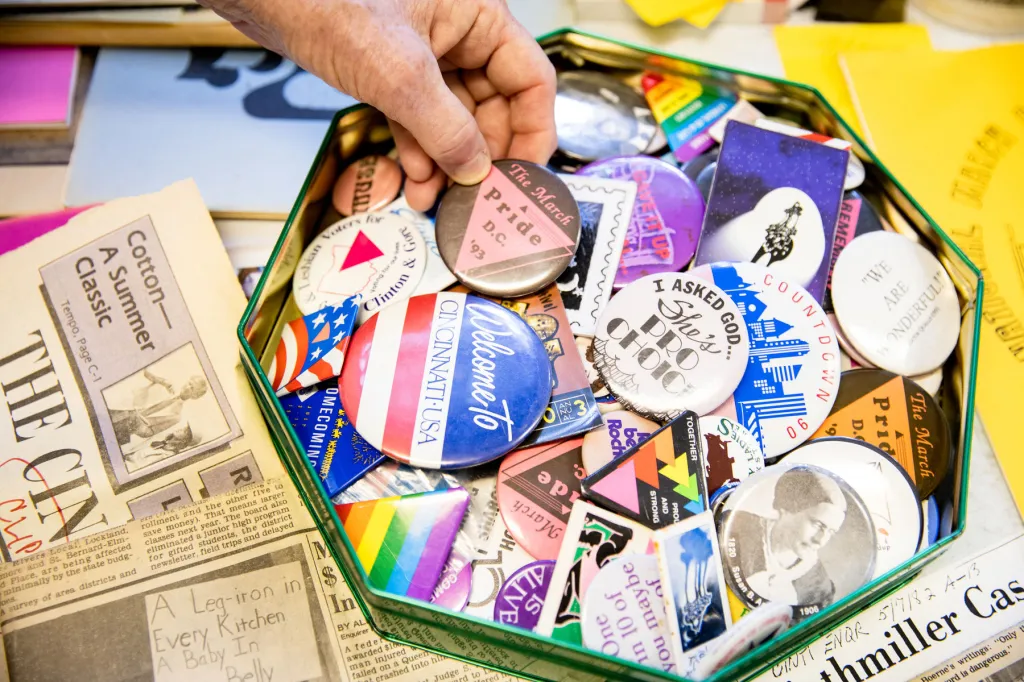
Ephemera collected at the Ohio Lesbian Archives include buttons from past Pride marches, political campaigns and other symbols of lesbian life. (Courtesy Ohio Lesbian Archives)
Preservation on hold
Marking Diverse Ohio and other programs recognizing specific communities weren’t the only programs impacted in the state when DOGE cut IMLS grants and the federal agency essentially shuttered. And, given that more than $250 million is granted annually to libraries and museums nationally, the economic chaos at the country’s museums, libraries and historical institutions wasn’t confined to Ohio.
In Ohio, other entities that received recent IMLS funding include the Frank Lloyd Wright-designed Westcott House in Springfield, for post-pandemic, on-site programming; the Cincinnati Zoo for a big cat breeding program; Dayton Metro Library programs that helped low-income Ohioans secure Internet access; and Cincinnati’s Contemporary Arts Center, which lost $175,000 slated for programming aimed at the 3,000 or more teens it serves each year.
Institutions in Pennsylvania warned the economic upheaval could scuttle the digitization of The Rosenbach museum’s collection of rare books and manuscripts; the Woodmere Art Museum was mid renovation on a building to house its collection and expected to be reimbursed. In Wisconsin, small-town libraries said without the $3 million from the IMLS they’d received the year before they would have to reduce staff and therefore services. The American Library Association, or ALA, and the American Federation of State, County and Municipal Employees, or AFSCME, the labor union representing government workers, sued the Trump administration. ALA President Cindy Hohl said at the time that, “Libraries play an important role in our democracy, from preserving history to … offering access to a variety of perspectives.” AFSCME President Lee Saunders added: “Libraries and museums contain our collective history and knowledge.”
Earlier this month, a federal judge ruled that the Trump administration could continue dismantling the Institute of Museum and Library Services as the case continues.
For now, Ohioans who want LGBTQ+ history represented among the 1,800 markers in the state will not get the federal funding that was granted and must search for alternative resources in their communities. A couple of the markers look poised to move forward with outside funding from community foundations and other organizations. Others, like the Ohio Lesbian Archives and the Crazy Ladies Bookstore, are still waiting. The remaining cost to install the marker would likely be $3,000-$5,000.
When The 19th reached out to Ohio History Connection to ask if any alternative funding sources were being explored to install the Archives’ marker, spokesperson Neil Thompson said that he was “not able to provide any additional information for an Ohio Historical Marker application that is not in the public domain” and that it is only considered in the public domain once “the markers are finalized, cast and ready to be installed and dedicated.”
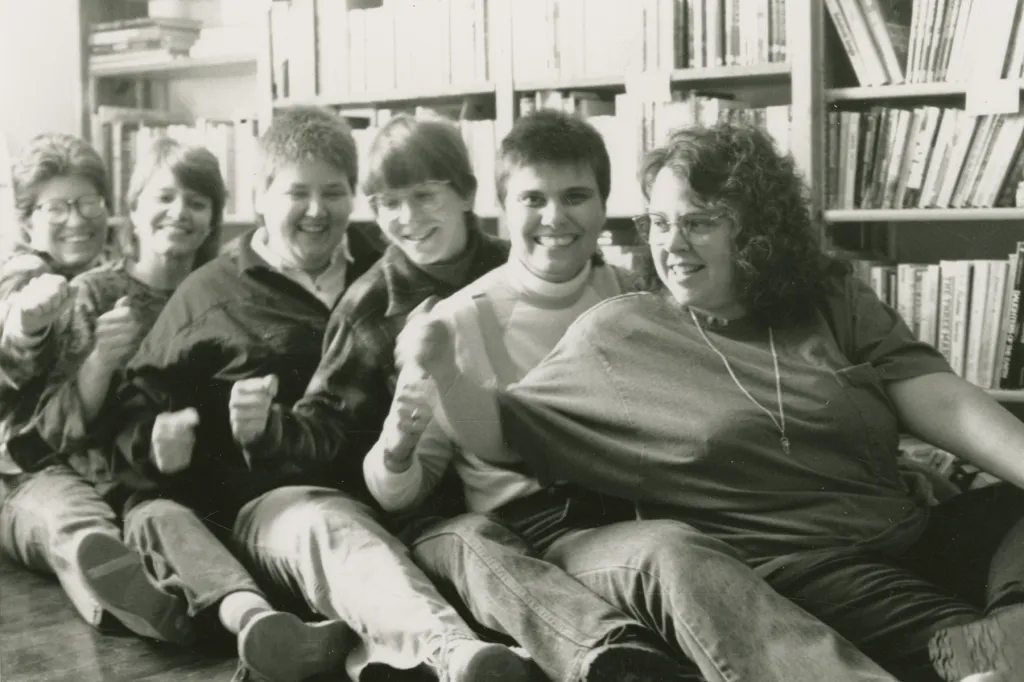
Phebe Beiser (far left), who co-founded the Ohio Lesbian Archives with her longtime friend Victoria ‘Vic’ Ramstetter, with Janice Uhlman, Elizabeth Van Dyke, Cathy McEneny, Morgan Kronenberger, and Ruth Rowan (left to right) at the Ohio Lesbian Archives in 1989. (Cincinnati & Hamilton County Public Library)
‘A reflection of themselves’
The Ohio Lesbian Archives has always been a DIY endeavor, powered by a group of passionate volunteers. When the Crazy Ladies Bookstore’s founder, Carolyn Dellenbach, moved out of the area, she handed it over to its patrons to be run as a feminist collective. A lesbian newsletter called Dinah operated out of the upper floor — they referred to the National Organization for Women’s Task Force on Sexuality and Lesbianism, established in 1973, as FOSAL, or fossil, and Dinah was a play on dinosaur. Beiser laughed explaining the name: It was the 1970s; maybe there were drugs involved. For a time she wrote for Dinah and loved interviewing famous arrivals from the “women’s music circuit” when they came to town.
At some point, the women working shifts at the bookstore, writing for Dinah and organizing talks and other events related to feminist and lesbian issues, realized that the community they had built, and the ephemera they were collecting and creating, were an important part of history — theirs, lesbians,’ Ohioans,’ and women’s.
“We held on to them because we knew they could not be replaced,” Beiser said of the collection. “It’s proof of our existence … so we held on to these things to never be invisible again.”
We held on to them because we knew they could not be replaced. It’s proof of our existence.” Phebe Beiser
Books on lesbian history line the shelves of the Ohio Lesbian Archives. (Courtesy Ohio Lesbian Archives)
In a 1991 issue of Dinah, letters to the editor included one from “Ma” who updated the “wimmin” in the community — they often spelled variations of their gender in ways that did not include “man” — that she was homesteading outside the city with her partner and building a log cabin. Another was from a woman who said she was “shocked” to find out that her being fired for being a lesbian was not a violation of civil rights laws and she was disappointed that the LGBTQ+ community did not come out to support her recent picket, writing: “I hope that in my lifetime I will see the gay and lesbian community get off their asses and together start fighting for their rights.”
Across from the metal filing cabinet at the Archives that houses the Dinah issues, a modern-looking poster from before the Supreme Court decided Bostock v. Clayton County in 2020, which extended employment protections to LGBTQ+ Americans, reminded Ohioans that it was still legal for them to be fired for their sexual orientation or gender identity. Today, Trump’s Equal Employment Opportunity Commission is aiming to curtail those hard-won workplace protections established by Bostock.
Lüdi Rich, a 27-year-old librarian, was working a recent Sunday afternoon at the Archives’ twice-weekly open hours, organizing books and research materials while the space was open to members of the community to drop in.
When Rich moved to Cincinnati nearly two years ago, she didn’t know anyone in the area, so she looked online for queer spaces so she could start building her community. When she attended a panel on local queer history, one of the speakers was Beiser, a longtime librarian herself in the country’s second-largest public library system.
Beiser mentioned at the panel that the Ohio Lesbian Archives would be having an open house that night at its new location next to Over-the-Rhine’s Washington Square Park, where Beiser was among those who met to march in Cincinnati’s first Pride Parade in April 1973. Rich asked Beiser how she could volunteer.
A couple months later, Rich showed up for her first shift, “And I’ve been here working ever since,” she said.
Nancy Yerian, the 34-year-old president of the Archives’ board, said that when she graduated from college in Massachusetts, she didn’t know if she could return to Cincinnati, where she grew up — until she discovered the Archives. “I thought that to live the kind of life I wanted to lead, I had to get out of what I thought was a very conservative place,” said Yerian, who has been volunteering at the Archives in some capacity since shortly after she finished school.
“Finding the Archives and the people I’ve met through the organization and the community we’re creating, as well as the history we’re preserving — it gave me a lot of hope that I could create a life for myself here,” she added.
It really is just us, preserving our history.”Lüdi Rich
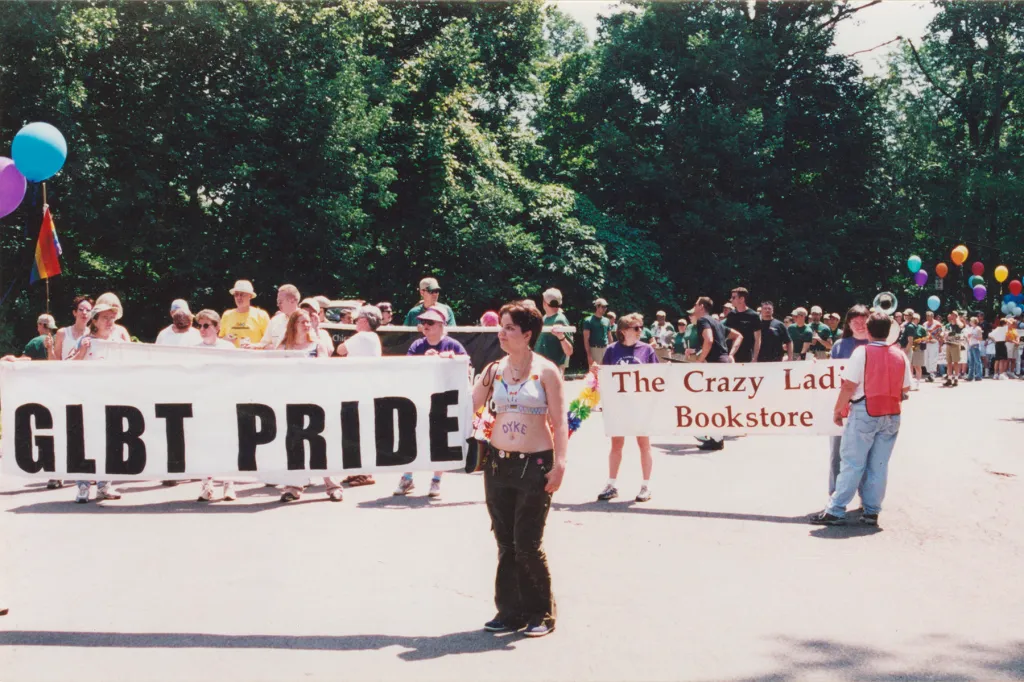
The Crazy Ladies Bookstore marched in a Cincinnati, Ohio Pride parade. (Cincinnati & Hamilton County Public Library)
The Archives’ volunteers have helped digitize old photos, some of which are now in a collection at the Cincinnati Public Library. They organize the books, arranged by first names instead of last, since so many women, especially in those early years, published works after taking on their husbands’ surnames. There are filing folders of Dinah newsletters. A cabinet holds multiple VHS and DVD copies of the early aughts television drama “The L Word.” A collection of buttons includes those from past Pride marches; supporting Hillary Clinton’s presidential campaigns; and one with “REMEMBER” and an inverted pink triangle, the Nazi symbol that Adolf Hitler used to identify gay and trans people. There is also one with the logo of the Crazy Ladies Bookstore, the silhouette of a woman reading while reclined in a chair, a cat by her side.
“Many people who are coming to the archives are looking for a reflection of themselves and in many ways that’s why Vic and Phebe started it. It shows models of ways to be in the world and a feeling of not being alone and not being the first queer person or lesbian,” Yerian said.
The Ohio Lesbian Archives, marker or not, is and will keep doing what it always has: making sure that lesbian Americans are visible in the country’s historical record.
“It really is just us, preserving our history,” Rich said.
Feeling overwhelmed by the news? The 19th is considering new ways to keep you informed. But we need your input! Fill out this quick survey to share your thoughts.
A crop field in Oxnard, California, U.S., June 18, 2025. REUTERS/Pilar Olivares
Lisa Tate is a sixth-generation farmer in Ventura County, California, an area that produces billions of dollars worth of fruit and vegetables each year, much of it hand-picked by immigrants in the U.S. illegally.
Tate knows the farms around her well. And she says she can see with her own eyes how raids carried out by agents from U.S. Immigration and Customs Enforcement in the area’s fields earlier this month, part of President Donald Trump’s migration crackdown, have frightened off workers.
“In the fields, I would say 70% of the workers are gone,” she said in an interview. “If 70% of your workforce doesn’t show up, 70% of your crop doesn’t get picked and can go bad in one day. Most Americans don’t want to do this work. Most farmers here are barely breaking even. I fear this has created a tipping point where many will go bust.”
In the vast agricultural lands north of Los Angeles, stretching from Ventura County into the state’s central valley, two farmers, two field supervisors and four immigrant farmworkers told Reuters this month that the ICE raids have led a majority of workers to stop showing up.
That means crops are not being picked and fruit and vegetables are rotting at peak harvest time, they said.
One Mexican farm supervisor, who asked not to be named, was overseeing a field being prepared for planting strawberries last week. Usually he would have 300 workers, he said. On this day he had just 80. Another supervisor at a different farm said he usually has 80 workers in a field, but today just 17.
A Guatemalan immigrant works on a crop field at a farm in the Kern County, California, U.S., June 19, 2025. REUTERS/Pilar Olivares
BAD FOR BUSINESS
Most economists and politicians acknowledge that many of America’s agricultural workers are in the country illegally, but say a sharp reduction in their numbers could have devastating impacts on the food supply chain and farm-belt economies.
Douglas Holtz-Eakin, a Republican and former director of the Congressional Budget Office, said an estimated 80% of farmworkers in the U.S. were foreign-born, with nearly half of them in the country illegally. Losing them will cause price hikes for consumers, he said.
“This is bad for supply chains, bad for the agricultural industry,” Holtz-Eakin said.
Over a third of U.S. vegetables and over three-quarters of the country’s fruits and nuts are grown in California, according to the California Department of Food and Agriculture. The state’s farms and ranches generated nearly $60 billion in agricultural sales in 2023.
If they show up to work, they don’t know if they will ever see their family again.
Migrant worker
Of the four immigrant farmworkers Reuters spoke to, two are in the country illegally. These two spoke on the condition of anonymity, out of fear of being arrested by ICE.
One, aged 54, has worked in U.S. agricultural fields for 30 years and has a wife and children in the country. He said most of his colleagues have stopped showing up for work.
“If they show up to work, they don’t know if they will ever see their family again,” he said.
The other worker in the country illegally told Reuters, “Basically, we wake up in the morning scared. We worry about the sun, the heat, and now a much bigger problem – many not returning home. I try not to get into trouble on the street. Now, whoever gets arrested for any reason gets deported.”
Item 1 of 4 An immigrant worker harvests crops during the weekend, as labor shortages risk leaving fields unpicked, in Oxnard, California, U.S., June 22, 2025. REUTERS/Pilar Olivares
[1/4]An immigrant worker harvests crops during the weekend, as labor shortages risk leaving fields unpicked, in Oxnard, California, U.S., June 22, 2025. REUTERS/Pilar Olivares
To be sure, some farmworker community groups said many workers were still returning to the fields, despite the raids, out of economic necessity.
The days following a raid may see decreased attendance in the field, but the workers soon return because they have no other sources of income, five groups told Reuters.
Workers are also taking other steps to reduce their exposure to immigration agents, like carpooling with people with legal status to work or sending U.S. citizen children to the grocery store, the groups said.
ICE CHILL
Trump conceded in a post on his Truth Social account this month that ICE raids on farmworkers – and also hotel workers – were “taking very good, long-time workers away” from those sectors, “with those jobs being almost impossible to replace.”
Trump later told reporters, “Our farmers are being hurt badly. They have very good workers.” He added, “They’re not citizens, but they’ve turned out to be great.”
He pledged to issue an order to address the impact, but no policy change has yet been enacted.
Trump has always stood up for farmers, said White House spokeswoman Anna Kelly in response to a request for comment on the impact of the ICE raids to farms. “He will continue to strengthen our agricultural industry and boost exports while keeping his promise to enforce our immigration laws,” she said.
Bernard Yaros, Lead U.S. Economist at Oxford Economics, a nonpartisan global economics advisory firm, said in a report published on June 26 that native-born workers tend not to fill the void left by immigrant workers who have left.
“Unauthorized immigrants tend to work in different occupations than those who are native-born,” he said.
ICE operations in California’s farmland were scaring even those who are authorized, said Greg Tesch, who runs a farm in central California.
Farmers and laborers in California told Reuters that many field workers have stopped showing up to pick fruit and vegetables. Emma Jehle reports.
“Nobody feels safe when they hear the word ICE, even the documented people. We know that the neighborhood is full of a combination of those with and without documents,” Tesch said.
“If things are ripe, such as our neighbors have bell peppers here, (if) they don’t harvest within two or three days, the crop is sunburned or over mature,” said Tesch. “We need the labor.”
The Reuters Tariff Watch newsletter is your daily guide to the latest global trade and tariff news. Sign up here.
Reporting by Tim Reid, Sebastian Rocandio, Pilar Olivares and Leah Douglas. Editing by Mary Milliken and Rosalba O’Brien.
Prank my ass, this was a hate crime against the marchers. The slurry can be classified as a biohazard. If it got into the water table it would contaminate the water supply. Chicken shit is full of diseases and stinks worse than any other manure. This was done to hurt LGBTQ+ people and their allies. Hugs
Updated / Monday, 30 Jun 2025 15:06
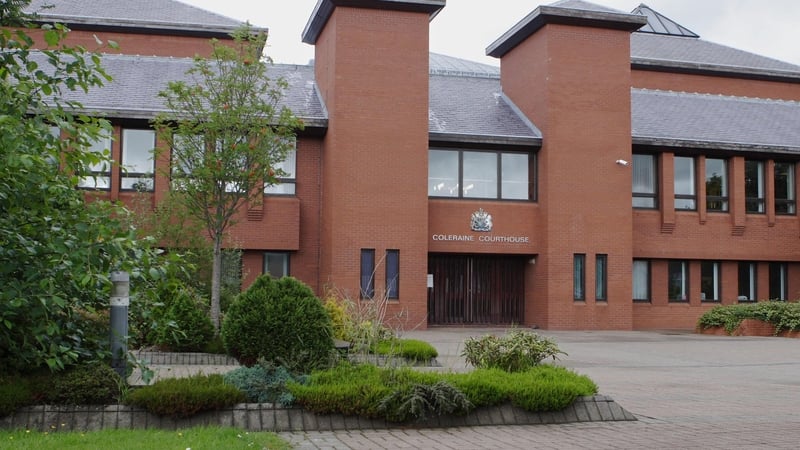
Coleraine Magistrates Court heard that the 19-year-old “made full and frank admissions” to police
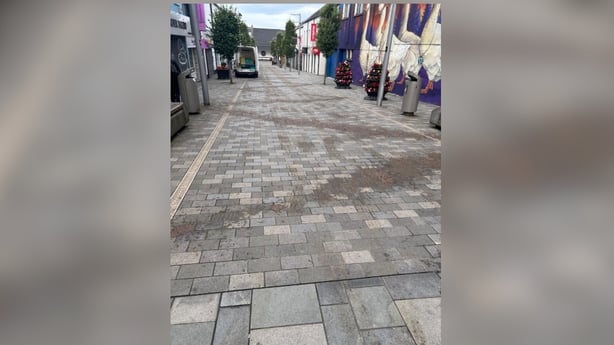
A Co Antrim teenager spread gallons of hen manure on a road before Ballymena’s first Pride parade as part “of a prank,” a court has heard.
Coleraine Magistrates Court also heard that 19-year-old Isaac Adams “made full and frank admissions” to police when he was arrested.
Defence solicitor Stewart Ballentine said Mr Adams was “literally caught in the headlights of the police vehicle” when committing the offence.
Appearing handcuffed in the dock, Mr Adams, from the Lislaban Road in Cloughmills, confirmed his identity and that he understood the three charges against him, all alleged to have been committed on 28 June this year.
He was charged with causing criminal damage to Granville Drive in Ballymena, causing manure to be deposited on the road and possessing a bladed article, namely a lock knife.
According to a police statement at the time, Mr Adams was arrested in the early hours following reports of slurry being spread on the road at around 02.55am.
“The matter is being treated as a hate crime,” said the police statement.
The PSNI said they observed slurry on the road at Greenvale Street
While Mr Adams was charged to court today, a 20-year-old man who was arrested in connection with the incident has been released on police bail and is due to appear in court in November.
During Mr Adams’ brief court appearance, a police officer gave evidence that she believed she could connect the teenager to each of the offences.
She outlined how police on patrol happened upon a male wearing a balaclava and carrying “two empty 25 litre jugs”.
“He admitted that he had been spreading the manure over the roads to disrupt the Pride parade,” the officer told the court, adding that the lock knife was found in his pocket when he was searched.
The courty heard that Mr Adams “freely admitted” that he intended to disrupt that Pride parade due to be held later that day and during formal police interviews, the teenager told police “he was not the only person involved”.
The farmer told police he had filled four or five, five gallon jugs with “hen litter waste” from his family farm “and described it as a prank”.
Regarding issues of bail, the officer conceded the parade had now taken place and further that Mr Adams has absolutely no criminal record.
District Judge Peter King heard the clean up operation cost £788 (€921).
Under cross examination from Mr Ballentine, the officer agreed that Mr Adams “cooperated fully with the police” and also that he told them he had the knife as part of his work.
Submitting that Mr Adams “comes from good stock” in North Antrim and that the incident “is very much out of character,” Mr Ballentine said that having spent the weekend in a police cell, Mr Adams “has learnt a very salutary lesson”.
He argued that Mr Adams could be granted bail and Judge King agreed.
Freeing Mr Adams on his own bail of £500 and adjourning the case to 24 July, the judge imposed several conditions, including a curfew, barred Mr Adams from entering Ballymena and from contacting his co-accused.
Having heard the incident by mobile phone, he also ordered that Mr Adams can only have a phone which cannot access the internet and he has to pass on the details of any phone to the police.
Homeland Security Secretary Kristi Noem | Steven Spearie/The State Journal-Register / USA TODAY NETWORK
Rep. Robert Garcia (D-CA) confronted Homeland Security Secretary Kristi Noem about the administration sending a gay man to a prison camp in El Salvador and not even knowing if he’s still alive. Noem said that it wasn’t her problem.
Noem, who has bragged in the past about shooting her dog to death, appeared before the House Homeland Security Committee for a hearing yesterday, where Garcia asked her about Andry Hernandez Romero, a gay hair dresser from Venezuela who came to the U.S. legally to escape anti-LGBTQ+ violence and who was sent to the CECOT camp in El Salvador, which is known for torturing inmates, earlier this year.
The administration, which sent immigrants to the CECOT without letting courts determine if they were in the country illegally or if they had committed any crimes, has refused to try to bring anyone back from the camp.
“Would you commit to just letting his mother know – as a mother-to-mother – if Andry is alive?” Garcia asked Noem. “He was given an asylum appointment by the United States government. We gave him an appointment, we said, Andry, come to the border at this time and claim asylum, he was taken to a foreign prison in El Salvador.”
“His mother just wants to know if he’s alive. Can we check and do a wellness check on him?”
Noem said she doesn’t “know the specifics” of Hernandez Romero’s case but said that since he’s in El Salvador, Garcia should be asking El Salvador’s government about him.
“This isn’t under my jurisdiction,” Noem said.
Garcia reminded her that she said that the Salvadoran prison is a “tool in our toolkit” for fighting crime.
“You and the president have the ability to check that Andry is alive and not being harmed,” he said. “Would you commit into at least looking and asking El Salvador if he is alive?”
“This is a question that is best asked to the president and the government of El Salvador,” Noem responded drily.
Garcia to Noem: "Can you commit to just letting his mother know mother to mother if Andry is alive? He was given an asylum appointment by the United States government."(Noem wouldn't commit to it.)
Hernandez Romero is a Venezuelan immigrant who trekked to the U.S. and entered legally last year at San Diego. There, he asked for asylum, saying that he was being targeted in Venezuela for being gay and due to his political beliefs. He was held in a CoreCivic detention center, where he was screened by Charles Cross Jr.
“The government had found that his threats against him were credible and that he had a real probability of winning an asylum claim,” his lawyer, Lindsay Toczylowski, said.
In March, he, along with over 200 other immigrants, was taken in shackles to the CECOT camp in El Salvador. Even his lawyer said she didn’t know what happened to him until he was gone and missed a hearing in his immigration case.
In a video from the CECOT, Hernandez Romero could be heard saying, “I’m not a gang member. I’m gay. I’m a stylist,” as he was slapped and had his head shaved.
It was later revealed that the evidence Immigration and Customs Enforcement (ICE) had against Hernandez Romero was his tattoos, which came from a report from the contractor CoreCivic, specifically from former police officer Charles Cross Jr., who lost his job with the Milwaukee police after he drunkenly crashed into a house and allegedly committed fraud. His name was subsequently added to the Brady List, a list of police officers who are considered non-credible for providing legal testimony in Milwaukee County.
Cross claimed that Hernandez Romero had crown tattoos associated with a gang. The tattoos are labeled “Mom” and “Dad” and are common symbols associated with his hometown of Capacho, Venezuela. Capacho is known for its elaborate festival for Three Kings Day, and a childhood friend, Reina Cardenas, told NBC News that it was that festival that awakened Hernandez Romero’s desire to be an artist.
“Andry dedicated his life to arts and culture, and he worked hard to better his craft,” Cardenas said.
Subscribe to the LGBTQ Nation newsletter and be the first to know about the latest headlines shaping LGBTQ+ communities worldwide.








 Homeland Security Secretary Kristi Noem | Steven Spearie/The State Journal-Register / USA TODAY NETWORK
 Scottie's Playtime