This is why the administration is blocking legal oversight and demanding illegally to have three days prior warning for inspections. They are keeping these kidnapped victims in horrific conditions to force them to agree to deportation. The facility in Florida a former worker admitted that and said it worked.
“Under such conditions, some of those arrested are pressured into accepting voluntary departure,” the lawsuit stated.
——————————————————————————————————————
Dakota Smith
5 min read
Rep. Jimmy Gomez (D-Los Angeles) stands outside the Edward R. Roybal Federal Building downtown earlier this summer. On Monday, he was allowed to enter the ICE processing facility in the basement. (Carlin Stiehl / Los Angeles Times)
More
For two months, several Democratic members of Congress have been unable to enter a downtown L.A. processing center run by U.S. Immigration and Customs Enforcement, prompting widespread complaints and a federal lawsuit.
On Monday, the Congress members got their first look at the basement facility known as B-18.
But Reps. Brad Sherman, Judy Chu and Jimmy Gomez said that they were left with more questions than answers — and accused the government of sanitizing the center.
Advertisement
“They wanted to show us nothing,” said Gomez, whose district includes downtown L.A. “It was nothing, it was like no one was there. It was deliberate so members of Congress cannot conduct oversight.”
Scores of migrants, as well as some U.S. citizens, have been taken from Home Depot parking lots, car washes and other locations by masked and heavily armed agents and brought to B-18 since early June. Some detainees have complained of overcrowding and being held for multiple days.
The facility can hold up to 335 migrants, but there were just two people in one of the holding rooms Monday, the members said at a news conference in downtown L.A. after their visit.
The group’s previously scheduled visit was canceled by ICE. Monday’s visit took days of planning and advance notice, according to the politicians.
They described a sparse scene inside B-18, with nine holding rooms, each with two toilets.
Chu, whose district includes Monterey Park, described the floors as concrete and said that there were no beds. She said ICE detainees are supposed to be held at the facility for only 72 hours, but she has heard stories of people kept there for 12 days.
Some detainees have reported receiving one meal a day, she said. On Monday, she visited the food pantry at B-18, which Chu described as “scanty.”
Advertisement
“I am deeply disturbed by what I saw and what I heard,” Chu said.
Chu also said she has been told that detainees have no soap or toothbrushes.
“It’s alarming that it’s taken so long for congressional members to gain access to this site,” said Sergio Perez, executive director of the Center for Human Rights and Constitutional Law, a nonprofit that seeks to protect the rights of immigrants.
Perez was able to visit Narciso Barranco, a Mexican national whose three sons are U.S. Marines, in June. Perez said he saw Barranco after he’d been held at the facility for three days. Perez said Barranco, who was punched and pepper-sprayed during his arrest, did not receive medical attention.
Advertisement
The Department of Homeland Security shared video of his arrest on social media and said Barranco attacked an agent with his gardening tool.
Barranco told Perez that each of the rooms held 30 to 70 people at the time and that some had to sleep standing up, Perez said. Food was scarce and they didn’t have access to showers.
The ICE facility was designed as a processing center, not a detention facility, Perez said.
Department of Homeland Security Assistant Secretary Tricia McLaughlin denied that individuals don’t receive medical care. She also disputed Chu’s suggestion that an individual was held at the facility for 12 days.
Advertisement
Addressing the politicians’ other complaints about B-18, McLaughlin wrote, “Now, politicians are complaining about ICE processing facilities being TOO CLEAN.”
McLaughlin said that claims of poor conditions at ICE facilities are false and that the agency “has higher detention standards than most U.S. prisons that hold actual U.S. citizens.”
“Ensuring the safety, security, and well-being of individuals in our custody is a top priority at ICE,” she said.
Sherman, who represents parts of the San Fernando Valley and Pacific Palisades, said that one of the two detainees at B-18 on Monday rested with his head on a table.
Advertisement
Sherman said he “illegally” took a picture during his visit and that he shouted out to several people being brought into the facility for processing, asking them whether they were U.S. citizens or green card holders. No one replied, he said.
Sherman, Chu, Gomez and Rep. Maxine Waters (D-Los Angeles), who joined the group after their visit, criticized the ongoing immigration enforcement, and in particular the use of masked, roving agents.
A federal judge last month temporarily barred the government from mass sweeps in Los Angeles and seven nearby counties without first establishing reasonable suspicion that the targets are in the U.S. illegally.
The American Civil Liberties Union of Southern California, which sued the federal government over the sweeps, described B-18 as “dungeon-like” and accused the administration of failing to “provide basic necessities like food, water, adequate hygiene facilities, and medical care.” Detainees were allegedly subjected to overcrowding and did not have adequate sleeping accommodations.
Advertisement
“Under such conditions, some of those arrested are pressured into accepting voluntary departure,” the lawsuit stated.
On Monday, Chu said that she asked ICE representatives during the tour why people were jumping out of vans with masks, and no identification.
She said the representatives replied, “That’s not us, and we go in if there’s probable cause, if there’s a warrant out there.”
Gomez, who has been repeatedly turned away from entering the B-18 facility since the crackdown started this year, is part of a group of Democratic House members suing the federal government over the lack of access.
Advertisement
The lawsuit, filed last month in U.S. District Court in Washington, said the individuals attempted to visit a detention facility, either by showing up in person or by giving Homeland Security Department officials advance notice, and were unlawfully blocked from entering.
ICE recently published new guidelines for members of Congress and their staff, requesting at least 72 hours’ notice from lawmakers and requiring at least 24 hours’ notice from staff before an oversight visit.
Times staff writer Andrea Castillo contributed to this report.
In its largest employee perk rollout in years, Walmart is extending its 10% grocery discount to cover nearly all food categories for its 1.6 million U.S. workers—marking a significant boost to benefits at the nation’s largest private employer. Announced in a LinkedIn video by Kieran Shanahan, executive vice president and chief operating officer at Walmart U.S., the change is effective immediately and applies both in-store and online, signaling Walmart’s bid to support its workforce amid rising food prices and retention challenges.
In a separate LinkedIn post, JD Mahaffey, group director and global head of executive total rewards, expanded on the new benefit: Previously, Walmart’s 10% discount for employees was limited to fresh produce and select general merchandise, and most grocery items were excluded except during the November to December holiday season. With the new policy, nearly every food category is covered year-round, including staples such as dairy, frozen foods, dry groceries, meat, and seafood. In total, approximately 95% of regularly priced items in-store are now eligible for the discount.
All employees and eligible corporate staff receive a discount card after 90 days of employment. The move was prompted by persistent worker feedback that called for more comprehensive and accessible perks, particularly as food inflation has squeezed household budgets. “We’ve heard your feedback that these savings make a real difference for you and your families,” chief people officer Donna Morris wrote in a staff memo shared with Fortune. In fact, she described it as “one of our most requested benefits.”
Why is Walmart doing this now?
The expansion comes as economic pressures weigh on households nationwide. Recent government data shows food prices for staples such as eggs and meat have jumped sharply year over year. The move also coincides with heightened concerns over new tariffs that threaten to further raise prices across major retailers, Walmart included. More than half of grocery shoppers surveyed in August cited tariffs as their top worry about food costs.
By ramping up employee benefits, Walmart is responding to both external market forces and internal demand. It’s a strategic step designed to bolster recruitment and retention at a time when competition for retail talent is fierce. Analysts note the company’s efforts to improve its work culture, including earlier expansions of training programs, wage hikes for hourly staff, and the introduction of bonus programs for frontline workers.
COO Shanahan explained in the company video: “We know the impact this discount has for so many associates and their families, and one consistent piece of feedback we hear is to look at how we can make our associate discount program even better.”
How does Walmart compare with other retailers?
With the new perk, Walmart’s benefits now align more closely with those of leading competitors. Target offers a similar 10% discount on most merchandise plus 20% off select food items, while Kroger gives staff 10% off house-brand products and other categories. Hy-Vee (a Midwest grocer) and Trader Joe’s have even more generous policies, with discounts of up to 20% for employees.
The timing of the announcement is crucial, coming just days before Walmart’s quarterly earnings release and as the company grapples with both supply-chain challenges and inflation pressures. As economic uncertainty continues to roil the retail sector, Walmart’s expanded grocery discount stands out as both a smart business maneuver and a measure aimed at fostering goodwill among its massive employee base.
In May, Walmart issued a warning along with its earnings report that it may have to raise prices because of the anticipated impact of President Donald Trump’s tariffs. “We’re wired to keep prices low, but there’s a limit to what we can bear, or any retailer for that matter,” chief financial officer John David Rainey told the AP at the time.
Trump responded by ordering Walmart to “EAT THE TARIFFS.” This move by Walmart appears to confirm that Walmart can’t eat all of them, and it will at least be helping its employees take home something to eat for the pre-tariff prices they used to see.
Walmart did not immediately respond to a request for comment.
For this story, Fortune used generative AI to help with an initial draft. An editor verified the accuracy of the information before publishing. (snip)
Forget “100 points to Gryffindor,” 100% of profits going to trans charities sounds even better.
Czech Games Edition, the publisher behind the new board game Codenames: Back to Hogwarts, has announced that the total sum of profits made by the game will go to trans charities following consumer backlash against the Harry Potter tie-in product.
The gaming publisher announced the decision in a social media post issued on Friday. “We are all devastated that the project we were so excited to share with you caused harm instead of joy,” the August 8 statement reads. “Over time, the harmful views of the story’s creator have escalated into harmful actions. We apologize unreservedly for not doing more to consider that possibility, and for subsequently announcing the game without taking preemptive actions to mitigate the pain it would cause.”
Codenames is an award-winning word-based board game that has sold over 15 million units since its launch in 2015, per The Guardian. Czech Games Edition announced its first Harry Potter board game tie-in, Codenames: Harry Potter, in 2019, months before Rowling started making public anti-trans proclamations.
The company went on to say in its August 8 statement that it was “not prepared for the volume of the response” to Back to Hogwarts and that, aside from donating profits, it will ensure that “an amount equal to or greater than the fee paid to license this product” will go toward organizations that support the trans community. The company will determine which organizations receive the money based on community feedback, per the apology statement, prioritizing “those that offer direct, practical help to people in need.”
Czech Games Edition first announced Back to Hogwarts on July 23, per board game news website Wargamer. After two days of consumers pointing out the issues with licensing the J.K. Rowling-owned property, the company issued a statement saying that “we fully respect and understand those who do not wish to engage with this game,” and requesting an “ongoing conversation” characterized by “care, empathy and respect — both online and in person.”
On July 30, after continuing backlash, the company issued a follow-up statement saying that “our aim was never to cause harm,” and that it was working toward a “concrete solution” at the time.
Rowling’s anti-trans politics are well-known by now, as are her own monetary contributions to the movement, including her legal fund, which is hoping to push trans people out of public life. As Rowling’s views have grown louder and more vitriolic, actors attached to projects in the still-growing Harry Potter universe have made several statements condemning her views. One San Francisco bookstore has even announced that it would stop selling books about the Boy Wizard on its shelves, encouraging people who want to read them to seek out used copies instead.
It’s important to remember things, and to keep “issues” in context.Also, who have we asked for the Epstein files today? 😂
No, Rightwing Sh*tbirds Didn’t Pressure Costco Out Of Selling Abortion Pill by Rebecca Schoenkopf
Let’s not give a bunch of hate groups a win they didn’t earn. Read on Substack
With the neverending firehose of incredibly disappointing information, it’s easy to assume that everything is garbage and everything sucks all of the time. Yesterday, I yelled “Well, fuck Costco!” after reading a Reuters article titled “Costco to stop selling abortion pill mifepristone at its US pharmacy stores” — because that’s some bullshit, right?
Well, it was, just not in the way you might immediately assume. Costco never actually sold mifepristone, so they couldn’t “stop” selling something they never sold to begin with.
Stories later in the day did get it right (our link is to the archived very wrong version!). Costco had apparently been deliberating on whether or not to sell abortion medication at their pharmacies (it requires a certification to be able to carry it), and decided against.
Reuters and several other sources noted that the move came after “pressure” from anti-abortion groups, as well as Southern Poverty Law Center-designated hate groups like Alliance Defending Freedom, which even went so far as to issue an utterly insipid victory statement.
“We applaud Costco for doing the right thing by its shareholders and resisting activist calls to sell abortion drugs. Retailers like Costco keep their doors open by selling a lifetime of purchases to families, both large and small. They have nothing to gain and much to lose by becoming abortion dispensaries. Retail pharmacies exist to serve the health and wellness of their customers, but abortion drugs like mifepristone undermine that mission by putting women’s health at risk,” said Michael Ross, the group’s legal counsel.
For the record, mifepristone has an extremely low rate — 1 percent — of complications. It is more safe than Viagraor even Tylenol. Abortion is not the only use for the drug, either. It is also used to help safely expel a miscarriage so that one does not become septic (and perhaps require penicillin … yet another drug that is less safe than mifepristone). Groups like the ADF think that if they just keep confidently repeating blatant lies about abortion medication like they are universally accepted as true, that everyone will just go along with them. Just like maybe they’ll believe that the ADF and other groups are so influential that they actually did successfully push Costco to refuse to sell mifepristone.
But there is no reason to believe, without evidence, that Costco’s decision actually had anything to do with “bending the knee” to them or any other insane religious organizations dedicated to making life hell for women, LGBTQ+ people, and anyone who doesn’t share their religious beliefs.
Why? Because the company has no history of doing that, at all, for any reason. In fact, the company has notably refused to “bend the knee” to Republican Attorneys General and whiny conservatives across the land who have been demanding they ditch their DEI policies.
“If these are the policies you see as offensive, I must tell you I am not prepared to change,” CEO Richard Vachris wrote to a “concerned” customer who emailed him, upset about the company’s DEI policies and demanding to know if the company was hiring people based on “skin color” or “gender identification.”
“Attacks on DEI aren’t just bad for business — they hurt our economy. A diverse workforce drives innovation, expands markets, and fuels growth,” Costco board member Jeff Raikes wrote on social media.
Why would a company willing to risk the ire of these groups in that way suddenly decide to capitulate to them in another?
While it’s certainly disappointing that they didn’t change their policy of not selling mife, and those of us with Costco memberships should let them know that, the company has not said that this decision had anything at all to do with wanting to put a smile on the faces of the bigots at the ADF.
Rather, they said they didn’t think there was a demand for it.
“Our position at this time not to sell mifepristone, which has not changed, is based on the lack of demand from our members and other patients, who we understand generally have the drug dispensed by their medical providers,” Costco said in a statement. It’s not what we want to hear, obviously, but it doesn’t necessarily mean that they did this because of pressure from the Right.
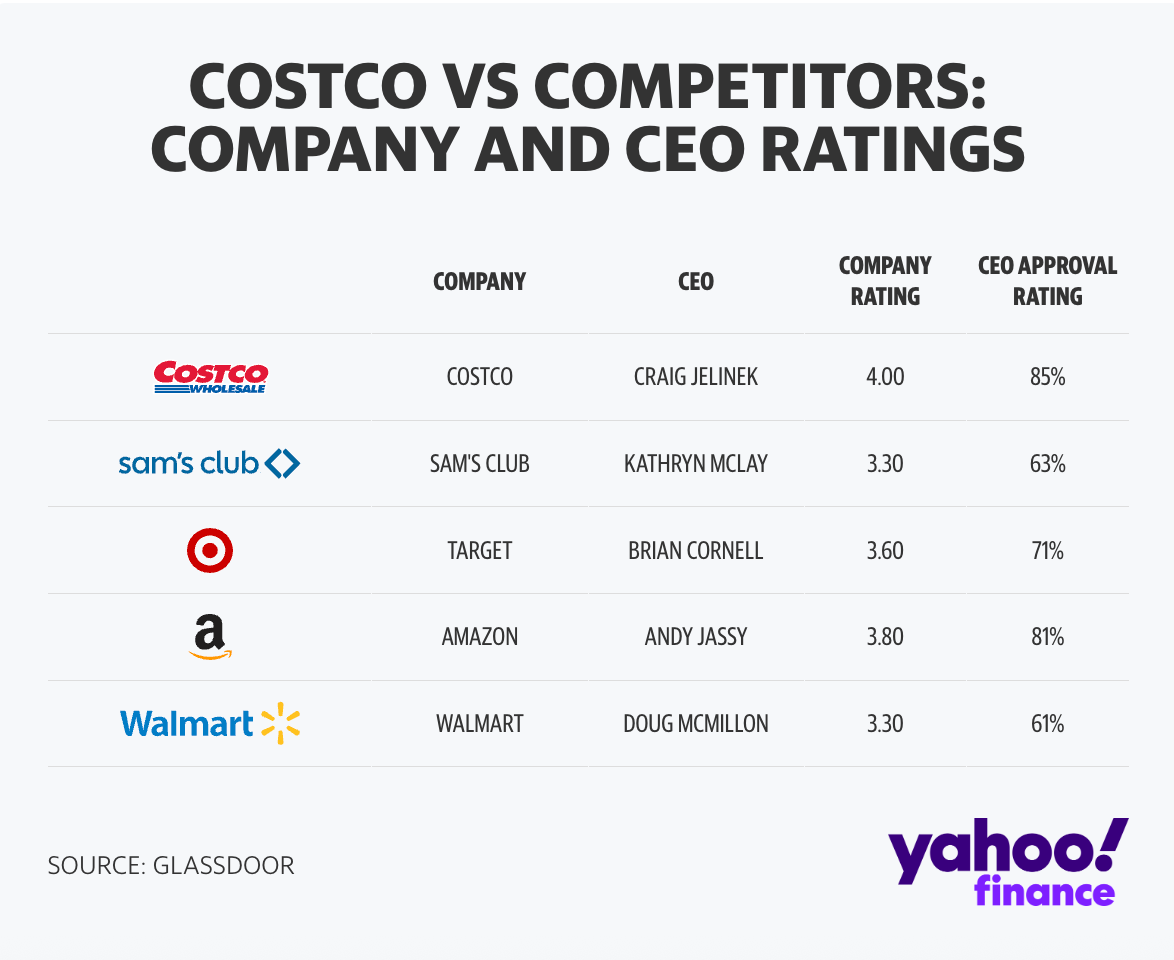
It’s also worth noting that Costco is known to treat their workers well, paying them, on average $31 an hour with good benefits — quite a bit higher than many of their competitors.
They also have a strong history of not being shitty in this way.
It would be a mistake to roll over on one of the few companies out there that isn’t completely evil. In addition, we shouldn’t hand groups like ADF an unearned “win,” which they have made clear they want to use to pressure other companies — including CVS and Walgreens, which are certified to dispense mifepristone — to stop selling abortion medication, as well as to make the rest of us feel that they are winning the culture war.
It’s like when the One Million Moms (one mom) take credit for getting TV shows canceled or commercials pulled off the air when those decisions actually had nothing to do with them at all. Claiming victory, for these groups, is a way for them to rally their base and to make other companies think they have more influence than they actually do.
The majority of Americans believe that abortion should be legal, and they’ve demonstrated this by voting in favor of keeping it legal in their states at practically every turn (not in Florida, because Florida requires 60 percent of the population to approve a ballot measure, which is some bullshit).
If Costco thinks there isn’t enough demand for mifepristone (which, yes, is a weird thing to say because it’s not like a medication anyone gets on a regular basis), then we should convince them that there is, by encouraging them to change their mind and get the certification necessary to sell abortion medication. You can go directly to their website and click the “Feedback” tag on the right side of your screen, call them at 1-800-774-2678, or send them a letter at Costco Wholesale, P.O. Box 34331, Seattle, WA 98124.
August 15, 1876 Congress passed a law to remove the Lakota Sioux and their allies from the Black Hills country of South Dakota after gold was found there. Often referred to as the “starve or sell” bill, it provided that no further appropriations would be made for 1868 Treaty-guaranteed rations for the Sioux unless they gave up their sacred Black Hills, or Paha Sapa. That treaty had granted them the territory and hunting rights in exchange for peace. Lakota Sioux watch as their Black Hills are invaded. painting by Howard Terpning The larger story of the Sioux and the U.S.
August 15, 1947 Great Britain partitioned its empire on the Asian subcontinent into primarily Hindu, but nominally secular, India, and predominantly Muslim Pakistan (including the non-contiguous state of East Bengal, now the nation of Bangladesh). The two nations became independent of British rule after 200 years of colonial control, and more than two decades of Gandhi-led resistance. Rioting between Hindus, Sikhs and Muslims followed, especially over the state of Kashmir, majority Muslim but newly part of India.Mahatma Gandhi had been an advocate for a united India where Hindus and Muslims would live together in peace. A few months later, at the age of 78, he began a fast with the purpose of stopping the sectarian bloodshed, in which hundreds of thousands died, and many more displaced. After five days the opposing leaders pledged to stop the fighting and Gandhi broke his fast. Twelve days later he was assassinated by a Hindu opposed to his program of tolerance for all ethnicities, castes and religions. One of the principal leaders of the independence movement, Jawaharlal Nehru, who became India’s first prime minister, spoke to the Constituent Assembly of India in New Delhi:“Long years ago we made a tryst with destiny, and now the time comes when we shall redeem our pledge, not wholly or in full measure, but very substantially. At the stroke of the midnight hour, when the world sleeps, India will awake to life and freedom. A moment comes, which comes but rarely in history, when we step out from the old to the new, when an age ends, and when the soul of a nation, long suppressed, finds utterance.It is fitting that at this solemn moment we take the pledge of dedication to the service of India and her people and to the still larger cause of humanity.” Among the tributes to Gandhi upon his death were these words by Albert Einstein: “Generations to come will scarce believe that such a one as this walked the earth in flesh and blood.” Listen to a portion of Nehru’s speech and a bit of old film More on partition and independence
August 15, 1967 The Reverend Martin Luther King, Jr., speaking at a Southern Christian Leadership Conference in Atlanta, urged a massive civil disobedience drive in northern cities. Responding to the widespread rioting there, he said, “It is purposeless to tell Negroes they should not be enraged when they should be . . . Civil disobedience can utilize the militance wasted in riots . . . .”
Chuck Schumer has created and talked about a fictitious family declaring they are real people. It seems he has talked himself into believing they are real. This is the Democratic Party leader in the Senate. Hugs
Education advocates are afraid that the administration’s getting hold of admissions racial data could make colleges a more hostile place for students of color.
“The student data could be used to challenge the admission of Black students in particular under assumptions that they are presumptively unqualified because of their race,” Janel George, a law professor at Georgetown University, told HuffPost.
“Woke is officially DEAD at Brown. Thank you for your attention to this matter!” Donald Trump declared in a Truth Social post last week.
He was celebrating the fact that the prestigious Providence, Rhode Island, university had just agreed to a settlement with him. In order to restore its federal funding, the school agreed to implement anti-transgender policies and hand over its race and admissions data.
It was similar to a deal the federal government had struck with Columbia University in New York after Trump relentlessly attacked the school in the wake of on-campus pro-Palestinian protests.
And then on Thursday, Trump went further: He signed an executive order demanding that every college in the country hand over its admissions data, citing a 2023 Supreme Court decision prohibiting the use of race as a factor in college admissions. “Greater transparency is essential to exposing unlawful practices and ultimately ridding society of shameful, dangerous racial hierarchies,” the order reads.
Already, there is growing fear from legal experts and higher education advocates that he could weaponize this data in order to get higher education institutions to fall in line with his administration’s goals.
“They can misuse the data, they can interpret it in any way they want,” said Mariam Rashid, the associate director for the Center for American Progress’ racial equity and justice program. “And they can misuse it in order to misinform the public, too.”
For example, the Trump administration could use the racial data to claim a university is discriminating against a certain race, or infer that not enough Trump supporters are being admitted because the freshman class doesn’t have a high enough percentage of students from red states.
Trump’s latest strike on American institutions connects his war on diversity and his administration’s assault on colleges across the country in a way that could turbocharge both. It’s not just that Trump will have an extraordinary amount of information about colleges; it’s how he’s likely to use it to further his false narrative about both race and higher education. And it’s students who will bear the brunt of the consequences.
“Given the administration’s flawed interpretation of our civil rights law, they might use this data to accuse schools of discrimination and threaten universities,” Donya Khadem, an attorney at the NAACP Legal Defense Fund, told HuffPost.
“It’s unprecedented scrutiny by the federal government.”
– Donya Khadem, attorney at the NAACP Legal Defense Fund
Some schools refused to play the game. In April, Harvard University wrote a letter to Trump saying that his demands flew in the face of free speech laws and would stifle the kind of learning and research that happens at a place of higher education. But other schools, like Columbia and Brown, bent the knee and gave Trump what he wanted.
“It’s very concerning because it’s unprecedented scrutiny by the federal government,” Khadem said.
This time, the administration is taking aim at an aspect of educational life that has long been a bugbear for conservatives. There is a widespread belief among conservatives that colleges and universities have given advantages to students of color at the expense of white students.
By allowing race to be a factor in admissions, the claim goes, schools are taking spots away from certain groups of students and instead admitting students they claim are less qualified, based solely on their race. (In reality, race has been one of many factors admissions officers consider when choosing between fully qualified applicants.)
“This is all motivated by a racist myth that Black people don’t deserve to be in these elite spaces,” Khadem said.
And now that Trump is back in office, getting his hands on this data is likely just the beginning of his attempt to turn back the clock on admitting students of color.
Asked for comment about how it intends to use the admissions data, the Department of Education directed HuffPost to a press release about the new executive order Trump signed on Thursday.
“We will not allow institutions to blight the dreams of students by presuming that their skin color matters more than their hard work and accomplishments,” Education Secretary Linda McMahon said.
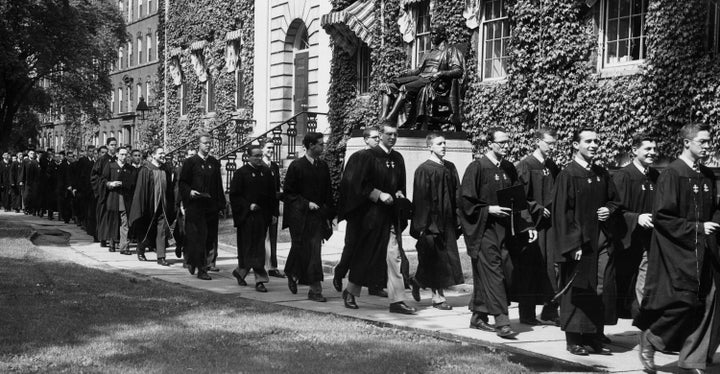
Students pass the statue of John Harvard in Harvard Yard on their way to baccalaureate services ahead of commencement at Harvard University on June 17, 1951.
Photo by Sam Hammat/The Boston Globe via Getty Images
Conservatives celebrated when the U.S. Supreme Court struck down race-conscious college admissions processes in Students For Fair Admissions v. Harvard in 2023, saying that schools can not use race as a factor in college admissions.
Harvard, together with fellow defendant the University of North Carolina at Chapel Hill, had argued that schools needed to be able to consider race as one factor among many to ensure the educational benefits of a diverse student body. The high court disagreed, saying the schools did not have a “compelling interest” in considering race as a factor and thus violated the 14th Amendment.
But education law experts say that the federal government is using that ruling and expanding it far beyond its original intent.
In the same ruling, the court expressly said that “nothing prohibits universities from considering an applicant’s discussion of how race affected the applicant’s life, so long as that discussion is concretely tied to a quality of character or unique ability that the particular applicant can contribute to the university.”
Now, Trump’s order undermines that.
“They’re using the Students For Fair Admissions [decision] in ways that are not what the justices meant when they wrote it,” Khadem said.
Education advocates are afraid that the administration’s getting hold of admissions racial data could make colleges a more hostile place for students of color.
“The student data could be used to challenge the admission of Black students in particular under assumptions that they are presumptively unqualified because of their race,” Janel George, a law professor at Georgetown University, told HuffPost.
“This is all motivated by a racist myth that Black people don’t deserve to be in these elite spaces.”
– Khadem
It could also turn off otherwise qualified students from attending some of these colleges. “I think it’s a big deterrent,” Khadem said. “Columbia’s campus has become and will continue to become less welcoming to Black students.”
Columbia and Brown did not immediately respond to HuffPost’s request for comment.
Systemic racism and inequality are already significant barriers to college attendance. Research shows that Black students and other people of color are more likely to be from low-income families and struggle to afford college. Then there’s the fact that standardized tests frequently used in college admissions are biased toward white students and those from wealthier families.
Studies have shown that race-neutral admissions processes lead to a drop in diversity. In 1996, after California voters approved a measure that would ban affirmative action at the state’s public universities, the state’s most prestigious schools saw a drastic drop in diversity. Indeed, one of the arguments made by Harvard during its legal fight was that no race-neutral admissions process offers the same diversity benefits.
The first college classes to be enrolled after the Students for Fair Admissions ruling varied in their diversity. Some schools, like the Massachusetts Institute of Technology, Tufts University and the University of North Carolina at Chapel Hill, saw a decrease in Black and Hispanic enrollment, while other schools’ racial compositions stayed roughly the same.
Not only could these changes further hinder access to higher education for nonwhite students, but there’s a question of how making this data public could harm students. If the Trump administration publicly calls out a school for having a certain number of nonwhite students, that could become a problem for people on campus.
“I do think it’s harmful,” Rashid said. “[The data] is not going to be attached to a name, but they can make up whatever narrative they want.”
Experts warn that it could create a hostile environment on campuses, where nonwhite students feel as if their peers believe that they’re unqualified to be there. “At schools with higher admissions of Black students or faculty, some people are going to feel a certain way about how they’re perceived at school,” Khadem said.
There is a direct line from Trump’s attacks on colleges to his administration’s larger anti-diversity campaign.
In an attempt to begin removing people of color from public life, Trump signed an executive order in January that sought to end diversity, equity and inclusion programs at different institutions, including nonprofit organizations receiving federal grants, law enforcement agencies and institutions of higher education. The penalty for not ending DEI, though vague, was the loss of crucial federal funding.
The Department of Education followed up with guidance for educational institutions, telling them they must end “racial preferences” and restore “merit.”
The Department of Justice joined the crusade too, launching investigations of colleges and universities it alleged were not complying with the Supreme Court’s ruling on using race in college admissions under the pretense of combating “illegal discrimination.”
“The [DOJ] will put an end to a shameful system in which someone’s race matters more than their ability,” acting Associate Attorney General Chad Mizelle said in a press release in March.
To the Trump administration, American society, and colleges in particular, have been beset by a racial regime that disfavors white conservatives — and this executive order was intended to combat that. Others, though, see a very different agenda.
“What they want to do is make everything race-neutral,” Rashid said. “In other words, make everything white.”


 By
By 






 Scottie's Playtime