
Category: Businesses / Corporations / Industry
An Important Read About Black-Owned Businesses In These Days
Ami Colé is closing. The brand’s story has implications for the Black beauty industry.
Aug 04, 2025
This story was originally reported by Marissa Martinez of The 19th. Meet Marissa and read more of their reporting on gender, politics and policy.
Next month, beauty brand Ami Colé will shutter, marking an unfortunate reality for many Black-owned businesses — what happens when financial interest dries up?
Founder Diarrha N’Diaye-Mbaye’s July announcement, which she detailed for The Cut, shocked many across the beauty space.
In the piece, N’Diaye-Mbaye outlined the journey of starting her business, from growing up in her mother’s Harlem braiding salon to pitching Ami Colé — known for their innovation in lip oils and shade-inclusive makeup — to over 150 investors in 2019. After a surge in support for Black entrepreneurship following the murder of George Floyd in Minneapolis in 2020, N’Diaye-Mbaye said she received more interest in the brand, becoming one of 30 Black women to raise $1 million for her start-up within months.
But four years after her official launch, N’Diaye-Mbaye said growth at Sephora couldn’t compete with corporate brands, and scaling up production to meet potential demand came at a steep cost when online influence fluctuated.
“Instead of focusing on the healthy, sustainable future of the company and meeting the needs of our loyal fan base,” N’Diaye-Mbaye wrote, “I rode a temperamental wave of appraising investors — some of whom seemed to have an attitude toward equity and ‘betting big on inclusivity’ that changed its tune a lot, to my ears, from what it sounded like in 2020.”
This sentiment isn’t unique among Black entrepreneurs. Five years after venture capital firms, investors and consumers alike followed a wave of support for Black-owned businesses, interest in diverse brands has waned significantly. Through TikTok and other social media platforms, access to an audience has never been greater, but the capital needed to sustain brands at a high profile has dropped off.

Nationally, there has been a societal swing — in tandem with pressure from President Donald Trump’s administration — against intentional incorporation of diversity, equity and inclusion (DEI) in creators’ paths, with waning urgency to support these businesses en masse. And the amount of money flowing to Black-founded companies has hit a multiyear low, according to the business publication Crunchbase News. Only $730 million — 0.4 percent of all funding — went to startups with a Black founder or co-founder last year, down more than two-thirds from 2021. The startups that did receive funding were mostly in the tech or health spaces.
Esthetician and beauty influencer Tiara Willis said she has noticed that cultural shift in support over the last five years. Brands rushed to onboard diverse creators in the summer of 2020. Now, the long-term partnerships, increased shade ranges and targeted marketing seem to have wavered. N’Diaye-Mbaye’s struggle to meet demand as influencers promoted her products is something that would have been covered by investors who were in it for the long haul, Willis said.
She pointed to celebrity founders like Hailey Bieber, whose Rhode makeup and skin care brand began with millions of dollars to swing big while starting her business. Rhode was acquired by e.l.f Beauty for $1 billion in May.
“They rarely ever start by themselves, like the rest of us do — they already have someone on their team,” Willis told The 19th. “Trying to build your own brand while trying to compete with companies who are able to launch products every two seconds, and are able to fill retail space and have less obstacles than brands like Ami Colé — it’s not entirely surprising she wasn’t able to keep up.”
Black creators voiced concern immediately following N’Diaye-Mbaye’s announcement, calling her brand’s shuttering “disheartening” and indicative of larger trends in the Black beauty space. Being able to trust that a brand like Ami Colé would have inclusive shade ranges and products by virtue of their leadership made shopping simpler, some said on social media.
Sephora store shelves reflect a mad dash to support Ami Colé and restock on favorites before the brand officially closes in September. Sales associates told The 19th that the lip oils had sold out online and in store immediately following the announcement, though the demand for other products has slowed since.
But consumers should not feel the pressure to support Black-owned businesses when the larger issue is who has access to capital and investors, some creators pointed out. The issue isn’t the lack of customers, Javon Ford, a cosmetic chemist and entrepreneur, said in a recent TikTok video.
“That is not a sustainable business model. The issue is money. It’s capital. Operating in a retailer like Sephora is expensive,” Ford said. “That’s how cutthroat retail is when you scale to a certain extent, and this is also why exit strategies are important, because it’s really hard to keep up with legacy brands.”
Willis echoed the unstable environment in which Black influencers like herself find themselves: “It creates financial insecurity, where I get the most support of brands based on what’s going on in the news, versus getting support because of my work and my talent and the things I provide to the table.”
I Read This Substack Every Chance I Get; About Louisiana Culture, History, & Food, & Now Survival
This one’s about trouble for all coastal states, coming from Louisianans.
Louisiana Fights Against Becoming Another Not There No More Statistic by Jerileewei
Terrebonne Parish: Where the Rivers Meets the Sea Read on Substack
CCJC Audio Podcast Episode 00086, Season 2
“It’s not just the land we’re losing. It’s the stories. The way we talk. The smell of the air before a big storm.” — Emile Navarre
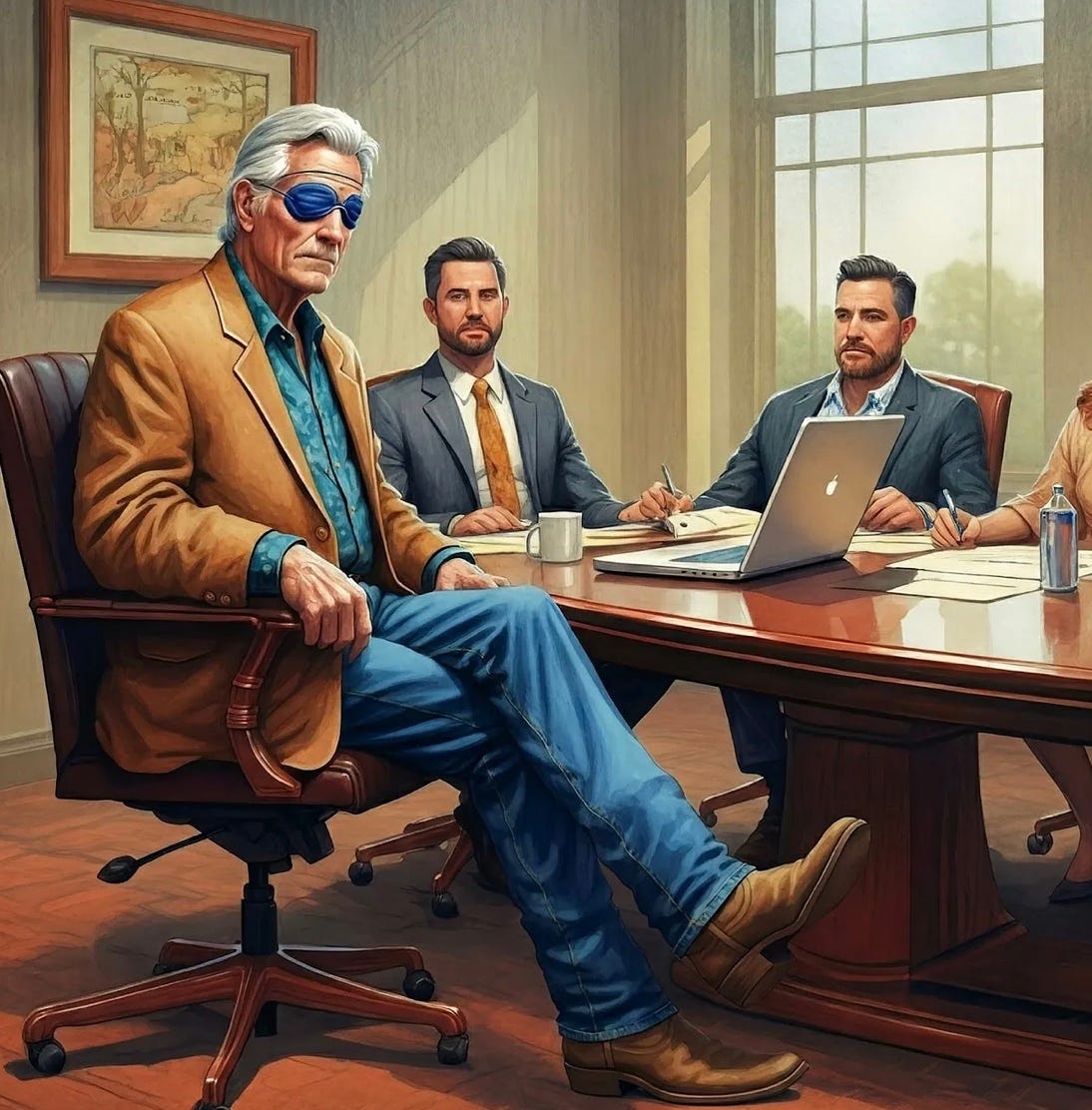
Back from his month long vacation in Chacahoula, Louisiana, Cajun Chronicle Podcast, Writer/Editor, Emile Navarre arrived for our first staff meeting armed with fresh material for a future episode, as soon as Marie Lirette, our Outreach Coordinator can reach out to potential experts on the topic of “Ain’t There No More” – a nation wide trending group talk everywhere these days, as our world changes in ways none of us could have imagined.
Here is his recount of his lifelong story telling to his family’s youngest children:

“Come closer, chérs,” he said, his voice a low rumble like the last Lafitte skiff shrimping boat of the day heading down the Bayou Lafourche over Galliano or Golden Meadow way. His cane bottom rocking chair seat creaked a steady rhythm against the worn Cedar floorboards as he said that.
The sun, a too warm blanket he could feel, but not see, was sinking somewhere behind the great oak in the yard he will always remember. He ran a hand over the cane of his chair, then rested it on the knee of a boy sitting on the steps below him. He lifted his walking stick and pointed off to the right side. “You see that big fence, hein?
“Or that levee your mamans and pépère have to climb to get home from work at the Bollinger Shipyard, just to get up to the house? We didn’t have such a thing when I was a boy. Back then, my feet knew every dip and bump in this land”.
“From our porch right down that oyster shell road to the bayou where the shrimp jumped so high, you’d swear you could catch them in your mouth, if you were quick.” A ripple of giggles ran through the children.
“Ah, oui,” he chuckled, “I lost a good tooth catching shrimp that way. But the land, it was different. We were like a river family. She’d bring us a big muddy hug every spring, and we’d be happy for it.”
“The floods, they were always a part of life. We’d move our things up high, sing songs, and wait for the water to go down. When it did, Mother Nature would leave behind a gift, a rich, dark mud that made our gardens burst with life. You could feel it in your toes, a soft, giving sponge of sandy soil that told you everything was going to be alright.”
He paused, and the laughter faded, replaced by the chirping of crickets.
“My pépère, he’d sit right here on the back porch with a fishing line tied to his toe, but in his mind, Gaia was always busy with the water. He’d talk about how the Lafourche river was a living thing, always moving, always changing. ‘She builds, and she takes away,‘ he’d say.”
“We knew that. A little bit here, a little bit there. It was a fair trade. But then came the men with the big ideas. They came from places where the land didn’t move so much. They told us we could stop the river’s big hugs. They said we could make a straight line and build high walls, so the water would stay in its place.”
Emile’s voice dropped to a conspiratorial whisper. “The young people, they thought it was wonderful. No more floods! No more moving furniture to the attic! But my pépère, he just shook his head. ‘You can’t trap a wild woman, not for long,’ he said. ‘She will find her way, and she will be angry for it.'”
“And she was,” he said, his hand now clutching his walking stick. “For years, the river was quiet, but our land, she was not. I can’t see it anymore with my eyes, but I felt it with my feet. The soil grew tired, no longer receiving her yearly gift.”
“The ground began to sag, and the bad marsh saltwater, it came closer in to say hello, not from a storm, but like a thief in the night, creeping up through the channels les Américains dug for the oil. They were for the big machines, the big money, but they were also a wound. A wound in the land that never healed.”
He turned his head toward the silent children, his milky blind blue eyes fixed on something only he could see. “Now, this levee you have, it protects you from the river, oui? But it holds the land in a box. It cannot breathe. The land is sick, and the ocean is hungry, taking a football field from our home every hour, the experts say.”
“I hear it in the wind now, not just the storms, but also in the sad whispers of the marsh, of the birds that have no place to land anymore. The land is leaving us, and we are left behind. We traded our river’s muddy hugs for a straight line and some high walls, and now we pay for it. Now, it’s not just the water that takes. It’s the land that gives itself away.”
The porch was silent, a stillness that was heavier than the humid air. The children looked at each other, not understanding all the words, but feeling the weight of them. One of the little girls, her braids tied with pink ribbons, quietly moved her hand to rest on the Emile’s knee as she headed inside for bed.
Emile smiled, his face creasing with a thousand invisible memories. Talking to the breeze, he raised his fist and threatened, “But you know what else my pépère said? He said, ‘As long as we tell the stories, the land is not truly gone.’ So listen, chérs, listen closely to my bedtime stories. Because now, it is your turn to remember.”

He had felt the last of the children’s light footsteps fade into the dusk, and the porch was still again except for his rocking chair. His head turned to the quiet rustling of the adults lingering on the porch. “You hear my stories, oui?” he said, his voice now lower, rougher.
“You too remember what I said about the river’s gift of mud? We didn’t know it, but we were like a family that had a big, generous table. Rivers brought food, and our land ate it. Every year, she’d get fat and happy. We thought we were so smart, so clever, when we built those high walls.”
“We told Gaia to stop eating for a while, believing for a while that she didn’t need the mud. ‘Don’t worry,’ we said, ‘We’ll protect you from the floods.’ But what we really did was put the food in a box and send it out to sea. Now, the land is starving. You cannot see it in a day, or a year. But that’s happening rapidly.”
“But I feel it in every part of my mind and body. Every year, she gets thinner, weaker. And like a sick old person who can’t stand anymore, Mother Earth’s starting to melt away. The medicine to save her is that very food we cut her off from. But the walls of levees and the canals the Corps of Engineers built? They are so high.”
“How will we get the food back to Louisiana’s coast before she’s gone entirely? That is the story my heart tells me now. And that is the story for you all to worry about. Time’s running out. I’m 75 years young this month. In another 75 years I won’t be here to see that my beloved Louisiane will be added to that dreaded list, “Ain’t Here No More.“
Cajun Chronicles Note: Sediment Starvation: The settlers’ levees and later government agencies built, while protecting their land from floods, also had an unintended consequence that would become a major factor in today’s coastal crisis. By containing the rivers, they prevented the natural flooding that would have deposited sediment into the wetlands.
This sediment was the building block of the delta. Without it, the land began to sink (subsidence) and slowly disappear. The settlers since the 1800s and later colonists were unaware of this long-term process and the vital role of the Mississippi’s and other rivers’ sediment in sustaining the land.
Water’s Takin’ Our Land, Gulf’s Hungry & She Ain’t Slowin’ Down
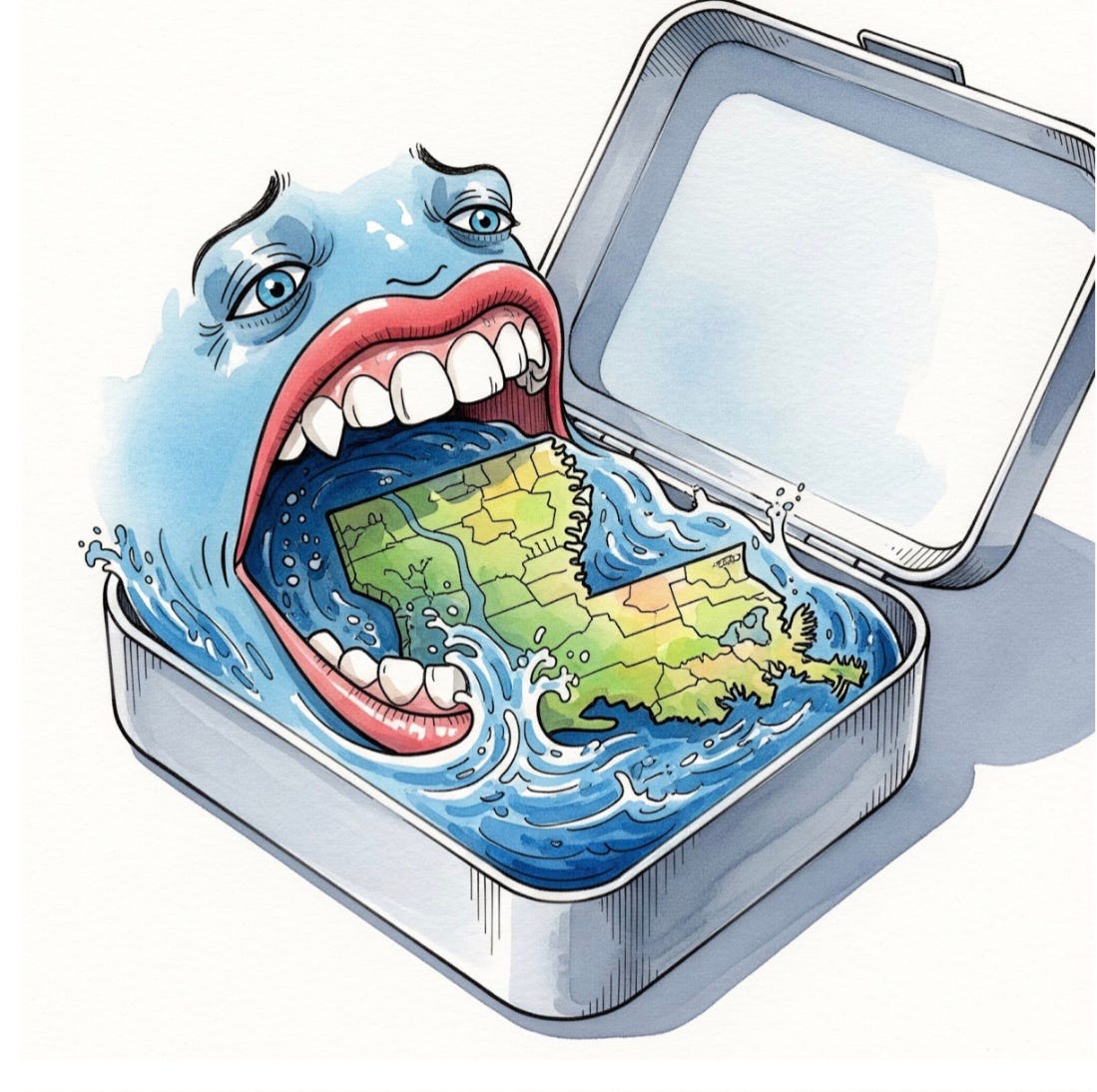
Louisiana has the highest coastal land loss rate in the United States. Since the 1930s, the state has lost about 2,000 square miles of land. This is a significant amount, roughly the size of the state of Delaware.
Without major intervention, the state of Louisiana is projected to lose an additional 700 to 1,000 square miles of land by the year 2050. This is an area roughly the size of the greater Washington D.C.-Baltimore area.
By the year 2100, the projections are even more dire, with some worst-case scenarios suggesting that up to 3,000 square miles of land could be lost. Some scientists have even warned that the entire remaining 5,800 square miles of Louisiana’s coastal wetlands in the Mississippi River delta could eventually disappear.
A Word of Wisdom:
Our fictional and non-fictional tales are inspired by real Louisiana and New Orleans history, but some details may have been spiced up for a good story. While we’ve respected the truth, a bit of creative license could have been used. Please note that all characters may be based on real people, but their identities in some cases have been Avatar masked for privacy. Others are fictional characters with connections to Louisiana.
As you read, remember history and real life is a complex mix of joy, sorrow, triumph, and tragedy. While we may have (or not) added a bit of fiction, the core message remains, the human spirit’s power to endure, adapt, and overcome.
© Jerilee Wei 2025 All Rights Reserved.
Whistleblower: 10-year-old Palestinian boy ‘gunned down’ after receiving food aid
Former US Green Beret says Israel committed war crimes at Gaza food distribution site | BBC News
In Gaza, hunger forces impossible choices as Hamas releases propaganda video of hostage
Doctor Gives Eyewitness Account Of Gaza Horrors| Dr. Ambereen Sleemi | TMR
ICE is thugs targetting brown people who are US citizens, detaining them, taking their ID and not returning it, assaulting them, then making up charges against them.
Enjoy Your Morning Beverage, and See 25 Years Into The Future-
How The World Will Look Very Different in 2050, According to Neil deGrasse Tyson
Neil deGrasse Tyson says you’ll regrow organs and vacation in space by 2050 — lock in.
By Asheea Smith Published August 2, 2025

Leave it to Neil deGrasse Tyson to casually predict the next 25 years like it’s no biggie. During episode 1904 of the Joe Rogan Experience, the astrophysicist, author, and science celeb offered a bold glimpse into where humanity might be headed in the next 25 years. While flying cars didn’t make the cut (sad face), his projections are closely aligned with today’s advances in science and technology — and some could be closer than we might expect.
So, who exactly is Tyson, and what does he think the world might look like by 2050? Get in — we’re going exploring.
Who is Neil deGrasse Tyson?
If you’ve ever caught the eye-watering space series, “Cosmos” or heard someone break down the mysteries of the universe without sounding like a textbook — you’ve probably heard of Tyson. Born in New York City, Tyson graduated from the Bronx High School of Science. He later earned his Bachelor of Arts in Physics from Harvard University in 1980 and went on to complete a Masters and Ph. D in Astrophysics from Columbia University in 1989 and 1991, per Britannica.
Tyson is best known for hosting the celestial TV series, “Cosmos: A Spacetime Odyssey” and his radio program, “StarTalk.” Beyond his obsession with exploding stars, black holes, and dark matter, he gives viewers a grip on what the heck is going on in the cosmos, and what it has to do with us.
Now, for his next trick, Tyson’s turning that cosmic lens toward laying out what he believes is next for humanity.
Mental Illness Will Be Cured

“Neuroscience and our understanding of the human mind will become so advanced that mental illness will be cured, leaving psychologists and psychiatrists without jobs,” Tyson, 66, said during the interview.
The Take Over of Self-Driving Cars

“Self-driving electric vehicles will fully replace all cars and trucks on the road. If you wanna be nostalgic with your fancy combustion engine sports car, you can drive on specially designed tracks,” Tyson explained.
Space Tourism
“The human space program will fully transition to a space industry, supported not by tax dollars, but by tourism,” Tyson said.
It seems that in Tyson’s vision, regular folks will be able to book a trip to orbit. Voyager Station — a space hotel set to open in 2027 — is already in the works, complete with a bar, restaurant, concert hall, gym, and a cinema theatre, per Astronomy.
The Cure for Cancer & Tailored Medicine

“We develop a perfect ani-viral serum and cure cancer. Medicines will tailor to your own DNA, leaving no adverse side effects,” Tyson predicted to Rogan.
We’ll Regrow Limbs and Organs

“We will learn how to regrow lost limbs and failing organs, bringing us up to the level of other regenerating animals on earth, like salamanders, starfish, and lobsters,” the “Cosmos” host stated.
Artificial Intelligence Won’t Become Our Overlords

“Instead of becoming our overlord and enslaving us all, artificial intelligence will be just another helpful feature of the tech infrastructures that serve our daily lives,” Tyson concluded.
David Bruce, Laurie McBride, 13,000 PATCO Members, & More, In Peace & Justice History for 8/3
| August 3, 1882 Congress passed the first U.S. law to restrict immigration of a particular ethnic group into the United States, the Chinese Exclusion Act. It stopped all further Chinese immigration for ten years, and denied citizenship to those already in the country, most of whom had been recruited by American railroad and mining companies. The law remained in effect until 1943.  Chinese rail workers Very cool site from the National Archives and Records Administration |
| August 3, 1913 Four died and many others were injured in the Wheatland Hop Riot when police fired into a crowd of California hop pickers trying to organize (with the help of the IWW, or Industrial Workers of the World). At the Durst Ranch in Wheatland, the state’s largest single agricultural employer, hundreds of workers—whites, Mexicans, and Filipinos—had put down their tools because of terrible working conditions, low wages, and an almost complete lack of sanitation and decent housing. It was one of the first attempts to organize agricultural workers. The story of the Wheatland Hop Riot |
August 3, 1981 Nearly 13,000 of the nation’s 17,500 air traffic controllers, members of the Professional Air Traffic Controllers Organization (PATCO), went on strike.After six months of negotiations with PATCO President Robert Poli, the Federal Aviation Administration (FAA) had offered less than 10% of what the union had sought. Due to the stressful nature of their jobs, managing the nation’s ever-increasing volume of airport landings and take-offs without up-to-date equipment, they had asked for a shorter workweek, an increase in pay and retirement after 20 years. 95% of PATCO members rejected the FAA’s final offer. The union had endorsed Ronald Reagan for president in 1980 (one of very few to do so), but President Reagan said they were violating U.S. law banning strikes by federal workers, and would all be terminated unless they returned to work within 48 hours. A Reagan Letter to Robert Poli, PATCO (October. 20, 1980) Dear Mr. Poli: I have been briefed by members of my staff as to the deplorable state of our nation’s air traffic control system. They have told me that too few people working unreasonable hours with obsolete equipment has placed the nation’s air travellers in unwarranted danger. In an area so clearly related to public safety the Carter administration has failed to act responsibly. You can rest assured that if I am elected President, I will take whatever steps are necessary to provide our air traffic controllers with the most modern equipment available and to adjust staff levels and work days so that they are commensurate with achieving a maximum degree of public safety…. I pledge to you that my administration will work very closely with you to bring about a spirit of cooperation between the President and the air traffic controllers. Sincerely, Ronald Reagan More about the strike |
| August 3, 1986 Laurie McBride and seven other Motherpeace members of the Nanoose Conversion Campaign were arrested for picnicking on Winchelsea Island, east of British Columbia’s Vancouver Island. They, along with dozens of volunteer witnesses and supporters who had set off by boat from the town of Nanoose Bay, were protesting the ten-year extension of free use by the U.S. of the Canadian Forces Maritime Experimental Test Range (CFMETR). It is a joint Canadian-American facility for torpedos, other maritime warfare and detection equipment; the island held the command and control center. The Campaign advocated conversion of the area back to peaceful purposes. Laurie McBride’s story |
| August 3, 1988 One hundred forty-three white English and Afrikaans conscripts from four cities in South Africa announced their refusal to serve in the South African Defense Force. The SADF was engaged in actions to preserve apartheid, the social and economic system of racial separatism, in South Africa, and to occupy and thwart independence for South Africa’s neighbors, Angola and Namibia [see July 31, 1986].  24-year-old David Bruce had just been sentenced to six years in prison for refusing to serve; he was released after two. He works today with The Centre for the Study of Violence and Reconciliation on issues of integrity, conduct and accountability in democratic policing. David BruceThe Police That We Want .pdf |
https://www.peacebuttons.info/E-News/peacehistoryaugust.htm#august3
Some News Of The Day
Senate Democrats Estimate DOGE Caused Billions of Dollars In Government Waste by TPM
Read on Substack
A lot of things happened. Here are some of the things. This is TPM’s Morning Memo. Sign up for the email version.
What DOGE Cost Us
Democrats on the Senate Permanent Subcommittee on Investigations yesterday released a jaw-dropping report attempting to document the scope and scale of financial waste, personnel upheaval, and human suffering caused by the so-called Department of Government Efficiency and Elon Musk’s giddily uninformed strike force of Peter Thiel acolytes. In all, the Democrats, led by Richard Blumenthal (CT), estimated DOGE cost the government $21.7 billion.
“DOGE-generated waste could also have easily funded monthly food assistance for the 5.3 million families losing an average of $146 in monthly food security assistance ($9.3 billion per year) under the new budget; or it could have been used more broadly to support the 40 percent of taxpayers that will see a net increase to their taxes as a direct result of the Trump tax plan,” the report contends.
Major news coverage focused on the cost of the government paying over 150,000 federal workers who accepted the Trump administration’s deferred resignation incentives, under which they had to stop working but are continuing to be paid through September or even December. The minority’s report, which estimated that 200,000 workers took these buyouts, calculated that paying workers for not working cost the government $14.8 billion.
Neither the buyouts nor paying workers while on administrative leave (costing an additional $6.1 billion) increased government efficiency, as was always obvious and predictable. The report details many other costs, from the petty and pointless (millions of hours of wasted employee time writing the Musk-required email listing their weekly accomplishments) to the catastrophic (the elimination of the United States Agency for International Development, “projected to cause millions of additional deaths globally while simultaneously endangering domestic public health by reducing essential medical staff and programs.”)
As it rampaged through the government, DOGE destroyed valuable assets, wasting money already set aside to be spent, or depriving the government of income-generating programs. Product spoilage of USAID supplies of food and medicines cost the government nearly $10 million. DOGE’s elimination of the Internal Revenue Service’s Direct File program, the report estimates, wasted a more than $33 million investment in it, not to mention that taxpayers no longer have a free electronic filing option. DOGE caused the loss of more than $263 million of interest and fee income by shutting down Department of Energy loans from a program to modernize the electricity grid. The actual cost of the mass cancellations of medical research grants at the National Institutes of Health has yet to be fully calculated.
This summary represents a fraction of the entire report, and much is still not even known about the scope of the DOGE destruction. Yesterday, Blumenthal wrote to the inspectors general at 27 agencies, requesting they “initiate a comprehensive review of DOGE’s activities within your agency in order to determine the full scope of costs that DOGE’s careless actions have imposed,” particularly “the financial impact of the reorganization of federal agencies through mass layoffs, the canceling of grants, contracts, and other projects for partisan reasons, and the stifling of income-generating activities.”
Is MAGA Turning on Trump over Israel?
I spotted two stories this week in the inside-the-Beltway press, one in Politico and the other in Axios, suggesting MAGA is turning on Trump because of his continued support of the Netanyahu regime and its assault on Gaza that even Israeli human rights organizations have called a genocide. The Axios piece even suggests a “GOP realignment” on the issue may be underway. The Politico piece is more measured on that possibility, but neither piece mentions the critical role of Christian Zionists — that is, evangelicals who vigorously support Israel’s far right, like Ambassador to Israel Mike Huckabee — in the Trump coalition.
It is hard to know now this possible coalitional split will play out. In the meantime, can we talk about how the MAGA figures turning against Israel are saying things that have gotten foreign students detained and universities’ funding cut off?
(snip-MORE, + other subjects)
 Scottie's Playtime