A Movement to Destroy U.S. Democracy Controls the Presidency, Congress, and the Supreme Court—But What’s Behind It?

A Movement to Destroy U.S. Democracy Controls the Presidency, Congress, and the Supreme Court—But What’s Behind It?


The man in the MAGA cap and the “Size Matters” T-shirt allowed me to take his picture. The “size” in question had to do with bullets, represented on the shirt in a line from pistol- to bazooka-grade. Not far from us stood a man in a T-shirt that read “MAKE MEN MEN AGAIN.” Women walked past in red-white-and-blue outfits. Many had Bible verse numbers or slogans on their T-shirts, though quite a few sported images of guns, some of which were aimed at “RINOs.” At a booth nearby, a group of women was raising money for the “patriots” of January 6 incarcerated in “the DC gulag.”

It was a hot summer day in 2023, and there was little new for me at this gathering of right-wing activists in Las Vegas. Yet as I took in the January 6 memorabilia, I couldn’t help thinking back on another, very different event four years earlier. In 2019, I found myself in a seventeenth-century palazzo in Verona, Italy, for a gathering of the World Congress of Families, where I sat in on speeches and discussions with American, Russian, and European political activists on “the LGBT totalitarians” and the evils of “global liberalism.” The message was in some sense the same as the one in Las Vegas, but it’s safe to say that among the well-heeled, stylishly-dressed, highly-educated, and well-traveled participants there, members of the Nevada T-shirt crowd would have stuck out like a platter of corn dogs at a fine Italian trattoria.

The last of the speakers in Verona was a diminutive white-haired academic in a nondescript jacket and tie, the dean of a small law school in California, whose brief tirade about “gender confusion” among the “radical Left” didn’t leave much of an impression on me. I did, however, take note of his name: John Eastman. The same Eastman would later show up at the podium on the White House lawn on the morning of January 6 and he would subsequently turn up as “Co-Conspirator 2” in the federal indictment of Donald Trump for conspiring to overturn the 2020 election. He himself would be indicted in Georgia for the same conspiracy and disbarred in his home state of California. (He’s pled “not guilty” to conspiracy fraud and forgery charges.)

It’s a long way from the palazzo populists of Verona to the RINO hunters of Las Vegas, but they’re clearly part of the same story—the rise of an antidemocratic political movement in the United States. Though diverse and complicated, the movement is united in its rejection of the Enlightenment ideals on which the republic was founded and represents the most serious threat to American democracy since the Civil War.

They don’t want a seat at the table—they want to burn down the house

The American idea, as Abraham Lincoln saw it, is the familiar one articulated in the preamble to the Declaration of Independence. It says that all people are created equal; that a free people in a pluralistic society may govern themselves; that they do so through laws deliberated in public, grounded in appeals to reason, and applied equally to all; and that they establish these laws through democratic representation in government. While the American republic has often fallen short of this idea, many people rightly insist that we should, at the very least, try to live up to it. And in its better moments, the United States and its revolutionary creed have inspired freedom movements around the world.

But in recent years a political movement has emerged that fundamentally does not believe in the American idea. It claims that America is dedicated not to a proposition but to a particular religion and culture. It asserts that an insidious and alien elite has betrayed and abandoned the nation’s sacred heritage. It proposes to “redeem” America, and it acts on the extreme conviction that any means are justified in such a momentous project. It takes for granted that certain kinds of Americans have a right to rule, and that the rest have a duty to obey.

No longer casting the United States as a beacon of freedom, it exports this counterrevolutionary creed through alliances with leaders and activists who are themselves hostile to democracy. This movement has captured one of the nation’s two major political parties, and now controls the Presidency, Congress, and the Supreme Court. It claims to be “patriotic,” and yet its leading thinkers explicitly model their ambitions on corrupt and illiberal regimes abroad that render education, the media, and the corporate sector subservient to a one-party authoritarian state.

How did such an anti-American movement take root in America?

The antidemocratic movement isn’t the province of any single demographic, or even ideology. The real story of the authoritarian Right features a rowdy mix of personalities, often working at odds with one another: “apostles” of Jesus; atheistic billionaires; reactionary Catholic theologians; pseudo-Platonic intellectuals; woman-hating opponents of “the gynocracy”; high-powered evangelical networkers; Jewish devotees of Ayn Rand; pronatalists preoccupied with a dearth of (White) babies; COVID truthers; and battalions of “spirit warriors” who appear to be inventing a new style of religion even as they set about undermining democracy at its foundations.

To repeat the obvious: this movement represents a serious threat to the survival of American democracy. Today’s political conflicts aren’t simply the result of incivility, tribalism, “affective partisanship,” or some other unfortunate trend in manners. All will be well, the thinking goes, if the red people and the blue people would just sit down for some talk therapy and give a little to the other side. In earlier times this may have been sage advice. Today it’s a delusion.

American democracy is failing because it’s under direct attack, and the attack isn’t coming equally from both sides. The authoritarian movement isn’t looking for a seat at the noisy table of American democracy; it wants to burn down the house. It isn’t the product of misunderstandings; it advances its antidemocratic agenda by actively promoting division and disinformation. In my book, Money, Lies and God, I bring the receipts to support these uncomfortable facts.

The fall has been swift, but it was decades in the making

When did the crisis begin? It can sometimes seem that the antidemocratic reaction snuck up on us and suddenly exploded in our living rooms when Donald Trump descended on the escalator and announced his candidacy. Looking back over the decade and a half I’ve spent reporting on the subject, the escalation of the threat is breathtaking. In 2009, I was reporting on an antidemocratic ideology focused on hostility to public education that appeared to be gaining influence on the Right. By 2021, I was writing about an antidemocratic movement whose members had stormed the Capitol—and about a Republican Party whose leadership disgracefully acquiesced in the attempted overthrow of American democracy. Yet the swiftness of the fall should not distract from the long duration of the underlying causes.

The present crisis is deeply rooted in material changes in American life over the past half century. The antidemocratic movement came together long before the 2016 election, and the forces hurling against American democracy will long outlive the current political moment. Their various elements have emerged along the fissures in American society, and they continue to thrive on our growing educational, cultural, regional, racial, religious, and informational divides.

This antidemocratic reaction draws much of its energy from the massive increase in economic inequality and resulting economic dislocations over the past five decades. In the middle of the twentieth century, capitalist America was home to the most powerful and prosperous middle class the world had hitherto seen. By the second decade of the twenty-first century, capitalism had yielded in many respects to a form of oligarchy, and the nation had been divided into very different strata. At the very top of the wealth distribution arose a sector whose aggregate net worth makes the rich men of earlier decades look like amateurs. Between 1970 and 2020, the top 0.1 percent doubled its share of the nation’s wealth. The bottom 90 percent, meanwhile, lost a corresponding share.

For the large majority of Americans, the new era brought wage stagnation and even, within certain groups in recent years, declining life expectancy. In the happy handful of percentiles located just beneath the 0.1 percent, on the other hand, a hyper-competitive group has managed to hold on to its share of the pie even as it remains fearful of falling behind.

While the political conflicts of the present cannot be reduced to economic conflicts, the great disparity in wealth distribution is a significant contributor. It has fractured our faith in the common good, unleashed an epidemic of status anxiety, and made a significant subset of the population susceptible to conspiracism and disinformation.

Different groups, of course, have responded differently. The antidemocratic movement isn’t the work of any one social group but of several working together. It relies in part on the narcissism and paranoia of a subset of the super-rich who invest their fortunes in the destruction of democracy. They appear to operate on the cynical belief that manipulation of the masses through disinformation will enhance their own prosperity. The movement also draws in a sector of the professional class that has largely abdicated its social responsibility. Much of the energy of the movement, too, comes from below, from the anger and resentment of those who perceive that they’re falling behind.

As these groups jockey for status in a fast-changing world, they give rise to a politics of rage and grievance. The reaction may be understandable. But it’s not, on that account, reasonable or constructive. Although the antidemocratic movement emerged, in part, out of massive structural conflicts in the American political economy, it does not represent a genuine attempt to address the problems from which it arose. This new politics aims for results that few people want and that ultimately harm everybody.

The rocket fuel of the new American authoritarianism

What are the main features of this new American fascism grounded in resentment? In America, just as in unstable political economies of the past, the grievances to which the daily injustices of an unequal system give rise inevitably vent on some putatively alien “other” supposedly responsible for all our ills. America’s demagogues, however, have a special advantage. They can draw on the nation’s barbarous history of racism and the fear that the “American way of life” is slipping away, abetted by an out-of-touch elite.

The story of this movement cannot be told apart from the racial and ethnic divisions that it continuously exploits and exacerbates. The psychic payoff that the new, antidemocratic religious and right-wing nationalism offers its adherents is the promise of membership in a privileged “in-group” previously associated with being a White Christian conservative—a supposed “real American”—with the twist that those privileges may now be claimed even by those who aren’t White, provided they worship and vote the “right” way. At the same time, the movement is the result of the concerted cultivation of a range of anxieties that draw from deep and wide roots.

Anxiety about traditional gender roles and hierarchies is the rocket fuel of the new American authoritarianism. Among the bearded young men of the New Right, it shows up in social media feeds bursting with rank misogyny. In the theocratic wing of the movement, it puts on the tattered robes of patriarchy, with calls for “male headship” and female subordination, and relentlessly demonizes LGBT people. On the political stage, it has centered around the long-running effort to strip women of their reproductive health rights and, in essence, make their bodies the property of the state. That effort has had significant consequences at the ballot box—which is why a sector of movement leadership is starting to speak openly about stripping women of the right to vote. The tragedy of American politics is that the same forces that have damaged so many personal lives have been weaponized and enlisted in the service of a political movement that’s sure to make the situation worse.

Expressions of pain, not plans for the future

The bulk of this movement is best understood in terms of what it wishes to destroy, rather than what it proposes to create. Fear and grievance, not hope, are the moving parts of its story. Its members resemble the revolutionaries of the past in their drive to overthrow “the regime”—but many are revolutionaries without a cause.

To be sure, movement leaders do float visions of what they take to be a better future, which typically aims for a fictitious version of the past: a nation united under “biblical law”; a people liberated from the tyranny of the “administrative state”; or just a place somehow made “great again.” But in conversations with movement participants, I have found, these visions quickly dissipate into insubstantial generalizations or unrealizable fantasy. There is no world in which America will become the “Christian nation” that it never actually was; there’s only a world in which a theocratic oligarchy imposes a corrupt and despotic order in the name of sectarian values.

These visions turn out to be thin cover for an unfocused rage against the diverse and unequal America that actually exists. They’re the means whereby one type of underclass can be falsely convinced that its disempowerment is the work of another kind of underclass. They’re expressions of pain, not plans for the future. This phenomenon is what I call “reactionary nihilism.” It’s reactionary in the sense that it expresses itself as mortal opposition to a perceived catastrophic change in the political order; and it’s nihilistic because its deepest premise is that the actual world is devoid of value, impervious to reason, and governable only through brutal acts of will. It stands for a kind of unraveling of the American political mind that now afflicts one side of nearly every political debate.

Yet there is method in this phenomenon. The direction and success of the antidemocratic movement depends on its access to immense resources, a powerful web of organizations, and a highly self-interested group of movers and backers. It has bank accounts that are always thirsty for more money, networks that hunger for ever more connections, religious demagogues intent on exploiting the faithful, communicators eager to spread propaganda and disinformation, and powerful leaders who want more power. It takes time, organizational energy, and above all, money to weaponize grievances and hurl them against an established democracy—and this movement has it all.

To be clear, there’s no single headquarters for the antidemocratic reaction. There are, however, powerful networks of leaders, strategists, and donors, as well as interlocking organizations, fellow travelers, and affirmative action programs for the ideologically pure. That matrix is far more densely connected, well-financed, and influential at all levels of government and society than most Americans appreciate.

History shows, however, that better organization does not always flatten the contradictions. On the contrary, it can sometimes amplify the conflicts. This is perhaps the most difficult to appreciate aspect of the antidemocratic movement—and the source of both its weakness and its strength. This movement is at war with itself even as it wages war on the rest of us. It consists of a variety of groups and organizations, each pursuing its own agendas, each in thrall to a distinct set of assumptions.

Viewed as a whole, it seems to want things that cannot go together—like “small government” and a government big enough to control the most private acts in which people engage; like the total deregulation of corporate monopolies and a better deal for the workforce; like “the rule of law” and the lawlessness of a dictator and his cronies who may pilfer the public treasury; like a “Christian nation” that excludes many American Christians from the ranks of the supposedly righteous. It pursues this bundle of contradictions not merely out of hypocrisy and cynicism but because the task of tearing down the status quo brings together groups that want very different things and are even at odds with one another.

Hope despite—and because of—the chaos

While a survey of the antidemocratic reaction in the United States is bound to provoke alarm and perhaps even a feeling of hopelessness, the self-contradictory nature of this reaction should be a source of hope for those who want to defend American democracy. MAGA is in many regards a weak movement, not a strong one. It draws on multiple factions, including oligarchic funders, the Christian Right, the New Right, libertarians, Q-Anoners, White nativists, “parent activists” radicalized by disinformation, health skeptics, a small segment of the Left, and others, all of whom worked together to bring slim majorities of voters to their side. These groups don’t really belong together, and they probably won’t stay together indefinitely.

In spite of their differences, for now these groups are rowing in the same boat. They told us ahead of the 2024 election that they were going to smash the federal bureaucracy, which they view for ideological reasons as interfering with their agenda. Trump said in no uncertain terms that he would turn the Department of Justice into his personal vendetta machine, and that’s what he’s attempting to do. He promised trade wars and let everybody know he would trash vital international alliances, and that’s what he’s doing.

So this is no time to retreat under the covers. Now is the time for moral courage. There are more Americans who would prefer to live in a democracy than a kleptocratic, Christian nationalist autocracy. We need to come together in broad coalitions and stay focused on organizing—from developing pro-democracy strategies and infrastructure to taking local action to improving voter turnout operations—now and in the long term.

When they lost in 2020, the MAGA movement didn’t roll over. They simply resolved to organize better and fight harder. Above all, they found new populations to evangelize with untruths. We wouldn’t wish to emulate their most craven tactics, of course, but we can learn something from their strategic resolve.

 

“You’re Here Because of Your Tattoos”

“You’re Here Because of Your Tattoos”


The Trump administration sent Venezuelans to El Salvador’s most infamous prison. Their families are looking for answers.

A collage featuring three black-and-white portraits of young men on the left, a central orange-tinted image of ICE officers in police jackets peering into a doorway, and on the right, a close-up of a tattoo on someone’s arm

Mother Jones illustration; Mark Boster/Los Angeles Times/Getty; Photos courtesy Génesis Lozada, Joseph Giardina, Arturo Suárez, and María Alvarado

Fight disinformation: Sign up for the free Mother Jones Daily newsletter and follow the news that matters.

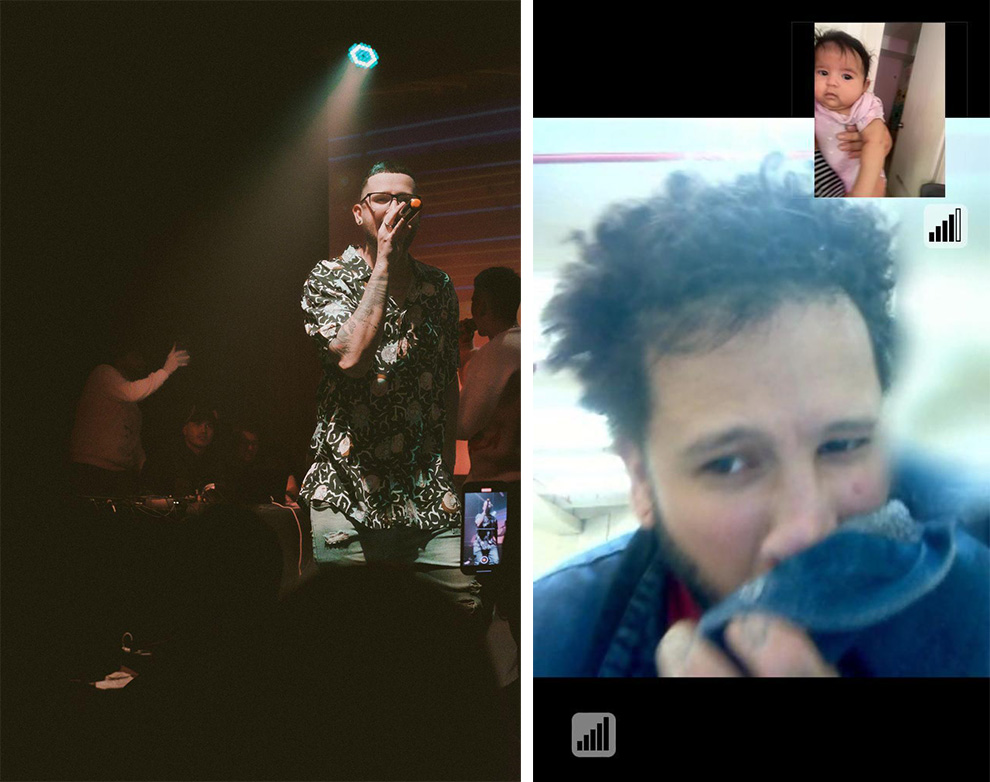
On Friday, March 14, Arturo Suárez Trejo called his wife, Nathali Sánchez, from an immigration detention center in Texas. Suárez, a 33-year-old native of Caracas, Venezuela, explained that his deportation flight had been delayed. He told his wife he would be home soon. Suárez did not want to go back to Venezuela. Still, there was at least a silver lining: In December, Sánchez had given birth to their daughter, Nahiara. Suárez would finally have a chance to meet the three-month-old baby girl he had only ever seen on screens.

But, Sánchez told Mother Jones, she has not heard from Suárez since. Instead, last weekend, she found herself zooming in on a photo the government of El Salvador published of Venezuelan men the Trump administration had sent to President Nayib Bukele’s infamous Terrorism Confinement Center, or CECOT. “I realized that one of them was my husband,” she said. “I recognized him by the tattoo [on his neck], by his ear, and by his chin. Even though I couldn’t see his face, I knew it was him.” The photo Sánchez examined—and a highly produced propaganda video promoted by Secretary of State Marco Rubio and the White House—showed Venezuelans shackled in prison uniforms as they were pushed around by guards and had their heads shaved.

The tattoo on Suárez’s neck is of a colibrí, a hummingbird. His wife said it is meant to symbolize “harmony and good energy.” She said his other tattoos, like a palm tree on his hand—an homage to Suárez’s late mother’s use of a Venezuelan expression about God being greater than a coconut tree—were similarly innocuous. Nevertheless, they may be why Suárez has been effectively disappeared by the US government into a Salvadoran mega-prison.

Mother Jones has spoken with friends, family members, and lawyers of ten men sent to El Salvador by the Trump administration based on allegations that they are members of the Venezuelan organized crime group Tren de Aragua. All of them say their relatives have tattoos and believe that is why their loved ones were targeted. But they vigorously reject the idea that their sons, brothers, and husbands have anything to do with Tren de Aragua, which the Trump administration recently labeled a foreign terrorist organization. The families have substantiated those assertions to Mother Jones, including—in many cases—by providing official documents attesting to their relatives’ lack of criminal histories in Venezuela. Such evidence might have persuaded US judges that the men were not part of any criminal organization had the Trump administration not deliberately deprived them of due process.

On March 14, President Donald Trump quietly signed a proclamation invoking the Alien Enemies Act—a 1798 law last used during World War II. The order declared that the United States is under invasion by Tren de Aragua. It is the first time in US history that the 18th-century statute, which gives the president extraordinary powers to detain and deport noncitizens, has been used absent a Congressional declaration of war. The administration then employed the wartime authority unlocked by the Alien Enemies Act to quickly load Venezuelans onto deportation flights from Texas to El Salvador.

In response to a class action lawsuit brought by the ACLU and Democracy Forward, federal judge James Boasberg almost immediately blocked the Trump White House from using the Alien Enemies Act to summarily deport Venezuelans, and directed any planes already in the air to turn around. But in defiance of that order, the administration kept jets flying to El Salvador. Now Suárez and others like him are trapped in the Central American nation with no clear way to contact their relatives or lawyers.

Suárez, whose story has also been reported on by the Venezuelan outlet El Estímulo, is an aspiring pop musician who records under the name SuarezVzla. His older brother, Nelson Suárez, said his sibling’s tattoos were intended to help him “stand out” from the crowd. “As Venezuelans, we can’t be in our own country so we came to a country where there is supposedly freedom of expression, where there are human rights, where there’s the strongest and most robust democracy,” Nelson said. “Yet the government is treating us like criminals based only on our tattoos, or because we’re Venezuelan, without a proper investigation or a prosecutor offering any evidence.” (All interviews with family members for this story were conducted in Spanish.)

“Well, you’re here because of your tattoos,” the ICE agent reportedly said. “We’re finding and questioning everyone who has tattoos.”

The Justice Department’s website states that Suárez’s immigration case is still pending and that he is due to appear before a judge next Wednesday. Records provided by Nelson Suárez show that Arturo has no criminal record in Venezuela. Nor, according to his family, does Suárez have one in Colombia and Chile, where he lived after leaving Venezuela in 2016. They say he is one of millions of Venezuelans who sought a better life elsewhere after fleeing one of the worst economic collapses in modern history. (Just a few years ago, Secretary Rubio, then a senator from Florida, stressed that failure to protect Venezuelans from deportation “would result in a very real death sentence for countless” people who had “fled their country.”)

The stories shared with Mother Jones suggest that Trump’s immigration officials actively sought out Venezuelan men with tattoos before the Alien Enemies Act was invoked and then removed them to El Salvador within hours of the presidential proclamation taking effect.

“This doesn’t just happen overnight,” said immigration lawyer Joseph Giardina, who represents one of the men now in El Salvador, Frizgeralth de Jesus Cornejo Pulgar. “They don’t get a staged reception in El Salvador and a whole wing for them in a maximum-security prison…It was a planned operation, that was carried out quickly and in violation of the judge’s order. They knew what they were doing.” 

Arturo Suárez performing and speaking with his baby daughter from detention.Courtesy Arturo Suárez

The White House has yet to provide evidence that the hundreds of Venezuelans flown to El Salvador—without an opportunity to challenge their labeling as Tren de Aragua members and “terrorists”—had actual ties to the gang. When pressed on the criteria used for their identification, Press Secretary Karoline Leavitt pointed to unspecified “intelligence” deployed to arrest the Venezuelans she has referred to as “heinous monsters.” Trump’s border czar Tom Homan has insisted—without providing specific details—that the public should trust ICE to have correctly targeted the Venezuelans based on “criminal investigations,” social media posts, and surveillance.

Robert Cerna, an acting field office director for ICE’s removal operations branch, said the agency “did not simply rely on social media posts, photographs of the alien displaying gang-related hand gestures, or tattoos alone.” But Cerna also acknowledged that many of the Venezuelans deported under the Alien Enemies Act had no criminal history in the United States, a fact he twisted into an argument to seemingly justify the summary deportations without due process. “The lack of a criminal record does not indicate they pose a limited threat,” Cerna wrote. “In fact, based upon their association with TdA, the lack of specific information about each individual actually highlights the risk they pose. It demonstrates that they are terrorists with regard to whom we lack a complete profile.”

The relatives who talked to Mother Jones painted a vastly different picture from the US government’s description of the men as terrorists or hardened criminals. Many said their loved ones were tricked into thinking they were being sent back to Venezuela, not to a third country. (The Department of Homeland Security and ICE did not respond to a detailed request for comment asking for any evidence that the Venezuelans named in this article have ties to Tren de Aragua.)

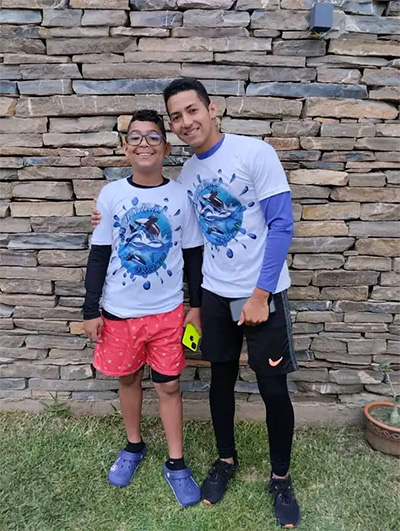
Before leaving for the United States in late 2023, Neri Alvarado Borges lived in Yaritagua, a small city in north central Venezuela. His father is a farmer and his mother supports his 15-year-old brother, Nelyerson, who has autism.

Neri Alvarado with his brother Nelyerson in 2023.Courtesy María Alvarado

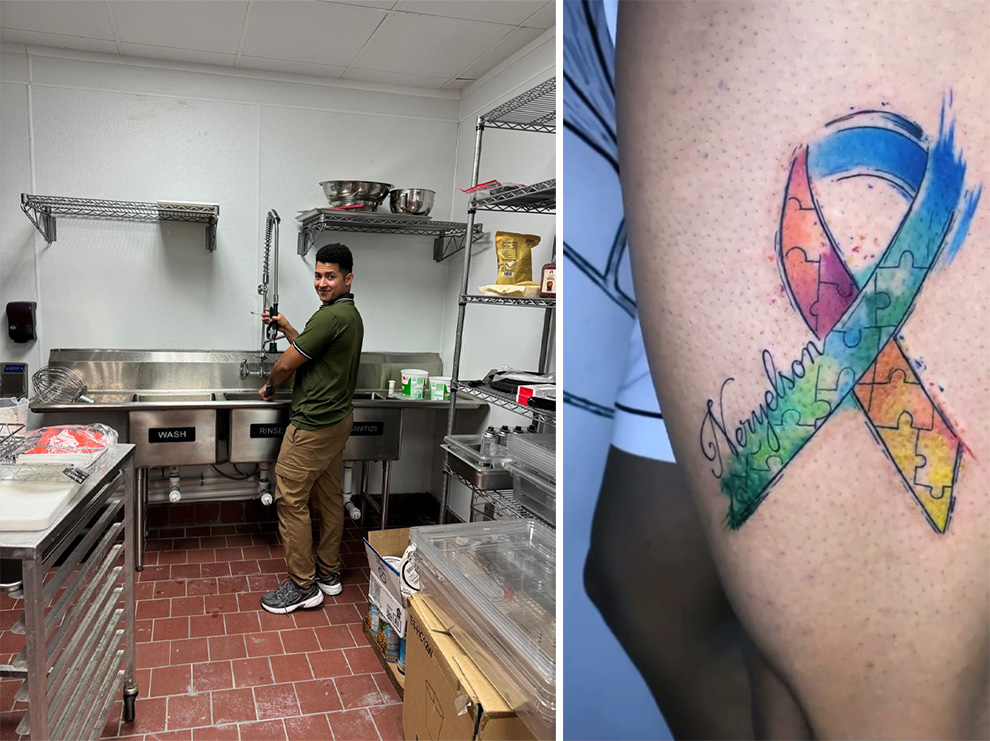
Alvarado’s older sister, María, stressed in a call from Venezuela that her brother has no connection to Tren de Aragua. She said her brother was deeply devoted to helping Nelyerson—explaining that one of his three tattoos is an autism awareness ribbon with his brother’s name on it and that he used to teach swimming classes for children with developmental disabilities. “Anyone who’s talked to Neri for even an hour can tell you what a great person he is. Truly, as a family, we are completely devastated to see him going through something so unjust—especially knowing that he’s never done anything wrong,” María said. “He’s someone who, as they say, wouldn’t even hurt a fly.”

Still, Alvarado was detained by ICE outside his apartment in early February and brought in for questioning, Juan Enrique Hernández, the owner of two Venezuelan bakeries in the Dallas area and Alvarado’s boss, told Mother Jones. One day later, Hernández went to see him in detention and asked him to explain what had happened. Alvarado told Hernández that an ICE agent had asked him if he knew why he had been picked up; Alvarado said that he did not. “Well, you’re here because of your tattoos,” the ICE agent replied, according to Hernández. “We’re finding and questioning everyone who has tattoos.”

The agent then asked Alvarado to explain his tattoos and for permission to review his phone for any evidence of gang activity. “You’re clean,” the ICE officer told Alvarado after he complied, according to both Hernández and María Alvarado. “I’m going to put down here that you have nothing to do with Tren de Aragua.”

For reasons that remain unclear, Hernández said that another official in ICE’s Dallas field office decided to keep Alvarado detained. María Alvarado said her brother told her the same story at the time.

Hernández spoke to Alvarado shortly before he was sent to El Salvador. “There are 90 of us here. We all have tattoos. We were all detained for the same reasons,” he recalled Alvarado telling him. “From what they told me, we are going to be deported.” Both assumed that meant being sent back to Venezuela.

Hernández, a US citizen who moved to the United States from Venezuela nearly three decades ago, searched desperately for Alvarado when he didn’t show up in his home country that weekend. He was nearly certain that Alvarado was in El Salvador when he first spoke to Mother Jones on Thursday. “I have very few friends,” he said. “Very few friends and I have been in this country for 27 years. I let Neri into my house because he is a stand-up guy…Because you can tell when someone is good or bad.” Later that day, on Alvarado’s 25th birthday, Hernández got confirmation that his friend was in El Salvador when CBS News published a list of the 238 people now at CECOT.

A centerpiece of Bukele’s brutal anti-gang crackdown, CECOT is known for due process violations and extreme confinement conditions. Last year, CNN obtained rare access to the remote prison, which can hold up to 40,000 people. The network found prisoners living in crowded cells with metal beds that had no mattresses or sheets, an open toilet, and a cement basin. Visitation and time outdoors are not allowed. A photographer who was allowed into the prison as the Venezuelans arrived earlier this month wrote for Time magazine that he witnessed them being beaten, humiliated, and stripped naked.

The Trump administration has indicated in court records that the El Salvador operation was weeks, if not months, in the making. In a declaration, a State Department official said arrangements with the Salvadoran and Venezuelan governments for the countries to take back US deportees allegedly associated with Tren de Aragua had been made after weeks of talks “at the highest levels”—including ones involving Secretary of State Rubio—and “were the result of intensive and delicate negotiations.”

As part of the deal, the US government will pay El Salvador $6 million to hold the Venezuelan men for at least one year. Calling the agreements a “foreign policy matter,” Rubio has claimed the outsourcing of deportees’ detention to Bukele’s “excellent prison system” is saving money for US taxpayers.

It is unclear if, or when, anyone sent to CECOT will be able to return to Venezuela. A Human Rights Watch program director noted in a declaration that the organization “is not aware of any detainees who have been released from that prison.” During an appeals court hearing on March 24, the ACLU’s lead counsel Lee Gelernt said, “We’re looking at people now who may be in a Salvadoran prison the rest of their lives.”

Neri Alvarado working at the bakery and the autism awareness tattoo with his brother’s name.Courtesy María Alvarado

Joseph Giardina’s client Frizgeralth de Jesus Cornejo Pulgar thought he was set to return to Venezuela on a deportation flight. Carlos, Frizgeralth’s older sibling, said his 26-year-old brother called their sister, who lives in Tennessee, from the El Valle detention center in Texas. He said Frizgeralth told her he was going to be deported to Venezuela later that day. “He was happy that he was going to be here with us,” Carlos said from Caracas in a video call with Mother Jones.

But Frizgeralth never arrived. Eventually, the family heard from the girlfriend of another Venezuelan set to be deported on the same flight as Carlos. She had identified him in videos shared on social media of the men who had been sent to the prison in El Salvador. On March 19, Carlos started scouring the internet and spotted his brother in a TikTok video. In it, Frizgeralth has his freshly shaved head pressed down, a rose tattoo on his neck peeking out from under a white t-shirt.

“We felt very powerless and in a lot of pain,” Carlos said. “To see how they mistreat a person who doesn’t deserve any of that. It’s not fair.”

“I never imagined being imprisoned just for getting a tattoo.”

Frizgeralth arrived in the United States in June 2024 after crossing the Darién Gap and waiting several months in Mexico for a CBP One appointment. The Biden-era program, which the Trump administration has since terminated, allowed migrants to schedule a date to present lawfully at a US port of entry. Carlos said Border patrol agents let Frizgeralth’s girlfriend and their other brother, as well as two friends, through but they held Frizgeralth back. He ended up detained at Winn Correctional Center, an ICE facility in Louisiana.

In messages to his family from detention, Frizgeralth expressed concern he was being investigated because of his tattoos. He explained that none of the 20 or so images—including one on his chest of an angel holding a gun—he has tattooed on his body have any connection to gang activity. He also described feeling discouraged from hearing stories in detention of Venezuelans who had recently been redetained and said ICE agents picked them up over suspicions about their tattoos. 

Frizgeralth even had a declaration from his tattoo artist confirming the harmless nature of the artwork. “I never imagined being imprisoned just for getting a tattoo,” Frizgeralth, who owns a streetwear clothing brand with Carlos, wrote. “I never imagined being separated from my family. I wouldn’t wish this on anyone, not even my worst enemy if I had one. It’s horrible, it’s mental torture every day.”

Like Suárez and Alvarado, Frizgeralth had no criminal record in Venezuela, documents show. Giardina said his client also had no known criminal history in the United States. Nor did he have a final deportation order. During his preliminary court hearings, the US government never claimed or presented evidence that Frizgeralth had ties to Tren de Aragua. “He was doing everything he was supposed to do,” Giardina said. “He got vetted and checked when he came into the country. He was in detention the entire time. It’s insanity.” If anything, Giardina said, his client had a strong claim for asylum based on political persecution. He said Frizgeralth was being targeted by the colectivos, paramilitary groups linked to the Maduro regime.

About a week prior to his deportation, they moved Frizgeralth to Texas. His next hearing, which is scheduled for April 10, still appears on the immigration court’s online system. “To detain them in this maximum security prison with no access to lawyers, no charges, just because you’re saying they’re terrorists…,” Giardina said. “I mean, what the hell?” 

Génesis Lozada Sánchez said she and her younger brother Wuilliam are from a rural Venezuelan “cattle town” called Coloncito near Colombia. Following Venezuela’s economic collapse, both she and Wuilliam lived in Bogota, where her brother saved up for the journey to the United States by making pants at a clothing factory. After he reached the border last January, Wuilliam was detained for more than a year, Génesis said.

On Friday, March 14, he called a cousin in the United States to say that he was about to be deported to Venezuela. “But to everyone’s surprise, that’s not what happened. They were kidnapped,” Génesis said. “Why do I say kidnapped? These people have no ties to El Salvador. They haven’t committed any crimes there. And they’re not even Salvadoran. They don’t even cross into El Salvador after going through the Darién Gap on their way to the United States. So, it’s a kidnapping. They tricked these guys into signing papers by telling them they were being sent to Venezuela.”

Like other men sent to El Salvador, Wuilliam has tattoos. But Génesis said that they have nothing to do with Tren de Aragua and that her brother has no criminal record. His goal had been to make enough money in the United States to help support their parents and to save up enough to hopefully open a clothing factory back home.

Other reporting and court briefs further support the families’ suspicions that their loved ones were primarily targeted for deportation because of their tattoos. In one instance, a professional soccer player, whose attorney said had fled Venezuela after protesting against the Maduro regime and being tortured, was accused of gang membership based on a tattoo similar to the logo of his favorite team, Real Madrid.

John Dutton, a Houston-based immigration attorney, said that he started noticing ICE officers detaining Venezuelans during check-ins due to their tattoos earlier this year. “If they notice they have a tattoo, they’re just taking them into custody,” he explained. “No more questions to ask.” Dutton estimated he now has about a dozen clients who have been arrested because of tattoos.

One of his clients, Henrry Albornoz Quintero, was due in court for a bond hearing last Wednesday after being taken into detention at a routine ICE check-in. “I show up. The judge asked me where my client is,” the Houston lawyer said. “I asked the same question to the DHS attorney. She looked at her notes, shuffled papers around as if she’s gonna find the answer in there, looks up, and said, ‘Judge, I don’t know.’”

Dutton told the judge that his client might be in El Salvador; his relatives had recognized him in one of the images of people at CECOT. The judge then decided not to hear the case on the grounds that he no longer had jurisdiction. “You could tell he wanted to help me,” Dutton added. “He just couldn’t. There’s nothing he could do.”

The next day, Albornoz’s name appeared on the list of people imprisoned in El Salvador. So far, Albornoz is the only one of Dutton’s clients to be sent there. His wife is nine months pregnant with their first child.

“They didn’t just deport these people and then set them free,” says Ilya Somin, a law professor at George Mason University. “They sent them to El Salvador, where that country, at the behest of the United States, is incarcerating them for at least a year in their prison system. This is not just deportation without due process. This is imprisonment without due process in a foreign prison system that has terrible conditions. That’s a pretty blatant violation of the Fifth Amendment’s due process clause, which says that you can’t take away people’s life, liberty or property without due process of law.” 

Until Thursday, March 20, Barbara Alexandra Manzo still wasn’t sure if her brother Lainerke Daniel Manzo Lovera was among those sent to El Salvador and transferred to CECOT. The family hadn’t heard from him since that Saturday, when he called from El Paso, Texas, to say they were deporting him to Venezuela or Mexico. Her confirmation also came when she saw his name on the CBS News list.

Barbara Alexandra told Mother Jones that Lainerke didn’t even have a tattoo before he left Venezuela in December 2023. He got one—a clock on his arm—while living and working in Mexico, waiting for a CBP One appointment. It was a gift from a roommate who had been given a date before he did. Last October, Lainerke showed up at the border and was sent to ICE detention; first in San Diego, then briefly in Arizona. He had a court hearing scheduled for March 26.

“My son went to look for a better future, the American Dream,” his mother Eglee Xiomara said in a video. “And it didn’t come true. That was the worst trip he has ever made in his life.”

Lainerke has yet to meet his six-month-old daughter, who was born in the United States. “He’s never been in prison,” Barbara Alexandra said. “[We’re wondering] if he’s ok or if something is happening to him. And we’ll never know because we have no recourse.”

Nelson Suárez fears that he, too, could meet the same fate as his brother Arturo, the Venezuelan musician. Even during the first Trump administration, the fact that Nelson has Temporary Protected Status and a pending asylum case would have been enough to protect him from deportation. But there are no guarantees that it will be now. If Judge Boasberg’s temporary restraining order is lifted or overturned, he could be immediately deported to Venezuela, or sent to El Salvador, without due process. He doesn’t know if he will walk out of a scheduled check-in with ICE in May free or in chains.

“I’m really scared,” he said last week. “My three daughters are here with me. My wife is here. My kids are in school. I don’t know what could happen. Since this happened to my brother, I really haven’t been able to sleep. I have no peace, no sense of calm. I’m afraid to go out on the street. But at the same time, we have to go out to work and get things done.”

What the Venezuelans Deported to El Salvador Experienced

https://time.com/7269604/el-salvador-photos-venezuelan-detainees/


I want to thank Allison Gill for this report.  I got it from her daily beans podcast that I listen to while I brush my teeth, shower, and if she goes long while I dress.   Her podcasts are very informative with three different segments of news and what is happening.  Often I write down what I can remember to talk about.  Then I realized she gives a transcript of each show, and that transcripts with links is bringing you this post.  She has a substack which I also follow where she reports the news giving tips on how to get involved.  https://www.muellershewrote.com.  What follows is horrifying and triggered me because the abuse these people went through was some of what I did.  But remember most of the people on these flights are not gang members.   This all comes from a slum lord not wanting to deal with a protest on his apartment complex that was getting really dangerous for the people living there.  He went to the news claiming a gang called … had taken over and was shaking down him and residents.  Yes they did go to a few residences and demand the money, the money promised to help fund their fight against the landlord.  Many right wing outlets selectively edited the videos to make the protesting people seem very sinister.  TYT also pushed the scenario hard.  As you will read the people in this foreign prison for at least a year held in commutation black out are not gang members, many came to the US in legal ways, some had green cards.  They can not access lawyers, can’t call friends or family, they are held for a year in horrific conditions like in a Russian gulag because tRump and crew don’t care about the constitution or the people.  All they want is all non-white people removed from the US.  Some of those deported by the way, luckily not to this place are US citizens that are fighting for their rights.  Hence the sending them to El Salvador that has no laws of rights and agreed for a huge price per detainee to keep them from accessing any outside person.  They could kill them tomorrow and no one would know.   The tRump people are grabbing anyone they can and sending them there knowing they can not get any help.  Sadly I just watched a clip on Tim Pool a low info moron who clearly thinks this is great no matter how many innocent people get caught up in it.  It doesn’t matter they broke no laws, and entering the US illegally to ask for asylum is not a criminal offense despite what the white supremacist say it is a protected right under US laws and the treaties, That makes it legal.  Again not that tRump and crew care.  By any definition that torture is against the US Constitution.  An impeachable offense.  Hugs


Holsinger is an American photojournalist based out of Nashville, Tenn.
————————————————————————————————————–
On the night of Saturday, March 15, three planes touched down in El Salvador, carrying 261 men deported from the United States. A few dozen were Salvadoran, but most of the men were Venezuelans the Trump Administration had designated as gang members and deported, with little or no due process. I was there to document their arrival.
For more than a year, I have been embedded throughout El Salvador’s society, working on a book chronicling the country’s transformation. From the huts of remote island fishermen to the desk of the President, from elite homicide detective units to elementary school classrooms, I have interviewed government officials and everyday people, collecting stories that would shock Stephen King. I’ve stood in classrooms full of happy students which not long ago were empty, because children here once learned early that schools were places to be raped or recruited. I’ve interviewed killers in prison and sat with them face-to-face.
As I stood on the tarmac, an agent with the U.S. Department of Homeland Security’s ICE Special Response Team told me that some of the Venezuelans had weakly attempted to take over their plane upon landing. It wasn’t unusual for detainees to try to make a last stand, the agent said, guarding the doorway to the plane at the top of the gangway stairs. “They began to try to organize to overthrow the plane by screaming for everyone to stand up and fight. But not everyone was on board,” the agent said, cautioning me to be careful because some of the Venezuelans would fight once they were offloaded
Venezuelan Deportation to El Salvador
Philip Holsinger
Venezuelan Deportation to El Salvador
PHILIP HOLSINGER
Venezuelan Deportation to El Salvador
Philip Holsinger

Even if not fighting, almost all the detainees came to the door of the plane with angry, defiant faces. It was their faces that grabbed me, because within a few hours those faces would completely transform.

The Venezuelans emerging from their plane were not in prison clothes, but in designer jeans and branded tracksuits. Their faces were the faces of guys who in no way expected what they first saw—an ocean of soldiers and police, an entire army assembled to apprehend them.

Venezuelan Deportation to El Salvador
Philip Holsinger
Venezuelan Deportation to El Salvador
Philip Holsinger

One of the alleged organizers of the attempted overthrow fought the U.S. agents on the plane, cursing the Americans, the Salvadorans, President Nayib Bukele himself. El Salvador’s Minister of Defense, René Merino, who had been standing on the tarmac at the bottom of the gangway, rushed aboard, dragged the guy to the gangway himself, and flung him into the waiting hands of black-masked guards.

Venezuelan Deportation to El Salvador
Philip Holsinger

The transfer from the plane to the buses that would carry them to prison was rapid, yet it might as well have been the crossing of an ancient continent. I felt the detainees’ fear as they marched through a gauntlet of black-clad guards, guns raised like the spears of some terrible tribe. I walked the line of buses waiting to depart, photographing faces. A guard noticed one of the detainees turned toward the window and wrenched his head back down into his chest.

Philip Holsinger

Around 2 a.m., the convoy of 22 buses, flanked by armored vehicles and police, moved out of the airport. Soldiers and police lined the 25-mile route to the prison, with thick patrols at every bridge and intersection. For the few Salvadorans, it was a familiar landscape. But for a Venezuelan plucked from America, it must have appeared dystopian—police and soldiers for miles and miles in woodland darkness.

The Terrorism Confinement Center, a notorious maximum-security prison known as CECOT, sits in an old farm field at the foot of an ancient volcano, brightly lit against the night sky. I’ve spent considerable time there and know the place intimately. As we entered the intake yard, the head of prisons was giving orders to an assembly of hundreds of guards. He told them the Venezuelans had tried to overthrow their plane, so the guards must be extremely vigilant. He told them plainly: Show them they are not in control.

Venezuelan Deportation to El Salvador
Philip Holsinger

The intake began with slaps. One young man sobbed when a guard pushed him to the floor. He said, “I’m not a gang member. I’m gay. I’m a barber.” I believed him. But maybe it’s only because he didn’t look like what I had expected—he wasn’t a tattooed monster.

The men were pulled from the buses so fast the guards couldn’t keep pace. Chained at their ankles and wrists, they stumbled and fell, some guards falling to the ground with them. With each fall came a kick, a slap, a shove. The guards grabbed necks and pushed bodies into the sides of the buses as they forced the detainees forward. There was no blood, but the violence had rhythm, like a theater of fear.

Inside the intake room, a sea of trustees descended on the men with electric shavers, stripping heads of hair with haste. The guy who claimed to be a barber began to whimper, folding his hands in prayer as his hair fell. He was slapped. The man asked for his mother, then buried his face in his chained hands and cried as he was slapped again.

Venezuelan Deportation to El Salvador
Philip Holsinger

After being shaved, the detainees were stripped naked. More of them began to whimper; the hard faces I saw on the plane had evaporated. It was like looking at men who passed through a time machine. In two hours, they aged 10 years. Their nice clothes were not gathered or catalogued but simply thrust into black garbage bags to be thrown out with their hair.

They entered their cold cells, 80 men per cell, with steel planks for bunks, no mats, no sheets, no pillow. No television. No books. No talking. No phone calls and no visitors. For these Venezuelans, it was not just a prison they had arrived at. It was exile to another world, a place so cold and far from home they may as well have been sent into space, nameless and forgotten. Holding my camera, it was as if I watched them become ghosts.

Venezuelan Deportation to El Salvador
Philip Holsinger

Some Belle of the Ranch videos

Some same Seder

Sam and Emma in the fun half.  Normally there is only two ways to watch the fun half.  You can be a member which they admit that some people can not afford which they have a way to get free membership if you need it.  Or you can catch the first half while it is playing live and in the description box will be a link to the free fun half.  If you click on that you can watch the entire thing.  If you save it like I do for later you can go back and watch it at any time because if you don’t the link will disappear so you can’t see it.  They make the second half private.  Hugs

10,558 views Premiered 6 hours ago FUN HALF

Livestreamed on March 21, 2025:

00:00 – FUN HALF

00:22 – AOC/Bernie team-up

08:20 – “TAX THE RICH!”

14:17 – Trump’s war on libraries and museums

29:01 – Jesse Watters is Fox’s straw man

42:55 – DOGE lovin’ Republicans getting booed everywhere

Ep 250321

Watch the Majority Report live Monday–Friday at 12 p.m. EST on YouTube OR listen via daily podcast at http://www.Majority.FM …OR become a member at JoinTheMajorityReport.com: https://fans.fm/majority/join


Peace & Justice History for 3/24

March 24, 1616
William Leddra was executed by the Charter government of Massachusetts for being a Quaker. He was the fourth and last of his religion to be hanged with the approval of Governor John Endicott. Though the court did not find him “evil,” he had sympathized with the Quakers who were executed before him; he had refused to remove his hat, and he used the words “thee” and “thou,” which, to Quakers, implied the equality of all people.
(Check out the way the link works for this. Much better than the terrible transcription I read the other day.
-Newsletter author)
Contemporaneous letter describing Leddra’s and other Quakers’ persecution  (starts p.58)
===========================================
March 24, 1918
Native-born Canadian women over 21 (except native, or First Nations, women) won the right to vote in federal elections, but not to run for office for yet another year. Suffrage was not granted to women in Quebec provincial elections until 1940.
Read about Thérèse Casgrain 
===========================================
March 24, 1964

In a sit-down against nuclear weapons at Parliament Square in London, England, 1,172 were arrested.
============================================
March 24, 1965

The first Teach-In on the Vietnam War was held at the University of Michigan a month after President Lyndon Johnson ordered bombing of North Vietnam. The U-M teach-in was among the first of a new form of campus protest that was to spread nationwide, as a means of mobilizing students to examine policies of their government that they previously had taken for granted.

About the 1st Teach-In 
view original leaflets 
Very few Americans had ever heard of the country in southeast Asia, and the event was intended to educate the participants in the history of Vietnam and foreign aggression there.

Young protester in Chicago march, photo Jo Freeman
=============================================
March 24, 1967
Reverend Martin Luther King, Jr. led an anti-war march for the first time in Chicago, opposing the Vietnam War by saying:
“Our arrogance can be our doom. It can bring the curtains down on our national drama . . . Ultimately, a great nation is a compassionate nation The bombs in Vietnam explode at
home—they destroy the dream and possibility for a decent America . . . .”

Reverend King addresses rally at the end of the Chicago march, photo: Jo Freeman
==============================================
March 24, 1980


The Coalition of Labor Union Women (CLUW) was founded, electing as their first president Olga Madar, a vice president of the United Auto Workers.
The convention adopted four goals: organize the unorganized; promote affirmative action; increase women’s participation in their unions; and increase women’s participation in political and legislative activities.

CLUW history 
CLUW today
=============================================
March 24, 1980

The archbishop of San Salvador, Óscar Arnulfo Romero y Galdámez was assassinated while consecrating the Eucharist during mass.
Monseñor Romero had become a well-known critic of violence and injustice and, as such, was perceived in the right-wing civilian and military circles of El Salvador as an enemy, and criticized by the Roman Catholic church. Romero had exhorted the police and soldiers to disobey orders to kill innocent people, refusing to be silenced. Worshippers had interrupted, with ovations, his homilies condemning the terrorism of the state.

The ongoing legacy of Monsignor Romero (The Fransiscans have scrubbed him away. Here’s another place to read about him)
==============================================
March 24, 1989
The most environmentally damaging oil spill to date began when the supertanker Exxon Valdez, owned and operated by the Exxon Corporation, ran aground on Bligh Reef in southern Alaska’s Prince William Sound. An estimated 11 million gallons of oil (257,000 barrels or 38,800 metric tons) eventually leaked into the water.Attempts to contain the massive spill were unsuccessful, and wind and currents spread the oil nearly 500 miles from its source, eventually polluting more than 1300 miles of coastline. Hundreds of thousands of birds and thousands of sea mammals were lost in the disaster.

A dead murrelet, one of the hardest-hit sea birds in the Valdez spill.
25 years after the Exxon Valdez Oil Spill, read more

https://www.peacebuttons.info/E-News/peacehistorymarch.htm#march24

Some Women’s And Labor History

When They Jailed The Most Dangerous Woman In America, Mary ‘Mother’ Jones, For ‘First Amendment’ by Rebecca Schoenkopf (Eric Loomis on Wonkette)

March 22, 1914, in labor history! Read on Substack

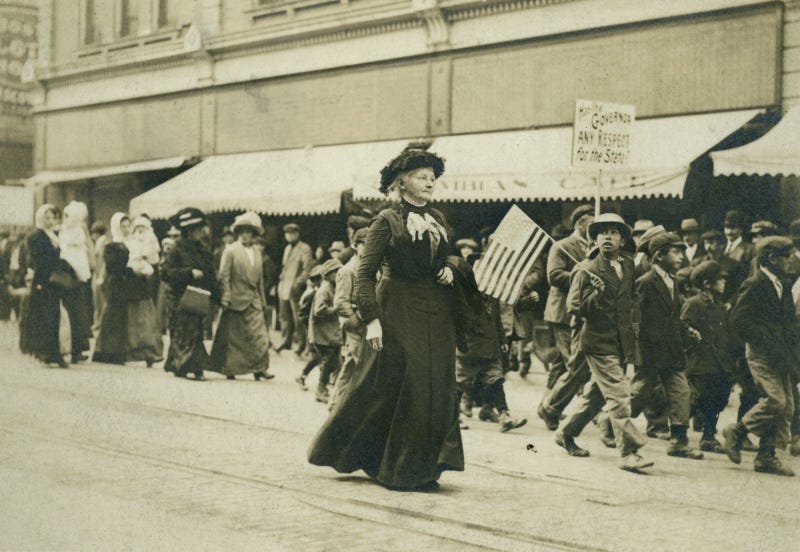
Mother Jones, c. 1910, marching in Trinidad, Colo. Photo courtesy of The Newberry Library, Chicago. Call # MMS Kerr Archives.

On March 22, 1914, Mary “Mother” Jones was arrested on a train in southern Colorado for her work in fighting for the coal miners on strike that area. This was her second arrest in this conflict, as she had previously been detained by the state militia in Trinidad and then sent to Denver. Upon release in Denver, she immediately went back to the coal fields, daring the mine owners and their bought police forces to arrest her again. Her work here was typical of the sacrifices this iconic organizer made in the second half of her life as she fought for the miners so badly exploited in late nineteenth and early twentieth century America.

Mother Jones is one of the most fascinating characters in American history. An Irish housewife who had little connection to political activism for much of her adult life, she emerged in middle age as a fiery agitator after her husband and all four of her children died of yellow fever in Memphis and her dress shop burned in the Chicago fire of 1871. She quickly became the voice of the mineworkers, especially in the coal country of Pennsylvania and West Virginia. She bridged generations of activism, being extremely close friends with Terence Powderly while also hailing the rise of the United Mine Workers and radical activists that Powderly could barely understand at his peak in the 1880s. She said she was much older than she actually was, which had both rhetorical powers and helped cement her in our historical memory, as she claimed to be 100 years old the year she died when in fact she was probably 93.

By 1897, she was known as Mother Jones, wearing out of style Victorian black dresses and using the mantle of motherhood as central to her organizing prowess. Calling her “mother” both established her as a maternal figure among the miners but also centered her emphasis on childhood and motherhood in organizing. For instance, she opposed women’s suffrage and ultimately believed that women should be taking care of their children rather than getting involved in politics. Her own life story made this stance not hypocritical. She also used children in her organizing, including the 1903 Children’s Crusade, a march of miners’ children from Pennsylvania to Theodore Roosevelt’s home in Oyster Bay, New York, where the children carried signs reading, “We want to go to School and not the mines.” Roosevelt refused to meet with them. She worked for the UMWA but attended the founding convention of the Industrial Workers of the World in 1905 and worked as an organizer for the Socialist Party in the late 1900s, returning to the UMWA as a paid organizer in 1911.

Though all of these actions, Mother Jones became known as “the most dangerous woman in America,” a title given to her by a district attorney in West Virginia named Reese Blizzard. During a 1902 trial where she was charged with ignoring injunctions against miners holding union meetings (First Amendment in the coal fields indeed!), Blizzard pointed at her, saying, “There sits the most dangerous woman in America. She comes into a state where peace and prosperity reign … crooks her finger [and] twenty thousand contented men lay down their tools and walk out.” That wasn’t true and served the interests of the owners to say that their employees were actually good people but stupid and easily led astray by outside agitators, instead of admitting their employees had a bloody good reason to go on strike. Anyway, the nickname stuck and this attitude from employers was something Jones reveled in.

In the fall of 1913, Mother Jones traveled to Colorado to participate in mineworkers’ organizing in the coal fields in the southern part of that state. Conditions in the coal fields were all too typical of the time: complete industry control over a workforce that was polyglot and desperate. Working conditions were horribly dangerous. Between 1884 and 1912, 1,708 workers died in Colorado coal mines (over 42,000 nationwide). Companies controlled not only the mines but housing, stores, and education. Union organizing was met with brutality and murder. Effectively, the coal companies controlled workers’ lives in Colorado as they did in West Virginia and Pennsylvania. These were Mother Jones’s people.

The companies did not welcome Jones’s presence. She was thrown off company property several times. She was arrested twice. After the first arrest, she was placed in a comfortable hospital for a month. After all, she was an elderly woman and a bit harder to crack the whip on than the miners themselves. But on March 22, 1914, she was arrested again. This time, the companies were less kind. They threw her into the Huerfano County jail in Walsenburg. This was no nice hospital. She spent 23 days in the jail.

The United Mine Workers tried to capitalize on Jones’s arrest. They issued a pamphlet describing (and perhaps exaggerating a bit) the conditions this old woman had to suffer through as she lived her faith of defending the miners. The pamphlet discussed the filth, the rats in the cell, the snow pouring in a broken window, a guard jabbing her with a bayonet. On the other hand, the mine owners and their friends accused Mother Jones of having been a prostitute in a Denver brothel in 1904 and said her support for Coxey’s Army had consisted of procuring women for sex. On both sides, Mother Jones elicited strong opinions.

After her second release, Mother Jones went to Washington DC to testify on the conditions in the coal country. A few days later, the Colorado coal wars would see their most violent incident, with the Ludlow Massacre. Between Ludlow and the aftermath when enraged miners went on a rampage against anyone associated with the coal companies, up to 200 people died in this strike, possibly the most deadly in American history. John D. Rockefeller Jr. agreed to meet with her about the conditions of the miners as part of his public relations effort when he was savagely attacked for his role at Ludlow.

Mary Jones died in 1930. Earlier that year, on the day she supposedly turned 100, Mother Jones was filmed with sound about workers’ rights.

FURTHER READING:

Elliott Gorn’s The Most Dangerous Woman in America.

Thomas Andrews, Killing for Coal: America’s Deadliest Labor War.

Sad, Indeed.

Gay MAGA Complain About Getting Banned From Gay Bars by God

Sad! Read on Substack

Dear Humans,

BEHOLD! Gay Republicans are finding out they cannot wear the red hat of hatred in LGBTQ+ nightclubs.

1. Gay Bar Bans Bigots

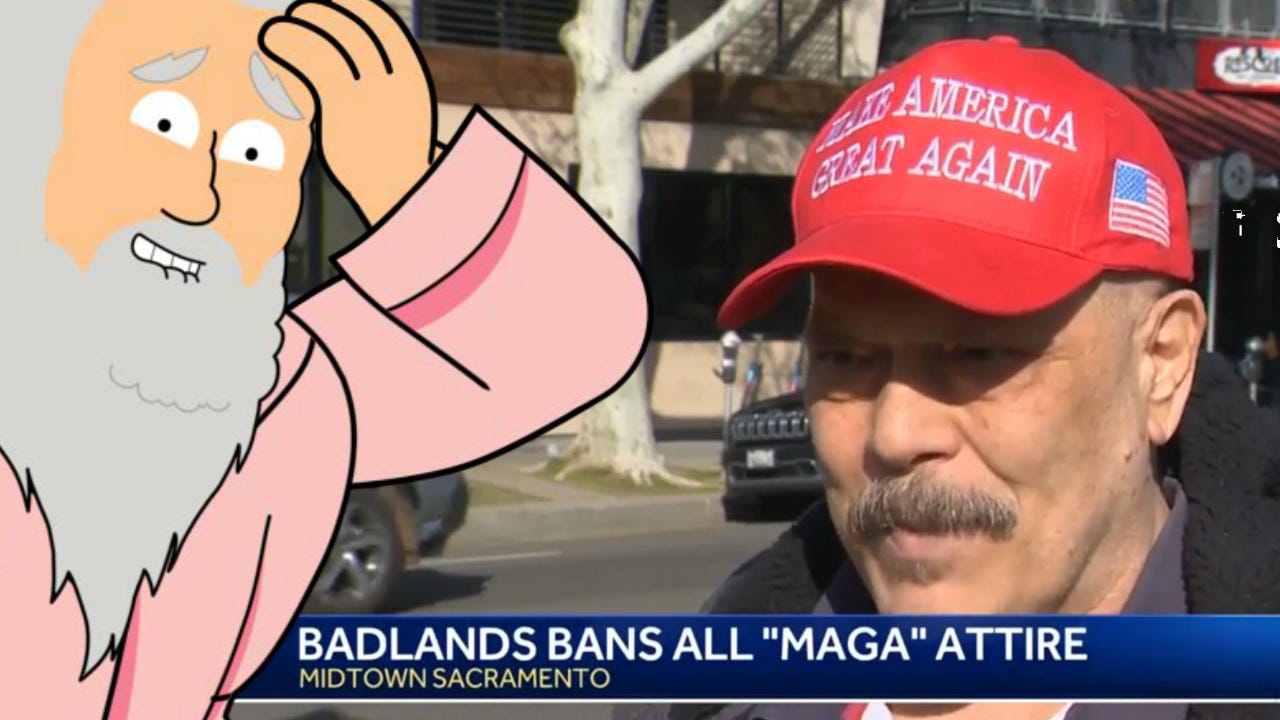
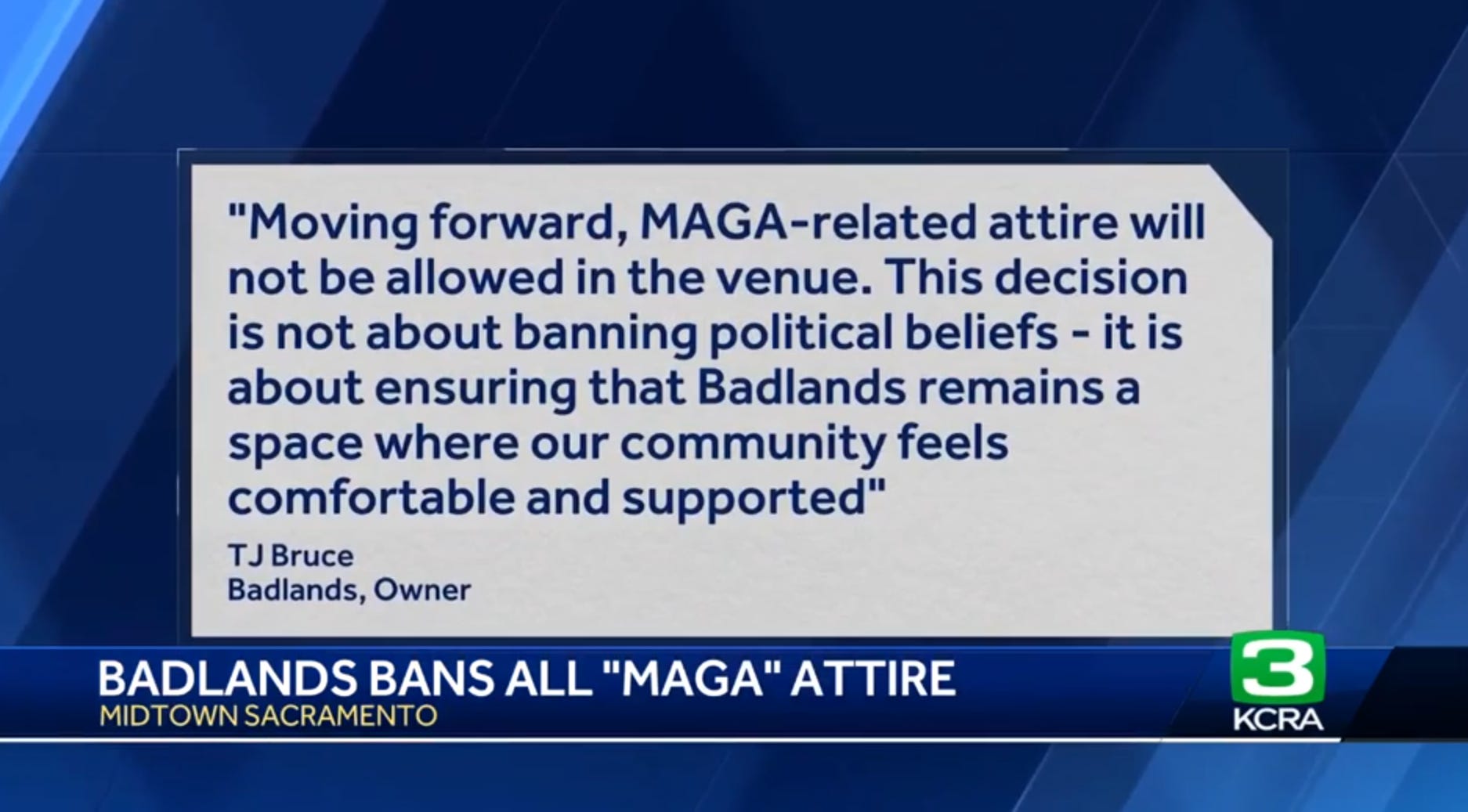
Last week, Badlands, a beloved LGBTQ+ nightclub in Sacramento, posted this heavenly announcement:

“Moving forward, MAGA-related attire will not be allowed in the venue. This decision is not about banning political beliefs — it is about ensuring that Badlands remains a space where our community feels comfortable and supported.”

That’s not censorship. That’s community care. And this is not the first bar to make the news for banning MAGA, either. Last week a bar in Indianapolis went viral for kicking out one of these bigots.

2. “What the Heck? Let’s See What Happens”

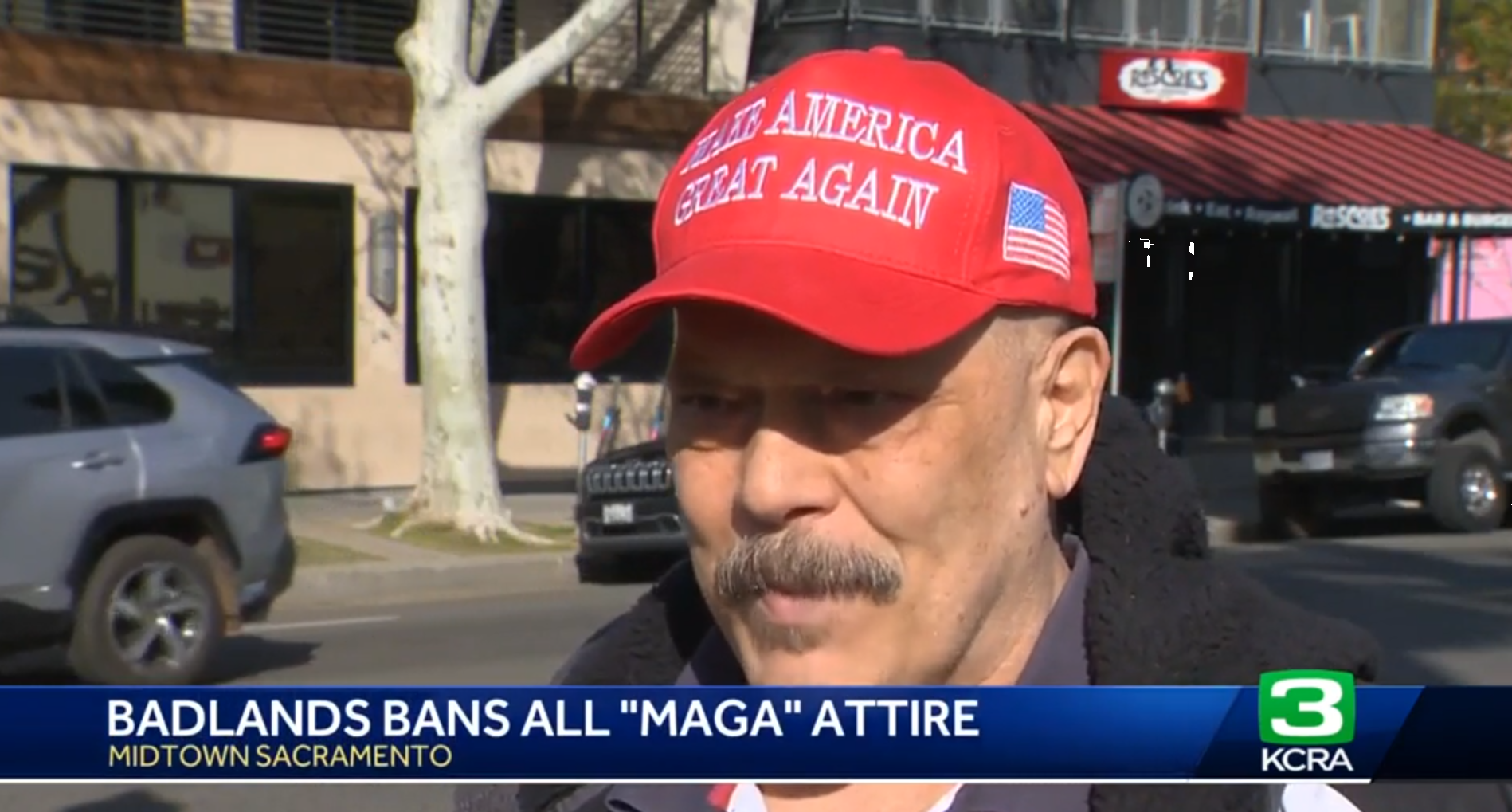
Steven Bourassa, the idiotic Trump supporter whose actions inspired the bar to make the change, told local news station KCRA:

“I’ve never worn a red [Make America Great Again] hat to the gay bars before. I said, ‘What the heck? Let’s see what happens.’ We were having drinks and hanging out, and it was a pleasant time. So I was really impressed. And I complimented security on the good job they did.”

What didst this imbecile think wouldst happen?!?

This is not a prank show. This is real life. And you’re not the main character.

Steven Bourassa.

3. “It’s About Bullying”

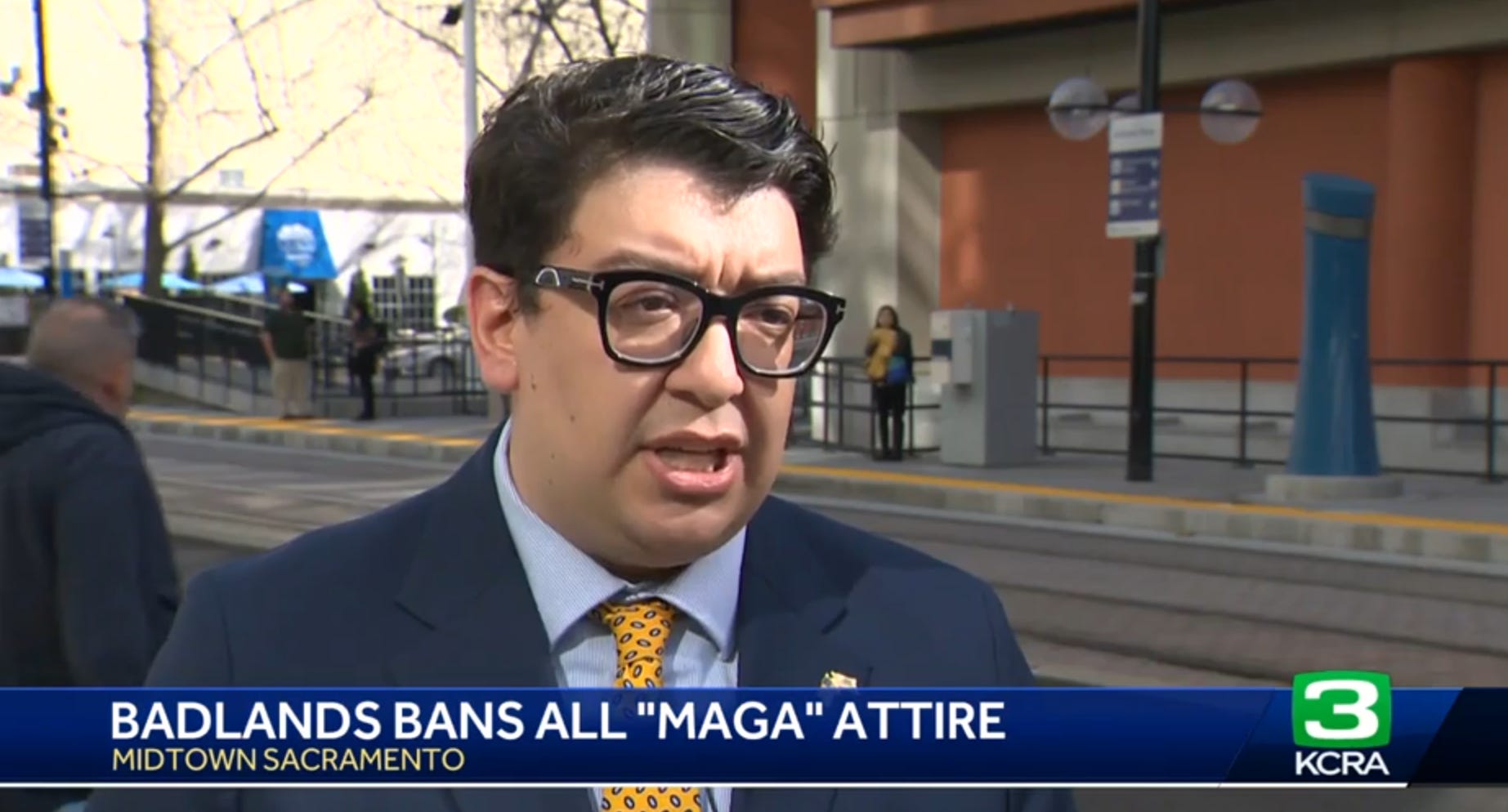
“This decision is not based upon protecting our community,” said Preston Romero, president of the Log Cabin Republicans of Sacramento.
“It’s about bullying and singling out one particular political ideology. And we believe that that’s unfair.”

WHAT HEINOUS HYPOCRISY!!! Because when trans kids are banned from sports, queer teachers are forced back into the closet, and drag queens are treated like criminals—they don’t say ONE DAMN WORD.

But when a gay bar sets a boundary to protect its patrons from symbols of literal hatred? Suddenly it’s bullying? Give God a damn break!

Preston Romero, president of the Log Cabin Republicans of Sacramento.

4. God’s Final Word

And after all the hypocritical outrage, Bourassa says he’ll still go to Badlands but he’ll just leave the hat at home.

“I didn’t have any problems,” he said. “I’ll still go back… but I’ll leave the hat at home now.”

This man got banned, agreed with the ban, and is going right back.

REJOICE, everyone! We finally found the thing that can break the MAGA cult…and apparently it’s gay sex.

5. We’re Fighting Back And It’s Working

This isn’t just a moment, it’s momentum.

And it’s building everywhere you look.

People are fighting back everywhere.

Here’s how we fight:

  • Keep people engaged & informed with truth, hope and laughter.
  • Rally thousands of voices to push back against fascism.
  • Build an independent platform where truth can’t be silenced.

And it’s working.

📈 LOOK AT THIS: (snip-go look. The clicks help God [the Substack.])

Peace & Justice History for 3/23

March 23, 1918
The trial of 101 Wobblies (members of the Industrial Workers of the World or IWW) began in Chicago, for opposition to World War I. In September 1917, 165 IWW members were arrested for conspiring to hinder the draft, encourage desertion, and intimidate others in connection with labor disputes. The trial lasted five months, the longest criminal trial in American history at the time.The jury found them all guilty. The judge sentenced IWW leader “Big Bill” Haywood and 14 others to 20 years in prison; 33 were given 10 years, the rest shorter sentences. They were fined a total of $2,500,000 and the IWW was shattered as a result. Haywood jumped bail and fled to the Soviet Union, where he remained until his death 10 years later.

“Big Bill” Haywood
Read more 
March 23, 1942

The U.S. government began moving all those of Japanese ancestry, including some native-born U.S. citizens (known as nisei), from their west coast homes to indefinite imprisonment in detention centers, beginning with Manzanar in California which eventually held more than 10,000 Americans.
Located on 60,000 acres west of Los Angeles, it is now a national historic site; only 3 of the original 800 buildings remain.
Gallery of photos and other materials about Manzanar 
March 23, 1961
Army Major Lawrence Robert Bailey was the first recorded American to be held as a prisoner of war in Southeast Asia. One of eight crew members of a C-47 surveillance aircraft shot down over Laos, Bailey was held by the Pathet Lao for 17 months, losing one-third of his body weight (down to 53 kg, or 117 lbs) during that time. The other occupants of the plane are presumed to have died in the crash; Bailey always wore a parachute.
March 23, 1984

USS Queenfish nuclear submarine student die-in outside the U.S. Consulate.
One thousand boats, known informally as the Auckland Harbour Peace Squadron, demonstrated against arrival of the nuclear submarine, U.S.S. Queenfish in New Zealand.

https://www.peacebuttons.info/E-News/peacehistorymarch.htm#march23

Anti-Trans Hate Group Targets Furry Fandom

Hello Everyone.  Before I turn you over to Ethel to watch her informative video on the same group attacking trans people making up lies about furry’s to try to attack trans people through them.  Of course according to the hate group anything not cis straight that they don’t understand is attacking children somehow.   But my good news I won’t have to dump my main computer.  I figured out what was causing two of my programs that I need to refuse to work.   I combed through the setting of both programs.  I then dumped the video computer.   I later realized I did not have to.  There was a setting that said make this program work with the VPN (paraphrased) Then the other side of that said make programs not work with VPN.  So I had placed the switched it to work with VPN.  For two days I couldn’t get the two program.  This morning at 3 am I dumped the computer, resetting it, then loaded up the two programs and kept changing settings and things until suddenly everything works.  Then I check to make sure the VPN was not leaking my location with the settings that way.  The switch should have said this way bypasses the VPN, this way makes the program use the VPN.  Why do I need the VPN?  I live in Florida, a republican nanny state that thinks adults in the state need permission to visit sites labeled NSFW if you get my meaning.   Anyway.  Now I have to reload all my programs on the video computer.  Now to the video.   Hugs